
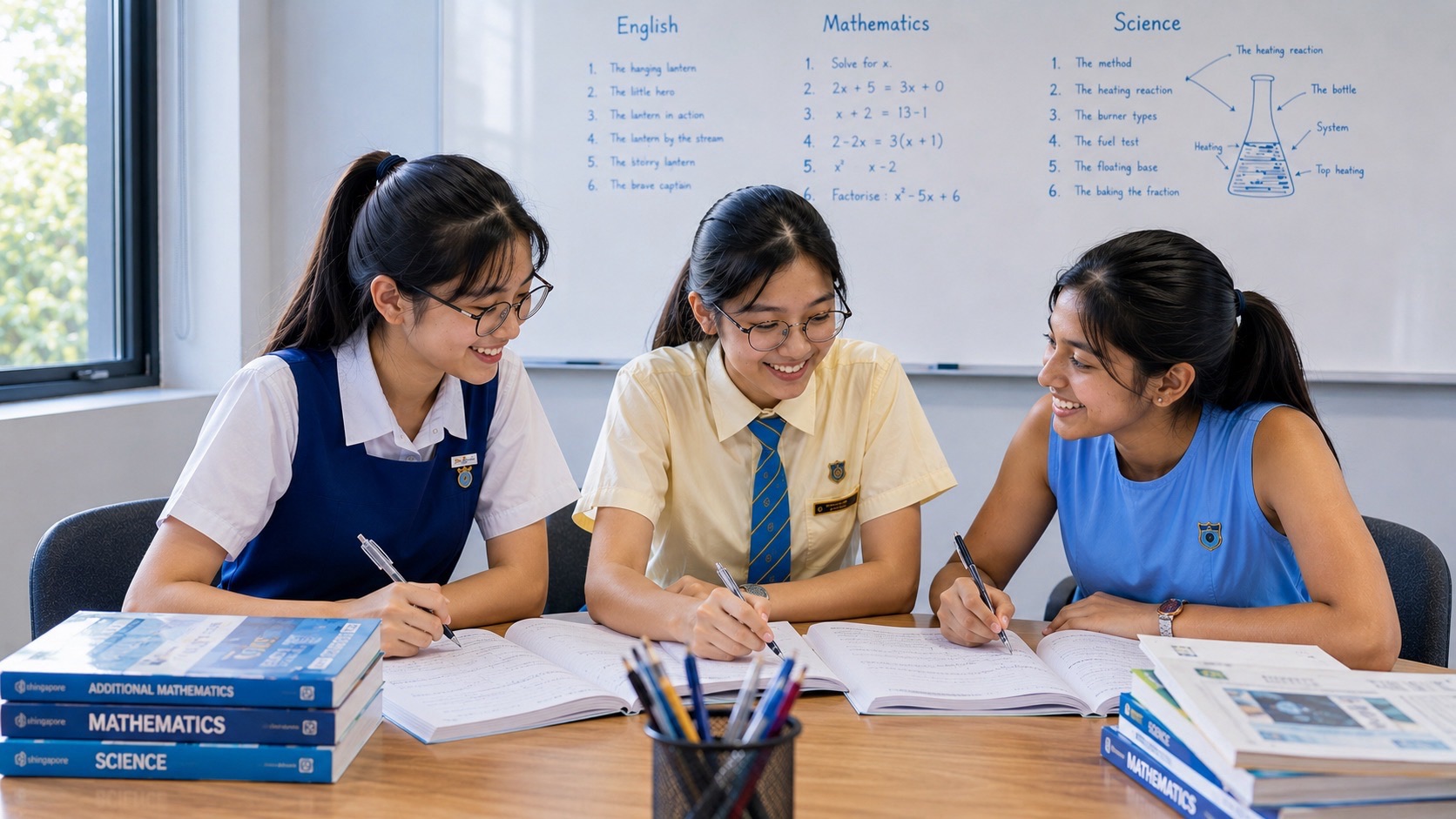
Editorial note: The family scenes in this article use the same fictional recurring Punggol residents — Maya, Jia Jun, Hana and Ethan — to make the learning system concrete. They are not testimonials or fixed learner types. Each child can be curious, mistaken, careful, impatient, confident and uncertain at different moments.
The 50-second parent route
A Science education system is not a stack of chapters.
It is the machinery that turns a child’s encounter with the world into increasingly reliable knowledge.
The full route is:
world → attention → question → observation → representation → model → prediction → test → evidence → explanation → correction → transfer → independent judgement
If the system is healthy, the child does more than remember Science. The child becomes better at deciding what can be observed, what must be inferred, what evidence is relevant, what a model can explain, where uncertainty remains, how to test an idea and when a conclusion should change.
That is why Science education matters beyond examinations.
PSLE Science, school assessments and later Secondary Science all matter. But the deeper educational job is larger: to help a young person become harder to fool, more willing to revise an idea, more capable of reasoning from evidence and more confident when meeting something not yet understood.
At eduKatePunggol, this local Science Education Systems series sits between several existing routes. The child-level journeys are already visible in Primary 3 Science in Punggol, Primary 4 Science in Punggol, Primary 5 Science in Punggol and Primary 6 Science and PSLE Science in Punggol. The practical tuition route sits at Science Tuition at eduKatePunggol. The wider method sits in How Science Works. The teaching-manual route is carried by The eduKate Science Learning Manual, while the broader subject library is visible through the eduKate Sengkang Science Hub.
This article owns the layer between them:
How does the whole Science education system fit together?
1. Science begins before the word “Science” appears on the timetable
On a Sunday morning in Punggol, Maya noticed three things before breakfast.
A wet patch on the balcony floor had become smaller.
A bird landed on the railing, looked down and flew away.
A metal spoon felt cooler than a wooden chopstick even though both had been on the same table.
None of those observations arrived with a worksheet.
The world presented them without headings.
Children begin life surrounded by phenomena: heat, light, sound, motion, materials, growth, decay, weather, animals, plants, food, water, illness, machines, shadows, magnets, screens, batteries and thousands of other changes. Long before they know scientific vocabulary, they are already making informal models.
The wet patch “went into the air.”
The bird “wanted food.”
The spoon “has cold inside it.”
Some early models are useful. Some are wrong. Some are incomplete. Almost all are interesting because they reveal how a child is trying to make the world coherent.
This is the first principle of Science education:
The learner does not enter the classroom empty.
The learner arrives carrying explanations.
Good teaching therefore does not merely add correct facts. It discovers the child’s current model, compares it against evidence, then helps the child build a stronger one.
That is fundamentally different from saying, “Memorise the right sentence.”
2. A Science curriculum is not the same thing as a Science education system
A curriculum answers an important question:
What content and practices should be learned?
A Science education system must answer several more:
- What prior idea must be ready before this concept can make sense?
- What experience makes the concept visible?
- What misconception is likely to appear?
- How can the misconception be exposed without humiliating the learner?
- Which representation should come first: object, picture, diagram, table, graph, symbol or equation?
- How does the learner move from guided explanation to independent reasoning?
- What evidence shows that understanding survived after the lesson?
- Can the idea transfer into a different context?
- How should assessment feed information back into teaching?
- How does one year hand capability to the next year?
Those questions form the hidden architecture of education.
A child may complete the curriculum and still have a weak learning system. The pages were covered, the notes were copied, the worksheets were submitted and the tests were taken, yet the knowledge remains brittle. Change the diagram and the child is lost. Remove the teacher’s prompt and the answer disappears. Ask “why?” and a memorised phrase arrives without mechanism.
Coverage happened.
Education did not fully happen.
The opposite can also occur. A child may not remember every detail immediately, yet possess a powerful system for rebuilding understanding: read carefully, identify what is known, inspect evidence, retrieve the relevant concept, test the explanation, check the limits and revise when necessary.
That child has something durable.
3. The kernel: Reality gets the final vote
Jia Jun once made a confident prediction that every shiny metal object would be attracted to a magnet.
It was a perfectly understandable rule.
Many familiar magnetic objects are metallic and shiny. His brain had compressed several experiences into one shortcut.
Then the test failed.
That moment is the kernel of Science.
A scientific education teaches the learner that reality has authority over preference.
You may like the explanation.
You may have memorised it.
Your friend may agree.
Your tutor may have said something similar last week.
The diagram in your old notes may look familiar.
But if the evidence under the relevant conditions contradicts the claim, the claim must be reconsidered.
This is one reason Science can be emotionally difficult for children. School often rewards being correct. Science also requires becoming comfortable with being correctable.
Those are not the same thing.
A learner who needs every first answer to be right will hide uncertainty. A learner who sees correction as part of the method can expose an idea early enough to improve it.
The best Science classroom therefore has a peculiar quality: confidence and humility operate together.
“Here is what I think.”
“Here is why.”
“Here is what would make me change my mind.”
That last sentence is one of the deepest goals in the entire subject.
4. The receiver: Attention comes before explanation
Hana was careful, but careful did not always mean observant.
In one investigation she read the question three times and still missed the fact that one condition had changed.
She had attention. It was simply pointed at the wrong thing.
Science begins with receiving reality at useful resolution.
What changed?
What stayed the same?
What was measured?
What was merely described?
Which label belongs to which part?
What unit is used?
What happened first?
What happened after?
Which comparison is valid?
What information is missing?
Many apparent Science errors happen before the scientific concept is retrieved. A child overlooks a table heading, reverses two labels, ignores the word except, misreads the axis, assumes two objects are identical or answers the question they expected rather than the one printed.
Adults often call all of this “careless.”
That label is too vague to repair.
A Science education system should distinguish at least several attention failures:
- selection failure: the learner notices information but not the relevant information;
- comparison failure: the learner looks at two things without establishing a common basis;
- sequence failure: the learner loses track of order or change through time;
- representation failure: the learner does not connect the words, diagram, table or graph;
- condition failure: the learner misses a changed variable or restriction;
- question failure: the learner begins answering before identifying the task.
Once the failure has a name, the intervention can become small.
That is better than telling a child to “be more careful” for the next four years.
5. Observation is not inference
The four children were walking beside the waterway after rain.
Maya pointed at a bird with wet feathers.
“It was swimming.”
Ethan looked at her.
“Did we see it swimming?”
“No, but it is wet.”
“Then wet is what we saw. Swimming is one explanation.”
That distinction is one of the first great intellectual gates in Science.
Observation concerns what is detected or measured under the relevant conditions.
Inference is an interpretation or conclusion built from observations plus prior knowledge.
Both are useful.
They are not interchangeable.
A child who learns this early becomes stronger in experiments, data questions, ecology, forces, electricity, chemistry, biology and almost every later branch of Science. A child who does not learn it may repeatedly write explanations that are possible but unsupported.
The simple home language is enough:
I notice…
I think… because…
This is not a template for every answer. It is training wheels for epistemic discipline.
6. Representation: The world has to be compressed before it can be studied
Real life is messy.
A plant does not appear as a clean labelled diagram.
An ecosystem has more organisms than a food-chain arrow.
An electrical circuit in a home does not look like a Primary Science circuit diagram.
A digestive system does not operate as isolated coloured boxes.
A force cannot be seen as the neat arrow drawn beside an object.
Science education therefore teaches representation.
Objects become diagrams.
Events become sequences.
Measurements become tables.
Tables become graphs.
Structures become labelled models.
Relationships become arrows.
Quantities become symbols.
Later, symbols become equations.
Every representation gains clarity by losing detail.
That is why children must eventually learn two things at once:
A model is useful.
A model is not the thing itself.
Emily in the eduKate Sengkang Science Hub notices that a diagram and the real thing do not quite match. That is not a nuisance to be eliminated. It is a doorway into scientific modelling.
When children understand models as tools, unfamiliar diagrams become less threatening. They can ask what the representation is trying to preserve.
Shape?
Sequence?
Flow?
Relationship?
Scale?
Quantity?
Cause and effect?
A learner who asks that question can often reconstruct meaning even when the picture has changed.
7. Models: The invisible engine inside Science learning
A scientific model can be a physical model, diagram, analogy, conceptual relationship, mathematical equation or computer simulation. At school level, the word does not need to become technical. The important thing is that the child learns to use a representation to explain or predict something about the world.
When a child says that a material is waterproof, there is already a model: under relevant conditions, water does not pass through the material easily.
When a child explains that a plant needs light for photosynthesis, there is a model connecting light to a biological process.
When a child predicts that a certain arrangement of magnet poles will repel, there is a model connecting pole relationship to interaction.
When a Secondary student explains current in a circuit, particle motion in matter, diffusion, energy change or forces, the model becomes richer.
Science education becomes powerful when learners can do four things with a model:
- State it. What relationship does the model claim?
- Use it. What does the model predict in this case?
- Test it. What evidence supports or challenges the prediction?
- Bound it. Where does the simplified model stop being sufficient?
The fourth ability arrives gradually. Young children do not need constant caveats. But they should not be trained to believe that every school sentence is a universal slogan without conditions.
“All metals are magnetic” fails because a category was stretched too far.
“Heavy things sink” fails because mass alone does not determine the full behaviour.
“Plants take in food from soil” fails because the child has compressed nutrition into an everyday eating model.
A good Science lesson does not merely replace the wrong sentence with the right sentence.
It replaces the weak model with a stronger one.
8. Prediction: Thinking must become vulnerable before evidence arrives
Prediction is educationally valuable because it makes a learner’s internal model visible before the answer is known.
Suppose Jia Jun is given five objects and a magnet.
If he tests every object immediately, he may end with five correct observations and still reveal little about what he believed beforehand.
If he predicts first, the tutor can see the model.
Paper clip — yes.
Coin — yes.
Plastic ruler — no.
Aluminium foil — yes.
Steel screw — yes.
Now the experiment has educational leverage.
The result is no longer only “which objects were attracted?”
It becomes “which rule did the learner use, and did reality support it?”
This structure is transferable:
predict → test → observe → compare → revise
It works in simple Primary Science investigations and later in laboratory work, mathematical modelling, engineering, coding, research and everyday decision-making.
Prediction also helps children develop a healthier relationship with error.
A prediction can be wrong without the learner being foolish.
The intellectual duty begins after the result.
Will the child update?
9. Fair comparison: Experiments are arguments built with conditions
Ciara in the Sengkang Science story loves making things but changes several things at once. Many children do this because action feels scientific.
Pour more.
Move closer.
Use a bigger container.
Change the material.
Wait longer.
Then compare.
But a comparison becomes hard to interpret when too many conditions differ.
The school phrase “fair test” is important because it introduces experimental control at a child-friendly scale.
The core idea is:
Change the factor you want to investigate. Keep other important conditions sufficiently comparable. Observe or measure the outcome.
The deeper reason is causal interpretation.
If three things changed, which change produced the result?
Primary children do not need formal causal inference. But they can understand that a test should be designed so the result has a clear meaning.
This is why Science education should not treat practical work as entertainment.
A dramatic experiment that teaches nothing about method may be memorable but educationally shallow.
A simple comparison with two cups, equal amounts, one controlled difference and a careful record may teach more.
10. Evidence: Information does not become evidence until it bears on a claim
One of the most useful words in Science education is also one of the most easily flattened.
Evidence is not merely “data.”
Evidence is information used to support, weaken or discriminate among claims.
A table contains measurements.
A graph represents a pattern.
An observation records an outcome.
These become evidence when the learner connects them to the question.
If a question asks which material absorbed the most water, the relevant evidence lies in the measured result under the stated conditions.
If a question asks which plant grew fastest, the evidence requires comparing change over time, not merely the final height without context.
If a question asks whether two variables are related, the graph must be read as a relationship, not as a picture.
The child must therefore learn to ask:
Evidence for what?
That question is a firewall against many weak answers.
11. Explanation: The answer must carry the relationship
Jia Jun often knew the right keyword and stopped.
“Waterproof.”
“Repulsion.”
“Photosynthesis.”
“Evaporation.”
The word may be relevant. It may even identify the correct concept. But an explanation must show the relationship.
This is where Science and English meet.
A learner needs the language to connect:
cause to effect;
structure to function;
property to use;
condition to outcome;
observation to inference;
evidence to conclusion;
change to mechanism;
comparison to judgement.
Useful connectors become scientific tools:
because, therefore, compared with, as a result, increases, decreases, remains constant, allows, prevents, transfers, absorbs, reflects, attracts, repels, produces, requires.
This does not mean every Science answer should use the same rigid sentence frame.
Templates are scaffolds, not substitutes for thought.
The order should remain:
understand the relationship → choose the relevant concept → use the evidence → communicate clearly
When children reverse the order — memorise a sentence then search for a place to paste it — performance becomes brittle.
12. Correction: The marked paper is a sensor, not a verdict
A Science education system becomes intelligent when error information returns to teaching.
A test that produces a score but no change is a weak feedback system.
A marked paper can reveal:
- concept gaps;
- misconceptions;
- reading failures;
- language failures;
- representation failures;
- data interpretation failures;
- overgeneralisation;
- weak evidence use;
- poor time control;
- independence gaps;
- or simple transcription mistakes.
These mechanisms should not receive the same treatment.
If the child misunderstood evaporation, teach the concept.
If the child knows evaporation but missed the changed condition, train question reading.
If the child sees the relationship but writes an incomplete answer, train explanation.
If the child can answer only after a prompt, test independence.
If the child repeatedly remembers the correct fact but applies it in the wrong context, train transfer.
This is the logic behind the first-weak-link approach.
A score may say 68.
Diagnosis may say three recurring mechanisms.
The second description is much more useful.
13. Memory: Science knowledge must remain available after the lesson ends
Understanding in the room is not enough.
The learner also needs retrieval.
A child may understand a teacher’s explanation beautifully on Tuesday and fail to reconstruct it on Friday. That does not mean the Tuesday lesson was useless. It means the learning has not yet stabilised.
Science memory should therefore be built through spaced return.
Not endless rereading.
Return.
Close the notes.
Retrieve.
Explain.
Draw.
Compare.
Answer one changed-context question.
Correct.
Return later again.
This creates a learning system in which concepts remain reachable.
It also prevents a common chapter illusion: the child is good at the current topic because the current topic is the only drawer being opened.
Mixed retrieval removes the label.
Now the learner must recognise which concept is needed.
That is closer to real assessment and real reasoning.
14. Transfer: The idea must survive a change of clothes
Maya could answer a materials question when the example was a raincoat.
Then the tutor changed the object to a lunchbox seal.
She hesitated.
The concept had not yet become portable.
Transfer is one of the clearest signs that learning belongs to the learner rather than the page.
The same relationship can appear with different:
- objects;
- organisms;
- numbers;
- diagrams;
- contexts;
- wording;
- measurement scales;
- or problem structures.
A strong Science education system therefore introduces variation deliberately.
Not chaos.
Variation.
Change one surface feature while preserving the underlying relationship.
Then change another.
Then remove a prompt.
Then mix the concept with earlier work.
The learner gradually discovers that the idea is the stable thing underneath the changing question.
15. The four environments: Home, school, tuition and the world should not do the same job
A child may encounter Science across several environments. Problems begin when every environment tries to become the same classroom.
Home: make the world available
Home is excellent for observation, conversation, reading, simple safe experiments, routine and emotional safety.
Home should not become a permanent second school.
School: establish the shared curriculum
School provides common concepts, sequence, terminology, investigations, assessment and a peer learning environment.
Tuition: increase diagnostic resolution
Useful tuition should identify the learner’s specific weak link, repair it, guide application, test independence and return the learner stronger to school work.
The world: provide transfer
The neighbourhood, parks, transport system, kitchen, technology, weather and ordinary family life provide mixed contexts where concepts stop wearing chapter labels.
When the four environments cooperate, the child gets a coherent system.
When they compete, the child gets volume.
16. Why Punggol is a useful Science learning environment
Punggol is educationally interesting because built and natural systems appear close together.
Water.
Vegetation.
Birdlife.
Housing.
Transport.
Bridges.
Materials.
Energy use.
Digital infrastructure.
Drainage.
Weather exposure.
Human movement.
None of this needs to become a formal field trip.
A child can walk through Punggol as a Classroom without carrying a clipboard.
The educational move is small:
Notice one thing.
Ask one question.
Separate observation from explanation.
Connect one school idea to one real object or event.
Then keep walking.
The aim is not to convert childhood into homework.
The aim is to prevent Science from becoming trapped inside worksheets.
17. Primary 1 and Primary 2: Protect the pre-Science engine
Formal Primary Science begins later, but the preconditions can grow earlier.
Young children can:
- notice differences;
- sort objects;
- describe change;
- ask why;
- predict;
- count and compare;
- learn words for everyday phenomena;
- read simple non-fiction;
- draw what they see;
- and discover that “I don’t know yet” is acceptable.
The mistake is to interpret readiness as early syllabus completion.
The better preparation is capability.
A child who can look carefully, listen to a question, compare fairly and explain a simple reason is arriving with strong equipment.
18. Primary 3: Science becomes a formal way of seeing
Primary 3 is the first major handoff.
Curiosity acquires public rules.
The learner meets formal vocabulary, classification, materials, life cycles, magnets and the beginnings of structured inquiry. More importantly, the child begins learning that Science answers are judged by the relationship between question, concept and evidence.
The full narrative of this year is explored in Primary 3 Science in Punggol | The Year a Child Learns to See the World Differently.
The system target is not “finish P3.”
It is:
observe → classify → compare → explain → predict → correct
19. Primary 4: Connections begin to matter more than isolated facts
Primary 4 adds content, but the deeper change is relational.
Children increasingly need to connect parts into systems and follow processes across several steps. Knowledge becomes less like a collection of labelled drawers and more like a network.
A concept learned earlier may now appear inside a new question. The child must carry prior knowledge forward rather than treating every year as a reset.
This is why the Primary 4 journey is described as The Year the Pieces Begin to Work Together.
The system target becomes:
retrieve → connect → represent → explain → transfer
20. Primary 5: Systems become denser
By Primary 5, Science asks the learner to assemble more parts before answering.
Processes interact.
Diagrams carry more information.
Experiments demand stronger variable reasoning.
Open-ended answers require more precise causal chains.
The child may know every individual word and still fail to assemble the mechanism.
This is why Primary 5 Science in Punggol frames the year as learning to assemble and apply.
The system target becomes:
parts → relationships → system → evidence → application
21. Primary 6 and PSLE: Integration under constraints
PSLE Science does not suddenly invent new learning principles.
It increases the demand that the earlier system operate reliably under assessment conditions.
The learner must retrieve across years, identify the tested relationship, ignore irrelevant detail, interpret evidence, select concepts, communicate precisely, manage time and recover after uncertainty.
The challenge is therefore integration.
Primary 6 Science and PSLE Science in Punggol follows this consolidation from home to school to tuition to the examination year.
The system target becomes:
recognise → retrieve → integrate → reason → communicate → check → perform
22. Secondary Science: The system expands in scale and abstraction
Secondary Science changes the size of the mental machinery.
Students encounter more abstract models, greater mathematical dependence, more formal experimental design, denser terminology and more specialised disciplinary thinking.
Particles explain matter.
Forces become more quantitative.
Cells and systems become layered.
Chemical change requires symbolic representation.
Energy becomes a transferable accounting idea.
Graphs and equations carry relationships that cannot be managed by prose alone.
The child who learned earlier to distinguish observation from inference, model from reality, evidence from opinion and concept from keyword now has a stronger platform.
This is why Primary Science should not be taught as disposable PSLE technique.
The habits have a future.
23. English is an interface layer inside Science
Science is not English, but for many Singapore students Science performance travels through English.
A learner may understand a process and still lose the relationship because of language.
Compare.
Explain.
State.
Infer.
Predict.
Suggest.
Describe.
Give a reason.
Based on the graph.
Under the same conditions.
Except.
Most likely.
These phrases shape the task.
Science education should therefore repair language exactly where it blocks scientific thought.
Teach the command.
Clarify the connector.
Contrast neighbouring terms.
Practise one complete explanation.
Then return to Science.
This is one example of how the larger eduKate ecosystem connects subjects without erasing them.
24. Mathematics is another interface layer
Science increasingly depends on Mathematics because measurement creates quantities and quantities create relationships.
At Primary level the learner reads tables, compares amounts, follows changes, understands scale, works with time, recognises more and less and interprets simple graphs.
Later, rates, ratios, formulas, coordinates, gradients, probability, uncertainty and algebra become part of scientific reasoning.
A weak graph-reading skill may appear as a Science error.
A weak ratio concept may distort concentration.
A weak sense of proportionality may make physical relationships mysterious.
A strong Science education system notices these dependencies.
It does not assume the subject label tells us where the weak link lives.
25. Technology and AI: Powerful tools, poor substitutes for judgement
Modern learners can access explanations, simulations, animations, videos, interactive diagrams and AI-generated answers almost instantly.
This changes the information problem.
Information scarcity is no longer the main challenge.
Judgement becomes more important.
Does the explanation match the question?
Is the source reliable?
Is a simulation showing a model or reality?
Which assumptions were built into the model?
Can the learner explain the result without copying the tool?
Can the learner identify when an AI answer is overconfident, incomplete or simply wrong?
Science education is unusually well placed to teach this because its method already contains the needed habits:
check claims;
look for evidence;
inspect method;
compare sources;
state uncertainty;
revise when contradicted.
A tool can accelerate access.
It should not replace epistemic responsibility.
26. The small-group tutorial as a high-resolution sensor
Three students answer the same question incorrectly.
It is tempting to assign all three the same worksheet.
But listen.
Maya did not read the final condition.
Jia Jun remembered the keyword but not the causal relationship.
Hana had the right explanation, then changed it because she distrusted herself.
Same mark.
Different mechanism.
This is why a three-student tutorial can be powerful when used properly.
The advantage is not simply that the class is small.
The advantage is visibility.
The tutor can ask:
“What made you choose that?”
“Show me the line you used.”
“Which concept are you applying?”
“What evidence supports your explanation?”
“Would your rule still work if I changed this part?”
“Now do the next one without me.”
A small group also gives peer contrast.
One learner’s misconception becomes another learner’s counterexample.
One complete explanation shows what another answer is missing.
One student’s overconfidence and another’s excessive doubt can both be checked against evidence.
The group becomes useful when reasoning is visible.
Otherwise three children can sit silently beside one another and receive little more than three parallel worksheets.
27. What a Science teacher is really trying to transfer
The visible curriculum contains knowledge.
The hidden curriculum contains moves.
Look again.
Name the relevant variable.
Separate what you saw from what you concluded.
Choose the right representation.
Compare on a common basis.
Use a model to predict.
Test the prediction.
Read the result.
Explain the mechanism.
Check whether the conclusion exceeds the evidence.
Correct the model.
Try it somewhere new.
These moves are the portable part of Science education.
They survive when chapter names change.
28. What parents should not accidentally destroy
Parents care deeply, which is why some well-intentioned habits can become harmful.
Do not make every question a test
Children need conversations where curiosity is not graded.
Do not answer too quickly
Sometimes the useful move is, “What do you think?” or “How could we find out?”
Do not punish revision
Changing an answer after better evidence is a scientific strength.
Do not equate more worksheets with more learning
Volume can hide the actual weak link.
Do not turn one score into identity
A result is evidence about a performance, not a definition of the child.
Do not rescue forever
Support should move toward independence.
The parent’s eventual success is visible when the child can do more without the parent.
29. Green, Amber and Red: A parent Science learning signal
This is not a medical or psychological diagnosis. It is a practical educational signal.
Green — the system is holding
The child usually understands current lessons, retrieves earlier ideas, completes work in reasonable time, explains some answers independently, corrects mistakes and remains willing to try unfamiliar questions.
Parent move: maintain. Do not add intensity merely because another family has.
Amber — a repeated mechanism is visible
The child repeatedly loses marks through the same misconception, cannot convert understanding into written explanation, misreads data, depends on prompts or becomes fragile when questions change format.
Parent move: diagnose the mechanism. Use marked work. Repair narrowly.
Red — the learning system is becoming unstable
Earlier concepts are missing across several topics, current lessons no longer make sense, distress is persistent, independence is collapsing or workload has become unmanageable.
Parent move: stop adding volume. Gather evidence, speak with the relevant adults and identify whether the problem is conceptual, linguistic, mathematical, organisational or broader than Science.
30. The independence test
Every teaching system should eventually ask:
Can the learner now perform the capability without the scaffold?
Can the child read the question without the adult pointing at the key word?
Can the child choose the concept without the chapter label?
Can the child explain without the sentence starter?
Can the child interpret the graph without the tutor asking the first three questions?
Can the child correct an error after feedback?
Can the child recognise when the evidence is insufficient?
Can the child retrieve the idea two weeks later?
Can the child use it in a different context?
If yes, support can recede.
If no, the scaffold has not yet completed its job.
Good teaching makes itself gradually less necessary.
31. Science assessment is a sample of the system, not the whole system
An examination can test important capabilities.
It can sample knowledge, application, data interpretation, explanation and reasoning under time constraints.
But it cannot observe the whole learner.
One paper may overrepresent a strength or barely touch a weakness.
One careless error can coexist with deep understanding.
One rehearsed question can produce a high mark without flexible transfer.
That is why assessment should be treated as evidence, not omniscience.
The next article in this series, How Science Assessment Works, examines this layer in detail: what a Science paper can see, what it cannot, how marks become diagnostic information and how understanding becomes examination performance without reducing Science to examination technique.
32. Science education must keep two horizons at once
There is a near horizon.
This week’s concept.
This term’s test.
This year’s syllabus.
PSLE.
Secondary examinations.
Those matter.
There is also a far horizon.
The adult who will make decisions about health, technology, money, environment, evidence, risk and public claims.
The worker who may need to understand a new technical system.
The citizen who will encounter graphs, headlines, scientific uncertainty and confident misinformation.
The parent who will one day answer another child’s “why?”
Science education is strongest when the near horizon prepares for the far horizon.
Teach the examination skill.
But connect it to the reasoning habit.
Teach the keyword.
But connect it to the concept.
Teach the model.
But show its boundary.
Teach the right answer.
But preserve the method that can find the next answer.
33. A Science education system in one diagram
We can compress the whole architecture:
Phenomenon — something happens in the world.
↓
Attention — the learner notices relevant features.
↓
Question — uncertainty is made explicit.
↓
Observation and measurement — information is gathered.
↓
Representation — information becomes words, diagrams, tables, graphs or symbols.
↓
Model — a relationship or mechanism is proposed.
↓
Prediction — the model becomes vulnerable to a future observation.
↓
Test — a comparison or investigation is designed.
↓
Evidence — results bear on the claim.
↓
Explanation — concept and evidence are connected.
↓
Correction — the learner updates what failed.
↓
Memory — the improved model remains retrievable.
↓
Transfer — the model survives a new context.
↓
Independence — the learner can perform without the scaffold.
↓
Judgement — the learner can decide what the evidence justifies and where uncertainty remains.
This is not a rigid classroom sequence. Real Science loops backward and sideways. New evidence can create a new question. A failed prediction can force a new model. A transfer failure can reveal a hidden misconception.
That looping is the point.
34. Maya, Jia Jun, Hana and Ethan at the end of the system
Several years after the first Primary 3 observations, imagine the four friends again.
Maya still notices quickly. But now she has learned to delay explanation until she has enough evidence.
Jia Jun still likes compressed answers. But now he knows when a keyword must become a mechanism.
Hana is still careful. But now caution no longer means changing a supported answer simply because uncertainty feels uncomfortable.
Ethan still generates possibilities faster than everyone else. But now he sorts them into plausible, testable, supported and speculative.
None of those changes belongs to one chapter.
They are system changes.
The children have become better receivers of reality.
Better builders of models.
Better users of evidence.
Better correctors of themselves.
That is what a Science education system is trying to produce.
35. Frequently asked questions
What is a Science education system?
It is the connected process that turns curiosity and experience into reliable scientific understanding: attention, observation, representation, models, testing, evidence, explanation, correction, memory, transfer and independent judgement.
Is Science education mainly about memorising facts?
No. Scientific knowledge matters, but useful Science education also teaches how knowledge is built, represented, tested, applied and corrected.
Why can a child know the topic but still lose marks?
The weak link may be reading, representation, evidence use, language, transfer or independent application rather than pure knowledge.
Why are open-ended questions difficult?
They require several systems to work together: understanding the question, retrieving the relevant concept, using evidence and communicating the relationship precisely.
Is more practice always better?
No. Practice is useful when it targets a real capability and includes correction. Repeating many questions without identifying the failure mechanism can reinforce shallow habits.
How should parents use marked papers?
Read them as diagnostic evidence. Group repeated mistakes by cause before deciding what to practise next.
How does Science connect with English?
Language carries scientific relationships. Command words, vocabulary, comparisons, causal connectors and precise explanation can all determine whether understanding reaches the page.
How does Science connect with Mathematics?
Measurement, comparison, graphs, rates, ratios, quantities and equations increasingly carry scientific relationships as the learner progresses.
Should AI be used for Science learning?
It can be useful for explanations, questioning and exploration, but the learner should still verify claims, inspect evidence and remain able to explain the concept independently.
What is the goal of Science tuition?
When tuition is needed, its strongest role is diagnostic: identify the first weak link, repair it, guide application, test independence and reduce the need for support over time.
36. Continue the Science Education Systems series
This master article opens three deeper routes:
- How Scientific Thinking Is Built | Observation, Models, Evidence and Explanation
- How Science Learning Progresses | From Primary Curiosity to Secondary Systems
- How Science Assessment Works | From Understanding to Evidence to Performance
Then move outward through the wider eduKate ecosystem:
- How Science Works | Evidence, Models, Testing and Correction
- The eduKate Science Learning Manual
- eduKate Sengkang Science Hub
- Science Tuition at eduKatePunggol
- Education at eduKatePunggol
Conclusion: Teach the child how knowledge earns trust
Science education begins with a child looking at something ordinary.
A wet floor.
A seed.
A magnet.
A shadow.
A bird.
A graph.
A circuit.
A question.
At first the child sees the phenomenon and tells a story.
Education slowly adds discipline.
Look again.
What did you actually observe?
What are you assuming?
Which representation helps?
What model explains the pattern?
What would the model predict?
How could we test it?
What does the evidence support?
What does it not support?
Can you explain the relationship?
What changed after the correction?
Can you still do it next week?
Can you use it somewhere new?
Can you do it without me?
That final question is where teaching becomes education.
A child who can only repeat the adult remains dependent on the adult.
A child who can inspect the world, build a model, test an idea, use evidence, communicate clearly and revise when necessary has begun to own the method.
That method is Science.
And when Science is properly taught, the world becomes not simpler, but more readable.
Continue reading: connected learning guides
Scientific thinking, learning and evidence
- Measurement Invariance
- Missing Data
- Measurement Reliability
- Construct Validity
- Registered Reports
- Preregistration
- Meta-Analysis
- Systematic Review
- Bayesian Updating
- Multiple Comparisons
- Statistical Significance
- Hypothesis Testing
- Confidence Intervals
- Statistical Power
- Effect Size
- Internal Validity
- Transportability
- External Validity
- Confounding
- Blinding
- Randomisation
- Triangulation
- Longitudinal Studies
- Observational Studies
- Bias
- Interoperability
- Time
- Dimensional Analysis
- Controls
- Sensitivity Analysis
- Thresholds
- Rates
- Variables
- Standards
- Parameter Estimation
- Anomaly Detection
- Data Quality
- Provenance
- Reproducibility
- Calibration
- Instrumentation
- Collaboration
- Simulation
- Probability
- Sampling
- Validation
- Robustness
- Generalisation
- Comparison
- How Scientific Knowledge Changes
- Constraints
- Analogy
- Abstraction
- Synthesis
- Scale
- Falsification
- Prediction
- Science Decision-Making
- Systems Thinking
- Causality
- Classification
- Literacy
- Ethics
- Consensus
- Peer Review
- Science Communication
- Replication
- Uncertainty
- Measurement
- Argumentation
- Science Data Interpretation
- Science Evidence
- Science Inquiry
- Science Transfer
- Science Retrieval and Memory
- Science Explanation
- Science Experiment Design
- Science Knowledge Networks
- How Scientific Models Grow With the Learner
- Science Misconception Repair
- Science Curriculum Coherence
Continue through the learning library
- eduKate Punggol Science Education Overview — From Primary 1 to Secondary 4 (Concept Clarity to Exam Precision)
- eduKate Punggol Contents & Learning Routes
Choose one guide for the difficulty in the learner’s work. Try a fresh task without the example, check it again later, then return to this route to decide the next step.
Scientific mechanisms, monitoring and design
More published guides
Guides 1–9
- How Scientific Boundary Conditions Work | Knowing Where a Model Stops Working
- How Scientific Counterfactual Reasoning Works | Asking What Would Happen If One Cause Changed
- How Scientific Fieldwork Works | Learning From the World When the World Cannot Be Held Still
- How Scientific Identifiability Works | Knowing Whether the Data Can Distinguish the Model
- How Scientific Network Analysis Works | Nodes, Connections, Centrality and Cascades
- How Scientific Spatial Analysis Works | Location, Pattern, Distance and Dependence
- How Scientific Time-Series Analysis Works | Trend, Seasonality, Lag and Change Through Time
- How Scientific Uncertainty Propagation Works | Following Error Through Calculations, Models and Decisions
- How Water Moves Through Plants: Roots, Xylem, Transpiration and a Coloured-Flower Experiment
Scientific models: choosing, testing and interpreting
Continue into the model and evidence guides when the question concerns predictive performance, uncertainty, complexity or what a model has actually learned.
- How Scientific Model Selection Works | Choosing Between Competing Explanations Without Rewarding Complexity
- How Scientific Cross-Validation Works | Testing Models on Data They Did Not Learn From
- How Scientific Regularisation Works | Controlling Complexity When Models Learn Too Much
- How Scientific Dimensionality Reduction Works | Finding Structure in Many Variables Without Losing the Signal
- How Scientific Clustering Works | Finding Groups Without Pretending Every Cluster Is Real
- How Scientific Feature Selection Works | Choosing Variables Without Letting Noise Choose the Story
- How Scientific Ensemble Learning Works | Combining Models to Reduce Error and Instability
- How Scientific Hyperparameter Optimisation Works | Searching Model Settings Without Overfitting the Search
- How Scientific Probability Calibration Works | When 70% Really Means About 7 in 10
- How Scientific Decision Thresholds Work | Turning Scores Into Actions Under Cost and Risk
- How Scientific Distribution Shift Works | When the World Changes After the Model Is Trained
- How Scientific Model Interpretability Works | Understanding What a Predictive Model Uses and Why


