
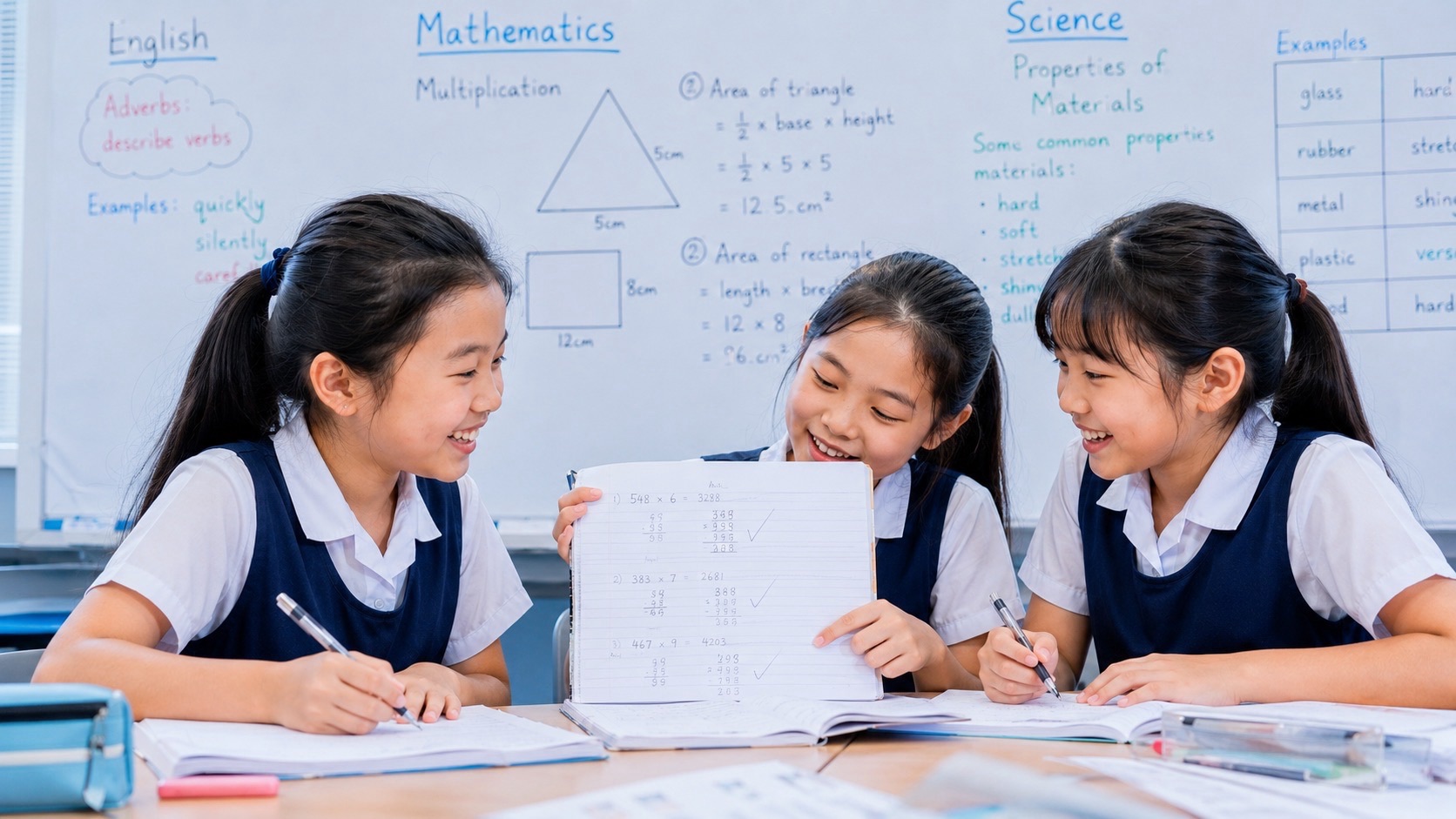
At 6.18 on the first Monday of Primary 6, Mira is looking for her calculator.
Adrian is making coffee. Jo is checking that a water bottle is actually inside the school bag rather than standing beside it. The house is doing what houses do on school mornings: producing socks, locating files, closing zips, remembering forms, discovering that the thing everybody was certain had been packed has not been packed at all.
“I need my calculator,” Mira says.
Adrian looks at the worksheet on the dining table. “For this?”
Mira looks down. The question is 3/4 divided by 1/2.
She looks back at him. “Maybe not.”
Jo puts the water bottle into the bag. “That,” she says, “is Primary 6.”
Primary 6 Mathematics begins with a peculiar truth. The child has already learned Mathematics for five years, yet the final year is not simply five years plus one more chapter. The job changes. Earlier years could still feel like a sequence of topics. Primary 6 asks whether the topics can assemble into an independent system that works when the chapter title disappears, when the tutor is silent, when the parent is elsewhere, when the calculator is not allowed, when the question looks unfamiliar, and when a clock is moving.
That is why the final primary year can feel both familiar and completely new. Fractions are familiar. Percentage is familiar. Geometry is familiar. The child has met graphs, area, volume, decimals and word problems before. But now the relationships tighten. Fractions lead into ratio. Percentage must work backwards as well as forwards. Algebra introduces letters as mathematical objects. Circles ask the child to connect radius, diameter, circumference and area. Composite geometry stops looking like a chapter and starts looking like a decision problem. The PSLE then takes the whole primary system and removes most of the teaching scaffolds.
Primary 6 is therefore the final assembly year.
And PSLE Mathematics is the execution environment.
The resident characters in this article are fictional continuing eduKatePunggol characters used to illustrate learning. Real Punggol locations provide geographic texture. The scenes are narrative illustrations, not testimonials, and do not describe or endorse any particular school, teacher or pupil.
Continue to the 2026 PSLE Mathematics Topic Guides
The home–school–tuition planning journey works best when parents can reach the exact learning difficulty. For the revised 2026 paper format, original mixed-topic examples and a route to nine focused Primary 6 guides, open the 2026 Punggol PSLE Mathematics worked guide and topic index.
If the first error is already clear, go directly to simple linear equations, fraction division, reverse percentages or circles and composite figures. Each page starts with the quantity relationship, develops original practice and provides checking and a parent diagnostic. This is a learning route, not a claim that every child needs tuition.
Prepare for 2027 PSLE Mathematics: Four Focused Punggol Guides
Families preparing for 2027 can start with the child’s actual learning needs. Use the readiness diagnostic before choosing a paper-specific study routine, and consult the comparison of bar models and algebra when word problems remain difficult. The exam rules discussed in these guides use the published revised 2026 Standard Mathematics format as a reference; check SEAB again when the 2027 examination documents are available.
- 2027 PSLE Mathematics Paper 1: Non-Calculator Accuracy — Thirty original worked checks, MCQ selection, Booklet B working and arithmetic verification.
- 2027 PSLE Mathematics Paper 2: Structured Answers — Twenty-four original multistep problems, labelled models, units and calculator judgment.
- Primary 5 to Primary 6 Mathematics Readiness — Thirty diagnostic questions, foundation checks and a six-week parent preparation route.
- Bar Models vs Algebra for PSLE Word Problems — Twenty-eight paired explanations comparing equal-part bars, equations, diagrams and tables.
All four lessons contain original worked questions and diagnostic guidance. They complement the existing Primary 6 topic guides rather than replacing official MOE teaching or asserting that every pupil needs private tuition. For Mathematics content, consult the MOE Primary Mathematics syllabus, October 2025 update.
2027 PSLE Mathematics Parent Planning and Decision Guides
Once a child’s Primary 5-to-6 readiness has been checked, choose the next article according to the actual question the family faces. A monthly study timetable, mistake-log workbook, subject-level decision and prelim-script review serve four different purposes. None predicts a guaranteed Achievement Level, and all should be read alongside the pupil’s school teaching and current official information.
Plan learning and repair mistakes
- 2027 PSLE Mathematics Month-by-Month Study Timetable — a full-year rhythm of concept repair, spaced retrieval, mixed practice and sufficient rest.
- 2027 PSLE Mathematics Mistake Log — diagnose the first wrong step, distinguish mathematical concepts from arithmetic slips and retest independently.
Choose the appropriate scope and respond to school evidence
- Standard vs Foundation PSLE Mathematics — examine MOE learning objectives, the distinct 2026 subject formats, Foundation Achievement Levels and questions for a parent–school discussion.
- 2027 PSLE Mathematics Prelim Results and Revision — interpret a school’s marked script without treating a preliminary percentage as a guaranteed national examination result.
Families should always identify whether a child is registered for Standard Mathematics 0008 or Foundation Mathematics 0038 before choosing examination practice. The comparison guides cite the official MOE Primary Mathematics syllabus and the confirmed 2026 SEAB examination formats; check official 2027 documents when they become available. The objective remains independent mathematical understanding, not maximum worksheet volume.
Primary 6 is not a twelve-month countdown
A countdown is useful for knowing how much time remains. It is a poor curriculum.
When adults think only in days-to-PSLE, January can begin to feel late. February feels later. June feels alarming. August feels like an emergency. The child receives the emotional message that the year is shrinking faster than learning can happen. That can produce more worksheets, more timed papers and more correction without necessarily improving the system underneath.
Primary 6 works better when the year is divided by jobs rather than fear. Early in the year, complete and stabilise the Primary 6 concepts while identifying inherited weaknesses from Primary 3 to Primary 5. Through the middle of the year, increase mixed retrieval and transfer. When school assessments and prelims arrive, treat marked work as diagnostic evidence rather than as a verdict. In the final stretch, reduce novelty, rehearse the actual paper conditions, sharpen timing and checking, and protect sleep and calm. Then the PSLE becomes the final performance of a system that has already been rehearsed.
This is the central proposition of Primary 6 Mathematics in Punggol:
Do not spend the year trying to make the child feel examined. Spend the year making the child increasingly capable of examining independently.
The difference is large. One approach produces permanent rehearsal pressure. The other builds ownership until examination conditions are simply the place where ownership is demonstrated.
The 2026 cohort is the first Primary 6 cohort fully under the 2021 Primary Mathematics syllabus
This matters for the current Punggol family. The Ministry of Education’s 2021 Primary Mathematics syllabus was introduced progressively from the 2021 Primary 1 cohort. It reaches Primary 6 in 2026. That means the current P6 cohort is not simply following an old P6 syllabus with a new examination cover. The national curriculum sequence itself has completed its transition.
The syllabus still places mathematical problem solving at the centre, supported by concepts and skills, processes, metacognition and attitudes. In practice, that means a child cannot be prepared for the final year by memorising isolated tricks alone. The curriculum expects the learner to interpret information, choose and use representations, connect ideas, reason, communicate and monitor the quality of a solution.
That is also why the new P6 topics should not be taught as detachable ornaments. Ratio should connect to fractions. Percentage increase and decrease should connect to multiplicative scaling. Algebra should compress relationships the child has already represented with bars and arithmetic. Circle formulae should grow from geometric meaning. Reverse volume questions should be understood through the relationship among volume, base area and height. The child is still learning new content, but the deeper work is integration.
The revised 2026 PSLE Mathematics format changes the performance surface
For the 2026 PSLE, SEAB lists Mathematics under subject code 0008 with a revised examination format. There are two written papers comprising three booklets, and both papers are taken on the same day with a break between them.
Paper 1 is 1 hour 10 minutes and carries 50 marks. It has 30 questions: 18 multiple-choice questions followed by 12 short-answer questions. Calculators are not allowed. Paper 2 is 1 hour 20 minutes and also carries 50 marks. It has 15 questions: five short-answer questions and ten structured or long-answer questions. Calculators are allowed. Across both papers, the pupil completes 45 questions for 100 marks in 2 hours 30 minutes of examination time.
The equal 50–50 mark split matters pedagogically. Paper 1 is not a warm-up before “the real paper”. It is half the Mathematics result. A child who can solve sophisticated long problems but leaks routine marks through non-calculator arithmetic, careless reading or weak short-answer control has a real performance problem. A child who flies through Paper 1 but cannot organise the state of a longer Paper 2 problem has a different one.
The two papers therefore need overlapping Mathematics but different operating habits. Paper 1 rewards reliable retrieval, mental and written computation, estimation, compact working and accurate selection without calculator support. Paper 2 allows a calculator, but that does not remove the need to interpret, represent, plan, show method and judge whether a result is sensible.
SEAB’s assessment objectives make the intention clear. AO1 concerns recall and straightforward computation or algebraic procedure. AO2 concerns interpretation and application in different contexts. AO3 concerns mathematical reasoning, analysis, inference and strategy selection. The paper is not designed around one idea of “hard”. It samples different kinds of mathematical competence.
For the 2026 cohort, PSLE Mathematics is on Friday, 25 September
The official 2026 PSLE timetable places Mathematics on Friday, 25 September. Paper 1 runs from 0815 to 0925, and Paper 2 from 1030 to 1150. The specific date belongs to the 2026 edition of this guide; future families should always check the current SEAB calendar rather than inheriting an old date from a search result or screenshot.
The exact date is useful for planning, but it should not dominate the learning. A calendar tells the family when preparation stops. It does not tell them what to prepare. That comes from the child’s actual Mathematics.
What Primary 6 Standard Mathematics adds to the system
The current Primary 6 Standard Mathematics syllabus adds several important pieces. In fractions, pupils divide a proper fraction by a whole number and divide a whole number or proper fraction by a proper fraction without calculator. In percentage, pupils find the whole when a part and percentage are known and work with percentage increase and decrease. Ratio becomes formal through a:b and a:b:c notation, equivalent ratios, division of quantities in a given ratio, simplification, missing terms and the relationship between fraction and ratio.
Algebra enters explicitly. A letter can represent an unknown number. Pupils interpret and write simple expressions, simplify simple linear expressions without brackets, evaluate expressions by substitution and solve simple linear equations with whole-number coefficients. Measurement and geometry add the area and circumference of circles, including semicircles and quarter circles, as well as composite figures involving familiar shapes and circular parts. Volume becomes reversible: instead of always finding volume from dimensions, the child may have to recover a missing dimension from volume and other information. Geometry continues into unknown-angle reasoning in composite figures involving triangles and special quadrilaterals. Average remains part of the data-analysis system.
But PSLE Mathematics is cumulative. The examination does not forget Primary 5 because Primary 6 has begun. Rate, fractions, decimals, percentage, area, volume, geometry, tables, graphs, number operations and earlier problem-solving structures remain available to the examiner. The final-year learner therefore has two simultaneous jobs: learn what is new and keep what is old retrievable.
Fraction division: the first question is “what does division mean here?”
Mira sees 3/4 ÷ 1/2. She knows an algorithm is coming. She has heard the familiar phrase about inverting and multiplying. But Primary 6 is too late to accept an algorithm that has no meaning attached to it.
Three quarters divided by one half can be read as: how many halves are contained in three quarters? One full half fits. Another half would be too much, but half of a half—that is one quarter—fills the remaining amount. So there are one and a half groups of one half in three quarters. The quotient is 1 1/2.
The symbolic method, 3/4 × 2/1 = 3/2, is efficient. The meaning explains why the reciprocal appears. Division by a fraction asks how many units of that fractional size fit into the original quantity. Multiplying by the reciprocal converts that comparison into a scale factor.
The point is not that every PSLE fraction-division question should be solved with a drawing. The point is that the procedure should be reconstructable from meaning. If the child forgets which fraction to invert, the structure should rescue the memory: dividing by 1/2 asks how many halves, so the answer should be larger than 3/4, not smaller. Estimation gives an immediate directional check.
Percentage now has to work backwards
Primary 5 often asked for a percentage part of a whole. Primary 6 asks the child to recover the whole from the part.
Thirty per cent of a quantity is 72. What is the whole?
The weak approach is to hunt for a remembered formula. The stronger approach restores the hundred-part model. If 30% corresponds to 72, then 10% corresponds to 24 and 100% corresponds to 240. Or represent 30% as 3/10: if three tenths is 72, one tenth is 24 and ten tenths is 240. The relationship is reversible because percentage is still a part-whole relationship.
This is one of the central Primary 6 habits: relationships must work in both directions. The child should not know only “whole × percentage = part”. The child should know enough of the relationship to recover whichever quantity is missing.
Percentage increase and decrease are about the new whole, not merely the percentage part
A quantity increases by 20%. If the original is 150, the increase is 30 and the new quantity is 180. The 20% part is an intermediate state, not necessarily the requested answer.
A quantity decreases by 20%. The same percentage part, 30, is now removed, producing 120. This is familiar from discount work, but Primary 6 expects the child to handle the relationship more flexibly. A 20% increase creates 120% of the original. A 20% decrease creates 80% of the original. That representation becomes useful in reverse-percentage problems and in later secondary Mathematics.
Mira writes a small sentence beside one mistake: percentage change changes the whole state. Jo does not make her copy it ten times. The sentence is useful only if the next question shows whether she actually understood it.
Ratio formalises a comparison the child has been building for years
Two red counters for every three blue counters. The ratio of red to blue is 2:3. The ratio is not “two plus three”. It is a multiplicative comparison describing how the quantities scale together.
If the ratio remains 2:3 and the red quantity becomes 8, the scale factor is four, so the blue quantity becomes 12. Equivalent ratios preserve the multiplicative relationship. 2:3, 4:6, 6:9 and 8:12 are different numerical states of the same proportional structure.
This is where Primary 5 preparation pays off. A child who understands fractions, percentage and rate as relationships is not meeting proportional reasoning for the first time. Ratio gives the relationship a new notation and a new set of transformations.
Ratio and fraction are related, but the referent matters
If red:blue = 2:3, red is 2/3 of blue, but red is 2/5 of the total. Those are different fractions because the reference whole changed.
This is a classic Primary 6 source of errors. The numbers 2 and 3 are visible, and the child jumps directly to 2/3 without asking, “two compared with what?” Ratio-to-fraction conversion therefore becomes a referent problem.
The question “what is the whole?” becomes increasingly powerful. If the fraction is red out of all counters, total parts are 2 + 3 = 5. If the fraction compares red with blue, the denominator refers to the blue quantity only. The arithmetic is simple. The interpretation determines the denominator.
Dividing a quantity in a ratio is a unit-part problem
$420 is shared in the ratio 3:4. Total parts are seven. One part is $60. The two shares are $180 and $240.
The algorithm is compact: add the ratio units, find one unit, scale each share. But the child should see what one ratio unit means. It is the common scale underlying both quantities. Once one unit is known, the entire ratio state can be reconstructed.
Ben initially skips the one-unit line because he can calculate mentally. That is fine when the state is simple and he remains accurate. In a longer problem, however, the explicit unit can protect him from mixing the ratio before and after a change. Primary 6 working should be as visible as the problem requires, not as long as possible and not as short as possible.
Algebra is not the end of model drawing; it is another way to compress a relationship
For years, Mira has represented unknown quantities with boxes, bars and question marks. Primary 6 gives the unknown a letter.
If a number is represented by a, then “three more than the number” can be written as a + 3. Three times the number is 3a. The symbol is not a decoration and not a secret code. It is a placeholder that allows a relationship to be written before the unknown is known.
This is a powerful compression. A bar model may show a relationship visually. Algebra can preserve the same relationship symbolically and manipulate it more economically. The child should be allowed to move between them. A visual representation can explain the equation. The equation can make a repeated pattern easier to express.
Substitution teaches that a symbol has a role before it has a value
If 3a + 2 represents a quantity and a = 5, then the expression becomes 3(5) + 2 = 17. The letter had a structural role before its numerical value was supplied.
Clara initially treats the letter as if it were a label rather than a number. She writes 3a as “3 and a”. The tutor returns to meaning: 3a means three groups of a. If a is five, there are three groups of five. The notation is compressed multiplication.
The repair is small, but it matters because Secondary Mathematics will soon make symbolic compression central. Primary 6 algebra should leave the child thinking, “A letter can carry a number relationship,” not, “Algebra is a collection of strange letter rules.”
Simple equations make balance explicit
3a + 5 = 20.
The equation states that two expressions have equal value. Solving means finding the value of a that preserves the equality. Subtract five from both sides. 3a = 15. Divide both sides by three. a = 5.
The phrase “both sides” matters. The balance idea makes later equation solving much safer than moving terms across an equals sign with unexplained sign changes. Primary 6 does not need to become a Secondary 1 algebra course. It should establish the correct mental object: an equation is a statement of equality, and legal operations preserve that equality.
Circles arrive with a constant hiding inside every one
At Punggol Waterway Park, Mira notices circular rail details, bicycle wheels and curved structures. None of them announces π. The relationship is there anyway.
For a circle, circumference divided by diameter gives the constant π. The child does not need to rediscover the entire history of π to use the formula, but the formula should have meaning. Circumference = π × diameter. Since diameter is twice radius, circumference can also be written as 2πr. The two formulae are the same relationship expressed through different given information.
This distinction becomes useful in checking. If the radius doubles, the diameter doubles and the circumference doubles. The relationship is linear. Area behaves differently because area = πr². Doubling the radius multiplies area by four. A child who sees only formula shapes misses this difference. A child who sees scaling can predict the direction and rough size of the result before pressing any calculator button.
Radius and diameter are a small relationship that causes surprisingly expensive mistakes
A diagram gives diameter 14 cm. The child inserts 14 into πr².
The multiplication can be perfect. The representation is wrong. Radius is 7 cm. The area is built from radius, not diameter.
Primary 6 circle work rewards a simple discipline: label what the given number represents before using a formula. r = 7 cm. d = 14 cm. C for circumference. A for area. Clear labels lower the chance that a visible number is recruited into the wrong role.
Semicircles and quarter circles expose the difference between arc and perimeter
Half a circle has half the circular arc length, but the perimeter of a semicircle also includes the straight diameter. A quarter circle has one quarter of the circumference as its arc, but its perimeter includes two radii.
Ryan once calculates half the circumference and stops. The number is correct for the curved arc. The question asks for perimeter. His checking question becomes: “Have I walked around the whole boundary?”
This is an excellent geometry habit because perimeter is a boundary concept. Imagine tracing the outline with a finger. Every segment crossed belongs to the perimeter. The picture itself becomes a checking tool.
Composite area becomes a decomposition contest, not a formula contest
A figure may contain a rectangle, triangle, semicircle and quarter circle. There is no single “composite shape formula”. The learner chooses a decomposition.
One route may add familiar components. Another may subtract cut-out regions from a larger familiar shape. The better route is usually the one that preserves the clearest known lengths and creates the least unnecessary arithmetic. The choice itself is part of the Mathematics.
Mira has spent Primary 4 and Primary 5 learning that representation can change while value remains the same. Primary 6 composite geometry turns that principle into examcraft. Redraw the same figure in a way that makes the relationship cheaper to see.
Volume works backwards in Primary 6
Earlier, length × breadth × height produced volume. Primary 6 increasingly asks for a missing dimension.
A cuboid has volume 480 cm³, length 12 cm and breadth 5 cm. What is its height? The base area is 12 × 5 = 60 cm². If each one-centimetre layer occupies 60 cm³, eight layers produce 480 cm³. Height is 8 cm.
The reverse problem is not a different formula family. It is the same relationship with a different unknown. Volume = base area × height. Know any two suitable parts and recover the third. Again, Primary 6 is training reversibility.
Unknown-angle problems become networks of constraints
By Primary 6, a geometry diagram can contain triangles, rectangles, parallelograms, rhombuses and trapeziums in one composite figure. The child is not expected to measure the drawing. The drawing may not even be to scale. The job is to identify which structural facts force which angles.
Angles on a straight line total 180°. Angles around a point total 360°. Vertically opposite angles are equal. Triangle angles total 180°. Special triangles and quadrilaterals carry further properties. The solution often consists of a chain: one rule produces an intermediate angle, which unlocks another shape, which produces the target.
Aisha benefits from writing what each intermediate angle means rather than leaving disconnected numbers around the diagram. A small “∠ABC = 65°” can preserve more state than a naked 65. Geometry is particularly unforgiving when the child forgets which angle a number belonged to.
Average remains simple only until it is embedded inside a longer problem
Average = total ÷ number of data is familiar. Primary 6 makes it useful inside mixed contexts. If an average is known and the number of data is known, recover the total. If one value is removed or added, the total changes before the new average can be found.
For example, five scores have average 72. Total score is 360. A sixth score is added and the new average becomes 75. New total is 450, so the sixth score is 90. The hard part is not division. It is tracking the old state and the new state without mixing them.
This is exactly the kind of problem where a child who labels intermediate quantities can outperform a child who knows the formula but loses the story.
January: do not begin by pretending Primary 5 has vanished
The first useful Primary 6 question is not “What new chapter comes first?” It is “What from Primary 5 must be dependable before the new chapter begins to lean on it?”
For Mira, the January audit is short and targeted. Multiplication facts are stable. Fraction equivalence is stable. Decimal place value is stable. Percentage part-whole work is mostly secure, but she occasionally stops after finding an intermediate percentage amount. Triangle base-height pairing is much improved. Her main inherited weakness is representation under hurry: she sometimes sees familiar numbers and calculates before fixing what the numbers mean.
That is not a reason to repeat Primary 5. It is a reason to carry one diagnostic objective into Primary 6: representation before execution.
The first month should feel constructive. New topics begin. Old facts are retrieved in small doses. The tutor watches which prior skills collapse only when mixed with new ones. Home protects routine. School establishes the year. Nobody needs to manufacture PSLE drama in January to prove that PSLE exists.
February: ratio reveals whether multiplicative reasoning is actually connected
Mira understands 2:3 immediately when the quantities are counters. Then she meets a change problem. Two quantities begin in one ratio, something is added to one side, and the final ratio changes.
Now she cannot simply scale one ratio table. There are two states: before and after. One quantity may remain unchanged while the other changes. The relationship must be anchored to an invariant.
This is where Primary 6 word problems become less about naming the chapter and more about identifying what stayed the same. If the number of boys did not change but the number of girls increased, the boys provide a bridge between the original and final ratios. Equalise the boy units across the two ratio states, then compare the corresponding girl units. The difference represents the number added.
Ratio change problems are not magic. They are state-matching problems. The learner needs one stable bridge.
March: algebra teaches Mira that the unknown does not have to be pictured every time
For years, bar models have served Mira well. Primary 6 does not ask her to abandon them. It gives her another option.
In a simple relationship, the algebraic equation can be shorter than the drawing. In a comparison problem with several changing states, a bar model may remain clearer. The choice should be functional.
Ethan loves algebra because it compresses. Clara initially dislikes it because the symbols feel less concrete. Ben likes it because it is fast and therefore tries to use it before he has expressed the relationship correctly. The same topic reveals three different learning needs.
This is why “the class is doing algebra” is not enough diagnostic information. One child needs meaning. One needs accurate translation. One needs fluency. One needs extension. The visible chapter is shared; the first weak link is individual.
The March holidays are not a miniature June intensive
A school break can be useful for repair because the ordinary weekly timetable loosens. It should not automatically become seven days of full-paper drilling.
Mira’s family uses three short Mathematics blocks across the break. One revisits ratio state changes. One retrieves mixed Primary 5 topics. One includes a partially timed Paper 1 segment. Then the family goes out.
At Waterway Point, Mira notices sale percentages. At Punggol Regional Library, she finds a book with population data in millions. At the park, she notices circles, arcs and composite shapes without being asked to photograph them for “Math enrichment”. Jo’s old rule survives: do not manufacture a Mathematics lesson when life has already provided a mathematical world.
Term Two: the curriculum becomes a network
By Term Two, the new P6 topics are increasingly linked with older ones. Fraction division requires multiplication facts and fraction simplification. Reverse percentage requires unit-part thinking. Ratio requires fraction awareness. Algebra requires operation sense. Circle area requires multiplication and squared units. Composite geometry requires earlier angle and area knowledge.
This is the moment a parent can misread difficulty. A child may say, “I don’t understand ratio,” when the actual failure is fractions. Or “I’m bad at circles” when the formula is remembered but radius and diameter are repeatedly confused. Or “I cannot do algebra” when the equation is fine but division facts are slow. The most useful diagnosis keeps asking: where does the process first stop being dependable?
Primary 6 support should repair the oldest useful cause, then return quickly to the current work. The child does not need a museum tour of every old mistake. The repair should be just deep enough to make the current dependency stable.
June: the long break is the best large repair window left
By June, the year has generated enough evidence to know what needs attention, and there is still enough time for repair to consolidate before the final examination stretch.
This makes June valuable. Not because the child should spend the holiday doing Mathematics all day, but because the family can schedule deliberate blocks without competing with the full school week.
For Mira, June has four jobs. First, close any remaining P6 concept gaps. Second, retrieve the entire P3–P5 foundation in mixed form. Third, practise Paper 1 without calculator under increasing time realism. Fourth, practise Paper 2 long-answer organisation, including calculator use, units and working.
Full papers now become useful because enough of the syllabus is available and the purpose is clear. But every paper must return information. A paper that is completed, marked, scored and then filed has used only part of its value. The real return comes from classifying the errors and deciding what to change before the next paper.
Paper 1 is the place where basic reliability becomes expensive or valuable
Paper 1 in the revised 2026 format is 70 minutes for 50 marks. Calculators are not allowed. The child therefore needs a different rhythm from Paper 2.
The first habit is retrieval. Multiplication facts, fraction equivalences, place-value relationships and standard formula knowledge should be available without long reconstruction. The second is compact accuracy. Short questions should not generate pages of working, but enough working should be visible to prevent avoidable state loss. The third is estimation. If a multiplication result is off by a factor of ten, or a fraction answer moves in the wrong direction, rough magnitude should create friction before the answer is committed.
The fourth habit is question-value awareness. A one-mark MCQ and a two-mark MCQ do not deserve identical emotional investment if the child is stuck. The fifth is recovery. A difficult item should not consume the next five minutes simply because the child refuses to move.
Paper control is not the same as rushing. It is the ability to allocate attention proportionately to the marks and difficulty while protecting accuracy.
The no-calculator rule makes number sense visible
A calculator can produce a result without revealing whether the student expected that result. Paper 1 removes that support.
This is not an argument against calculators. Paper 2 deliberately allows one. It is an argument for knowing what the tool is doing. In Paper 1, the child must carry the operation internally. That makes weak multiplication, fraction manipulation and decimal magnitude more visible.
Mira learns to estimate before some calculations. 49 × 198 is roughly 50 × 200, or 10,000. If her exact work produces 970.2, she knows the scale is impossible. The estimate did not replace the calculation. It audited it.
MCQ elimination is Mathematics when it uses mathematical constraints
Multiple-choice questions are not guesses with better manners. Options can be used as evidence.
If the answer must be greater than one, eliminate options below one. If a percentage decrease must produce a value below the original, remove larger values. If a circle’s area is clearly larger than a surrounding rectangle in one option, reject it. If a ratio share must be divisible by a unit part, some options may be structurally impossible.
Elimination should not replace solving when a direct route is cheap. It becomes valuable when the options reveal constraints that reduce the work or provide an independent check.
Short-answer questions need working that is visible enough to survive interruption
A short-answer question may still contain two or three conceptual moves. The child should not write a novel, but the state should be preserved.
For Aisha, this means labelling intermediate quantities. For Ben, it means delaying speed until the relationship is named. For Ryan, it means one purposeful check rather than repeated anxious rechecking. For Mira, it means fixing the representation before calculation.
The same paper format can therefore be trained differently for different learners. “Do more Paper 1” is not a complete intervention. The paper has to reveal which operating habit is leaking marks.
Paper 2 is not the calculator paper; it is the representation-and-organisation paper with a calculator available
Paper 2 in the revised 2026 format is 80 minutes for 50 marks. The calculator is allowed, but interpretation remains human.
The calculator cannot decide whether a visible 14 cm is radius or diameter. It cannot decide which ratio state remained unchanged. It cannot know whether 25% is the discount amount or the final price. It cannot choose a useful model. It cannot tell whether the question asks for volume or height. It cannot decide whether a long answer should be abandoned temporarily and revisited later.
Good Paper 2 preparation therefore trains the tool and the thinker separately. The child should use an SEAB-approved calculator model and become familiar with the actual keys. But button fluency must sit under mathematical control: estimate first when useful, enter values carefully, notice unreasonable results, and preserve working so an input error can be found.
A calculator should reduce arithmetic cost, not reduce thinking
On a long geometry problem, the expensive cognitive work may be identifying the correct decomposition. Once that is done, the calculator can cheaply handle multiplication or division. On a ratio problem, the expensive work may be matching the invariant state; the calculator may contribute almost nothing.
This distinction helps pupils stop pressing keys at the first sight of numbers. Decide the mathematics first. Use the tool where it genuinely lowers execution cost.
Long-answer working is a communication channel to the marker and to the child’s own future self
A long-answer question can take several minutes. The learner may calculate an intermediate result, move to another sub-part and return. If the working is opaque, even the original thinker can lose the route.
Mira’s working becomes more deliberate in Primary 6. She does not decorate the page. She labels useful states. She draws a model when it reduces ambiguity. She writes units where they matter. She keeps equations aligned enough that an arithmetic check is possible. She circles a final answer only after confirming what was asked.
Clear working is not about pleasing adults. It is external memory. It reduces the amount the child must hold mentally while solving.
One 1.5-hour lesson in August: three pupils, one ratio problem, three different PSLE risks
Mira, Ben and Ryan sit at the table. The question describes two groups of students. The groups begin in the ratio 3:5. Some students join only the first group. The final ratio becomes 4:5. The number in the second group never changes.
Mira draws two ratio states and immediately searches for the unchanged second group. She equalises those units and finds the difference in the first group. Her answer is correct.
Ben sees 3:5 and 4:5 and subtracts 3 from 4. He knows “one part joined” and then multiplies by the wrong scale because he never fixed what one part represents. His instinct about the difference is useful; his state is incomplete.
Ryan also gets the answer. Then he checks the ratio, becomes uneasy because the numbers look too neat, erases the correct method and tries a second route that introduces an error.
Same question. Same syllabus. Same room. Different intervention.
Mira needs transfer: vary the question so the invariant is less obvious. Ben needs one-unit control and explicit matching of states. Ryan needs a checking stopping rule: verify the final ratio once; if the independent check works and no contradiction remains, move on.
This is the reason small-group tuition can be valuable in Primary 6 when it is genuinely diagnostic. The tutor can watch where a route diverges rather than seeing only a final mark.
A 1.5-hour P6 lesson should not be ninety minutes of paper
Full-paper rehearsal has a place. Ordinary lessons need more flexibility.
A strong session may begin with ten minutes of retrieval: one fraction division, one percentage reversal, one angle relationship, one old decimal item. Then a diagnostic question exposes the day’s first weak link. The tutor teaches or repairs that mechanism. Guided examples compress the concept into a usable method. Variation changes the surface. A mixed question tests transfer. A short timed segment tests access speed. The lesson finishes with an independent item the pupil must complete without prompting.
This sequence changes cognitive mode several times. Retrieval is different from explanation. Explanation is different from execution. Execution is different from transfer. Timed work is different from construction. A ninety-minute lesson can therefore be serious without being monotonous.
The marked paper is the most useful object in the room when it is read properly
By Primary 6, a score alone is too compressed. Two pupils can score 70 for completely different reasons.
One may have perfect routine arithmetic and weak AO3 problem solving. Another may solve hard questions but lose ten marks through rushed Paper 1 errors. Another may understand the Mathematics but leave eight marks blank because of pacing. Another may have one foundation gap in fractions that infects ratio, percentage and word problems.
The paper should therefore be decompressed. For every lost mark, ask what failed first: reading, concept, representation, method choice, arithmetic, unit, working, checking, timing or emotional recovery. Then group repeated mechanisms across topics.
This produces a repair map instead of a pile of corrections.
Mira’s prelim paper looks like six weaknesses until the working is examined
She loses marks on ratio, reverse percentage, circle perimeter, volume, an average problem and one long mixed question.
Six topics. The first reaction could be six revision packs.
The working reveals two mechanisms. In four questions, she calculated before fixing the representation. In two, she reached a correct intermediate result and answered before completing the final state.
The repair plan is therefore much smaller than the score report makes it appear. First: representation before execution. Second: after every intermediate result, reread the question and name what remains. A fortnight later, the same two mechanisms are tested across completely different surfaces.
This is what it means for mistakes to become smaller after teaching. The target is not that the child never errs again. The target is that repeated errors become less frequent, more local and easier for the child to detect independently.
Aisha’s Primary 6 problem is not Mathematics knowledge; it is preserving the changing state
Aisha can understand a question when it is explained. Her risk appears when a long problem contains several “now” moments.
A group begins with one ratio. Some people leave. Money is added. A percentage change occurs. The final question asks for a quantity after all changes. Aisha may use a correct number from the wrong stage.
Her Primary 6 discipline is simple: every important number gets a meaning label. Original amount. Amount added. New total. Percentage decrease. Final amount. She does not need labels on every arithmetic line; she needs labels where the story changes state.
The result is not prettier working. It is a lower chance of using yesterday’s number in today’s equation.
Ben’s Primary 6 problem is speed before interpretation
Ben can be the fastest pupil in a three-person class and still be the first to lose a mark.
Primary 6 amplifies his tendency because the numbers look familiar. Ratio? He scales. Percentage? He multiplies. Circle? He reaches for π. Algebra? He begins manipulating. Sometimes the question required a different relationship entirely.
His gate remains: interpretation mode, then execution mode. Before calculating, he names the mathematical relationship in a few words. Reverse percentage. Ratio with unchanged blue group. Semicircle perimeter including diameter. Missing cuboid height from volume. Once the route is named, speed becomes an advantage again.
Primary 6 should not slow Ben into somebody else. It should teach him where speed is safe.
Ryan’s Primary 6 problem is checking without knowing when checking is finished
Ryan used to change correct answers because uncertainty itself felt like evidence of error. In Primary 6, the clock makes that habit expensive.
He learns different checks for different risks. Magnitude check for decimal and percentage results. Inverse check for simple arithmetic or algebra. Unit check for measurement. Substitute-back check for equations. Structural check for ratio. Boundary trace for perimeter. Recompute only when a specific reason exists.
Then comes the most important checking skill: stop. A check is an information-gathering act, not a ritual for reducing anxiety. If an independent check supports the result and there is no identified contradiction, move on.
Clara’s Primary 6 problem is template ownership
Clara is reliable when a question resembles the worked example. PSLE does not promise that comfort.
Her ratio work therefore changes orientation, wording and location of the unknown. Her circle questions rotate and combine shapes differently. Algebra problems move between words, bars and equations. Volume problems ask for different missing dimensions. Percentage questions reverse the direction.
For Clara, variation is not an enrichment extra. It is the mechanism that separates the concept from the surface on which she first learned it.
Ethan’s Primary 6 stretch is depth under conditions
Ethan likes the question behind the question. Primary 6 can feed that curiosity without turning every lesson into Secondary 1.
Why does dividing by a fraction multiply by its reciprocal? Under what conditions does a percentage increase followed by the same percentage decrease fail to return to the original? Why does doubling a circle’s radius double circumference but quadruple area? Can two different ratio states have the same total? Can two different cuboids have the same volume? Can two datasets have the same average and completely different distributions?
These questions strengthen the structure underneath the syllabus. Ethan still needs full-paper stamina and routine accuracy. Depth is not an excuse to ignore execution. But execution without depth would waste one of his strengths.
Home in Primary 6 should become calmer as the exam gets closer
This can sound counterintuitive. Shouldn’t the final year become more intense?
The learning may become more deliberate. Home does not need to become more emotionally noisy. By the final months, many families already have enough evidence. Constant commentary about marks, school choices, comparison and countdowns can consume the same attention the child needs for recovery and learning.
Jo’s home rule becomes shorter through the year. Mira completes school work independently. She marks genuinely stuck items. She attempts one re-entry before asking for help. When a school paper returns, the family discusses patterns rather than interrogating every mark. If a concept needs reteaching, it goes back to the teacher or tutor. The parent remains a parent.
Primary 6 is a poor time to make love feel conditional on the accuracy of Question 14.
The parent should not become the emergency tutor every night
If homework repeatedly requires forty-five minutes of parent explanation, that is diagnostic information. It may indicate a concept gap, excessive workload, low fluency, or a mismatch between what the child can do independently and what the assignment demands.
The useful response is not automatically more explanation at 10.30 pm. Record the question. Note what the child understood. Bring the pattern to the learning environment where it can be repaired. Protect sleep.
One tired evening does not destroy a PSLE. A repeated system that sacrifices sleep to unfinished Mathematics can damage the very attention and working memory the child needs the next day.
Mira’s Primary 6 help protocol
By the middle of the year, “I don’t know” is no longer enough. Mira has learned to locate her uncertainty.
“I know the second ratio group is unchanged, but I cannot see how to match the units.”
“I know this is a percentage decrease, but I am unsure whether the given amount is before or after the decrease.”
“I know the formula for circle area, but I cannot tell whether the 12 cm is radius or diameter.”
“I know the cuboid volume and base dimensions; I think height is the missing part, but I am not sure how to isolate it.”
This is metacognitive progress. The learner does not merely experience difficulty. She can inspect it.
A normal weekday still contains more life than PSLE
Mira wakes, eats, goes to school, learns several subjects, talks to friends, comes home, showers, rests, does homework, goes to tuition on one scheduled day, eats dinner, reads, complains about something ordinary, laughs at something that will not matter tomorrow, packs her bag and sleeps.
Mathematics lives inside the day. It should not consume the day.
The strongest preparation system is sustainable enough to run for months. A heroic three-day burst can feel productive and still be inferior to a calm routine that retrieves, repairs and rehearses repeatedly without exhausting the child.
Prelims are a rehearsal and a diagnostic stress test, not a prophecy
Schools schedule their own preliminary examinations, so exact timing and format details vary. For many families, the prelim period arrives in the later part of the year and becomes the first sustained experience of full examination conditions across subjects.
The useful question after a prelim is not “What will this become at PSLE?” No single school paper can provide that certainty. The useful questions are operational. Did the child finish Paper 1? Where did the first careless losses appear? Did a difficult item destabilise the next section? Was Paper 2 working organised? Did the child use the calculator efficiently? Which topics remained weak under mixed conditions? Which errors repeated from earlier papers?
A prelim is valuable because it increases load. Weak systems reveal themselves when chapter labels disappear and time becomes real. That makes the paper a stress test of the learning architecture.
The two weeks after prelims should not become method churn
This is a dangerous period. A child sees a new trick in one solution key, another shortcut in a video, a different model from a friend, and a fourth method from a tuition worksheet. Adults panic because the calendar is short and begin adding methods.
Late-stage preparation should usually simplify the operating system, not expand it recklessly. Keep the child’s reliable methods. Add a new method only when it clearly solves a repeated problem better and can be stabilised quickly. Do not replace a functioning representation because a fashionable shortcut looks shorter.
PSLE revision triage is partly about protecting method stability. There is not enough value in making the child relearn everything in a new accent three weeks before the paper.
The final month is for narrowing
By the final month, the family should know the child’s main risks. Mira’s list is short: representation under hurry, incomplete final-state answers, and occasional overinvestment in one stubborn Paper 2 question.
The programme narrows around them. Full papers continue, but every paper is not followed by a complete syllabus reteach. Targeted micro-sets attack the repeated mechanisms. Paper 1 segments rehearse no-calculator accuracy. Paper 2 rehearsals include deliberate decisions to skip and return. Sleep becomes more protected. New resources are filtered aggressively.
The goal is not to discover everything the child does not know. The goal is to make the most important known weaknesses smaller while preserving the strengths already built.
A full paper should answer more questions than “what score?”
After each late-stage full paper, Mira records a compact review. Which three marks were cheapest to recover? Which one question consumed disproportionate time? Which error mechanism repeated? Which hard question was actually solved well? Was the final five-minute check useful? Did she finish with enough time to revisit flagged items?
This converts practice from score collection into system tuning.
The last seven days should feel familiar
No new grand system. No secret folder of impossible questions. No dramatic promise that one final technique will transform everything.
Retrieve. Review the error map. Complete short mixed work. Rehearse a few paper segments. Check the calculator and stationery against current examination requirements. Confirm practical logistics through the school. Sleep.
Familiarity in the final week is not complacency. It is the result of having done the construction earlier.
Friday, 25 September 2026: the Mathematics paper finally becomes just a paper
Mira wakes before the alarm.
There is no worksheet on the table.
Adrian has learned not to ask last-minute Mathematics questions. Jo has learned not to say “remember to check everything” because checking everything indiscriminately is not Mira’s plan.
They eat breakfast.
Mira knows what Paper 1 will feel like. Seventy minutes. No calculator. Multiple choice, then short answer. She has rehearsed the rhythm enough that the format no longer consumes attention. She knows her own gate: read, represent, route, solve, check. If a question stalls, mark it and move. If an answer is surprising, estimate. If a fraction division produces a direction that makes no sense, inspect it. If the radius-diameter relationship is unclear, label it before using π.
At 0815, Paper 1 begins.
The adult world disappears.
This is why independence was the real curriculum all year.
The break between Paper 1 and Paper 2 is not a forensic investigation
Paper 1 ends at 0925. Paper 2 starts at 1030.
The break can be wasted by reconstructing every Paper 1 answer with friends. Did you get 48? Was Question 17 B or C? What did you do for the fraction? The answer to Paper 1 is no longer changeable.
Mira’s plan is operational. Eat or drink as allowed and appropriate. Go to the toilet if needed. Reset. Do not import Paper 1 uncertainty into Paper 2.
This is not denial. It is resource allocation. Paper 2 still contains 50 marks. The mind should return to the task that remains influenceable.
At 1030, the calculator returns but the thinking stays with Mira
Paper 2 begins.
The calculator reduces arithmetic cost. It does not choose the route. Mira reads the question, stabilises the representation, then uses the tool where useful. On a long ratio question, almost all the difficulty is in matching states. On a circle calculation, the calculator helps with π-related arithmetic after radius is confirmed. On a volume problem, it handles division after the relationship has been identified.
One long question refuses to open. Mira spends enough time to know she does not yet have a route. She leaves space, marks it and moves on.
Six months earlier, leaving the question would have felt like failure. Now it is paper control.
She returns later with a fresher mind and sees the invariant she missed.
At 1150, Primary Mathematics stops being something the family can improve for this examination
The paper ends.
There will be answers discussed outside the gate. There will be confident pupils, worried pupils, pupils who remember only the strange question and pupils who insist the paper was easy before discovering they misread something.
Jo’s first question is not “How many marks?”
It is “Are you hungry?”
The Mathematics has already been submitted.
That boundary matters.
After PSLE, the learning system should not disappear with the paper
PSLE ends one educational stage. It does not end Mathematics.
The useful Primary 6 achievements are larger than any one paper. Mira can now retrieve more independently. She can identify an unknown and choose a representation. She can move among fraction, decimal, percentage and ratio. She can use algebra to compress simple relationships. She can distinguish radius from diameter and perimeter from arc. She can reverse volume relationships. She can infer angles from structural constraints. She can use a calculator as a tool rather than as a decision-maker. She can leave a difficult question and return. She can describe where she is unsure.
Those capabilities travel into Secondary 1.
The Primary 6 to Secondary 1 bridge is not “more difficult sums”
Secondary Mathematics changes the symbolic environment. Negative numbers become more important. Algebra expands. Equality, expressions and equations become everyday objects. Geometry becomes more formal. Graphs carry relationships. The student is expected to manage a larger body of notation and increasingly abstract reasoning.
Primary 6 preparation helps when it leaves the child with structural habits. A pupil who learned algebra as balance is better prepared than one who learned unexplained sign-moving. A pupil who understands ratio as multiplicative comparison is better prepared for proportion. A pupil who understands percentage change as scaling is better prepared for later reverse percentages. A pupil who can write clear working is better prepared for longer secondary solutions.
The handover therefore asks: what should Secondary 1 inherit?
Not a child exhausted by twelve months of permanent examination.
A child with a more independent mathematical operating system.
December is allowed to contain no PSLE Mathematics at all
There is no educational virtue in refusing to let a twelve-year-old finish a stage.
Some children enjoy Mathematics and will keep playing with puzzles. Some benefit from a light Secondary 1 bridge later in the holiday. Some need a genuine rest first. The transition should fit the child.
Mira goes to the library. She reads. She meets friends. She notices numbers because she now notices numbers, not because somebody has assigned them. Eventually, Secondary 1 Mathematics will begin. The algebra she met in Primary 6 will return in a larger world.
The primary-school story does not end with a perfect score. It ends with a handover.
The Primary 6 parent field guide
If fractions are weak
Do not begin with the hardest PSLE fraction problem. Check equivalent fractions, simplification, multiplication facts and the meaning of division. Fraction division sits on those dependencies. Repair the oldest necessary link, then return to P6 questions quickly.
If ratio is weak
Check whether the child understands ratio as multiplicative comparison rather than as two numbers separated by a colon. Then test equivalent ratios, one-unit reasoning, total parts, ratio-to-fraction referents and change problems with an invariant quantity.
If percentage is weak
Return to percentage as a fraction of one hundred. Make forward and reverse relationships explicit. Distinguish percentage amount from final state. Then add increase and decrease problems.
If algebra is weak
Check whether the letter is understood as a number placeholder. Reconnect 3a with three groups of a. Use substitution to give the symbol a concrete value. Treat equations as balance. Avoid teaching unexplained symbolic tricks that will need to be unlearned later.
If geometry is weak
Separate property knowledge from diagram reading. Can the child state the relevant angle relationships? Can those properties be recognised when the figure is rotated or embedded? For circles, label radius and diameter before formula use. For perimeter, trace the entire boundary.
If careless mistakes dominate
“Careless” is not a diagnosis. Classify the errors. Misread question? Wrong unit? Arithmetic slip? Copied number? Incomplete final state? Wrong operation? Changed correct answer? Time pressure? Different causes need different checks.
If the child leaves questions blank
Find out whether the issue is knowledge, route selection, fear of committing, or time management. A blank answer can be the final symptom of very different processes. Practise productive first moves: identify givens, name the unknown, draw a representation, write a relationship, then decide whether to continue or temporarily move on.
If full papers cause panic
Reduce the unit. Practise one booklet or timed segment. Build familiarity with the format before demanding complete stamina. Once the component routines are stable, reassemble the full paper.
If the child is already strong
Do not respond only with more quantity. Vary representations, demand explanations, compare methods, explore conditions, improve paper efficiency and preserve curiosity. Strong learners still need routine accuracy, but they also benefit from depth.
The long middle of Primary 6: where the PSLE is built without being mentioned every hour
There is a stretch of Primary 6 that rarely appears in a photograph. It is not the first day of school, not the prelim paper, not the PSLE morning and not results day. It is the long middle: ordinary Tuesdays, half-finished corrections, school buses, damp umbrellas, canteen queues, lessons that go well, lessons that do not, tuition after a tiring day, forgotten files, short bursts of progress and the quiet repetition through which a child becomes more dependable.
This middle matters because examination performance is not built mainly in dramatic moments. It is built when a learner retrieves a fraction rule three weeks after learning it, when a percentage question appears without a chapter title, when a circle is rotated and the radius is still recognised, when a ratio problem changes state and the child keeps the invariant visible, when algebra is used because it helps rather than because the chapter says Algebra, and when a wrong answer is corrected in a way that changes the next attempt.
The final year can tempt families to see every week as a miniature test. But a test samples the system; it does not construct it. The construction happens between the tests. A useful Primary 6 programme therefore alternates between learning, retrieval, diagnosis, repair, variation, integration and rehearsal. If every session is only rehearsal, the child becomes practised at exposing the same weaknesses. If every session is only explanation, the child may understand beautifully and still fail to retrieve under pressure. The system needs both construction and performance.
A complete Primary 6 weekday begins before Mathematics and ends after it
At 6.18, Mira wakes. By 6.40, the household has shifted into transport mode. Breakfast is ordinary. Nobody is discussing AL bands. Adrian has learned that the morning before school is a poor place to introduce a percentage puzzle, even if the cereal box contains a 20% promotion. Jo checks the practical things. Mira checks her own bag. That last detail is part of the year: ownership is not only mathematical.
At school, Mathematics may be one lesson among several. There is English, Science, Mother Tongue, physical education, assembly, recess, friends, administrative instructions and the social work of being twelve. When the Mathematics lesson begins, the teacher owns the national curriculum sequence and the classroom. A new ratio idea may be introduced collectively. Worked examples establish the shared method. Practice reveals who is secure and who is not. The school is not expected to become a private diagnostic clinic for one child at a time; it has the job of teaching a class through the syllabus.
Mira returns home with a worksheet. She eats first. The pause matters. After a school day, the brain is not an empty container waiting to be filled with more educational material. She showers, changes and rests. Then homework begins. She does not call Jo to sit beside her. She starts alone. On Question 4, a ratio problem, she knows the initial and final ratios but cannot see which quantity stayed fixed. She puts a star beside it and continues. This is progress. In Primary 3, being stuck could stop the entire page. In Primary 6, one stuck question becomes one local problem.
On a tuition day, she leaves later for the lesson. The journey itself creates a useful boundary. School is over. Home has done its job. Tuition is not a second school day replayed. It has a narrower purpose: see what the child is doing, find the first weak link, repair or strengthen it, then return the learning to the child.
After tuition, dinner still happens. There may be ten minutes of finishing a correction. There may be none. The system is not judged by whether every minute is academically occupied. It is judged by whether the child is becoming more capable while remaining able to live a normal life.
The school, home and tuition have different jobs in the P6 year
Confusion increases when all three environments try to do the same thing. School owns the curriculum and formal school assessment. Home owns love, routine, sleep, practical organisation and the daily conditions in which learning can continue. Tuition, when used, should own focus: diagnosis, repair, targeted practice, transfer and paper rehearsal. These responsibilities can overlap, but they should not collapse into one another.
If home becomes another tuition centre, every wrong answer can become a family event. If tuition tries to replace school, the child may receive parallel curriculums and competing methods. If school marks are treated as the only truth about learning, deeper improvements that have not yet surfaced in one paper can be missed. A coherent system lets each environment contribute what it does best.
Jo’s question after a difficult week is therefore not, “How do I reteach ratio tonight?” It is, “What information needs to go back to the teacher or tutor?” She can preserve the question, note Mira’s first attempt and make sure the work is seen. That is enough. The parent does not need to solve every educational problem personally in order to be responsible.
The ninety-minute P6 lesson in slow motion
The first ten minutes are retrieval. No chapter is announced. One fraction division. One reverse percentage. One ratio simplification. One angle. One calculation from an earlier level. The purpose is not to make the children anxious. It is to see what knowledge is available without the original lesson sitting beside it.
Mira answers the fraction item correctly but hesitates on the reverse percentage. Ben gets all five quickly and misreads one unit. Ryan gets four correct and spends too long proving the fifth to himself. The tutor already has information before the main lesson begins.
The next fifteen minutes use the starred homework question Mira brought from school. The tutor does not explain immediately. “What stayed the same?” Mira studies the two ratio states. Ben begins calculating. Ryan watches. The unchanged group becomes visible. The tutor asks each child to represent it differently: Mira uses bars, Ben uses equivalent ratio units, Ryan writes a short table. Three representations point to the same invariant.
The next twenty minutes teach the current concept more deeply. If the lesson is percentage increase and decrease, the tutor connects 20% increase with 120% of the original and 20% decrease with 80% of the original. The children test whether increasing by 20% and then decreasing by 20% returns to the start. It does not, because the second percentage is taken from a different whole. A concrete numerical example exposes the changing reference base. The point is not to go beyond Primary 6 for prestige. It is to make the current idea resistant to common misreadings.
The following fifteen minutes compress the concept. Once meaning is stable, the method becomes shorter. The learner should not have to redraw a hundred-square every time a percentage appears. Representations are scaffolds and thinking tools, not mandatory rituals. The tutor shows how the same relationship can be handled with a fraction, a unit percentage, a bar model or a compact algebraic statement. The children compare which route is cheapest for different numbers.
Then comes variation. The surface changes. The original amount is hidden. The percentage is hidden. The wording changes from discount to increase. A table replaces prose. A question embeds percentage inside ratio. This is where Clara’s learning becomes visible: can she recognise the relationship when the worksheet pose changes?
The final twenty minutes become mixed and partially timed. One Paper 1 style item demands no calculator. One Paper 2 style item requires organised working. One long problem contains more information than is needed. The children must decide what matters. The timer is not used to make them panic; it creates a realistic cost for indecision. When time ends, the tutor does not merely announce scores. Each pupil identifies one thing that slowed or destabilised the route.
The lesson ends with an independent exit question. No hints. No peer discussion. No “almost there”. If the child can finish the final question alone, the tutor has evidence that the new learning has begun to transfer from shared space into individual ownership.
The parent handoff should be short enough to be useful
A long parent briefing after every lesson can turn tuition into a second performance for the adult. The handoff needs only the information that changes the next decision. “Ratio concept is secure. The current leak is matching states after a change. We are testing it again next week under mixed conditions.” Or: “Paper 1 arithmetic is fine; the recurring loss is unit reading. Please send the next marked school paper if the pattern continues.”
This kind of communication is calm because it names the job. It also creates a review condition. If the stated problem does not become smaller after several cycles, the intervention should change. Tuition should not be justified by its own continuation.
Primary 6 revision is a memory problem as much as a worksheet problem
A child can understand a lesson on Tuesday and fail to retrieve it three weeks later. That is not proof that the lesson was useless. It is proof that learning requires reactivation. The PSLE is particularly unforgiving because the examination does not place the original teaching sequence beside the question.
Revision therefore needs spacing. Fractions return after ratio. Percentage returns during geometry week. An old Primary 4 angle idea appears beside a Primary 6 circle problem. A decimal conversion appears in a mixed Paper 1 segment. Retrieval should be distributed enough that the child practises finding knowledge rather than merely recognising it in the same chapter where it was learned.
This also prevents a common false confidence. Rereading a worked solution creates familiarity. The page feels known because the eyes have seen it before. PSLE requires production. Close the solution. Reconstruct the route. Explain why it works. Then change the surface. If the learner can still solve, ownership is more plausible.
A four-week retrieval cycle can be stronger than four weeks of new worksheets
Week One teaches or repairs a concept. Week Two retrieves it briefly before a different lesson. Week Three hides it inside a mixed set. Week Four brings it back under partial timing. The same relationship is contacted in different contexts and at different delays.
For Mira, this matters with reverse percentage. On the first day she can solve because the tutor has just explained it. A week later she solves a short unit-percentage problem. Two weeks later the same relationship appears inside a shopping context with an extra discount amount. A month later it appears without the word “percentage decrease” in a mixed paper. Each return asks the memory system to do more of the work.
Practice volume can still be substantial. The key is that the questions have a memory and transfer function rather than simply increasing page count.
The mixed-paper problem: the chapter heading was secretly helping
When a workbook chapter says “Ratio”, the child already knows that ratio is probably relevant. When a page says “Area of Circle”, π is waiting nearby. When a revision sheet says “Average”, the relationship between total and number of data is primed before the first sentence is read.
A mixed paper removes that cue. The student must classify the problem from the information itself. This is why some children appear strong chapter by chapter and weaker on examination papers. The missing skill is not necessarily computation. It may be routing.
Routing begins with a few stable questions: What is changing? What is fixed? What is the unknown? What quantities are being compared? Is the relationship additive, multiplicative, geometric or data-based? What representation would reduce ambiguity? These are not slogans to chant before every item. They are habits that become available when a question does not immediately announce its route.
The first weak link can sit several years below the visible P6 question
A Primary 6 ratio problem may fail because equivalent fractions were never stable. A reverse percentage problem may fail because the child cannot move confidently between part and whole. A circle question may fail because squared units remain conceptually weak. A long-answer volume problem may fail because multiplication facts consume too much working memory. A Paper 1 question may fail because place value has never become automatic across decimals.
The repair should be precise. If the child needs ten minutes of Primary 4 fraction equivalence to unlock the current ratio work, do the ten minutes. If the gap requires a deeper rebuilding, do that. But do not punish the learner with an entire lower-primary textbook simply because the problem has roots. Diagnosis should reduce unnecessary work, not create it.
When more work is not the answer
A child completes three full papers and repeats the same interpretation error. The family responds with five more papers. The error repeats five more times. Quantity has increased the sample size without changing the mechanism.
At that point, stop sampling and teach. Isolate the error. Build a smaller task where the relationship is visible. Compare correct and incorrect representations. Ask the child to explain the difference. Vary the surface. Retrieve later. Then return to the paper.
Full papers are excellent instruments when used for the jobs they can do: integrate, reveal, rehearse and measure. They are inefficient teachers of a concept the child never understood in the first place.
Paper 1 needs an internal tempo, not frantic speed
Seventy minutes for thirty questions creates an average of a little over two minutes per question, but averages are not instructions. Some one-mark MCQs should take far less. Some two-mark items deserve more. A rigid stopwatch rule can be as unhelpful as having no time awareness at all.
The better skill is tempo. Early routine items should move. A question that is clearly within reach but requires careful arithmetic gets the time it needs. A question that has no route after a reasonable attempt is marked for return. The child protects a final window for flagged questions and checking if the paper allows it.
Mira practises this by marking questions with a tiny dot rather than staring at the clock every thirty seconds. One dot means “return if time”. Two dots are never allowed. The paper should not become a field of emotional annotations. The mark is functional.
Paper 1 arithmetic should be fluent enough that reasoning has somewhere to live
Working memory is limited. If the child must reconstruct 7 × 8 while also tracking a fraction, a ratio state and a unit conversion, the arithmetic has become a tax on reasoning. Fluency lowers that tax.
This is why basic facts still matter in Primary 6. They are not beneath higher reasoning. They support it. The strongest problem solver benefits when simple computation is cheap. The child should not need to choose between conceptual depth and arithmetic fluency. The mature system contains both.
Paper 1 estimation is not only for checking multiplication
Estimation can audit fraction direction, percentage size, area magnitude and measurement units. If 35% of a quantity is asked, the result should be a little more than one third of the whole. If a semicircle has diameter 14 cm, its area cannot plausibly be 600 cm². If 2.4 kg is converted to grams, the numerical value should become larger, not smaller. If a fraction is divided by a number greater than one, the quotient should generally become smaller for positive quantities.
These expectations act like guardrails. They do not prove the answer, but they make absurd answers harder to submit silently.
Paper 1 multiple choice can be solved forwards or backwards
Sometimes the cheapest route is direct computation. Sometimes the options make substitution or elimination cheaper. If the question asks for a possible value, testing the options may be efficient. If three options violate a clear constraint, full calculation may be unnecessary.
But option-testing should remain mathematical. Ben loves shortcuts and can turn elimination into guessing if the logic is not explicit. The tutor asks him to state why an option is impossible. “Too large because this is a decrease.” “Cannot be the ratio because the common factor is wrong.” “Cannot be the radius because the diameter is given as 12.” The reason turns elimination into reasoning.
Paper 2 long answers need a beginning protocol
The hardest part of a long question is often the first useful move. A child sees five lines of prose, three numbers and a diagram and experiences the whole object as difficulty.
Mira’s beginning protocol is simple. Read the final question once so the target is known. Return to the information. Mark quantities and units. Identify states if the story changes. Draw or rewrite only what reduces ambiguity. Then begin.
This prevents a common failure: calculating the first visible pair of numbers simply to feel that something is happening. Productive work is not the same as immediate arithmetic.
A long-answer question can contain several correct answers that are not yet the answer
The child finds the number of boys before the change. Correct. Then the new total. Correct. Then a percentage part. Correct. Then stops, because the page now contains several successful calculations and the mind experiences completion.
This is the state-completion problem. The cure is not “be more careful”. The cure is to give intermediate quantities names and keep the final target visible. What have I found? What was I asked? What remains between them?
Aisha’s entire Primary 6 improves when she begins writing short labels beside intermediate values. She is not slower. She is carrying less invisible state.
Paper 2 calculator errors are often interpretation errors wearing a numerical mask
A pupil enters 14 instead of 7 as the radius. The calculator returns a perfectly accurate value for the wrong mathematical model. Another pupil enters the original amount instead of the reduced amount into a percentage calculation. Again, the machine is correct.
This is why calculator training should include prediction. Before pressing equals, what kind of answer is expected? Larger or smaller? Around what magnitude? Which unit? If the result violates those expectations, inspect the model before assuming the calculator failed.
Calculator familiarity should be boring by September
The approved calculator should not feel new on examination day. The child should know where ordinary operations, brackets and correction keys are. The display should be familiar. Batteries and practical requirements should be checked according to current school and SEAB instructions.
There is no educational prize for using a more complicated calculator than the child needs. Familiar, approved and reliable is enough. Paper 2 is a Mathematics examination, not a demonstration of calculator features.
Time loss has different causes
One child is slow because multiplication facts are weak. Another reads every question three times because confidence is low. Another writes too much working. Another refuses to leave a hard question. Another finishes quickly but spends ten minutes rechecking everything from the beginning. Another uses the calculator for calculations that would be faster mentally.
“Work faster” is too vague to repair any of these. Timing is an output. The intervention must target the mechanism producing the delay.
A hard question should have an exit ramp
Primary 6 pupils sometimes believe that leaving a question temporarily means surrendering. Under examination conditions, the opposite can be true. A strategic exit protects marks elsewhere and creates the possibility of returning with a different mental state.
The exit ramp has conditions. First, make a genuine attempt. Identify the target and relevant information. Try one productive representation. If no route emerges within a reasonable time relative to the paper, mark the question and move. Do not repeatedly leave every question at the first sign of difficulty; that is avoidance, not strategy.
Ryan finds this especially useful. His old habit was to stay because leaving felt unsafe. Once he learns that the paper is a resource-allocation problem, moving on becomes a rational act rather than an emotional failure.
Recovery is the hidden PSLE Mathematics skill
A child will probably encounter something uncomfortable. A question may look unfamiliar. A first calculation may produce nonsense. A method may stall. The paper may feel harder than expected. The pupil beside them may turn pages quickly. None of these events determines the remaining marks.
Recovery means returning attention to the next controllable act. Reread the target. Simplify the representation. Estimate. Move on. Come back. Start the next question cleanly. The learner does not need to feel calm before acting calmly. A trained procedure can carry behaviour while emotion catches up.
This is why full-paper rehearsal matters near the end. It exposes not only Mathematics weaknesses but recovery behaviour. What happens after the first hard question? That pattern can be trained.
Four families of P6 errors
Some errors are knowledge errors: the child does not know or cannot retrieve a fact, concept, rule or formula. Some are representation errors: the knowledge exists, but the situation is modelled incorrectly. Some are execution errors: the route is correct, but arithmetic, algebra or calculator input fails. Some are regulation errors: time, checking, confidence or attention changes how the child uses otherwise available knowledge.
This classification is not perfect, but it is much more useful than calling everything careless or weak. Knowledge errors need teaching or retrieval. Representation errors need modelling and variation. Execution errors need fluency and checking. Regulation errors need paper routines, stopping rules and recovery practice.
A single question can contain more than one family. The diagnostic task is to locate the first failure that made later errors inevitable.
The correction book should not become a cemetery of wrong answers
Copying a perfect solution beneath a wrong one can create a beautiful record with little learning. The correction must change retrieval or decision-making.
For an interpretation error, Mira writes the sentence she misread and the correct relationship. For a ratio-state error, she redraws the two states with the invariant highlighted. For a calculation slip, she identifies the operation and does one near-transfer example. For a timing problem, she notes where she should have exited. The correction is shaped by the cause.
Then the original concept returns later in a new question. That delayed test matters more than the neatness of the correction page.
The strongest signal of repair is not “I understand now”
Understanding after explanation is valuable but incomplete evidence. The stronger signal appears later, when the child meets a changed question without help and does not repeat the same mechanism error.
Mira’s ratio repair is considered stable only after she handles an invariant-state problem with different wording two weeks later. Ryan’s checking repair is stable when he stops changing correct answers across several papers. Ben’s interpretation gate is stable when he slows for five seconds before the right difficult questions and still moves quickly through the easy ones.
The goal is not compliance with a lesson. It is behaviour that survives the lesson.
July: full-paper work begins to look more like the real environment
By July, enough of the syllabus has been taught that complete-paper rehearsal becomes increasingly informative. The exact school calendar varies, so the sequence should follow the child’s school, but the general shift is useful: less chapter isolation, more integration.
Mira’s first full revised-format Paper 1 is not impressive. She knows most of the Mathematics and leaves four marks through pacing and two through unit reading. The score feels disappointing because the family expected the knowledge to transfer automatically. It did not.
The paper does its job. It reveals that no-calculator arithmetic is not the main problem. Tempo and reading are. The next two weeks therefore include short sections where she must state units before calculating and practise leaving one difficult MCQ for return. The intervention is smaller than “revise Paper 1”.
August: prelim pressure reveals which habits survive a busy school calendar
The academic load is no longer only Mathematics. Other subjects are preparing too. School revision intensifies. Sleep can shrink if the family responds to every concern by adding another night session. This is where the learning system has to include capacity management.
Jo looks at the weekly schedule rather than at Mathematics in isolation. There are school commitments, tuition, homework, revision for languages and Science, and ordinary family logistics. Some nights are intentionally light. One full Mathematics paper may replace several smaller worksheets rather than being added on top of them. The schedule is designed as a finite container.
This is not lowering standards. It is recognising that a child has one nervous system, not a separate one for each subject.
The prelim result should be turned into a ranked repair queue
Not every lost mark deserves equal attention. Some are one-off slips. Some reveal a repeated mechanism. Some come from topics that are already improving. Some are expensive because they affect many question types.
Mira’s repair queue is ranked by reach. First, incomplete state tracking because it affects percentage, ratio, average and multi-step word problems. Second, radius-diameter labelling because it creates avoidable circle losses. Third, Paper 2 exit timing because it can affect completion. A single unusual construction-style geometry mistake sits lower because it has not repeated.
Ranking prevents the final month from becoming a frantic tour of everything that went wrong once.
September: the curriculum is no longer expanding; control is tightening
For the 2026 cohort, the written Mathematics paper arrives on 25 September. By early September, the value of adding brand-new methods falls sharply. The value of stable retrieval, error reduction and paper familiarity rises.
Mira’s revision becomes boring in the best way. Fraction division appears repeatedly but briefly. Ratio state problems return. Reverse percentage returns. Circle questions mix circumference and area so she must classify them. Algebra appears in short Paper 1 form. Mixed geometry demands property selection. Full papers test the whole system.
The adult temptation is to search for more: another elite paper, another strategy video, another secret list. Jo instead asks whether the new resource solves a known problem. If not, it does not enter the week.
The final fortnight: fourteen days is still enough time to improve, but not enough time to reinvent the child
Fourteen days can stabilise a repeated calculation, improve a paper routine, repair one clear concept, rehearse the new format and protect confidence. It is not a good period for rebuilding the entire primary syllabus from scratch or changing every familiar method.
Day fourteen is a full-paper review. Day thirteen is a light repair day. Day twelve retrieves the highest-risk topics. Day eleven rehearses a Paper 1 segment. Day ten rehearses a Paper 2 segment. The exact calendar is not sacred; the alternation is. Full load, targeted load, lighter load. The nervous system needs variation too.
One weekend contains a complete two-paper simulation with the same broad sequence: Paper 1, a break, then Paper 2. This is not because the practice score must predict the PSLE. It is to rehearse the transition between operating modes. No calculator, then calculator. Faster short items, then longer structured work. Finish Paper 1 and mentally release it. Begin Paper 2 cleanly.
The next day is not another full simulation. Corrections are selective. Mira identifies three recoverable marks and one timing decision. Then the family does something else.
The last five days should reduce uncertainty, not increase content
The child should know the paper format. The approved calculator should be familiar. Stationery should be ordinary and ready. School instructions should be followed. The route to school is not suddenly new. Sleep and wake times should resemble the normal pattern as much as practical.
Mathematics work becomes shorter. Retrieval cards or a compact error map can remind Mira of her known risks: label radius and diameter; check what percentage state is given; match ratio states through an invariant; do not overstay on one Paper 2 question; check units. These are personal instructions derived from months of evidence, not generic motivational slogans.
The family does not need to discuss school posting at dinner every night. The examination has a date. Secondary school will have its own time later.
The night before Mathematics
Mira wants to look at one more ratio question. Jo asks whether the question solves a known weakness or merely makes the evening feel productive. Mira thinks about it. “Just makes it feel productive.” The paper stays closed.
Adrian checks that practical items are ready according to school instructions. Nobody gives a speech. The year does not need a ceremonial climax at 10 pm. The best thing the household can do is make tomorrow ordinary enough that Mira’s trained routines are easy to access.
Before sleep, she remembers the four words that have travelled through the primary years: Read. Represent. Solve. Check. Primary 6 has added two quiet ideas around them: route before rushing, recover after disruption.
The examination morning is a logistics problem before it is a Mathematics problem
Wake. Eat. Dress. Arrive according to school requirements. Carry the correct approved equipment. Do not use the breakfast table for emergency instruction. The child already possesses whatever Mathematics will be available that morning. The adult cannot insert a missing ratio concept during the walk to school.
This is one of the hardest Primary 6 transitions for a caring parent: the final act is to release control. For six years, adults have reminded, explained, packed, corrected and arranged. In the examination room, none of that can enter. The child receives the paper alone.
That is not abandonment. It is the destination of the year’s independence work.
What Mira carries into Paper 1
She carries multiplication facts, fraction relationships, decimal magnitude, percentage, ratio, algebra, geometry, area, volume, data and years of earlier Mathematics. She also carries operating rules.
Read the exact target. If the question looks easy, do not punish it with carelessness. If it looks hard, do not grant it unlimited time. Estimate when magnitude can help. Keep short working visible enough to audit. Use options intelligently. Check units. Mark and return when necessary. Start the next question cleanly.
These are not separate from Mathematics. They determine whether available Mathematics reaches the answer sheet.
What Mira carries into the break
Nothing from Paper 1 needs to be solved again. The marks are already beyond influence. This is a difficult but liberating principle.
The break is for resetting the body and attention. If friends discuss an answer, Mira does not need to prove them wrong or prove herself right. She can say, “I’ll think about it later.” Later may mean after the whole examination period. The remaining problem is Paper 2.
What Mira carries into Paper 2
The calculator is now available, but the operating system is the same. Read. Represent. Route. Solve. Check. Recover.
Long questions are not monsters; they are sequences of states. Circle diagrams are not visual puzzles; they are relationships among lengths, areas and boundaries. Ratio changes need invariants. Percentage changes need reference wholes. Algebra needs equality. Volume needs dimensions. Average needs totals and counts.
One difficult question will not be allowed to become the entire paper. This single rule protects more performance than any late-night collection of exotic heuristics.
After the paper: do not turn the school gate into a marking room
Children will compare answers. Adults will search for solutions online. Group chats will produce numbers before anyone has the official result. The urge is understandable. Uncertainty is uncomfortable.
But the educational job has changed. The Mathematics paper cannot be altered. Other examinations may remain. The child may need lunch more than analysis. A family can choose how much post-paper discussion is useful and how much simply transfers adult anxiety back to the child.
Jo asks Mira what she wants to eat. If Mira volunteers that one question was hard, Jo listens. She does not ask for the entire question from memory and begin solving it on the pavement.
Waiting for results is not a new revision phase
The national result will come later. In 2026, SEAB gives a tentative results-release window in late November, with the actual date confirmed when processes are complete. The waiting period should not turn into weeks of score reconstruction.
The child is between systems. Primary school is ending. Secondary school is ahead. This is a legitimate transition period. There will be decisions about posting and pathways, but they do not require the family to keep replaying Question 29.
The Mathematics worth keeping after PSLE
Keep number sense. Keep fraction meaning. Keep the idea that percentage is a relationship to a whole. Keep ratio as multiplicative comparison. Keep algebra as a language for unknowns and equality. Keep the habit of labelling what a number means. Keep the idea that geometry is constrained by properties rather than by how a drawing looks. Keep estimation. Keep clear working. Keep the willingness to leave and return. Keep the ability to say where uncertainty begins.
These are durable capabilities. The exact PSLE question types will fade. Secondary Mathematics will add negative numbers, richer algebra, graphs, equations, geometry and eventually much more. The child who carries structural habits forward is not starting again.
The Secondary 1 handover should preserve confidence without pretending the next stage is easy
Secondary Mathematics is a genuine transition. The symbolic density rises. Chapters become less concrete. Algebra becomes central. A child who was strong in Primary Mathematics may still need time to adapt. That is normal educational movement, not evidence that Primary 6 failed.
The best handover tells the truth in both directions. Primary 6 matters because it builds foundations. Secondary 1 is not merely more of the same. The new environment will ask the learner to extend those foundations into more abstract systems. A short bridge later in the holidays can be useful, especially around signed numbers, algebraic notation and equation structure, but it should follow recovery rather than erase it.
A final note to the Primary 6 parent
The year can make every mark feel expensive. It can make every mistake feel late. It can make other children’s scores look like information about your own child. It can make one weak paper appear to demand an immediate overhaul.
Most useful decisions are smaller. What is the first weak link? Is it repeated? Does it affect many topics? Can it still be repaired? What support has a defined job? What practice will test that repair? What can be removed from the schedule because it is no longer useful? What should home protect?
Primary 6 is important. The PSLE is a national examination and a real educational transition. Taking it seriously does not require making the child live as if every evening were an examination hall.
The aim is more demanding than panic and more humane than panic: build a learner who can carry six years of Mathematics into a room, read an unfamiliar paper, make good decisions, recover when something goes wrong, and hand the result in knowing the work is finished.
That is the final assembly.
Frequently asked questions about Primary 6 and PSLE Mathematics in Punggol
What is different about the 2026 PSLE Mathematics format?
The revised 2026 Standard Mathematics format gives Paper 1 and Paper 2 50 marks each. Paper 1 is 70 minutes, has 30 questions and does not allow calculators. Paper 2 is 80 minutes, has 15 questions and allows calculators. Across both papers there are 45 questions for 100 marks.
When is PSLE Mathematics in 2026?
The official 2026 timetable places Standard Mathematics on Friday, 25 September 2026, with Paper 1 from 0815 to 0925 and Paper 2 from 1030 to 1150. Future cohorts should check the current SEAB timetable because dates change by year.
Is Primary 6 only revision?
No. Primary 6 adds new syllabus content including fraction division, reverse and change percentage work, formal ratio, introductory algebra, circle measurement, reverse volume relationships and further composite geometry. At the same time, PSLE preparation requires cumulative retrieval of earlier Mathematics.
Does PSLE Mathematics test only Primary 6 topics?
No. It assesses attainment at the end of primary education, so earlier primary knowledge remains part of the system the pupil must bring to the examination.
Should my child memorise reciprocal rules for fraction division?
The efficient algorithm should become fluent, but it is safer when the child also understands division by a fraction as asking how many units of that fractional size fit into the quantity. Meaning supports recall and checking.
Why is reverse percentage difficult?
The child is accustomed to finding a part from a known whole. Reverse percentage changes the unknown. Use unit-percentage or fraction reasoning so the relationship works backwards rather than relying on an isolated formula.
Why does ratio cause so many word-problem errors?
Ratio questions often contain changing states. The pupil must identify what remains constant, match equivalent units across states and distinguish part-to-part from part-to-whole relationships. The arithmetic may be easy once the state is represented correctly.
Should my child stop using bar models because algebra has started?
No. Algebra is another representation. Use the representation that makes the relationship clearest. Primary 6 is a good time to move flexibly among bars, tables, diagrams, equations and symbolic expressions.
What is the biggest circle mistake?
Confusing radius and diameter is a common and expensive error because the formula can then be executed perfectly with the wrong input. Label r and d before substitution, and distinguish circular arc length from the full perimeter of semicircles or quarter circles.
How should Paper 1 be practised?
Build no-calculator fluency, compact working, estimation, question selection and recovery. Use timed segments before full papers if the child is not yet stable. Analyse errors by mechanism, not only topic.
How should Paper 2 be practised?
Train interpretation, representation, organised working, calculator familiarity, time allocation and long-question recovery. The calculator should lower arithmetic cost after the mathematical route has been chosen.
Should my child use an approved calculator before the exam?
Yes. Use a calculator model currently approved by SEAB for the relevant examination and practise with that actual model so key layout and ordinary operations are familiar. Families should check the current official approved-calculator list rather than rely on an old list.
How many full papers should a P6 child do?
There is no universally correct number. A full paper is useful when it serves a purpose: diagnose, rehearse timing, test retrieval, practise paper control or verify a repair. If papers are being completed faster than errors are being understood and repaired, adding more volume may have low value.
Are prelim scores predictive of PSLE?
They are evidence about current performance under a particular school paper and set of conditions, not a guaranteed prediction of the national result. Use them to identify topic and paper-control weaknesses that can still be improved.
What should change after prelims?
Narrow the repair plan. Protect reliable methods, target repeated error mechanisms, rehearse the actual PSLE paper constraints and reduce unnecessary novelty. Late-stage preparation should generally become more stable, not more chaotic.
Does every Primary 6 child need Mathematics tuition?
No. Tuition is useful when it has a defined job: foundation repair, current concept support, problem-solving transfer, Paper 1 accuracy, Paper 2 organisation, timing, checking or stretch. If the child is learning well at school and becoming independent, additional tuition may not be necessary.
How do I know whether tuition is working?
The original problem should shrink. The child needs fewer prompts, makes fewer repeated mechanism errors, can retrieve old learning more reliably, finishes more of the paper, checks more purposefully and explains where uncertainty begins.
What should happen in the final week?
Use familiar methods, short retrieval, selected paper rehearsal, practical exam preparation and adequate rest. Avoid introducing a completely new revision system unless there is a compelling reason.
What should a child do between Paper 1 and Paper 2?
Reset for the remaining 50 marks. Avoid spending the break reconstructing every Paper 1 answer. Attend to practical needs, then enter Paper 2 ready to work with a fresh state.
What is the most important Primary 6 outcome beyond the score?
Independent mathematical control: the ability to read, represent, select, execute, check and recover without another person carrying the process. That capability is what Secondary 1 can inherit.
The last Punggol morning of Primary Mathematics
Some weeks after the PSLE, Mira is walking beside the water.
Adrian points at a bicycle wheel.
“Radius?” he asks.
Mira looks at him.
“No.”
“No?”
“I finished PSLE.”
Jo laughs.
They keep walking.
There are ratios in the world. Percentages in shops. Rates in travel. Circles in wheels. Angles in bridges. Algebra waiting in Secondary 1. None of it needs to be asked right now.
Primary 1 began with two socks.
Primary 2 widened the number system.
Primary 3 coordinated more operations.
Primary 4 became the upper-primary bridge.
Primary 5 built the runway.
Primary 6 assembled the system and handed it to the child.
That is the deeper end of the PSLE Mathematics year.
The examination has finished.
The Mathematics has not.
Read. Represent. Solve. Check.
And when necessary:
Recover.
Part II: The Primary 6 & PSLE Mathematics Diagnostic and Performance Master
The longform above explains the final Primary Mathematics year as a journey. This second part turns that journey into a working diagnostic and performance system for the months before PSLE and the handoff into Secondary 1.
The central question is not simply:
Can the child solve this question?
It is:
Where does the mathematical process first become unreliable, and does the repair survive a fresh representation, a delay, a mixed paper, time pressure and the absence of the tutor?
Primary 6 is where broad labels become especially expensive. “Weak in ratio” can hide a fraction dependency. “Weak in algebra” can be a translation problem rather than a symbol problem. “Weak in circles” can be radius-diameter confusion. “Careless” can hide a state-preservation failure, unit loss, premature calculation, overchecking or poor recovery after one difficult item.
Good diagnosis makes the problem smaller. Good teaching repairs the smallest useful mechanism. Good examination preparation proves that the repair remains available when the paper stops telling the child what chapter it belongs to.
1. The Primary 6 Mathematics capability chain
A useful final-primary chain is:
Read → Quantify → Represent → Transform → Route → Execute → Preserve state → Verify → Interpret → Regulate time → Recover → Transfer.
Read means the child identifies exactly what the question asks, including the unit, comparison, condition, percentage state, unknown, diagram label and whether the requested value is intermediate or final.
Quantify means every number has a role. A visible number might be an original amount, percentage part, final amount, ratio unit, radius, diameter, circumference, area, volume, total, average, algebraic coefficient or number of data.
Represent means exposing the relationship with a bar model, ratio table, equation, number line, annotated geometry diagram, state chain, unit label or decomposition.
Transform means changing the form so the next move becomes easier: fraction to percentage, ratio to equivalent ratio, word relationship to equation, composite figure to familiar pieces, diameter to radius, average to total.
Route means selecting the operation or relationship after the representation is stable.
Execute means carrying out arithmetic, algebra or calculator work accurately.
Preserve state means keeping track of what is true now. The percentage part is not automatically the final quantity. The original ratio is not the final ratio. A found base area is an intermediate quantity if height is still required.
Verify means using independent evidence: magnitude, inverse relationship, substitution, units, ratio reconstruction, geometry constraints, calculator reasonableness or alternative representation.
Interpret means answering the actual question with the correct unit, form and meaning.
Regulate time means matching effort to question value and progress.
Recover means continuing after one route fails.
Transfer means the Mathematics survives when the chapter heading, tutor prompt and familiar surface disappear.
2. The Primary 6 Mathematics error taxonomy
Use error labels as descriptions of a task failure, not as identities.
- Question-reading error: the child answers a nearby question rather than the one asked.
- Referent error: a fraction, percentage or ratio is attached to the wrong whole or comparison quantity.
- Representation error: the relationship is understood vaguely but modelled incorrectly.
- Route-selection error: the representation is available but the wrong operation or method is chosen.
- Fraction-division error: reciprocal procedure is remembered without understanding which quantity is being divided by which.
- Reverse-percentage error: the child can find a part from a whole but cannot reconstruct the whole from a percentage part.
- Percentage-state error: percentage part and final state are confused.
- Ratio-invariant error: changing ratio states are compared without identifying what stayed fixed.
- Ratio-referent error: part-to-part and part-to-whole fractions are confused.
- Algebra-translation error: words or diagrams are converted into the wrong expression or equation.
- Equality error: an equation is manipulated as a sign-moving trick rather than a balance relationship.
- Radius-diameter error: the visible length is inserted into a formula without identifying its role.
- Arc-boundary error: circular arc length is confused with full perimeter.
- Composite-decomposition error: the figure is split in a costly or invalid way.
- Volume-reversal error: the child knows length × breadth × height but cannot recover a missing dimension from volume.
- Geometry-constraint error: shape or angle properties are known but not retrieved when embedded.
- Average-state error: old total, new total, number of data and average are mixed.
- Unit error: the numerical route is plausible but the quantity type or unit is wrong.
- Magnitude error: an impossible answer is accepted because no rough expectation was formed.
- Execution error: the mathematical route is correct but arithmetic, algebra or calculator input fails.
- State-preservation error: a correct intermediate result is used as if it were the final answer or wrong stage.
- Checking error: the same route is repeated instead of checked independently.
- Overchecking error: correct answers are changed without contradictory evidence.
- Prompt-dependence error: the child succeeds only after an adult names the representation or method.
- Mixed-paper routing error: the child works well in topical practice but cannot classify the problem independently.
- Time-regulation error: one question consumes marks elsewhere.
- Recovery error: one difficult item destabilises the next section.
- Transfer error: the repaired skill disappears when numbers, context, diagram orientation or question order change.
3. The marked-paper protocol: turn lost marks into a repair map
A Primary 6 paper should be read twice.
First: what was the score?
Second: what system produced the score?
For every lost mark, identify the earliest likely failure point. Did the child misread the target? Attach a percentage to the wrong whole? Miss the invariant in a ratio change? Use diameter where radius was required? Enter the calculator correctly for the wrong model? Lose a unit? Stop at an intermediate state? Spend too long checking? Leave a question because no first move was available?
Then group errors across topics.
A ratio error, reverse-percentage error, average error and long word problem may all be state-management failures. A circle-area error, semicircle-perimeter error and composite-geometry error may all begin with diagram-role labelling. Several Paper 1 losses may come from one magnitude habit that never activates under speed.
A paper with sixteen lost marks may therefore contain four real jobs. That compression is the beginning of efficient revision.
4. The twenty-five-minute P6 diagnostic
A compact diagnostic cannot replace a full paper. It can expose the load-bearing parts of the system quickly.
Minute 1: fraction division direction
Ask 3/4 ÷ 1/2. Before calculation, ask whether the answer should be greater than or less than 3/4 and why.
Minute 2: reciprocal meaning
Ask the child to explain what “how many halves fit into three quarters?” means and connect it to the algorithm.
Minute 3: reverse percentage
30% of a quantity is 72. Find the whole using a method the child can explain.
Minute 4: percentage increase state
A quantity of 150 increases by 20%. Ask for increase and final quantity separately.
Minute 5: ratio referent
If red:blue = 2:3, ask for red as a fraction of blue and red as a fraction of total.
Minute 6: ratio share
Divide 420 in the ratio 3:4. Ask what one ratio unit represents.
Minutes 7–8: ratio change
Give an initial ratio and final ratio where one group is unchanged. Ask the child to identify the invariant before any arithmetic.
Minute 9: algebra expression
Write “three more than twice a number” as an expression and explain every symbol.
Minute 10: substitution
If a = 5, evaluate 3a + 2 and explain 3a as multiplication.
Minute 11: equation balance
Solve 3a + 5 = 20 and require an equality-preserving explanation.
Minute 12: radius and diameter
Give diameter 14 cm. Ask for radius before allowing any circle formula.
Minute 13: semicircle boundary
Ask the child to trace the entire perimeter with a finger before calculating.
Minute 14: circle scaling
If radius doubles, ask what happens to circumference and area qualitatively.
Minute 15: composite decomposition
Show a rectangle combined with a semicircle. Ask for two decomposition routes before calculating.
Minute 16: reverse volume
Volume 480 cm³, base 12 cm by 5 cm. Find height and explain using layers.
Minute 17: angle constraint
Use a composite figure where one intermediate angle must be found before the target. Ask for the rule before the number.
Minute 18: average reversal
Five values average 72. Ask for total. Then add one value and give a new average, asking for the new value.
Minute 19: unit conversion
Use a conversion where the unit size changes and require a direction explanation.
Minute 20: Paper 1 magnitude check
Give one calculation with an obviously impossible candidate answer and ask how the child would detect it without recomputing fully.
Minute 21: Paper 1 movement
Give one deliberately sticky MCQ and ask what the child does after a genuine attempt produces no route.
Minute 22: Paper 2 calculator reasonableness
Ask the child to estimate before entering an exact computation and compare the calculator output with the expected magnitude.
Minute 23: state labelling
Give a two-stage percentage or ratio question and ask the child to label each intermediate number in words.
Minute 24: mixed routing
Show four questions from different topics and ask for route labels only. No solving.
Minute 25: learner recovery protocol
Ask: “When a PSLE Mathematics question does not open, what can you do before asking for the answer?” A mature P6 learner should have a sequence.
5. Fraction division: procedure must remain connected to magnitude
Division by a proper fraction can produce a larger answer because the divisor represents a unit smaller than one.
3/4 ÷ 1/2 asks how many half-units fit into three quarters. The answer 1 1/2 makes sense because one half fits, then another half of that half-unit fits in the remaining quarter.
Use three checks before the algorithm disappears into routine.
What does the division mean?
Should the quotient be larger or smaller than the dividend?
Can multiplication reconstruct the original relationship?
Once the child can answer these, reciprocal multiplication becomes safe compression rather than a disconnected chant.
6. Reverse percentage: make the hundred-part structure reversible
Forward percentage asks:
given the whole and the percentage, find the part.
Reverse percentage asks:
given the part and the percentage, recover the whole.
The child should be able to solve through unit percentage, fraction structure or another valid school method.
Example: 30% is 72.
10% is 24.
100% is 240.
Now vary the numbers so the unit percentage is not always an integer. The learner should still know what the relationship means even if another method becomes more efficient.
7. Percentage change: separate original, change and final state
Write three labels when the problem is prone to state confusion.
Original.
Change.
Final.
For an increase, final = original + change.
For a decrease, final = original − change.
Or represent directly as 120%, 80% and so on when that route is appropriate.
The label prevents a correct percentage part from being mistaken for the requested final quantity.
8. Percentage increase then decrease: reference whole changes
Increase 100 by 20%. New value: 120.
Then decrease 120 by 20%. Decrease: 24. Final value: 96.
The learner who expects a return to 100 has treated the second 20% as if it still referred to the original whole.
This is a reference-base lesson disguised as percentage arithmetic.
Primary 6 pupils should become increasingly sensitive to the question:
Percentage of which quantity?
9. Ratio: one ratio unit is a hidden common scale
If a:b = 3:4 and the total is 420, there are seven equal ratio units.
One unit is 60.
The quantities are 180 and 240.
The important idea is not “add three and four” as an isolated rule. It is that both quantities are built from the same unit size in the stated relationship.
When the total changes or one quantity is known, the same unit structure can be reconstructed.
10. Ratio and fraction: the denominator is chosen by the referent
If boys:girls = 2:3, boys are 2/3 of girls but 2/5 of the total group.
Ask before writing any fraction:
“Compared with what?”
This single question prevents a large family of errors.
The numerator may remain two while the denominator changes because the reference quantity changed.
That is not a fraction trick. It is meaning.
11. Ratio change: identify the invariant before equalising units
Suppose boys:girls changes from 3:5 to 4:5 after boys join, while the number of girls remains unchanged.
The girls provide the bridge.
Both states already show five girl units, so one original boy unit and one final boy unit share the same scale. The change from three to four boy units represents the number added.
When the unchanged quantity does not have matching ratio units immediately, equivalent ratios are used until the invariant aligns.
The key step is not arithmetic. It is identifying what did not change.
12. Algebra: translate meaning before manipulating symbols
“Three more than twice a number” should become 2a + 3 because the relationship is twice the unknown, then three more.
“Three times the sum of a number and two” becomes 3(a + 2) in later algebraic notation when brackets are within the taught scope of the expression.
The wording determines the structure.
A useful translation ladder is:
words → relationship in ordinary language → expression or equation.
Do not jump directly from nouns to symbols if the relationship is still unclear.
13. Algebraic substitution: the letter is not a label
If a = 5, then 3a means 3 × 5.
Ask the child to replace the symbol verbally before calculating.
3a + 2 becomes three groups of five plus two.
This makes the symbolic structure less mysterious and prepares the learner for more abstract Secondary Mathematics.
The notation should compress meaning, not replace it.
14. Equations: preserve equality, not sign-moving folklore
3a + 5 = 20.
Subtract five from both sides.
3a = 15.
Divide both sides by three.
a = 5.
Substitute back to verify.
The child should understand why the equality remains true after the operation.
This is a far stronger Secondary 1 handoff than “move five across and change the sign”.
15. Circle work: label the role before the formula
Before using π, write r or d beside the given length.
Diameter 14 cm means radius 7 cm.
Then choose circumference or area based on the question.
Circumference concerns boundary length.
Area concerns enclosed surface.
This three-step gate prevents many expensive errors:
role → quantity type → formula.
16. Circle scaling: use structural expectations as checks
If radius doubles, circumference doubles because circumference is proportional to radius.
Area becomes four times as large because radius is squared.
The child need not turn every question into formal proportional reasoning. But this structural expectation gives a powerful plausibility check.
If a doubled radius produces only double the area, inspect the work.
17. Semicircle and quarter-circle perimeter: trace the full walk
The curved arc is only part of the boundary.
A semicircle perimeter includes half the circumference plus the diameter.
A quarter circle perimeter includes one quarter of the circumference plus two radii.
When unsure, imagine walking around the entire edge.
Every segment touched belongs to the perimeter.
This turns a memorised formula family into a boundary concept.
18. Composite geometry: choose the decomposition with the lowest cognitive cost
Two valid routes can differ greatly in difficulty.
One decomposition may require finding three missing lengths before any area is calculated.
Another may subtract one simple cut-out from a larger known shape.
Ask:
Which route uses the most given information directly?
Which creates the fewest new unknowns?
Which is easiest to check?
Strategy selection is part of the Mathematics.
19. Reverse volume: recover the missing dimension from the same relationship
Volume = base area × height.
If volume and base area are known, height = volume ÷ base area.
The formula did not change. The unknown moved.
Use unit layers to preserve meaning.
If each one-centimetre layer occupies 60 cm³ and the total volume is 480 cm³, there are eight layers. Height is 8 cm.
This conceptual route reduces formula-memory dependence.
20. Geometry constraints: mark what must be true before calculating
Primary 6 composite angle questions can look busy because several shape systems overlap.
Before arithmetic, mark the facts.
Straight line: 180°.
Angles at a point: 360°.
Vertically opposite angles equal.
Triangle total: 180°.
Special shape properties as taught.
Then find one forced angle at a time.
Geometry becomes a chain of constraints rather than visual guessing.
21. Average: preserve old total and new total separately
Five values average 72.
Old total = 5 × 72 = 360.
A sixth value is added and new average becomes 75.
New total = 6 × 75 = 450.
Added value = 90.
The arithmetic is easy. The state discipline matters.
Write old total and new total explicitly when the problem changes the dataset.
22. Mixed problems: classification is part of PSLE Mathematics
A topical worksheet says Ratio.
A PSLE paper does not.
The child must classify from the relationship.
Percentage state?
Ratio invariant?
Algebra translation?
Circle boundary?
Reverse volume?
Average-total relationship?
Composite geometry?
One powerful practice method is to classify ten mixed questions without solving them. Then compare the route labels. This isolates routing from execution.
23. Paper 1 control: fluency is a reasoning support
Without calculator support, routine arithmetic should be cheap enough that working memory remains available for interpretation.
Multiplication facts.
Fraction simplification.
Decimal place value.
Common percentage equivalents.
Basic geometry facts.
The goal is not speed for its own sake.
The goal is to lower the cost of routine work so harder reasoning has cognitive room.
24. Paper 1 magnitude gates
Install expectations before exact calculation where useful.
35% of a positive whole must be less than the whole.
Dividing by 1/2 should increase a positive quantity.
A 20% decrease should not produce a result above the original.
An area answer must use square units.
A semicircle perimeter must exceed its half-circumference arc because the diameter is also included.
These gates do not prove the answer. They catch large-direction errors cheaply.
25. Paper 1 MCQ elimination should be evidence-based
Options can reveal constraints.
If the answer must be greater than one, remove values below one.
If a ratio share must be divisible by a known unit, impossible options can be removed.
If a circle result violates obvious scale, reject it.
If an algebra option fails substitution, reject it.
The child should be able to say why an option is impossible. That makes elimination a mathematical method rather than a guessing technique.
26. Paper 1 movement thresholds
A candidate should not abandon every hard-looking question instantly.
Make a genuine attempt.
Read the target.
Identify a possible representation.
If no route develops and time cost becomes disproportionate, mark and move.
Return later.
This is paper control, not surrender.
Ethan and Ryan especially benefit because strong accuracy can tempt them to overinvest in one unresolved item.
27. Paper 2 control: the calculator is downstream of the model
Before key entry, the child should know what the calculation represents.
14 is diameter, so radius is 7.
72 is 30%, so the whole is larger.
60 cm² is base area, so volume ÷ 60 gives height.
450 is new total, so subtract old total to find the added value.
The calculator executes the arithmetic chosen by the learner.
It does not validate the model automatically.
28. Calculator training: estimate, enter, inspect
Use a three-part routine.
Estimate. What rough magnitude or direction should the answer have?
Enter. Key the expression carefully using the familiar approved calculator.
Inspect. Does the result fit the expected magnitude, unit and context?
This routine catches input errors and model errors that pure button fluency cannot.
29. Paper 2 working: preserve state for the marker and the future self
Long-answer working should make important transitions visible.
Original ratio.
Equivalent ratio.
Number added.
Original percentage state.
Change amount.
Final state.
Base area.
Missing height.
Intermediate angle.
The point is not to maximise writing. It is to externalise the state transitions that would otherwise occupy working memory.
30. Long-answer beginning protocol
When a long question feels dense:
Read the final target.
Mark quantities and units.
Identify states if something changes.
Name the likely relationship.
Choose one representation.
Then calculate.
This prevents “number panic”, where the child multiplies the first two visible values simply to feel active.
31. State chains: the antidote to multi-step confusion
Primary 6 word problems often contain several valid numbers across time.
Original amount → percentage increase → new amount.
Initial ratio → people added → final ratio.
Old average → old total → new total → new average.
Diameter → radius → circumference or area.
Volume → base area → height.
Write what each number means when the state changes.
A naked number is easy to misuse later.
32. Checking needs a different evidence channel
Repeating the same method can reproduce the same mistake.
Use an independent check where possible.
- Magnitude: is the scale plausible?
- Inverse: does multiplication undo the division?
- Substitution: does the algebraic answer satisfy the original equation?
- Ratio reconstruction: do the final quantities reproduce the stated ratio?
- Percentage reconstruction: does the recovered whole produce the given percentage part?
- Boundary trace: does the perimeter include every edge?
- Geometry total: do angle sums remain valid?
- Units: does the unit match length, area, volume, rate or quantity?
Then stop checking when the independent evidence supports the result and no contradiction remains.
33. Worked case: Mira and representation before execution
Mira sees a reverse-percentage problem and starts calculating from the visible numbers before deciding whether the given amount is the original, the percentage part or the final amount.
Observable evidence: arithmetic is strong; interpretation is unstable under speed.
Mechanism: representation before execution.
Teach: label the given number by role before choosing an operation.
Fresh attempt: change the context and place the unknown in a different state.
Delayed retrieval: mixed set one week later.
Transfer: Mira begins writing “30% = 72” before calculating independently.
The repair preserves her speed and gives it a gate.
34. Worked case: Ben and ratio change without state matching
Ben sees 3:5 becoming 4:7 and immediately compares the visible unit differences.
Observable evidence: equivalent ratios and arithmetic are secure.
Mechanism: no invariant identified.
Teach: ask what quantity did not change, then equalise that quantity’s ratio units across states.
Fresh attempt: a different context where the unchanged group is not the second ratio quantity.
Delayed retrieval: mixed Paper 2 question after two weeks.
Transfer: Ben remains fast, but only after identifying the bridge between states.
35. Worked case: Aisha and the correct intermediate answer
Aisha finds the percentage decrease amount correctly and writes it as the final answer even though the question asks for the remaining quantity.
Observable evidence: percentage calculation is secure.
Mechanism: incomplete state transition.
Teach: label the result “decrease amount”, then reread the target.
Fresh attempt: percentage increase where the part must be added.
Delayed retrieval: mixed percentage problem.
Transfer: Aisha begins labelling intermediate states without prompting.
36. Worked case: Ryan and checking that creates error
Ryan solves an algebra question correctly, substitutes the answer back correctly, then becomes uneasy and changes a sign while “checking again”.
Observable evidence: knowledge and first verification are secure.
Mechanism: no stopping rule.
Teach: one independent check; if the original equation is satisfied, move unless new contradictory evidence appears.
Fresh attempt: timed mixed algebra and arithmetic items.
Delayed retrieval: full Paper 1.
Transfer: correct answers stop becoming casualties of anxiety.
37. Worked case: Clara and the rotated circle-composite figure
Clara solves familiar semicircle questions accurately. Rotate the composite figure and place the diameter label in an unexpected position; she uses it as the radius.
Observable evidence: formula knowledge is strong.
Mechanism: surface-dependent diagram reading.
Teach: role labels r and d before formula selection.
Fresh attempt: rotate again and move the labelled line.
Delayed retrieval: composite area question with only one circular component.
Transfer: Clara labels the role before seeing whether the picture resembles practice.
38. Worked case: Ethan and depth before acceleration
Ethan completes ordinary ratio and percentage work quickly.
Instead of rushing into Secondary content, the tutor asks:
Why does a 20% increase followed by a 20% decrease not return to the original?
Can two different pairs have the same ratio and different totals?
Can two circles have the same circumference? What does that force about their radius?
Can two cuboids have equal volume and very different dimensions?
Can two datasets share an average but differ widely?
Extension job: explanation, construction, invariance and method comparison.
Depth prepares Ethan for Secondary abstraction without turning P6 into premature Secondary school.
39. The learning loop: probe → teach → fresh attempt → delayed retrieval → transfer
This loop should govern final-year repair.
Probe. Find the first unstable operation.
Teach. Repair that operation narrowly.
Fresh attempt. Change numbers, context, unknown, diagram orientation or representation immediately.
Delayed retrieval. Return after the worked example is no longer active in working memory.
Transfer. Look for the behaviour in a mixed paper, school assessment or new context.
Immediate success is encouraging. Independent delayed transfer is stronger evidence.
40. Prompt fading: every P6 strategy needs an exit plan
Support begins specific.
“What stayed unchanged between the two ratio states?”
Then:
“Invariant?”
Then:
“Represent.”
Then silence.
For state tracking:
“What does this number mean?”
Then:
“Label.”
Then silence.
For timing:
adult reminder → clock cue → self-monitoring.
If the behaviour disappears with the prompt, the strategy is not yet owned.
41. Spacing: old Mathematics must remain alive
Primary 6 is cumulative.
Fractions support ratio.
Percentage supports reverse percentage.
Area supports circle and composite figures.
Volume supports reverse-dimension problems.
Average supports changed-dataset questions.
Place value supports Paper 1 accuracy.
Spacing should therefore keep earlier dependencies retrievable in small doses rather than allowing chapters to vanish until final revision.
42. Interleaving: route selection must become independent
Once the individual topics are stable, mix them.
Ratio beside percentage.
Circle beside volume.
Average beside algebra.
Old fractions beside new ratio.
Do not announce the method family.
The child must identify the route.
Interleaving is valuable because the examination does not organise itself by the learner’s preferred chapter order.
43. Variation: change the costume, preserve the relationship
Teach reverse percentage with money.
Then use population or quantity.
Teach ratio change with boys and girls.
Then use red and blue objects or amounts of liquid.
Teach circle area with a clean circle.
Then embed the circle inside a composite figure.
Teach reverse volume with height missing.
Then make another dimension missing.
Variation proves that the learner owns the relationship rather than the original diagram.
44. Practice architecture: every set needs a job
- Fluency: make routine arithmetic cheaper.
- Retrieval: bring back older knowledge after delay.
- Representation: practise modelling without immediate calculation.
- Variation: change surface features while preserving structure.
- Interleaving: force route selection.
- Error repair: target a repeated mechanism from marked work.
- Checking: practise independent evidence channels.
- Timing: test already-secure Mathematics under realistic constraints.
- Recovery: practise leaving and returning.
- Transfer: hide familiar Mathematics inside a new context.
- Independence: remove prompts.
A full paper is useful when integration, stamina or timing is the job.
A ten-question micro-set may be far better when the target is one ratio-state mechanism.
45. Full papers should test a hypothesis
Before the paper, name the performance question.
Can Mira preserve representation before execution under time?
Can Ben slow at route selection and remain fast elsewhere?
Can Aisha preserve state across long questions?
Can Ryan stop checking after independent confirmation?
Can Clara recognise geometry relationships under changed orientation?
Can Ethan finish without over-investing in one hard problem?
After the paper, answer that question before chasing the overall score.
46. Prelim triage: rank by reach, repetition and repairability
After prelims, rank errors by three criteria.
Reach: does this mechanism affect several topics or paper sections?
Repetition: has it appeared more than once?
Repairability: can it realistically improve in the remaining weeks?
A repeated state-preservation error affecting percentage, ratio and average outranks one unusual geometry mistake.
A timing problem that leaves questions blank outranks a rare advanced method the child may never need.
Late-stage preparation needs ruthless relevance.
47. Parent evidence trail: keep representative proof of the system changing
- one January baseline;
- one fraction or percentage diagnostic;
- one ratio-change task;
- one algebra task;
- one circle/composite-geometry task;
- one reverse-volume or average task;
- one Paper 1 timed segment;
- one Paper 2 long-answer sample;
- one prelim paper;
- one late-stage full paper.
Compare prompting, route selection, state labelling, units, checking, timing and recovery.
The score may fluctuate with paper difficulty. The process evidence shows whether the learner is becoming more independent.
48. Useful tutor feedback names the first weak link
“Mira is careless” is low-information.
“Mira’s arithmetic is secure; the repeated loss occurs when she calculates before identifying what the given percentage represents” is useful.
“Ben is fast” is incomplete.
“Ben’s execution is fast and accurate once the route is correct; the intervention is a five-second interpretation gate before mixed problems” is useful.
“Ryan lacks confidence” is vague.
“Ryan verifies correctly, then keeps checking after evidence is sufficient and changes correct answers” is actionable.
Mechanism-level feedback gives the family something observable and prevents unnecessary reteaching.
49. Home, school and tuition need distinct jobs in the final year
School owns the main curriculum route, classroom instruction and formal school assessment.
Tuition, where used, should diagnose, repair, consolidate, extend and return capability to school.
Home should protect:
sleep.
routine.
materials.
calendar.
homework ownership.
evidence sharing.
calm after mistakes.
time that is not examination preparation.
The child benefits when the three environments cooperate without becoming three copies of the same worksheet centre.
50. When more Mathematics tuition is not the first answer
If the learner is already secure, independent and progressing, more classes may only add load.
If performance drops alongside persistent exhaustion, distress or major schedule overload, investigate the whole system rather than assuming a new Mathematics gap.
If persistent difficulty extends beyond ordinary subject instruction, coordinate with the school and, where appropriate, the relevant qualified professional.
A tutor can observe task behaviour and teach Mathematics. A tutor should not pretend every difficulty belongs inside Mathematics tuition.
51. The PSLE Mathematics independence test
Near the end of the year, give representative work and become quiet.
Observe whether the learner can:
- read the exact target before calculating;
- identify what each number means;
- choose a representation without being told;
- handle fraction division with directional sense;
- reverse percentage relationships;
- separate percentage part from final state;
- move between ratio and fraction with the correct referent;
- identify invariants across ratio changes;
- translate words into algebra;
- solve and verify simple equations;
- label radius and diameter correctly;
- trace circular perimeters completely;
- choose a composite-area decomposition;
- recover missing volume dimensions;
- use geometry constraints before guessing;
- reverse average relationships;
- estimate magnitude;
- use the calculator after the model is stable;
- leave and return when one question stalls;
- check with an independent evidence channel;
- stop checking when the evidence is sufficient;
- ask a localised question when genuinely stuck.
The final item matters. “I know this is a ratio-change problem, but I cannot identify which quantity stayed unchanged” is a much stronger learning state than “I cannot do this question.”
52. Paper 1 readiness gates
Retrieval gate: core arithmetic and facts are available cheaply enough for no-calculator work.
Magnitude gate: obviously impossible answers create friction.
Routing gate: mixed questions can be classified without topic labels.
Working gate: short answers contain enough state to prevent avoidable errors.
MCQ gate: options can be eliminated for mathematical reasons.
Movement gate: the child can leave a stalled item and return.
Review gate: checking focuses on flagged items and personal risks rather than restarting the paper from Question 1 without a plan.
53. Paper 2 readiness gates
Interpretation gate: the child identifies the relationship before pressing calculator keys.
Representation gate: long questions can be converted into manageable states or diagrams.
Calculator gate: the approved calculator is familiar and used as an arithmetic tool, not a route selector.
State gate: intermediate quantities remain labelled.
Working gate: method remains visible enough to audit.
Checking gate: answers are challenged independently where useful.
Recovery gate: one long problem does not consume the remaining paper.
54. Primary 6 → Secondary 1 handoff gates
Number gate
Whole-number, decimal, fraction and percentage relationships are stable enough that Secondary work does not need to rebuild basic magnitude.
Fraction gate
Fraction operations, including division by fractions, are meaningful and executable.
Percentage gate
Forward, reverse, increase and decrease relationships are understood through reference wholes and state changes.
Ratio gate
Ratio is understood as multiplicative comparison, and equivalent states can be matched through common units and invariants.
Algebra gate
Letters can represent numbers, expressions carry structure, substitution is meaningful and equations preserve equality.
Geometry gate
Properties and constraints matter more than diagram appearance. Circle relationships, perimeter, area and composite figures are controlled through meaning.
Measurement gate
Area, volume, units and reverse relationships are stable enough for more abstract secondary work.
Data gate
Average, totals and number of data operate reversibly and remain state-controlled.
Representation gate
The learner can move among words, bars, diagrams, tables and equations without treating one format as the Mathematics itself.
Paper-control gate
The learner can allocate time, check purposefully, recover after difficulty and complete a mixed assessment with increasing independence.
55. A Primary 6 parent dashboard
Use three states for individual capabilities rather than one global judgement.
Green: independent across fresh, delayed and mixed work.
Amber: concept understood but still dependent on a recurring prompt, familiar representation or extra time.
Red: underlying concept or dependency repeatedly blocks current work.
A child can be green in fractions, amber in ratio change, green in algebra, red in radius-diameter control and green in average.
The dashboard exists to choose the next job, not to colour the child.
56. Strong Primary 6 learners need deeper Primary 6 Mathematics
- Explain two valid methods for the same reverse-percentage problem and compare efficiency.
- Create two ratio states with one invariant and ask another learner to find the change.
- Construct an equation from a word relationship, then represent the same relationship with a bar model.
- Find two circles where one radius is double the other and predict circumference and area scaling before calculating.
- Create two composite figures with the same area but different boundaries.
- Create several cuboids with equal volume and different dimensions.
- Create two datasets with the same average and very different distributions.
- Write two different word problems that share the same underlying equation.
- Compare a direct solution with option elimination on an MCQ and decide which is cheaper.
Depth builds method choice, invariance and explanation. These are excellent bridges into Secondary Mathematics.
57. Frequently asked diagnostic questions
My child knows the topic but fails mixed papers. Why?
Topical practice announces the route. Mixed papers require classification. Once individual topics are secure, interleave them and require the child to name or represent the relationship before solving.
My child understands reciprocal multiplication but still makes fraction-division errors. What should I inspect?
Check operation order, which fraction is the divisor, simplification, mixed-number conversion and magnitude expectations. A memorised reciprocal rule can still fail if the original division statement is not read correctly.
Why does reverse percentage feel much harder than ordinary percentage?
The unknown has moved. The child must reverse the part-whole relationship rather than repeat the familiar forward operation. Unit-percentage reasoning makes the reversal visible.
Why does my child get ratio-change problems wrong despite knowing equivalent ratios?
The missing skill may be state matching. Ask what quantity remained unchanged, then equalise that quantity’s ratio units across the before-and-after states.
Should my child always use algebra once algebra is taught?
No. Algebra is another representation. Use it when it reduces complexity. Bar models, tables and diagrams remain valid when they make the relationship clearer.
Why does my child keep mixing radius and diameter?
Install a role-label gate before formula use. The visible number must be marked r or d first. Then select circumference or area based on the target quantity.
Why are semicircle perimeter questions expensive?
Children often calculate only the curved arc. Trace the whole boundary. Perimeter includes every edge, including the straight diameter or radii.
Why can my child find volume but not a missing dimension?
The relationship may be known only in the forward direction. Rebuild volume as base area × height and use layer reasoning so any missing part can be recovered.
My child is accurate but slow. What should I inspect?
Find the cost: arithmetic retrieval, reading, representation choice, excessive working, repeated checking, calculator use, handwriting or refusal to leave a question. “Work faster” is not a diagnosis.
My child is fast and careless. Should I make them slow down everywhere?
No. Install short gates before known risks: label the percentage state, identify the invariant, mark radius versus diameter, estimate magnitude or reread the target. Preserve speed after the route is sound.
How do I know whether checking is useful?
A check should provide new evidence. Use magnitude, inverse, substitution, unit, geometry constraint or ratio reconstruction. Repeating the same route is weaker. Once independent evidence supports the answer, stop unless a contradiction remains.
How many full papers should we do?
Enough to train integration, stamina, timing and transfer, but not so many that repeated errors are merely sampled again. Full papers should alternate with diagnosis, targeted repair and retesting.
What should the June holidays focus on?
Close P6 concept gaps, retrieve P3–P5 dependencies, increase mixed practice, rehearse Paper 1 no-calculator control and Paper 2 long-answer organisation, while preserving real recovery time.
What should happen after prelims?
Rank the repair queue by reach, repetition and repairability. Protect reliable methods, reduce novelty and rehearse the actual paper constraints.
What should happen in the final week?
Short retrieval, personal error-map review, familiar paper segments, practical exam preparation, normal routines and adequate sleep. The final week should reduce uncertainty rather than expand the curriculum.
How do I know tuition is transferring?
The target behaviour appears outside tuition without the tutor. The child labels states, identifies invariants, checks magnitude, uses the calculator appropriately, moves when stuck or asks a more localised question independently.
Does every Primary 6 child need Mathematics tuition?
No. Tuition should have a defined job. If the child is progressing securely and independently through school, additional load may not be useful.
58. Claims, evidence and boundaries
The Ministry of Education Primary Mathematics syllabus and Singapore Examinations and Assessment Board remain the authoritative owners of the national curriculum, current PSLE format, timetable and examination requirements. Families should use current school and SEAB communications for logistics and approved equipment.
This article does not guarantee marks, predict an individual PSLE result or treat one school paper as a forecast.
The resident learners are fictional instructional characters used to make learning mechanisms visible.
A useful final claims discipline is:
Do not call a correct topical answer transfer until it survives a mixed context.
Do not call a calculator result correct until the model and magnitude make sense.
Do not call a ratio method secure until it survives changing states.
Do not call a formula known if radius, diameter or units are still confused.
Do not call repeated prompting independence.
Do not call more papers more learning.
Do not call one score the learner.
Read the evidence.
Locate the first unstable operation.
Teach it.
Change the surface.
Return after time.
Look for transfer.
Fade the prompt.
Then update the plan.
59. The final Primary 6 control layer
At the end of Primary 6, Mira can face a Mathematics paper without needing every question to look familiar.
She knows that fraction division has magnitude meaning.
She knows percentage can run forwards and backwards.
She knows percentage change changes the state and the reference whole matters.
She knows ratio is multiplicative comparison and changing ratios need an invariant.
She knows algebra compresses relationships and equations preserve equality.
She knows a circle formula is useless until radius and diameter are distinguished.
She knows perimeter means the entire boundary.
She knows composite geometry rewards decomposition choices.
She knows volume can work backwards.
She knows angle diagrams are networks of constraints.
She knows averages contain totals and counts that can be recovered.
She knows Paper 1 needs no-calculator reliability and movement control.
She knows Paper 2 gives her a calculator but still requires her to choose the Mathematics.
She knows working can preserve state.
She knows checking should challenge the route, not repeat anxiety.
She knows one difficult question is still only one question.
And when the answer does not appear immediately, she increasingly knows how to continue.
Read.
Quantify.
Represent.
Transform.
Route.
Solve.
Preserve state.
Check.
Interpret.
Move.
Recover.
Transfer.
Then let Secondary 1 inherit the learner, not merely the PSLE score.
Return to the eduKatePunggol Content Library
Continue through the eduKatePunggol Content Library for the wider Primary, Secondary and subject learning journey.
Continue the Mathematics journey
- Primary 5 Mathematics in Punggol | The PSLE Runway
- Primary 6 Mathematics Tuition at eduKatePunggol
- Punggol Primary 6 Mathematics | PSLE Revision Triage Without Method Churn
- How to Improve Primary 6 Mathematics in Punggol | PSLE 2026 Improvement System
- Primary 6 Science & PSLE Science in Punggol
- Secondary 1 Mathematics in Punggol | From Home to School to Tuition
Official references for the 2026 cohort
- MOE Primary Mathematics Syllabus, updated October 2025
- SEAB PSLE Formats Examined in 2026
- SEAB PSLE Mathematics 0008, for examination from 2026
- SEAB Important Dates for Candidates
- SEAB Approved Calculators
For examination logistics, approved equipment, access arrangements and exact school reporting instructions, families should always use the child’s school communications together with the current SEAB pages.


