
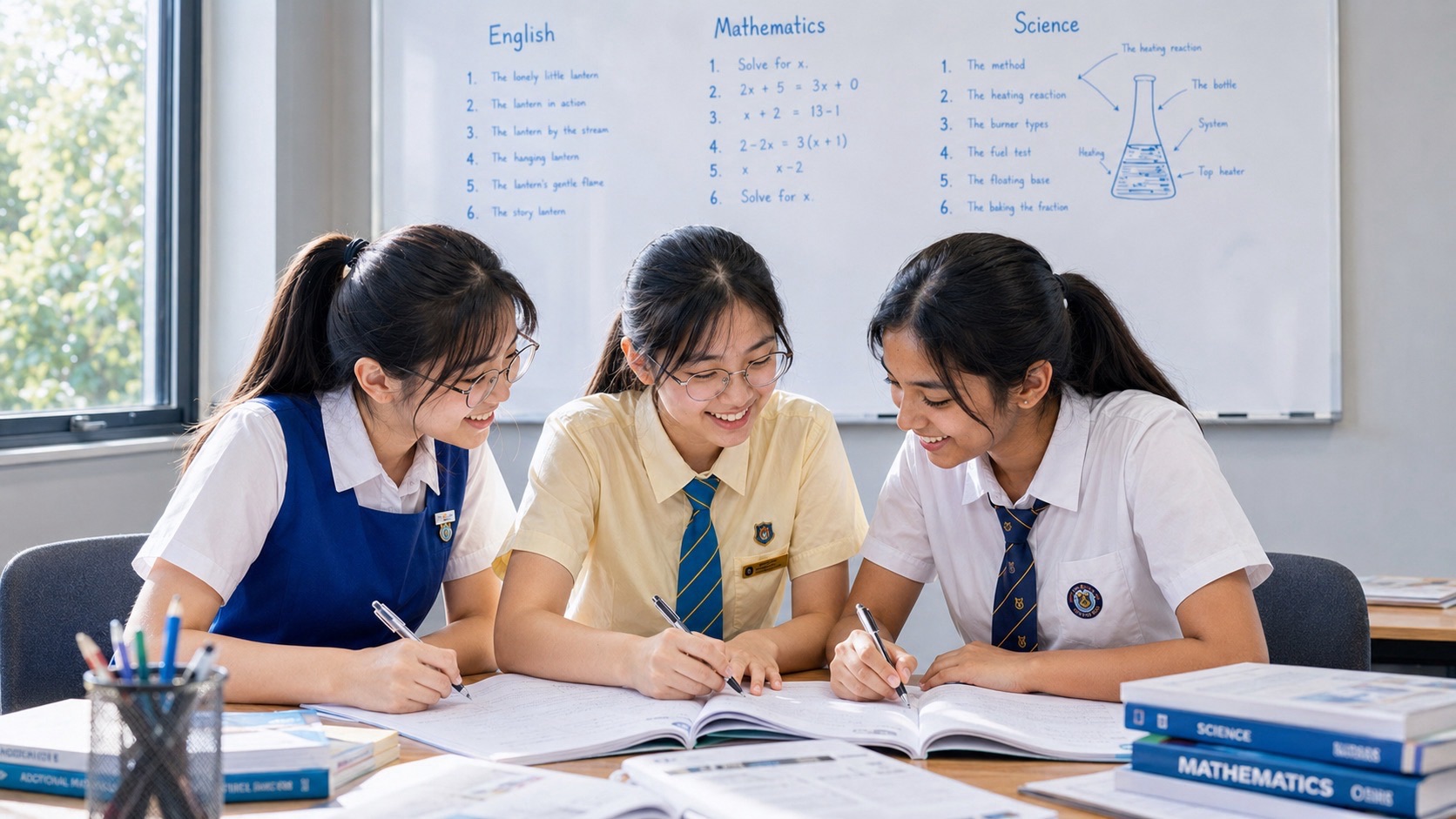
Science Education Systems · Article 37. Maya, Jia Jun, Hana and Ethan remain fictional Punggol learners. This article follows the comparison layer: how Science decides what should be compared, against what reference, and under which conditions.
The 50-second parent route
Science often begins with a difference.
One plant grows more.
One material heats faster.
One circuit produces a different reading.
But a difference becomes useful evidence only when the comparison is meaningful.
The route is:
question → reference → matched conditions → changed feature → measurement → difference → normalisation → interpretation → limitation → conclusion
The key question is:
Compared with what?
This article extends How Science Experiment Design Works, How Science Evidence Works and How Science Data Interpretation Works.
1. Comparison creates meaning
A temperature of 35°C means more when we know the starting temperature.
A plant height of 18 cm means more when we know its initial height or the height of another plant.
A score of 70 means more when we know the test difficulty or earlier performance.
Comparison creates a reference frame.
2. A baseline is the reference before change
If an intervention is introduced, the baseline tells us what the system looked like before it.
Without a baseline, improvement or deterioration can be hard to judge.
3. A control is a reference without the tested treatment
In a fair experiment, a control group or condition helps answer:
What would have happened without the change?
This makes the causal comparison stronger.
4. Baseline and control are not identical
Baseline compares the system with itself over time.
Control compares treated and untreated conditions during the same study.
Some investigations use both.
5. Primary Science begins comparison with visible properties
Longer.
shorter.
heavier.
warmer.
more transparent.
more flexible.
These simple contrasts train evidence-based description.
6. Comparison needs the same property on both sides
Comparing the mass of Object A with the length of Object B is meaningless.
The variable must match.
Science compares like with like unless a defined transformation makes them comparable.
7. Units must be compatible
50 cm and 0.7 m can be compared after unit conversion.
50 cm and 0.7 kg cannot.
Unit discipline protects the comparison.
8. Matched conditions protect fairness
Two plants receive different amounts of light.
If one also receives more water, the comparison no longer isolates light cleanly.
Comparison quality depends on what remains the same.
9. Fair tests are comparison machines
Change one relevant factor.
Hold others sufficiently constant.
Measure the outcome.
The experiment creates a structured contrast.
10. Maya’s comparison error is comparing end states only
Plant A ends at 20 cm.
Plant B ends at 18 cm.
She says A grew more.
But A started at 19 cm and B at 10 cm.
Her repair:
compare change, not only final value.
11. Jia Jun’s comparison error is ignoring scale
He says a 2-unit increase is the same in every context.
From 2 to 4 is proportionally different from 100 to 102.
His repair:
ask whether absolute or relative change matters.
12. Hana’s comparison error is demanding perfect equality
Two groups differ slightly at baseline.
She thinks comparison is impossible.
Her repair:
judge whether the difference is large enough to affect interpretation materially.
13. Ethan’s comparison error is changing the reference midstream
He compares against one baseline when the result looks favourable and another when it does not.
His repair:
define the reference before inspecting the outcome.
14. Absolute difference answers one question
New value minus old value.
This shows the amount of change in the original unit.
15. Percentage change answers another
Difference relative to the starting value.
This helps compare changes across different baselines.
16. Ratios can reveal proportional relationships
Twice as much.
half as large.
three times faster.
Ratios communicate multiplicative comparison.
17. Percentage points and percent are different
A rate rises from 20% to 30%.
That is a 10-percentage-point increase.
Relative to the original 20%, it is a 50% increase.
Scientific literacy should distinguish them.
18. Normalisation can make unequal systems comparable
Per kilogram.
per square metre.
per person.
per unit time.
Normalisation divides by a relevant scale so comparisons become fairer.
19. Rates are normalised comparisons over time
Distance per second.
mass change per minute.
population growth per year.
Rates compare change against time.
20. Density is a comparison of mass to volume
Two objects can have different masses because their sizes differ.
Density normalises mass by volume and reveals a deeper material property.
21. Surface area per volume is another meaningful normalisation
It helps explain transport and exchange constraints across differently sized organisms or structures.
Comparison becomes mechanistic.
22. Good comparison depends on the scientific question
Final value?
change from baseline?
rate?
percentage?
ratio?
distribution?
The right comparison is task-dependent.
23. Primary 3 comparison should make the reference explicit
“Object A is heavier than Object B.”
“Plant A has more leaves than Plant B.”
Reference language builds precision.
24. Primary 4 comparison can include before-and-after change
Measure before.
change the condition.
measure after.
Now the learner sees the baseline structure.
25. Primary 5 comparison can include multiple criteria
Which material is best?
Strongest?
lightest?
most waterproof?
Comparison can require trade-offs.
26. Primary 6 comparison becomes evidence selection
Several data values are provided.
The learner must identify which pair answers the question.
This is comparison under distraction.
27. Secondary Biology compares populations and conditions
Mean.
range.
rate.
proportion.
response under different environments.
Biological variability makes comparison richer.
28. Secondary Chemistry compares quantities through equations
Reactant amount.
yield.
concentration.
rate.
energy change.
Stoichiometric relationships make comparisons precise.
29. Secondary Physics compares through models and ratios
Speed.
acceleration.
resistance.
power.
efficiency.
Many physical quantities are structured comparisons.
30. Averages can support comparison
When repeated measurements vary, comparing means can summarise central tendency.
But the spread should not disappear from interpretation.
31. Distributions can reveal what averages hide
Two groups can share the same mean but differ greatly in spread.
Comparison should include distribution when variation matters.
32. Statistical significance is not the same as practical importance
A tiny difference can be statistically detectable in a very large sample.
That does not automatically make it scientifically or practically important.
Effect magnitude matters.
33. Practical significance asks whether the difference matters enough to care about
One thermometer differs by 0.01°C.
Does that difference change the decision?
Context decides.
34. Comparison and causality are connected
Causal inference depends on comparing what happens with and without the candidate cause under sufficiently matched conditions.
See How Scientific Causality Works.
35. Comparison and classification are connected
Classification asks whether cases share defining properties.
Comparison reveals similarities and differences that create the category boundary.
36. Comparison and uncertainty are connected
A difference smaller than measurement variability may not support a strong conclusion.
Scientific comparison should consider uncertainty.
37. Comparison and replication are connected
Replication compares independent attempts.
Do the results agree within reasonable uncertainty?
Compatibility is itself a comparison judgement.
38. Comparison and synthesis are connected
Scientific synthesis compares evidence quality, methods, populations and outcomes across studies.
See How Scientific Synthesis Works.
39. Comparison can be manipulated
Choose a weak baseline and improvement looks large.
Choose a flattering time window and a trend looks strong.
Choose a poor competitor and a product looks excellent.
Reference selection is part of scientific honesty.
40. Before-and-after photographs can mislead
Different lighting.
different angle.
different scale.
different time.
Comparison requires matched conditions even in images.
41. Graphs can manipulate comparisons visually
Truncated axes can magnify differences.
inconsistent scales can distort trends.
Scientific readers inspect the frame before accepting the visual conclusion.
42. AI can compare quickly but not always fairly
An AI system may choose criteria silently.
It may compare products, studies or explanations using different standards.
Learners should ask:
What criteria were used?
Were the same criteria applied to every option?
43. AI can help practise scientific comparison
Useful prompts:
“Give me two experiments that differ in one hidden variable.”
“Give me a table where the wrong pair looks tempting.”
“Ask whether absolute or percentage change is more appropriate.”
“Give me a misleading graph and let me diagnose the comparison.”
44. Parents can build comparison thinking in ordinary life
“Compared with last week?”
“Compared with the same time of day?”
“Is that an absolute difference or a percentage?”
These simple questions make reference frames habitual.
45. Small-group tuition can run contrast diagnostics
Three students receive the same dataset.
Maya compares the wrong rows.
Jia Jun ignores the baseline.
Hana notices uncertainty.
The tutor can see exactly where comparison reasoning fails.
46. A compact comparison checklist
- What exactly is being compared?
- What is the reference or baseline?
- Are the same variables measured?
- Are units compatible?
- Are conditions sufficiently matched?
- Should I compare final value, change, rate, ratio or percentage?
- Is normalisation needed?
- How large is the difference?
- How large is the uncertainty?
- Could reference selection distort the conclusion?
- Does the difference matter scientifically or practically?
47. Frequently asked questions
Why is comparison central to Science?
Because evidence often depends on detecting differences or similarities relative to a reference, baseline or control.
What is a baseline?
A baseline is a reference state, often measured before an intervention or change.
What is a control?
A control is a comparison condition without the tested treatment or factor, used to estimate what would happen otherwise.
Why use percentage change?
It can make changes across different starting values more comparable.
How does comparison help PSLE Science?
It supports fair tests, tables, graphs, suitability questions and evidence-based conclusions.
How does comparison change in Secondary Science?
It becomes more quantitative through rates, ratios, distributions, uncertainty, statistical reasoning and model-based comparisons.
48. Continue the Science Education Systems series
Conclusion: A difference only matters when the reference is honest
Maya sees the difference.
Jia Jun checks the unit.
Hana checks the baseline.
Ethan asks whether another comparison would change the story.
Science needs all four.
Choose the reference.
match the conditions.
measure the same quantity.
normalise when needed.
compare honestly.
Then interpret.


