
Secondary 3 Mathematics Tuition · Punggol
Secondary 3 Mathematics: choose your next step
Choose the difficulty that matches your current work. Use the guide for an overview, or open a specific article below.
Select one situation
Recommended starting point
Selected for your concernSecondary 3 Mathematics Support
What this may mean
How tuition should begin
eduKatePunggol · Secondary Mathematics Tuition Edition
Secondary 3 Mathematics Tuition With eduKatePunggol
Secondary 3 is the first upper-secondary Mathematics year and the first half of the final two-year runway. Lower-secondary algebra must now carry functions, graphs, geometry, trigonometry, equations and longer problem-solving routes. For some students, E-Math and A-Math begin to create two different workloads. eduKatePunggol tuition is designed to identify the exact point where control is breaking, rebuild it and prepare the student for Secondary 4 and the SEC route without turning every difficult chapter into a crisis.
Secondary 3 often feels like Mathematics has changed shape. The student may have passed lower secondary and still discover that familiar habits no longer produce familiar results. Algebraic steps become longer. Graphs carry more meaning. Geometry and trigonometry require route selection. A-Math, where taken, adds a second layer of notation, functions and manipulation.
This is why Secondary 3 deserves its own conversation. Secondary 1 introduced the language. Secondary 2 tested whether the language was becoming fluent. Secondary 3 asks the student to use that language inside a denser, more connected and more examination-shaped system. Weaknesses that were once local can now affect several topics at once.
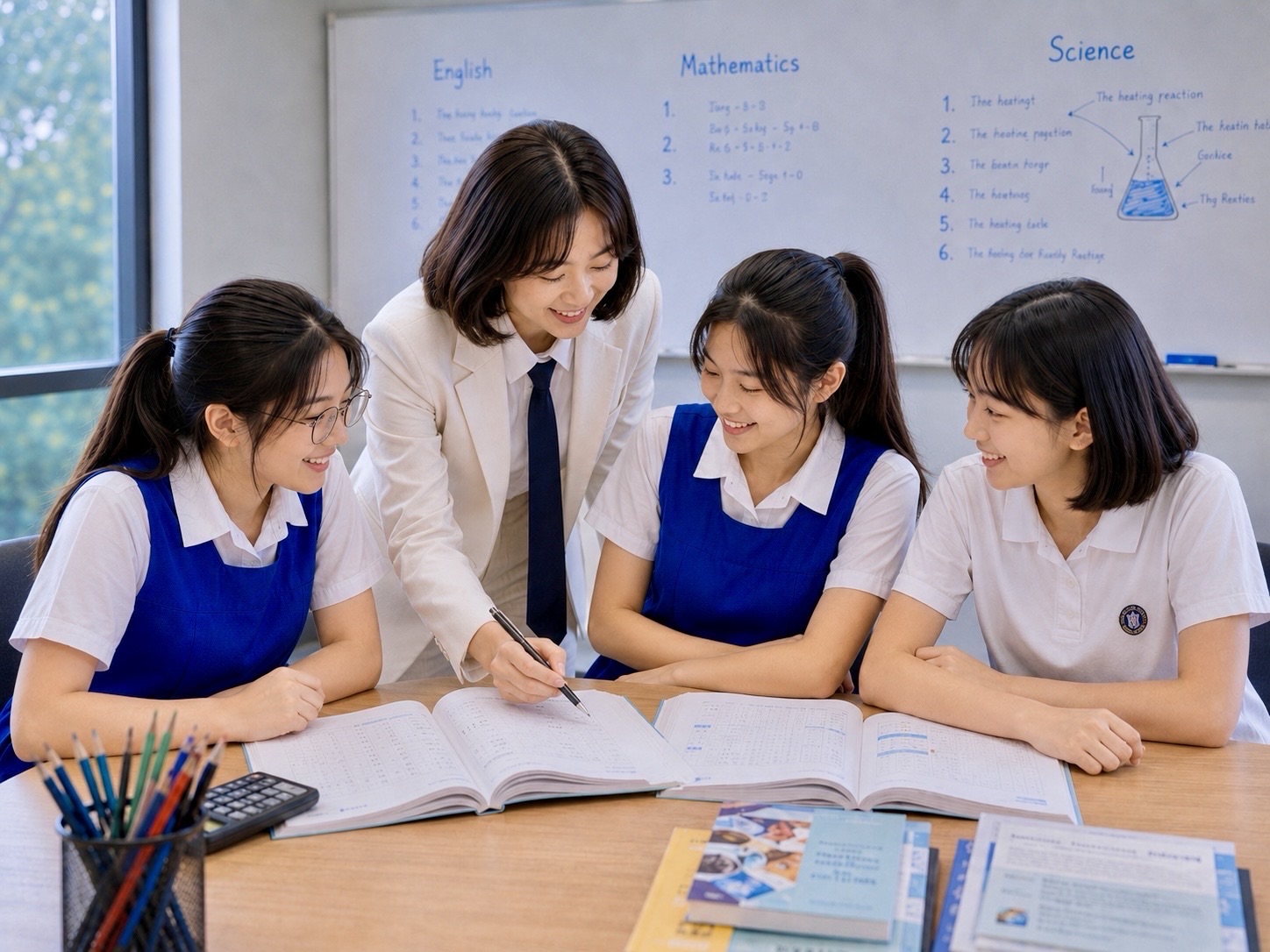
eduKatePunggol approaches tuition as a targeted learning intervention rather than an extra pile of worksheets. In a small group of no more than three students, the tutor can read the working, hear the reasoning, separate E-Math difficulties from A-Math difficulties and decide whether the next step is repair, school synchronisation or extension.
Catch Up
Return to the earliest weak link: algebra manipulation, equations, indices, graphs, geometry, ratio, percentage, negative signs or incomplete working. Rebuild it while keeping the student connected to the current upper-secondary chapter.
Keep Up
Support the current E-Math and, where applicable, A-Math sequence with explanation, correction, retrieval and mixed practice. Prevent unfinished learning from accumulating before the Secondary 4 revision year.
Move Ahead
Stretch a secure student through unfamiliar questions, connected topics, proof-like reasoning, modelling and cleaner mathematical communication. Build examination readiness without replacing understanding with premature drilling.
A student may move between these routes during the year. Good tuition responds to the current learning need rather than fixing the child permanently inside one label.
Secondary 3 Mathematics Tuition With eduKatePunggol
We diagnose the student’s upper-secondary system, then connect the repair back to school.
A useful Secondary 3 class begins with diagnosis. Two students may obtain the same mark for very different reasons. One may have weak lower-secondary algebra. One may understand E-Math but be overloaded by A-Math. Another may know the content yet lose marks through poor notation, slow route selection or incomplete working.
eduKatePunggol therefore looks beneath the result. We read the student’s written steps, ask how the question was interpreted and locate the first point of failure. The repair may belong in a lower-secondary foundation, the current E-Math topic, an A-Math prerequisite, mixed-topic transfer or assessment control.
Lessons are 1.5 hours and limited to a maximum of three students. This creates room for explanation, individual correction, deliberate practice and extension while preserving the benefits of hearing another student’s method or question. Materials are provided, and between-lesson WhatsApp support is available for difficult work.
The class may teach ahead of the school schedule when the student is ready, but acceleration is not used to hide weak foundations. The route remains baseline to advanced: understand the concept, control the method, retrieve it later, transfer it to an unfamiliar form and hold it under timed assessment conditions.
Students learn to classify the question, identify the governing relationship and choose a route before substituting numbers or symbols.
Sign errors, algebraic breakdowns, graph mistakes, diagram assumptions and unfinished reasoning are traced to their cause, corrected and retested later.
Earlier and current topics are interleaved so algebra, functions, graphs, geometry, trigonometry and problem-solving can operate as one connected system.
Three students do not mean one identical worksheet path. The group is small enough for the tutor to observe each student’s E-Math or A-Math working and adjust explanation, question difficulty and repair priorities.
Reasons Before the Subject Explainer
Why might a Secondary 3 student need Mathematics tuition?
Not every Secondary 3 student needs tuition. Some students are learning independently, retaining lower-secondary knowledge, correcting their own errors and keeping pace with upper-secondary schoolwork. Tuition becomes worth considering when the present learning system is no longer producing stable progress—or when a stronger student needs deliberate extension beyond routine homework.
The reasons below are not diagnoses by themselves. They are parent signals. The useful next step is to identify which signal is present, what sits underneath it and whether targeted teaching can change it before Secondary 4 compresses the available repair time.
Lower-secondary gaps are now multiplying.
01- Algebra, indices, equations or graph reading remain unstable.
- One weak prerequisite is affecting several upper-secondary topics.
- The student keeps relearning instead of retaining earlier methods.
Find the earliest weak link and rebuild it while preserving progress in the current school chapter.
E-Math and A-Math demands are separating.
02- The student can manage one subject but becomes overloaded by both.
- A-Math manipulation exposes weak algebraic fluency.
- Methods are memorised without understanding when or why they work.
Separate the two learning problems, repair shared foundations and build a sustainable method for each syllabus.
Marks are leaking through examination control.
03- Working is incomplete even when the central idea is correct.
- The student cannot choose routes quickly in mixed questions.
- Time, notation, checking and recovery under pressure are weak.
Install a repeatable classify-solve-check routine and test it under progressively more demanding conditions.
The student needs a stable runway into Secondary 4 and SEC.
04- Parents are unsure whether current G1, G2 or G3 demand is being met.
- The student is entering the final year with unfinished Sec 3 work.
- Current habits may not survive cumulative revision and timed papers.
Stabilise the present subject level, close critical gaps and build the habits needed for the final examination year.
From visible signal to useful response
Observe → Diagnose → TeachThe visible signal
- Results drop after the move into upper secondary.
- E-Math is manageable but A-Math is becoming overwhelming.
- The child says, “I understand in class, but I cannot start the test.”
- Mathematics work is consuming time needed by every other subject.
The learning cause
- Weak lower-secondary algebraic fluency.
- Poor route recognition in mixed questions.
- Unstable functions, graphs, geometry or trigonometric reasoning.
- Low confidence after repeated unresolved errors.
The repair route
- Precise diagnosis across foundations, E-Math and A-Math.
- First-principles explanation with visible mathematical working.
- Spaced retrieval, interleaving and cumulative review.
- Progression from supported practice to timed independent control.
The eduKatePunggol Learning-and-Review Loop
Good tuition should diagnose, rebuild, connect, test and stabilise.
Secondary 3 improvement does not come from one perfect explanation. A concept must be understood, practised, recalled after time has passed, connected to other topics and checked under assessment conditions. The learning loop therefore repairs earlier knowledge while building the cumulative control needed for Secondary 4.
The Secondary 3 Mathematics repair loop
Baseline → Control → TransferRead the working, not only the answer. Identify whether the break belongs in foundation, E-Math, A-Math, notation, pacing or confidence.
Teach from first principles and restore the missing algebraic, graphical or geometric baseline before adding more complexity.
Link the repaired skill to the current chapter and to nearby ideas such as functions, coordinate geometry, trigonometry or equations.
Return to knowledge after a delay and mix topics so recognition becomes independent rather than dependent on chapter labels.
Use timed work, checking routines and exam-style variation so the method survives pressure and remains available in Secondary 4.
A student can learn the next upper-secondary chapter while still revisiting a lower-secondary weak link. The sequence is managed so acceleration does not create a polished surface over an unstable foundation.
Who the Tuition Route May Help
Choose support according to the student’s present upper-secondary condition.
The student whose lower-secondary gaps are surfacing
Algebra, graph sense or working discipline was never fully stable, and the new Sec 3 topics are now exposing the weakness repeatedly.
PriorityRepair the earliest weak link while restoring enough school synchronisation to prevent further accumulation.
The student managing E-Math but struggling with A-Math
Basic schoolwork is manageable, but the additional algebraic load, abstraction and pace of A-Math are becoming unsustainable.
PriorityStrengthen shared algebra foundations, separate the two methods and create a realistic weekly learning rhythm.
The student who is passing but not examination-ready
Topic tests are acceptable, yet mixed questions, timed papers, complete working and cumulative recall remain inconsistent.
PriorityBuild transfer, route selection, checking discipline and control across increasingly mixed assessment conditions.
The strong student who needs deliberate extension
Routine exercises are secure, but unfamiliar problems, deeper reasoning and mathematical communication need a more demanding pathway.
PriorityMove beyond speed into structure, modelling, proof-like reasoning and durable readiness for Sec 4 and post-secondary options.
Mathematics may be offered at G1, G2 or G3 subject levels, and the student’s actual subject combination may include E-Math and A-Math where suitable. Tuition should therefore match the syllabus being taken while building the capability needed at the next junction.
Continue the Existing Page
Now read what Secondary 3 Mathematics actually contains.
The reasons for tuition are now clear: lower-secondary repair, E-Math or A-Math control, stronger independent method, examination readiness or deliberate extension. The next article can therefore do its proper job. It can explain Secondary 3 Mathematics itself—the first upper-secondary year, the Sec 2 to Sec 3 bridge, algebra, functions, graphs, geometry, trigonometry, assessment craft and the route towards Secondary 4 and SEC.
The Next Useful Step
Understand the student, then stabilise the upper-secondary route.
Continue into the existing “What is Secondary 3 Mathematics?” guide for the subject map already on this page. When you are ready to discuss tuition, send us the student’s current G-level, whether E-Math and A-Math are being taken, the latest result, the repeated difficulty and the main concern you want solved. We begin with a consultation rather than assuming every student needs the same class response.
The first button moves directly to the current eduKatePunggol article selector and “What is Secondary 3 Mathematics?” block below. The second opens a WhatsApp consultation for Secondary 3 Mathematics tuition.
What Is Secondary 3 Mathematics? WhatsApp +65 8823 1234Official route references
Curriculum, Full SBB and SEC arrangements may be updated. Parents should refer to the latest MOE and SEAB pages for official requirements.
Secondary 3 Mathematics Tuition at eduKatePunggol
Secondary 3 Mathematics Tuition in Punggol: Year 1 of 2 before the final examination year
Secondary 3 Mathematics is where many students feel the real upper-secondary jump.
Secondary 1 was the transition year.
Secondary 2 was the bridge year.
Secondary 3 is Year 1 of 2.
This is the year where Mathematics begins to feel more serious, more layered and more connected to the final examination route. Students are no longer only learning lower-secondary foundations. They are now building the machinery that must hold through Sec 3, Sec 4 and the final SEC examination.
For parents, Secondary 3 often brings a new kind of concern.
“My child used to be okay. Why is Math suddenly harder?”
“Is this an E-Math problem, an A-Math problem, or both?”
“Can we still repair the gaps before Sec 4?”
“Is my child falling behind quietly?”
“Should we push harder or slow down and rebuild?”
“What does G2 or G3 Mathematics mean for the next step?”
“How do we lower stress without lowering standards?”
At eduKatePunggol, Secondary 3 Mathematics tuition is designed to answer these questions calmly.
We help students understand the topic, repair weak foundations, build exam discipline, improve algebra control, strengthen problem-solving habits and prepare properly for Sec 4.
The goal is not panic.
The goal is control.
Quick answer: What is Secondary 3 Mathematics tuition?
Secondary 3 Mathematics tuition is structured upper-secondary support that helps students manage the first year of the final examination runway. It strengthens algebra, graphs, geometry, trigonometry, coordinate geometry, functions, equations, inequalities, mensuration, statistics, probability and problem-solving habits according to the student’s school syllabus and subject level.
At eduKatePunggol, Secondary 3 Mathematics tuition helps students catch up, keep up and move ahead by diagnosing weak points, teaching clearly, correcting working habits, building test confidence and preparing students for Sec 4 Mathematics.
Why Secondary 3 Mathematics feels harder
Secondary 3 feels harder because the subject changes in three ways.
First, the content becomes deeper. Students meet heavier algebra, more abstract graphs, stronger geometry, trigonometry, coordinate reasoning and more multi-step questions.
Second, the pace becomes less forgiving. Schools have to cover upper-secondary content while preparing students for examination standards. A student who misses one chapter may find the next chapter harder because the topics connect.
Third, the student’s old habits are exposed. A child who used to rely on memory, last-minute revision or copying examples may now struggle because Sec 3 questions require stronger reasoning and cleaner method.
This does not mean the child has become weak.
It means the subject is asking for a more mature learner.
Secondary 3 is not the year to panic. It is the year to organise.
Many parents start to worry in Sec 3 because the marks may drop suddenly.
A child who used to score comfortably may now score lower.
A child who passed lower-secondary Math may now feel lost.
A child who chose Additional Mathematics may suddenly feel overloaded.
A child who is strong may become careless because the questions look familiar but contain traps.
The parent’s first job is not to panic.
The first job is to organise the problem.
Is the child struggling with E-Math?
Is the child struggling with A-Math?
Is the child weak in algebra?
Is the child losing marks through careless working?
Is the child unable to start unfamiliar questions?
Is the child overloaded by too many subjects?
Is the child still carrying Sec 1 or Sec 2 gaps?
Is the child quietly losing confidence?
Once the problem is named, the repair becomes clearer.
Why Sec 3 is Year 1 of 2
Secondary 3 and Secondary 4 should be read together.
Sec 3 is not a small separate year. It is the first half of a two-year examination runway. What happens in Sec 3 affects how much pressure the child will face in Sec 4.
A student who builds strong Sec 3 foundations enters Sec 4 with more space to revise, practise and sharpen exam craft.
A student who leaves Sec 3 with gaps may enter Sec 4 needing to learn new topics, repair old topics, practise papers, manage time pressure and recover confidence all at once.
That is a heavy load.
This is why Sec 3 tuition should not only help with this week’s homework. It should build the structure for the whole two-year route.
Sec 3 is where the child installs the upper-secondary machine.
Sec 4 is where the child must execute with that machine.
E-Math and A-Math: what parents need to understand
In Secondary 3, many parents begin to hear two different Mathematics conversations.
E-Math is the core Mathematics route for many students. It develops broad mathematical competence across algebra, geometry, graphs, statistics, probability, measurement and problem-solving.
A-Math, where offered and taken, is more abstract and algebra-heavy. It usually involves stronger manipulation, functions, equations, calculus-related thinking later, and deeper symbolic control.
The important parent point is this:
A-Math does not replace E-Math.
For students taking both, the two subjects must be managed together. A child who becomes overwhelmed by A-Math may also lose stability in E-Math. A child with weak E-Math algebra will usually feel A-Math more painfully. A child who is strong but careless must learn precision early because upper-secondary Mathematics rewards controlled method.
At eduKatePunggol, we help parents read the situation carefully.
Some students need E-Math repair.
Some students need A-Math support.
Some students need both.
Some students need to protect confidence while adjusting to the heavier load.
Some students need stretch because they are aiming for distinction.
The right support depends on the student’s actual working, not only the subject name.
Common Secondary 3 Mathematics problems parents notice
Parents often see the symptoms before the child can explain the cause.
The child says, “I understand in class,” but cannot do the homework alone.
The child can do basic questions but cannot handle exam-style questions.
The child loses marks through algebra errors, sign mistakes or missing steps.
The child takes very long to complete one worksheet.
The child avoids A-Math or says it is impossible.
The child focuses only on answers and does not show method properly.
The child panics when questions combine two topics.
The child’s marks drop after moving into upper secondary.
The child becomes quiet, defensive or tired when Mathematics is mentioned.
The child is strong in classwork but careless during tests.
The child cannot revise because the folder, notes and mistakes are disorganised.
These are not reasons to attack the child.
They are signals.
The useful parent question is:
“What is the repeated pattern, and what repair will help?”
Main Secondary 3 Mathematics areas students must strengthen
Different schools may sequence topics differently, and students may be studying at different subject levels. However, the main upper-secondary Mathematics skills usually require stronger algebra, graphs, geometry, trigonometry, coordinate reasoning, statistics, probability and application.
1. Algebra must become controlled
Algebra is the main engine of Secondary 3 Mathematics.
Students need to simplify, expand, factorise, solve equations, rearrange formulae, handle fractions, work with indices, manage inequalities and connect algebra to graphs and word problems.
Many Sec 3 students are not weak because they cannot “do Math”. They are weak because the algebra collapses halfway.
They may start correctly but make a sign error.
They may know the formula but cannot rearrange it.
They may expand brackets too quickly.
They may factorise without checking.
They may skip steps and lose control.
They may not understand what the variable represents.
At eduKatePunggol, algebra is not treated as one chapter. It is treated as a language that appears across many chapters.
2. Graphs require interpretation, not just plotting
Upper-secondary graph work asks students to understand relationships.
Students must read curves, understand intercepts, use gradients, connect equations to shapes, interpret transformations and solve problems using graphical reasoning.
A student may be able to draw a graph but not understand what it tells them. Another student may know the equation but not connect it to the diagram.
Graph questions test whether the child can move between symbols, diagrams and meaning.
3. Geometry requires proof-like discipline
Geometry becomes more demanding when students must justify angle relationships, work with similarity, congruence, circles, polygons or more complex diagrams.
The issue is not only whether the child can “see” the answer.
The child must know which rule applies, write the reason clearly, and build the solution step by step.
Students who jump too quickly often lose marks because the reasoning is incomplete.
4. Trigonometry introduces a new kind of thinking
Trigonometry can be a turning point for many students.
It uses ratios, angles, triangles, diagrams, formulae and calculator discipline. Some students are fine with basic trigonometry but struggle when questions involve bearings, elevation, depression, area of triangles or multi-step geometry.
Trigonometry also reveals whether the student reads diagrams carefully.
At eduKatePunggol, we slow down the triangle. We teach students to label properly, choose the correct ratio, check whether the answer is reasonable, and write the method clearly.
5. Coordinate geometry connects algebra and diagrams
Coordinate geometry can be difficult because it sits between algebra and visual reasoning.
Students must handle gradients, distances, midpoints, straight lines, equations and coordinate relationships.
The child needs to know not only which formula to use, but why the formula fits the question.
This is where route recognition matters.
6. Statistics and probability require accuracy and interpretation
Some students underestimate statistics and probability because they look less algebra-heavy. But these topics can be full of traps: careless reading, wrong denominator, poor interpretation, missing conditions or weak explanation.
The student must learn to slow down and read the situation.
Probability especially rewards clear structure. Guessing is dangerous.
7. Word problems and applications require route recognition
Upper-secondary word problems are often where students freeze.
The child may know the chapter. The child may know the formula. But when the question is written differently, the child does not know how to start.
This is route recognition.
A student must learn to ask:
What is given?
What is unknown?
What relationship connects them?
Is this algebra, geometry, graph, trigonometry, percentage, rate or probability?
What should I write first?
What answer is reasonable?
This is not only content. This is mathematical thinking.
The Sec 3 Mathematics jump under Full SBB and G-level subject routes
Under Full Subject-Based Banding, students may study subjects at G1, G2 or G3 levels according to their route, aptitude, interest and learning needs.
For parents, the most useful way to think about this is:
The subject level tells us the demand.
The child’s working tells us the repair.
A G3 Mathematics student may need distinction-level stretch.
A G3 Mathematics student may also need algebra repair.
A G2 Mathematics student may need confidence, working discipline and stronger exam rhythm.
A student taking Additional Mathematics may need separate support because A-Math adds a different layer of symbolic demand.
A student who is quiet may need close correction before small confusion becomes a larger gap.
The level does not tell the whole story.
The child’s working tells the truth.
At eduKatePunggol, we look at how the child thinks on paper: the steps, the gaps, the errors, the hesitation and the confidence.
That is where tuition becomes useful.
How eduKatePunggol teaches Secondary 3 Mathematics
Secondary 3 Mathematics tuition must be more strategic than simply giving more questions.
More questions do not automatically help if the child keeps repeating the same mistake.
At eduKatePunggol, we use a repair-and-growth system.
1. Diagnose the exact issue
Before pushing harder, we identify what is breaking.
Is the child weak in algebra?
Is the child careless with signs?
Is the child slow because foundations are weak?
Is the child unable to start unfamiliar questions?
Is the child overwhelmed by A-Math?
Is the child avoiding practice because confidence is low?
Is the child making exam mistakes despite knowing the content?
A child who does not understand needs teaching.
A child who is careless needs discipline.
A child who is slow needs fluency.
A child who is afraid needs controlled success.
A child who is strong needs stretch.
Different problems need different tuition.
2. Rebuild foundations without wasting the year
Sec 3 students do not have unlimited time. But foundation repair is still necessary when the gap is blocking progress.
If a student is weak in fractions, indices, factorisation, expansion, equations, negative signs or graph basics, those gaps must be repaired because they appear repeatedly inside upper-secondary topics.
We do not spend time pretending the gap is gone.
We repair the gap efficiently and reconnect it to the current school topic.
3. Teach the upper-secondary method clearly
Sec 3 Mathematics requires clean method.
Students must learn how to structure working, choose formulae, justify steps, label diagrams, manage calculator use, check units and avoid careless leaps.
In upper secondary, the student is not only trying to “get the answer”.
The student is learning how to produce a solution that earns marks.
4. Correct mistakes closely
Small mistakes become expensive in Sec 3.
A dropped negative sign can destroy a whole solution.
A wrong expansion can ruin the next three lines.
A missing reason in geometry can cost marks.
A careless denominator in probability can change the answer.
A wrong scale in graph work can affect the whole question.
In small-group tuition, the tutor can see these mistakes earlier and correct the habit before it becomes part of the child’s exam pattern.
5. Build exam rhythm before Sec 4
Sec 3 students should not wait until Sec 4 to learn exam rhythm.
They need to learn how to revise, attempt, check, manage time and recover from mistakes.
We help students build the habits that Sec 4 will need:
Topic-by-topic mastery.
Mistake correction.
Clear working.
Timed practice.
Paper-style questions.
Confidence under pressure.
Better decision-making when stuck.
Sec 4 should be the sharpening year, not the first time the student learns how to train.
6. Stretch strong students properly
Strong students also need careful teaching.
Some strong students become careless because they rely too much on speed. Some avoid writing steps because they can see the answer mentally. Some dislike unfamiliar questions because they are used to being correct quickly.
For strong Sec 3 students, tuition should stretch reasoning, precision and exam craft.
The goal is not just to stay good.
The goal is to become reliable.
Catch up, keep up or move ahead in Sec 3 Mathematics
Secondary 3 students usually fall into three broad routes.
Route 1: Catch up
This student is already struggling.
The child may have weak Sec 1 or Sec 2 foundations, poor algebra control, low confidence or difficulty understanding upper-secondary topics.
This student needs patient repair.
The priority is to rebuild the missing links, reteach current topics clearly and help the child experience progress again.
The first win may be simple:
“I can start the question now.”
That matters.
Route 2: Keep up
This student is not failing badly, but the parent can sense instability.
The child may be passing, but not secure. Results may swing. Homework may take too long. The child may be heavily dependent on examples and unable to handle new question types.
This student needs rhythm.
The priority is to strengthen working discipline, close small gaps, organise revision and build a stable pattern before Sec 4.
Route 3: Move ahead
This student is already doing well.
But Sec 3 is where strong students must be trained beyond comfort. They need tougher questions, better reasoning, exam precision and higher-quality correction.
This student needs stretch.
The priority is to prepare for distinction-level performance without becoming careless.
Secondary 3 Mathematics and A-Math stress
A-Math can change the emotional load of Sec 3.
For some students, A-Math is exciting. It gives them challenge, structure and stronger problem-solving. For others, it feels like a sudden wall because the subject is more abstract and algebra-heavy.
Parents may notice:
The child spends too much time on A-Math and neglects E-Math.
The child gives up quickly when A-Math questions look unfamiliar.
The child becomes afraid of algebra.
The child’s confidence drops across both Mathematics subjects.
The child used to like Math but now says, “I cannot do this.”
This needs careful handling.
The answer is not always to push harder immediately. Sometimes the child needs the topic broken down more clearly. Sometimes the child needs algebra repair. Sometimes the child needs better time management. Sometimes the child needs to separate E-Math and A-Math practice so one subject does not flood the other.
At eduKatePunggol, we help students manage the load rather than drown in it.
Why Sec 3 Math tuition should not be random worksheet drilling
Random worksheets can make a parent feel that something is being done. But if the child does not understand the method, the worksheet only repeats the confusion.
Good Sec 3 Mathematics tuition should answer:
What is the child weak in?
What topic must be repaired first?
What mistakes keep repeating?
What level of difficulty is appropriate now?
What school demand is coming next?
What exam habit must be trained?
How does this connect to Sec 4?
The child needs structured practice, not noise.
Parent guide: how to read a Sec 3 Math result
A Sec 3 result should be read carefully.
Do not only ask, “What is the mark?”
Ask:
Which topic caused the most loss?
Was the loss from concept weakness or careless mistakes?
Did the child know how to start the questions?
Were the mistakes repeated from past work?
Did the child run out of time?
Were there missing steps?
Was the answer wrong because the method was wrong, or because one small line collapsed?
Does this affect E-Math, A-Math, or both?
This keeps the conversation useful.
Instead of “Why did you score like this?”, the family can ask:
“What does this result tell us to repair next?”
That lowers stress because the result becomes information, not judgement.
The Sec 3 mistake ledger
A mistake ledger is especially useful in Secondary 3 because repeated mistakes become expensive.
The child records recurring errors such as:
I lose negative signs.
I expand brackets too quickly.
I factorise without checking.
I misread the question.
I use the wrong trigonometric ratio.
I forget to label the diagram.
I skip geometry reasons.
I use the wrong formula.
I do not check units.
I panic when two topics combine.
I spend too long on one question.
I leave blanks too early.
This turns anxiety into data.
Once the mistake is visible, the student can train against it.
What parents can do at home without increasing pressure
Parents do not need to become the tutor at home.
The better role is to help the child stay organised, steady and honest about the work.
Ask calm questions:
What topic are you learning now?
Which part is easy?
Which part is not stable yet?
Which mistake keeps returning?
What did your last test show?
What must be repaired before the next test?
Are you stuck because you do not understand, or because you have not practised enough?
Are you leaving questions blank too quickly?
These questions are not soft. They are precise.
They help the child anticipate rather than retaliate.
Why Secondary 3 tuition is also parent clarity
Parents are not only paying for extra lessons. They are trying to understand the education route around the child.
Secondary 3 sits in the middle of many decisions:
E-Math expectations.
A-Math load.
G2 or G3 subject demands.
School assessment.
Sec 4 preparation.
Post-secondary possibilities.
Confidence and emotional load.
Time management across all subjects.
It is easy for the parent to feel foggy.
eduKatePunggol helps make the route clearer.
Tuition becomes part of the education structure around the child. It helps the student understand the subject, helps the parent read the system, and helps the family make the next decision with more calm.
Secondary 3 Mathematics and the wider eduKatePunggol ecosystem
eduKatePunggol teaches P1–P6 English and Mathematics, P3–P6 PSLE Science, Sec 1–4 English, Sec 1–4 Mathematics and Sec 3–4 Additional Mathematics.
This matters because Secondary 3 Mathematics does not sit alone.
English affects the ability to read word problems accurately.
Science trains process thinking and explanation.
Mathematics trains structure, precision and problem-solving.
A-Math trains deeper algebra and abstract reasoning.
Parent clarity supports the child’s emotional stability at home.
A child is not a worksheet machine.
A child is moving through school, exams, choices, confidence, family expectations and future pathways.
Tuition should support that whole movement.
When should a Sec 3 student start Mathematics tuition?
A Sec 3 student should consider tuition when the pattern is repeated, not only when one mark is disappointing.
Start support when:
Algebra mistakes keep returning.
The child cannot start unfamiliar questions.
The child is overwhelmed by A-Math.
E-Math results are dropping.
Homework takes too long.
The child is quietly losing confidence.
The child is strong but careless.
The child needs distinction-level stretch.
The child is entering Sec 4 soon with gaps still open.
Parents feel they cannot read the route clearly anymore.
It is better to repair in Sec 3 than to overload Sec 4.
What a good Secondary 3 Mathematics tuition programme should answer
Parents searching for Secondary 3 Mathematics tuition usually want practical answers.
Will this help my child understand the topic?
Will this help with school tests?
Will this repair algebra?
Will this support E-Math, A-Math, or both?
Will the tutor see my child’s mistakes?
Will the class be small enough for close correction?
Will this prepare my child for Sec 4?
Will my child become more confident?
Will this reduce stress instead of adding more?
Will parents understand what is happening?
At eduKatePunggol, the answer is structure.
We teach clearly.
We repair carefully.
We correct closely.
We train exam habits early.
We help students build confidence through visible progress.
We help parents understand the route.
Secondary 3 Mathematics Tuition at eduKatePunggol
Secondary 3 is the first half of the final examination runway.
It is the year to build before Sec 4.
It is the year to repair before the pressure rises.
It is the year to strengthen algebra before it affects everything else.
It is the year to manage E-Math and A-Math properly.
It is the year to train working discipline.
It is the year to turn mistakes into data.
It is the year to help students catch up, keep up and move ahead.
At eduKatePunggol, Secondary 3 Mathematics tuition is designed for calm progress.
Not panic.
Not punishment.
Not random worksheets.
A structured booster.
The student learns the topic.
The student practises the method.
The student corrects the mistake.
The student builds rhythm.
The parent understands the route.
The family moves forward with better control.
Frequently Asked Questions about Secondary 3 Mathematics Tuition at eduKatePunggol
Why is Secondary 3 Mathematics so much harder?
Secondary 3 Mathematics is harder because students enter upper-secondary content. Algebra becomes more important, graphs become more abstract, geometry and trigonometry require stronger reasoning, and questions often combine several skills. It is a normal jump, but it must be managed properly.
Is Secondary 3 too late to repair Math foundations?
No. Secondary 3 is still a good time to repair foundations, especially before Sec 4 begins. The repair must be focused and efficient because the year is important, but it is not too late.
Should my child focus on E-Math or A-Math first?
It depends on the child’s situation. If E-Math foundations are weak, they usually need to be stabilised because weak algebra and poor working habits can affect A-Math too. If A-Math is causing overload, the child may need separate support to manage its heavier symbolic demand.
Can tuition help a Sec 3 student who understands in class but fails tests?
Yes. This usually means the child understands during explanation but cannot reproduce the method independently under test conditions. Tuition can help by training independent attempt, route recognition, timed practice and mistake correction.
What is the most important Sec 3 Math skill?
Algebra control is one of the most important skills. It affects equations, graphs, coordinate geometry, functions, A-Math and many upper-secondary problem types. A student who strengthens algebra usually gains more control across the subject.
What if my child is strong but careless?
Strong but careless students need stretch and precision. They should be trained to write proper steps, check carefully, handle harder questions and avoid losing marks through speed, overconfidence or incomplete working.
How does eduKatePunggol help with A-Math stress?
We help students break down the topic, repair algebra gaps, practise progressively, separate E-Math and A-Math demands where needed, and build confidence through clearer method and controlled difficulty.
Does Sec 3 tuition prepare for Sec 4?
Yes. Good Sec 3 tuition should prepare the child for Sec 4 by strengthening foundations, correcting repeated mistakes, training exam rhythm and building confidence before the final year becomes heavier.
What should parents send before asking about Sec 3 Math tuition?
Parents can send the child’s level, current Mathematics subject level, whether the child takes E-Math only or both E-Math and A-Math, recent test concerns, weak topics and the pattern seen at home. For example: “Sec 3, weak in algebra and trigonometry, taking E-Math and A-Math, loses marks through careless signs and cannot start harder questions.”
What is the main goal of Secondary 3 Mathematics tuition?
The main goal is to build control before Sec 4. The child should understand upper-secondary topics better, repair weak foundations, improve algebra and working discipline, reduce repeated mistakes, gain confidence and become more ready for the final examination year.

Your Secondary 3 Mathematics pathway within PunggolOS
At Secondary 3, the Mathematics route inside PunggolOS is designed to strengthen algebra, functions, geometry, multi-step reasoning and mixed-question method selection.
Why this stage matters: Upper-secondary Mathematics becomes more manageable when the student can see which method applies and why.
More published guides
Guides 1–10
- Enhancing Learning Experiences with Secondary 3 Mathematics Tuition in Punggol: The Power of Small Group Learning
- How to Improve Sec 3 G3 Mathematics in Punggol | SEC 2027 Readiness Guide
- Punggol Secondary 3 Mathematics Tutor
- Sec 3 G2 Mathematics Tuition Punggol | 2026 Upper-Secondary Transition to SEC K210
- Secondary 3 E Math Tutor
- Secondary 3 Mathematics in Punggol | The SEC Runway Begins — From Home to School to Tuition
- Secondary 3 Mathematics in Punggol | Upper-Secondary Transition Guide
- Secondary 3 Mathematics Tuition in Small Groups at Sengkang | Chain Methods, Audit Every Step
- Secondary 3 Mathematics Tuition Sengkang | Build the Upper-Secondary Baseline Before Exam Pressure Takes Over
- Secondary 3 Mathematics Tuition | eduKatePunggol
Current Secondary 3 Mathematics Project Guide
Secondary 3 → SEC Mathematics Runway
Secondary 3 to SEC Mathematics — Build the Exam Runway Before Secondary 4
More guides:
- When to check the answer key
- Self-study or tuition?
- When one weak chapter affects others
- Formula sheets and revision notes
- Catch up after missed lessons
- Extension without overtraining
- From middle grades toward distinction
- A 12-week revision runway
- Worksheets, books or past papers?
- Speed versus accuracy
- The 48-hour correction and retest
- Recover after a poor test result
- Balance Mathematics and A-Math
- Build speed without careless errors
- Turn homework understanding into test performance





