
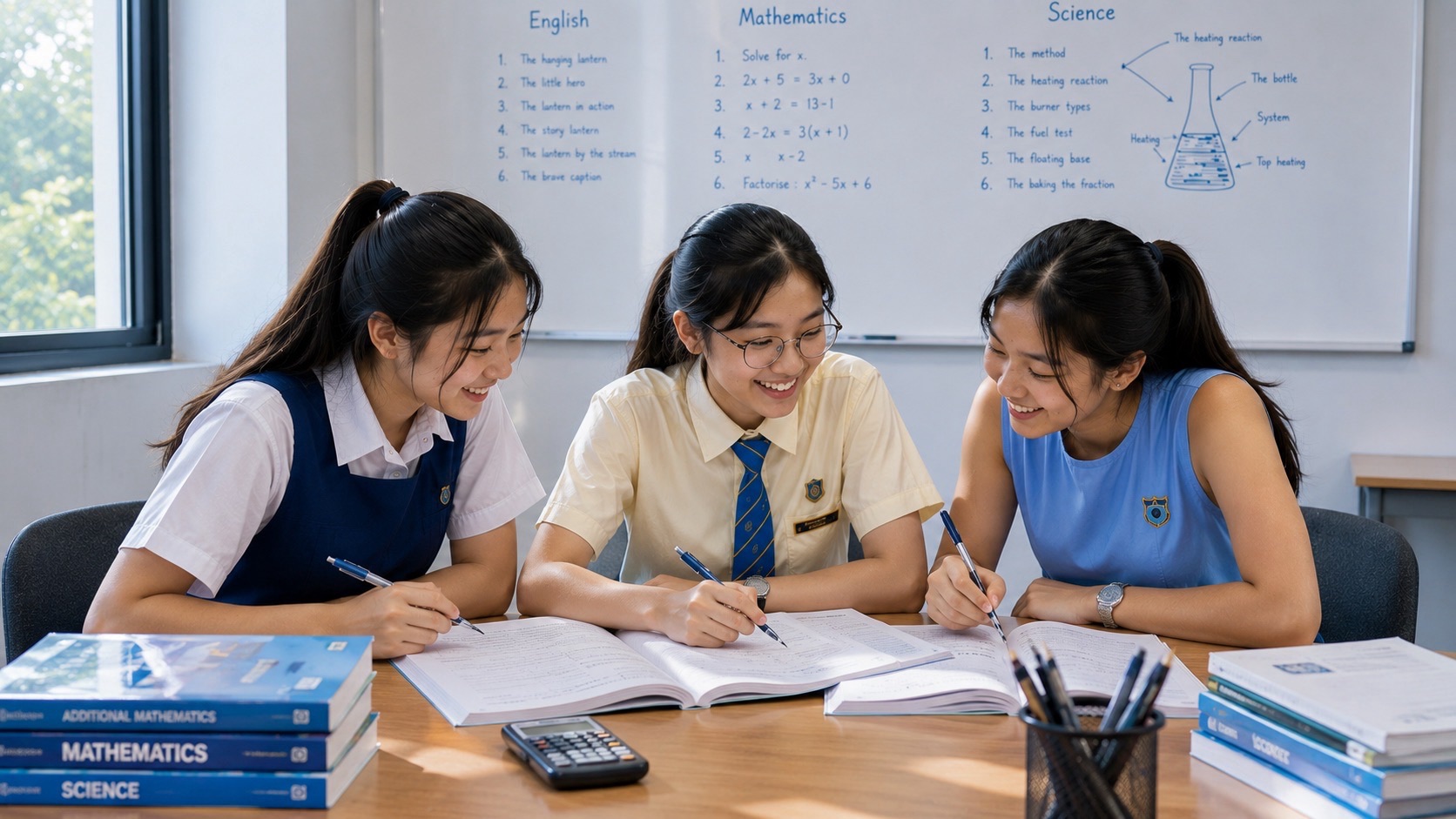
Science Education Systems · Article 53. Maya, Jia Jun, Hana and Ethan remain fictional Punggol learners. This article follows the variables layer: how Science turns a messy real-world situation into a testable relationship without pretending the rest of the system has disappeared.
The 50-second parent route
Scientific variables are not merely labels to memorise.
They are a way of deciding what changes, what is measured, what is held steady and what may still be hiding in the background.
The route is:
question → system → candidate factors → independent variable → dependent variable → controlled variables → hidden variables → measurement → relationship → interaction → revision
The key question is:
Which factor are we changing, which response are we measuring, and what else could be responsible?
This article extends How Science Experiment Design Works, How Scientific Causality Works and How Scientific Constraints Work.
1. A variable is something that can take different values
Temperature.
time.
mass.
light intensity.
plant height.
voltage.
population size.
Variables turn qualitative situations into quantities or categories that can be compared.
2. The independent variable is deliberately changed
In a controlled experiment, the independent variable is the factor the investigator manipulates systematically.
It is the input whose effect we want to investigate.
3. The dependent variable is the measured response
Change the light intensity.
measure growth rate.
Change resistance.
measure current.
The dependent variable is the outcome whose behaviour we are trying to understand.
4. Controlled variables are held sufficiently constant
Same plant species.
same amount of water.
same duration.
same container.
Controls reduce alternative explanations.
5. Controlled does not mean irrelevant
A controlled variable can be scientifically important.
We hold it steady precisely because changing it might also affect the outcome.
6. Maya’s variables error is changing two things at once
She gives Plant A more light and more water.
Plant A grows more.
Her repair:
change one target factor while controlling other plausible causes.
7. Jia Jun’s variables error is label memorisation
He can recite “independent, dependent, controlled” but cannot identify them in a new investigation.
His repair:
ask three operational questions:
What did we deliberately change?
What did we measure?
What else needed to stay comparable?
8. Hana’s variables error is trying to control everything
Real systems contain thousands of changing features.
Her repair:
control the variables that plausibly influence the question strongly enough to matter.
9. Ethan’s variables error is hidden-variable enthusiasm
He lists every imaginable confounder until no experiment seems possible.
His repair:
rank alternative variables by plausibility and likely effect.
10. Operational definitions turn ideas into variables
“Plant health” is vague.
Will it mean height increase?
leaf count?
dry mass?
chlorophyll concentration?
Science must define what is actually measured.
11. The same concept can have several operational definitions
“Fitness” in Biology can mean reproductive success in one context.
“Fitness” in everyday health can mean something else entirely.
Scientific variables depend on context and definition.
12. Primary Science begins variables through fair tests
Change one thing.
observe what happens.
keep the rest sufficiently similar.
The formal terms can come after the logic.
13. Primary 3 can begin with simple factor-response pairs
More water → plant response.
different material → amount of light transmitted.
different surface → frictional effect.
The learner sees cause-and-response structure.
14. Primary 4 can formalise what must stay the same
Container.
starting amount.
duration.
position.
Students begin to understand why fair comparisons require controlled variables.
15. Primary 5 can introduce interacting factors
Light may affect plant growth.
Water may also affect plant growth.
The effect of one factor can depend on the level of another.
Variables do not always act independently.
16. Primary 6 can evaluate hidden variables
If two groups differ in more than one way, which difference could explain the result?
This strengthens experiment critique.
17. Secondary Science makes variable structure more formal
continuous variables.
categorical variables.
discrete variables.
covariates.
confounders.
interactions.
Students begin to analyse the type and role of each variable.
18. Continuous variables can take many values across a range
Temperature.
time.
mass.
voltage.
These are often measured numerically.
19. Discrete variables take countable values
Number of leaves.
number of offspring.
number of collisions.
Counts are numeric but not continuous.
20. Categorical variables represent groups
Material type.
species.
treatment group.
habitat type.
Categories require clear classification criteria.
21. Confounding creates false causal stories
Variable X appears related to Y.
But Variable Z influences both.
The apparent X→Y relationship may therefore be misleading.
22. Temperature can be a confounder
Suppose one reaction is tested under brighter light and a warmer lamp.
Faster reaction could reflect temperature rather than light.
Experimental design must separate the factors.
23. Randomisation helps distribute hidden variables
When units are assigned randomly to conditions, known and unknown differences can be distributed more fairly on average.
Randomisation does not guarantee perfect balance, but it strengthens causal inference.
24. Blocking controls important known variation
If plant size differs strongly at baseline, group similar-sized plants before random assignment.
Blocking can reduce noise from known variables.
25. Matching is another control strategy
Compare cases that are similar on relevant variables.
Matching can improve fairness where random assignment is impossible, though unmeasured confounding may remain.
26. Variables can interact
The effect of temperature may depend on humidity.
The effect of light may depend on carbon dioxide availability.
An interaction means the effect of one variable changes depending on another.
27. Interaction destroys simple “one cause, one effect” thinking
Real systems are conditional.
“More X causes more Y” may hold only when Z is available.
This is where variables meet systems thinking.
28. Mediators sit inside causal pathways
X changes M.
M changes Y.
The mediator helps explain how the effect occurs.
Distinguishing mediator from confounder is important in causal reasoning.
29. Moderators change effect size or direction
An intervention works strongly at low temperature and weakly at high temperature.
Temperature moderates the effect.
Context becomes part of the model.
30. Variables can be measured with error
The intended variable is temperature.
The thermometer is biased.
The recorded variable differs from the true underlying state.
Measurement error weakens inference.
31. Proxy variables stand in for harder-to-measure concepts
Exam score may stand in for some aspects of learning.
Body mass index may stand in for one aspect of body composition.
Proxies are useful but imperfect.
The proxy should not be confused with the full concept.
32. Variables need units and scales
Temperature in °C.
mass in g.
time in s.
growth in cm per day.
Scale determines what mathematical operations make sense.
33. Transformations create derived variables
Speed = distance/time.
density = mass/volume.
percentage change = change/baseline × 100%.
Derived variables compress relationships.
34. Variables and abstraction are inseparable
A complex real-world property becomes one measurable dimension.
This is powerful because it allows comparison.
It is dangerous if the abstraction removes scientifically important context.
35. Variables and comparison are inseparable
A fair comparison requires the same outcome variable measured in compatible ways under appropriately matched conditions.
36. Variables and causality are inseparable
Causal questions require explicit treatment of candidate causes, outcomes and alternative variables.
See How Scientific Causality Works.
37. Variables and parameter estimation are connected
Variables change across observations.
Parameters summarise the relationship among variables within a model.
See How Scientific Parameter Estimation Works.
38. Variables and data quality are connected
If the definition of a variable changes halfway through a dataset, apparent trends can be artificial.
Operational consistency protects analysis.
39. Variables and standards are connected
Shared units, naming conventions and operational definitions allow the same variable to be compared across studies.
40. AI can identify variables quickly
It can parse an experiment and propose:
independent variable.
dependent variable.
controls.
confounders.
But plausible lists still require scientific judgement.
41. AI can hallucinate hidden variables too
A language model can invent elaborate confounders with little relevance.
Learners should rank candidate variables by mechanism and plausibility.
42. AI can help practise variable reasoning
Useful prompts:
“Give me an experiment with one hidden confounder.”
“Ask me to identify IV, DV and controls.”
“Give me two interacting variables and let me predict the graph.”
“Give me a proxy variable and ask what concept it fails to capture.”
43. Parents can model variables in everyday life
“You slept more and felt more alert. What else changed?”
“The plant grew faster. Was it only the water?”
Everyday causal claims become opportunities to identify variables.
44. Small-group tuition can compare variable maps
Give three learners the same investigation.
Each draws a variable map.
Compare which hidden variables they noticed and which they overvalued.
This makes causal structure visible.
45. A compact variables checklist
- What scientific question are we asking?
- What factor is deliberately changed?
- What response is measured?
- How is each variable operationally defined?
- Which variables should be held constant?
- Which hidden variables could affect the result?
- Could any variable confound the relationship?
- Do two variables interact?
- Is there a mediator or moderator?
- Are units and measurement scales appropriate?
- Could a proxy be mistaken for the full concept?
- What variable change would test the model most clearly?
46. Frequently asked questions
What is an independent variable?
It is the factor deliberately changed or contrasted to investigate its relationship with an outcome.
What is a dependent variable?
It is the measured response or outcome whose change is being investigated.
What is a controlled variable?
It is a factor held sufficiently constant because it could otherwise influence the outcome.
What is a confounder?
A confounder is a variable associated with both the candidate cause and outcome that can create or distort an apparent causal relationship.
How do variables help PSLE Science?
They strengthen fair-test reasoning, experiment evaluation, prediction and precise explanation.
How do variables change in Secondary Science?
Students encounter more quantitative variables, interactions, confounding, derived variables and formal operational definitions.
47. Continue the Science Education Systems series
Conclusion: Variables are how Science turns a crowded world into a testable question
Maya sees the change.
Jia Jun names the measured response.
Hana checks what must stay constant.
Ethan looks for the hidden variable.
Science needs all four.
Define.
change.
measure.
control.
look for interactions.
Then return to the whole system and ask whether the variable map still explains reality.


