
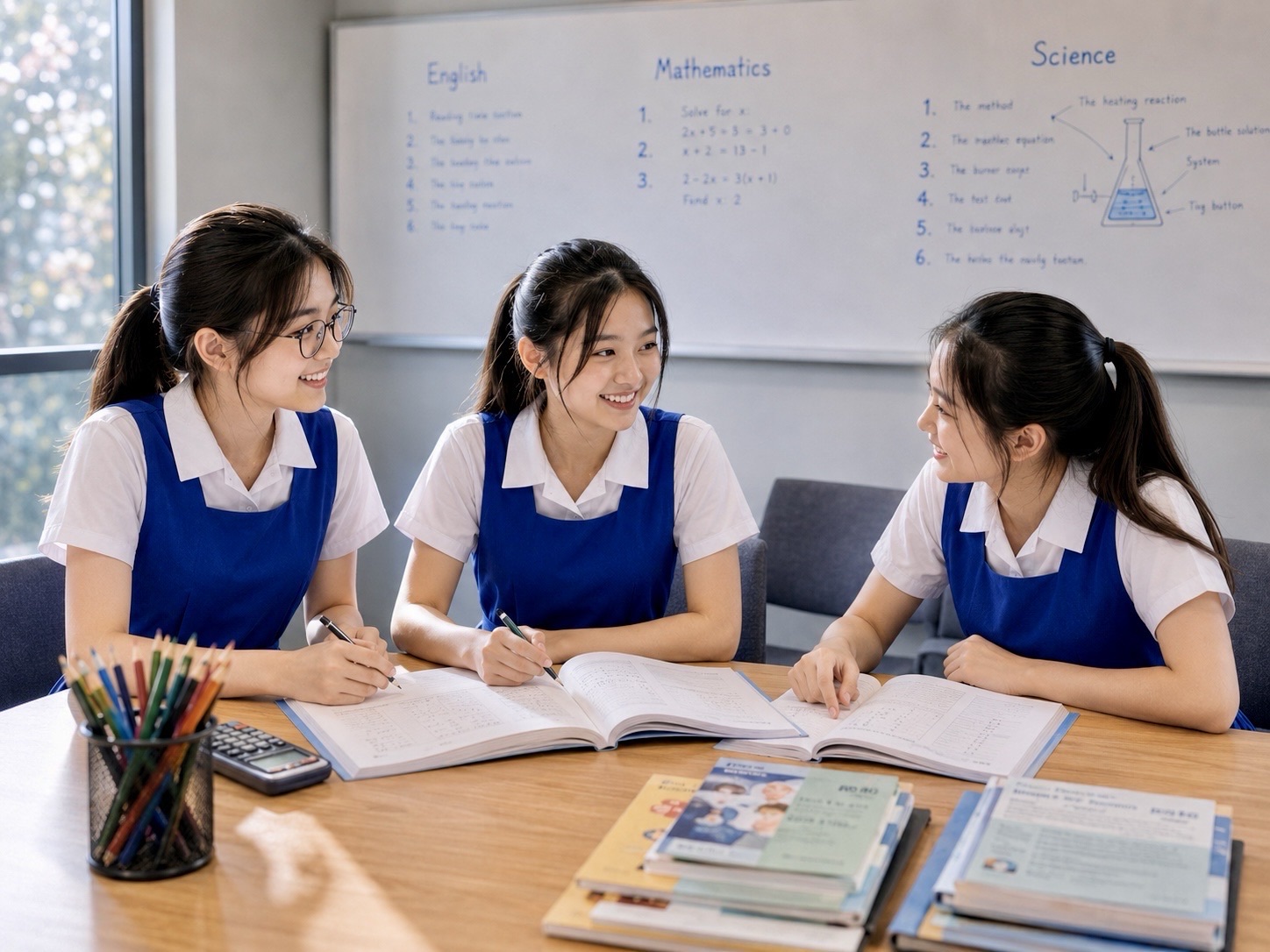
Education Versus Studying
Studying helps a child complete the next task. Education prepares the child for the next unknown.
Studying and education are closely connected.
But they are not interchangeable.
Studying is one of the activities through which education may occur.
Education is the larger transformation that studying is supposed to produce.
A student studies when he or she:
- reads a textbook;
- memorises vocabulary;
- practises Mathematics;
- revises Science;
- completes homework;
- prepares for an examination;
- or repeats a method until it becomes familiar.
These are visible activities.
Education is less visible.
Education is what is being constructed inside the student while those activities are taking place.
It includes the student’s growing ability to:
- understand;
- reason;
- communicate;
- recognise patterns;
- question assumptions;
- detect errors;
- regulate attention;
- work with others;
- make judgments;
- and continue learning independently.
Studying is the work in front of the student.
Education is the person gradually emerging from that work.
That is the difference.
Studying Is an Event. Education Is a System.
Studying normally has a defined beginning and end.
A student sits down.
The student opens a book.
The student completes a chapter, revises a topic or prepares for a test.
Then the study session ends.
Education should not end when the book closes.
It should remain inside the person.
The student may forget the exact question, but retain the method of reasoning.
The student may forget a particular passage, but retain the ability to interpret language.
The student may forget the details of one experiment, but retain the habit of asking whether a claim is supported by evidence.
The student may forget the exact feedback from one correction, but retain a more disciplined way of checking future work.
This is why education cannot be measured only by how much work a student completes.
A large amount of studying can produce very little durable education.
A smaller amount of carefully designed study can transform the way a student thinks.
The difference lies in what the activity installs.
Studying Produces an Output. Education Changes the Operator.
When a student studies for an examination, the immediate output may be:
- a completed worksheet;
- a memorised answer;
- a corrected composition;
- a solved equation;
- or an improved grade.
These outputs matter.
They provide evidence of progress.
But education goes further.
It changes the person producing the output.
A well-educated student does not merely know the answer to one question.
The student becomes better at recognising what kind of question is being asked.
The student becomes more capable of selecting a method.
The student becomes more aware of uncertainty.
The student can notice when an answer does not make sense.
The student can explain the reasoning to another person.
The student can transfer the principle into a situation that looks different.
Studying produces the answer.
Education improves the answerer.
A Child Can Study Without Becoming Educated
This may sound uncomfortable, but it is possible.
A student can spend many hours studying and still remain dependent.
The student may memorise model compositions but struggle to develop an original argument.
The student may repeat Mathematics procedures but become lost when the wording changes.
The student may remember Science keywords but fail to understand the causal process beneath them.
The student may achieve excellent marks while remaining unable to plan, question, adapt or begin work without instructions.
This does not mean the studying was useless.
It means the studying was incomplete.
The student learned how to perform inside a known structure.
But education must also prepare the student for situations in which the structure is incomplete, unfamiliar or changing.
The future will contain many such situations.
A person may enter a job that did not exist when he or she was in school.
A familiar task may be automated.
A new technology may change an industry.
A qualification may no longer connect directly to one permanent occupation.
A person may need to learn again at 30, 45 or 60.
Studying prepares the student for a defined demand.
Education develops the ability to meet new demands.
Studying Usually Begins With an Answer Already Known
In most school exercises, someone already knows the answer.
The teacher knows it.
The textbook contains it.
The marking scheme defines it.
The student’s job is to reach the established destination.
This is necessary.
Children need to learn what humanity has already discovered.
They should not have to rediscover arithmetic, grammar, chemistry or history from the beginning.
Education depends on the transmission of accumulated knowledge.
But adult life does not always provide a marking scheme.
Many real problems are unclear.
The information may be incomplete.
Different people may disagree about the desired outcome.
Every available option may involve a trade-off.
The first difficulty may be deciding what the real problem is.
Education must therefore move students gradually from questions with known answers towards problems in which they must:
- define the issue;
- gather information;
- distinguish evidence from opinion;
- identify constraints;
- compare alternatives;
- accept uncertainty;
- and justify a decision.
Studying teaches students to reach known answers.
Education must eventually help them operate when the answer is not yet known.
Studying Can Be Measured Quickly. Education Reveals Itself Over Time.
A test can show whether a student remembers a topic today.
It is much harder to measure whether the student will use that knowledge intelligently five years later.
A grade can show performance under one set of examination conditions.
It may not reveal how the student responds when:
- instructions are ambiguous;
- a method fails;
- several disciplines must be connected;
- another person disagrees;
- technology produces a questionable answer;
- or the student must act without supervision.
Education often reveals itself later.
It appears when a former student encounters a new system and learns it.
It appears when a person recognises manipulation.
It appears when someone admits an error and repairs it.
It appears when knowledge from one field is transferred into another.
It appears when a person remains calm enough to think inside uncertainty.
It appears when someone uses intelligence responsibly rather than merely effectively.
This makes education more difficult to display than studying.
Studying produces visible activity.
Education produces long-term capacity.
Because visible activity is easier to count, systems can mistakenly optimise for it.
More homework.
More revision.
More assessments.
More pages completed.
But activity is not automatically development.
The real question is not only:
How much did the student study?
It is:
What became more capable because the student studied?
Studying Is Part of Education, Not Its Opposite
We should not create a false argument in which studying is bad and education is good.
There is no deep education without serious study.
A student cannot develop mathematical judgment without learning Mathematics.
A student cannot think historically without historical knowledge.
A student cannot evaluate Science without understanding scientific concepts.
A student cannot communicate with precision without vocabulary, grammar and repeated practice.
Knowledge matters.
Memory matters.
Practice matters.
Discipline matters.
Education is not vague creativity floating above content.
The problem arises only when the means becomes the end.
Studying is a tool.
It becomes educational when it changes what the student can understand and do.
Studying becomes empty when it produces only short-term compliance or temporary recall.
The goal is not less studying.
The goal is better-designed studying with a larger purpose.
Schooling Is Where the System Is Installed
This gives us three connected ideas:
Studying Is the Activity
The student reads, practises, remembers, writes and solves.
Schooling Is the Environment
The school provides teachers, subjects, routines, classmates, assessments and sequence.
Education Is the Internal System
The student develops knowledge, judgment, character, adaptability and the ability to continue learning.
Schooling is therefore the installation period.
It is where the child first learns how to operate a growing mind.
The subject is the training ground.
The teacher is not merely delivering information.
The teacher is helping install a system.
Mathematics installs more than calculation.
It can install structure, logic, representation, precision and persistence.
English installs more than vocabulary.
It can install interpretation, expression, perspective and control of thought.
Science installs more than facts.
It can install evidence, causation, observation and disciplined doubt.
Humanities install more than dates and places.
They can install context, consequence, culture and an understanding of institutions.
Corrections install more than the right answer.
They can install humility, diagnosis and repair.
The timetable contains subjects.
Education must connect what those subjects are building.
The Danger of Teaching Only for Performance
When education is reduced to studying, the student may begin to believe that learning has only one purpose:
to produce a result that another person can measure.
The student learns for the test.
Writes for the marker.
Reads for the question.
Memorises for the grade.
Once the measurement is removed, the learning stops.
This creates fragile competence.
The student may perform well inside the examination format but fail to carry the capability into life.
The problem is not the examination itself.
Examinations can be useful.
They test knowledge, preparation, accuracy and execution under constraints.
The problem begins when the examination becomes the entire definition of learning.
A measurement should reveal education.
It should not replace it.
AI Makes the Difference More Important
The distinction between studying and education becomes more urgent in the age of artificial intelligence.
AI can produce many of the visible outputs associated with studying.
It can:
- answer questions;
- summarise chapters;
- write essays;
- solve problems;
- generate revision notes;
- explain concepts;
- and create polished presentations.
A student may therefore produce a better-looking output without becoming more capable.
This creates a new educational illusion.
The work improves.
The student does not.
The answer becomes more sophisticated.
The student’s understanding remains shallow.
That is why education can no longer be judged only by the quality of the submitted product.
We must also examine the process.
Did the student understand the problem?
Could the student explain the answer?
Did the student decide how AI should be used?
Could the student identify an error in the generated response?
What judgment did the student add?
What was learned that can now be carried into the next problem?
AI can help a student study.
But AI cannot guarantee that education has occurred.
When Intelligence Becomes Cheap, Education Becomes More Valuable
The cost of accessing information has already fallen.
The cost of obtaining some forms of machine-generated cognitive work is also falling.
This changes the economic value of a standard answer.
When an answer is difficult to obtain, producing the answer is valuable.
When the answer can be generated instantly, value moves elsewhere.
It moves towards:
- asking the right question;
- checking whether the answer is true;
- understanding the context;
- seeing what has been omitted;
- applying the answer responsibly;
- communicating it to real people;
- and accepting responsibility for the consequences.
These are educational outcomes.
They cannot be built through passive answer collection.
Students must experience the reasoning, uncertainty, correction and responsibility through which these capabilities grow.
The cheaper intelligence becomes, the less valuable it is to educate a child merely to imitate an intelligent machine.
The child must learn to direct intelligence.
Rethinking How We Teach
Teaching must continue to provide strong foundations.
But it must become more deliberate about what those foundations are for.
Move From Coverage to Construction
Teachers are often pressured to cover the syllabus.
Coverage matters because students need exposure to the required content.
But exposure is not construction.
A topic has not truly been taught merely because it was presented.
The teacher must ask:
- What mental model is being built?
- What misconception is likely?
- What prior knowledge is required?
- Can the student recognise when the concept applies?
- Can the student explain it without copying?
- Can the student use it in a changed context?
The goal is not to move through content.
It is to build something durable with it.
Move From Correct Answers to Visible Thinking
A correct answer can hide weak reasoning.
A wrong answer can contain valuable thinking.
Teaching should make the process visible.
Ask students to show:
- what they noticed;
- what they assumed;
- why they selected a method;
- where they became uncertain;
- what alternative they considered;
- and how they checked the result.
This allows teachers to correct the structure of thinking rather than merely the final output.
Move From Immediate Rescue to Productive Struggle
Students need help.
But help must be timed carefully.
If the teacher supplies the answer too quickly, the student may never develop the ability to remain inside difficulty.
If the teacher withholds help for too long, confusion becomes discouragement.
The aim is productive struggle.
The student should experience enough difficulty to develop persistence, but enough guidance to continue making progress.
Good teaching does not remove every obstacle.
It teaches the student how to move through obstacles.
Move From Teacher Dependence to Guided Independence
At the beginning, the teacher provides structure.
The teacher models the method.
The teacher identifies the important features.
The teacher asks the questions.
Over time, these responsibilities must begin moving towards the student.
The student learns to:
- identify the task;
- select the method;
- monitor understanding;
- check the answer;
- recognise when help is needed;
- and decide what to learn next.
The transfer of responsibility is one of the clearest signs that education is occurring.
A student who can perform only while the teacher is present has learned the task.
A student who can continue without the teacher has begun to acquire education.
Move From Isolated Subjects to Connected Capability
Students often experience the curriculum as separate boxes.
English belongs to English class.
Mathematics belongs to Mathematics class.
Science belongs to Science class.
But real life does not arrive divided into school subjects.
A public health problem may require Science, statistics, communication, ethics and policy.
A business problem may require Mathematics, psychology, technology and language.
A climate problem may require engineering, economics, geography and cooperation.
Teaching should help students recognise that subjects are different instruments inside one larger intelligence.
The student should not merely know each instrument.
The student should learn when and how to combine them.
Move From Using AI for Answers to Using AI for Thinking
AI should not be banned simply because it can produce answers.
Nor should it be used without structure.
Students should learn several modes of AI use.
They can ask AI to explain a difficult idea in another way.
They can compare two methods.
They can generate counterarguments.
They can test a hypothesis.
They can request practice questions.
They can use it to reveal gaps in their reasoning.
But students should also be required to explain:
- why the AI was used;
- what part of the output was accepted;
- what part was rejected;
- what required verification;
- and what human judgment was added.
The goal is not AI-assisted submission.
It is AI-assisted education.
Teaching Must Build Transfer
Transfer is the ability to use learning in a different situation.
It is one of the clearest dividing lines between studying and education.
A student may know how to solve a question that looks exactly like the example.
Education begins to show when the student can recognise the same principle inside a different-looking problem.
A student may understand a word inside one comprehension passage.
Education begins to show when the student can interpret the same nuance elsewhere.
A student may memorise the steps of an experiment.
Education begins to show when the student can evaluate a new claim using the same scientific principles.
Transfer does not happen automatically.
Students need opportunities to:
- compare similar problems;
- identify deep structures;
- vary the context;
- explain principles;
- make connections;
- and reflect on what remains unchanged when the surface changes.
Studying often focuses on the example.
Education extracts the principle.
Teaching Must Include Error Intelligence
Students are often trained to avoid mistakes.
But an educated person must know how to use them.
A mistake contains information.
It may reveal:
- a missing concept;
- an unstable method;
- a language misunderstanding;
- an attention failure;
- an incorrect assumption;
- or a weakness in checking.
Students should not merely correct the answer.
They should diagnose the error.
Where did the reasoning diverge?
Why did the wrong method appear reasonable?
What signal was missed?
What procedure can prevent the same error later?
This develops error intelligence: the ability to convert failure into an improved system.
A student who fears mistakes may hide them.
A student who can study mistakes can grow from them.
Teaching Must Develop an Inner Teacher
At first, the teacher exists outside the child.
The teacher says:
Pay attention.
Check your work.
Explain your reasoning.
Do not rush.
Try another approach.
Ask whether the answer makes sense.
Over time, these instructions should become internal.
The student begins to tell himself or herself:
I do not understand this yet.
I need to slow down.
This answer is inconsistent.
I should return to the earlier step.
I need another source.
I should ask for help.
This is one of the deepest outcomes of education.
The external teacher gradually installs an internal teacher.
The student becomes capable of supervising his or her own learning.
That internal voice can remain long after formal schooling ends.
The Student Is Not a Storage Device
Traditional education has sometimes treated the student as a container.
Information enters.
Examinations check whether it remains.
But a human mind is not valuable only because it stores information.
It is valuable because it can reorganise information around new problems.
It can connect knowledge with experience.
It can imagine alternatives.
It can decide what matters.
It can act inside a social and moral world.
Students still need memory.
But memory should support thought.
Knowledge should become available for reasoning, creation and judgment.
The student is not merely storing the civilisation that already exists.
The student may one day need to repair, extend or redesign it.
Education Is the Invariant
The content of school will change.
Technology will change.
The economy will change.
Career structures will change.
Some knowledge will be updated.
Some tasks will be automated.
Some occupations will disappear, while new ones emerge.
Education must be the invariant that travels through those changes.
The student may not know which software will be used in 2040.
But the student can know how to learn an unfamiliar system.
The student may not know which career will remain secure.
But the student can understand how capabilities connect to human need.
The student may not know which AI tools will dominate.
But the student can learn to verify, direct and remain responsible for intelligent systems.
Education is not one permanent collection of answers.
It is the durable capacity to continue becoming capable.
What Parents Should Look For
Parents understandably look at marks.
Marks matter.
They provide information about performance and readiness.
But parents should also look beneath them.
Ask:
- Can my child explain what was learned?
- Can my child begin work without being chased?
- Can my child identify where the difficulty lies?
- Can my child learn from a correction?
- Can my child transfer a method?
- Can my child ask a useful question?
- Can my child distinguish understanding from memorisation?
- Can my child use AI without surrendering thought?
- Can my child cope when the question changes?
- Is my child becoming more independent over time?
A rising grade is encouraging.
A growing internal learning system is more important.
The strongest outcome is both.
What Students Should Look For
Students often ask:
Will this be tested?
It is a practical question.
But there is a larger question:
What can I become better at through this?
When you study Mathematics, do not only memorise the method.
Learn how to recognise structure.
When you study English, do not only collect model phrases.
Learn how language changes thought and interpretation.
When you study Science, do not only memorise keywords.
Learn how evidence supports a claim.
When you receive a correction, do not only replace the wrong answer.
Find the point at which your thinking changed direction.
When you use AI, do not only collect the result.
Find out what the machine did, what you understand and what still belongs to your judgment.
Studying becomes education when you extract a capability from it.
The Difference in One Sentence
Studying is what the student does to learn something.
Education is what the student becomes able to do because learning has changed the student.
That difference should reshape how we teach.
We should still teach knowledge.
Still expect practice.
Still correct errors.
Still prepare students properly for examinations.
But we must keep the larger purpose in view.
The worksheet is not the education.
The examination is not the education.
The syllabus is not the education.
They are instruments through which education can be built.
The real outcome is a student who can understand more, think more clearly, act more responsibly and continue learning when the original teacher, textbook and marking scheme are no longer present.
Studying prepares the child for the next answer.
Education prepares the child for the next question.
And the future will contain many questions that have not yet been written.
Return to Wider Learning and Education
This page owns one specific wider-learning job. Use the routes below to return to the current Education owner or the complete eduKatePunggol registry.





