Secondary 4 Mathematics Tuition · Punggol
Secondary 4 Mathematics: choose your next step
Choose the difficulty that matches your current work. Use the guide for an overview, or open a specific article below.
Select one situation
Recommended starting point
Selected for the concern you describedSecondary 4 Mathematics Support
What this may mean
How tuition should begin
eduKatePunggol · Secondary 4 Mathematics Tuition Reasons Edition
Secondary 4 Mathematics Tuition With eduKatePunggol
Secondary 4 changes the parent question. There is no longer unlimited time to strengthen everything equally, yet there is still enough time to improve when the repair is precise. A student may know many topics but lose marks through unstable algebra, weak question recognition, incomplete working, poor paper timing, repeated careless errors or anxiety when familiar ideas appear in unfamiliar forms. The reason for tuition is therefore not simply that the examination is approaching. It is that the student needs the highest-value weaknesses identified, repaired and converted into reliable performance before the final Mathematics papers.
Secondary 4 Mathematics tuition becomes useful when effort is no longer translating into predictable examination performance. A student may revise for many hours, complete topical worksheets and understand a teacher’s explanation, yet still enter a mixed paper without knowing which route to choose, how long to spend, when to move on or how to recover after a mistake.
The final year exposes the whole Mathematics system at once. Sec 3 algebra, graphs, geometry, trigonometry and other upper-secondary foundations return inside mixed questions. Remaining topics must be completed. School assessments and prelims become rehearsal points. Paper speed, stamina, working discipline and emotional control begin to affect marks as much as chapter knowledge.
eduKatePunggol therefore does not treat every Sec 4 concern as a need for more worksheets. One student needs a concentrated repair of algebra and signs. Another needs mixed-paper route recognition. Another can solve difficult questions but gives away easy marks. Another needs distinction-level refinement, while another needs a calm pass-building strategy. The reason determines the sequence, intensity and evidence used in tuition.
Catch Up
Locate the smallest high-impact gaps in algebra, number work, graphs, geometry, formulas, reading or working discipline that repeatedly prevent later questions from being completed.
Keep Up
Finish remaining content, consolidate school revision, correct prelim evidence and maintain a weekly system so that old and new topics do not separate into competing workloads.
Execute
Train question selection, paper timing, multi-step stamina, clear presentation, checking and recovery so the student can reproduce Mathematics when the paper changes shape.
These routes overlap. A student may repair one foundational topic, keep pace with school and rehearse full papers inside the same phase. Priority is set by current evidence and time remaining.
The First Principle
Secondary 4 tuition should solve a defined mark-loss problem.
A poor result can create a powerful urge to increase volume. More hours, more papers and more reminders feel like action. Yet volume does not automatically repair the stage where the student is failing. If the child repeatedly misreads the command, chooses the wrong route or collapses after one difficult question, another unexamined worksheet may simply reproduce the same loss.
A useful Sec 4 diagnosis separates knowledge from performance. Does the student not understand the concept? Understand it but fail to retrieve it? Retrieve it but choose it in the wrong question? Choose correctly but make calculation errors? Complete accurately but run out of time? Each break requires a different intervention.
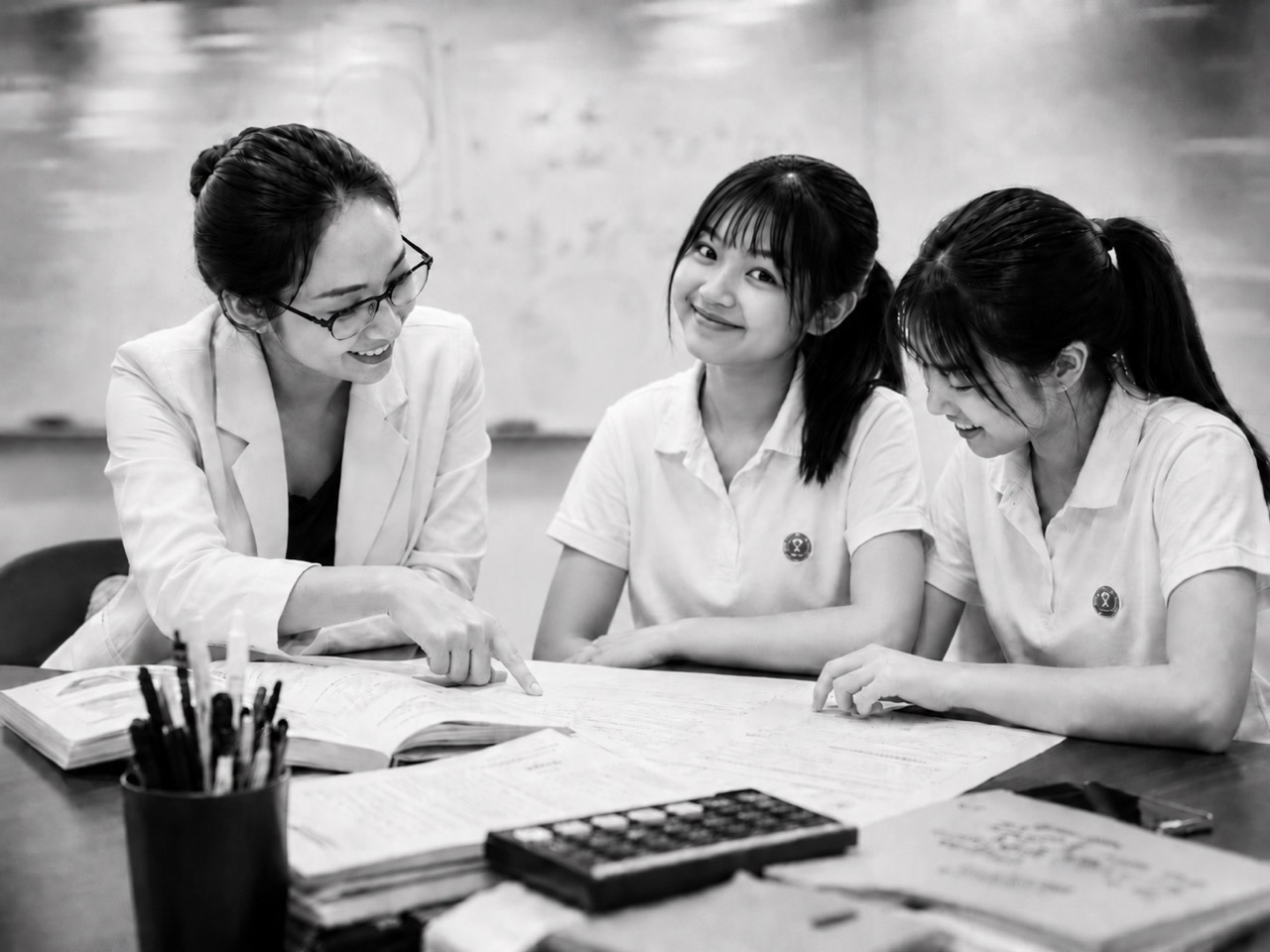
At eduKatePunggol, small-group teaching makes the working visible. The tutor can observe where the student pauses, what is written first, which lines disappear, how corrections are received and whether the same mistake returns two questions later. This is more useful than treating a percentage as a complete explanation.
The final-year goal is independence under pressure. The student should increasingly be able to recognise the route, organise the working, protect time, check intelligently and continue after a difficult moment without needing an adult to restart the process.
Use tests, prelim scripts and live problem-solving to separate concept gaps, route errors, execution mistakes and timing loss.
Prioritise recurring patterns rather than reacting equally to every isolated difficult question or accidental mistake.
Select a manageable improvement that can be taught, practised, checked and transferred within the remaining runway.
Two students with the same result may require opposite plans. One needs conceptual rebuilding. The other needs paper discipline and a way to stop giving completed knowledge away.
Reason One · The Execution Year
Sec 3 built the upper-secondary machine. Sec 4 must make it run.
Secondary 3 is where the upper-secondary load becomes visible. Secondary 4 asks whether that knowledge can now operate as one connected system. The student is no longer practising only the chapter currently taught. Algebra may appear inside coordinate geometry. Trigonometry may depend on diagram reading. A percentage, graph or mensuration question may require several earlier skills before the visible topic can even begin.
This is why a student who appeared stable during topical learning may become unstable during prelims. The issue is not necessarily that the student forgot everything. The issue may be that the knowledge has not yet been organised for selection, sequencing and use under mixed conditions.
S4 Execute the system
Separate chapters become a network
The student must retrieve earlier ideas and connect several methods when the examination does not announce the route.
The first move becomes decisive
Students need to classify the problem, identify usable facts and select a route before calculation begins.
Time changes the task
A method that works slowly at home must become accurate enough, efficient enough and retrievable enough for timed assessment.
Every paper becomes data
Prelims and practices should produce a repair list, not merely a score followed by another untouched paper.
Why this is a reason for tuition
A student may need a tutor not because the whole syllabus is unknown, but because the pieces are not yet organised into an examination system. Tuition can make the hidden links explicit, revisit only the prerequisite that is blocking progress and then place the repaired method back inside mixed questions.
This keeps Sec 4 from becoming an endless race through papers. The student still practises, but each practice has a reason: retrieve a method, reduce a repeated error, improve one timing decision or prove that a correction now survives without prompting.
Reason Two · Repeated Mark Loss
Students often know more Mathematics than their scripts are able to show.
Sec 4 parents frequently describe a frustrating gap: “My child can do this at home.” That observation may be accurate. Examination marks can disappear after understanding has already occurred. A negative sign is dropped. A diagram is copied incorrectly. The answer is given without required working. A student spends too long protecting one difficult question and never reaches several manageable marks later.
These losses are not all “carelessness”. Carelessness is often a name given after the event. Effective tuition asks what system allowed the mistake: weak notation habits, overloaded working memory, no checking trigger, rushed reading, anxiety, poor layout or insufficient familiarity with the paper’s decision demands.
Mark where the answer first moved away from a valid route—not only where the final answer became wrong.
Separate missing knowledge from misreading, poor selection, weak notation, calculation or time pressure.
Re-teach the concept or add a practical control such as a layout rule, sign check or question-classification step.
Practise changed forms and mixed settings until the correction can be retrieved without a matching example nearby.
Return the skill to a timed set or paper and confirm that the recovered mark remains recovered under pressure.
Tuition becomes useful when correction does not transfer.
Many students can understand a correction while looking at the old script. The real test is whether the student recognises the same structure one week later in a different question. eduKatePunggol uses variation, retrieval and repeated correction to turn an explained mistake into a changed future response.
Reason Three · Harder Conditions
Paper control combines speed, stamina, selection and recovery.
Students sometimes interpret paper practice as a request to work faster. Speed matters, but uncontrolled speed creates new losses. Examination control is a larger system: reading the whole demand, deciding where to begin, protecting accessible marks, showing enough working, monitoring time and returning intelligently to unfinished questions.
Paper structures differ by subject level and syllabus, so tuition should follow the student’s actual G1, G2 or G3 Mathematics demand. The shared principle is that shorter core questions and longer multi-step questions expose different weaknesses. A student may be accurate but too slow, fast but careless, conceptually strong but poor at diagrams, or capable until stamina falls late in the paper.
Control
Knowledge becomes marks only when the student can select, execute and sustain the method within the paper’s conditions.
Read the command, identify the topic structure and make a valid first move.
Keep signs, units, diagrams, algebra and justifications visible enough to protect method marks.
Recognise when to continue, when to move, and how to reserve time for checking and return.
Use partial information, restart from a known step and prevent one difficult question from damaging the paper.
Check high-risk points deliberately instead of rereading every line without a clear target.
| Visible problem | Possible cause | Useful tuition response | Evidence of improvement |
|---|---|---|---|
| Cannot begin | Weak question classification, language or prerequisite recall. | Teach the recognition cues and first valid move across varied forms. | The student starts independently without waiting for a hint. |
| Knows but loses marks | Signs, units, notation, incomplete working or rushed checking. | Install visible working rules and risk-specific checks. | Routine losses fall across several later practices. |
| Runs out of time | Slow retrieval, over-investment in one question or no paper plan. | Use timed sets, decision points and question-order rehearsal. | More accessible marks are attempted within the same duration. |
| Freezes under pressure | Low familiarity with mixed conditions or no recovery routine. | Practise restart strategies and graduated timed exposure. | The student continues after difficulty instead of abandoning the paper. |
Read the Evidence
The strongest reasons appear as repeated patterns across several papers.
One difficult test may reflect illness, poor sleep, an unfamiliar school paper or a single weak topic. A tuition decision becomes more grounded when the same type of difficulty appears repeatedly across homework, topical tests, timed practices, prelims or the student’s behaviour before Mathematics work.
Parents do not need to diagnose the syllabus alone. They can observe the pattern. Does the child repeatedly leave the same question type blank? Are marks stable in topical work but much lower in mixed papers? Does the child spend a long time yet complete little? Does anxiety appear before every timed task? Evidence turns a stressful feeling into a teachable starting point.
Unstable foundations
Repair- Algebra or signs repeatedly break later questions.
- Earlier topics cannot be retrieved without examples.
- Corrections make sense but do not last.
The newest chapter may not be the first problem.
Mixed-paper collapse
Organise- Topical practice looks stronger than full papers.
- The student cannot identify which method applies.
- Long questions produce blank starts.
Knowledge may exist without an examination retrieval system.
Execution leakage
Protect- Easy marks disappear through signs, units or skipped steps.
- The paper is unfinished despite adequate understanding.
- Checking is random or absent.
The next gain may come from control rather than harder content.
Confidence shutdown
Rebuild- The student avoids papers or becomes defensive.
- One difficult question changes the rest of the attempt.
- Study volume rises while belief and clarity fall.
Confidence needs evidence from successful method, not reassurance alone.
The best evidence is often smaller: the same sign error, the same blank start, the same unfinished final page or the same avoidance appearing often enough to show that the system is not self-correcting.
When to Begin
It is not too late when the remaining time is matched to a realistic repair.
“Is it too late?” is usually the wrong binary question. The useful question is what can still be changed within the available runway. A student may not rebuild every weak chapter to distinction level in a short period, but may still recover recurring algebra marks, improve paper completion, strengthen a pass, stabilise a grade or convert understanding into cleaner examination performance.
Starting earlier allows broader rebuilding. Starting later requires sharper prioritisation. Both can be useful when expectations are honest and the plan is based on evidence rather than panic.
Before school intensity rises
Repair Sec 3 carry-over gaps and organise revision before prelim preparation begins to compete with unfinished foundations.
Best useBroad repair, syllabus consolidation and habit building.
After a diagnostic test
Use a clear school result to identify recurring loss and build a focused response before the same weakness returns in prelims.
Best useEvidence-led topic repair and execution correction.
After prelim evidence
Read the complete paper carefully, protect recoverable marks and rehearse the most important corrections under timed conditions.
Best useHigh-priority mark recovery and paper strategy.
Near the final examination
Reduce noise. Preserve sleep, confidence and familiar methods while focusing only on corrections that can still become stable.
Best useControlled rehearsal, confidence and error prevention.
G1, G2, G3 and SEC
Tuition must prepare the student for the actual Mathematics level being examined.
Under Full Subject-Based Banding, G1, G2 and G3 describe subject levels. The first Full SBB cohort will sit the Singapore-Cambridge Secondary Education Certificate examinations at their respective subject levels in 2027. The certificate reflects the subjects and levels taken. This makes precision important: a Secondary 4 plan should follow the student’s actual syllabus, paper demand and next route rather than teaching a generic idea of “Sec 4 Math”.
The teaching principle remains stable across levels—understand, practise, correct and transfer—but the depth, abstraction, pace and examination conditions differ. Support should preserve dignity while being honest about the level of performance required.
One repair principle, three levels of demand
Teach the student’s actual syllabusSecure functional control
Build accurate use of essential numerical, algebraic, geometrical and data skills through clear procedures and meaningful practical contexts.
- Protect accessible marks.
- Strengthen method confidence.
- Practise the actual G1 paper demand.
Stabilise application
Connect concepts to multi-step questions, improve algebra and representation, and develop enough paper control for varied applications.
- Strengthen route recognition.
- Reduce repeated execution loss.
- Build timed stamina progressively.
Refine abstraction and precision
Develop stronger algebraic fluency, unfamiliar-question transfer, reasoning, accuracy and paper strategy at the more demanding subject level.
- Protect distinction-level accuracy.
- Rehearse mixed-paper decisions.
- Coordinate with A-Math where involved.
Posting Groups guide the starting point into secondary school; G1, G2 and G3 describe the level at which a subject is taken. Confirm the student’s current Mathematics level and examination syllabus before planning revision or tuition.
The Tuition Environment
The right tuition setting must make the student’s final-year work more visible and more manageable.
Secondary 4 tuition should not become another crowded source of pressure. It should reduce uncertainty. The student should know what is being repaired, why the practice was selected, how the correction will be checked and what evidence would show that the work is holding.
eduKatePunggol’s maximum three-student class keeps the classroom small enough for live working to be observed while preserving the useful rhythm of a group. Students can see that mistakes are normal, hear different questions and still receive individual correction.
The student needs visible diagnosis.
The tutor should inspect actual scripts and watch the student attempt questions rather than infer everything from a grade.
Useful evidenceWhere the first wrong decision appears and why it repeats.
The student needs selective practice.
Practice should target a known weakness, then widen into mixed and timed forms after the repair becomes stable.
Useful evidenceThe same skill survives when the question changes shape.
The student needs correction that closes.
Errors should be explained, reattempted and revisited instead of being marked once and left inside a growing stack of papers.
Useful evidenceRepeated losses reduce across later work.
The student needs pressure with control.
Timed practice should be introduced deliberately so confidence grows from real execution rather than from avoiding examination conditions.
Useful evidenceCompletion, decision-making and recovery improve together.
Four tuition choices that often miss the real reason
Volume without diagnosis. Completing many papers can disguise the fact that the same error is being rehearsed.
Explanation without retrieval. A student may understand while the tutor speaks but still fail to produce the method independently later.
Pressure without sequencing. Treating every topic as equally urgent can overload the student and dilute high-value repair.
Confidence without evidence. Encouragement matters, but durable confidence comes from seeing corrected methods succeed inside later timed work.
The eduKatePunggol Method
The reason is converted into a five-stage final-year repair route.
Secondary 4 requires both urgency and patience. Urgency means the most important weakness should be found quickly. Patience means it must still be taught properly. Skipping explanation and rushing directly into full papers may produce activity without changing the underlying response.
The Secondary 4 Mathematics execution route
Diagnose → Prioritise → Repair → Rehearse → ExecuteRead schoolwork, tests, prelims and live attempts to locate the first point where valid Mathematics becomes lost marks.
Select the weakness that is frequent, high-impact, teachable and realistic within the remaining examination runway.
Rebuild the prerequisite, concept, notation or decision rule without adding unnecessary work around the real problem.
Move from focused practice to changed forms, mixed sets and graduated timed conditions with explicit correction.
Apply the repair to papers, protect marks under pressure and confirm that the same loss no longer repeats.
A 1.5-hour lesson gives time to teach, observe, practise, correct and consolidate instead of turning the session into a rapid answer demonstration. The maximum three-student setting supports individual feedback while allowing students to work inside a real classroom rhythm. Questions between lessons can also be surfaced through messaging support so that a repeated misunderstanding does not remain hidden until the next major paper.
The Parent Decision
Bring the scripts, the repeated loss and the remaining route to the consultation.
A useful Secondary 4 consultation begins with current evidence. Share the student’s G1, G2 or G3 Mathematics level, recent tests or prelim scripts, school feedback, the topics causing difficulty, whether the paper was completed and whether Additional Mathematics is also part of the workload. Include strengths. A plan should protect what is already working as carefully as it repairs what is not.
The consultation can then ask a more accountable question: what should become visibly better in the next phase? The answer may be a repaired algebra carrier, fewer recurring losses, better completion, stronger mixed-paper recognition, a stable pass, distinction-level precision or calmer performance under time.
Current examination evidence
Recent tests, prelim scripts, corrections, teacher comments and the question types that remained blank or incomplete.
Why it mattersThe complete script shows both knowledge and execution loss.
The repeated mark pattern
Algebra errors, sign loss, slow completion, weak long questions, diagram mistakes, random checking or anxiety under time.
Why it mattersRecurring loss deserves priority over isolated difficulty.
The student’s own explanation
“I do not know how to start,” “I run out of time,” “I panic after one question,” or “I understand only when I see the example.”
Why it mattersThe student often identifies the fragile stage directly.
The capability needed next
A stable grade, SEC paper control, stronger G-level performance, A-Math coordination or readiness for the intended post-secondary route.
Why it mattersA defined outcome makes the remaining tuition time purposeful.
This opening article has answered why tuition may be useful and what should be repaired first. The existing article below continues with the next parent question: What is Secondary 4 Mathematics, and what exactly must become examination-ready?
The Page Continues
First understand the reason. Then understand Secondary 4 Mathematics.
The parent decision becomes clearer when the order is correct. Identify why support may be needed, locate the highest-value mark loss and define what tuition should change. Then continue into the existing subject guide to understand consolidation, Paper 1 and Paper 2 control, SEC readiness and the route after Secondary 4.
Read “What Is Secondary 4 Mathematics?” immediately below this block. For a consultation, message eduKatePunggol at +65 8823 1234.
Continue: What Is Secondary 4 Mathematics?Official references
The route terminology in this article was checked against current Ministry of Education and Singapore Examinations and Assessment Board information in July 2026. Examination syllabuses, school sequencing and post-secondary admission requirements should always be checked against current school and official guidance.

Secondary 4 Mathematics Tuition at eduKatePunggol
Secondary 4 Mathematics Tuition in Punggol: the execution year
Secondary 4 Mathematics is the year where everything becomes visible.
The foundations from Sec 1.
The bridge work from Sec 2.
The upper-secondary jump from Sec 3.
The algebra habits.
The careless mistakes.
The exam timing.
The confidence.
The ability to stay calm when the question changes shape.
By Sec 4, Mathematics is no longer only about learning the next chapter. It is about execution.
The child must revise earlier topics, finish the remaining syllabus, practise examination-style questions, correct repeated mistakes, manage Paper 1 and Paper 2 demands, and enter the final examination with enough confidence to think clearly under pressure.
For parents, Secondary 4 often brings a different kind of worry.
“Can my child still improve?”
“Is it too late to repair the weak topics?”
“Why does my child know the topic but still lose marks?”
“How do we prepare for Paper 1 and Paper 2?”
“Should we focus on E-Math, A-Math, or both?”
“How do we lower panic but still push properly?”
“What is the fastest useful repair now?”
At eduKatePunggol, Secondary 4 Mathematics tuition is designed to answer these questions calmly.
We help students organise the syllabus, repair the highest-value gaps, improve working discipline, practise examination-style questions, strengthen confidence, and prepare for the final year with clearer control.
The goal is not noise.
The goal is execution.
Quick answer: What is Secondary 4 Mathematics tuition?
Secondary 4 Mathematics tuition is structured final-year support that helps students consolidate the upper-secondary Mathematics syllabus, repair weak topics, reduce repeated mistakes, improve Paper 1 and Paper 2 performance, build examination timing, and prepare for the final national examination route.
At eduKatePunggol, Secondary 4 Mathematics tuition helps students catch up, keep up and move ahead by focusing on targeted repair, exam craft, algebra control, structured revision, paper practice, mistake correction and confidence under timed conditions.
Why Secondary 4 Mathematics feels different from Sec 3
Secondary 3 is Year 1 of 2. Secondary 4 is the execution year.
In Sec 3, students build the upper-secondary machine.
In Sec 4, students must make the machine work under examination pressure.
That is why a Sec 4 student can feel stressed even if they are not weak. There is more to hold at the same time:
New topics may still be taught.
Old topics must be revised.
Weak chapters return inside mixed questions.
Past mistakes become expensive.
Paper timing becomes real.
The child must decide which question to attempt, how long to spend, when to move on and how to check.
A student who only studies chapter by chapter may feel unprepared when the examination paper combines everything.
Secondary 4 tuition must therefore move from “learning only” into “learning plus execution”.
Secondary 4 is not only about harder Math. It is about harder conditions.
By Sec 4, many students already know a lot of Mathematics. The problem is often not pure ignorance.
The problem may be that the child cannot perform reliably under pressure.
A child may know the formula but choose the wrong one.
A child may understand algebra but drop a negative sign.
A child may know geometry rules but forget to justify steps.
A child may be able to do the question at home but freeze during a timed paper.
A child may revise many hours but still repeat the same careless mistake.
A child may score well in topical practice but struggle with full-paper stamina.
A child may leave too many blanks because panic arrives before thinking.
This is why Secondary 4 Mathematics tuition should not only add more worksheets.
It should train performance.
The main Sec 4 parent question: What repair gives the highest return now?
In Sec 1 and Sec 2, there is more time to build slowly. In Sec 3, there is time to repair and prepare. In Sec 4, time becomes more precious.
This does not mean the child cannot improve. Many students still improve strongly in Sec 4.
But the repair must be intelligent.
Parents should not ask only:
“How many hours is my child studying?”
The better questions are:
Which topics are costing the most marks?
Which mistakes keep repeating?
Is the child losing marks from concept weakness or exam carelessness?
Is algebra still unstable?
Can the child finish within time?
Does the child know how to attempt Paper 1 and Paper 2 differently?
Can the child recover when stuck?
Does the child know what to revise next?
Sec 4 Mathematics is about useful precision.
The child does not need random pressure. The child needs the next best repair.
Paper 1 and Paper 2: why students need different exam skills
For many upper-secondary Mathematics routes, students must learn to handle different paper demands. Paper structures vary by syllabus and cohort, but the parent idea remains useful: students usually need both fast, accurate core skills and stronger multi-step problem-solving.
Paper 1 often exposes speed, accuracy, algebra control and breadth.
Paper 2 often exposes stamina, multi-step reasoning, application, diagrams, graphs and extended working.
A student may be good at one and weaker at the other.
Some students can do short questions but collapse in long problems.
Some students can reason through hard questions but lose easy marks through careless work.
Some students spend too long on one question and damage the whole paper.
Some students do not know when to stop, check or move on.
At eduKatePunggol, we help students understand paper behaviour.
The student must know:
Which marks are secure?
Which marks are often lost?
Which topics need repair?
Which questions should be attempted first?
Where does time disappear?
Which mistakes must be stopped before the final paper?
Examination performance is a skill. It can be trained.
Common Secondary 4 Mathematics problems parents notice
By Sec 4, the symptoms become clearer.
The child studies but the marks do not rise.
The child understands lessons but loses marks during tests.
The child is slow in full papers.
The child keeps making careless mistakes.
The child forgets earlier Sec 3 topics.
The child is weak in algebra, trigonometry, graphs, geometry or probability.
The child can do topical questions but struggles with mixed papers.
The child panics when the first few questions are difficult.
The child leaves blanks too early.
The child cannot explain why the answer is wrong.
The child is overwhelmed by E-Math and A-Math together.
The child’s confidence falls as prelims or final examinations approach.
These are not reasons to give up.
They are instructions.
They tell us what to repair.
What Secondary 4 Mathematics tuition should focus on
Secondary 4 Mathematics tuition should be focused, organised and honest.
It should not pretend every topic needs the same amount of time. Some topics are already stable. Some are weak but easy to repair. Some are difficult and need repeated practice. Some are high-value because they appear across many questions.
At eduKatePunggol, we usually look at several layers.
1. Algebra control
Algebra is still one of the biggest gates in Sec 4 Mathematics.
If algebra is unstable, many topics become harder:
Equations.
Inequalities.
Graphs.
Functions.
Coordinate geometry.
Trigonometry.
Mensuration.
A-Math topics.
Word problems.
Formula manipulation.
Students often lose marks not because they do not understand the topic, but because the algebra collapses halfway.
The child must learn to handle signs, brackets, fractions, substitution, expansion, factorisation, equation solving and formula rearrangement with better control.
In Sec 4, algebra must become reliable.
2. Topic repair
Some students have clear weak topics.
They may struggle with trigonometry.
They may avoid coordinate geometry.
They may forget probability.
They may be unsure about graphs.
They may lose marks in geometry.
They may be weak in mensuration.
They may not know how to handle application questions.
The important thing is to repair topics in priority order.
Not all revision is equal.
A focused repair plan asks:
Is this topic high-weight?
Does it affect other topics?
Is the gap conceptual or careless?
Can it be repaired quickly?
Does the student need basic reteaching or exam-style practice?
How often does this mistake return?
This keeps Sec 4 revision efficient.
3. Mixed-question practice
Topical practice is necessary, but it is not enough.
The final paper will not politely announce every route. The student must read, identify, decide and execute.
Mixed-question practice trains the child to recognise the hidden topic.
Is this actually algebra?
Is this a trigonometry route?
Is this a graph interpretation question?
Is this a probability condition?
Is this a geometry rule question?
Is this a word problem that needs an equation?
Many Sec 4 students know topics separately but struggle when they are mixed. Tuition should help them build route recognition across the whole paper.
4. Working discipline
Marks are not only lost because the final answer is wrong.
Marks are lost because the method is unclear, incomplete or careless.
Students must learn to show enough working, write steps in order, label diagrams, include units, justify geometry, avoid mental leaps, manage calculator steps and check answers.
Good working protects the child.
It helps the student think.
It helps the tutor find the mistake.
It helps the marker see the method.
It helps the child recover partial marks even when the final answer is wrong.
In Sec 4, good working is not decoration.
It is exam craft.
5. Timing and paper stamina
A student who can do the question slowly may still lose marks if the paper is timed.
Sec 4 students need stamina.
They need to complete questions under time pressure, decide when to move on, avoid over-spending time on one difficult question, and return to check.
Some students panic because they have not trained full-paper rhythm. Others are too slow because they write too little structure early, then have to rework everything later. Some rush and lose easy marks.
Timing improves when the student knows the paper, knows their own habits, and practises with correction.
6. Mistake correction
By Sec 4, repeating the same mistake is expensive.
A mistake ledger becomes very useful.
The student should know their own common errors:
I lose negative signs.
I expand brackets wrongly.
I forget units.
I use the wrong trigonometric ratio.
I skip geometry reasons.
I misread the graph scale.
I choose the wrong formula.
I leave questions blank too early.
I panic when the question is long.
I do not check whether the answer makes sense.
I spend too long on one mark.
I lose easy marks because I rush.
Once the student can name the mistake, the student can train against it.
E-Math and A-Math in Secondary 4
For students taking E-Math and A-Math, Sec 4 can feel like two different Mathematics loads running together.
E-Math often rewards broad control, accuracy, application and paper discipline.
A-Math demands stronger algebra, functions, equations, calculus-related thinking, trigonometry and symbolic fluency.
The two subjects are connected.
Weak algebra in E-Math can damage A-Math.
A-Math overload can reduce time for E-Math.
Poor working habits affect both.
Low confidence in one subject can spill into the other.
At eduKatePunggol, we help students manage the load.
Some students need to protect E-Math marks first.
Some students need urgent A-Math repair.
Some students need both subjects organised into a realistic weekly plan.
Some students need exam paper practice.
Some students need confidence rebuilding because they feel flooded.
The route should be clear.
Not every child needs the same repair.
Sec 4 Mathematics under Full SBB, G1/G2/G3 and SEC routes
Singapore’s secondary route is changing through Full Subject-Based Banding. Students are posted through Posting Groups and may take subjects at G1, G2 or G3 levels according to their route, aptitude, interest and learning needs. The SEC examination route from 2027 lists syllabuses for G1, G2 and G3 school candidates.
For parents, the important tuition point is this:
The subject level tells us the demand.
The child’s working tells us the repair.
A G3 Mathematics student aiming for distinction may need sharper paper strategy and harder questions.
A G2 Mathematics student may need stronger confidence, topic repair and exam rhythm.
A student taking A-Math may need separate support for symbolic control and problem-solving.
A student who is passing but unstable may need to secure easy marks before chasing harder ones.
A student who is weak may need high-value rescue, not random revision.
At eduKatePunggol, we read the child’s actual work.
The paper shows what the child knows, what the child forgets, what the child avoids and what the child repeats.
That is where the tuition plan begins.
How eduKatePunggol teaches Secondary 4 Mathematics
Secondary 4 Mathematics tuition must be focused because time matters.
At eduKatePunggol, we teach through a final-year execution system.
1. Diagnose the current mark pattern
We look beyond the score.
A 55 can be very different from another 55.
A 70 can still hide dangerous mistakes.
A student scoring well may still be careless under full-paper timing.
A student scoring poorly may have a few repairable gaps rather than a complete collapse.
We ask:
Where are the marks being lost?
Which topics are weak?
Which errors repeat?
Is the problem concept, method, timing or confidence?
What should be repaired first?
This prevents wasted effort.
2. Repair the highest-value gaps
In Sec 4, repair must be strategic.
We target gaps that affect many marks or many topics.
Algebra control.
Trigonometry basics.
Graph interpretation.
Geometry reasoning.
Coordinate geometry.
Probability structure.
Mensuration formula use.
Word-problem route recognition.
Paper timing.
Careless error reduction.
The child needs the repairs that make the most difference now.
3. Teach clearly, even in the final year
Some students reach Sec 4 with topics they never fully understood.
They may have survived by memorising examples. But final examination questions can change shape, and memorised steps may fail.
We reteach when needed.
Clear teaching still matters in Sec 4. The student must understand why the method works, not only what to copy.
4. Practise exam-style questions
Sec 4 students need exposure to examination-style questions.
Topical drills build confidence.
Mixed questions build recognition.
Timed questions build pressure control.
Full papers build stamina.
But practice only helps when mistakes are corrected.
Doing more questions without learning from them is just repeating the same route.
5. Train Paper 1 and Paper 2 habits
Students need to know how to handle different parts of the examination.
They must learn to secure easy marks, show working, manage time, check answers, avoid panic, and handle harder multi-step questions with a clear route.
A good paper attempt is not only about intelligence.
It is about discipline.
6. Build confidence through evidence
Sec 4 confidence must be grounded.
The child should be able to say:
I know which topics are weak.
I know what I fixed.
I can start more questions now.
I can finish faster now.
I can catch my common mistakes.
I know how to handle Paper 1.
I know how to handle Paper 2.
I am not as afraid when the question looks different.
That is real confidence.
Not empty encouragement.
Evidence.
Catch up, keep up or move ahead in Sec 4 Mathematics
Secondary 4 students usually need one of three routes.
Route 1: Catch up
This student is behind and worried.
The child may have weak Sec 3 foundations, poor algebra, low confidence, incomplete notes or poor paper rhythm.
This student needs urgent but calm repair.
The aim is to secure the most useful marks first, rebuild key foundations, reduce repeated mistakes and help the child stop feeling lost.
The first target may be stability.
Then improvement.
Route 2: Keep up
This student is passing but unstable.
The marks may be acceptable, but not safe. The child may lose marks carelessly, struggle with timing or forget earlier topics.
This student needs consolidation.
The aim is to protect marks, close remaining gaps, train paper habits and reduce avoidable loss.
Route 3: Move ahead
This student is strong and aiming high.
The child may need distinction-level practice, harder paper questions, cleaner presentation, better time strategy and sharper accuracy.
This student needs stretch and precision.
The aim is to convert ability into reliable exam performance.
Why Sec 4 students lose marks even when they understand the topic
This is one of the most common parent frustrations.
The child says, “I know how to do it.”
But the marks still disappear.
There are several reasons.
The child understands slowly, but the paper is timed.
The child understands when the question is direct, but not when it is disguised.
The child understands the first step, but not the full route.
The child knows the formula but applies it to the wrong situation.
The child skips working and loses control.
The child panics when a question looks unfamiliar.
The child makes careless errors because checking is weak.
The child practises but does not correct mistakes properly.
Understanding is necessary.
But Sec 4 needs performance.
The Sec 4 Mathematics mistake ledger
A mistake ledger is very powerful in Sec 4 because it prevents the child from repeating the same errors across papers.
A useful mistake ledger can be simple:
Question type.
Mistake made.
Reason for mistake.
Correct method.
What to watch next time.
Examples:
Topic: Trigonometry
Mistake: Used cosine instead of sine.
Reason: Did not label opposite and adjacent sides.
Next time: Label triangle before choosing ratio.
Topic: Algebra
Mistake: Lost negative sign after expanding brackets.
Reason: Rushed the second line.
Next time: Write expansion in full before simplifying.
Topic: Probability
Mistake: Used wrong denominator.
Reason: Did not identify total outcomes after condition changed.
Next time: Rewrite sample space.
Topic: Geometry
Mistake: Answer correct but no reason given.
Reason: Jumped to angle result.
Next time: Write angle rule beside each step.
This turns revision into a feedback system.
The student is no longer just “doing more Math”.
The student is becoming harder to defeat.
What parents can do at home during Sec 4
Parents do not need to become the Mathematics tutor.
The more useful role is to help the child stay steady, organised and honest.
Ask:
Which topic is costing the most marks now?
Which mistake keeps repeating?
Are you revising topics or practising papers?
Are you checking corrections or just doing new questions?
Can you finish within time?
Which paper section is weakest?
What is the next repair before the next test?
Do you need explanation, practice, or exam timing?
These questions help the child think clearly.
They also reduce the emotional heat at home.
Instead of “Why are your marks not improving?”, the conversation becomes:
“What is the next useful repair?”
That is calmer and more productive.
How to lower stress without lowering standards
Sec 4 is stressful because the year matters.
Parents should not pretend it does not matter. But pressure without structure can make the child freeze.
The better approach is calm seriousness.
Set the route.
Name the weak topics.
Repair the foundations.
Practise with purpose.
Correct mistakes.
Build timing.
Track progress.
Sleep properly.
Return to the next question.
Stress reduces when the child knows what to do next.
Confidence grows when the child sees evidence of improvement.
Standards stay high, but the route becomes clearer.
Secondary 4 Mathematics and post-secondary readiness
Mathematics does not only affect the final examination.
It affects confidence for the next route: JC, polytechnic, ITE, applied courses, science pathways, business pathways, engineering-related routes, computing-related routes and many future choices.
Not every child will use advanced Mathematics in the same way. But the habits trained in Mathematics matter:
Accuracy.
Patience.
Problem-solving.
Logical steps.
Checking.
Resilience.
Time management.
Confidence under pressure.
Ability to recover after mistakes.
Sec 4 Mathematics is therefore not only about a grade.
It is also about helping the child leave secondary school with stronger learning control.
Secondary 4 Mathematics and the wider eduKatePunggol ecosystem
eduKatePunggol teaches P1–P6 English and Mathematics, P3–P6 PSLE Science, Sec 1–4 English, Sec 1–4 Mathematics and Sec 3–4 Additional Mathematics.
This matters because the child is not only taking one paper.
English affects word-problem reading and written explanation.
Science affects process thinking and interpretation.
Mathematics affects structure, accuracy and confidence.
A-Math affects symbolic control and higher-level problem-solving.
Parent clarity affects the emotional system at home.
A child is not a bundle of marks.
A child is moving through school, examinations, choices, confidence, family expectations and the next chapter of life.
Tuition should support that whole movement.
When should a Sec 4 student start Mathematics tuition?
A Sec 4 student should start tuition when the current pattern is not improving on its own.
Consider support when:
The child’s marks are stuck.
The child is weak in algebra.
The child cannot finish papers on time.
The child keeps losing careless marks.
The child understands topics but performs poorly in tests.
The child is overwhelmed by E-Math and A-Math.
The child has weak Sec 3 topics.
The child avoids full papers.
The child becomes anxious when Mathematics is mentioned.
The child is strong but needs distinction-level sharpening.
Parents are unsure what to repair first.
It is not too late to improve in Sec 4.
But the repair must be focused.
What a good Secondary 4 Mathematics tuition programme should answer
Parents searching for Secondary 4 Mathematics tuition usually want practical answers.
Can my child still improve?
Which topics should be repaired first?
How do we prepare for Paper 1 and Paper 2?
How do we reduce careless mistakes?
How do we manage E-Math and A-Math together?
How do we build exam confidence?
How do we improve timing?
How do we revise without wasting time?
How do we know whether tuition is working?
At eduKatePunggol, the answer is structure.
We diagnose the pattern.
We repair high-value gaps.
We teach clearly.
We practise exam-style questions.
We correct mistakes closely.
We train paper rhythm.
We build confidence through evidence.
We help parents understand the route.
Secondary 4 Mathematics Tuition at eduKatePunggol
Secondary 4 is the execution year.
It is the year to turn knowledge into performance.
It is the year to protect easy marks.
It is the year to repair weak topics quickly.
It is the year to train Paper 1 and Paper 2 habits.
It is the year to manage timing and confidence.
It is the year to stop repeated mistakes.
It is the year to prepare for the final examination route with calm seriousness.
At eduKatePunggol, Secondary 4 Mathematics tuition is built to help students catch up, keep up and move ahead.
Not panic.
Not punishment.
Not random worksheets.
A structured final-year booster.
The student learns the topic.
The student practises the method.
The student corrects the mistake.
The student trains the paper.
The student builds confidence.
The parent understands the route.
The family moves forward with better control.
Frequently Asked Questions about Secondary 4 Mathematics Tuition at eduKatePunggol
Is Secondary 4 too late to improve in Mathematics?
No. Secondary 4 is not too late, but the repair must be focused. Students should identify the highest-value gaps, correct repeated mistakes, practise exam-style questions and build paper timing. Improvement is still possible when revision becomes structured.
What should Sec 4 Mathematics tuition focus on?
Sec 4 Mathematics tuition should focus on syllabus consolidation, algebra control, weak topic repair, exam-style practice, Paper 1 and Paper 2 skills, timing, careless error reduction, mistake correction and confidence under pressure.
Why does my child understand Math but still lose marks?
Many students understand the lesson but lose marks through poor working, careless signs, weak timing, misread questions, incomplete steps, wrong formula choice or panic during tests. Sec 4 tuition should train performance, not only understanding.
How can my child reduce careless mistakes?
Careless mistakes reduce when the child tracks repeated errors, writes clearer working, checks specific danger points, slows down at high-risk steps and practises under timed conditions with correction. A mistake ledger is useful in Sec 4.
Should my child do more papers or revise topics first?
It depends on the child’s current pattern. If foundations are weak, topic repair may be needed first. If topics are mostly understood, mixed papers and timed practice become more important. A good plan uses both topic repair and paper practice.
How does eduKatePunggol help with Paper 1 and Paper 2?
We help students identify mark loss, repair weak topics, practise different question types, improve working discipline, manage time and build full-paper stamina. The aim is to help students enter the examination with clearer strategy and stronger control.
What if my child is taking both E-Math and A-Math?
The two subjects must be managed carefully. Weak algebra can affect both. A-Math overload can damage E-Math revision. Tuition can help organise the workload, repair the correct gaps and train each subject according to its demands.
Can strong Sec 4 students benefit from tuition?
Yes. Strong students may need harder questions, distinction-level practice, sharper paper strategy, better checking habits and more precise working. The goal is to convert ability into reliable exam performance.
What should parents send before asking about Sec 4 Math tuition?
Parents can send the child’s level, Mathematics subject level where known, whether the child takes E-Math only or both E-Math and A-Math, recent test results, weak topics, paper timing issues and the repeated mistakes seen at home.
What is the main goal of Secondary 4 Mathematics tuition?
The main goal is execution. The child should consolidate the syllabus, repair key gaps, reduce repeated mistakes, improve paper performance, build exam confidence and enter the final examination route with better control.
Your Secondary 4 Mathematics pathway within PunggolOS
At Secondary 4, the Mathematics route inside PunggolOS is designed to consolidate method choice, accuracy, mixed-topic transfer, pacing and recovery after an error.
Why this stage matters: Examination readiness depends on a stable route through the paper, not only on the number of questions completed.
More published guides
Guides 1–16
- GCE O-Level Mathematics Tuition in Small Groups at Sengkang | 2026 Mathematics, 2027 SEC Handoff
- How Mathematics Becomes More Abstract: From Primary Word Problems to Algebra, Trigonometry, Functions and Graphs
- How Small-Group O-Level Mathematics Tuition Works | Diagnose → Repair → Transfer
- How to Improve Sec 4 G3 Mathematics in Punggol | 2026 O-Level & 2027 SEC Guide
- O-Level Mathematics Revision in Punggol | Secondary 4 E-Math & A-Math Cycle
- Punggol GCE O-levels Mathematics Tutor
- Punggol Secondary 4 Mathematics Tutor
- Sec 4 G2 Mathematics Tuition Punggol | 2027 SEC K210 Final-Year Calibration
- Secondary 4 E Math Tutor
- Secondary 4 Mathematics in Punggol | The SEC Examination Year — From Home to School to Tuition
- Secondary 4 Mathematics Paper Management | Easy-Mark Protection, Time Traps and Recovery Decisions
- Secondary 4 Mathematics Tuition Sengkang
- Secondary 4 Mathematics Tuition Small Groups
- Secondary 4 Mathematics Tuition | eduKatePunggol
- Secondary Mathematics Algebra Foundation Audit | Punggol Parent Guide
- Secondary Mathematics Punggol | A Four-Year Capability Ledger from Sec 1 to Sec 4