
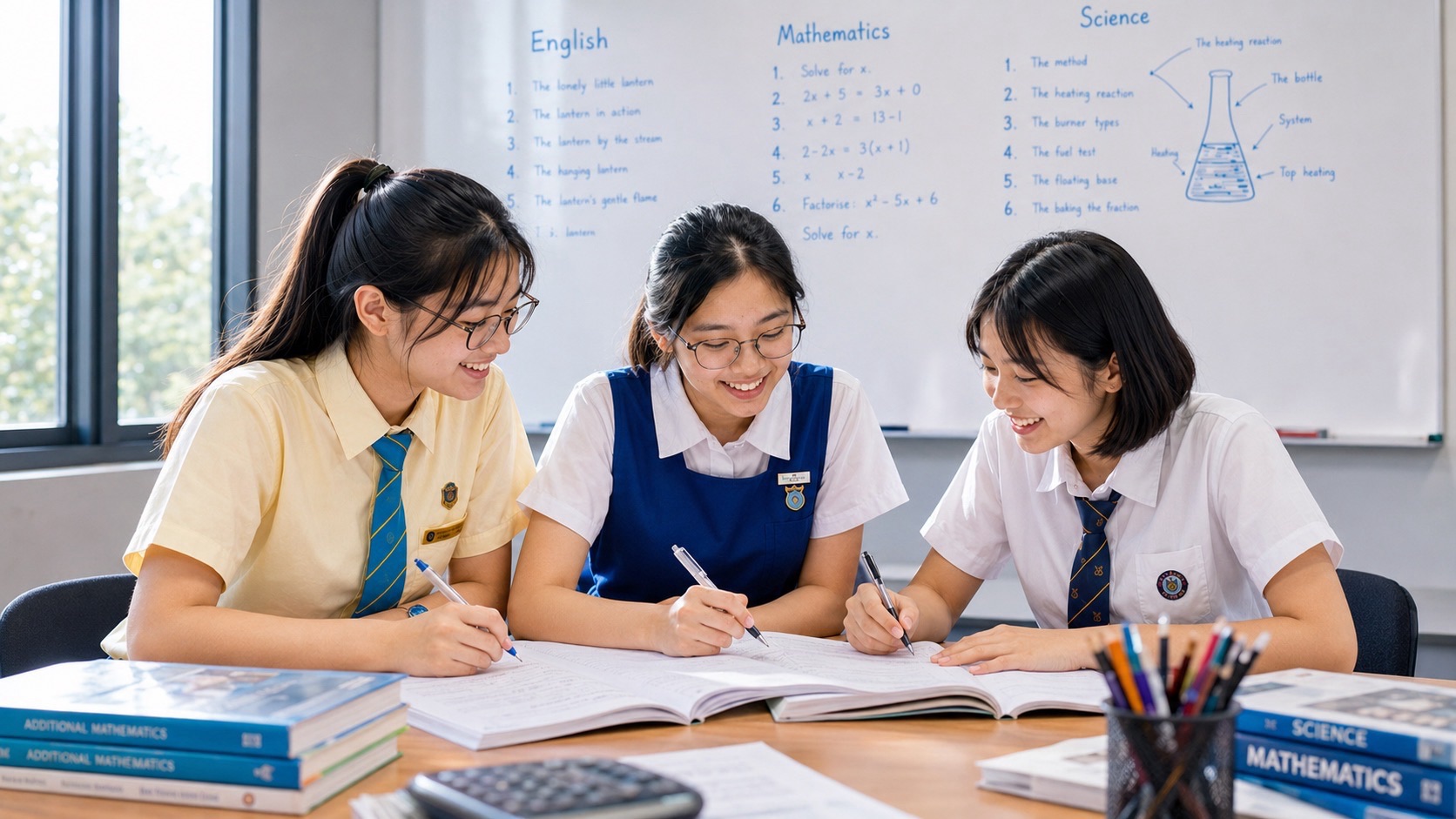
Science Education Systems · Article 44. Maya, Jia Jun, Hana and Ethan remain fictional Punggol learners. This article follows the collaboration layer: how Science distributes observation, expertise, critique and responsibility across many people without losing accountability.
The 50-second parent route
Modern Science is often too large for one person.
One researcher understands the instrument.
another the statistics.
another the field system.
another the theory.
another the engineering.
The route is:
shared question → role definition → common method → coordinated evidence → transparent records → cross-check → disagreement → integration → replication → shared conclusion → accountability
The key question is:
How do many minds become one reliable scientific system without hiding who did what?
This article completes Articles 41–44 after How Scientific Sampling Works, How Scientific Probability Works and How Scientific Simulation Works.
1. Collaboration begins with a shared question
A team cannot coordinate well if each person is solving a different problem.
The central question creates the common target.
2. Roles reduce duplication
One person measures.
one records.
one checks controls.
one analyses.
Clear roles let attention specialise.
3. Specialisation makes modern Science possible
No individual can master every instrument, theory, dataset and method.
Scientific communities distribute expertise.
Collaboration allows knowledge to scale.
4. Specialisation also creates interface risk
The statistician assumes one thing about the sample.
The field team assumes another.
The programmer interprets a variable differently.
Failures can appear between experts rather than inside one expert’s work.
5. Shared definitions protect interfaces
What does “growth” mean?
height?
mass?
cell count?
Common operational definitions allow evidence from different team members to connect.
6. Shared units protect interfaces too
Centimetres versus metres.
seconds versus milliseconds.
local time versus UTC.
Small standardisation errors can destroy large collaborative projects.
7. Primary Science collaboration begins with fair participation
One child should not hold every tool while the others watch.
Roles can rotate:
measurer.
recorder.
checker.
explainer.
This teaches that collaboration is active work, not shared seating.
8. Maya’s collaboration weakness is silent agreement
She sees a problem but avoids saying it.
Her repair:
raise the scientific issue respectfully before the group builds on it.
9. Jia Jun’s collaboration weakness is task capture
He does everything because it feels faster.
The group finishes.
The other learners do not learn.
His repair:
separate efficiency from educational participation.
10. Hana’s collaboration weakness is coordination overhead
She wants consensus on every tiny detail before anyone begins.
Her repair:
define the critical standards, then let roles operate independently where safe.
11. Ethan’s collaboration weakness is idea branching
He introduces new directions continuously.
The team loses the original question.
His repair:
park secondary questions and protect the main experimental objective.
12. Collaboration needs visible records
Who measured?
when?
with which instrument?
under what conditions?
What changed?
Records create shared memory.
13. Shared notebooks reduce dependency on one person
If only one team member knows what happened, the project is fragile.
Good documentation allows another member to reconstruct the work.
14. Collaboration and reproducibility are connected
A team must make its own work reproducible internally before outsiders can reproduce it externally.
Clear method is collaborative infrastructure.
15. Independent checking strengthens teams
One person calculates.
another verifies.
one labels samples.
another checks IDs.
Critical work benefits from redundancy.
16. Redundancy can look inefficient
Why should two people inspect the same result?
Because high-impact errors can be more expensive than duplicated checking.
Reliability sometimes requires deliberate overlap.
17. Collaboration needs controlled disagreement
Scientific teams should not optimise for harmony alone.
A strong team allows:
“I think this assumption is wrong.”
“This data point needs checking.”
“This conclusion is broader than the evidence.”
18. Disagreement should target the claim, not the person
“Your analysis ignores the baseline” is useful.
“You are careless” is less useful.
Scientific collaboration depends on critique without personal attack.
19. Psychological safety matters for error detection
If junior members fear speaking up, teams can miss serious problems.
Reliable systems make it possible to report uncertainty, mistakes and dissent.
20. Hierarchy can help coordination and hurt truth-seeking
Large teams need leadership.
But status should not make a weak claim immune to evidence.
Good scientific leadership protects both direction and challenge.
21. Expertise should be respected without becoming unchallengeable authority
A specialist may know far more about one method.
Others should still be able to ask what assumptions support the conclusion.
Expertise and transparency reinforce one another.
22. Primary 3 collaboration can focus on roles
Who observes?
who records?
who checks?
who explains?
The child learns coordination.
23. Primary 4 collaboration can add independent predictions
Each learner predicts before discussion.
Then compare.
This prevents the fastest speaker from becoming the group’s automatic answer.
24. Primary 5 collaboration can add evidence pooling
Different groups collect data from different locations.
Combine results.
Now the class has a larger sample than any one group could collect.
25. Primary 6 collaboration can add peer critique
One group explains.
another asks where the evidence is.
a third checks whether the conclusion is too broad.
Collaboration becomes quality control.
26. Secondary Science can specialise roles more deeply
Experimental design.
instrument setup.
data management.
calculation.
graphing.
evaluation.
Students can experience how scientific teams divide expertise.
27. Large scientific collaborations need governance
Who decides method changes?
who controls data access?
who approves publication?
who resolves disputes?
Organisation becomes part of scientific reliability.
28. Authorship should reflect contribution honestly
Scientific papers may involve many contributors.
Authorship and contribution statements should make intellectual and practical work visible appropriately.
Credit is part of research ethics.
29. Ghost authorship and gift authorship damage trust
Someone who did major work should not disappear.
Someone who did little should not receive authorship merely because of status.
Contribution transparency matters.
30. Data ownership should be defined early
Who can access the dataset?
who may publish?
what happens if partners separate?
Collaboration works better when these questions are resolved before conflict.
31. Collaboration across institutions increases independence
Different laboratories may use different staff, equipment and local assumptions.
If findings converge, confidence can increase.
32. Multi-centre studies can improve generalisation
One hospital.
one school.
one field site.
A finding can be location-specific.
Multiple centres help test whether it travels.
33. International collaboration expands variation
Different climates.
populations.
institutions.
instruments.
Scientific claims can be stress-tested across broader conditions.
34. Shared standards make international collaboration possible
Units.
data formats.
naming conventions.
calibration procedures.
metadata.
Standards let evidence cross borders.
35. Collaboration and sampling are connected
Many teams can collect a larger and more diverse sample than one team.
But methods must remain sufficiently compatible for synthesis.
36. Collaboration and probability are connected
Larger combined datasets can improve estimates of uncertain quantities.
Independent teams can also test whether probabilities are calibrated across settings.
37. Collaboration and simulation are connected
Complex simulations may require scientists, mathematicians, software engineers and domain experts.
Model interfaces become collaboration interfaces.
38. Collaboration and peer review are connected
Peer review is collaboration across a boundary.
The reviewer is not part of the original team but contributes critique to improve scientific quality.
39. Collaboration and replication are connected
Independent teams repeating the work provide stronger evidence than one team repeating itself indefinitely.
Independence reduces shared-bias risk.
40. Collaboration and synthesis are connected
One researcher may specialise in combining evidence from many teams.
Scientific knowledge grows through layered collaboration across collection, analysis, review and synthesis.
41. Collaboration can amplify bias if everyone shares the same assumption
Ten people are not ten independent perspectives if all were trained to overlook the same problem.
Diversity of method and viewpoint can improve error detection.
42. Groupthink is a scientific risk
A prestigious theory dominates.
Dissent feels socially expensive.
Contradictory evidence receives less attention.
Good systems create channels for evidence-based challenge.
43. Diversity helps when it changes what the team can notice
Different expertise.
different lived contexts.
different methodological traditions.
These can expose blind spots.
Diversity is most scientifically useful when differences can enter the reasoning process.
44. Communication quality constrains collaboration quality
An unclear method cannot be handed off reliably.
An ambiguous variable cannot be analysed consistently.
Scientific communication is coordination infrastructure.
45. Version control matters in collaborative Science
Which dataset version?
which analysis script?
which model parameters?
which manuscript?
Without versioning, teams can reproduce different answers from supposedly the same project.
46. Provenance matters
Where did this value come from?
who transformed it?
which instrument produced it?
which file contains the original?
Traceability protects collaborative evidence.
47. AI can become a collaborator
AI can summarise literature, generate code, compare models, draft explanations and identify possible errors.
But responsibility for scientific claims cannot simply disappear into the tool.
48. AI contributions need verification
Did the citation exist?
does the code perform the intended calculation?
did the summary preserve uncertainty?
Human collaborators must inspect AI outputs like any other unverified contribution.
49. AI can help coordinate teams
Useful prompts:
“Summarise unresolved decisions.”
“Compare definitions used by each subgroup.”
“List assumptions that differ across models.”
“Generate a handoff checklist between experimental and analysis teams.”
50. AI can also create false consensus
A polished synthesis may hide disagreement among team members or sources.
Collaboration should preserve who believes what and why until the evidence resolves the conflict.
51. Parents can model collaboration through household experiments
One child measures.
one parent records.
another person checks the setup.
Then swap roles.
Children learn that reliable teamwork requires both contribution and checking.
52. Small-group tuition is naturally collaborative—but only if independence remains
Three learners should not collapse into one shared answer too early.
Independent attempt first.
comparison second.
critique third.
revision fourth.
independent retest later.
This preserves both collaboration and individual learning.
53. A compact collaboration checklist
- What is the shared scientific question?
- Who owns each role?
- Are definitions and units standardised?
- How are observations recorded?
- Can another team member reconstruct the method?
- Which critical steps receive independent checking?
- Can junior members raise objections safely?
- How are disagreements resolved?
- How are data and versions tracked?
- Are contributions credited honestly?
- Which evidence is genuinely independent?
- Who remains accountable for the final conclusion?
54. Frequently asked questions
Why is collaboration important in Science?
Modern scientific problems often require more expertise, data, instruments and checking than one individual can provide.
Does collaboration automatically make Science more reliable?
No. Reliability depends on clear roles, shared standards, transparent records, independent checking and the ability to challenge weak assumptions.
Why is disagreement useful?
Evidence-based disagreement can expose hidden assumptions, methodological flaws and alternative explanations before they become entrenched.
How does collaboration help Primary Science?
It teaches role-sharing, accurate recording, peer checking, evidence pooling and respectful scientific discussion.
How does collaboration change in Secondary Science?
Roles can become more specialised across experimental design, measurement, data analysis, modelling, evaluation and communication.
How should AI be used in scientific collaboration?
As an assistive tool whose outputs remain traceable and verified by humans responsible for the scientific work.
55. Continue the Science Education Systems series
- How Scientific Sampling Works
- How Scientific Probability Works
- How Scientific Simulation Works
- How Scientific Peer Review Works
- How Scientific Replication Works
Conclusion: Collaboration is how Science grows beyond one mind
Maya notices the anomaly.
Jia Jun checks the calculation.
Hana protects the method.
Ethan sees a model nobody else considered.
The team becomes stronger because the minds are different but the evidence system is shared.
Define the question.
divide the work.
standardise the interfaces.
record everything important.
invite disagreement.
cross-check the critical steps.
credit honestly.
remain accountable.
That is how many partial viewpoints can become one more reliable scientific result.


