
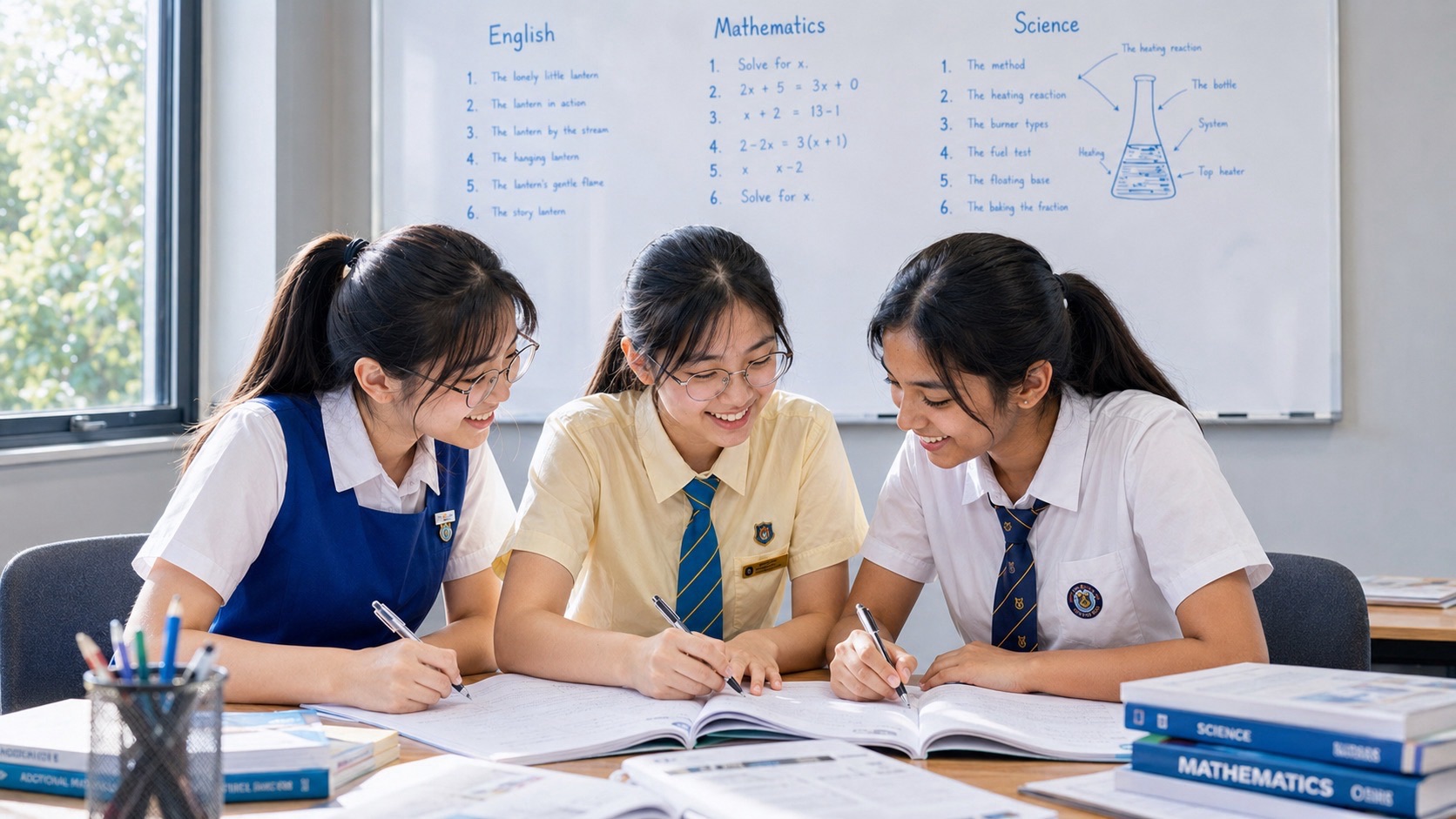
Science Education Systems · Article 34. Maya, Jia Jun, Hana and Ethan remain fictional Punggol learners. This article follows the analogy layer: how Science uses familiar systems to illuminate unfamiliar ones without pretending the two are identical.
The 50-second parent route
An analogy says:
This unfamiliar system behaves like that familiar system in some important way.
The danger appears when the learner silently adds:
Therefore everything about them is the same.
The route is:
target concept → familiar source → map shared structure → identify corresponding parts → test predictions → mark the breakpoints → return to the target model
The key question is:
Which relationship transfers, and which does not?
This article extends How Scientific Abstraction Works, How Scientific Models Grow With the Learner and How Science Misconception Repair Works.
1. Analogies are bridges, not destinations
A learner cannot see electric current directly.
A teacher compares it with flowing water.
The familiar system gives the learner somewhere to stand.
But the lesson must eventually return to electricity itself.
2. Good analogies map relationships
Weak analogy:
“A cell is like a city because both have many things.”
Better analogy:
“Different specialised components perform coordinated functions that support the whole system.”
The second maps structure, not decoration.
3. Surface resemblance is not enough
A dolphin looks fish-like.
That does not make it a fish.
A wire and a water pipe are both long tubes.
That visual similarity is not what makes the current-flow analogy useful.
Scientific analogies depend on relational similarity.
4. The source and target must remain separate
Source:
the familiar system used for comparison.
Target:
the scientific system being learned.
Learners should know which is which.
5. Maya’s analogy problem is literal transfer
If current is like water flow, she imagines electrons being used up like water leaving a tank.
Her repair:
state the exact relationship the analogy is meant to represent.
6. Jia Jun’s analogy problem is memorising the metaphor
He remembers “cell = factory” but cannot explain what maps to what.
His repair:
write a correspondence table.
7. Hana’s analogy problem is rejecting all imperfect analogies
She notices the cell is not literally a factory.
Correct.
But the analogy may still be useful for division of labour.
Her repair:
judge an analogy by whether the intended relationship is preserved.
8. Ethan’s analogy problem is analogy multiplication
He invents five metaphors for one concept.
Each maps different features.
The learner becomes confused.
His repair:
use the analogy only for the specific conceptual bottleneck it solves.
9. Primary Science uses analogies constantly
Heart as pump.
roots as uptake structures.
circuits as pathways.
food chains as linked transfer relationships.
Analogies help children enter invisible or complex systems.
10. Analogies should begin after some concrete experience
If a child has never seen a pump, “heart as pump” may not help.
The source must genuinely be more familiar than the target.
11. Good analogies reduce cognitive load
The learner reuses an existing mental structure instead of building every relationship from zero.
This is efficient learning.
12. Bad analogies create durable misconceptions
Once a vivid mental picture is established, it can persist even after correction.
Teachers should therefore choose analogies carefully and state the limitations explicitly.
13. “The heart is a pump” is useful
Both create pressure differences that move fluid through a system.
The analogy supports circulation.
14. But the heart is not simply a mechanical pump
It is living tissue.
It regulates itself.
it changes over time.
it operates within a biological feedback system.
The analogy has limits.
15. “The cell is a factory” can help with specialised functions
Different components perform different tasks.
materials enter.
products are made.
waste is handled.
coordination matters.
16. But the cell does not have little human workers
Animations can accidentally literalise metaphors.
Molecular processes arise from physical and chemical interactions, not miniature intention.
17. “Current is like water flow” can help with continuity
A complete pathway matters.
resistance changes flow.
potential differences can be compared loosely with pressure differences at an introductory level.
18. But electrical systems are not hydraulic systems
Charge behaviour, fields and circuit dynamics differ from water in pipes.
The analogy should not be stretched beyond its teaching purpose.
19. Particle analogies are especially delicate
Students may imagine particles as tiny coloured balls because diagrams show them that way.
The visual model is useful for spacing and arrangement.
It is not a literal photograph of atoms or molecules.
20. Primary learners need “like” language
“We can think of it like…”
“This part is similar because…”
“But unlike the analogy…”
These phrases keep the bridge visible.
21. Secondary learners need explicit mapping
Source feature.
Target feature.
shared relation.
breakpoint.
This makes analogical reasoning inspectable.
22. Analogy supports abstraction
Two different systems share one underlying relationship.
The learner extracts that common structure.
That is abstraction through comparison.
23. Analogy supports transfer
If the learner can identify a structural similarity between a familiar and unfamiliar problem, they can carry reasoning across contexts.
This is powerful when the transfer is justified.
24. Analogy can also cause negative transfer
A familiar source contains a feature absent from the target.
The learner imports it anyway.
The analogy becomes a misconception generator.
25. Breakpoint teaching prevents negative transfer
Every analogy should eventually answer:
Where does this comparison stop being useful?
This one sentence improves scientific discipline significantly.
26. Analogies can be tested with predictions
If the analogy is structurally useful, what does it lead us to expect?
Does the target system behave that way?
Where does prediction fail?
Failure maps the analogy boundary.
27. Analogies should preserve causal direction
If the source suggests A causes B, but the target relationship runs differently, the analogy is dangerous.
Structural mapping must include causal direction.
28. Analogies should preserve scale carefully
A macroscopic analogy may help explain a microscopic process.
But scale changes can introduce properties absent from the source.
See How Scientific Scale Works.
29. Analogies can link disciplines without merging them
Feedback appears in Biology, engineering and climate.
Flow appears in circuits, fluids and transport systems.
Network structures appear in ecosystems, neurons and infrastructure.
Shared patterns can illuminate relationships while each discipline retains its own mechanisms.
30. An analogy is strongest when it reveals a deep invariant
Different surface.
same relational architecture.
The learner becomes less dependent on topic-specific appearance.
31. Analogies are useful in explanation
They can give a reader an intuitive route into a difficult model.
But the scientific explanation should eventually state the actual mechanism directly.
32. Analogies are useful in hypothesis generation
If System A and System B share structure, perhaps another relationship transfers too.
This can inspire a new hypothesis.
The hypothesis still needs testing.
33. Historical Science has often used analogy productively
Scientists compare unfamiliar phenomena with known systems to generate models.
Some analogies become powerful frameworks.
Others are discarded when evidence exposes their limits.
34. Analogy is therefore provisional
It helps thinking.
It does not guarantee truth.
The target system remains the final authority.
35. Small-group tuition can compare analogies
Give three students different analogies for the same concept.
Ask:
Which relationship does each preserve?
Which one creates the most dangerous misconception?
Which is useful at this level?
36. Parents can use analogies carefully
“What is this like?”
Then immediately:
“And what is different?”
The second question protects the first.
37. AI is excellent at generating analogies
That can be useful.
It can also generate analogies that sound elegant but map poorly.
Learners should evaluate structure, not literary appeal.
38. AI can help stress-test analogies
Useful prompts:
“Map each part of this analogy explicitly.”
“List three ways the analogy fails.”
“Give me a better analogy for the same mechanism.”
“What misconception could this analogy create?”
39. Scientific communication benefits from analogy only when the caveat travels too
A popular explanation may preserve the vivid metaphor but lose the limitations.
Then the public remembers the analogy as literal Science.
Good communication carries the breakpoint with the metaphor.
40. A compact analogy checklist
- What is the target concept?
- What familiar source are we using?
- Which parts correspond?
- Which relationships correspond?
- Is the causal direction preserved?
- Is the scale compatible enough for the intended lesson?
- What useful prediction does the analogy suggest?
- Where does the analogy fail?
- What misconception could it create?
- Can the learner now explain the target without the analogy?
41. Frequently asked questions
Why are analogies useful in Science?
They let learners use familiar relational structures to understand unfamiliar systems.
Why can analogies be dangerous?
Learners may import features from the familiar source that do not exist in the scientific target.
How should teachers use analogies?
Map the useful similarities explicitly, state where the analogy breaks, and then return to the actual scientific model.
How do analogies help PSLE Science?
They can clarify systems, functions and processes, provided children understand which features are literal and which are only comparison tools.
How do analogies change in Secondary Science?
They become more abstract and must coexist with formal particle, mathematical and systems models.
42. Continue the Science Education Systems series
Conclusion: The best analogy teaches you when to leave it behind
Maya sees the resemblance.
Jia Jun maps the parts.
Hana finds the breakpoint.
Ethan tests what else might transfer.
Science needs all four.
Use the familiar world to enter the unfamiliar one.
Carry only the relationships that survive.
Mark the limits.
Then stand inside the scientific model itself.


