
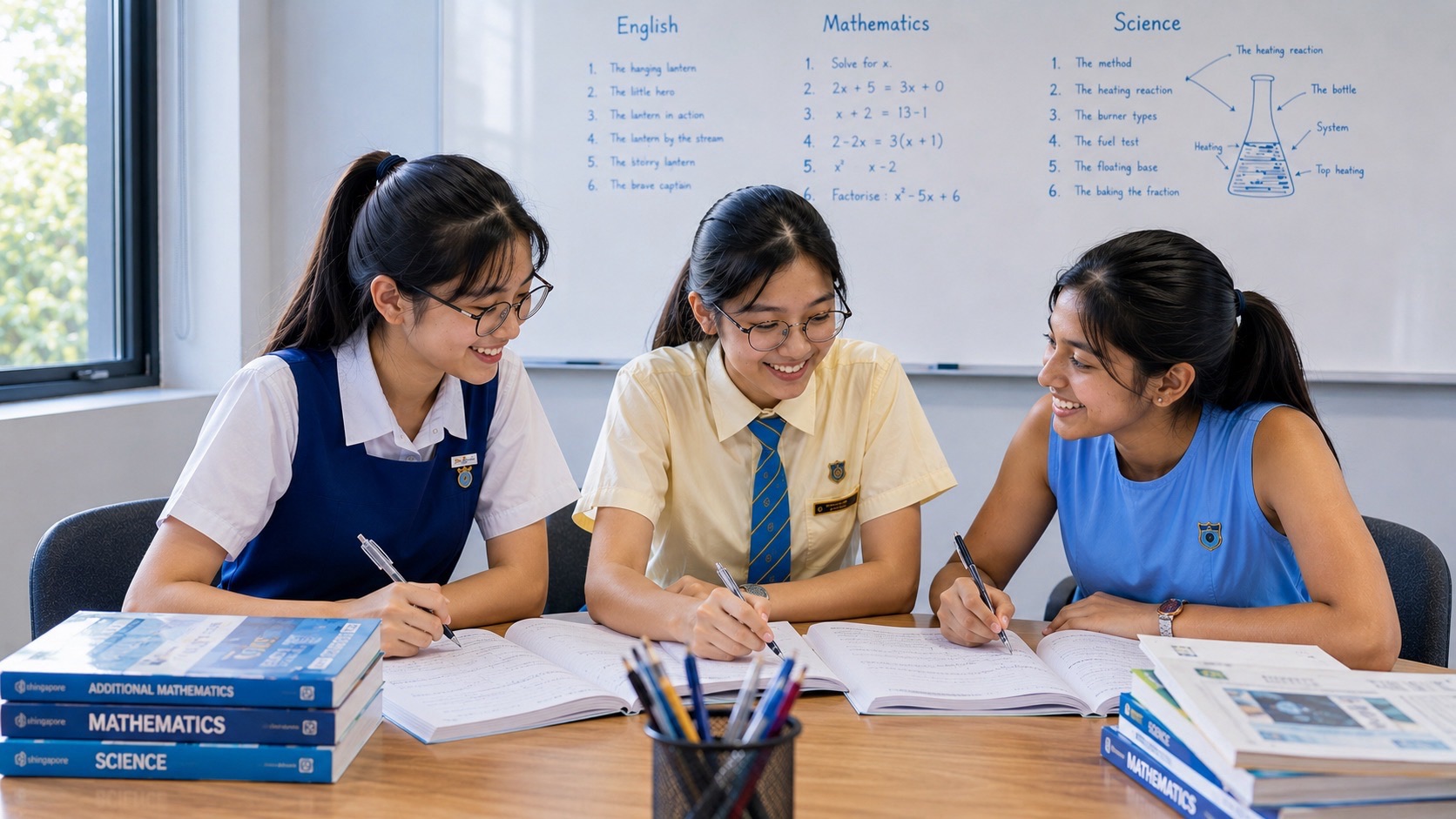
Science Education Systems · Article 36. Maya, Jia Jun, Hana and Ethan remain fictional Punggol learners. This article follows the knowledge-change layer: how Science remains reliable precisely because its explanations can be revised.
The 50-second parent route
Scientific knowledge changes.
That does not mean Science has no standards.
It means evidence can force better explanations.
The route is:
current model → prediction → new evidence → mismatch → scrutiny → replication → revised model → wider testing → consensus update → new boundary
The key question is:
What changed in the evidence strongly enough to justify changing the model?
Scientific progress is not random replacement.
Good new models usually explain why the older model worked where it did—and why it failed where it did not.
This article completes Articles 33–36 after How Scientific Abstraction Works, How Scientific Analogy Works and How Scientific Constraints Work.
1. Science is stable enough to teach and flexible enough to improve
This is one of its deepest design features.
Students need dependable models.
Scientists need permission to replace those models when stronger evidence arrives.
Both can be true.
2. A model should not change merely because a new idea is exciting
Novelty is not enough.
The new model must explain evidence at least as well as the old one and preferably solve problems the old model could not.
3. New evidence creates pressure for revision
A prediction fails repeatedly.
A better instrument detects something previously invisible.
An anomaly survives replication.
A new observation does not fit the established model.
These are reasons to investigate change.
4. One anomaly does not always overturn a field
The measurement may be wrong.
The method may be flawed.
The sample may be unusual.
The analysis may contain an error.
Scientific change requires enough evidence to distinguish model failure from local failure.
5. Replication decides whether the anomaly travels
If independent groups reproduce the surprising result, the pressure on the old model increases.
If nobody can reproduce it, confidence may remain with the existing explanation.
6. Better instruments often change knowledge
Microscopes revealed cellular structures.
telescopes expanded astronomy.
precision clocks transformed measurement.
genetic sequencing transformed Biology.
Scientific tools expand what can be observed.
7. New scales can expose old model boundaries
A model works at ordinary speed.
Another model is needed at extreme speed.
A model works macroscopically.
Another level becomes necessary microscopically.
Scientific progress often maps domains rather than simply deleting the past.
8. Older models can remain useful
Newtonian mechanics remains extraordinarily useful for many everyday and engineering situations despite later physical theories.
A model can be limited and still be powerful within its domain.
9. Scientific change is therefore often nested
The new model contains the old model as an approximation under certain conditions.
This is more sophisticated than saying:
“Old Science was wrong; new Science is right.”
10. Primary Science can introduce knowledge change through model refinement
Child:
“All things that move are living.”
Counterexample:
A car moves.
The model changes.
This is scientific revision at child scale.
11. Primary learners need to see correction as success
If changing an answer feels humiliating, learners may defend misconceptions.
Good Science classrooms reward justified revision.
“I changed my answer because this evidence does not fit my first model.”
That is strong thinking.
12. Maya’s knowledge-change weakness is identity attachment
She thinks:
“If my first answer was wrong, I failed.”
Her repair:
separate the learner from the model.
A model can be revised without lowering the worth of the person who held it.
13. Jia Jun’s knowledge-change weakness is note authority
“But this is what I wrote last term.”
His repair:
notes are snapshots of current understanding, not permanent law.
14. Hana’s knowledge-change weakness is distrust after revision
“If Science changed before, why trust it now?”
Her repair:
compare the strength of the evidence systems, not the mere fact that change occurred.
15. Ethan’s knowledge-change weakness is novelty worship
Every new idea seems better because it is new.
His repair:
ask whether the new model explains more evidence with equal or greater rigor.
16. Scientific confidence should be proportional to evidence depth
A newly proposed model deserves less confidence than one supported by decades of independent evidence.
Both remain revisable.
The evidential burden differs.
17. Failed predictions are major engines of change
If a model repeatedly predicts A and reality repeatedly produces B, the mismatch cannot be ignored indefinitely.
See How Scientific Prediction Works.
18. Falsification creates pressure to revise
A clear counterexample can defeat an overbroad rule.
Repeated discriminating failures can weaken a model.
See How Scientific Falsification Works.
19. Synthesis determines whether evidence really points elsewhere
One new study may contradict a field.
A synthesis asks whether the wider evidence has shifted.
See How Scientific Synthesis Works.
20. Consensus changes after evidence changes
Scientific consensus should not move merely with popularity.
It should move when the accumulated evidence and explanatory balance move.
See How Scientific Consensus Works.
21. Peer review helps filter proposed changes
New claims receive methodological scrutiny.
Can the result be reproduced?
Does the argument overreach?
Does the new model actually outperform the old one?
22. Scientific revolutions still depend on evidence
Large conceptual changes can happen.
But they are not licensed by drama alone.
The new framework must solve real empirical problems.
23. Paradigm change can reorganise existing facts
Sometimes the observations remain mostly the same while their interpretation changes.
A new model can connect facts that previously seemed unrelated.
Knowledge changes through structure as well as new data.
24. New terminology can reflect deeper conceptual change
When scientific categories are revised, names and definitions may change too.
Language follows the model.
This can make older textbooks look outdated even when much of their evidence remains useful.
25. Scientific classification changes with new relationships
Biological classification has changed as molecular and genetic evidence revealed relationships not obvious from appearance alone.
Categories evolve with evidence.
26. Scientific constants and values can be refined
More precise measurements can improve numerical estimates without changing the underlying theory dramatically.
Knowledge change can be incremental.
27. Not every update is a revolution
A better decimal value.
a narrower uncertainty range.
a refined mechanism.
a newly identified subgroup.
Science often advances through accumulation and correction rather than dramatic overthrow.
28. Model scope can change
A rule once thought universal becomes conditional.
Rather than discarding it, Science may state the exact range in which it works.
Boundary knowledge is progress.
29. Constraints can explain why old models failed
The old relationship held until a limiting factor appeared.
The revised model includes that constraint.
See How Scientific Constraints Work.
30. Abstraction can change as Science matures
Early models may use visible categories.
Later models use invisible mechanisms, equations or probability distributions.
The abstraction becomes more powerful as evidence supports it.
31. Analogies can be retired
A beginner learns with a metaphor.
Later the metaphor becomes too crude.
Scientific learning itself changes models as expertise grows.
See How Scientific Analogy Works.
32. School Science often presents the current simplified model
This is appropriate.
A Primary learner does not need every historical controversy.
But the teacher can occasionally show that the model is a carefully chosen level of explanation rather than eternal wording.
33. Secondary Science can make model history more explicit
Atomic models are a classic example.
New evidence produced revised representations.
The sequence teaches both content and the nature of scientific change.
34. Historical sequencing can show why each model was reasonable
Do not caricature earlier scientists as foolish.
Ask what evidence they had.
What could their instruments detect?
Which observations forced the next change?
This builds epistemic empathy.
35. Scientific knowledge has memory
New models inherit measurements, methods, data and concepts from older work.
Science accumulates even while changing.
36. Corrections should preserve provenance
What changed?
Why?
Which evidence triggered the change?
Which previous conclusions still hold?
Transparent revision makes scientific progress intelligible.
37. Retractions are dramatic but not the whole story of correction
Corrections can include:
updated datasets;
revised estimates;
new methods;
narrower claims;
changed guidelines.
Self-correction happens at many scales.
38. Scientific guidelines can change without the underlying Science being chaotic
Recommendations combine evidence with risk, cost, feasibility and values.
As evidence or conditions change, guidance can change too.
That is decision-system updating.
39. Public communication often misunderstands change
Headline:
“Scientists reverse themselves again.”
Maybe the actual change is a refined estimate or new subgroup.
Scientific literacy asks how large the update really is.
40. “Science was wrong before” is not a complete argument
The relevant question is:
How strong is the current evidence and correction system?
Past errors show fallibility.
They do not make all present claims equally doubtful.
41. “Science is settled” can also be misused
Some conclusions are extraordinarily well supported.
That does not mean every detail is closed forever.
Strong confidence and openness to revision can coexist.
42. The burden of evidence should rise with the size of the proposed change
A minor parameter revision may need modest evidence.
Overturning a deeply replicated framework requires much stronger, independently verified evidence.
This is rational conservatism, not resistance to progress.
43. Science should be conservative about evidence and radical about correction
Do not change models cheaply.
But when the evidence genuinely demands change, change them.
This tension protects both stability and progress.
44. Small-group tuition can model knowledge revision directly
Ask each learner to write:
My first model.
New evidence.
What no longer fits.
My revised model.
What still remains true.
This makes learning visible as scientific change.
45. Parents can normalise revision
“I thought X yesterday. I checked the evidence, and I need to update.”
This models intellectual integrity.
Children learn that changing one’s mind for a reason is strength, not inconsistency.
46. AI makes knowledge-change literacy essential
AI may answer from outdated training data or mix old and new scientific states.
Learners should ask:
What date does this information reflect?
Has the guideline changed?
What is the latest authoritative evidence?
Is this still the current consensus?
47. AI can also help compare model generations
Useful prompts:
“What did the older model explain?”
“What observation did it fail to explain?”
“What did the newer model add?”
“Which predictions distinguish them?”
“Where is the older model still useful?”
48. Scientific knowledge change is different from opinion drift
Opinion may change because tastes or social pressures change.
Scientific knowledge should change because evidence, methods or explanatory power change.
The update should be traceable.
49. A compact knowledge-change checklist
- What is the current model?
- What evidence supports it?
- What new observation conflicts with it?
- Could the conflict come from method or measurement error?
- Has the new result replicated?
- Does a revised model explain both old and new evidence?
- What predictions differ between the models?
- What domain does each model cover?
- How much of the old model remains useful?
- Has the wider evidence base shifted?
- How should confidence change?
- What new test should come next?
50. Frequently asked questions
Why does scientific knowledge change?
Because new evidence, better instruments, failed predictions, improved methods or broader models can reveal limits in earlier explanations.
Does changing Science mean it is unreliable?
No. Reliability comes partly from the ability to revise explanations when stronger evidence appears.
Can an old scientific model still be useful?
Yes. Many older models remain excellent approximations within particular conditions or scales.
Why does replication matter before changing a model?
It helps determine whether a surprising result reflects a robust phenomenon or a local error, anomaly or methodological problem.
How does this help PSLE Science?
It helps children treat mistakes and counterexamples as evidence for revising understanding rather than simply memorising corrections.
How does it change in Secondary Science?
Students encounter more explicit histories of model revision, quantitative anomalies, changing representations and evidence-based theory development.
51. Continue the Science Education Systems series
- How Scientific Abstraction Works
- How Scientific Analogy Works
- How Scientific Constraints Work
- How Scientific Falsification Works
- How Scientific Synthesis Works
Conclusion: Science changes because reality gets the final vote
Maya has the first model.
Jia Jun has the measurements.
Hana sees the anomaly.
Ethan proposes the alternative.
Then the evidence accumulates.
Some parts of the old model survive.
Some are narrowed.
Some are replaced.
A better model emerges.
Science is trustworthy not because it promises never to change.
It is trustworthy because good scientific systems make change answerable to evidence.


