
eduKatePunggol · What is eduKatePunggol?
A small room connected to a very large education.
Adrian and Jo have now learned how to recognise six different student patterns. Their next question is simpler and larger at the same time: what exactly have they walked into?
The 50-second answer
eduKatePunggol is a local learning system.
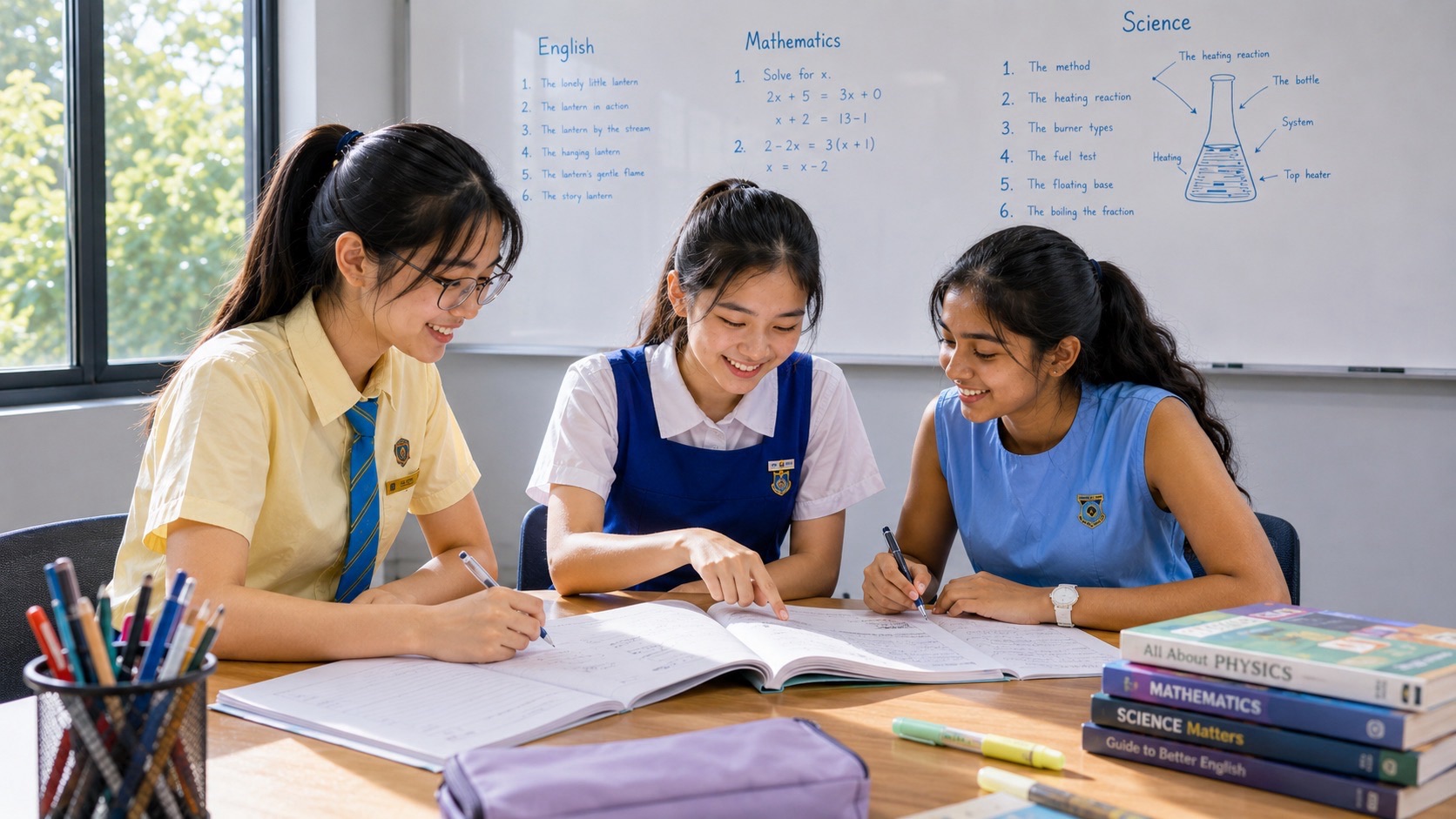
It is a three-student classroom, a 1.5-hour teaching cycle, a way of diagnosing weak links, a route through English, Mathematics and Science, a bridge back to school, a library behind the lesson, and a conversation with parents about what the child should become able to do with less help.
Read the storyReturn to Book a ConsultationThe simplest definition
It makes a large education small enough to see.
School is large. Curriculum is large. A child is complicated. A result can hide many causes. eduKatePunggol takes one learner, one stage, one subject and one repeated signal at a time, then turns the problem into a teachable next step. The room is small on purpose. The system behind it is not.
Follow the family, or enter where your question begins.
The door after the consultation
By the time Adrian and Jo finish the consultation story, they can describe six students without reducing any of them to a mark.
Aisha is drifting. Ryan changes under pressure. Ben leaks marks through speed. Mira hides uncertainty. Clara works without breaking through the plateau. Ethan is already strong and needs genuine stretch.
That understanding creates the next question naturally.
If tuition is supposed to respond differently to all six, what exactly is eduKatePunggol?
They arrive expecting a physical answer.
A room.
A teacher.
A table.
Three chairs for students.
Books, papers, pens, perhaps a whiteboard.
That answer is true and incomplete.
A hospital is not merely a collection of beds. A library is not merely shelves. A school is not merely classrooms. The visible place holds a system of decisions, roles, methods, records, knowledge and relationships that make the place work.
eduKatePunggol is similar in a smaller educational way.
The physical classroom matters because learning becomes observable there. The teacher matters because somebody has to interpret what the student is doing. The curriculum matters because the child is not learning in isolation from school. The parent matters because the week continues after the lesson. The student matters most because the system has no reason to exist unless capability becomes more independent over time.
Then there is the wider eduKate estate behind the room: subject knowledge, school-stage routes, vocabulary, Mathematics methods, Science explanation, examination craft, parent guidance and the deeper question of what education is trying to build.
The room is therefore an interface.
It is where a very large education system becomes small enough for one student to work with today.
Adrian looks around and asks, “So is this a tuition centre?”
Jo answers before anyone else can.
“Yes. But that cannot be the whole answer.”
Exactly.
This page is the rest of the answer.
What is a tuition centre if it is not merely another class?
Adrian has a practical definition.
“A tuition centre teaches after school.”
That is also true.
But after-school timing does not explain the educational function.
A child can attend another class and receive another explanation of the same material. That may help. It may also leave the actual weak link untouched.
The more useful definition begins with the difference between school and tuition.
School carries the main curriculum and the larger institutional responsibility. It has to educate many students, manage progression, assessment, subject arrangements, national requirements and the life of a school community.
Tuition does not replace that.
Its advantage is narrower.
It can spend more attention on the local learning problem.
What does this child misunderstand?
What part of the school route is not travelling properly?
What keeps repeating?
What can the student do with a model beside them but not alone?
What must become reliable before school adds more load?
In that sense, eduKatePunggol is a booster system.
It does not need to recreate the whole school day. It needs to identify a useful teaching job and perform it well.
For Mira, the job may be making English reasoning visible.
For Ben, representing the relationship before calculating.
For Aisha, finding where drift started.
For Ryan, separating knowledge from performance under pressure.
For Clara, changing practice conditions so effort produces transfer.
For Ethan, creating depth rather than simply more pages.
The centre earns its place in the week when the class has that kind of specificity.
Otherwise, the family has added time without adding enough direction.
So what is eduKatePunggol?
At this stage of the answer, it is a place where the broad curriculum is translated back into a precise teaching problem for one learner.
The room is small because visibility has value
Three students maximum.
The number is easy to advertise and easy to misunderstand.
Small is not automatically good.
A small class can still become a lecture. Three students can still copy without understanding. A tutor can still talk through the whole lesson and discover very little about how the students think.
The value of the size appears only if the tutor uses the visibility it creates.
Ben starts a Mathematics question. Before the calculation, he draws nothing, labels nothing and chooses an operation from one familiar word. The teacher sees the decision happen.
Mira reads an English question. She underlines the evidence but hesitates before writing the explanation. The teacher can ask what she is thinking before another student supplies the answer.
Ryan begins a timed section and gets trapped by one difficult item. The tutor can observe the moment the condition changes his behaviour.
Clara completes familiar work smoothly. The teacher changes the context and watches the route disappear.
Ethan finishes first. Instead of rewarding speed with more of the same, the tutor asks him to justify the method or find another route.
Aisha needs slightly more time to retrieve an earlier concept. The pause is visible before it becomes a wrong answer.
This is what the room is for.
Not merely fewer bodies.
More readable learning.
The small group also creates a social learning environment. Students can hear another method, realise somebody else is uncertain, explain an idea, compare approaches and discover that mistakes can be discussed without becoming humiliation.
But the teacher should still know whose reasoning is whose.
That is the design challenge.
Shared classroom rhythm without losing the individual learner.
When the balance works, the room becomes an instrument for observation.
And observation is the beginning of accurate teaching.
One and a half hours is not a promise. It is a container.
A lesson length can sound like a product specification.
Ninety minutes.
The more important question is what fits inside it.
A useful eduKatePunggol lesson can contain several different forms of work.
First, the tutor reads the student who has arrived today. Not the student from last month. Not the child described only by the consultation. What happened in school? What returned? What is currently unstable?
Then the task is mapped. Which subject component is actually involved? Which prerequisites does it assume? What does the question demand?
The weak point is located.
A concept may need teaching or reteaching.
Guided practice follows because understanding an explanation is not yet independent performance.
Support is reduced.
The student attempts again.
Correction becomes a teaching event rather than a red mark.
The idea is connected to another form, schoolwork, a changed context or mixed retrieval.
Then the lesson reviews what held.
This is why the ninety minutes should not be filled automatically from beginning to end with worksheet completion.
Different days may require different proportions.
Aisha may need more diagnosis and reconnection.
Ryan may need a short controlled timed task.
Ben may need several quick cycles of attempt-check-retry.
Mira may need time to articulate reasoning.
Clara may need changed contexts that expose transfer.
Ethan may need one difficult problem that deserves sustained thought.
The time is therefore a container for a learning cycle.
It is long enough to teach, observe, practise and review.
It is not valuable merely because the clock reaches ninety.
The lesson earns the time when the child leaves with a clearer capability than the one they brought in.
The teacher is not only an explainer
Parents often evaluate teaching by explanation.
Was the tutor clear?
Did the child understand?
Those questions matter.
eduKatePunggol needs the teacher to do more than explain well.
The teacher has to observe.
Diagnosis begins before the explanation. Which detail did the child miss? Which method did they choose? What did they assume? What happens when the tutor remains silent for ten more seconds?
The teacher has to design.
Once the weak link is understood, what example will make the idea visible? Which comparison will distinguish two similar structures? What should be changed in the next question to test transfer?
The teacher has to correct.
Not simply supply the answer. The correction should reveal why the original route failed and what the learner can do differently next time.
The teacher has to calibrate support.
Too little help and the student can remain stuck without learning. Too much and the student succeeds only because the adult is carrying the route.
The teacher has to remember trajectory.
What required full guidance three weeks ago? What now needs one cue? What has become independent? What has returned under pressure?
The teacher has to connect.
Tuition cannot become an island unrelated to current schoolwork. An older foundation may be repaired, but the student needs to understand why it matters to the current chapter.
The teacher also has to know when not to make the lesson larger.
One clear weak link repaired properly can be more valuable than covering three chapters superficially.
This is a quieter definition of expertise.
Not performing knowledge at the child.
Using knowledge to read the child’s next learning move accurately.
That is part of what eduKatePunggol is.
The loop is what turns a lesson into a system
Jo notices that the teacher keeps returning to the same sequence.
Read.
Map.
Locate.
Teach.
Practise.
Connect.
Apply.
Review.
It looks simple enough to fit on one line. The importance is that every part answers a different learning question.
Read the student: What is happening now?
Map the task: What knowledge and decisions does this work require?
Locate the break: Where does the student first lose control?
Teach: What explanation, distinction or method is missing?
Practise: Can the student reproduce it with decreasing support?
Connect: How does the repair relate to current schoolwork and earlier knowledge?
Apply: Does it survive changed wording, mixed questions, a new passage or a timed condition?
Review: What held, what failed, and what should happen next?
This loop prevents two kinds of educational laziness.
The first is treating every lesson as content delivery. Chapter next, worksheet next, test next.
The second is treating diagnosis as a one-time event. The child was assessed once, labelled, and every future lesson assumes the same picture.
But children change.
Mira can become more willing to reveal uncertainty. Ben can learn a checking routine. Aisha can stop drifting. Ryan can regain control under time. Clara can break a plateau. Ethan can encounter a difficulty that finally requires a new kind of persistence.
So the system needs feedback.
The returning student is new evidence.
That is why review sits at the end and also at the beginning of the next lesson.
eduKatePunggol is therefore not a fixed programme imposed on a static child.
It is a loop that updates as the learner updates.
That is the first sense in which the centre behaves like a system rather than a room.
School remains the main road
Adrian asks a question many parents eventually ask.
“If tuition becomes very good, does school matter less?”
The answer should be no.
A useful tuition centre should make school more usable, not compete with it for ownership of the child’s education.
School carries the official curriculum, the larger peer environment, teachers across subjects, CCAs, assessments, institutional routines, subject arrangements and the social experience of growing up with other students.
eduKatePunggol enters as a focused support system.
If Mira’s school is teaching a particular comprehension skill, tuition can make the reasoning more visible and give her enough practice to return to school with greater control.
If Ben’s class is moving into a Mathematics topic that assumes fractions are stable, tuition can repair the fraction weakness so the current lesson becomes accessible.
If Aisha is falling behind school pace, tuition can help reconnect her rather than create a parallel syllabus that moves in another direction.
If Ryan is preparing for an assessment, tuition can help with paper control without pretending to replace school feedback or official examination requirements.
The distinction matters because children can become over-systematised.
School teaches one method. Tuition teaches another. Home adds a third. The child spends energy choosing among adult systems rather than understanding the subject.
Good tuition should reduce that conflict.
Where school terminology or required answer form matters, the tuition route should respect it.
Where an alternative explanation helps understanding, the tutor can offer it and then reconnect the child to the form school expects.
The child should not feel they belong to two rival educations.
So what is eduKatePunggol?
It is not a replacement road.
It is a repair lane, a clarification lane, sometimes an acceleration lane, built beside the main road of school.
The parent is part of the system, but should not have to become the tutor
Jo understands more about the system now, but she does not want a second job.
She should not need one.
Parents hold a different kind of information.
They see the child after school.
They know whether homework takes twenty minutes or two hours.
They know whether the child needs the first step supplied every night.
They see the emotional residue of a difficult subject.
They know the week around the lesson: CCA, travel, sleep, family commitments and the ordinary disruptions that do not appear on a test paper.
That information is valuable.
But turning the parent into a full-time academic supervisor can damage the system.
The parent starts reteaching every subject. Homework becomes a nightly lesson. Every correction becomes a relationship event. The child begins to wait for the adult before attempting because help is always nearby.
eduKatePunggol should reduce that burden.
The tutor owns close subject teaching.
The parent can protect routines, provide relevant evidence, communicate changes and create enough structure for independent practice to happen.
Home can also remain somewhere the child is not continuously being assessed.
Jo can ask Mira what part felt difficult without turning dinner into English tuition.
Adrian can notice Ben’s checking routine without teaching the entire chapter again.
The system works better when roles are complementary.
Parent: context and continuity.
Tutor: diagnosis, teaching, correction and review.
School: curriculum and institutional route.
Student: increasing ownership.
This is another answer to the page title.
eduKatePunggol is not only what happens between tutor and worksheet.
It is a coordination point among people who see different parts of the child’s learning life.
The student is not the recipient. The student is the system’s eventual operator.
This is the most important shift.
A child can look like the person adults are helping.
Teacher explains.
Parent organises.
School assigns.
Tutor corrects.
Student receives.
If that remains the permanent structure, the system has failed.
The learner is supposed to become increasingly capable of operating the route.
Mira identifies what the question demands.
Ben represents the quantities before choosing an operation.
Aisha notices when schoolwork begins taking much longer and asks earlier.
Ryan uses a timed-paper recovery routine without an adult reminding him.
Clara tests herself without immediately opening the model answer.
Ethan chooses a deeper problem and stays with it when the answer does not appear quickly.
Independence does not mean never needing help.
Experts ask for help too.
It means the student becomes better at recognising what kind of help is needed and doing more of the route before the help arrives.
This is why the tutor reduces prompting deliberately.
At first, full explanation.
Then guided practice.
Then a smaller cue.
Then an independent attempt.
Then changed application.
Then delayed retrieval.
Every stage transfers a little more control to the student.
So when Adrian asks what eduKatePunggol ultimately produces, the best answer is not completed worksheets.
It should produce a learner who needs less rescue to perform the next reasonable learning task.
The student is not merely inside the system.
The student is gradually learning to carry the system internally.
Curriculum is the map, not the child
A curriculum is necessary because education needs an organised sequence of knowledge and capability.
It is also easy for adults to confuse the map with the learner.
The map says what should be taught.
The learner reveals what is actually ready.
Suppose school is teaching Secondary algebra. The curriculum is correct to move forward. Mira or Aisha may still carry a prerequisite weakness that makes the new work unstable.
The answer is not to accuse the curriculum of being too fast or the child of being too slow.
The tuition system can bridge the mismatch.
Repair only as far back as necessary.
Reconnect immediately to the present topic.
This prevents two extremes.
One is racing ahead because the chapter list says the child should be there.
The other is dragging the student through years of old content because one foundation is weak.
A curriculum also helps the tutor anticipate load.
Primary vocabulary will later carry comprehension.
Number sense will later carry fraction, ratio and algebra.
Science process language will later carry more precise open-ended explanations.
Secondary algebra will later carry Additional Mathematics where the student takes it.
Understanding these dependencies allows tuition to act before a small weak link becomes an expensive one.
But the child still determines the starting point.
That is a subtle but important identity claim.
eduKatePunggol is curriculum-aware without being curriculum-blind to the learner.
The map matters.
The person walking it matters more.
English: the system for making meaning available
The six students move to an English table.
Immediately, eduKatePunggol becomes a language system.
English tuition is not simply grammar plus composition plus comprehension as separate boxes.
It is the movement of meaning.
First the student receives meaning.
Can the words be accessed?
Can the sentence be parsed?
Can the passage be followed?
Can the question demand be understood?
Then the student organises meaning.
Which evidence matters?
What is implied?
What belongs in the paragraph?
What does the reader need next?
Then the student expresses meaning.
Can the reasoning be made visible in a precise answer, paragraph, composition, summary or oral response?
Mira’s problem sits between internal interpretation and external explanation.
Aisha may be losing vocabulary depth, making every later step heavier.
Ryan may know the passage but overthink under time.
Ben may misread because speed outruns reference.
Clara may write complete pieces that never develop further.
Ethan may sound sophisticated while evidence discipline remains shallow.
The same subject therefore contains different weak links.
eduKatePunggol’s English identity is not “we give English worksheets.”
It is “we inspect where meaning stops travelling reliably, then teach that part.”
That may mean vocabulary, grammar, comprehension, inference, evidence, sentence control, composition, oral communication or examination craft.
The subject page owns the deeper technical route.
This page keeps returning to the identity question.
What is eduKatePunggol when it teaches English?
A place where private thought is trained into public language.
Mathematics: the system for turning relationships into method
At the Mathematics table, the room changes again.
Now the student has to preserve relationships through symbols, diagrams, operations and working.
A Mathematics question may look like calculation.
The important work often happens before the first calculation.
What quantities exist?
How are they related?
What is known?
What is unknown?
Which representation makes the structure visible?
Which method is valid under these conditions?
Then execution matters.
Signs.
Units.
Notation.
Logical working.
Checking.
Ben’s old habit was to start too quickly. The tutor slows the decision without slowing Mathematics into boredom.
Clara’s plateau may arise because topic practice tells her which tool to use. Mixed practice asks her to recognise the tool herself.
Ryan may know the route but abandon it under time.
Mira may follow algebraic transformations without understanding why one step preserves equality.
Ethan may solve correctly and still need to compare methods or justify the condition that makes the method work.
The subject grows from Primary number sense and problem solving into Secondary algebra, graphs, geometry, statistics and, where applicable, Additional Mathematics.
The tutor’s job is to keep the method connected to meaning.
Otherwise Mathematics becomes a collection of remembered moves with no reliable way to choose among them.
So what is eduKatePunggol when it teaches Mathematics?
A place where the invisible structure of a problem is made explicit enough to reason with.
Science: the system for connecting concept, process and evidence
Primary Science creates another version of the same challenge.
A child can know the topic and still fail to produce an answer that shows the knowledge.
“Evaporation.”
Correct word.
Incomplete explanation.
Science asks the student to connect.
What concept applies?
What process occurs?
What changes?
What evidence is shown?
What can be concluded, and what cannot?
Aisha may remember facts separately but lose the connection among them.
Ryan may write so carefully under pressure that the causal chain becomes stiff and incomplete.
Ben may spot a keyword and stop reading before the actual question demand.
Mira may understand the process but hesitate about how much to write.
Clara may memorise model answers that fail when the diagram changes.
Ethan may infer beyond what the evidence supports.
These are different scientific problems.
The tuition route can therefore move through concept, process, observation, variables, diagrams, MCQ choices, open-ended explanation and experimental reasoning.
The goal is not keyword accumulation.
Keywords should carry concepts, not substitute for them.
The student should eventually be able to look at a new scenario, identify the relevant scientific relationship and explain it precisely enough for another person to inspect the reasoning.
So what is eduKatePunggol when it teaches Science?
A place where knowledge becomes evidence-based explanation.
Vocabulary is infrastructure, not decoration
The room keeps returning to words.
Even Mathematics needs them.
“Increase by” and “increase to” are not the same relationship.
Science depends on precise terms because ordinary language can blur distinctions that the subject needs to preserve.
English obviously depends on vocabulary, but not as a collection of impressive words inserted into compositions.
Words are access points.
A student who does not understand the language of the task can appear weak in the subject even when some underlying concept is present.
This is why eduKate’s wider vocabulary system matters behind the local classroom.
Vocabulary can be learned by frequency, theme, morphology, context, collocation, semantic relationship and repeated use across reading and writing.
But the local question remains practical.
Which words are currently blocking the child?
Aisha may need vocabulary repair because drift has reduced reading access.
Mira may understand a passage but lack the precision to express the inference.
Ben may misread a Mathematics relationship because one phrase is interpreted loosely.
Clara may rely on memorised Science phrases without understanding their internal meaning.
Words therefore connect subjects.
They are part of the hidden infrastructure under school performance.
eduKatePunggol does not need to turn every lesson into a vocabulary lesson.
It needs to recognise when vocabulary is the weak link and then route the student into the appropriate deeper system.
This is what a networked learning centre can do that a single worksheet cannot.
The local lesson sees the problem.
The larger eduKate estate can supply the deeper knowledge route.
The weak link is the point where the system decides where to enter
By now Adrian recognises the phrase immediately.
Weak link.
He also understands that it does not mean “the oldest thing the child ever got wrong.”
The weak link is the earliest point that explains the repeated present difficulty.
A Secondary Mathematics question may fail in algebra because fractions are unstable.
An English paragraph may fail in development because the student cannot select relevant evidence.
A Science answer may fail because the causal relationship is not understood even though the keyword is known.
An examination may fail because timing changes route selection despite stable content.
The system works backwards only as far as useful.
Then it turns around.
This return is crucial.
Repairing fractions in isolation can feel childish to a Secondary student. Repairing the exact fraction operation and immediately showing how it unlocks the current algebra problem gives the student a reason.
Repairing vocabulary without reconnecting to the current passage leaves the child with another list.
Repairing a checking routine without using it on real school work leaves it theoretical.
The weak-link model therefore has two movements.
Backwards to find.
Forwards to reconnect.
That movement is one of the most important things eduKatePunggol actually is.
It is a place designed to move across levels without confusing level with identity.
A strong Secondary student can need one Primary foundation repaired.
A struggling Primary student can have a genuinely advanced strength elsewhere.
The route is determined by the dependency, not the label attached to the whole child.
When the first weak link is repaired and current work becomes usable again, the system moves on.
It does not keep the student permanently inside the problem that first brought them in.
Correction is where information turns into change
A wrong answer is only useful if something about the next attempt changes.
This sounds obvious.
It is not how correction always works.
A student can copy the correct answer, understand it while reading, and reproduce the same error three days later.
The page looks corrected.
The learning system is not.
eduKatePunggol therefore treats correction as a second teaching moment.
What was the wrong route?
Why did it look reasonable?
What principle distinguishes it from the correct route?
What small check could catch the same mistake next time?
Then the student tries again without the answer beside them.
Ben benefits from this immediately.
If he writes the discount amount as the final price, the tutor does not simply replace the number. Original price, amount reduced and final price are labelled as different quantities. A fresh question follows. Ben has to identify which quantity the question is actually asking for.
Mira’s correction can be equally structural.
If she gives an inference without evidence, the tutor does not write the missing explanation for her. Mira identifies the detail, states what it suggests and rebuilds the link herself.
For Clara, correction must break the plateau. Reading a model answer may create recognition. Reconstructing the method without the model tests whether the correction changed control.
For Ethan, a correct final answer can still deserve correction if the reasoning is fragile. High-performing students need to learn that correction is not reserved for being wrong.
Correction also affects classroom culture.
If mistakes produce humiliation, students hide them.
If mistakes are treated as information, students expose more of the learning process.
This does not mean errors are celebrated for their own sake. The goal is still accuracy.
The difference is how accuracy is reached.
A mistake should become a map to the next repair.
That is why correction sits near the centre of what eduKatePunggol is.
Retrieval asks whether the lesson survived after the room disappeared
A student can look transformed at the end of a lesson.
The explanation is fresh.
The example is nearby.
The tutor has just asked the right question.
Everything feels available.
Then Tuesday arrives.
The method is gone.
This is not proof that the Saturday lesson was useless. It is evidence that the learning has not consolidated strongly enough yet.
Retrieval matters because school rarely asks knowledge under the same conditions in which it was learned.
The student has to find the route again.
For Aisha, delayed retrieval may reveal why drift is occurring. She understands in class but the learning decays before the next topic arrives.
For Mira, a comprehension structure may work immediately and disappear when the passage changes two days later.
For Ben, the checking routine may be present only when the tutor reminds him.
For Clara, recognising a correction is not the same as reconstructing it.
For Ethan, rapid learning can create an illusion of permanence because the first encounter was easy.
The tuition system therefore needs spacing.
Teach.
Practise.
Return later.
Mix the idea with other work.
Ask again without the same cues.
This does not require turning every lesson into a memory laboratory.
It requires the tutor to care whether learning remains available after time has passed.
Parents can notice the pattern too.
“Understands after tuition, forgets by homework.”
That sentence is enough to trigger a different teaching design.
So what is eduKatePunggol in this chapter?
A place that does not confuse immediate success with durable learning.
Transfer asks whether the method belongs to the student or the worksheet
The chapter heading tells Clara what to do.
Ratio.
She succeeds.
The examination paper removes the heading.
The same relationship appears inside a different context.
She hesitates.
This is the transfer problem.
A method can be fluent inside one surface and fragile outside it.
eduKatePunggol therefore changes the surface intentionally.
Numbers change.
Wording changes.
Diagrams change.
Topics are mixed.
Prompts are reduced.
Time conditions may be added later.
The goal is not novelty for entertainment.
The goal is to discover what the student actually owns.
English transfer means using a reasoning principle in a new passage instead of reproducing the wording of a model answer.
Mathematics transfer means recognising a relationship when the context no longer announces the technique.
Science transfer means identifying the same process in a changed experimental setup.
Examination transfer means using a checking or recovery routine when the paper feels unfamiliar.
Ethan needs transfer for a different reason.
Strong students can become extremely good at recognising familiar structures. Real stretch begins when recognition is no longer enough.
Ben needs transfer so his checking routine travels with him rather than appearing only in tuition.
Mira needs transfer so the ability to explain evidence becomes part of English, not one passage she practised repeatedly.
Transfer is therefore the bridge between tuition and the world outside tuition.
If a method works only inside the lesson, the lesson has not completed its job.
What is eduKatePunggol?
A place designed to make learning portable.
Confidence is built from control, not slogans
“Be confident.”
Ryan has heard it before.
He would like to comply.
The problem is that confidence is not a switch.
It often grows from evidence that the learner can perform a previously difficult action.
A student who knows how to recover after a hard question has more reason to remain composed.
A child who can find the first step independently has more reason to begin homework.
A student who can catch their own error has more reason to trust checking.
Confidence can also be misleading.
Ethan may feel extremely confident because familiar work is easy. The confidence is real but not yet tested by enough variation.
Ben may appear confident because he starts quickly. Speed can hide weak interpretation.
Mira may appear unconfident because she speaks less, while her internal understanding is strong.
The tutor therefore looks for behaviour rather than mood alone.
Does the child attempt?
Do they persist?
Can they ask precisely?
Can they recover from correction?
Can they explain the method?
Does the behaviour remain stable when the task becomes harder?
Confidence becomes stronger when the student can point to capability.
“I know what to do if I get stuck.”
“I can check this.”
“I can explain why the answer follows.”
“I can ask where I lost the step.”
This is one reason correction without humiliation matters so much. The child learns that difficulty can be entered, examined and repaired.
eduKatePunggol should therefore not sell confidence as decoration around tuition.
It should help produce confidence as a consequence of increasing control.
Assessment is feedback to the system, not the identity of the child
The family first arrived because of a paper.
It is fitting that the paper returns here.
Assessment matters.
It samples what the student can produce under particular conditions.
It helps schools make decisions.
It gives tuition evidence about whether learning is travelling.
But the mark is downstream.
A result can tell the system to look again.
It cannot always tell the system what to do next.
Consider two sixty-eights.
One is Ben’s preventable leakage.
One is Clara’s plateau.
The numbers match.
The teaching should not.
Assessment review at eduKatePunggol can therefore separate several categories.
Knowledge gap.
Question interpretation.
Method choice.
Execution error.
Language expression.
Timing.
Incomplete work.
Checking failure.
Transfer failure.
Not every mistake fits neatly into one category. The categories are tools for inspection, not permanent labels.
The system then asks whether the current tuition plan is changing the relevant category.
If Mira’s evidence explanations improve but her paper remains unfinished, a new timing problem has become visible.
If Ben’s checking improves and marks rise, the original hypothesis gains support.
If Clara continues to plateau despite changed practice, the system should review again rather than simply repeat itself.
This feedback loop keeps tuition accountable.
eduKatePunggol is not a machine for producing marks directly.
It is a teaching system that uses marks, among other evidence, to decide whether the learning machinery is improving.
Aisha enters the system as drift, not failure
Aisha has not collapsed academically.
That makes her easy to miss.
Her work has simply become slower, less stable and more dependent on reminders. The latest mark is not disastrous. The direction is.
For Aisha, eduKatePunggol becomes an early-warning system.
The tutor compares current performance with earlier capability.
Which skills used to be automatic?
Which now require prompting?
Is the difficulty broad or concentrated around one dependency?
Does Aisha retrieve knowledge after a delay?
Does the school pace outrun consolidation?
Has confidence changed because repeated uncertainty has made asking harder?
The tuition response begins by restoring continuity.
Perhaps one vocabulary layer is repaired so English passages become less effortful.
Perhaps a Mathematics foundation is rebuilt so current work stops stacking new complexity on top of old uncertainty.
Perhaps Science concepts need reconnecting rather than re-memorising.
The key is not to turn drift into crisis before it is a crisis.
Small repairs can be enough when the problem is caught early.
This is one of the reasons eduKatePunggol exists locally.
A parent can notice a change before the system produces a dramatic result.
The tutor can test whether the change reflects a teachable weak link.
Then school remains usable rather than becoming progressively harder to re-enter.
For Aisha, the centre is a place that notices trajectory.
Not “What did you score?”
But “What is changing over time?”
That question can save months of unnecessary accumulation.
Ryan enters the system through the gap between knowledge and performance
Ryan teaches the room that knowing and accessing are different.
Untimed, he can explain.
Timed, he can lose the route.
For him, eduKatePunggol becomes a controlled environment for comparing conditions.
The tutor should not assume that every low result means missing content.
Nor should the tutor assume the content is secure merely because Ryan can discuss it calmly.
Both need testing.
Start untimed.
Then add a moderate time condition.
Observe the first point where behaviour changes.
Does Ryan rush?
Freeze?
Overcheck?
Spend too long on one question?
Abandon a valid method because the answer is not immediate?
This makes the problem more specific.
Content repair may still be required.
But examination craft can also be taught as behaviour.
Read.
Identify what is known.
Attempt the reasonable route.
Mark a question for return if it consumes disproportionate time.
Recover after difficulty.
Check deliberately at the end of the route rather than compulsively every line.
These are not motivational slogans.
They are actions.
Ryan can practise actions.
As they become reliable, confidence can follow.
For Ryan, eduKatePunggol is not a place that tells him to relax.
It is a place that gives him something to do when relaxing is not available.
Ben enters the system through precision
Ben dislikes the word careless now.
He has learned why.
It hides too much.
For him, eduKatePunggol becomes a precision workshop.
The tutor does not say, “Slow down” and hope the personality changes.
The tutor identifies exact error points.
Read the unit.
Label the quantity.
State what must be found.
Preserve the sign.
Check whether the answer satisfies the original condition.
In English, precision can mean pronoun reference, tense, evidence or task fulfilment.
In Mathematics, it can mean relationship, notation, operation, working and checking.
In Science, it can mean answering the actual causal question rather than dropping the correct keyword onto the page.
Ben’s strength is speed.
The system does not want to destroy it.
Speed is useful when it rests on stable recognition.
The aim is to earn the right to be fast.
This is an important idea because parents often respond to carelessness by adding repetition.
More questions can produce more opportunities to practise the same leak.
A better intervention installs a small routine at the exact point the error enters.
Then the routine is practised until it no longer needs an adult cue.
Ben’s improvement is visible before the mark changes.
He catches the mistake himself.
That is a transfer of control.
For Ben, eduKatePunggol is where “be careful” becomes a teachable sequence.
Mira enters the system through visibility
Mira’s difficulty is almost architectural.
Her thinking exists.
Too much of it remains inside.
For her, eduKatePunggol becomes a place where private reasoning can be made visible without demanding that she become a different personality.
The tutor can ask smaller questions.
Which line became unclear?
Which two methods are you choosing between?
What evidence made you think that?
Can you say the explanation before you write it?
Can you mark the first uncertain step?
These prompts are useful because they reduce the social cost of asking for help.
Mira does not need to announce, “I understand nothing.”
She can point to one transition.
In English, this helps her move from inference to explicit explanation.
In Mathematics, it helps reveal whether a symbolic step is understood or merely followed.
In Science, it helps turn a concept she recognises into a causal chain she can write.
The three-student room matters here because the tutor can notice silence.
Not all silence is confusion.
That is why the tutor must ask carefully rather than assume.
Over time, Mira’s goal is not to speak more for the sake of speaking.
It is to become better at exposing the part of the learning system that requires help.
Then the teacher can respond before the uncertainty hardens into a gap.
For Mira, eduKatePunggol is a place where quiet thinking becomes teachable information.
Clara enters the system through the plateau
Clara is the test of whether the system can respect effort without worshipping volume.
She works.
She practises.
She corrects.
The result stays almost the same.
For her, eduKatePunggol becomes an experiment in changed learning conditions.
What has the current practice made fluent?
What has it failed to change?
Does Clara succeed because the topic is labelled?
Can she retrieve after time?
Can she reconstruct a correction?
Can she transfer when the surface changes?
Does she need an older weak link repaired?
Does the plateau appear only under examination conditions?
The system should not answer a plateau with automatic volume.
It should alter the variable that may be limiting progress.
Remove the prompt.
Mix topics.
Delay the return.
Ask for explanation.
Change the representation.
Compare methods.
Shorten the time.
Then observe.
Clara’s effort deserves a system capable of learning from her effort.
If nothing changes, the teaching plan should not remain proud of its consistency.
It should update.
This makes Clara particularly important to the identity of eduKatePunggol.
A learning system should be willing to change its own intervention when evidence says the intervention is not enough.
For Clara, the centre is where persistence is redirected rather than merely increased.
Ethan enters the system through stretch
Ethan is already doing well.
That makes it easy to misunderstand what tuition could be for.
If the system only repairs weakness, Ethan does not need it.
If the system can also deepen strength, the question becomes more interesting.
For Ethan, eduKatePunggol becomes a place where ease is not mistaken for mastery.
Can he justify why a method applies?
Can he find another route?
Can he recognise the hidden assumption?
Can he remain precise when the problem is unfamiliar?
Can he accept that a correct answer may rest on weak reasoning?
Can he revise an argument after evidence challenges it?
Stretch is therefore not necessarily next year’s syllabus.
It can be deeper current work.
In English, more mature inference and qualification.
In Mathematics, non-routine reasoning, proof, comparison and efficiency.
In Science, stronger experimental reasoning and evidence control.
There may be times when acceleration is appropriate.
The system should have a reason.
Otherwise “ahead” becomes a direction without a purpose.
Ethan also needs the room to normalise being wrong.
A child who is used to being the fastest can protect identity by avoiding anything that threatens speed.
Real stretch has to create difficulty safely enough that the student learns how to inhabit it.
For Ethan, eduKatePunggol is where potential becomes disciplined mastery rather than permanent comfort.
Primary school: the system builds the carriers before the load gets heavier
For Primary students, eduKatePunggol has a long view without making childhood feel like one long examination runway.
Primary 1 and Primary 2 build basic carriers.
Reading.
Sentence formation.
Number sense.
Instructions.
The first habits of beginning and completing work.
Primary 3 and Primary 4 increase connection.
Science enters formally.
Mathematics relationships become richer.
English comprehension and writing require more integration.
The child now has to coordinate capabilities that were previously separate.
Primary 5 increases the cost of unfinished foundations because PSLE is no longer abstractly distant.
Primary 6 combines knowledge with examination execution.
The local tuition system can therefore respond differently by stage.
For a younger child, the first job may be reading the task independently.
For a Primary 4 child like Ben, it may be moving from keywords to actual mathematical relationships.
For Primary 5, it may be stabilising retrieval before the final-year load.
For Primary 6, the system may need to combine concept repair with timed paper control.
The important identity point is that eduKatePunggol does not treat Primary as a miniature version of Secondary.
The developmental stage matters.
A young child who needs help starting is not a failed independent learner.
They are still becoming one.
The system should support that becoming without importing unnecessary urgency.
PSLE: the system narrows because the conditions matter more
PSLE changes the family atmosphere because a national examination compresses many capabilities into a bounded set of papers.
That can tempt the tuition system into becoming paper after paper after paper.
Practice matters.
But the question remains: what is the paper revealing?
A weak English section may need vocabulary, comprehension evidence, writing control or time.
A Mathematics paper may reveal route selection, arithmetic stability, representation, working or checking.
A Science paper may reveal concept, process, evidence, answer structure or MCQ control.
The closer the examination becomes, the more the system must distinguish teaching from testing.
A child cannot be tested into knowing something they do not yet know.
Nor should every weak performance trigger a return to first principles if the knowledge is stable and the issue is execution.
PSLE tuition therefore narrows around the actual remaining constraints.
Repair where needed.
Retrieve across topics.
Mix practice.
Build timing.
Review errors by mechanism.
Practise recovery after hard questions.
Keep enough ordinary life around the examination that the child remains a person.
For parents, this is also where eduKatePunggol should reduce noise.
Not every new assessment book is a strategy.
Not every low practice mark is a crisis.
The system needs a hierarchy of priorities.
What still needs teaching?
What needs consolidation?
What needs examination control?
What is already stable enough to leave alone?
For PSLE, eduKatePunggol becomes a narrowing engine: fewer guesses about what to do next, more attention on what still limits performance.
Secondary 1: the system helps the child learn a new operating environment
Mira already taught the family this lesson in Start Here.
Secondary school is not simply Primary school with harder chapters.
The week changes.
More teachers.
CCA.
More independent recording of work.
More symbolic Mathematics.
More precise English reasoning.
A larger expectation that the student will notice and manage uncertainty.
eduKatePunggol at Secondary 1 therefore has two jobs.
Teach the subjects.
Help stabilise the learning operating system.
A student may need to learn how to record a question, plan a late-CCA evening, identify what homework actually requires, and return to a difficult task after the first attempt fails.
This does not make tuition a life-coaching programme.
It means academic performance depends partly on whether the student can operate the academic week.
For Mira, the move into Edgefield in the story makes the transition concrete. The new environment is exciting and demanding. The early result is not proof that Primary learning was fake. It is evidence that the operating conditions changed.
eduKatePunggol can provide continuity during that reset.
Current school work comes in.
Weak links are repaired.
New routines are made explicit.
The student becomes less dependent on adults organising every academic action.
For Secondary 1, the centre is a local transition bridge.
Full Subject-Based Banding means the system must read the actual subject route
Secondary education no longer fits comfortably into one broad label for the entire child.
Under Full Subject-Based Banding, students may take subjects at different subject levels, and Posting Groups should not be treated as permanent descriptions of ability across every domain.
For eduKatePunggol, that means the consultation and class route need more accurate information.
Which subject?
Which subject level where relevant?
Which school stage?
Which examination year?
What current topic?
The system should not infer Mathematics needs from an English label or treat one subject level as an identity for the whole learner.
Mira can be stronger in one subject than another.
Ryan’s pressure pattern can be severe in one paper and mild elsewhere.
Ethan can need stretch in Mathematics and ordinary consolidation in English.
Clara can plateau in writing while Science moves steadily.
The architecture of Full SBB actually reinforces the logic of eduKatePunggol.
Read the learner at the level of the actual subject.
Teach the actual requirement.
Review the actual evidence.
Official school arrangements remain owned by the school, MOE and SEAB.
The tuition centre does not need to become the authority on placement decisions.
Its job is to help the student learn the subject they are actually taking.
For parents, this makes the system calmer.
One label does not have to explain the entire child.
For Full SBB, eduKatePunggol becomes a subject-specific support layer inside a more flexible national school architecture.
Upper Secondary: the system starts asking whether methods survive consequence
By Secondary 3 and Secondary 4, the child is no longer learning only isolated methods.
The methods now sit inside larger chains.
One algebraic error can alter several later lines.
One misunderstanding of a question can waste enough time to affect the rest of a paper.
One weak writing habit can repeat across several components of English.
This changes what eduKatePunggol needs to do.
At lower levels, a tutor may spend more time establishing the basic method.
At upper Secondary, the student increasingly needs to recognise when the method applies, execute it cleanly, combine it with other knowledge and remain controlled when the paper stops looking familiar.
Consider Mathematics.
A student may know how to factorise a quadratic when the question sits inside a chapter called Quadratic Equations.
The examination does not promise that courtesy.
The student needs to recognise structure.
They also need to understand conditions.
Setting each factor equal to zero is valid when the product equals zero. It is not a universal move whenever brackets appear.
That distinction separates method memory from method understanding.
English has the same upper-Secondary demand in another form.
A student may have learned a paragraph structure. The harder task is deciding what claim is worth making, which evidence actually supports it, how much explanation is enough, and when a qualification makes the argument more accurate.
Examination craft also becomes more expensive.
The student must know when to persist and when to move.
They need checking routines that target their real error patterns.
They need to recover from one unfamiliar question without allowing it to redefine the whole paper.
eduKatePunggol at this stage therefore becomes less like a place that supplies methods and more like a place that tests method ownership.
Can the student choose?
Can they justify?
Can they combine?
Can they recover?
Can they perform under the actual conditions of the route they are approaching?
This is why upper Secondary tuition cannot be reduced to “finish the syllabus early.”
Coverage matters.
Control matters more once coverage exists.
The student is moving towards an examination in which nobody will stand beside them to identify the chapter.
The system should prepare for that independence long before the final paper begins.
Additional Mathematics: where the room becomes a workshop for abstraction
Additional Mathematics makes the identity of eduKatePunggol especially visible because abstraction exposes weak links quickly.
Symbols compress relationships.
That compression is powerful when the student understands the structure.
It is disorienting when the symbols become a language the learner can manipulate only by memory.
Suppose Ethan meets differentiation.
He can memorise that the derivative of x² is 2x.
That is a useful start.
But the method becomes much more powerful when he understands what the derivative is representing: a rate of change, a gradient function, a way of describing how the curve behaves locally.
At x = 3, the original function y = x² gives the point (3,9). The derivative 2x gives a gradient of 6 there.
The point and the gradient are not interchangeable.
The tutor can then connect them to the tangent y − 9 = 6(x − 3).
Now the algebra, graph and calculus are speaking about the same object.
This is the kind of connection Additional Mathematics requires.
Aisha may struggle because algebraic manipulation underneath calculus is unstable.
Ryan may know the method but become overwhelmed when a question combines several topics.
Ben’s future version may lose signs or skip conditions through speed.
Mira may follow transformations without explaining why one line follows from the previous one.
Clara may complete topic practice but fail mixed questions because route recognition remains weak.
Ethan may need proof, comparison and non-routine work rather than simple acceleration.
For each student, the same subject needs a different entry point.
This is why eduKatePunggol should not treat Additional Mathematics as a badge of difficulty.
It is a language of structure.
The room becomes a workshop where that language is unpacked until symbols, diagrams, conditions and methods reconnect.
When the student can move among those representations independently, the abstraction stops feeling like a wall.
It becomes a tool.
For Additional Mathematics, eduKatePunggol is the place where compressed mathematical language is expanded until the learner can operate it, then compressed again into efficient independent method.
Examination craft is the final translation layer
Knowledge has to become performance under conditions.
That sentence explains why examination craft belongs inside the identity of eduKatePunggol without allowing examinations to become the whole identity.
A student can understand a concept and still produce weak evidence of that understanding under time.
A student can know several methods and choose poorly because the paper mixes them.
A student can write beautifully and still fail to complete the required sections.
A student can solve accurately at home and lose control when one difficult question changes the emotional meaning of the paper.
Examination craft is therefore the translation layer between capability and visible assessed performance.
It includes reading the instruction accurately.
Identifying the mark demand.
Choosing the route.
Managing time.
Showing enough working.
Moving when necessary.
Returning deliberately.
Checking where the student actually tends to make errors.
This craft should be taught progressively.
There is little value in placing a fragile student under harsh timing before the method itself is secure.
There is also little value in keeping a strong student permanently untimed when the examination will not.
The system has to know which layer is ready.
For Ryan, this progression is central.
He begins with stable content and manageable time conditions. The tutor helps him experience recovery as an action rather than a hope.
For Clara, mixed timed work may reveal whether the plateau is partly route selection.
For Ben, examination craft includes targeted checking that does not consume so much time that checking creates a new problem.
For Mira, it may mean making a reasonable response fully visible before overthinking the perfect one.
For Ethan, it may mean resisting the assumption that speed equals efficiency.
The examination is therefore not a separate world from learning.
It is one environment in which learning has to operate.
eduKatePunggol trains that operation without pretending that a paper is the final meaning of education.
The student should leave the examination room with evidence of what they can do.
But they should leave education with far more than the ability to sit examinations.
Punggol is not a keyword attached to the tuition centre
The family steps outside.
This matters to the definition too.
eduKatePunggol is local.
Local does not mean merely placing the word Punggol beside a tuition service.
It means the learning system exists inside a real neighbourhood with real routes, school days, travel times, parks, homes, friendships, meals and family schedules.
Mira’s fictional route through Edgefield made Secondary school concrete because the transition happened somewhere.
Ben’s week has a geography too.
A class that ends at a particular time has a different cost depending on where the child is coming from, what school commitments came before it and what the family needs to do after.
The local classroom therefore understands that timetable design is part of educational design.
A ninety-minute class at the wrong moment can be worse than a theoretically perfect lesson the child reaches exhausted.
Punggol also gives education ordinary life around it.
The Waterway does not have to become a Science worksheet.
A walk does not need to be converted into vocabulary enrichment.
A family meal does not need to become oral practice.
Learning already connects to the world naturally.
Signs have language.
Routes have distance and time.
Public spaces involve design, systems and civic choices.
The environment raises scientific questions.
People use English to negotiate meaning every day.
Mathematics is embedded in scheduling, measurement, finance and infrastructure.
But the child is allowed to inhabit those things before adults turn them into assignments.
This local grounding protects eduKatePunggol from becoming an abstract education machine.
The students are growing up here.
The tuition centre should improve their ability to participate in school and eventually in the wider world, not make the centre itself the centre of their lives.
So Punggol belongs in the name because place belongs in the education.
eduKatePunggol is a local node in a larger learning network, anchored in the ordinary lives of families who happen to be raising children here.
The library behind the room is larger than the room should ever become
Adrian has finally discovered the scale problem.
eduKate’s wider ecosystem contains far more information than any family should have to read before making one tuition decision.
There are subject hubs.
Vocabulary systems.
Primary and Secondary learning guides.
PSLE materials.
Mathematics walkthroughs.
Science explanations.
Parent guides.
How Tuition Works.
How Education Works.
Wider knowledge about society, civilisation, technology, institutions and the world students are eventually being educated to enter.
The temptation is to bring all of it into every page.
That would make the local centre less usable.
A library becomes helpful not because every book is placed on the front desk.
It becomes helpful because the right book can be found when a question requires it.
eduKatePunggol works the same way.
The classroom sees the local learning signal.
The signal determines which deeper knowledge node becomes relevant.
If vocabulary is blocking comprehension, the wider vocabulary system matters.
If a parent needs to understand Full SBB, the school-route explanation matters.
If a Secondary Mathematics foundation needs repair, the relevant mathematics guide matters.
If Science explanation is weak, the subject route matters.
If a parent wants to understand why tuition should reduce dependence rather than increase it, How Tuition Works matters.
The relationship among pages matters more than the raw page count.
This is the hidden architecture behind the local service.
eduKatePunggol can remain small at the point of contact because the knowledge estate behind it is large.
The reader does not need to understand the architecture.
They should simply feel that the next useful route appears when it becomes relevant.
This is why the story format matters.
The link is not a directory entry.
It appears because a character has reached the question that the linked page actually owns.
That creates a natural knowledge graph.
One coherent question.
Necessary crossings.
Meaningful return.
The room does not grow to contain the whole library.
The room learns how to retrieve from it.
eduKatePunggol is one local node in a wider eduKate civilisation of learning
The word network can become grand too quickly.
Jo keeps it practical.
“What does the wider eduKate ecosystem actually change for the child sitting here?”
That is the correct question.
The wider estate matters when it gives the local classroom somewhere deeper to go.
eduKateSingapore can act as a national library and knowledge gateway.
eduKateSG can hold larger explanations about how subjects, tuition, education and civilisation work.
eduKateSengkang can carry learning guides and local routes.
Bukit Timah Tutor can specialise more deeply in Mathematics.
eduKatePunggol remains the local family-facing classroom node for the families using it.
The value is not that the domains exist.
The value is that meaningful connections can move the reader or learner to the right depth.
A Secondary Mathematics student should not be sent into a civilisation article merely because the ecosystem contains one.
A parent asking what Full SBB means should not be forced through a vocabulary hub.
Connections need reasons.
That is the principle the family has been learning all along.
The same discipline applies to teaching.
More content is not automatically more learning.
More links are not automatically more understanding.
More tuition is not automatically more support.
The system needs selection.
Which node?
Which concept?
Which method?
Which page?
Which lesson?
Which intervention?
The apex of the wider eduKate project is therefore not simply size.
It is traversability.
A parent should be able to enter through a human question and move naturally towards the depth they need.
A student should be able to enter through a specific learning difficulty and reach the knowledge that repairs it.
Then both should be able to return.
eduKatePunggol is the local doorway into that larger network.
It does not have to display the entire network to prove that the network is there.
What eduKatePunggol is not
Definitions become clearer at the boundary.
So Adrian asks the reverse question.
What is eduKatePunggol not?
It is not a replacement for school.
The centre can support the curriculum, repair weak links and prepare for assessments. It does not own the school’s institutional decisions.
It is not a factory for guaranteed grades.
Teaching can improve capability and examination control. No responsible tutor controls every future paper, every starting point, every school condition or every student action strongly enough to promise a fixed result after a fixed number of lessons.
It is not a worksheet warehouse.
Practice matters only when the practice has a teaching purpose.
It is not a place where every child is pushed ahead.
Catch Up, Keep Up and Move Ahead are directions chosen from evidence. “Ahead” is not morally superior to “repair.”
It is not a diagnostic clinic for medical, psychological or developmental conditions.
Tutors can observe learning behaviour and share educational observations. Concerns outside tuition’s scope belong with the appropriate school or qualified professional.
It is not a place where parents surrender judgement.
The family should understand what the class is trying to change and why.
It is not a place where the child becomes a permanent type.
Aisha is not Drift.
Ryan is not Anxiety.
Ben is not Carelessness.
Mira is not Quiet.
Clara is not Stuck.
Ethan is not Potential.
The types are descriptions of current patterns.
Good teaching should make some of those patterns disappear.
It is not a place where more always means better.
Sometimes the correct answer after consultation is not to add another class.
These boundaries make the positive definition stronger.
eduKatePunggol is a focused educational support system.
Its power comes partly from knowing what it should not try to own.
What the centre should become over time: less necessary in the exact place it succeeded
This is the paradox Adrian likes least.
“If tuition works, should the child need less of the tutor?”
In the exact capability that has been successfully transferred, yes.
That does not mean every student leaves tuition immediately after one improvement.
Education continues.
New subjects, stages and demands appear.
But a successful repair should reduce dependence on that repair.
Ben should not need the tutor forever to remind him to label units.
Mira should not need the tutor forever to ask which evidence supports her inference.
Ryan should not need the tutor beside him to recover after one hard question.
Clara should not need a model answer to reconstruct the method.
Aisha should become better at noticing drift before months pass.
Ethan should become better at selecting challenge and persisting through uncertainty.
This creates an interesting measure of quality.
The tutor is valuable not because the child becomes permanently unable to learn without them.
The tutor is valuable because the learner increasingly carries the useful actions away.
Then tuition can move to the next legitimate job.
A new chapter.
A more advanced subject.
A different examination condition.
A deeper challenge.
Or, when no meaningful job remains, the system should be able to admit that too.
This is why independence is not a decorative value at the end of the eduKatePunggol story.
It is the direction of the architecture.
Read the child so the correct support can be given.
Give the support so the child can perform more of the route.
Reduce the support so ownership moves inward.
Review.
Repeat only where a new need justifies it.
The most successful part of the system becomes progressively less visible because the learner has absorbed it.
That is not the disappearance of teaching.
It is the evidence that teaching travelled.
Adrian tries to define eduKatePunggol in one sentence
They are back at the dining table.
Of course they are.
The whole sequence began there.
Start Here began with a family trying to understand a disappointing result.
Book a Consultation expanded the family into six student patterns and taught Adrian and Jo that the same visible outcome can have different causes.
Now the question is identity.
What is eduKatePunggol?
Adrian tries first.
“It is a tuition centre in Punggol with three students maximum and ninety-minute lessons.”
Correct.
Too small.
He tries again.
“It is a teaching method that diagnoses weak links, corrects mistakes and helps students catch up, keep up or move ahead.”
Also correct.
Still incomplete.
Jo adds the relationships.
“It is where school, parent, tutor, curriculum and student meet around one teachable problem.”
Better.
Mira adds the student.
“It is somewhere you are supposed to leave knowing more about how to do the work yourself.”
Better again.
Ben adds the local room.
“And somebody actually notices what you did before the wrong answer.”
That matters.
Aisha adds time.
“And they notice if something is getting worse before it completely falls apart.”
Ryan adds conditions.
“And whether you can still do it when it becomes a test.”
Clara adds feedback.
“And if the same practice is not helping, the practice should change.”
Ethan adds depth.
“And if you are already good, the work should become more interesting, not just longer.”
Now the sentence is becoming too long.
Which is exactly the problem the page has spent forty chapters solving.
A real system is difficult to compress without losing something important.
But a front door needs compression.
So Jo writes the final version.
eduKatePunggol is a local learning system that makes a child’s large education small enough to see, teach, repair and navigate—until the learner can carry more of it independently.
Everyone looks at it.
Adrian nods.
“That fits.”
It does.
The room closes for the evening. The system does not.
The last student leaves.
The chairs are empty.
The lesson is over.
That is the moment to test the definition.
If eduKatePunggol were only the room, it would now be finished for the day.
But the learning has already left with the students.
Mira takes home a better way to make reasoning visible.
Ben takes home a checking action that is beginning to belong to him.
Aisha takes home a repaired connection to current schoolwork.
Ryan takes home a route for recovering under pressure.
Clara takes home a practice method that no longer allows familiarity to masquerade as mastery.
Ethan takes home a problem he has not solved yet.
That last one makes him slightly uncomfortable.
Good.
Adrian and Jo take home something too.
They no longer have to treat every result as one undifferentiated message.
They know school has a role.
Tuition has a role.
Parents have a role.
The student increasingly has the largest role.
They know a three-student class is valuable only if the teacher uses the visibility.
They know ninety minutes is useful only if a learning cycle happens inside it.
They know the wider eduKate library should appear as needed, not overwhelm the reader at the door.
They know Punggol is part of the practical learning design because children live somewhere, travel somewhere and need a whole life around education.
Most importantly, they know what the centre is trying to do.
Not make the child permanently dependent on eduKatePunggol.
Make the next piece of education more understandable, more teachable and eventually more independently navigable.
Tomorrow, school begins again.
The curriculum continues.
New questions arrive.
Some methods hold.
Some fail.
Some weaknesses appear.
Some disappear.
The child returns with new evidence.
The loop begins again.
Read.
Map.
Locate.
Teach.
Practise.
Connect.
Apply.
Review.
That is what eduKatePunggol is when nobody is trying to turn it into a slogan.
A small local room connected to a very large education.
A place where the next useful thing can be seen clearly enough to teach.
And a system built so that, over time, more of that clarity belongs to the child.
Continue the resident route
Now you know what the place is.
The next menu pages can become more specific without starting over. Adrian, Jo, Mira, Ben, Aisha, Ryan, Clara and Ethan now know the system they are moving through. Every later subject, level and tuition story can begin from this shared world.
See tuition routesUseful doors
Go only as deep as the next question requires.
For the published description of this site’s local role and its connection to the wider eduKate ecosystem, read the eduKatePunggol Runtime Manifest. This reference describes local context, ownership and reading routes; it does not claim an automated teaching or decision service.





