
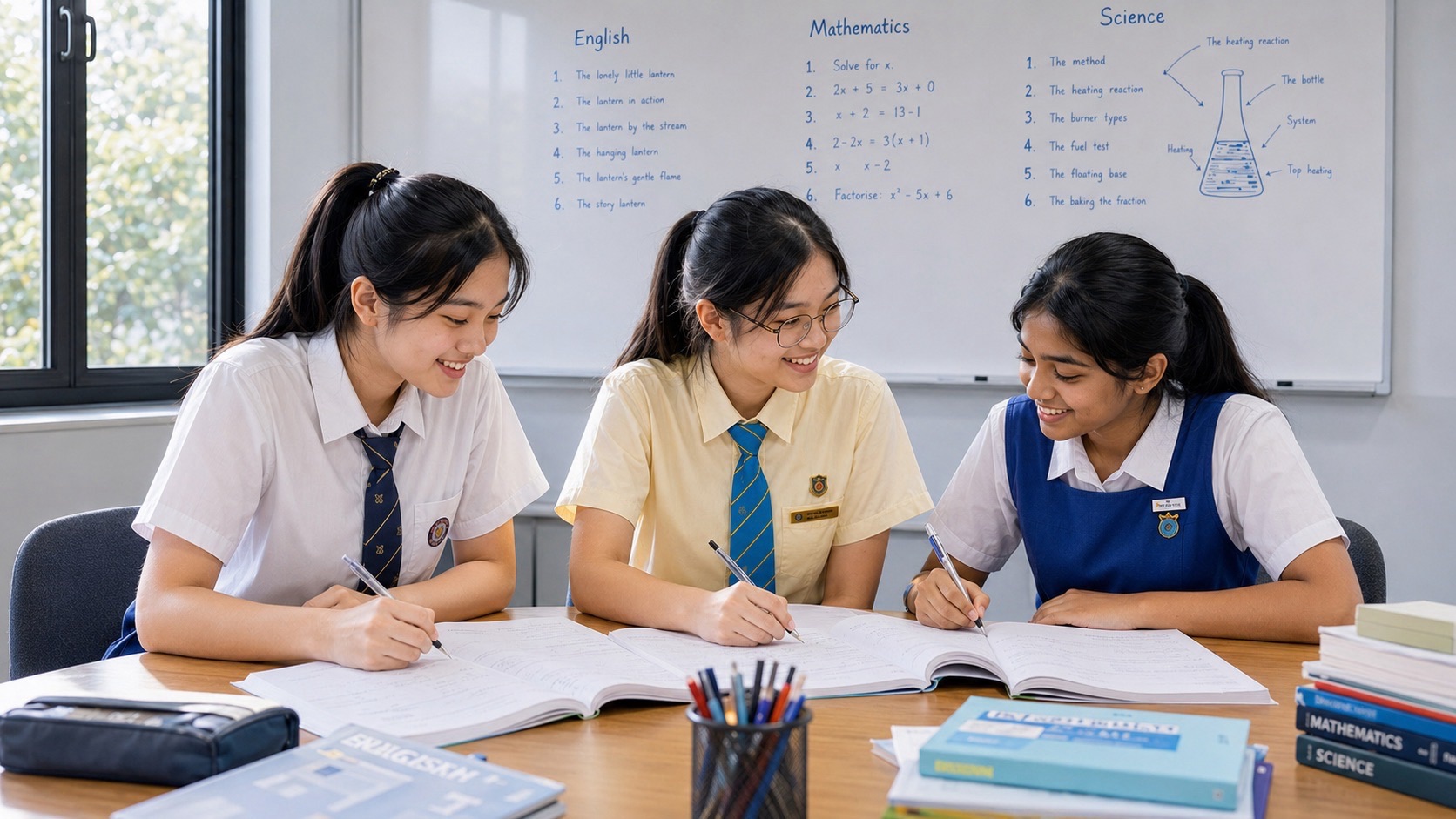
Science Education Systems · Article 14. Maya, Jia Jun, Hana and Ethan remain fictional Punggol learners. This article follows the evidence layer: how information becomes relevant to a claim, how evidence quality is judged and how conclusions should be limited by what the evidence can actually support.
The 50-second parent route
Evidence is not simply “information.”
It is information that bears on a claim.
A table can contain data.
A photograph can contain observations.
A graph can display a pattern.
A measurement can record a quantity.
A published study can report results.
None of these automatically answers the question.
The learner must connect evidence to a claim.
The evidence route is:
question → claim → relevant observation or measurement → provenance → comparison → interpretation → strength → limitation → justified conclusion → revision
The most useful sentence in Science may be:
Evidence for what?
That question prevents learners from copying numbers, quoting facts or citing observations without explaining how they matter.
This article continues from How Science Inquiry Works, How Science Experiment Design Works and How Science Explanation Works.
1. Data becomes evidence only in relation to a question
A number sits in a table.
12.
By itself, it tells us almost nothing.
Twelve centimetres?
Twelve seconds?
Twelve organisms?
Twelve volts?
Even with units, relevance is not automatic.
The question gives the number purpose.
If the investigation asks which plant grew more over a week, the relevant evidence may be change in height under comparable conditions.
If the question asks which material absorbed the most water, plant height is irrelevant even if measured perfectly.
Evidence is contextual.
2. Scientific claims come in different forms
Some claims describe.
“Plant A grew taller than Plant B over the measured period.”
Some compare.
“Material X absorbed more water than Material Y under these test conditions.”
Some explain.
“The observed difference is consistent with the material property affecting water absorption.”
Some predict.
“If the same relationship holds, increasing X should increase Y over the tested range.”
Some generalise.
“All materials of this type behave this way.”
The evidence burden rises as the claim becomes broader.
3. One observation can support a narrow claim
Maya observes that one tested object is attracted to a magnet.
That observation supports:
“This object was attracted under the test.”
It does not by itself support:
“All metal objects are magnetic.”
The second claim is much broader.
Evidence has scope.
4. Primary Science can teach scope without advanced statistics
Children do not need confidence intervals to understand:
“We tested these three objects.”
“This is what happened under our conditions.”
“We cannot automatically say every object in the category will behave identically.”
This is early scientific restraint.
5. Relevance comes before quantity
Ethan finds five facts online.
Only one addresses the question.
Five is not better than one if four are irrelevant.
Evidence quality begins with relevance.
Does this information bear directly on the claim being evaluated?
6. Direct evidence and indirect evidence play different roles
A thermometer reading is direct evidence about temperature under the measurement conditions.
A student saying “the cup felt warm” is indirect and less precise for the same quantity.
A footprint may be indirect evidence that an animal passed through an area.
Indirect evidence can be valuable.
It simply requires interpretation.
7. Observations are evidence when they are relevant and recorded carefully
Colour changed.
Bubbles appeared.
A shadow lengthened.
A plant bent toward a light source.
An object was attracted.
These observations can support scientific reasoning when connected to the question and recorded without adding unsupported interpretation.
8. Measurement can strengthen evidence by making comparison public
“Plant A looks taller” becomes:
Plant A increased by a measured amount over a stated period.
Measurement creates a common scale.
It allows another person to inspect the comparison.
But measurement quality still depends on method.
9. A number is only as trustworthy as the measurement process
Was the instrument appropriate?
Was the scale read correctly?
Were units recorded?
Was the method consistent?
Was the starting point defined?
Could reaction time matter?
Evidence inherits strengths and weaknesses from the method that produced it.
10. Provenance answers “Where did this evidence come from?”
Scientific literacy increasingly requires provenance.
Was the information measured by the learner?
Reported by a teacher?
Published by a scientific organisation?
Quoted from a secondary article?
Generated by a simulation?
Produced by AI?
Different sources deserve different levels of confidence depending on context.
11. Evidence from a simulation is evidence about the model unless tied to real-world validation
A simulation can show what its programmed model predicts.
That is useful.
But the animation itself does not prove that reality behaves exactly the same way.
The learner should distinguish:
model output
from
empirical observation.
This distinction becomes increasingly important with digital tools.
12. AI output is not automatically scientific evidence
An AI answer may summarise evidence.
It may also produce unsupported or inaccurate claims.
The learner should ask:
What source supports this?
Can I verify it?
Is the explanation consistent with established knowledge at this level?
Does the answer distinguish fact from inference?
Fluency is not provenance.
13. Comparison gives evidence meaning
Plant A grew 4 cm.
Is that a lot?
Compared with what?
Its starting height?
Plant B?
A control condition?
A previous week?
Evidence often becomes interpretable only through comparison.
14. Controls create a reference point
If one setup receives the investigated factor and another does not, the comparison can help isolate the effect.
The control is not simply “the one we leave alone.”
Its purpose is evidential.
It helps answer:
What would have happened without the change?
15. Repeats strengthen evidence differently from controls
Controls protect causal interpretation.
Repeats reveal variability.
If repeated measurements differ widely, confidence in one reading should decrease.
If they cluster closely, the result appears more stable.
These design elements answer different evidence questions.
16. More repeats cannot fix a biased method
If a ruler is used from the wrong zero point every time, repeating the same mistake ten times may produce a very consistent wrong result.
This is why reliability and accuracy cannot be collapsed into one idea.
Repeated evidence is useful only when the method itself is fit for purpose.
17. An anomaly is a signal about the evidence system
One reading lies far from the others.
Do not delete it because it is inconvenient.
Ask:
Was there a recording error?
Was the method performed differently?
Could the system genuinely vary?
Should the trial be repeated?
Anomalies can reveal hidden variables or measurement problems.
18. Patterns can support relationships
As X increases, Y increases.
As X increases, Y decreases.
Y rises then plateaus.
There is no clear trend.
One group differs from another.
These patterns become evidence when connected to a specific question or hypothesis.
19. A pattern does not explain itself
A graph rises.
That does not tell us why.
Interpretation requires scientific knowledge and a model.
Evidence and explanation are different layers.
This is why a learner can read a graph correctly and still give a weak scientific explanation.
20. Correlation is evidence of association, not automatically causation
Two variables change together.
That may support a relationship.
It does not automatically establish that one caused the other.
Could a third factor influence both?
Was the relationship tested experimentally?
What mechanism connects them?
These questions become more important as learners mature.
21. Causal evidence depends on design
A controlled experiment can strengthen the case that a manipulated factor influenced an outcome.
An observational study can reveal patterns but may leave more alternative explanations.
The correct conclusion should reflect the design.
This is evidence literacy.
22. Evidence should sometimes weaken a claim rather than simply support one
Science is not only about finding confirmation.
If a model predicts attraction and the object is not attracted, the result challenges the model.
If a hypothesis predicts a trend and no trend appears, the evidence may weaken the hypothesis.
Disconfirming evidence deserves attention.
23. One failed prediction does not always destroy a model immediately
The method could be flawed.
The measurement could be wrong.
The condition could be outside the model’s intended range.
The sample could be unusual.
The model could indeed be wrong.
Scientific reasoning asks which explanation best fits the evidence.
This is why replication and method evaluation matter.
24. Confirmation bias is an evidence-selection problem
Maya predicts that thick materials absorb more water.
She notices the two examples that fit.
She ignores the one that does not.
The evidence record becomes distorted.
Scientific discipline requires attending to inconvenient results too.
25. A good lab notebook protects against memory editing
Record what happened when it happened.
Do not reconstruct the result later to fit the conclusion.
Dates, measurements, observations and procedural notes create an evidential trail.
At school level, even a simple results table teaches this habit.
26. Evidence should distinguish observation from interpretation
Observation:
“The liquid changed from colourless to blue.”
Interpretation:
“A particular reaction may have occurred according to the tested chemical system.”
Keeping the layers distinct helps the learner see where inference enters.
27. The evidence chain can break at several points
The observation may be wrong.
The measurement may be poorly made.
The comparison may be unfair.
The data may be copied incorrectly.
The pattern may be misread.
The conclusion may overreach.
Evidence literacy means checking the whole chain.
28. Maya’s evidence weakness is selective attention
She notices the result that matches expectation first.
Her repair:
record every planned observation before interpreting.
This separates data collection from preferred conclusion.
29. Jia Jun’s evidence weakness is number copying
He writes:
“12 and 7.”
The numbers are correct.
The comparison is missing.
His repair:
state what the numbers mean for the question.
30. Hana’s evidence weakness is requiring impossible certainty
She sees a clear repeated pattern and still refuses to conclude anything because the data are not perfect.
Science rarely offers perfect certainty.
Her repair is calibration:
what conclusion is justified at the strength of evidence available?
31. Ethan’s evidence weakness is collecting too much
He finds many interesting observations.
The question needs two.
His repair is relevance control:
which evidence directly bears on the claim?
32. Primary 3 evidence begins with observable differences
Which object was attracted?
Which material allowed light through?
Which life-cycle stage came next?
Which property was observed?
The important habit is:
answer from what is observed or known, not from imagination alone.
33. Primary 4 evidence increasingly uses diagrams and simple tables
The learner must extract relevant information from representations.
Which part changed?
Which quantity is greater?
Which observation supports the answer?
Evidence is no longer always directly visible in the physical world.
34. Primary 5 evidence becomes system-based
Several observations may need to be combined.
A process may be inferred from multiple clues.
An experiment may include more conditions.
The learner must decide which data points belong to the causal chain.
35. Primary 6 evidence becomes examination infrastructure
PSLE Science may present evidence through tables, diagrams, experiment descriptions and unfamiliar contexts.
The child must identify the relevant evidence quickly and connect it to the correct concept.
Evidence selection becomes part of timed performance.
36. Secondary Science makes evidence more quantitative
More measurements.
More graphs.
More formal variables.
Longer practical methods.
Uncertainty becomes more explicit.
The learner must interpret evidence across several representations.
37. Biology evidence often contains natural variation
Living organisms are not identical components.
Samples vary.
Populations vary.
Environmental conditions vary.
Students should learn not to treat biological variation as automatically “bad data.”
Sometimes variation is part of the phenomenon.
38. Chemistry evidence often combines observation and measurement
Colour change.
Gas production.
Temperature change.
Mass.
Volume.
Time.
The learner may need to integrate qualitative and quantitative evidence to support a conclusion.
39. Physics evidence often makes measurement limitations visible
Timing errors.
Scale reading.
Parallax.
Instrument resolution.
Repeated measurements.
Scatter.
The evidence system becomes an object of analysis in its own right.
40. Tables are not evidence until read relationally
Rows and columns organise data.
The learner must still ask:
Which values should be compared?
What is held constant?
What changes?
What pattern emerges?
What claim is being evaluated?
The next article develops this in depth.
See How Science Data Interpretation Works.
41. Graphs make relationships visible but do not decide the conclusion for us
A line can rise, fall, flatten or scatter.
Scientific interpretation still depends on axes, units, range, design and background knowledge.
A graph is a representation of evidence.
It is not a substitute for reasoning.
42. Photographs can be evidence but also hide context
A photograph shows one view at one time.
What happened before?
What lies outside the frame?
Was the image edited?
What scale is shown?
Visual evidence should be interpreted with context.
43. Videos can show sequence but still require provenance
A video can reveal motion, timing and change.
But the learner should ask:
Is the clip complete?
Was it sped up?
Was it edited?
What happened outside the frame?
Digital evidence requires source literacy.
44. Published scientific evidence has a chain too
Question.
Method.
Sample.
Measurement.
Analysis.
Result.
Interpretation.
Publication.
Reporting.
By the time a child sees a headline, the original evidence may be several steps away.
Scientific literacy means learning to trace backward when stakes are high.
45. Headlines often compress uncertainty
“Scientists prove…”
“Study shows…”
“X causes Y…”
The underlying evidence may be narrower.
Students should grow into adults who ask:
What was actually studied?
How strong was the result?
Was the design experimental?
What limitations remain?
46. Expert consensus is evidence-informed knowledge, not mere popularity
Scientific consensus usually emerges from accumulated evidence, repeated testing, debate and convergence across researchers and methods.
It is not made true by voting.
Nor should expertise be dismissed because individual experts can be wrong.
A scientifically literate learner should understand why established expert consensus deserves substantial weight while remaining open to evidence-driven revision.
47. Extraordinary claims require proportionate evidence
If a claim sharply contradicts well-established knowledge, stronger evidence is needed than for an ordinary extension of what is already known.
This does not mean new ideas are forbidden.
It means the evidential burden rises with the size of the claim.
48. Evidence quality is multidimensional
Ask:
Is it relevant?
Is it direct?
Was it measured well?
Was the comparison fair?
Was it repeated?
Is the source credible?
Does another independent source agree?
What limitations remain?
No single question is enough.
49. Evidence strength should affect language strength
Weak evidence:
might suggest.
Moderate evidence:
supports.
Strong replicated evidence:
strongly supports or establishes within the relevant domain.
School language should stay age-appropriate, but the core habit is calibration.
50. “Proves” is often too strong for one school investigation
One classroom test under one set of conditions rarely establishes a universal scientific law.
Better language may be:
supports;
shows under these test conditions;
is consistent with;
provides evidence for.
The exact wording depends on the task.
The principle is evidential restraint.
51. Evidence can be sufficient for action without being perfect
Scientific judgement is not paralysis.
In real life, decisions often must be made under uncertainty.
Weather warnings.
Medical guidance.
Engineering safety.
Environmental policy.
The question becomes:
Is the evidence strong enough for the decision at hand?
Students can begin learning that evidence strength and decision stakes interact.
52. Evidence and explanation should remain distinct but connected
Evidence says what happened or what was measured.
Explanation says why or how, using a scientific model.
A strong answer may need both.
Mixing them too early can hide unsupported assumptions.
53. Evidence and argumentation should remain distinct but connected
An argument uses evidence to support a claim through reasoning.
Evidence alone is not the whole argument.
The next article, How Scientific Argumentation Works, develops this structure.
54. Evidence and inquiry form a loop
Inquiry generates evidence.
Evidence changes the model.
The changed model generates new questions.
See How Science Inquiry Works.
55. Evidence and experiment design form a chain
Weak design produces ambiguous evidence.
Strong design produces more interpretable evidence.
The experiment should be judged by the evidence it can support, not by how impressive the apparatus looks.
56. Evidence and memory interact
Learners should remember not only conclusions but also why the conclusion is trusted.
What experiment supports the model?
What observation distinguishes the categories?
What counterexample broke the misconception?
Memory becomes scientifically stronger when evidence routes are preserved.
57. Evidence and transfer interact
A new context may contain different evidence cues.
The learner must recognise which observations, measurements or patterns matter to the same underlying concept.
This is evidence transfer.
58. Small-group tuition can make evidence selection visible
Three students read the same question.
Maya points to one diagram feature.
Jia Jun points to a number.
Hana notices the control.
The tutor asks:
Which of these actually bears on the claim?
Peer contrast reveals what each learner treats as evidence.
59. Ask learners to point before they explain
“Show me the evidence.”
Point to the line.
Circle the data.
Identify the observation.
Then explain.
This simple routine prevents floating answers detached from the question.
60. Parents can use the same question lightly
“What makes you think that?”
Not as interrogation.
As a normal habit of reasoning.
If the child says, “Because I saw…” or “Because the table shows…,” evidence is entering everyday conversation.
61. But personal experience is not always enough
“It worked for me” is evidence about one experience.
It may not justify a broad claim about everyone.
This distinction becomes important in health, education, finance and technology claims later in life.
Scientific education helps learners understand the limits of anecdote.
62. Anecdotes are not worthless
A surprising individual case can generate a question.
It can reveal a possibility.
It can motivate systematic investigation.
The mistake is treating one story as sufficient evidence for a general rule.
63. Data volume can create false confidence
A spreadsheet with ten thousand rows looks impressive.
If the measurements answer the wrong question, scale does not rescue relevance.
If the sample is biased, more rows repeat the bias.
If the model is wrong, more computation can produce a more precise wrong answer.
Quantity must not replace design quality.
64. Precision is not the same as certainty
A result reported to many decimal places can look authoritative.
If the measurement method cannot support that precision, the digits are cosmetic.
Scientific evidence should respect instrument and method limits.
65. Statistical significance is not the same as practical importance
At advanced levels, learners may encounter statistical results.
A statistically detectable difference may still be too small to matter in practice.
Conversely, an important effect may be hard to estimate precisely with limited data.
Scientific judgement eventually has to ask both:
Is there evidence of an effect?
How large and meaningful is it?
66. Replication strengthens confidence
One result may be chance, error or an unusual sample.
Independent repetition under similar or varied conditions can strengthen confidence that the pattern is real.
School Science can introduce this through repeats and comparison.
Later scientific literacy expands the idea to replication across studies and research groups.
67. Converging evidence is especially powerful
Different methods point toward the same conclusion.
Observations.
Experiments.
Measurements.
Models.
Independent studies.
When multiple evidence streams converge, confidence can increase.
This is stronger than repeating one flawed method endlessly.
68. Contradictory evidence should not be hidden
If one result does not fit, include it in the reasoning.
Maybe the model needs refinement.
Maybe the method failed.
Maybe the system varies.
Science advances through anomalies because they reveal what the current explanation cannot yet handle.
69. Evidence literacy is protection against misinformation
The adult learner will encounter claims about:
health;
diet;
technology;
climate;
education;
risk;
AI;
products;
public policy.
The same questions still matter.
What is the claim?
What evidence supports it?
Where did the evidence come from?
What alternatives exist?
How strong should my confidence be?
70. A compact evidence checklist
- What is the claim?
- What evidence is being offered?
- Is it relevant?
- Is it observation, measurement, model output or reported research?
- Where did it come from?
- Was the comparison fair?
- Was the measurement appropriate?
- Were repeats or independent checks used?
- Are there anomalies?
- What alternative explanations remain?
- What does the evidence support?
- What does it not support?
- How confident should the conclusion be?
71. Frequently asked questions
What counts as scientific evidence?
Observations, measurements, experimental results, records and well-supported published findings can serve as scientific evidence when they are relevant to a specific claim and generated through appropriate methods.
Is data the same as evidence?
No. Data becomes evidence when interpreted in relation to a question or claim.
Why are controls important?
They create a meaningful comparison and reduce alternative explanations for an observed effect.
Why are repeats important?
They reveal variability and help assess whether a result is stable, but they do not automatically repair a biased or poorly designed method.
Can AI output be evidence?
AI can summarise or point toward evidence, but its output should not be treated as empirical evidence merely because it sounds authoritative. Claims should be verified against trustworthy sources and real data where relevant.
What does “evidence for what?” mean?
It asks the learner to identify the exact claim that an observation or measurement supports, weakens or fails to address.
How does evidence help PSLE Science?
Students must use information from diagrams, tables, experiment setups and observations to justify predictions, inferences and explanations.
How does evidence change in Secondary Science?
Evidence becomes more quantitative, method-dependent and explicitly linked to uncertainty, practical design and model evaluation.
72. Continue the Science Education Systems series
- Science Education Systems
- How Science Inquiry Works
- How Science Experiment Design Works
- How Science Data Interpretation Works
- How Scientific Argumentation Works
- How Science Explanation Works
Conclusion: Evidence gives Science permission to believe more strongly
At first Maya has an idea.
Jia Jun has a number.
Hana has a careful record.
Ethan has three competing explanations.
Science asks them to connect those pieces.
Which observation matters?
Which measurement is trustworthy?
Which comparison is fair?
Which source is credible?
Which pattern is real?
Which alternative explanation remains?
What does the evidence actually earn?
That last question matters most.
Evidence does not turn every claim into certainty.
It changes how much confidence the claim deserves.
Gather carefully.
Record honestly.
Compare fairly.
Interpret cautiously.
Revise willingly.
Then let the strength of the evidence determine the strength of the conclusion.


