
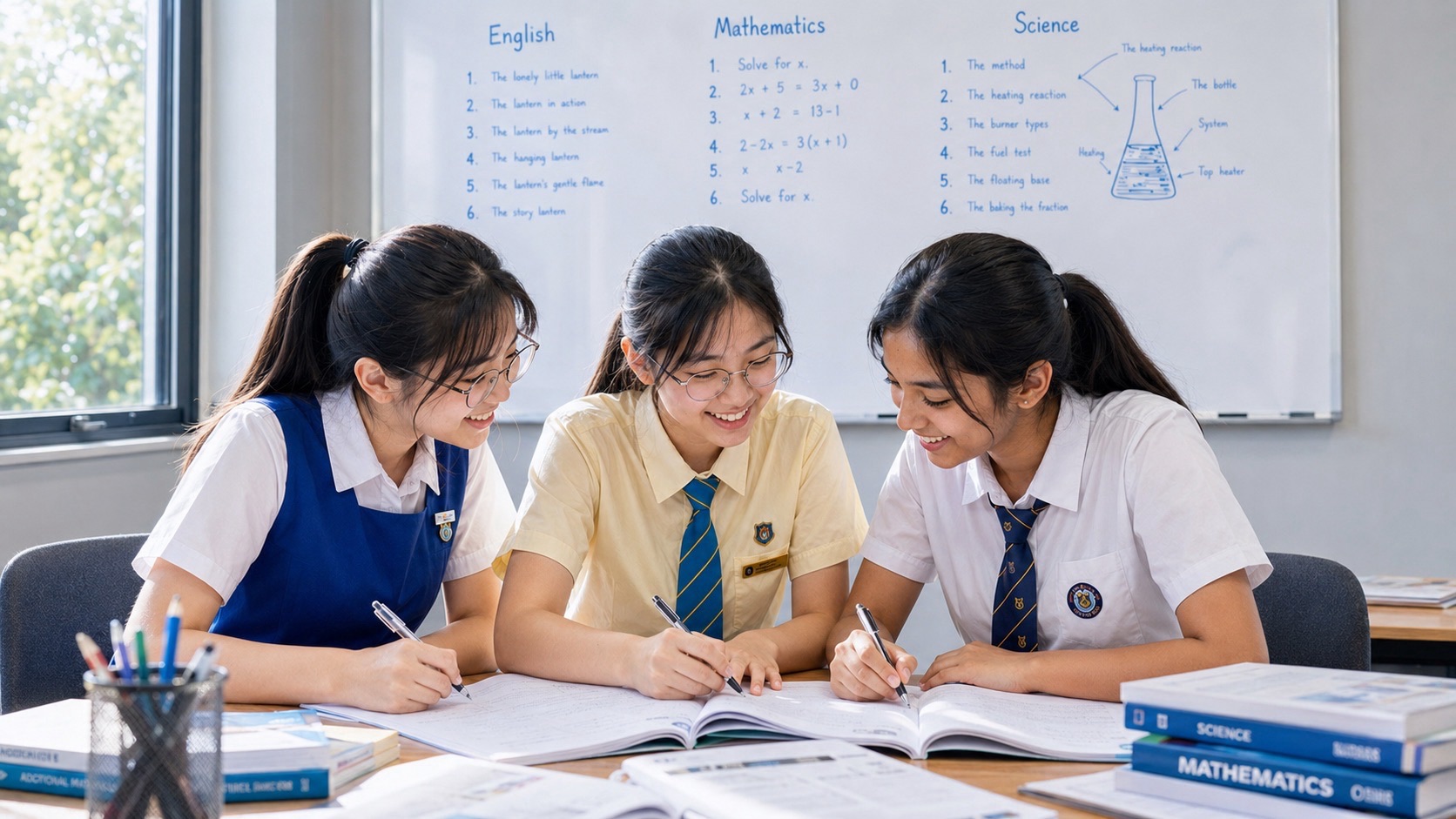
Science Education Systems · Article 8. Maya, Jia Jun, Hana and Ethan remain fictional Punggol learners. Here we follow how isolated facts become a connected scientific network that can support transfer, assessment and later learning.
The 50-second parent route
A child can know many Science facts and still be unable to use them.
The problem is not always storage.
Sometimes it is routing.
A fact sits alone.
The learner cannot find it when the question changes.
Cannot connect it to another process.
Cannot recognise it in a new diagram.
Cannot explain why it matters.
A knowledge network solves this by building meaningful edges.
The progression is:
fact → concept → contrast → representation → mechanism → connection → retrieval route → transfer
In a strong Science network, “photosynthesis” is not one paragraph in a notebook. It connects to light, water, carbon dioxide, plant structure, food production, gas exchange, energy, ecosystems and later biological ideas.
The network is what lets the learner enter from different questions and still reach the right concept.
This article completes the second four-article batch after How Science Curriculum Coherence Works, How Science Misconception Repair Works and How Scientific Models Grow With the Learner.
1. Knowledge can be present but unreachable
Jia Jun learned the concept last month.
The tutor asks him directly.
He answers.
Then the same concept appears inside an unfamiliar problem.
He says:
“I don’t know this one.”
The knowledge did not disappear.
The route disappeared.
This is one of the most important distinctions in learning.
Having information and being able to retrieve the right information under changing conditions are different capabilities.
2. Facts are necessary nodes
Knowledge networks are not an argument against facts.
The network needs nodes.
Vocabulary.
Definitions.
Processes.
Structures.
Properties.
Relationships.
Quantities.
Principles.
Without sufficiently accurate nodes, connections become vague.
The goal is not fewer facts.
It is usable facts.
3. Edges give facts meaning
“Chlorophyll” alone is a term.
Connect it to light absorption and photosynthesis and it gains function.
Connect photosynthesis to food production and gas exchange and the network widens.
Connect the plant to an ecosystem and the concept becomes part of a larger system.
An edge answers:
How is this related to that?
4. Not all edges are equally useful
A learner can create superficial connections.
“Both chapters have plants.”
True, but low value.
A stronger edge is relational:
“The structure of the leaf supports a process that affects gas exchange and food production.”
Useful edges carry mechanism, contrast, sequence, evidence or function.
5. Curriculum coherence builds the large roads
The curriculum determines which major ideas recur.
Structure and function.
Systems.
Interactions.
Matter.
Energy.
Cycles.
Evidence.
These become large roads through the knowledge landscape.
See How Science Curriculum Coherence Works.
6. Misconception repair redraws bad roads
A misconception is often a wrong edge.
metal → magnetic.
soil → plant food.
larger → heavier.
motion → force must be acting in same direction.
Repair is not only replacing a node.
It is removing or qualifying a connection and building a better one.
See How Science Misconception Repair Works.
7. Models create compression hubs
A model can connect many observations at once.
The particle model helps explain several properties and changes of matter.
Energy models connect apparently different physical and biological processes.
Structure-function reasoning connects many Biology topics.
A strong model becomes a hub because several facts can route through one explanatory structure.
See How Scientific Models Grow With the Learner.
8. Maya’s early network is visual
Maya remembers the picture.
She knows the magnet diagram because the poles are coloured.
She remembers a life-cycle page because the butterfly is in the top corner.
This is a network too.
But the edges are tied to surface appearance.
As she grows, the network must become more conceptual.
9. Jia Jun’s early network is compressed
Jia Jun stores keywords.
Waterproof.
Attract.
Germination.
Conductor.
The nodes are efficient.
The edges are weak.
He needs to attach each term to meaning, example, contrast and use.
10. Hana’s early network is precise but narrow
Hana stores correct relationships carefully.
But she may hesitate when the context changes because she does not yet know whether the relationship transfers.
Her network needs more varied entry points.
New diagrams.
New objects.
New wording.
Same concept.
11. Ethan’s network is wide but sometimes undisciplined
Ethan connects everything.
One Science question reminds him of a documentary, a fact about space and something he saw online.
Rich network.
Weak relevance control.
He needs to rank edges:
Which connection actually answers the question?
12. A strong network balances breadth and control
Too narrow and the learner cannot transfer.
Too broad and every thought competes.
The skill is selective activation.
What matters here?
Which concept is upstream?
Which evidence constrains the answer?
Which connections can be ignored?
13. Vocabulary nodes should have at least four edges
For an important scientific term, connect:
meaning
example
contrast
question use
Transparent.
Meaning: allows light through so objects can be seen clearly.
Example: a suitable clear window material.
Contrast: not merely shiny; distinguish from translucent or opaque where relevant.
Question use: suitability when visibility through the material matters.
Now the word is harder to misuse.
14. Concept nodes should connect to mechanisms
“Photosynthesis” should not float as a definition.
What inputs are involved?
What role does light play?
What is produced?
Where does the process fit into the plant’s wider system?
What observable consequences follow when conditions change?
Mechanistic edges make the node usable.
15. Mechanisms should connect to evidence
A model becomes scientifically meaningful when evidence can bear on it.
If the learner says light matters to a process, what investigation or observation could support that claim?
If a material property explains suitability, what test would reveal the property?
If a graph shows a relationship, what measurements created the graph?
Evidence edges prevent knowledge from becoming purely verbal.
16. Evidence should connect back to claims
Data without a claim is information.
A networked learner asks:
What does this result support?
What does it challenge?
What does it fail to establish?
This creates a reversible route:
claim → predicted evidence
and
evidence → justified conclusion.
17. Contrasts create high-value edges
Observation / inference.
Mass / weight.
Heat / temperature.
Metallic / magnetic.
Evaporation / boiling.
Physical / chemical change.
Correlation / causation.
Contrast tells the learner where one concept ends and another begins.
These edges are especially valuable because many examination errors occur between near neighbours.
18. Sequence creates temporal edges
Life cycles.
Water cycle.
Digestive processes.
Experimental procedures.
Energy changes.
Causal explanations.
Sequence language creates order.
Before.
After.
Then.
As a result.
Without temporal edges, the learner may know all the parts but reverse the mechanism.
19. Structure-function creates powerful Biology edges
What is the structure?
What function does it support?
Why does that feature help?
This relationship appears repeatedly from Primary Science into Biology.
Roots.
Leaves.
Cells.
Organs.
Adaptations.
Once the edge is familiar, new biological knowledge becomes easier to organise.
20. Matter-property creates powerful Chemistry edges
What is the substance?
What properties does it show?
How do those properties relate to particle structure or interactions at a later level?
How does change alter the system?
Primary materials can become an early route toward later matter concepts.
21. Interaction-change creates powerful Physics edges
What interacts?
What force or transfer occurs?
What changes?
What quantity represents the change?
Magnets, forces, electricity, heat and waves can all develop through increasingly precise interaction models.
22. Energy can become a cross-disciplinary hub
Energy appears in food.
Movement.
Electricity.
Heating.
Light.
Chemical processes.
Biological systems.
A coherent Science network does not force all topics into one vague energy story, but it recognises energy as a recurring organising idea whose treatment deepens with level.
23. Systems can become another cross-disciplinary hub
Plant systems.
Human body systems.
Ecosystems.
Electrical systems.
Mechanical systems.
Earth systems.
The recurring question is:
How do parts interact to produce whole-system behaviour?
That question is highly transferable.
24. Representation nodes connect the same concept across formats
Word.
Picture.
Diagram.
Table.
Graph.
Equation.
Simulation.
A learner should not store these as separate topics when they describe the same relationship.
Translation builds edges among formats.
25. Retrieval strengthens the roads that are actually used
Rereading can increase familiarity without testing navigation.
Retrieval forces the learner to travel the network.
Close the notes.
Start from the question.
Find the concept.
Explain the relationship.
Draw the model.
Return later.
Routes become stronger through use.
26. Mixed retrieval creates alternative entry points
A topic-labelled worksheet says where to enter.
A mixed set does not.
The learner must route from the problem.
This strengthens flexible access.
Which concept?
Which model?
Which evidence?
Which explanation shape?
27. Interleaving prevents the network from becoming one long corridor
If ten near-identical questions appear together, the first solved question can cue the next nine.
This builds local fluency.
Useful, but limited.
Interleaving mixes related problem types so the learner must discriminate among them.
Which method fits?
Which concept does not?
Discrimination strengthens routing.
28. Spacing keeps old regions of the network alive
Without return, recent topics dominate retrieval.
Spacing reactivates older knowledge.
One week.
Three weeks.
Two months.
Inside another chapter.
Before a cumulative paper.
The exact schedule can vary.
The principle is deliberate return.
29. Elaboration adds meaning when it creates useful edges
“Why does this make sense?”
“How is this similar to something we learned earlier?”
“What would be a non-example?”
“What would change if this condition changed?”
These questions elaborate by connection.
Elaboration should not become decorative extra information.
The new edge should improve understanding or retrieval.
30. Self-explanation reveals missing edges
A student says:
“I understand it.”
Ask for explanation.
Where the sentence breaks often shows where the network is weak.
The learner knows A.
Knows C.
Cannot explain B.
That missing edge becomes the teaching target.
31. Drawing a concept map can reveal architecture
Concept maps are useful when relationships are labelled.
Not merely bubbles and arrows.
“Light” → required for → “photosynthesis.”
“Photosynthesis” → produces → “food.”
“Leaf structure” → supports → “gas exchange.”
The relation word matters.
It turns proximity into meaning.
32. A weak concept map can still be diagnostically useful
If the learner links everything to everything, relevance control is weak.
If the learner produces isolated nodes, relationships are weak.
If arrows have no labels, causal or functional meaning may be unclear.
If one hub dominates incorrectly, a misconception may be organising the network.
The map gives the tutor a visual diagnostic.
33. Error logs can become network repair maps
Instead of recording only wrong questions, record:
which concept was missing;
which edge was wrong;
which contrast was confused;
which representation failed;
which retrieval route did not activate.
Then target the network, not the page.
34. Transfer is network navigation under changed surface conditions
A new context removes familiar cues.
If the learner can still reach the underlying concept, the network is flexible.
A changed object.
A changed diagram.
A new organism.
A different graph.
Same relationship.
Transfer is therefore a network stress test.
35. Novel questions reward structural knowledge
Students sometimes say:
“Teacher never taught this question.”
Often the surface is new but the underlying concept is not.
The learner needs to identify the structure.
What is interacting?
What changes?
What evidence is supplied?
Which model predicts the result?
Structural knowledge makes novelty less frightening.
36. PSLE Science is partly a network routing examination
The paper is cumulative.
Topics are mixed.
Contexts can be unfamiliar.
Representations change.
The learner must enter the network from the question and reach the appropriate concept quickly.
This is why mixed retrieval, transfer and model fluency matter.
See Primary 6 Science and PSLE Science in Punggol.
37. Secondary Science expands both node count and edge complexity
More vocabulary.
More models.
More equations.
More variables.
Longer causal chains.
More specialised representations.
The learner cannot survive by adding isolated flashcards forever.
Organisation becomes increasingly important.
38. Physics networks often depend on quantitative edges
Force relates to acceleration.
Speed relates distance and time.
Voltage, current and resistance become connected quantities.
Energy changes can be represented quantitatively.
Equations become explicit edges among variables.
Understanding means knowing what the relationship says, not only how to substitute numbers.
39. Chemistry networks often depend on representation translation
Substance names.
Particle models.
Formulae.
Equations.
Observations.
Properties.
Chemical reasoning requires moving among these nodes and representations without losing the underlying mechanism.
40. Biology networks often depend on nested systems
Molecule.
Organelle.
Cell.
Tissue.
Organ.
System.
Organism.
Population.
Ecosystem.
Different scales connect.
Students need to know which scale the question is asking about.
41. Scale is a network organiser
One phenomenon can be explained at several scales.
Macroscopic.
Microscopic.
Cellular.
Organismal.
Ecological.
Quantitative.
A strong learner knows when to zoom.
This is related to model resolution.
42. Time is another network organiser
Instant interactions.
Short-term changes.
Life cycles.
Seasonal patterns.
Evolutionary timescales later.
Scientific explanations often depend on the timescale being considered.
Sequence and rate therefore become important edges.
43. Cause is another network organiser
What causes what?
What mechanism sits between them?
What alternative explanation exists?
What evidence supports the causal link?
Causal networks help learners avoid isolated “because” sentences with missing mechanisms.
44. Conditions qualify edges
Scientific relationships are often conditional.
Under certain conditions.
Within a range.
If another variable is held constant.
At a particular stage.
Students who memorise unqualified rules overgeneralise.
A mature knowledge network stores boundaries.
45. Confidence should attach to evidence strength
Not every edge deserves equal confidence.
Some are directly established in the school model.
Some are plausible inferences.
Some are hypotheses.
Some are speculation.
Ethan’s growth is partly learning to tag connections by confidence.
This matters far beyond school.
46. Online information can pollute a network with false edges
The learner watches a video.
Reads a post.
Gets an AI explanation.
A new connection appears.
If unchecked, it may integrate with accurate knowledge and become hard to remove.
Scientific literacy therefore includes source checking and evidence comparison before accepting high-impact new edges.
47. AI can help build networks if used deliberately
Useful tasks include:
“Show me how these three concepts connect.”
“Give me a concept map, but label every relationship.”
“Create three transfer questions that use the same underlying idea in different contexts.”
“Give me one counterexample to my rule.”
“Ask me to explain the mechanism without using the keyword.”
The learner should verify content and remain responsible for the network.
48. The teacher designs shared roads; the learner builds a personal map
A curriculum gives common structure.
Every learner’s actual network differs.
Maya may connect strongly through visual representation.
Jia Jun through compact rules.
Hana through precise distinctions.
Ethan through broad analogies and hypotheses.
Teaching should respect different entry routes while ensuring the scientific edges remain accurate.
49. Small-group tuition makes networks audible
Ask students to explain the same question.
One routes through a property.
One through a diagram.
One through a remembered example.
The tutor can hear whether the routes converge on the right relationship.
Peer explanation also gives learners alternative entry points.
That is a major advantage when group reasoning is used deliberately.
50. The danger of the answer key
An answer key gives the destination.
It may hide the route.
If the learner only compares final answers, network weaknesses remain invisible.
Better correction asks:
Which concept did I use?
Which evidence mattered?
Which edge was missing?
Which wrong connection led me elsewhere?
51. The danger of copying notes
Beautiful notes can display nodes without proving edges.
Definitions.
Labels.
Colours.
Boxes.
The stronger notebook includes:
why;
because;
compared with;
leads to;
different from;
evidence;
counterexample;
common mistake.
These are relationship markers.
52. The danger of too many resources
More books can create more disconnected notes.
More videos can create more vocabulary.
More websites can create more examples.
The learner still needs integration.
One coherent model understood deeply may be more valuable than five competing explanations that are never reconciled.
53. A weekly network-building routine
At the end of a Science week:
- Retrieve one key concept without notes.
- State one useful contrast.
- Draw or explain one representation.
- Connect the concept to one earlier idea.
- Answer one changed-context question.
- Record one misconception or boundary.
This can take less time than another long worksheet while improving organisation.
54. A term-end network audit
Ask the learner to build a one-page map of the term.
Then test:
Can every major node be explained?
Are relationship arrows labelled?
Are important contrasts present?
Are old topics connected?
Can the learner use the map to answer a new question?
The map is not the final product.
It is a diagnostic instrument.
55. A PSLE network should compress four years without flattening them
By Primary 6, the learner needs topic knowledge and cross-topic routes.
Useful hubs might include:
systems;
energy;
cycles;
interactions;
materials and properties;
structure and function;
variables and evidence;
representation and explanation.
These hubs help mixed questions feel navigable.
56. Secondary networks need stronger Mathematics edges
Graphs, formulas, rates, ratios and units become more important.
The learner should link the mathematical form to scientific meaning.
Gradient is not only a calculation.
It may represent a rate.
A formula is not only something to rearrange.
It encodes a relationship.
This is where the Science and Mathematics estates should connect without losing subject ownership.
57. Secondary networks need stronger language edges too
As explanations become longer, sentence structure must carry mechanism.
Students need language for:
qualification;
causality;
comparison;
sequence;
evaluation;
uncertainty.
The language is not ornamental.
It is part of the reasoning interface.
58. The network should eventually support self-teaching
A mature learner encounters a new topic.
Instead of beginning from zero, the learner asks:
What does this connect to?
Which model family is familiar?
Which representation is new?
Which prerequisite do I need?
Which misconception might I be carrying?
How can I test my understanding?
That is educational independence.
59. Scientific literacy is a network that remains useful after school
Adult life presents mixed questions.
Health claims.
Environmental trade-offs.
Technology.
Energy.
Risk.
Data.
AI.
Food.
Engineering.
Public policy.
No chapter heading tells the adult which concept to use.
A connected knowledge network makes informed reasoning possible.
60. Frequently asked questions
What is a Science knowledge network?
It is an organised set of scientific facts, concepts, models and representations connected by meaningful relationships such as cause, function, sequence, contrast, evidence and dependency.
Why can my child remember a topic but fail an unfamiliar question?
The knowledge may be stored with narrow surface cues. Transfer requires stronger conceptual routes that can be activated from a changed context.
Are facts still important?
Yes. Facts are the nodes. The goal is to connect them so they can be retrieved and applied accurately.
How do concept maps help?
They can expose which relationships the learner understands, provided the arrows are labelled with meaningful connections rather than used decoratively.
Why is mixed practice useful?
It removes topic cues and forces concept selection, strengthening flexible retrieval routes.
How does spacing help?
Spacing reactivates older regions of the network so recent learning does not crowd them out.
How does this help PSLE Science?
PSLE is cumulative and mixed. A strong network supports quick routing from unfamiliar questions to the relevant concepts and evidence.
How does this help Secondary Science?
Secondary Science adds more nodes, abstract models, equations and longer causal chains. Good organisation becomes increasingly important as complexity rises.
Can AI help build knowledge networks?
Yes, through concept comparisons, transfer questions and labelled maps, but the learner should verify accuracy and remain responsible for understanding the connections.
61. Continue through the Science Education Systems series
- Science Education Systems
- How Scientific Thinking Is Built
- How Science Learning Progresses
- How Science Assessment Works
- How Science Curriculum Coherence Works
- How Science Misconception Repair Works
- How Scientific Models Grow With the Learner
Wider eduKate Science routes:
- How Science Works
- The eduKate Science Learning Manual
- eduKate Sengkang Science Hub
- Science Tuition at eduKatePunggol
- Punggol as a Classroom
Conclusion: The goal is not to know everything; it is to know how what you know fits together
At first, Maya remembers pictures.
Jia Jun remembers words.
Hana remembers precise explanations.
Ethan remembers connections.
Each memory style is useful.
Each becomes stronger when the knowledge is organised.
Facts become concepts.
Concepts acquire contrasts.
Models connect observations.
Representations connect formats.
Mechanisms connect causes and effects.
Evidence connects claims to reality.
Retrieval connects the past lesson to the present question.
Transfer connects school to the unfamiliar.
Eventually the learner no longer searches for the page that looks the same.
The learner asks:
What structure is underneath this question?
What do I already know that connects?
Which model is useful?
What evidence matters?
What relationship must I explain?
That is what a knowledge network is for.
Not to make Science smaller.
To make a large Science world navigable.


