
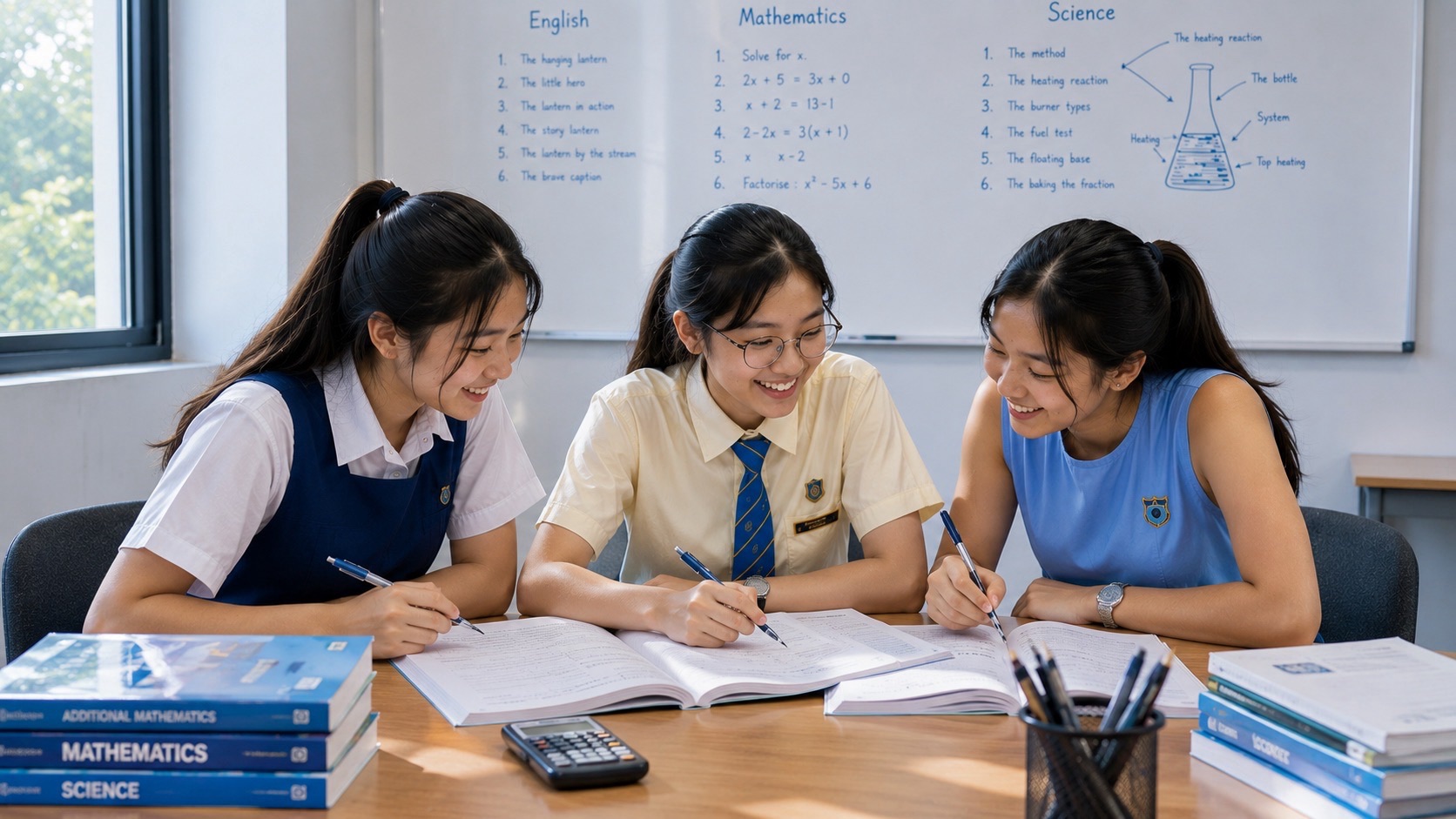
Science Education Systems · Article 28. Maya, Jia Jun, Hana and Ethan remain fictional Punggol learners. This article follows the decision-making layer: how scientific knowledge becomes action without pretending evidence alone decides every value judgement.
The 50-second parent route
Science can tell us what is likely to happen.
It cannot always tell us what we should choose.
Decision-making sits at the boundary between evidence and values.
The route is:
decision → options → evidence → causal model → uncertainty → probability → consequence → trade-off → ethics → reversibility → action → monitoring → update
The key question is not only:
What is true?
It is also:
Given what we know, what action is proportionate?
This article completes the Articles 25–28 batch after How Scientific Classification Works, How Scientific Causality Works and How Scientific Systems Thinking Works.
1. A decision begins by defining what must be chosen
“What should we do?” is too broad.
Choose between which options?
For what goal?
Under what constraints?
By when?
For whom?
Decision quality begins with decision clarity.
2. Science informs decisions through consequences
If we choose option A, what is likely to happen?
If we choose option B?
Scientific models estimate consequences.
Decision-making compares those consequences against goals and values.
3. Facts and values should not be confused
Science may estimate that one intervention reduces a risk.
Society must still decide how much cost, inconvenience or restriction is acceptable.
Evidence constrains the choice.
Values help rank the options.
4. Primary Science can begin decision-making through material choice
Which material is best for an umbrella?
The child considers:
waterproofness;
flexibility;
strength;
weight;
cost if introduced.
One property rarely decides everything.
5. Suitability is a multi-criteria decision
A material can be strong but heavy.
waterproof but brittle.
light but expensive.
Decision-making requires trade-offs.
Science supplies property evidence; the design goal determines which properties matter most.
6. Trade-offs are not failures
Many real decisions do not have one option that dominates every criterion.
Better speed may reduce energy efficiency.
greater safety may increase cost.
higher sensitivity may increase false alarms.
Good decisions make trade-offs explicit.
7. Risk combines probability and consequence
A very unlikely but catastrophic event may deserve attention.
A common but trivial inconvenience may deserve less.
Risk reasoning requires both likelihood and severity.
8. Probability without consequence is incomplete
“There is only a 1 percent chance.”
One percent chance of what?
A minor delay?
A major injury?
A system-wide failure?
The consequence changes the decision.
9. Consequence without probability is incomplete too
“This could be catastrophic.”
How likely is it?
Every action has imaginable worst cases.
Decision-making needs proportion.
10. Uncertainty should change the decision process
When evidence is strong, decisions can be firmer.
When evidence is weak but consequences are severe, precaution may matter.
When uncertainty is high and action is reversible, experimentation may be sensible.
Decision structure should respond to uncertainty.
11. Reversible and irreversible decisions should be treated differently
A small reversible classroom trial can be tested and changed.
A permanent environmental intervention deserves more caution.
Reversibility affects how much evidence is needed before acting.
12. The cost of delay matters
Waiting for more evidence is itself a choice.
If delay creates harm, demanding perfect certainty can be irresponsible.
Good decisions compare the risks of action with the risks of inaction.
13. The cost of premature action matters too
Acting on weak evidence can waste resources, create harm or lock a system into the wrong path.
Decision-making balances both errors.
14. False positives and false negatives are decision errors
A medical test may falsely identify disease.
Or miss disease that is present.
A safety system may trigger unnecessarily.
Or fail to trigger when danger is real.
The relative cost of these errors matters.
15. Thresholds convert evidence into action
Above a certain risk, act.
Below, monitor.
Thresholds are not always purely scientific.
They often combine evidence with policy, cost and ethics.
16. Maya’s decision weakness is choosing after the first vivid clue
One dramatic observation dominates her thinking.
Her repair:
list the decision criteria before comparing options.
17. Jia Jun’s decision weakness is single-metric thinking
He chooses the fastest, strongest or cheapest option automatically.
His repair:
ask what other criteria matter.
18. Hana’s decision weakness is waiting for certainty
She wants complete evidence before acting.
Her repair:
compare the cost of waiting with the cost of acting under uncertainty.
19. Ethan’s decision weakness is option explosion
He generates twelve possible interventions.
His repair:
eliminate dominated or impractical options first.
20. Decision matrices can make trade-offs visible
Options across rows.
criteria across columns.
evidence in the cells.
Weights where appropriate.
A matrix does not make the decision automatically.
It makes assumptions inspectable.
21. Weighting criteria introduces values
Safety weight = high.
cost weight = moderate.
speed weight = low.
Those weights are not discovered by experiment alone.
They reflect priorities.
22. Sensitivity analysis tests whether the decision is robust
If small changes in assumptions reverse the preferred option, the decision is fragile.
If one option remains best across reasonable assumptions, confidence increases.
23. Robust decisions perform reasonably well across uncertain futures
The “optimal” choice under one exact forecast may fail badly if the forecast is slightly wrong.
A robust choice sacrifices a little peak performance for better performance across plausible conditions.
24. Systems thinking improves decisions
An intervention changes one part of a system.
What happens elsewhere?
Feedback.
delays.
resource shifts.
unintended consequences.
See How Scientific Systems Thinking Works.
25. Causal thinking improves decisions
If the goal is to change an outcome, the intervention must act on a genuine cause or mechanism.
Correlation alone may lead to ineffective action.
See How Scientific Causality Works.
26. Classification improves decisions by defining states
Safe / unsafe.
high risk / low risk.
infected / not infected.
urgent / routine.
But classification errors propagate into action.
Decision systems should understand their thresholds.
27. Measurement quality affects decision quality
If the sensor is biased, the decision threshold may be crossed incorrectly.
If the measurement is noisy, repeated readings may be needed.
Upstream evidence quality matters.
28. Data visualisation affects decisions
A misleading graph can make a small effect look large.
A poor scale can hide a trend.
Decision-makers should inspect the underlying data and representation.
29. Consensus helps when individual verification is impossible
No parent can personally reproduce every medical trial.
No citizen can independently measure every climate variable.
Strong expert consensus can rationally inform decisions when it rests on broad evidence.
See How Scientific Consensus Works.
30. Consensus is input, not automatic policy
Experts may agree on likely outcomes while policymakers disagree about cost, fairness or acceptable risk.
Decision-making should separate scientific disagreement from value disagreement.
31. Ethics constrains acceptable options
An intervention may be effective and still unacceptable because it violates rights, creates disproportionate harm or exploits vulnerable groups.
See How Scientific Ethics Works.
32. Efficiency is not the only objective
Fastest.
cheapest.
highest output.
Those metrics can matter.
But resilience, fairness, safety and sustainability may matter too.
33. Resilience matters under uncertainty
A system designed only for average conditions can fail during shocks.
Buffers and redundancy may look inefficient until disruption arrives.
34. Safety margins are decisions about uncertainty
Engineering does not normally design exactly at the expected breaking point.
Margins account for variability, unknowns and consequences of failure.
Scientific uncertainty becomes design policy.
35. Precaution is appropriate in some high-consequence situations
When potential harm is severe and uncertainty substantial, decision-makers may act before certainty is complete.
But precaution should also be proportional.
Invoking danger without evidence can itself cause harm.
36. Expected value is one decision tool
Probability × consequence can produce an expected outcome measure in some contexts.
This is useful but incomplete when consequences are highly unequal, irreversible or ethically sensitive.
37. Utility extends beyond money
Time.
health.
comfort.
fairness.
environmental impact.
Decision-making often combines dimensions that do not share one natural unit.
38. Multi-criteria decisions require transparent priorities
If safety outweighs cost, say so.
If speed matters only after reliability crosses a threshold, say so.
Hidden priorities make decisions hard to audit.
39. Evidence should update decisions
A plan is chosen.
New data arrives.
Do not defend the old choice because effort has already been invested.
Update when the evidence meaningfully changes.
40. Sunk-cost thinking is a decision trap
“We have already spent so much, so we must continue.”
Past cost cannot be recovered.
The relevant question is whether continuing is still the best choice from now onward.
41. Monitoring turns decisions into experiments
Choose an intervention.
Define expected signals.
measure outcomes.
compare with baseline.
adjust.
Decision-making becomes an adaptive loop.
42. Exit criteria should be defined before emotion takes over
When will we stop?
When will we escalate?
What result counts as success?
What failure signal triggers review?
Predefined criteria reduce moving goalposts.
43. Reversible experiments are powerful under uncertainty
When safe and ethical, try a small-scale version first.
Measure.
learn.
then scale.
Pilots convert uncertainty into evidence.
44. Scaling changes systems
A solution that works for ten people may fail for ten thousand.
Resource constraints.
coordination.
feedback.
behavioural adaptation.
Scale itself can create new causal conditions.
45. Decision quality and outcome quality are different
A good decision can produce a bad outcome because uncertainty remains.
A bad decision can get lucky.
Evaluate the process as well as the result.
46. This distinction is essential for learning
Maya chooses the better-supported answer and happens to be wrong due to an unusual case.
Do not teach her that the reasoning was useless.
Ask whether the process was sound given the evidence available.
47. Primary 3 decision-making can be simple
Choose a material for a purpose.
State the relevant property.
Explain why it fits.
The child learns evidence-based suitability.
48. Primary 4 decision-making can add comparison
Option A has one advantage.
Option B another.
Which matters more for this task?
Trade-offs become visible.
49. Primary 5 decision-making can add systems
Change one part and trace downstream consequences.
The learner begins to see why local improvements can create system costs.
50. Primary 6 decision-making can add uncertainty
Evidence is incomplete.
Which conclusion is best supported?
Which action would be safest or most suitable under the given conditions?
Students learn calibrated judgement.
51. Secondary Science expands decision-making into risk and modelling
Energy choices.
environmental trade-offs.
medical evidence.
engineering design.
data uncertainty.
Students can evaluate options using multiple scientific criteria.
52. Scientific literacy is decision literacy
The purpose of understanding evidence is not only to answer questions.
It is to make better choices in health, technology, environment and public life.
See How Scientific Literacy Works.
53. AI can support decision analysis
Useful prompts:
“List the options and criteria.”
“What evidence supports each consequence?”
“What assumptions would reverse the recommendation?”
“What unintended consequences are plausible?”
“Which parts are value judgements rather than scientific facts?”
54. AI should not hide the decision-maker’s values
A recommendation can appear objective while silently weighting speed, cost or risk.
The learner should ask:
What objective is being optimised?
Whose costs count?
Which trade-offs were assumed?
55. AI should not be mistaken for final authority in high-stakes decisions
Health.
safety.
legal rights.
critical infrastructure.
Human expertise, accountability and appropriate institutions remain essential.
56. Parents can model decision-making with ordinary choices
“Which route should we take?”
Time.
weather.
cost.
reliability.
“Which study schedule is better?”
energy.
sleep.
deadlines.
trade-offs.
Everyday decisions can teach evidence-weighted thinking.
57. Small-group tuition can make decision criteria explicit
Three students choose different answers.
The tutor asks:
What objective are you optimising?
Which evidence matters?
What risk did you ignore?
What trade-off did you accept?
Decision reasoning becomes visible.
58. A compact Science decision-making checklist
- What decision must be made?
- What are the realistic options?
- What goal are we trying to achieve?
- What scientific evidence predicts each option’s consequences?
- How strong is the causal model?
- What uncertainty remains?
- What is the probability of harm or benefit?
- How serious are the consequences?
- What trade-offs exist?
- What ethical constraints matter?
- Is the decision reversible?
- What is the cost of waiting?
- What evidence should be monitored after action?
- What signal would make us change course?
59. Frequently asked questions
Can Science tell us what decision to make?
Science can estimate consequences and risks, but many decisions also require values, priorities, ethics and resource constraints.
What is risk?
Risk combines the likelihood of an outcome with the seriousness of its consequence.
Why does reversibility matter?
Reversible decisions can often be tested and adjusted, while irreversible choices usually deserve stronger evidence and caution.
What is a trade-off?
A trade-off occurs when improving one objective worsens another, such as increasing safety at greater cost or increasing speed while reducing efficiency.
Why monitor after acting?
Because decisions are made under uncertainty. Monitoring provides new evidence that can confirm, refine or reverse the original choice.
How does decision-making help PSLE Science?
It supports suitability questions, evidence-based comparisons, system reasoning and choosing conclusions that match experimental evidence.
How does decision-making change in Secondary Science?
It becomes more quantitative and multi-criteria, incorporating probability, uncertainty, environmental trade-offs, engineering constraints and ethical reasoning.
60. Continue the Science Education Systems series
- How Scientific Classification Works
- How Scientific Causality Works
- How Scientific Systems Thinking Works
- How Scientific Literacy Works
- How Scientific Ethics Works
Conclusion: Science earns its place in action by remaining honest about uncertainty
Maya sees the option that looks best.
Jia Jun sees the number.
Hana sees the uncertainty.
Ethan sees the system consequences.
Decision-making asks them to combine those views.
Define the goal.
compare the options.
trace the causes.
measure the risk.
respect the uncertainty.
make the trade-off visible.
apply the ethical boundary.
act proportionately.
monitor.
update.
Science does not remove responsibility from the decision-maker.
It gives the decision-maker a better map of the consequences.
The final act remains human.


