
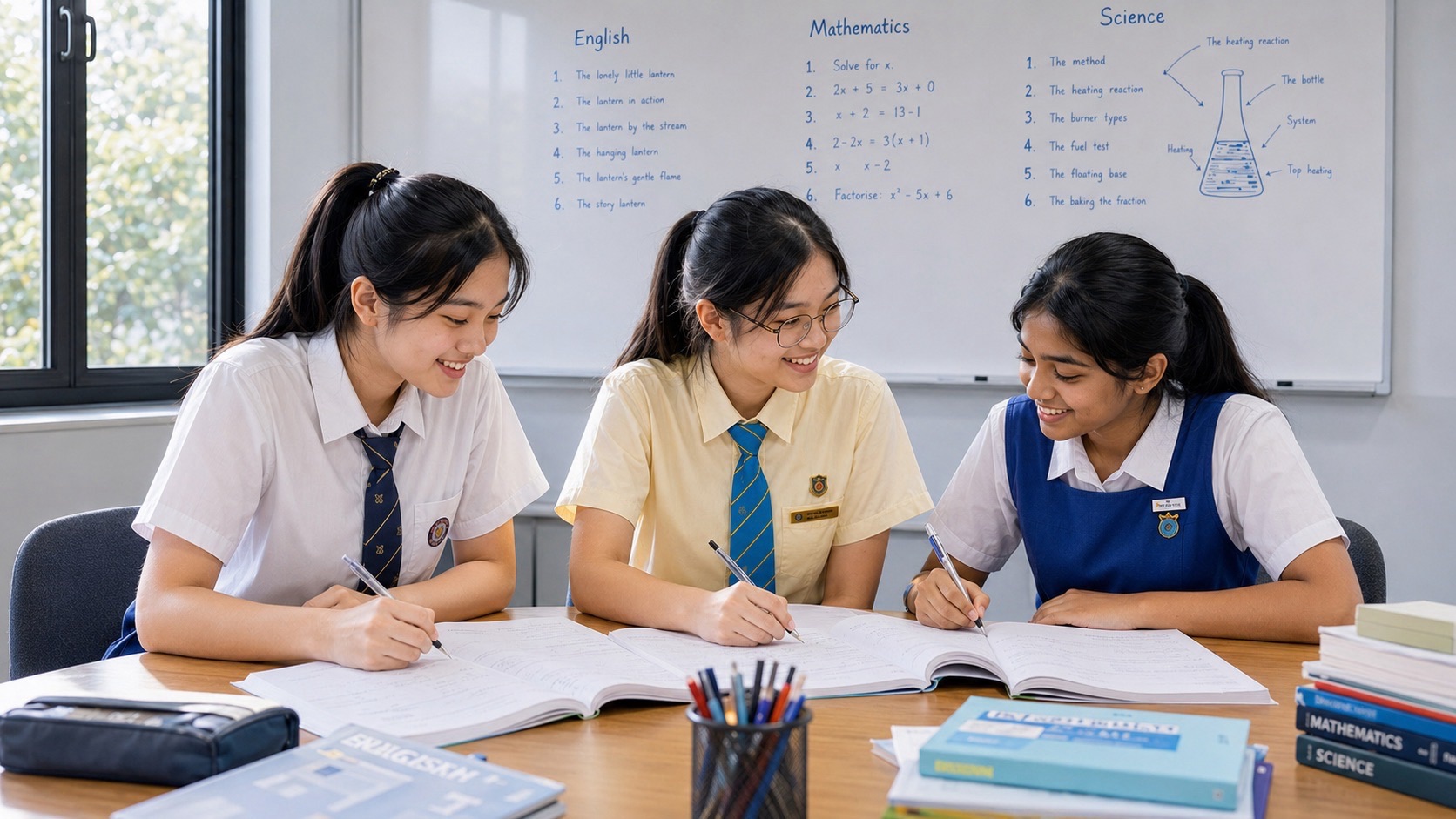
Science Education Systems · Article 39. Maya, Jia Jun, Hana and Ethan remain fictional Punggol learners. This article follows the robustness layer: how Science tests whether a result remains dependable when reasonable details change.
The 50-second parent route
A result can be repeatable and still fragile.
If it disappears when the instrument, sample, day, analysis or setting changes slightly, we need to understand why.
The robustness route is:
finding → identify assumptions → vary one reasonable condition → repeat → compare → stress-test → locate failure boundary → preserve invariant → update confidence
The key question is:
What changes can this result survive?
This article extends How Scientific Replication Works, How Scientific Generalisation Works and How Scientific Uncertainty Works.
1. Robustness is stability under reasonable variation
A relationship appears in one exact setup.
Now change something that should not matter fundamentally.
Another ruler.
another day.
another group.
another reasonable analysis.
If the central conclusion survives, it is more robust.
2. Robustness is not identical to replication
Replication asks whether the result occurs again.
Robustness asks whether it survives variation in conditions, methods or assumptions.
A replication can be nearly identical.
A robustness test deliberately changes something.
3. Robustness is not identical to generalisation either
Generalisation asks how far a finding should travel to new populations or settings.
Robustness asks whether the core result is stable when reasonable details change.
Strong robustness supports broader generalisation but does not guarantee it.
4. Primary Science can teach robustness through repeated contexts
A concept works with one familiar object.
Try another object with the same relevant property.
If the explanation still works, the learner begins to see the invariant.
5. The invariant is what survives
Different plant.
same underlying need for water.
Different circuit layout.
same requirement for a complete conducting path.
Different material example.
same defining property.
Robust thinking searches for stable structure.
6. Maya’s robustness weakness is exact-context dependence
She knows the answer only when the diagram looks familiar.
Her repair:
vary the surface while keeping the deep relationship the same.
7. Jia Jun’s robustness weakness is one-method dependence
He trusts a result only when measured using the same instrument and procedure.
His repair:
compare whether a second reasonable method reaches a compatible conclusion.
8. Hana’s robustness weakness is treating every difference as fatal
A measurement shifts slightly.
She assumes the whole model failed.
Her repair:
ask whether the central relationship survives within uncertainty.
9. Ethan’s robustness weakness is changing too much at once
Different sample.
different method.
different scale.
different analysis.
If the result changes, he cannot tell why.
His repair:
stress-test one dimension at a time before combining variations.
10. Method robustness matters
Measure the same quantity with two appropriate methods.
If both support the same conclusion, confidence increases that the result is not an artefact of one method.
11. Instrument robustness matters
A pattern appears with one instrument.
Does a calibrated alternative detect the same broad relationship?
Convergence reduces instrument-specific concern.
12. Sample robustness matters
A biological finding appears in one sample.
Does it survive another independent sample from the same target population?
Natural variation makes this especially important.
13. Setting robustness matters
Laboratory.
field.
home.
different classroom.
A finding that survives across settings can be more dependable, provided the settings are scientifically comparable.
14. Time robustness matters
Does the relationship appear only once?
Does it persist across days, seasons or longer periods where appropriate?
Some systems are stable; others are time-dependent.
15. Analytical robustness matters
A conclusion depends on one exact statistical choice.
Try another defensible analysis.
If the conclusion reverses, the result may be analytically fragile.
16. Assumption robustness matters
Models often assume:
linearity.
independence.
constant temperature.
negligible resistance.
closed boundaries.
Change a reasonable assumption and see whether the conclusion survives.
17. Sensitivity analysis is formal robustness testing
Vary model inputs or assumptions within plausible ranges.
Observe how much the output changes.
A robust conclusion remains similar across reasonable choices.
18. Robustness has boundaries
No scientific result needs to survive every imaginable change.
A plant relationship tested in moderate temperatures need not remain identical at extreme heat.
Robustness asks about reasonable variation inside the model’s intended domain.
19. Boundary failure is informative
The relationship survives until one variable crosses a threshold.
That threshold reveals where another mechanism becomes important.
Robustness testing maps the operating envelope.
20. Robustness and constraints are linked
A result may remain stable until a limiting factor appears.
See How Scientific Constraints Work.
21. Robustness and falsification are linked
Stress-testing places a model in conditions where hidden weaknesses may appear.
A robust model survives; a fragile one reveals where it needs revision.
22. Robustness and scale are linked
A relationship can be stable at one scale and fail at another.
Scaling itself is a robustness challenge.
See How Scientific Scale Works.
23. Robustness and synthesis are linked
If studies using varied methods and populations converge, synthesis may identify a robust core relationship.
See How Scientific Synthesis Works.
24. Primary 3 robustness can use changed examples
Same concept.
different object.
Ask whether the explanation still works.
This is transfer with controlled variation.
25. Primary 4 robustness can use changed procedures
Measure the same property using another suitable tool or arrangement.
Compare whether the broad result remains.
26. Primary 5 robustness can use changed system conditions
Alter a non-critical feature while preserving the causal mechanism.
Does the relationship remain?
The learner separates core from incidental detail.
27. Primary 6 robustness can use unfamiliar examination contexts
Different story.
same scientific structure.
If the learner performs consistently, understanding is becoming robust.
28. Secondary Science makes robustness quantitative
Different fitting methods.
different ranges.
uncertainty assumptions.
alternative instruments.
replicate samples.
Students can evaluate whether conclusions are stable.
29. Robustness is not perfection
Values can change slightly while the scientific conclusion remains the same.
A robust result is not one where every number is identical.
It is one where the meaningful interpretation survives.
30. Robustness should be defined relative to the decision
If small measurement changes do not affect the conclusion or action, the result may be practically robust.
If tiny changes reverse the decision, more caution is needed.
31. Robust decisions and robust science are related
A decision that remains sensible across plausible scientific uncertainty is stronger than one that depends on one exact estimate.
See How Science Decision-Making Works.
32. Robustness protects against overfitting
A model can match one dataset beautifully by capturing noise rather than structure.
Test it on new data.
If performance collapses, the fit was fragile.
33. New-data testing is especially important for predictive models
The model should face cases it did not already use for fitting.
This distinguishes memorisation from generalisable structure.
34. AI systems need robustness testing too
Change wording.
change image lighting.
change demographic distribution.
change data source.
Does performance remain acceptable?
AI reliability cannot be judged from one benchmark alone.
35. Adversarial tests reveal fragile systems
Small changes that should not matter cause large output changes.
This indicates the model may rely on superficial cues.
Robustness testing searches for these hidden dependencies.
36. Robustness and fairness can interact
A system performs well on average but poorly for one subgroup.
Average robustness can hide local fragility.
Scientific and ethical evaluation should inspect relevant subgroups.
37. Robustness and reproducibility can interact
A finding reproduced by another group using slightly different equipment is stronger than one reproduced only under one tightly controlled setup.
Independence adds value.
38. Robustness can reveal hidden variables
Change the room humidity and the result changes dramatically.
Humidity was previously ignored.
The robustness failure identifies a missing causal factor.
39. Robustness can improve models
The revised model includes the newly discovered dependency.
Its domain becomes clearer.
Its predictions improve.
40. Small-group tuition can build robust understanding
Do not drill twenty near-identical questions.
Use controlled variation:
same concept, different surface;
same relationship, different representation;
same model, new boundary condition.
This tests whether learning survives change.
41. Parents can ask one useful question
“Would your explanation still work if this detail changed?”
Then change one irrelevant feature.
Then one relevant feature.
The contrast teaches robustness.
42. AI can help generate robustness tests
Useful prompts:
“Change only superficial details.”
“Now change one scientifically important condition.”
“Ask whether the conclusion should survive.”
“Create three alternative but defensible analyses and compare results.”
43. A compact robustness checklist
- What is the core finding?
- Which assumptions support it?
- Which details should not matter?
- What reasonable method variations can be tested?
- What sample variations can be tested?
- What setting variations can be tested?
- What analytical variations are defensible?
- Does the central conclusion survive?
- Where does it fail?
- Does failure reveal a boundary or hidden variable?
- How should confidence change?
44. Frequently asked questions
What is scientific robustness?
It is the degree to which a scientific finding, model or conclusion remains stable under reasonable changes in methods, samples, assumptions or conditions.
How is robustness different from replication?
Replication repeats a study or result independently; robustness deliberately examines whether the conclusion survives reasonable variations.
Why is robustness important?
It helps show that a finding reflects deeper structure rather than one fragile combination of method, sample or assumptions.
How does robustness help PSLE Science?
It helps learners transfer concepts across unfamiliar contexts and distinguish relevant from irrelevant changes.
How does robustness change in Secondary Science?
It becomes more quantitative through sensitivity analysis, alternative measurements, model assumptions and data analysis choices.
45. Continue the Science Education Systems series
Conclusion: Robustness asks whether the Science survives a change of scenery
Maya recognises the pattern.
Jia Jun repeats the method.
Hana changes one assumption.
Ethan pushes toward the boundary.
If the relationship survives, confidence grows.
If it fails, the failure teaches us where the model depends on hidden conditions.
Robust Science is not Science that never changes.
It is Science whose important conclusions do not disappear when irrelevant details do.


