
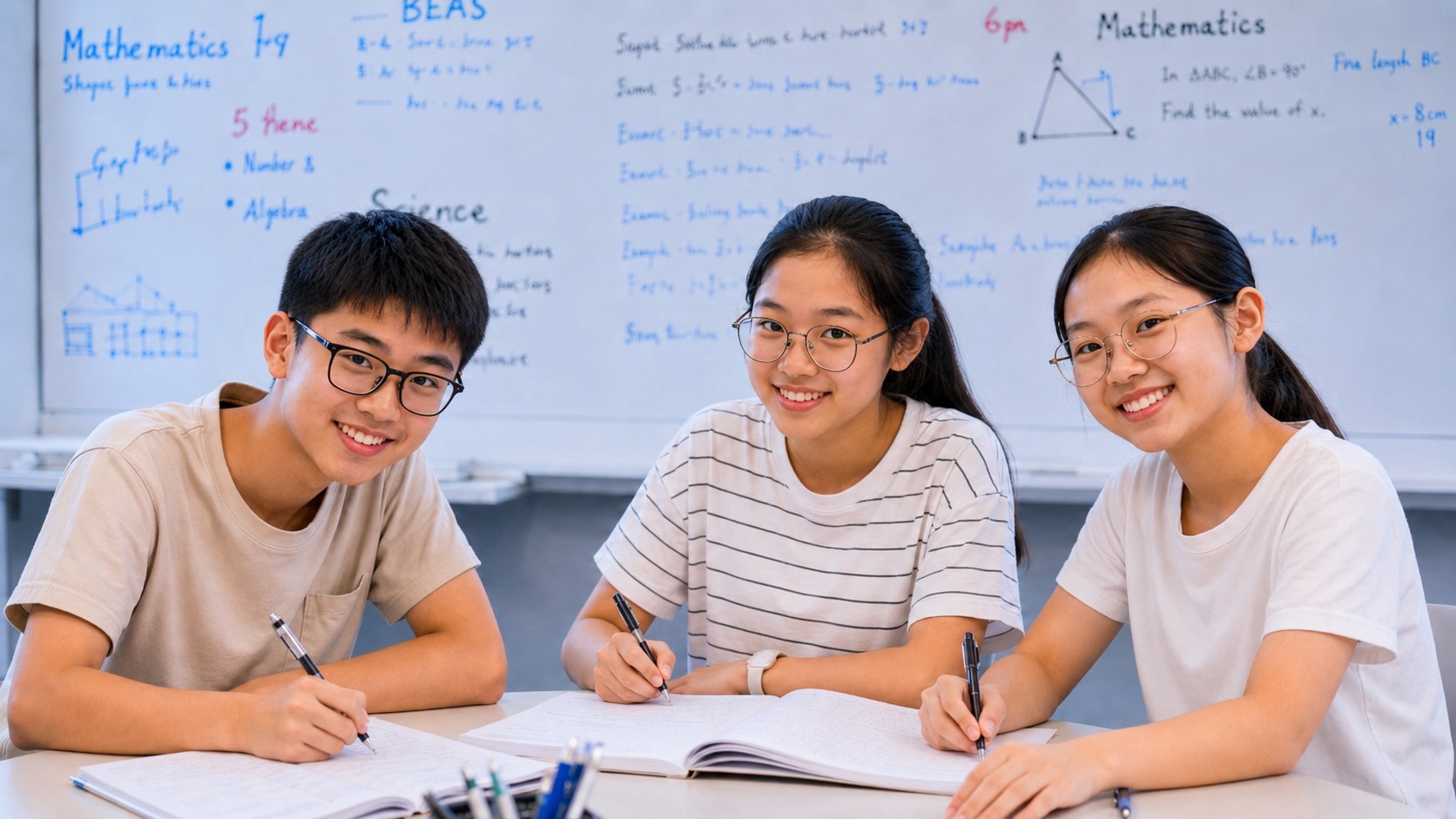
Secondary 1 Mathematics Tuition · Punggol
Secondary 1 Mathematics: choose your next step
Choose the difficulty that matches your current work. Use the guide for an overview, or open a specific article below.
Select one situation
Recommended starting point
Selected for the concern describedSecondary 1 Mathematics Support
What this may mean
How tuition should begin
Selected reading
Two useful guides for this route
eduKatePunggol · Secondary Mathematics Edition
Secondary 1 Mathematics Tuition for eduKatePunggol
Secondary 1 is not simply Primary 6 with harder sums. It is the year Mathematics becomes more symbolic, more connected and less forgiving of weak foundations. eduKatePunggol Mathematics Tuition helps students establish the algebra, working habits, G-level fit and assessment control needed for the secondary-school corridor ahead.
Secondary 1 Mathematics begins with a deceptive familiarity. Students still see integers, fractions, percentages, ratio, geometry and word problems. Yet the subject has changed underneath them. Numbers are joined by letters. A single unknown becomes an expression. An expression becomes an equation. An equation is placed on a graph. A word problem may now require the student to define a variable before any calculation can begin.
This is why a child who performed adequately in Primary 6 can suddenly look uncertain in Secondary 1. The difficulty is not always a lack of intelligence or effort. The student may be carrying primary-school methods into a subject that now requires abstraction, notation, multi-step organisation and independent method choice. Secondary 1 Mathematics Tuition at eduKatePunggol is designed to find that conversion point early and teach the new system properly.
The exact chapter sequence varies by school. The dependency order does not: weak arithmetic makes algebra heavier, and weak algebra makes later Mathematics increasingly difficult to organise.
The Transition
Secondary 1 is a conversion year, not merely a promotion year.
Primary Mathematics is often taught through recognisable problem types. Students learn methods for fractions, percentage, ratio, area, volume, speed and model drawing. These methods remain useful. The difficulty is that Secondary 1 begins compressing several familiar ideas into a more general mathematical language.
Instead of drawing a model for every unknown quantity, the student may define it as x. Instead of solving one familiar scenario, the student must manipulate an expression that could represent many scenarios. Instead of relying on a memorised sequence, the student must decide which property, operation or equation is relevant.
The cognitive load rises because several things must happen at once. The student has to read the problem, translate it, preserve negative signs, apply operation rules, show acceptable working and check whether the answer is sensible. A small weakness can therefore spread across the page.
Effective Secondary 1 Math tuition in Punggol should make this change visible. The tutor should not simply provide a second set of school worksheets. The tutor should teach the student how the new system is organised and repair the primary-school dependencies that cannot yet carry it.
A child who says, “I understood the example but could not do the question,” may be struggling with transfer and method selection—not only memory.
Algebra as Language
The letter is not the difficulty. The new grammar is.
Students are often told that algebra means “using letters instead of numbers”. That description is technically simple but educationally incomplete. Algebra is a language for describing relationships. The student must learn what a term is, what an expression means, why like terms can be combined, what the equal sign guarantees, and which operations preserve an equation.
When this language is memorised without meaning, errors become random. Students move terms across the equal sign because they were taught that signs “change sides”. They expand brackets mechanically but cannot explain the distributive structure. They substitute values without preserving operation order. These shortcuts may survive easy questions and collapse on unfamiliar ones.
Algebra cannot stabilise while basic operations keep changing the student’s answer unexpectedly.
A variable can describe an unknown value, a changing quantity or a general relationship.
Terms, coefficients, brackets, substitution and simplification become one connected grammar.
Solving equations becomes a sequence of equivalent statements rather than a collection of sign-changing tricks.
The same relationship can appear as words, a table, an equation or a line.
The student recognises structure without waiting for the chapter heading to reveal the method.
G1, G2 and G3 Mathematics
The level should describe present readiness—not the student’s permanent ceiling.
Under Full Subject-Based Banding, Mathematics is offered at G1, G2 and G3. Students are grouped for Mathematics according to the subject level they take, and the level may differ from some of their other subjects. Each level has a different learning demand, pace and degree of abstraction. The teaching must therefore match the actual syllabus and the student’s readiness.
G1 Mathematics
Revisits and reinforces important primary concepts before extending into new secondary content at a more manageable pace.
G2 Mathematics
Develops secondary concepts with increasing algebraic structure, application and examination discipline.
G3 Mathematics
Moves at greater academic demand and expects stronger abstraction, algebraic control, problem solving and independent transfer.
What should parents actually monitor?
Can the student operate with fractions, decimals, percentages and negative numbers accurately enough to support algebra?
Can the student read expressions, preserve signs, expand, simplify, substitute and solve without relying on unexplained shortcuts?
Can the student convert a verbal relationship into variables, equations, tables, diagrams or graphs?
Can the student organise steps so the method can be marked, checked and recovered when an error appears?
Can the student recognise which method is needed when the question is not arranged like the worked example?
A level change should never be pursued only for status. The stronger question is whether the student has the conceptual foundation, working reliability and pace to learn meaningfully at that level. Tuition should build real readiness rather than manufacture a temporary appearance of readiness.
The Earliest Weak Link
The difficult chapter is often only where the older weakness becomes visible.
A student who cannot simplify an algebraic fraction may actually be weak in ordinary fractions. A student who loses marks in linear equations may be unstable with negative numbers. A student who cannot form an equation may have a language-translation problem. A student who makes “careless” errors may be overloading working memory because too many elementary steps remain effortful.
The mistake must therefore be traced backward. Re-teaching only the current chapter can create short-term familiarity without repairing the dependency. Once the worksheet changes, the problem returns in another form.
eduKatePunggol teaches from the earliest weak link. This can mean returning briefly to fraction operations, ratio reasoning, unit conversion, order of operations or model interpretation before reconnecting the skill to the Secondary 1 chapter. The repair is not a detour. It is the shortest route to stability.
Strong students also have weak links. Their issue may be incomplete working, rushed reading, fragile proof, limited flexibility or difficulty with unfamiliar problems. Tuition should not merely give them harder questions. It should improve the quality of mathematical thinking and execution.
Do not ask only, “Which chapter is weak?” Ask, “Which earlier operation, concept or reading process must succeed before this chapter can work?”
The Secondary 1 Year Map
The first year should end with a platform—not a pile of completed chapters.
Schools may sequence topics differently, but the learning year can still be read as four developmental movements. The objective is to move from transition control to stable algebra, from isolated methods to connected structures, and from guided practice to independent assessment performance.
Settle
- Understand the G-level pace and school expectations.
- Stabilise integers, fractions, order of operations and notation.
- Build a complete-working habit before speed becomes the priority.
Find the transition gap before the first assessment turns it into a confidence problem.
Build
- Develop expressions, equations, ratio relationships and geometry.
- Connect symbolic steps to underlying meaning.
- Use retrieval and spaced practice so earlier topics remain available.
Teach slightly ahead where appropriate while repairing dependencies underneath.
Connect
- Recognise when number, algebra, graphs and geometry share a structure.
- Handle mixed-topic and unfamiliar questions.
- Improve method selection instead of depending on chapter cues.
Interleave topics and expose the student to questions that require transfer.
Perform
- Convert knowledge into marks under realistic timing.
- Review recurring errors by cause rather than by chapter alone.
- Prepare the algebra and working platform needed for Secondary 2.
Use mock assessment, feedback and correction loops to stabilise independent performance.
Assessment Control
Marks reveal performance, but the error pattern reveals the repair route.
A result alone does not explain why the result happened. Two students may both score 62%. One may understand most concepts but lose marks through incomplete working and careless signs. The other may reproduce routine methods but fail every unfamiliar question. Their tuition routes should not be the same.
S1 Math
eduKatePunggol reads the paper by error type: conceptual, procedural, language, representation, attention, timing or method choice. The next lesson then repairs the highest-leverage cause instead of repeating the entire paper without direction.
Assessment control is built through deliberate routines: identify the topic structure, annotate conditions, show one valid mathematical step at a time, estimate where useful, check signs and units, and return to unanswered questions strategically. These routines reduce the number of marks lost after the student already knows the Mathematics.
Why this matters beyond Secondary 1
The Secondary Education Certificate will record subjects at the G1, G2 or G3 levels students actually sit. Secondary 1 is therefore early in the runway, but not disconnected from it. Algebra, working discipline and subject-level readiness built now can influence later Mathematics choices, Additional Mathematics readiness, SEC performance and eligibility for post-secondary routes where Mathematics is required or heavily used.
eduKatePunggol Mathematics Method
Teach from the beginning, connect the middle and prepare for the end.
eduKatePunggol Secondary 1 Mathematics Tuition uses a small-group structure of up to three students. The class is small enough for individual diagnosis, direct questioning, visible working and immediate correction, while still allowing students to hear alternative methods and explain their reasoning.
The Secondary 1 learning loop
Diagnose → Repair → Build → Apply → ReviewRead the student’s G-level, school sequence, recent paper, working and repeated error pattern.
Return to number, fraction, ratio, language or sign control when the current chapter depends on it.
Explain what the rule means, why it works and how it connects to earlier and later topics.
Move from guided examples to mixed, unfamiliar and examination-style problems.
Use retrieval, spaced practice, correction and mock assessment to build independent control.
Lessons are 1.5 hours. Materials are provided, and support between lessons can be used for difficult questions where appropriate. Students may be taught ahead of the school schedule when their foundation is stable, but acceleration is not used to hide weak understanding. The route is baseline to advanced: establish the core, connect the subject and then increase the level of challenge.
The goal is not permanent dependence on tuition. It is a student who can read a question calmly, locate the mathematical structure, select a valid method, show complete working and recover from an error without losing the entire paper.
Consultation Before Placement
Begin with the student’s present Mathematics position.
Before recommending a Secondary 1 Mathematics class, eduKatePunggol needs to understand the student’s school, G1/G2/G3 Mathematics level, recent result, current topics, repeated difficulty and next assessment. This allows us to consider whether the immediate route should be transition support, foundation repair, consolidation, greater stretch or examination preparation.
Secondary 1 Mathematics Consultation
Do not wait for several chapters to fail for the same hidden reason.
Send the student’s present details through WhatsApp. We will consider the likely weak link, suitable Mathematics route and current small-group availability. Placement remains subject to class fit and available space.
Maximum three students per class · 1.5-hour lessons · Consultation-led placement
Official Reading
Check the student’s current school and examination requirements.
Secondary 1 Mathematics Tuition at eduKatePunggol
Secondary 1 Mathematics Tuition in Punggol: helping your child settle into the new Math language calmly.
Secondary 1 Mathematics is not simply “Primary 7”. It is the year where Mathematics changes language. Your child now has to move from familiar primary-school calculation into algebra, negative numbers, expressions, equations, graphs, geometry, data, ratio, percentage and clearer written working.
For many Punggol parents, the worry is not only the marks. It is the feeling that the whole school route has become harder to read: PSLE has just passed, Secondary 1 begins, Posting Groups appear, G1/G2/G3 subject levels matter, and the SEC route sits ahead. eduKatePunggol slows this down. We help parents understand what is happening, help students repair the next useful gap, and help the family move forward with less stress and more control.
Quick answer: What is Secondary 1 Mathematics tuition?
Secondary 1 Mathematics tuition is structured support that helps students bridge the jump from primary Mathematics into secondary mathematical reasoning. At eduKatePunggol, this means diagnosing weak foundations, teaching algebra and new concepts clearly, correcting working habits early, building confidence, and helping students catch up, keep up or move ahead through the Sec 1 year.
Why Secondary 1 Mathematics feels different from Primary 6 Mathematics
In Primary 6, many students can still depend on familiar question types, models, repeated drills and PSLE-style techniques. In Secondary 1, the student must become more independent. The question may not look exactly like the example. The numbers may be less friendly. The method may require two or three links before the answer appears.
This is why some students look “fine” after PSLE but begin to wobble in Sec 1. The child has not suddenly become weak. The subject has changed shape.
The main changes in Sec 1 Mathematics
- More symbols: students must understand variables, expressions, equations and formulae.
- More signs: negative numbers, brackets, expansion and simplification require careful working.
- More structure: marks are not only for answers, but for correct steps and method.
- More abstraction: letters can stand for numbers, and graphs can describe relationships.
- More pace: secondary school brings more subjects, CCA, longer days and faster homework cycles.
- More independence: students must ask questions, organise work, revise earlier and correct mistakes before tests.
A calm parent response is to read the pattern before reacting to the mark. Is the problem algebra? Is it accuracy? Is it careless working? Is it weak fractions? Is it poor confidence? Is it school pace? Once the problem is named, tuition can repair the right thing instead of adding random worksheets.
What topics are usually important in Secondary 1 Mathematics?
Schools may arrange their yearly sequence differently, but Sec 1 Mathematics usually strengthens the child across Number and Algebra, Geometry and Measurement, and Statistics/Data Handling. For parents, the exact chapter name is less important than the skill underneath it.
| Sec 1 Math Area | What students need to learn | Common problem parents notice |
|---|---|---|
| Number | Factors, multiples, primes, fractions, decimals, percentages, ratios, rates, approximation and negative numbers. | The child knows the topic in class but loses marks through signs, units, careless arithmetic or poor checking. |
| Algebra | Variables, expressions, substitution, expansion, simplification, equations and formulae. | The child says “I don’t understand letters in Math” or copies examples without knowing why each step works. |
| Geometry | Angles, polygons, parallel lines, properties, construction, measurement and diagram discipline. | The child sees the diagram but cannot decide which rule to use first. |
| Graphs and data | Coordinates, graph reading, data presentation, averages and interpretation. | The child can calculate but struggles to explain what the graph or data actually means. |
| Word problems and applications | Reading the question, extracting information, forming relationships and choosing the correct method. | The child understands the chapter but freezes when the question is written in unfamiliar words. |
This is why Secondary 1 Mathematics tuition should not only “cover topics”. It should also teach route recognition: What is the question asking? What information is given? Which method fits? What should be written first? How should the answer be checked?
How Full SBB, Posting Groups and G1/G2/G3 affect Sec 1 Mathematics
Under Full Subject-Based Banding, parents now hear two different kinds of route language. Posting Groups guide secondary school placement and the initial subject levels at the start of Secondary 1. G1, G2 and G3 describe the subject level the student studies for subjects such as Mathematics.
The simple parent map is this:
- Posting Group: the starting door into secondary school after PSLE.
- G-level: the subject level and demand for that subject.
- Mathematics readiness: what the child can actually do with the current work.
A child is not “just” a Posting Group. A child is a learner moving through a subject route. For Mathematics tuition, the important question is not only where the child started. The useful question is: what is the current Mathematics demand, what is breaking, and what repair keeps the route healthy?
At eduKatePunggol, we support this calmly. Some students need to rebuild primary foundations. Some students need help keeping pace with G2 or G3 Mathematics. Some students are strong and need stretch so that they do not become careless, bored or under-trained for later Sec 3 and Sec 4 demands.
Helpful official reading: MOE Full SBB secondary school experience, MOE Posting Groups explanation, and SEAB Secondary Education Certificate route.
When should a child start Secondary 1 Mathematics tuition?
The best time is not always “when the child fails badly”. Often, the better time is when small instability becomes visible. In Sec 1, small gaps can compound because later chapters depend on earlier habits: number sense, algebra steps, sign control, graph reading and working discipline.
Consider Sec 1 Math tuition when you notice these signs
- Your child says “I understand in class” but cannot do the homework independently.
- Algebra feels confusing, especially letters, brackets, expansion, simplification and equations.
- Marks are lost through missing steps, sign errors, careless arithmetic or incomplete working.
- Your child avoids Mathematics homework or takes a very long time to start.
- Test results are unstable: good one week, weak the next.
- Your child is quiet in class and does not ask when confused.
- Primary foundation gaps appear in fractions, ratios, percentages, units or word problems.
- Your child is already strong but needs harder questions, better reasoning and future Sec 2/Sec 3 readiness.
Do not over-read one bad mark. Look for the repeated pattern. If the same mistake returns, the system is asking to be repaired.
How eduKatePunggol teaches Secondary 1 Mathematics
eduKatePunggol Mathematics tuition is built around a simple repair loop: diagnose the gap, teach the method clearly, practise with structure, correct mistakes early, consolidate the learning, and transfer it back into schoolwork and tests.
1. Diagnose the real problem
A weak result can come from many different causes. It may be concept weakness, poor memory of primary foundations, algebra fear, weak working habits, careless signs, slow pace, poor question reading or low confidence. We first identify what is actually breaking.
2. Rebuild foundations without shaming the child
If the child has weak fractions, negative numbers, multiplication fluency, ratios or percentages, we repair those foundations because algebra will expose them quickly. The child is not blamed for the gap. The gap is named, taught and corrected.
3. Teach Sec 1 methods clearly
Sec 1 Mathematics needs clean method. Students must learn how to write steps, handle symbols, use diagrams, check signs, form equations and recognise question types. We slow the question down so the child can see what to do next.
4. Correct mistakes early in a small-group setting
In a small-group tutorial, mistakes become visible. The tutor can see whether the student is copying, guessing, skipping steps or misunderstanding the rule. This is important because repeated errors become habits if nobody catches them early.
5. Build confidence through controlled difficulty
Confidence does not come from praise alone. It comes from repeated evidence that the child can understand, attempt, correct and improve. We build from accessible questions towards harder questions so the student learns to stay steady when the problem changes shape.
6. Prepare for Sec 2 and the wider secondary route
Sec 1 is the installation year. The habits built now affect Sec 2 stability, Sec 3 upper-secondary readiness, future E-Math and possible A-Math pathways. We do not frighten Sec 1 students with the future. We build the foundations that make the future less frightening.
Catch up, keep up or move ahead: three parent routes for Sec 1 Math
Parents often ask whether tuition is only for students who are struggling. The answer is no. Sec 1 Mathematics tuition can support three different routes.
| Parent route | What it means | How tuition helps |
|---|---|---|
| Catch up | The child has gaps from primary school or is already confused by Sec 1 pace. | Repair foundations, reteach core methods, correct repeated mistakes and restore confidence. |
| Keep up | The child is passing but unstable, slow or easily shaken by tests. | Strengthen topic links, improve working discipline, build test rhythm and reduce careless loss. |
| Move ahead | The child is strong and needs better reasoning, harder questions and future readiness. | Stretch with non-routine problems, clearer explanation, deeper algebra control and stronger Sec 2/Sec 3 preparation. |
The kindest route is the one that matches the child’s actual need. Some students need rescue. Some need rhythm. Some need stretch. A good tuition system should know the difference.
What parents can do at home without adding more stress
Home support should reduce fog, not add pressure. Parents do not need to become the Mathematics teacher. The more useful role is to help the child notice patterns and build steady habits.
Ask better questions after a test
- Which questions did you know how to start?
- Which questions looked familiar but still went wrong?
- Was it a concept mistake, sign mistake, arithmetic mistake, working mistake or time mistake?
- Which chapter should we repair first?
- What is one thing you can do differently before the next test?
This keeps the conversation calmer. Instead of “Why did you lose marks?”, the family moves to “What broke, and what is the next useful repair?”
Build a small mistake ledger
A mistake ledger is a simple record of repeated errors. It does not need to be beautiful. It only needs to tell the truth. For example:
- I lose marks when I forget negative signs.
- I expand brackets too quickly.
- I do not show enough working.
- I misread ratio questions.
- I forget units in measurement questions.
When the child sees the pattern, the child can repair it. When the parent sees the pattern, the parent can respond with patience instead of panic.
Why Secondary 1 Mathematics matters beyond Sec 1
Sec 1 Mathematics is the first stage of the secondary Mathematics route. It prepares the child for Sec 2, upper-secondary Mathematics, future SEC expectations, and later subject choices. A-Math is not a Sec 1 problem, but A-Math readiness begins with Sec 1 habits: algebra confidence, symbol control, graph sense, careful signs, multi-step patience and willingness to correct mistakes.
This is also why English and Science can affect Mathematics. A student who struggles to read accurately may misread word problems. A student who struggles to explain cause and effect in Science may also struggle to justify steps in Mathematics. A student with weak vocabulary may find mathematical terms noisy before the calculation even begins.
eduKatePunggol teaches P1–P6 English and Mathematics, P3–P6 PSLE Science, Sec 1–4 English, Sec 1–4 Mathematics and Sec 3–4 Additional Mathematics. The subjects support one another because the child is one whole learner, not a collection of separate exam papers.
Secondary 1 Mathematics Tuition at eduKatePunggol: what parents are really choosing
Parents are not only choosing “extra Math lessons”. They are choosing a calmer support structure around a transition year. The goal is to help the child understand the topic, repair weak methods, correct errors early, gain confidence, and return to school with better control.
For a student who is struggling, this means the child does not have to face the new Math language alone. For a student who is passing but unstable, this means the method becomes cleaner before gaps grow. For a strong student, this means the route can stretch properly without creating careless habits.
eduKatePunggol’s line is simple: we help students catch up, keep up and move ahead, while helping parents lower stress by understanding the route around the child.
Useful next pages: Secondary Mathematics Tuition Punggol, Additional Mathematics Tuition Punggol, Primary Mathematics Tuition Punggol, PSLE Tuition Punggol, and How Mathematics Works.
If you would like help reading your child’s current situation, message eduKatePunggol with your child’s level, Mathematics subject level where known, recent concern, and the pattern you see at home.
Frequently Asked Questions about Secondary 1 Mathematics Tuition at eduKatePunggol
Is Secondary 1 Mathematics very different from Primary 6 Mathematics?
Yes. Primary Mathematics is often more concrete and familiar. Secondary 1 Mathematics introduces more algebra, symbols, negative numbers, graphs, geometry and structured working. The child must learn to recognise routes, not only calculate answers.
Does my child need tuition if the first Sec 1 Math result is not terrible?
Not always. One result should not be over-read. Look for repeated patterns: slow homework, algebra confusion, careless signs, poor working, avoidance, unstable scores or falling confidence. Tuition is most useful when it repairs the repeated pattern before the gap becomes larger.
How does eduKatePunggol help weak Sec 1 Math students?
We identify the weak point, rebuild foundations, reteach the method clearly, guide practice, correct mistakes early, and help the student regain confidence. The aim is not to shame the child, but to make the next repair visible.
Can strong Sec 1 students benefit from Mathematics tuition?
Yes. Strong students may need stretch, harder questions, cleaner reasoning and better working discipline. Tuition can help them move ahead without becoming careless or overconfident.
What should parents send before asking about tuition?
Send your child’s level, current school route or subject level if known, recent test or homework concern, and the pattern you see at home. For example: “Sec 1, confused by algebra, loses marks through signs, takes very long to start homework.” This helps us read the situation more accurately.
Is G1, G2 or G3 Mathematics fixed forever?
Under Full SBB, students have more flexibility to take subjects at different levels according to aptitude, interest and learning needs. Parents should check the school’s advice and the child’s actual readiness. Tuition can support the current subject level while helping the child build stronger foundations.
Should Sec 1 students worry about A-Math already?
No. Sec 1 students should not be frightened by A-Math. The better route is to build the habits that make future choices easier: algebra confidence, accurate working, graph sense, patience with multi-step problems and the ability to correct mistakes.
What is the main goal of Sec 1 Math tuition?
The main goal is stability. The child should understand the new Math language, repair weak foundations, learn proper methods, reduce repeated mistakes, gain confidence and become more ready for Sec 2 and the wider secondary route.
Your Secondary 1 Mathematics pathway within PunggolOS
At Secondary 1, the Mathematics route inside PunggolOS is designed to build the bridge from arithmetic into algebra, symbolic language and more independent mathematical reasoning.
Why this stage matters: The shift into Secondary Mathematics can look sudden when earlier number and representation gaps were hidden.





