
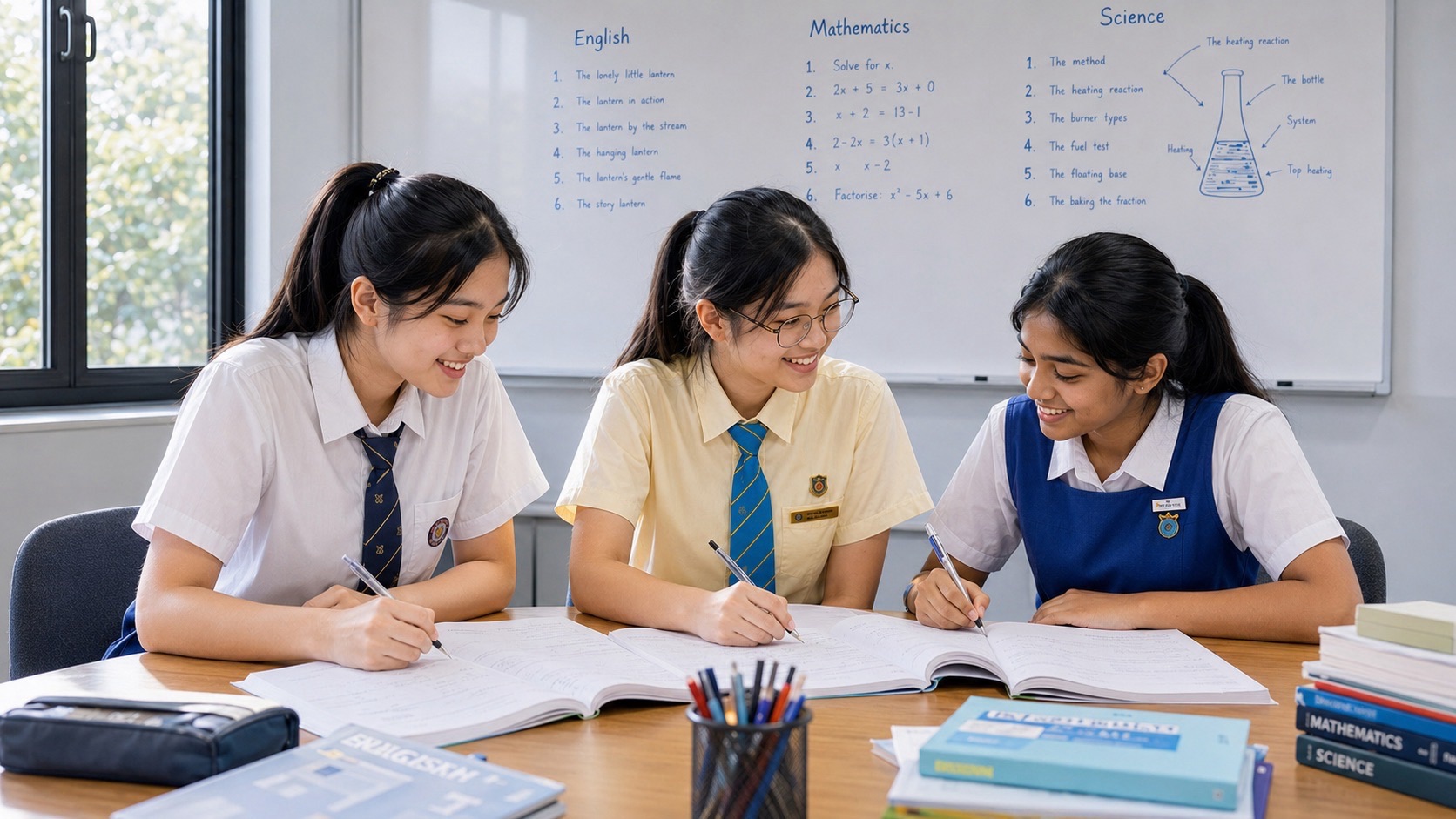
Science Education Systems · Article 9. Maya, Jia Jun, Hana and Ethan remain fictional Punggol learners. This article follows the experiment-design layer from the first fair comparison in Primary Science to increasingly formal practical reasoning in Secondary Science.
The 50-second parent route
A Science experiment is not “doing something with apparatus.”
It is a designed argument.
The learner asks a question, changes or compares something deliberately, observes or measures an outcome, keeps enough other conditions under control, then decides what the evidence allows them to conclude.
The core route is:
question → hypothesis or prediction → variables → operational definitions → controls → method → measurement → repeats → data → pattern → conclusion → limitations → improvement → transfer
At Primary level, this may appear as a simple fair test.
At Secondary level, the language becomes more formal: independent variable, dependent variable, controlled variables, range, interval, repeats, reliability, precision, accuracy, systematic and random effects, limitations and evaluation.
The deeper logic is continuous.
Can the learner design a comparison whose result actually means what they think it means?
This article extends How Scientific Thinking Is Built, How Science Assessment Works and How Science Curriculum Coherence Works.
1. The experiment starts before the equipment
Jia Jun sees three cups, a stopwatch and a tray.
He is ready.
“What do we do?”
The tutor does not touch the cups.
“What are we trying to find out?”
That question feels slower than pouring.
It is also the beginning of experimental design.
Without a question, apparatus becomes activity.
With a question, apparatus can become evidence.
The first discipline is therefore not procedural.
It is conceptual.
What uncertainty is this experiment supposed to reduce?
2. Good questions define the comparison
“Which material is best?” is vague.
Best for what?
Under which conditions?
Measured how?
“Which of these materials absorbs the greatest volume of water in two minutes when equal-sized samples are tested?” is far more useful.
The question now identifies:
- the materials being compared;
- the property of interest;
- a time condition;
- a sample-size condition;
- and an observable outcome.
Clarity at the question stage prevents confusion later.
3. A prediction exposes the learner’s model
Maya predicts that the thickest material will absorb the most water.
Why?
“Because thicker means it can hold more.”
Good.
Not necessarily correct.
But now the model is visible.
The experiment can do more than generate a result.
It can test a rule the learner is using.
A prediction therefore has diagnostic value.
4. Hypothesis and prediction should not collapse into one memorised sentence
A hypothesis proposes a relationship or explanation.
A prediction states what should be observed if that relationship is approximately correct under stated conditions.
For younger students, the distinction can remain informal.
I think X affects Y because…
If that is right, I expect…
Later Science can formalise the language.
The logic is already present.
5. Variables are roles inside a comparison
Students often memorise definitions:
independent variable;
dependent variable;
controlled variable.
Then they misidentify them in unfamiliar experiments.
A stronger approach asks what role each factor plays.
What are we deliberately changing or comparing?
What outcome are we observing or measuring?
What other conditions must remain sufficiently comparable so the result is interpretable?
The terminology then attaches to the logic.
6. The independent variable is not simply “the thing that changes”
Many things can change during an experiment.
Time changes.
Temperature may drift.
Materials may become wet.
The independent variable is the factor deliberately varied or the comparison factor specified by the investigation.
That role matters more than the phrase “thing that changes.”
7. The dependent variable is the outcome used to read the effect
What result will tell us whether the change mattered?
Temperature?
Time?
Length?
Mass?
Number of bubbles?
Volume?
Brightness?
Distance travelled?
Growth?
The dependent variable needs to be observable or measurable in a way that answers the question.
8. Controlled variables protect interpretation
If Hana changes both the material and the amount of water, the result becomes ambiguous.
If Ethan changes distance and lamp power, which difference caused the outcome?
Controlled variables are not bureaucratic boxes to fill.
They protect the interpretation of the comparison.
The learner should know why each control matters.
9. “Keep everything the same” is impossible and unnecessary
No two experiments are literally identical in every respect.
The meaningful instruction is:
keep the relevant other conditions sufficiently comparable.
This introduces an important scientific judgement.
Which conditions could plausibly affect the result?
Those deserve attention.
10. Operational definitions make vague ideas measurable
“Plant health” is vague.
What would count as healthier?
Height?
Leaf number?
Mass?
Colour?
Survival?
An operational definition states how a variable will be observed or measured in this investigation.
Primary learners can meet the idea without the formal term:
“How exactly will we know?”
Secondary learners should increasingly make the measurement rule explicit.
11. Measurement turns private impressions into inspectable records
“This one looks hotter.”
“This plant seems taller.”
“That sound feels louder.”
Scientific measurement gives the claim a public scale.
But a measurement is only as useful as the instrument, method and units.
Choosing a measurement is part of experiment design.
12. Instruments have resolution
A ruler marked in centimetres and a more finely graduated instrument do not support the same measurement resolution.
A stopwatch operated by a human introduces reaction-time effects.
A measuring cylinder has a scale.
A thermometer has a range and graduations.
Students should learn that instruments do not produce infinitely precise truth.
They produce readings within limits.
13. Units carry meaning
A number without a unit may be incomplete.
5 what?
Seconds?
Centimetres?
Grams?
Degrees Celsius?
Millilitres?
Units make quantities interpretable and comparable.
Later, unit consistency becomes essential in calculations.
14. Range matters because one comparison may reveal too little
Suppose a Secondary student wants to investigate how distance affects an outcome.
Testing only 10 cm and 11 cm may reveal very little.
A useful range should be wide enough to reveal the relationship while remaining safe and appropriate for the apparatus.
This is part of design judgement.
15. Intervals affect the shape of the evidence
Too few data points and a pattern may remain invisible.
Too many and time may be wasted without meaningful gain.
Students should gradually learn to choose sensible intervals for the question.
This is one reason experimental design becomes more mathematical with age.
16. Repeats answer a different problem from controls
Controls help isolate the factor being investigated.
Repeats help reveal variability in measurement or outcome.
Students often mix these purposes.
Repeating does not repair a systematically unfair comparison.
Controlling variables does not reveal whether one reading was anomalous.
Different design features solve different trust problems.
17. Repeated measurements reveal variation
Three trials do not always give the same result.
That is not automatically failure.
Variation can come from:
- measurement limits;
- natural variability;
- human timing;
- small environmental changes;
- or uncontrolled conditions.
Repeats let the learner see whether the result is stable enough to support a pattern.
18. Anomalies deserve investigation, not automatic deletion
One reading differs sharply.
Students may be trained to cross it out immediately.
Better question:
Why might it differ?
Was there a procedural problem?
Was the measurement copied wrongly?
Could it represent real variation?
Should the trial be repeated?
An anomaly is information about the measurement system.
19. Reliability is about consistency, not truth by itself
A method can give very similar results repeatedly and still be systematically wrong.
Consistency is valuable.
It is not identical to accuracy.
At school level, terminology should match the syllabus and teaching context, but the conceptual distinction is worth preserving.
20. Precision and accuracy solve different questions
Precision concerns how closely repeated measurements agree or the fineness with which a quantity is measured, depending on context.
Accuracy concerns closeness to an accepted or true value where that comparison is meaningful.
Students often blend the words.
Examples and diagrams help separate them.
21. Random effects and systematic effects should not be taught as slogans
Random variation can cause readings to scatter.
Repeated measurements and averaging may reduce its influence.
Systematic effects shift measurements in a consistent direction.
Repeating the same flawed method may reproduce the same bias.
Students should understand the mechanism, not only memorise the terms.
22. The method should be written so another person could perform it
“Heat the water and measure it” is not enough.
How much water?
Heat with what?
Measure what quantity?
At what intervals?
For how long?
What stays constant?
What safety precautions matter?
A method is a communication artifact.
It should make the experimental logic reproducible at the expected school level.
23. Sequence matters in procedures
If a reading must be taken before another condition changes, timing matters.
If one sample dries while another waits, the comparison changes.
If equipment is zeroed after use instead of before, the measurement system changes.
Procedural order is part of experimental validity.
24. Safety is part of design, not an appendix
A scientifically interesting procedure is not acceptable if it creates avoidable risk.
Heat.
Glass.
Electricity.
Chemicals.
Biological material.
Sharp instruments.
Movement.
Safety decisions should be proportional to the actual hazard and appropriate to the learner’s level.
Sometimes the correct design decision is not to conduct the experiment at home.
25. Ethics is also part of experimental design
A child sees an organism in a park.
Scientific curiosity does not create a right to capture, damage or disturb it.
Later Science introduces stronger ethical responsibilities involving living organisms, human participants, environmental impact and data integrity.
Method includes responsibility.
26. Data recording should preserve what actually happened
Do not tidy results into the pattern you hoped to see.
Record readings clearly.
Use headings.
Include units.
Keep anomalous values visible unless there is a justified reason to exclude them.
Scientific honesty begins with the record.
27. Tables are part of the experimental design
A good results table is planned around the variables.
The independent variable appears clearly.
The dependent measurement is recorded with units.
Repeated readings can be organised.
Means can be calculated where appropriate.
Planning the table before data collection often improves the method because it forces clarity about what will be measured.
28. Graph choice depends on the data and question
Not every result should be represented the same way.
Students need to understand what type of variable is being compared and what relationship the graph should reveal.
A graph is an analytical model of the data.
It should make the relationship easier to inspect.
29. A pattern is not automatically a cause
The experiment may show that two variables change together.
Whether the design supports a causal conclusion depends on how the comparison was constructed.
Controlled experiments can strengthen causal interpretation.
Observational patterns may require more caution.
This distinction grows more important as students mature.
30. Conclusions should match the strength of the evidence
One small experiment does not justify “always.”
A narrow range does not justify claims outside that range.
A single trial does not demonstrate perfect reliability.
A particular material sample does not prove every material in a broad category behaves identically.
Scientific writing should calibrate conclusion to evidence.
31. Evaluation asks where trust could improve
“The experiment was good” is not evaluation.
“Human error” is often too vague.
Useful evaluation identifies a specific limitation, explains how it could affect the result, then proposes an improvement that addresses that mechanism.
limitation → effect on evidence → targeted improvement
32. Improvements should solve the actual limitation
If reaction time is the problem, using a larger measuring cylinder does not help.
If inconsistent starting temperature is the problem, repeating without controlling temperature may not help.
If readings are too coarse, use a more suitable measuring instrument where available.
The improvement must fit the failure.
33. “Use better equipment” is often too vague
Better how?
Greater resolution?
Automated timing?
Wider range?
More stable conditions?
Reduced heat loss?
Lower parallax risk?
Experimental evaluation should name the mechanism of improvement.
34. Maya’s experiment-design weakness is rushing the comparison
Maya wants to begin before deciding which variable matters.
Her repair:
Question first. Prediction second. Apparatus third.
This small pause improves the design.
35. Jia Jun’s weakness is procedural compression
His method says:
“Repeat for the other material.”
Repeat what, exactly?
He knows the method mentally but leaves conditions unwritten.
His repair is reproducibility:
could another student carry out the comparison from the instructions?
36. Hana’s weakness is over-controlling
Hana wants every possible condition identical.
She can lose sight of which controls are actually relevant.
Her repair is causal prioritisation:
which other factors could plausibly affect the dependent measure?
Control those first.
37. Ethan’s weakness is changing the question midway
He sees an interesting unexpected result and starts investigating something else.
That curiosity is valuable.
But the original experiment still needs completion.
His repair:
finish the current question, record the new question separately, then design the next investigation.
38. Primary 3 experimentation: fair comparison begins
At Primary 3, the important learning is simple.
Change one relevant thing.
Keep important other conditions comparable.
Observe what happens.
Record honestly.
Use the result to improve the idea.
This is enough to build a strong foundation.
39. Primary 4 experimentation: relationships become clearer
The learner should increasingly identify what changes, what is measured and what should remain comparable.
Simple data tables and diagrams become part of the evidence system.
Questions can begin asking why the method is fair or how it can be improved.
40. Primary 5 experimentation: systems and variables become denser
Investigations may now involve more steps, biological processes, energy, water or electrical systems.
The child needs to track several conditions while maintaining the central comparison.
Cause-and-effect reasoning becomes more important.
41. Primary 6 experimentation: inquiry becomes examination-ready
By PSLE Science, students are expected to interpret experimental setups, predict outcomes, use evidence, identify variables and reason about methods at the level required by the syllabus.
The experiment is no longer merely something performed in class.
It is a representation the learner must understand on paper.
42. The paper experiment and the real experiment must remain connected
Students can learn to answer “controlled variable” questions mechanically without understanding actual experimental logic.
Hands-on experience helps when it makes the variables real.
Paper questions help when they make the learner analyse method without apparatus.
Both forms should support the same reasoning.
43. Secondary Science formalises the experiment vocabulary
The terminology becomes more precise.
Independent variable.
Dependent variable.
Controlled variables.
Range.
Interval.
Repeat.
Mean.
Anomaly.
Resolution.
Reliability.
Accuracy.
Precision.
Limitation.
Evaluation.
But terminology should always remain attached to purpose.
44. Biology experiments often add natural variability
Living systems vary.
Seeds are not identical machines.
Organisms differ.
Environmental conditions can fluctuate.
Biology therefore teaches learners to think carefully about sample size, controls, repeats and the limits of generalisation at an appropriate level.
45. Chemistry experiments often demand careful measurement and procedural control
Mass.
Volume.
Temperature.
Time.
Concentration.
Observations of change.
Small procedural differences can affect results.
The method must preserve comparability.
46. Physics experiments often expose measurement uncertainty sharply
Timing.
Distance.
Angles.
Current.
Voltage.
Temperature.
Forces.
Students begin seeing how instruments and human measurement influence quantitative evidence.
47. Practical examinations are performance systems
The learner must do several things at once:
understand the task;
handle apparatus appropriately;
record data;
manage time;
interpret results;
and communicate method or evaluation.
Practical competence is therefore not identical to conceptual knowledge.
It must be trained under increasingly independent conditions.
48. Good tuition should not replace practical reasoning with memorised evaluation phrases
“Avoid parallax error.”
“Repeat and take average.”
“Use more accurate apparatus.”
These phrases can become generic answer confetti.
The better question is:
What specific limitation exists in this setup?
How could it affect the result?
Which change addresses it?
That preserves reasoning.
49. A three-student experimental-design tutorial can be diagnostic
Give the same investigation to three students.
Maya identifies the result but misses a control.
Jia Jun identifies variables but writes an unusably short method.
Hana controls everything and designs an impractical experiment.
The tutor now has three different repairs.
Small groups work best when they expose thinking differences.
50. Peer critique is powerful when it targets method, not personality
Students compare methods.
Which one changes only the intended factor?
Which one defines the measurement clearly?
Which one has enough repeats?
Which one contains an unnecessary control?
Which one is safest?
Which conclusion would be justified?
The method becomes an object that can be improved collectively.
51. Parents can support experiment thinking without buying a laboratory
Use safe ordinary comparisons.
Which paper absorbs more water?
Which material is most flexible?
How does ice melting differ under two safe conditions?
How does a plant change over time?
Ask:
What are we changing?
What are we measuring?
What should stay comparable?
How will we record it?
Then keep the activity light.
52. The neighbourhood can inspire questions without becoming a test site
Punggol contains water, plants, built structures, surfaces, transport systems and weather exposure.
Not every question should become an experiment.
Some phenomena are better observed.
Some require information from trusted sources.
Some would be unsafe or unethical to manipulate.
Scientific maturity includes knowing which method fits the question.
53. Not every scientific question can be answered experimentally
Experiments are powerful.
They are not universal.
Astronomy often relies on observation.
Ecology uses field studies and multiple methods.
Historical sciences reconstruct past events from evidence.
Medicine uses diverse study designs.
Science education should not imply that knowledge only counts when a child can perform a classroom fair test.
54. Experiment design is really evidence design
The apparatus matters because it produces evidence.
The variable matters because it defines the comparison.
The control matters because it protects interpretation.
The repeat matters because it reveals variability.
The measurement matters because it creates the record.
The evaluation matters because it limits confidence.
The whole experiment is an architecture for trustworthy evidence.
55. AI can help students critique experiment designs
Useful AI prompts include:
“Give me a flawed experiment and ask me to identify the problem.”
“Create three possible controlled variables, one of which is irrelevant.”
“Ask me to improve this method without giving the answer.”
“Generate an anomalous data set and ask me what I should investigate.”
The learner should still reason independently before viewing explanations.
56. AI should not fabricate experimental evidence and pass it off as real
Generated data can be useful for practice when clearly labelled as simulated.
It should not be presented as observations that actually occurred.
Scientific education depends on provenance.
Where did the evidence come from?
How was it produced?
Can it be inspected?
57. Experiment design connects to the wider Science network
It requires knowledge.
It uses models.
It exposes misconceptions.
It produces evidence.
It requires Mathematics.
It requires precise language.
It feeds assessment.
It supports transfer.
This is why it is a central node in the Science Education Systems series.
58. A compact experiment-design checklist
- What exactly is the question?
- What do I predict, and why?
- What factor is changed or compared?
- What outcome is measured?
- Which other conditions matter?
- How will the outcome be measured?
- Is the range sensible?
- Are repeats useful?
- Is the method safe and ethical?
- How will data be recorded?
- What pattern would support the prediction?
- What limits the conclusion?
- What specific improvement would address the main limitation?
59. Frequently asked questions
What is the difference between a fair test and an experiment?
A fair test is a common school form of experiment in which one factor is changed or compared while relevant other conditions are controlled. Not all scientific investigations use this exact design.
Why do controlled variables matter?
They reduce alternative explanations by keeping other relevant influences sufficiently comparable.
Why repeat measurements?
Repeats reveal variability and help determine whether a result is stable. They do not automatically fix a systematically flawed method.
Why do students struggle with variables?
They often memorise terminology without understanding the roles each variable plays in the causal comparison.
What makes an improvement good?
It targets a specific limitation and explains how the change would improve the evidence or interpretation.
How should Primary children learn experiment design?
Begin with concrete fair comparisons, clear observation, simple predictions, honest recording and age-appropriate explanations of why conditions should be kept comparable.
How does experiment design change in Secondary Science?
It becomes more quantitative and formal, with greater attention to measurement, variables, repeats, range, reliability, precision, accuracy, limitations and evaluation.
Can experiment design help examination performance?
Yes. Paper-based practical and inquiry questions require the learner to reason about the same design logic even when no apparatus is present.
60. Continue the Science Education Systems series
- Science Education Systems
- How Science Curriculum Coherence Works
- How Science Misconception Repair Works
- How Scientific Models Grow With the Learner
- How Science Knowledge Networks Work
- How Science Explanation Works
- How Science Retrieval and Memory Work
- How Science Transfer Works
Conclusion: A good experiment earns the right to say something
Jia Jun finally reaches for the cup.
This time he knows why.
The question is clear.
The variable is defined.
The measurement is chosen.
The important other conditions are controlled.
The method is safe.
The results will be recorded honestly.
The conclusion will not be larger than the evidence.
That is the quiet discipline inside experiment design.
Science does not earn trust because apparatus looks impressive.
It earns trust because the route from question to evidence is inspectable.
Design the comparison.
Measure carefully.
Keep the record.
Look for variation.
Explain the pattern.
Name the limitation.
Improve the method.
Then allow the evidence to change the model.


