
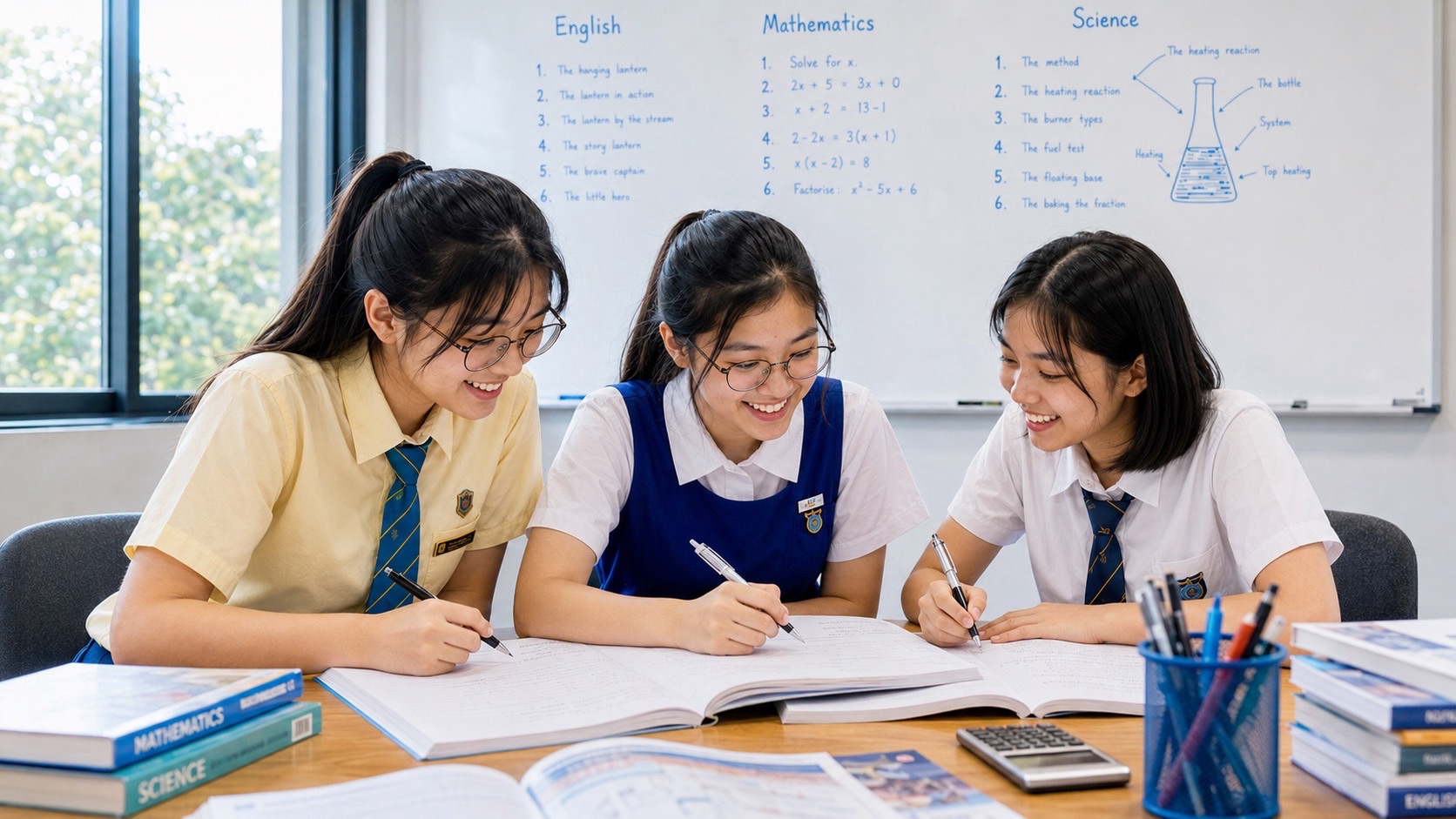
Science Education Systems · Article 29. Maya, Jia Jun, Hana and Ethan remain fictional Punggol learners. This article follows the prediction layer: how Science uses models to say what should happen next—and then lets reality judge the prediction.
The 50-second parent route
A scientific prediction is not a guess with confident wording.
It is an expected outcome generated from a model under stated conditions.
The route is:
model → conditions → variables → expected relationship → prediction → observation → comparison → error → explanation → revision
The central question is:
If this model is useful, what should we expect to observe?
Prediction makes scientific thinking vulnerable to evidence.
If the prediction repeatedly fails, the learner must inspect the model, method, assumptions or measurement.
This article extends How Scientific Models Grow With the Learner, How Scientific Causality Works and How Science Inquiry Works.
1. Prediction begins with a model
Maya says:
“I think the metal spoon will feel colder.”
That is a prediction.
But the scientific question is:
Why?
If her model involves heat transfer, the prediction is connected to a mechanism.
If she simply remembers yesterday’s answer, it is recall rather than prediction.
2. Conditions belong inside every prediction
“The plant will grow faster” is incomplete.
Under what light?
water?
temperature?
starting size?
species?
time period?
Scientific predictions are conditional.
3. Prediction is not prophecy
A prediction can be scientifically good and still fail.
The method may be weak.
the sample may vary.
an assumption may fail.
the model may be incomplete.
The value lies in exposing what the model expected.
4. Good predictions are specific enough to test
Weak:
“Something will happen.”
Better:
“As the temperature increases over the tested range, the measured rate will increase.”
The second can be compared with evidence.
5. Directional predictions are useful
Increase.
decrease.
remain approximately constant.
peak.
plateau.
A direction is already more informative than “change.”
6. Quantitative predictions are stronger when the model supports them
At later levels, equations can predict numerical outcomes.
If voltage doubles under specified conditions, what should happen to current according to the model?
Quantitative prediction makes disagreement with evidence measurable.
7. Primary 3 prediction begins with everyday expectations
Which material will let more light through?
Which object will be attracted?
Which seed condition is more suitable?
The child should give a reason before testing where possible.
8. Primary 4 prediction adds variable awareness
What changed?
What stayed the same?
What outcome should change?
The learner begins linking prediction to fair-test structure.
9. Primary 5 prediction becomes system-based
One condition changes.
A process changes.
The whole-system outcome changes.
Prediction now requires a causal chain.
10. Primary 6 prediction must survive unfamiliar contexts
The surface story changes.
The underlying model remains.
The learner must recognise the deep structure and predict from it.
11. Secondary Science makes prediction more quantitative
Graphs.
rates.
equations.
particle models.
energy models.
population patterns.
Predictions increasingly become numerical or graph-shaped.
12. A graph can be a prediction
Before collecting data, sketch the expected relationship.
Linear?
curve?
plateau?
peak?
The predicted graph makes the model visible.
13. Predicted graphs reveal hidden assumptions
Jia Jun draws a straight line forever.
The tutor asks:
“Do you really expect the relationship to remain linear outside the tested range?”
Prediction exposes extrapolation.
14. Prediction and extrapolation are not identical
A prediction can occur within a known range or outside it.
Extrapolation specifically extends a relationship beyond observed data.
Extrapolated predictions usually deserve more caution.
15. Prediction and hypothesis are related but different
A hypothesis proposes an explanation or relationship.
A prediction states what should be observed if that hypothesis is useful under the stated conditions.
Hypothesis:
light intensity affects the process.
Prediction:
increasing light over this range should increase the measured outcome.
16. Predictions should discriminate among explanations
Ethan has two competing models.
If both predict exactly the same result, the test will not distinguish them.
Good inquiry seeks conditions where the models disagree.
17. Discriminating predictions are especially powerful
Model A predicts increase.
Model B predicts no change.
Now one well-designed experiment can strongly shift confidence.
18. A failed prediction is not embarrassing
It is information.
The learner should ask:
Was the model wrong?
Was the prediction derived incorrectly?
Was the experiment badly designed?
Was the measurement weak?
Did an uncontrolled variable matter?
19. Prediction error should be diagnosed by layer
Concept.
calculation.
assumption.
method.
measurement.
data interpretation.
Different failures require different repairs.
20. Maya’s prediction weakness is intuition without mechanism
“I just feel it will happen.”
Her repair:
name the model or relationship that creates the expectation.
21. Jia Jun’s prediction weakness is formula without conditions
He applies an equation automatically.
His repair:
state when the relationship is valid.
22. Hana’s prediction weakness is refusing to commit
She says:
“Could be anything.”
Her repair:
make the best prediction from the current model, then let evidence update it.
23. Ethan’s prediction weakness is generating too many branches
Every possible outcome gets a story.
His repair:
rank the most plausible models and state the prediction that best discriminates among them.
24. Prediction is a memory test
The learner must retrieve the model before the result appears.
This is harder than recognising the correct answer after seeing the outcome.
Prediction therefore makes retrieval visible.
25. Prediction is a transfer test
Change the context.
Can the learner still predict from the same principle?
If yes, the model is becoming portable.
26. Prediction is an understanding test
A student can recite a definition without being able to say what should happen in a new scenario.
Prediction reveals whether the concept carries operational meaning.
27. Prediction strengthens experiment design
Before testing, ask:
What pattern would support the model?
What pattern would challenge it?
Which measurements are therefore necessary?
The expected result helps design the evidence collection.
28. Prediction should precede observation when possible
If students see the result first, they can invent a plausible explanation afterward.
Predict first.
Then observe.
This reduces hindsight bias.
29. Hindsight bias makes outcomes feel inevitable
After seeing the graph, the student says:
“Of course it would rise.”
Would they have predicted that beforehand?
Recording predictions protects against memory rewriting.
30. Prediction journals create visible model history
Prediction.
reason.
actual result.
difference.
model update.
Over time, the learner sees how explanations improve.
31. Scientific forecasting is prediction at scale
Weather.
epidemics.
climate.
astronomy.
engineering loads.
Forecasts use models, current data and uncertainty.
32. Forecasts should include uncertainty when appropriate
One exact number may imply false confidence.
A probability or range can communicate the model’s uncertainty more honestly.
33. Prediction intervals and probability are advanced forms of calibrated expectation
At later levels, learners may encounter predictions expressed as distributions or ranges.
The key idea is stable:
future outcomes can be expected without being certain.
34. Good models can make probabilistic predictions
“70 percent chance” is not a weak prediction simply because the event may fail to occur once.
Probabilistic predictions must be evaluated across many cases.
35. Calibration evaluates probabilistic predictions
If events predicted at 70 percent occur about 70 percent of the time across many comparable cases, the forecasts are well calibrated.
Prediction quality can be measured statistically.
36. Accuracy and calibration are different
A forecaster can choose the most likely outcome often and still express poor probabilities.
Scientific forecasting may need both correct ranking and appropriate confidence.
37. Prediction and causality are linked
If X truly causes Y, changing X should often create a predictable change in Y under relevant conditions.
Prediction tests causal models.
38. Prediction and systems thinking are linked
In complex systems, feedback and delays can make predictions counterintuitive.
A local increase may create a later decrease.
Systems models help trace those effects.
39. Prediction and uncertainty are linked
The farther the forecast horizon, the wider uncertainty may become.
Small errors in initial conditions or parameters can compound.
Predictions should carry appropriate confidence.
40. Prediction and falsification are linked
A prediction matters scientifically because evidence could disagree.
If every possible outcome can be explained as success, the prediction cannot meaningfully test the model.
The next article, How Scientific Falsification Works, follows this layer.
41. AI makes prediction easy to generate
Ask a model what happens next and it will often answer.
The learner should then ask:
What scientific model generated that prediction?
What conditions are assumed?
What evidence would contradict it?
How uncertain is the prediction?
42. AI confidence is not predictive calibration
Fluent wording does not prove forecast quality.
Predictions should be evaluated against actual outcomes over time.
43. AI can help students practise prediction
Useful prompts:
“Give me a Science scenario but hide the outcome.”
“Ask me to predict first.”
“Then show the result and ask me to diagnose any mismatch.”
“Change one condition and ask how the prediction changes.”
44. Parents can model prediction casually
Before ice melts:
“Which cube do you think will melt faster, and why?”
Before rain:
“What would we expect the ground to look like afterward?”
Before a journey:
“What happens to travel time if traffic increases?”
Prediction turns everyday life into model testing.
45. Small-group tuition can compare predictions before answers
Three learners commit independently.
The tutor compares the models behind each prediction.
Different predictions reveal different misconceptions before the result appears.
46. The best prediction lesson includes surprise
If every outcome is obvious, students never experience model revision.
Choose some cases where intuitive predictions fail.
Surprise creates a reason to improve the model.
47. Prediction should be revisited after evidence
Do not only say whether it was right or wrong.
Ask:
Which assumption produced the mismatch?
What should the new model predict next time?
48. Scientific progress often improves prediction
A better model can explain more observations and predict new ones more accurately.
Prediction is one way competing models earn trust.
49. But explanation and prediction are not identical
A model may predict accurately without providing a satisfying mechanism.
Another may explain mechanisms but make weaker numerical forecasts.
Science values both, depending on the question.
50. A compact prediction checklist
- What model am I using?
- What conditions are assumed?
- Which variable changes?
- Which outcome should respond?
- What direction or magnitude is expected?
- What result would challenge the prediction?
- How uncertain should I be?
- Is this within the tested range?
- What alternative model predicts something different?
- What happened?
- What should the model update be?
51. Frequently asked questions
What is a scientific prediction?
It is an expected observable outcome derived from a model under stated conditions.
Is a prediction the same as a hypothesis?
No. A hypothesis proposes an explanation or relationship; a prediction states what should be observed if that hypothesis is useful.
Can a good prediction be wrong?
Yes. A well-derived prediction can fail because the model, assumptions, method or measurements are incomplete or incorrect. The failure is scientifically informative.
Why predict before seeing the result?
It exposes the learner’s current model and reduces hindsight bias.
How does prediction help PSLE Science?
It supports experiment reasoning, trend interpretation, unfamiliar contexts and causal explanation.
How does prediction change in Secondary Science?
It becomes increasingly quantitative and model-based, using graphs, equations, rates and uncertainty.
52. Continue the Science Education Systems series
Conclusion: Prediction gives a model somewhere to fail
Maya expects.
Jia Jun calculates.
Hana states the conditions.
Ethan imagines another model.
Then reality arrives.
The point is not to protect the prediction.
The point is to compare expectation with observation honestly.
Predict.
test.
measure.
compare.
diagnose.
revise.
A scientific model earns confidence partly because it can tell us what should happen before we already know the answer.


