
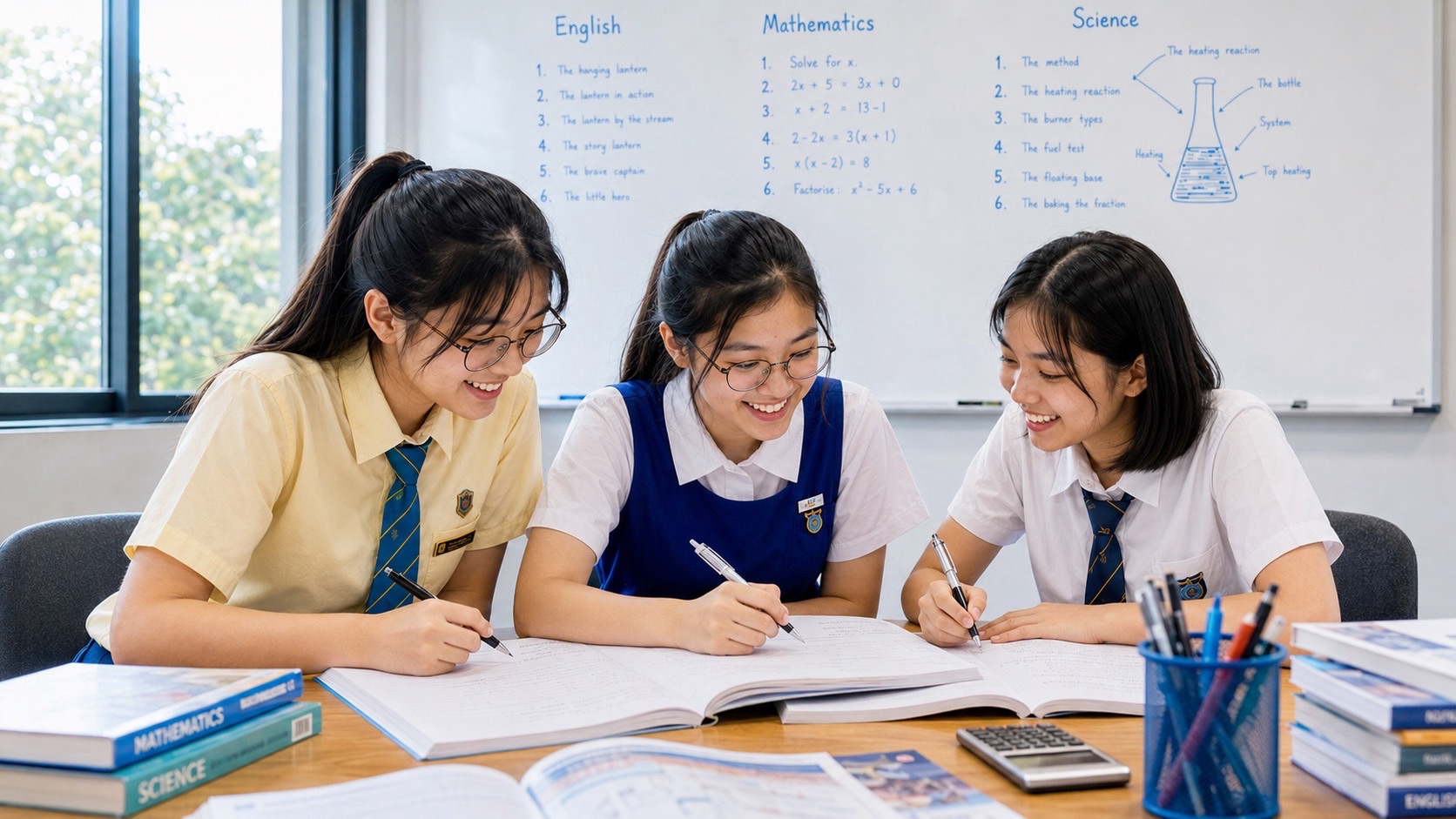
Science Education Systems · Article 24. Maya, Jia Jun, Hana and Ethan remain fictional Punggol learners. This article closes the fifth four-article batch by following the literacy layer: how school Science becomes a way of navigating claims, evidence, risk and decisions in the wider world.
The 50-second parent route
Scientific literacy is not knowing every fact in Science.
It is knowing enough Science, and enough about how Science works, to reason responsibly when facts, evidence and claims meet real decisions.
The route is:
question → background knowledge → source → evidence → model → data interpretation → uncertainty → consensus → ethics → decision → revision
A scientifically literate learner should be able to ask:
What is the claim?
What evidence supports it?
Where did the evidence come from?
What does the evidence not show?
What do relevant experts conclude?
What uncertainty remains?
What action is proportionate to the risk?
What would make me update?
This article draws together Science Evidence, Scientific Consensus, Scientific Ethics and the wider Science Education Systems series.
1. Scientific literacy is what remains when the examination paper disappears
At school, the chapter title tells the learner what topic is being tested.
Adult life does not.
A news article about food safety may involve Chemistry, Biology, statistics and risk.
A technology claim may involve Physics, engineering, probability and ethics.
A health claim may involve Biology, evidence quality, study design and uncertainty.
Scientific literacy is the ability to route across this mixed terrain.
2. Facts are necessary but not sufficient
A person can memorise hundreds of scientific facts and still fall for weak claims.
Why?
Because literacy also requires:
source evaluation;
evidence interpretation;
model understanding;
uncertainty calibration;
and transfer.
Knowledge is the floor.
Judgement is the structure built on it.
3. “Science says” is too vague
Which science?
Which study?
Which field?
Which evidence?
Which level of consensus?
Which date?
Which population?
Scientific literacy asks for a more inspectable chain.
4. Maya learns to separate claim from evidence
A video says:
“This drink improves memory.”
Maya asks:
“What evidence did they use?”
That question changes the entire interaction.
The claim is no longer being accepted because it was presented confidently.
5. Jia Jun learns to separate evidence from interpretation
The study reports a difference.
Does that mean the product caused the difference?
Not necessarily.
What was the study design?
Was there a control group?
How large was the effect?
Evidence must be interpreted through method.
6. Hana learns to separate uncertainty from ignorance
A report says the estimate has a range.
She used to think:
“They do not know.”
Now she understands:
“They know within limits.”
Bounded uncertainty can still support strong decisions.
7. Ethan learns to separate alternative explanations from equal explanations
Several possibilities exist.
They are not equally supported.
His job is to rank them by evidence.
Scientific open-mindedness does not mean refusing to decide.
8. Source evaluation is the first external literacy skill
Who produced the claim?
What expertise do they have?
What evidence do they cite?
Are they reporting original research or repeating someone else?
Do they have relevant conflicts of interest?
Can the evidence be traced?
9. A government or scientific institution is not automatically correct
But institutional sources often deserve more initial weight than anonymous social posts because they may have formal expertise, review processes, accountability and correction mechanisms.
Scientific literacy evaluates systems of trust, not just individual charisma.
10. A social-media post is not automatically wrong
It may link to excellent evidence.
The platform does not determine truth.
The evidence chain does.
But short-form formats often compress caveats, methods and uncertainty.
That increases the need to inspect the source behind the post.
11. Headlines are invitations, not conclusions
“Scientists prove…”
“New study reveals…”
“This food causes…”
Headlines are built for attention.
Scientific literacy reads past them.
What did the study actually test?
12. Relative risk and absolute risk can tell different stories
“Risk doubles” sounds alarming.
From 1 in 100 to 2 in 100?
From 1 in 100,000 to 2 in 100,000?
The relative change is the same.
The decision context is not.
Scientific literacy needs numeracy.
13. Percentages need denominators
“80 percent successful.”
80 percent of 10?
80 percent of 10,000?
Compared with what baseline?
For which population?
Numbers become meaningful only with context.
14. Average can hide variation
A treatment helps the average participant.
Some improve greatly.
Some not at all.
Some worsen.
Averages compress distributions.
Scientific literacy asks what the summary hides.
15. Correlation is one of the most important public distinctions
People who do X also show more Y.
Does X cause Y?
Maybe.
Maybe Y influences X.
Maybe a third variable influences both.
Association is not automatically causation.
16. Causation needs design, mechanism and evidence
Was the factor manipulated?
Were alternatives controlled?
Is there a plausible mechanism?
Did the result replicate?
How strong is the effect?
Causal claims deserve more scrutiny than descriptive ones.
17. Sample size matters
Three people are not a population.
But one million biased observations can still mislead.
Scientific literacy asks both:
How many?
And:
Who?
18. Representativeness matters
A study of one age group may not transfer to another.
A study in one climate may not generalise everywhere.
A result in one species may not automatically apply to humans.
Transfer has boundaries.
19. Replication matters because one study can be wrong
Chance.
measurement.
sample.
method.
analysis.
One study can fail for many reasons.
Independent replication tests whether the finding survives.
See How Scientific Replication Works.
20. Peer review matters but is not a truth stamp
Peer-reviewed work has undergone expert scrutiny.
That is meaningful.
It can still contain errors.
Scientific literacy treats peer review as one filter in a larger correction system.
21. Consensus matters when evidence has accumulated
One study says X.
Another says not-X.
What does the wider field conclude after many studies?
Consensus helps individuals navigate distributed knowledge they cannot personally reproduce.
See How Scientific Consensus Works.
22. Consensus should be weighted by field maturity
A century-old physical relationship replicated countless times is not epistemically identical to a new preliminary finding.
Scientific literacy pays attention to how long and how strongly a claim has survived scrutiny.
23. Uncertainty belongs inside literacy
Weather forecast: 70 percent chance.
Medical test: sensitivity and specificity.
engineering: safety margin.
climate projection: model range.
Scientific information often arrives probabilistically.
Literacy means acting responsibly without demanding impossible certainty.
24. Risk combines probability and consequence
A rare but catastrophic event may justify precaution.
A frequent but trivial event may not.
The same probability can imply different decisions depending on consequence.
Risk reasoning is scientific literacy applied to action.
25. Personal anecdotes are evidence with narrow scope
“It worked for me.”
That experience may be real.
It supports a claim about one person’s experience.
It does not automatically establish what will happen for everyone.
Anecdotes can generate hypotheses.
They rarely settle broad causal claims.
26. Testimonials are designed to feel more powerful than distributions
One vivid story is memorable.
A table of 10,000 outcomes is not.
Humans respond strongly to stories.
Scientific literacy respects stories without allowing one story to outweigh a much larger evidence base automatically.
27. Images can persuade before evidence is inspected
Before-and-after photographs.
microscope images.
satellite images.
graphs.
The learner should ask:
What is the scale?
Was the image edited?
What lies outside the frame?
Is the comparison fair?
28. Graph design can change perception
Truncated axes can magnify small differences.
wide scales can hide change.
selected dates can create an apparent trend.
Scientific literacy reads axes before narrative.
29. Models are essential for literacy
Weather models.
epidemiological models.
climate models.
economic models.
AI models.
A model is not the world.
It is a representation built to preserve selected relationships.
Literacy asks where the model works and where it may fail.
30. Forecasts are conditional model outputs
A forecast depends on data, assumptions and model structure.
Changing inputs can change the prediction.
A forecast can be useful even when it is not certain.
Scientific literacy does not confuse probability with failure.
31. “The model was wrong” needs context
A forecast predicted a range.
The observed value landed near one edge.
Was the model wrong?
Perhaps not.
Model evaluation should compare predicted uncertainty with actual outcome, not demand exact point prediction unless the model promised one.
32. Scientific literacy includes knowing what not to conclude
A study finds association.
Do not claim causation.
A study examines adults.
Do not automatically generalise to children.
A test works in a laboratory.
Do not assume it works identically at industrial scale.
Scope control is a literacy skill.
33. Scientific literacy is also knowing when expertise is needed
A child can reason about a school magnet experiment.
A parent should not independently improvise treatment for a serious medical problem from first principles.
Some decisions require trained experts, specialised instruments and institutional systems.
Good literacy includes knowing the limits of personal competence.
34. Expertise should be relevant to the claim
A celebrity can be intelligent and still lack medical expertise.
A scientist can be eminent in one field and outside their depth in another.
Scientific literacy checks domain relevance.
35. Credentials are useful signals, not substitutes for evidence
A qualified expert deserves more initial trust in their field than an anonymous stranger.
But claims should still connect to the evidence base.
Trust is strongest when expertise and transparent evidence align.
36. Scientific literacy is not cynicism
“Everything is biased.”
“Studies can be wrong.”
“Experts disagree.”
These statements can be true.
They do not justify treating all claims as equally uncertain.
Cynicism flattens evidence.
Literacy weighs it.
37. Scientific literacy is not blind trust either
“Scientists said it, therefore it cannot be questioned.”
That misunderstands Science.
Scientific confidence should remain connected to methods, evidence, replication and correction systems.
38. The correct stance is calibrated trust
Strong evidence?
High trust.
Preliminary evidence?
More caution.
Unknown source?
Verify.
Repeated independent consensus?
Substantial confidence.
Trust should move with the evidence.
39. Ethical literacy matters because scientifically possible is not automatically desirable
A genetic technology works.
Should it be used?
An AI system predicts behaviour.
Should it decide access to opportunities?
A field experiment can collect detailed location data.
Should those data be public?
Evidence informs the decision.
Values and ethics complete it.
40. Scientific literacy separates empirical and ethical questions
Empirical:
What is likely to happen?
Ethical:
What should we do about it?
The two interact.
They are not identical.
41. Health claims are a major literacy test
Does the product work?
Compared with placebo or usual care?
For whom?
How large is the benefit?
What side effects occurred?
Was the study randomised?
Has the finding replicated?
What do professional guidelines say?
These questions can protect people from persuasive but weak claims.
42. Nutrition claims often overcompress complex evidence
“Food X causes disease.”
Dietary research can involve confounding, self-report, long timescales and complex behavioural patterns.
Scientific literacy resists turning one association into a universal food rule.
43. Environmental claims require systems thinking
One intervention can affect:
energy use;
materials;
emissions;
water;
land;
cost;
behaviour.
Scientific literacy asks about the whole system rather than one visible benefit.
44. Technology claims require performance context
“AI is 95 percent accurate.”
On which dataset?
Which population?
What type of errors?
What happens in real deployment?
How costly are false positives and false negatives?
One accuracy number is rarely the whole system.
45. Engineering claims require safety margins
A structure can carry the expected load.
What about variation?
fatigue?
weather?
unexpected loads?
maintenance?
Scientific and engineering literacy think beyond average conditions.
46. Public policy uses Science but is not reducible to Science
Evidence may estimate costs, risks and outcomes.
Policy must also weigh values, distribution, feasibility and rights.
Scientific literacy helps citizens distinguish disagreements about facts from disagreements about priorities.
47. “Follow the Science” can oversimplify policy choices
Science can inform what is likely to happen under different options.
It does not automatically choose society’s values.
Responsible decision-making makes both evidence and value judgements explicit.
48. Scientific literacy includes historical awareness
Past scientific models changed.
Past institutions made mistakes.
Past discoveries transformed society.
History teaches humility.
But it also teaches how cumulative correction can produce extraordinarily reliable knowledge.
49. Science education should show how we know
Not every lesson needs historical reconstruction.
But learners should sometimes encounter:
the observation;
the experiment;
the measurement;
the failed model;
the evidence that changed the explanation.
Knowing how knowledge was earned makes it easier to evaluate new claims later.
50. Primary 3 scientific literacy begins with observation discipline
What did you actually see?
What are you inferring?
What would you need to check?
This is the root.
51. Primary 4 literacy adds comparison
Which setup differs?
Which evidence matters?
Which conclusion fits?
The child begins seeing that claims should be tied to observed conditions.
52. Primary 5 literacy adds systems
More than one factor may matter.
The child must track interactions and avoid simple one-cause stories where the system is more complex.
53. Primary 6 literacy adds unfamiliar contexts
PSLE Science can present novel scenarios.
The learner needs to identify deep structure, use evidence and explain under changed surface conditions.
This is transfer becoming literacy.
54. Secondary literacy adds abstraction and quantitative evidence
Graphs.
equations.
particles.
cells.
forces.
energy.
statistics.
practical uncertainty.
Scientific judgement becomes more formal.
55. School assessment should not be the endpoint
A student can score well by learning question patterns.
The larger aim is a person who can evaluate a health claim, interpret a graph, understand uncertainty and know when to consult an expert.
Examination performance is important.
Scientific agency is larger.
56. Small-group tuition can build literacy through contrast
Three students inspect the same claim.
Maya trusts the graph.
Jia Jun trusts the headline.
Hana worries about uncertainty.
The tutor asks:
What evidence is strongest?
Which interpretation overreaches?
What source should we check?
The discussion makes literacy visible.
57. Parents can model literacy through ordinary questions
“Where did you hear that?”
“What evidence did they show?”
“Is that one study or a larger consensus?”
“What would make us change our minds?”
These questions can happen around a dinner table without becoming a lesson plan.
58. Curiosity remains essential
Scientific literacy is not only defensive scepticism.
It also asks:
What could explain this?
How would we test it?
What new technology might follow?
What does this connect to?
Curiosity keeps the system generative.
59. Humility remains essential too
“I do not know.”
“I need a better source.”
“That is outside my expertise.”
“The evidence is mixed.”
These are not failures.
They are scientifically literate states when true.
60. The strongest learner knows how to update
New evidence arrives.
Does the learner cling to the old claim?
Or revise?
Scientific literacy is ultimately an updating system.
Beliefs should move when evidence moves.
61. AI makes scientific literacy more urgent
AI can generate:
facts;
citations;
graphs;
explanations;
arguments;
summaries;
and falsehoods
with the same fluent surface.
The learner can no longer use polish as a proxy for truth.
62. AI output should be treated as a claim-bearing object
What does it claim?
What sources support it?
Are the citations real?
Is the reasoning valid?
What uncertainty is hidden?
Does an authoritative source agree?
Verification becomes routine.
63. AI can also strengthen literacy practice
Ask it to generate:
a misleading graph;
a weak health claim;
a false-causation example;
two competing explanations;
a source-comparison exercise.
Then let the student critique before seeing the analysis.
64. Scientific literacy is a civic skill
Citizens vote on policies affected by Science.
Make health decisions.
buy technologies.
respond to environmental risks.
interpret public statistics.
A society with stronger scientific literacy can reason more effectively about shared problems.
65. Scientific literacy is also personal agency
The learner becomes harder to manipulate with:
fake certainty;
misleading percentages;
one dramatic anecdote;
authority without evidence;
novelty without replication;
or doubt without proportion.
That is independence.
66. A compact scientific literacy checklist
- What is the exact claim?
- What background Science is relevant?
- Who is the source?
- What evidence is offered?
- How was the evidence generated?
- Is the sample appropriate?
- Is the claim causal or merely associative?
- What do the data actually show?
- What uncertainty remains?
- Has the finding replicated?
- What is the wider expert consensus?
- Are there conflicts of interest?
- What ethical considerations matter?
- What decision is proportionate to the evidence and risk?
- What new evidence would make me update?
67. Frequently asked questions
What is scientific literacy?
Scientific literacy is the ability to understand and use scientific knowledge, evidence, models, data and uncertainty to evaluate claims and make responsible decisions.
Does scientific literacy mean knowing a lot of facts?
Facts matter, but literacy also requires understanding how evidence is produced, how models work, how uncertainty is handled and how claims should be evaluated.
Why is source evaluation important?
Because scientific claims can be distorted as they move from original research through summaries, media, social posts and AI-generated explanations.
Why does consensus matter?
Individuals cannot personally verify every scientific claim. Strong expert consensus provides a rational guide when it rests on broad, replicated evidence.
Does uncertainty make Science unreliable?
No. Science becomes more reliable by identifying uncertainty, quantifying it where possible and updating when new evidence appears.
How does scientific literacy help children?
It improves observation, question reading, evidence use, explanation, transfer and the ability to distinguish strong claims from weak ones.
How does it help adults?
It supports decisions about health, technology, environment, risk, public information and other evidence-rich parts of modern life.
How does AI change scientific literacy?
AI makes polished information easy to generate, so verification, source provenance, evidence checking and uncertainty awareness become more important.
68. Continue the Science Education Systems series
- Science Education Systems | How Curiosity Becomes Reliable Knowledge
- How Scientific Thinking Is Built
- How Science Evidence Works
- How Scientific Uncertainty Works
- How Scientific Peer Review Works
- How Scientific Consensus Works
- How Scientific Ethics Works
Wider routes:
- How Science Works
- eduKate Science Learning Manual
- eduKate Sengkang Science Hub
- Punggol as a Classroom
Conclusion: Scientific literacy is the return path
Maya began with a magnet.
Jia Jun with a keyword.
Hana with a careful answer.
Ethan with a question.
Across the Science Education Systems series, those small beginnings grew.
Observation.
model.
measurement.
evidence.
experiment.
data.
argument.
uncertainty.
replication.
peer review.
consensus.
ethics.
Now the knowledge returns to the world.
A headline appears.
A graph arrives.
A doctor explains risk.
A technology company makes a claim.
An AI system produces an answer.
The learner is no longer empty-handed.
They know how to ask what the claim means.
How the evidence was produced.
What the model assumes.
How uncertain the conclusion is.
What the wider scientific community thinks.
What ethical consequences matter.
And what would justify changing their mind.
That is what Science education is ultimately for.
Not merely to finish the chapter.
To build a mind that can keep learning from reality.


