
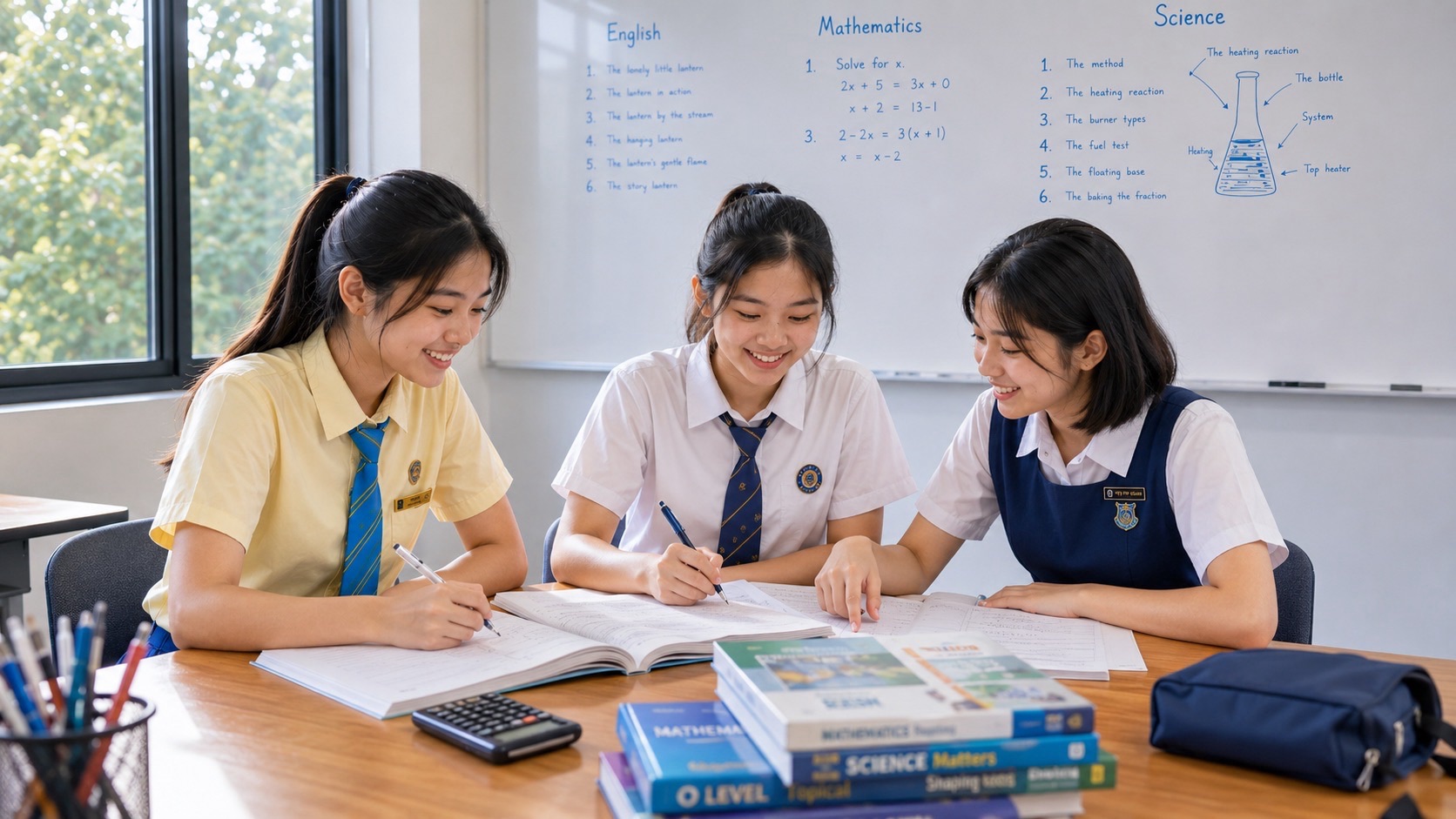
Science Education Systems · Article 21. Maya, Jia Jun, Hana and Ethan remain fictional Punggol learners. This article follows the peer-review layer: how scientific work is exposed to informed critique before confidence rises too quickly.
The 50-second parent route
Peer review is not a stamp that turns a paper into truth.
It is a quality-control conversation.
A researcher makes a claim.
Explains the method.
Shows the evidence.
Other qualified people inspect the logic.
They ask whether the question is clear, the method fits, the analysis is defensible, the evidence supports the claim and the limitations are honestly reported.
The route is:
question → method → evidence → manuscript → expert critique → revision → publication decision → replication → continuing scrutiny
The important educational lesson is bigger than journals.
Good work should survive informed challenge.
This article extends How Science Communication Works, How Scientific Argumentation Works and How Scientific Replication Works.
1. Science is public by design
A private idea can be brilliant.
It does not become scientific knowledge merely because its creator is confident.
Science depends on inspectability.
What was done?
What was measured?
How was the analysis performed?
Can another person find a weakness?
Can another person repeat it?
Peer review is one institutional way of inviting that inspection.
2. The reviewer is not supposed to applaud
The job is to look for problems.
Ambiguous methods.
unsupported claims.
missing controls.
weak analysis.
confounding factors.
unclear writing.
relevant work that was ignored.
A strong reviewer is useful because criticism improves the evidence system.
3. Critique is not hostility
Students often experience correction as personal.
“My answer is wrong, therefore I am bad at Science.”
Peer review offers a healthier model.
The object under review is the argument.
Not the worth of the person.
“This conclusion exceeds the evidence” is different from “You are not intelligent.”
4. Primary Science can learn peer-review habits without journals
Maya writes an explanation.
Jia Jun reads it.
He asks:
“Which evidence shows that?”
Hana checks the diagram.
Ethan offers an alternative explanation.
The answer returns to Maya stronger.
This is a child-sized version of informed critique.
5. Individual work should come before peer influence
If students see the strongest answer first, they may copy the structure without revealing their own thinking.
Ask for independent attempt.
Then review.
Peer review is most diagnostic when it compares actual reasoning, not borrowed consensus.
6. Review begins with the question
Is the question clear?
Is it answerable?
Is the claim actually responding to it?
A technically impressive analysis can still be irrelevant if the question was never defined well.
7. Then review the method
Does the method test what the authors say it tests?
Are key variables controlled?
Are measurements appropriate?
Is the sample suitable?
Can another person reconstruct the procedure?
Methods determine how much confidence evidence can carry.
8. Then review the evidence
Was the evidence recorded clearly?
Are all relevant results shown?
Were anomalies handled transparently?
Do tables and graphs represent the data faithfully?
Was inconvenient evidence omitted?
Peer review checks whether the evidential trail is visible.
9. Then review the reasoning
Does the conclusion follow?
Are alternative explanations considered?
Does the claim become broader than the tested range?
Does association become causation without justification?
Does the language imply more certainty than the data support?
This is argument review.
10. Then review the communication
A sound study can still be hard to inspect if the writing is vague.
Undefined terms.
missing units.
unclear figures.
ambiguous methods.
Scientific communication is part of scientific quality.
11. Reviewers do not need to agree on everything
One reviewer focuses on method.
Another on theory.
Another on statistics.
Disagreement among reviewers is normal because scientific work can be inspected from several angles.
The editor or decision process must weigh the critiques.
12. A review can recommend revision rather than rejection
The work may be promising but incomplete.
Add an analysis.
clarify the method.
reduce the scope of the claim.
explain a limitation.
include missing evidence.
Revision is not punishment.
It is part of scholarship.
13. “Major revision” can be good news
It means the work may have enough value to deserve another round after substantial correction.
Science improves through cycles.
Draft.
critique.
repair.
retest.
rewrite.
This resembles good learning.
14. Rejection can also improve future work
A rejected paper may reveal:
a weak design;
insufficient evidence;
an overbroad claim;
or a question already answered more strongly elsewhere.
The result can be used to redesign the next study.
15. Peer review does not guarantee correctness
Reviewers can miss problems.
They may disagree.
They may be biased.
Some errors become visible only after publication.
Some results fail to replicate.
Peer review raises the quality floor; it is not the final court of reality.
16. Publication is therefore not the end
Other scientists read.
Replicate.
criticise.
extend.
reanalyse.
New evidence arrives.
The scientific record remains revisable.
17. Replication is a different filter
Peer review asks:
Does this work appear credible enough to enter the literature?
Replication asks:
Does the finding occur again?
Both matter.
See How Scientific Replication Works.
18. Retraction is part of scientific self-correction
Sometimes a published paper contains serious problems.
When the record is corrected or a paper is retracted, this can look like Science failing.
Often it is Science’s correction machinery becoming visible.
The important question is whether problems are identified, investigated and corrected transparently.
19. Corrections should be visible
Quietly replacing a wrong claim can hide the history of the mistake.
Transparent correction preserves trust because readers can see what changed and why.
This principle applies in student work too.
Cross out, correct and annotate the reason.
20. Review should distinguish fatal flaws from fixable flaws
A missing unit may be fixable.
A fundamentally confounded design may require a new experiment.
A typo is not equivalent to fabricated evidence.
Good critique ranks problems by impact.
21. The strongest reviewer asks the discriminating question
Not fifty comments.
The one question that exposes the central weakness.
“What evidence distinguishes your explanation from this alternative?”
“How do you know the effect is not caused by the starting difference?”
“Why is this extrapolation justified?”
One sharp question can improve an entire paper.
22. Maya’s review weakness is politeness without critique
“Looks good.”
That is friendly.
It is not useful review.
Her repair:
identify one strength and one specific scientific question.
23. Jia Jun’s review weakness is correction without explanation
He circles a sentence and writes:
“Wrong.”
His repair:
name the reason.
“This conclusion is broader than the three tested samples.”
Now the writer can repair it.
24. Hana’s review weakness is searching for perfection
She finds ten tiny imperfections and misses the one causal flaw that matters.
Her repair is impact ranking.
Which issue changes the conclusion most?
25. Ethan’s review weakness is redesigning the entire study
He proposes a different question, different sample and different instrument.
Interesting.
Not necessarily review.
His repair:
first evaluate whether the current study supports its own claim.
26. Review benefits from checklists
Question.
method.
measurement.
data.
analysis.
claim.
uncertainty.
communication.
Checklists prevent important layers being forgotten.
27. But checklists do not replace judgement
A paper can tick every box and still contain a weak central inference.
Review needs flexible reasoning.
What is the main claim?
What is the strongest evidence?
Where could the chain break?
28. Review should preserve useful originality
Critique should not force every piece of work into one familiar shape.
New methods and ideas may look unusual.
The correct question is whether the work is rigorous enough to justify its claim—not whether it resembles the reviewer’s preferred style.
29. Bias can enter peer review
Reviewers are human.
Prestige.
institution.
theory preference.
personal familiarity.
These can influence judgement.
Different review systems attempt to reduce such effects, but none eliminates human judgement entirely.
30. Blinding can reduce some biases
Some review systems hide author identity from reviewers.
Some hide reviewer identity from authors.
Some make identities open.
Each arrangement has trade-offs.
The larger lesson is that system design can reduce certain biases without pretending bias vanishes.
31. Conflicts of interest matter
A reviewer may have financial, professional or personal reasons that affect judgement.
Disclosure helps editors assess whether the reviewer is appropriate.
Scientific trust depends partly on making relevant conflicts visible.
32. Expertise matters in review
A strong reviewer understands the methods and literature well enough to identify subtle problems.
Not every intelligent person can review every specialised paper equally well.
Domain knowledge matters.
33. But outsiders can sometimes spot assumptions insiders miss
A specialist may accept a convention automatically.
An outsider may ask:
“Why is that assumption justified?”
Healthy scientific systems benefit from both deep expertise and fresh scrutiny when roles are appropriate.
34. Student peer review should focus on a small number of criteria
For Primary Science:
Did the answer use the evidence?
Did it explain the relationship?
Did it answer the question?
For Secondary Science:
add method, uncertainty, graph interpretation and evaluation where relevant.
Too many criteria can overwhelm novice reviewers.
35. Peer review improves the reviewer too
Reading another person’s answer can make quality differences easier to see.
The reviewer notices:
missing evidence;
reversed causality;
overbroad claims;
vague language.
Then returns to their own writing more critically.
36. Reviewing weak examples is especially useful
Give three answers.
One is correct but incomplete.
One contains irrelevant evidence.
One overstates certainty.
Ask students to repair each.
Critique becomes pattern recognition.
37. Reviewing strong examples is useful too
Why is this answer good?
Which sentence carries the mechanism?
Which word calibrates confidence?
Where is the evidence used?
Strong examples teach structure when analysed rather than copied.
38. Peer review should not become answer-sharing before effort
Individual attempt first.
Review second.
Revision third.
Independent retest later.
This keeps peer learning from replacing self-learning.
39. Small-group tuition is naturally suited to review
Three students produce three different explanations.
Each answer becomes a visible model of thinking.
The tutor can ask the group to identify:
strongest evidence;
missing link;
overclaim;
best revision.
One problem produces multiple learning routes.
40. The tutor should still protect psychological safety
Critique the work.
Do not mock the learner.
Do not rank people publicly by intelligence.
Students need enough safety to expose unfinished thinking.
Otherwise peer review becomes performance theatre.
41. Parents can use a gentle review question
“What would someone who disagrees with you ask?”
This invites self-critique without turning the home into a marking room.
Another useful question:
“What evidence would make your answer stronger?”
42. Review is part of scientific literacy online
A viral post makes a scientific claim.
Ask:
Was the evidence peer-reviewed?
What kind of study was it?
Has it been replicated?
How does it fit with wider evidence?
Peer review is one signal among several.
43. “Peer reviewed” should not become a magic phrase
Two peer-reviewed papers can disagree.
One may be stronger.
Methods differ.
sample sizes differ.
evidence accumulates over time.
Scientific literacy evaluates the broader evidence landscape.
44. Preprints make timing visible
Modern research can circulate before formal peer review.
This speeds communication.
It also means readers must distinguish preliminary work from reviewed publication.
The scientific status of a claim can change as critique arrives.
45. AI can assist review but should not replace expert judgement
AI can check clarity.
summarise methods.
flag missing definitions.
generate questions.
But it may miss domain-specific flaws or invent critiques.
Human expert responsibility remains essential.
46. AI can be used to train students in review
Useful prompts:
“Give me a weak Science explanation with one hidden flaw.”
“Give me a method with one confounded variable.”
“Give me a claim broader than the evidence.”
“Let me review it before you show the flaw.”
This turns critique into deliberate practice.
47. Review should always ask about provenance
Where did the data come from?
Which source?
Which instrument?
Which analysis?
Untraceable evidence is difficult to inspect.
48. Review should always ask about uncertainty
What is known strongly?
What remains tentative?
What range was tested?
What alternative explanation remains?
Does the conclusion signal these boundaries?
49. Review should ask whether the work is reproducible
Could another group repeat the method?
Could another analyst reproduce the calculation?
Are the steps documented?
Transparency supports checking.
50. Review should ask whether the claim matters
A technically perfect analysis can answer a trivial or irrelevant question.
Scientific quality includes significance in the ordinary sense:
Does this result improve understanding of the problem being studied?
51. Scientific communities use many filters, not one
Peer review.
replication.
reanalysis.
meta-analysis.
debate.
new instrumentation.
new theory.
Time.
Reliable knowledge emerges from interacting correction systems.
52. Peer review is one reason Science can scale beyond one brilliant person
No individual can know everything.
Scientific communities distribute scrutiny.
One person designs.
another measures.
another reviews.
another replicates.
another synthesises.
Knowledge improves through organised collective intelligence.
53. This leads naturally to scientific consensus
When many evidence streams, replications and expert assessments converge over time, a field can develop a consensus.
The next article, How Scientific Consensus Works, follows that process.
54. A compact peer-review checklist
- Is the question clear?
- Does the method fit the question?
- Are key variables controlled or acknowledged?
- Are measurements appropriate?
- Is the evidence reported transparently?
- Does the analysis match the data?
- Does the claim exceed the evidence?
- Are alternative explanations considered?
- Is uncertainty communicated?
- Can the method be reconstructed?
- Are conflicts or assumptions visible?
- What single revision would improve the work most?
55. Frequently asked questions
What is scientific peer review?
It is a process in which qualified experts evaluate scientific work for clarity, methodological quality, evidential support and contribution before or around publication.
Does peer review prove a paper is correct?
No. It is a quality-control filter, not a guarantee. Replication and later scrutiny remain necessary.
Why do reviewers disagree?
They may focus on different methods, assumptions or interpretations. Scientific work often contains several legitimate points of evaluation.
What does revision mean?
Authors respond to critiques by clarifying, correcting, reanalysing, narrowing claims or sometimes collecting more evidence.
Is peer review useful for school students?
Yes. Students can review whether answers use evidence, explain relationships, address the question and communicate clearly.
How does peer review relate to replication?
Peer review evaluates the work; replication independently tests whether the result can be obtained again.
Can AI peer-review scientific work?
AI can assist with checking and critique, but expert human judgement remains important because AI can miss domain-specific problems or generate unsupported comments.
56. Continue the Science Education Systems series
- How Science Communication Works
- How Scientific Argumentation Works
- How Scientific Replication Works
- How Scientific Consensus Works
- How Scientific Ethics Works
- How Scientific Literacy Works
Conclusion: Good Science invites the intelligent objection
Maya writes an answer.
Jia Jun asks where the evidence is.
Hana spots an overclaim.
Ethan proposes an alternative explanation.
Maya revises.
The answer improves.
That small classroom scene contains the logic of peer review.
Make the work visible.
Invite critique.
Separate the person from the argument.
Fix what can be fixed.
Redesign what cannot.
Publish only with appropriate confidence.
Then keep testing.
Science becomes trustworthy not because scientists avoid error, but because good scientific systems make error increasingly difficult to hide forever.


