
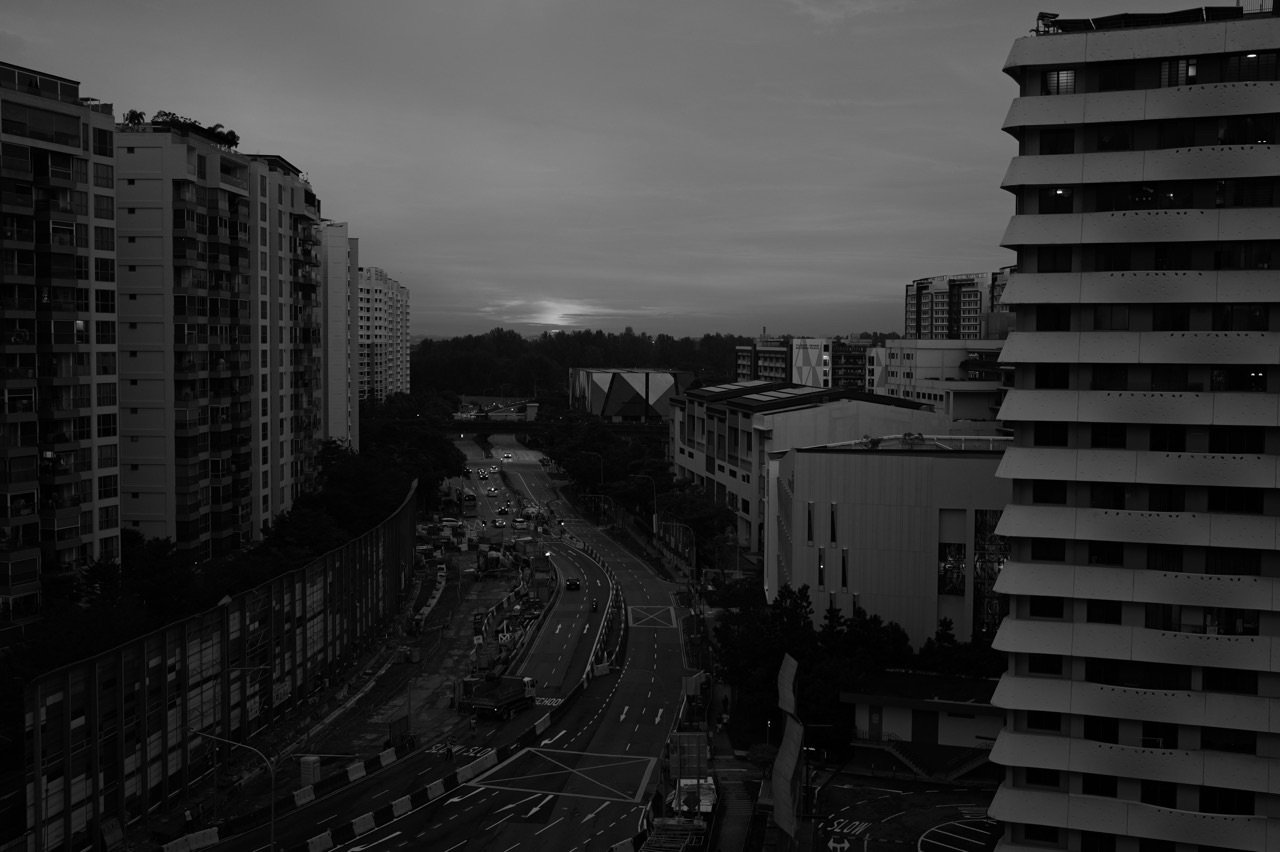
Should you go out to photograph a hazy sunset at Punggol Waterway Park? Check the current one-hour PM2.5 band and MOH’s outdoor activity guide before choosing the outing. A dramatic orange sky is not proof that the air is safe or unsafe, and a camera cannot read PM2.5 from the colour of the horizon. If the current advisory calls for minimising outdoor exposure, photograph from a suitable indoor location or save the waterfront shoot for better conditions. A long session with heavy camera equipment is still time spent outside, even if you are standing still.
For Punggol photographers and families, honest haze photos tell two stories. One is visual: the way late-afternoon light, humidity and perspective change the Waterway, the bridges, HDB skyline, Punggol Coast and Northshore. The other is evidence: the photograph’s actual date, viewpoint and independently sourced air-quality reading. This guide explains how to frame the view without exaggerating pollution, choose safe and respectful places to shoot, and create an engaging visual diary that connects to Punggol’s lifestyle, science and Geography references.

Choose a section: Before packing a camera, answer three practical questions · Punggol Waterway Park: choose a short, accessible vantage point · Camera settings that preserve truthful colour and atmosphere · Before-and-after skyline photographs are not laboratory measurements · When it is time to stop the shoot · Worked example: two photos, one sky, no exact PSI answer · The best photograph is not always the one you travel furthest to make
Before packing a camera, answer three practical questions
First ask whether the outing is necessary or merely attractive. A planned walk by the waterway may be postponed without any loss of opportunity because the town’s bridges and waterfront will still be there. Second ask who will be outside: a healthy adult, a child, someone with asthma or an older relative. The same regional reading can imply different precautions for different health groups. Third ask how long the trip will involve walking, carrying gear, standing on exposed bridges and returning home.
Use NEA’s latest one-hour PM2.5 band for the immediate outing. Use the next-day 24-hour PSI forecast and health advice when planning a more ambitious photography session. A spectacular sunset forecast is not a respiratory health assessment. There is no photographic prize for ignoring the official advisory.
Why visibility can change even when the pollutant reading does not
NEA explains that humidity and airborne water droplets scatter light. Fine particles that absorb moisture can scatter more light, affecting what distant buildings look like. At dawn or dusk the sun’s low angle, camera exposure and contrast change the apparent clarity again. This means a photograph of the skyline can look quite grey while the actual particulate concentration differs from someone’s guess.
Visibility is useful for art and observation, not as a standalone measure of air pollution. If a Punggol family wants to learn from a hazy picture, attach the corresponding official NEA reading with its time stamp and note that the reading applies to a reporting region, not the camera’s precise position. Never reverse engineer an exact concentration from how many HDB blocks are visible in a phone image.
Orange sunsets: beauty does not equal a health signal
Haze, cloud and ordinary atmospheric conditions can alter which wavelengths of sunlight reach a camera; camera white balance and processing can make a sunset appear warmer or cooler still. A vivid orange band behind Watertown is a photographic effect, not proof that the regional PSI is above a particular number. Likewise, a blue afternoon cannot guarantee that there are no fine particles.
Enjoying photography and understanding risk are compatible. A person can acknowledge that a smoky view looks striking while deciding not to spend an hour outdoors. Avoid instructing children to stand on an exposed bridge merely because the sky is colourful. This is not about spoiling art; it is about respecting the difference between a beautiful image and a safe outing.
Punggol Waterway Park: choose a short, accessible vantage point
Punggol Waterway Park provides canals, bridges, paths and high-rise scenery that are easy to recognise in a photograph. The park’s normal attractions make it a favourite site for sunset walks. However, these are outdoor environments. A visitor should not assume that being next to water or vegetation lowers inhaled PM2.5 during regional haze. If guidance makes outdoor exertion inappropriate, return another day.
When conditions are suitable, choose a short route with a safe return to the nearest realistic transport connection. Keep tripods and bags out of cycling lanes, leave paths accessible for wheelchairs and strollers, and avoid climbing railings for a wider view. The Punggol Waterway Park visitor guide describes the landscape, while this article focuses on air-quality decisions and honest photographic documentation.
Northshore and Punggol Coast: frame the district without inventing clean-air zones
The northern estates and Punggol Coast offer combinations of newer buildings, waterfront views and streetscape details. Those are useful photographic subjects even if the regional haze makes distant features less clear. There is no established rule that a breezier-looking coastal walkway offers an individual a safe air-quality exemption. Wind can transport particles as readily as it can make a location feel cooler.
An indoor or short-duration view of an interesting building can be a sensible substitute for a long coastal shoot, subject to venue access, personal health and the advisory. Do not enter a private property or restricted worksite for a ‘better angle’. Photographing a digital district is not permission to trespass or ignore construction safety signs. The picture improves when the photographer respects the place and the people using it.
Punggol Point and park closure notices: verify access separately
Punggol Point Park and the nearby waterfront are popular search terms for sunset photography, but site access changes over time. eduKate Punggol’s Punggol Point upgrading notice guide describes significant scheduled works and closures in the 2026–2027 period. Check the current NParks and relevant operator notices rather than assuming an older list of photo locations remains accessible.
Even when a location is open, the air quality remains a separate question. A gate being unlocked does not mean a long photography session is medically advisable; a temporary park closure is not evidence of a haze-related shutdown. Avoid conflating maintenance, weather and air-pollution advisories, especially when sending plans to visiting friends.
Camera settings that preserve truthful colour and atmosphere
Automatic exposure can brighten a hazy sky or make it look dramatically dark. White balance can shift a scene toward yellow or blue, while contrast and saturation sliders change the mood. Those techniques are legitimate photographic choices, but a public educational image should not be presented as an untouched scientific measurement if substantial editing was applied. Keep the original image where possible, and describe unusual processing in an explanatory caption.
A simple experiment is to take the same frame with auto white balance and a fixed daylight setting, then compare them side by side. The colours may differ even though the actual air did not change between shots. This demonstrates why colour alone cannot establish a precise pollutant concentration. A photograph is a powerful visual record; scientific measurement has its own methods.
Phone camera tips for a short, safe shooting window
Modern phones can capture the Waterway’s reflections without professional equipment. If conditions permit a brief outdoor activity, keep the phone secure, avoid walking while concentrating on the screen, and take photographs from designated public paths. Use a stable stance to avoid blurred images instead of leaning over a railing. A short shoot can include one wide establishing image, one landscape detail and one texture such as a bridge railing or leaf, without repeatedly relocating.
Do not increase outdoor exposure simply to recreate a trendy social-media composition. Some shots work well from windows or other permissible indoor viewing areas. If the official advice becomes more restrictive or symptoms appear, stop and return to a more suitable location. Being able to leave easily is part of a well-planned photography outing.
Time stamps and locations turn a picture into a useful record
A useful caption answers: what was photographed, approximately where, on what date and at what time? If a relevant NEA reading is provided, also identify its reporting region, time stamp and measurement type. A 24-hour PSI number should never be attached as though it were the instantaneous PM2.5 reading at the camera. Keep units attached to values and distinguish a current observation from a next-day forecast.
For example, write ‘Punggol Waterway bridge, photographed at 6:40pm. The sky appeared less clear than usual; refer to NEA’s separately reported air-quality measurements for the relevant period.’ That is honest without claiming an exact concentration or health risk from the image. Protect privacy when uploading: photo EXIF data may contain precise location coordinates, which need not be publicly shared for family pictures.
Before-and-after skyline photographs are not laboratory measurements
Two pictures taken from the same Punggol window may look different because of air quality, but also because of rain, cloud, sun angle, season and camera processing. For comparison, try using the same lens position, similar time of day, and fixed exposure/white-balance settings when practical. Record what changed and what did not. Then compare official readings separately, preserving both data sources.
A student may ask why the visibly clearer frame does not establish the exact improvement in micrograms per cubic metre. The answer is that image intensity is influenced by several variables. This is a beautiful miniature science lesson: observations support questions; measurements help test them. A photograph alone is not a calibrated particulate sensor.
Ethical editing and captions during a public health event
There is nothing wrong with creating an artistic amber sunset, but do not add a fabricated caption such as ‘PSI 400 in Punggol now’ without a corresponding source and time. A screenshot from another city or another year should not be presented as a current Punggol scene. When readers make activity decisions from a photograph, incorrect context can be more harmful than the choice of colour grading.
For editorial work, label archived or illustrative photographs, keep the original source, and cite official measurements rather than inferring them. If the image features identifiable people, seek appropriate permissions before promotional use, particularly for children. A strong photographer can create dramatic images and still be meticulously fair about what the picture establishes.
Family photography projects that can stay indoors
Children who are disappointed about a cancelled Waterway Park outing can build a Punggol photo story using pictures already taken on healthy-air days. Ask each child to choose five images: home, route, bridge, water and a favourite activity. They can arrange them into a short narrative and write a sentence for each. This keeps the visual exploration without needing another trip through poor outdoor air.
Older students can use an existing photo as a Geography prompt: where are the buildings, green areas and transport routes? What is the difference between smoke haze and a humid skyline? Why would a planner include sheltered walkways but still need indoor air-quality strategies? The project connects naturally to Punggol haze learning activities and Punggol sustainable urban Geography.
When it is time to stop the shoot
If the official one-hour PM2.5 band reaches High, MOH advises healthy people to avoid strenuous outdoor activity and vulnerable people to avoid outdoor activity. At Very High, healthy people should minimise outdoor activity while vulnerable people avoid it. Long distances, hauling equipment and standing outside for extended periods need to be considered. A photoshoot is optional; a medical condition is not.
People who develop wheeze, chest pain or unusual difficulty breathing should stop and seek appropriate healthcare, urgently when symptoms are serious. Do not treat an N95 mask as a permit to spend hours outside despite relevant health advice. A tight-fitting respirator has fit and tolerance considerations, particularly for children or people with heart or lung disease. The Punggol haze health guide provides the fuller health route.
Dawn and night photography: darker skies do not guarantee cleaner air
A common Punggol photography plan is to start before sunrise or stay for illuminated bridges. The hour of day does not guarantee low PM2.5; actual readings can change with weather and regional smoke. If the family plans a later outdoor trip, check the latest available information close to departure and ensure transport, lighting and park access are appropriate. Coney Island Park, for example, has controlled opening hours and should not be used as an improvised nighttime route.
Photographing after dark also introduces ordinary hazards such as poor visibility of steps, fast-moving cyclists and isolated paths. An atmospheric night picture is not worth blocking a connector, riding carelessly while filming or trespassing into a closed park. An alternative is to photograph local patterns and lights from a safe, permitted indoor area, or postpone the nature shot until conditions and access are suitable.
What a dated haze photograph can tell future Punggol residents
Imagine looking back in 2036 at a photo taken during the October 2026 haze episode. The picture may show an urban landscape at a particular time, and its accompanying source notes may link it to official national air-quality updates. That is historical evidence of one experience, not a complete medical or atmospheric record. A ten-year-old picture becomes far more informative when its caption distinguishes where the camera stood from where an official sensor was located.
A family archive can therefore include the raw picture, a date, a brief memory of what changed in daily life and a link to the official source available at the time. The result is a humane neighbourhood story: the people, place and decisions are visible, while the scientific claim remains grounded in measurements. A Punggol photo can be both art and part of a responsible civic memory.
Worked example: two photos, one sky, no exact PSI answer
A student photographs the same bridge at 5:30pm and 6:30pm. The first image has a pale grey skyline; the second is orange and sharply silhouetted. The student is tempted to claim the air became worse. But the setting sun and automatic exposure changed significantly between shots, while the photos do not measure particle mass. Even if a PM2.5 reading changed, the image alone cannot establish the direction or magnitude.
The student checks the NEA readings with their original time stamps, labels each image, and writes, ‘The camera recorded changes in colour and visibility; the official measurements describe ambient particles at reporting-region scale.’ This is a stronger assignment than claiming the orange sunset is proof of dangerous air. It trains visual literacy, source literacy and humility all at once.
Five haze-photography myths that mislead the public
Myth one: an orange sunset equals a precise PSI value. It doesn’t. Two: a clear skyline means no pollution. No. Three: a camera’s portrait mode can detect fine particles. It cannot. Four: the coast must be safer because it is breezy. Wind can transport smoke. Five: a beautiful edited photo proves the same scene looked identical to the naked eye. Editing and exposure affect appearance.
Instead, pair your art with honest context: date, place, equipment or processing when relevant, and reliable measurements for claims about air. There is no need to stop enjoying good compositions. It is enough to separate what a visual image shows from what only scientific instruments can establish.
Frequently asked questions about Punggol haze and photos
Can I photograph the waterway during haze? Check the immediate PM2.5 band, your health and intended time outdoors first. Do orange sunsets mean bad haze? Not on their own. Can a phone photo tell me the PSI? No. Is Punggol Coast always cleaner than the town centre? Do not assume so from its sea breeze. Does haze improve image colour? Different conditions and camera settings can create striking colours, but that is not a health benefit.
Can I take a short bridge picture with my children? Use current official guidance, child health and safe access. What should be in a caption? Accurate date and place, and separately cited data if relevant. What about Punggol Point? Verify current park and upgrading notices. Can I do photography indoors instead? Yes—archival, still-life and family storytelling projects can be equally interesting.
The best photograph is not always the one you travel furthest to make
Punggol’s sunrises, waterway bridges, evening lights and high-rise silhouettes provide wonderful photographic subjects. Haze adds a temporary layer of environmental decision-making, not an obligation to capture drama at any cost. The people behind the camera deserve the same care as those in front of it.
Check the air, keep the outing proportionate and be truthful about what a picture shows. An indoor photo story today and a beautiful waterfront sunset on another day can both be excellent photography.
| Photographic observation | What the image supports | What still needs an independent source |
|---|---|---|
| A skyline looks less clear | Visibility differed under those image conditions | PM2.5 concentration and health advice |
| Orange horizon at sunset | A change in apparent colour/lighting | Whether haze caused the colour |
| Two dated photos of the same bridge | A visual record at two times | A calibrated air-quality comparison |
| A clear sky near Punggol Coast | A visually clear local view | Air-quality clearance for prolonged exercise |
| A recorded sunset time stamp | The camera’s approximate capture timing | Accuracy of device clock, location and official region |
More Punggol haze guides worth reading
This Punggol haze photography reference answers one distinct question. When you need the current public health instruction, use NEA and MOH. To connect the science, household and neighbourhood questions, follow the topic-specific links below rather than assuming one page answers everything.
- One-hour PM2.5 vs forecast 24-hour PSI
- Why Punggol is hazy: regional smoke and wind
- HDB indoor air and air cleaners
- Reading PM2.5 graphs and wind maps
- Local dust, smoke and transboundary haze
- Punggol haze photography and visibility
- Punggol tuition and study continuity during haze
- Punggol eco-town design and haze resilience
- eduKateSG air-quality monitoring literacy
- eduKateSG Things to Do in Punggol hub
- Punggol’s ordinary-day photographic locations
- Punggol sunrise and sunset spots
- Punggol Point 2026–2027 upgrade and access
- Science and Geography learning activities
Sources and editorial review
Reviewed 17 October 2026. No actual neighbourhood pollution event, construction complaint, health diagnosis, park closure or live sensor reading is inferred from the illustrative photographs or hypothetical examples. Authorities, schools and facility operators make current decisions. Official primary resources and the latest advisories are more authoritative than static article examples.


