
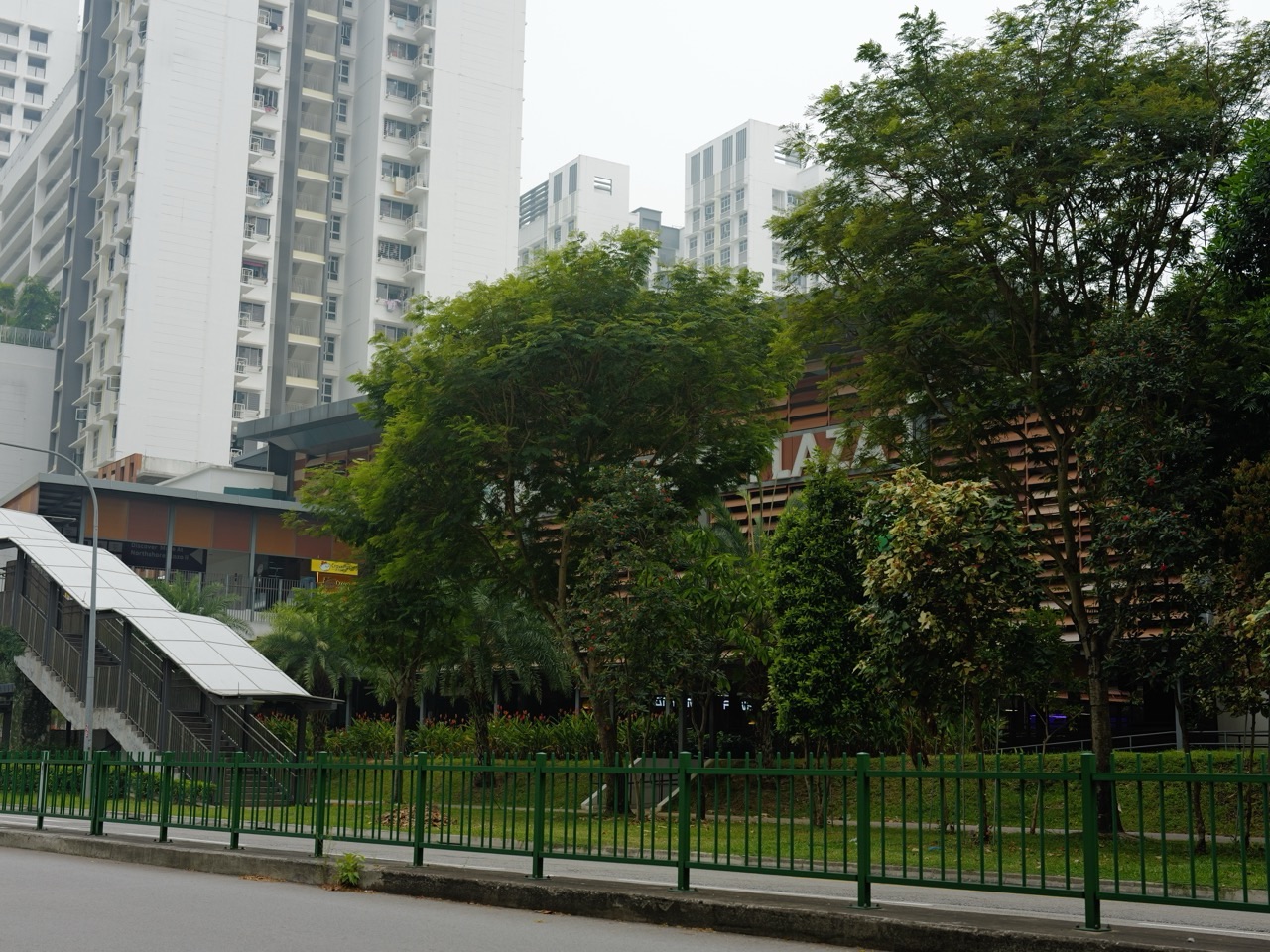
Can Punggol’s green buildings and town planning reduce haze exposure? Good urban design can provide shade, connected routes, ventilation and practical indoor alternatives, but a green roof, open-air breezeway or waterfront park is not a certified PM2.5 filter. Transboundary smoke still reaches outdoor spaces when regional conditions favour transport. The most reliable approach combines physical design with suitable building air-management systems, clear public guidance and flexible activity plans based on NEA’s live haze readings.
For searches such as Punggol Northshore sustainable design, Punggol Digital District air quality, HDB corridors during haze, green buildings and PM2.5, and haze-resilient neighbourhood planning in Singapore, this article explains how town design works and what it cannot promise. HDB’s official Biophilic Town Framework was first applied in Punggol Northshore in 2015. URA’s 2026 urban-design guidelines also describe a green, connected Punggol Digital District. Neither statement establishes that any specific block or mall has a measured “haze-free” air standard.
Quick answer: five design questions for a smoky day
A neighbourhood prepared for haze needs to consider outdoor exposure, usable indoor destinations, air-conditioning and mechanical ventilation where installed, accessible routes and reliable information. Buildings are not interchangeable: an open-sided covered corridor can shield against rain while remaining exposed to outdoor smoke; an enclosed building may reduce exposure but needs properly managed air filtration and fresh-air ventilation.
Good planning also benefits ordinary weather. Shade, greenery and wind-flow design can improve thermal comfort in Singapore’s tropical climate. During a haze episode, however, increasing outdoor airflow does not necessarily improve the particle concentration of incoming air. Moving air around and removing particles from that air are different physical tasks.
For household windows and HEPA sizing, use the Punggol Haze at Home guide. Here we focus on precinct layout, common spaces, buildings and the larger neighbourhood.
How Punggol became a sustainable-town testbed
HDB describes Punggol as Singapore’s first Eco-Town when selected for that role in 2010, reflecting efforts to test sustainable development ideas and integrate green living solutions. The official HDB Punggol town history traces the waterway, residential growth and later smart-town initiatives.
HDB announced Punggol Northshore in 2014 as a testbed for smart technology in public housing. Over time, developments and public amenities integrated strategies for wind flow, shade, estate energy use, pedestrian links and landscape design.
Those objectives are important even if haze never occurs. They affect heat comfort, everyday walking, access to nature and resource efficiency. It is a mistake to infer that a town labelled “eco” must have special protection against smoke particles carried across Southeast Asia.
A useful assessment asks which design feature is meant to solve which problem. A rain garden treats stormwater; a shaded footpath improves thermal comfort; an appropriately filtered indoor-air system targets particles in occupied rooms. One feature should not be credited with all three functions without evidence.
The HDB Biophilic Town Framework
HDB’s Biophilic Town Framework addresses soil, water, flora and fauna, outdoor comfort and people. It aims to help neighbourhoods support liveability and contact with nature.
The framework was first applied at Punggol Northshore in 2015. HDB describes using environmental simulations to guide building orientation and wind flow, reducing exposure to the sun, and integrating ecological features such as habitats for birds, butterflies and dragonflies.
Rain gardens and bioswales form part of the strategy to manage stormwater and support biodiversity. Those are demonstrable environmental purposes. They are not evidence that the nearby air is purified to a specified PM2.5 concentration during a regional haze event.
Biophilic design can make a neighbourhood more pleasant, but a precise air-quality claim requires the right pollutant measurement, location, methodology and time.
How building orientation changes comfort
Buildings cast shadows, block or channel wind, and shape the microclimate around them. HDB says environmental modelling influenced Northshore’s block orientation and designs to improve thermal comfort.
A shaded route may feel cooler because the sun is not heating the body directly. A breezy passage may help with outdoor heat stress under suitable conditions. Those features can make daily travel more bearable in Singapore.
Now change the scenario to a smoky day. The same open breezeway allows outside air to pass through it. A moving breeze may help disperse pollutants locally under some conditions but can also carry polluted air. The passage has not magically become a high-efficiency indoor air filter.
This is a design trade-off rather than a failure. Streets and open corridors are usually intended as outdoor or naturally ventilated spaces, while mechanical filtration is typically associated with suitable enclosed systems.
Punggol Northshore: the community spine
HDB’s Northshore Plaza guide describes a naturally ventilated community spine connecting residential blocks, Samudera LRT and the waterfront. HDB’s design award account also describes covered links, landscape decks and sheltered access between the residential precincts and neighbourhood centre.
For an everyday journey, this infrastructure can reduce exposure to rain and direct sun. It may also help residents avoid unnecessary detours. Those benefits still matter on a poor-air day.
But “sheltered” should not be confused with “enclosed and filtered”. A naturally ventilated corridor is open to outdoor air by design. Standing in it for a long time does not give an official guarantee of clean indoor air, regardless of how close it is to an air-conditioned shop.
Families can reduce unnecessary waiting outside and identify a genuinely appropriate indoor destination without expecting every covered link to provide smoke protection.
What is the difference between covered, semi-open and enclosed?
A covered walkway has a roof that reduces direct rain and sun exposure. Its sides may remain open. A semi-open corridor can be partly enclosed but still exchange air freely with outside spaces. An enclosed mechanically conditioned room may have a defined air-handling system, although its actual ventilation and filtration performance must still be assessed.
These categories matter more during haze than the simple label “indoors”. A covered hawker table with open sides is not equivalent to an enclosed, appropriately filtered room. An indoor lobby with frequently opened doors may also have different conditions from a managed study room.
No publicly available Punggol-wide dataset supplied here gives a certified particle concentration for each corridor, lobby, school classroom, food court or shopping centre. Avoid presenting a visual impression as if it were a measured building ranking.
For actual community respite arrangements, consult the Punggol Haze Indoor Places guide and verified People’s Association notices.
Ventilation and particle filtration: two separate engineering aims
Ventilation brings outside air into a building and removes or dilutes certain indoor-generated pollutants. Filtration removes some particles from air passing through an appropriate filter. During a regional haze event, the quality of incoming outdoor air creates a temporary challenge for ventilation design.
NEA explains that fine particles can enter air-conditioned buildings through fresh-air intakes, openings and gaps. If unfiltered outdoor smoke enters a building, indoor particle concentrations can rise. Suitable filtration and competent management of the air-handling system can reduce particle levels, but this requires attention to equipment and conditions.
Completely closing all fresh-air supply for extended periods is not an automatic safe solution. Buildings still need to manage occupancy, carbon dioxide and other indoor pollutants, as well as applicable safety and ventilation requirements.
The right response is system-specific. Building operators should follow qualified engineering advice and the applicable standards, not an instruction to tape over every ventilation opening.
The indoor-air route: intake, treatment, distribution and exhaust
Picture a simplified mechanical ventilation system. Outside air enters through an intake, may pass through filters or other treatment, moves through the ductwork and enters occupied spaces. Some air may be recirculated; some may be exhausted to maintain appropriate ventilation and pressure conditions.
The quality of the resulting room air depends on how much outdoor air enters, whether it is effectively filtered, indoor sources, how air mixes through rooms, filter maintenance and how frequently doors open. A roof garden or attractive glazed façade does not independently establish those details.
A fan-only system may move air without removing fine particles effectively. A correctly maintained high-efficiency filter can remove particles from air that actually passes through it, but its performance depends on design and operation.
The point for a reader is not to redesign the building’s HVAC system from a phone. It is to understand why the phrase “air-conditioned” by itself is not proof of a certified clean-air environment.
What does a Green Mark building rating mean?
Singapore’s Building and Construction Authority administers the Green Mark framework, which addresses building environmental performance and sustainability. Energy use, design, comfort, water and related sustainability dimensions can be relevant, depending on the scheme and version.
URA’s Punggol Digital District urban-design guidelines specify BCA Green Mark Platinum in line with public-sector sustainability requirements. The district is planned as a connected, walkable and cycling-friendly cluster.
Do not reinterpret that designation as “PM2.5 is always below a particular number inside every Green Mark building”. A sustainability rating is not an instant, room-by-room haze measurement. Individual systems and operational performance need their own evidence.
Green building design can contribute to resilience if it includes appropriately specified and maintained indoor-air systems, but the precise protections cannot be assumed merely from the word “green”.
Punggol Digital District: a mixed-use urban experiment
URA describes Punggol Digital District as a 50-hectare district integrating business, the Singapore Institute of Technology, public spaces and community amenities. It aims to bring jobs and learning opportunities closer to residents and support sustainable urban development.
The district includes public transport connections, walkways, landscaped spaces and buildings planned to work together. These features can reduce unnecessary travel distances and support a varied neighbourhood economy.
From a haze-resilience perspective, the opportunity is not a magical smoke-proof town. It is having multiple practical choices—reliable information, indoor meeting or learning spaces where suitable, access to public transport and flexible activity plans—without depending on one uninterrupted outdoor route.
Any claim that a particular Punggol Digital District building has certified filtration performance would need facility-specific evidence. A planned rating or design intention cannot be silently treated as a measured 2026 result for every occupied room.
Green roofs and vertical greenery: value without false claims
Green roofs and vertical planting can support biodiversity, shade, amenity and, in some settings, thermal management. URA’s design guidance for Punggol Digital District promotes greenery and landscape replacement.
Those environmental benefits should not be presented as proof that a green wall removes all smoke particles carried by the wind. Air flowing around foliage may interact with particles through deposition, but effects vary with species, wind and design geometry. A planted façade does not deliver an advertised smoke CADR the way a tested air-cleaning device might.
This distinction is important in marketing. “Sustainable building” should not be inflated into “a building where vulnerable people need not check haze advisories”. Real indoor-air quality still depends on the specific occupied space and its air systems.
A neighbourhood can be green, healthy in many ways and still require haze precautions during a regional smoke episode.
Rain gardens and bioswales: useful, but for water
HDB’s Northshore framework includes rain gardens and bioswales to manage stormwater runoff and support a greener landscape. These features guide water through planted or engineered pathways that can slow flows and help manage surface runoff.
A rain garden deals primarily with rainwater. It is not a device that sucks smoke out of the air above Punggol. The distinction mirrors the Lorong Halus Wetland, which is associated with water-treatment processes rather than certified PM2.5 filtration.
Students often hear the words “green infrastructure” and “pollution control” together and assume one system solves every pollutant. Good design requires naming the medium, pollutant, removal process and expected performance.
That kind of careful comparison is more useful than creating a general ranking of Punggol’s greenest-looking places.
Heat resilience and haze resilience can pull in different directions
Singaporean design often seeks to reduce heat through shade, breeze and passive airflow. Haze can create occasions when residents want to reduce the entry of polluted outdoor air into occupied enclosed rooms.
This tension does not mean the design is wrong. It means the optimal operating conditions differ by situation. Natural ventilation is valuable under suitable outdoor-air conditions. During poor regional smoke conditions, a managed indoor environment with adequate filtration may be preferable for some activities.
A resilient town should be able to operate in multiple modes: comfortable outdoor and naturally ventilated use on suitable days, with appropriate indoor alternatives during periods of poor air quality or severe weather.
Designers and facilities managers must balance ventilation, energy, occupant comfort and pollutant exposure rather than choose an inflexible one-rule-for-every-day policy.
The school, library and community-space question
Punggol families rely on schools, study spaces, libraries and community facilities. During haze, these places may support continuity of normal life when outdoor activities are adjusted, subject to their actual procedures and operational status.
A library with a suitable indoor environment can be useful for reading. A school may adapt PE and CCA under MOE and institution guidance. A designated community haze shelter has specific activation conditions and operating information.
None of this means every community space has equal air filtration or that a school remains open under every possible national condition. Facility management and authorised directives determine actual operations.
The existing Punggol Haze School Guide and Punggol Haze Indoor Places provide the practical reader routes.
A worked example: choosing between two covered routes
Imagine a fictional resident has a choice between Route A, a five-minute sheltered and naturally ventilated walkway to an LRT station, and Route B, a fifteen-minute open-air loop that passes attractive greenery. Under an official advisory recommending reduced outdoor exposure, which plan is likely to minimise time spent outside?
Route A involves 10 fewer minutes of outdoor-type exposure. The arithmetic difference is fifteen minus five. But the example does not prove an exact reduction in inhaled PM2.5, because concentrations, walking speed, effort and location-specific conditions would need measurement.
The design insight is still useful. Connected shorter routes can give residents more convenient choices and reduce avoidable time moving through open air.
For another person using a wheelchair or stroller, slope, lifts and step-free access might be decisive. Accessibility is part of resilience; a “shortest” route is not necessarily the usable route for every household.
Worked example: why a sheltered route is not filtered air
Take a hypothetical 100-metre roofed walkway with open sides. A resident says, “Since it is covered, we can spend two hours exercising here with no haze exposure.” That conclusion does not follow from the roof.
The roof blocks direct rain or sun, but it does not require outside air to pass through a particle filter. The concentration experienced depends on the actual outdoor air and micro-environment. The walkway might be convenient for a short necessary connection yet unsuitable as a substitute for a filtered indoor exercise space under certain advisories.
This is a clear example of a category error: treating weather shelter as pollution filtration. The correction is to classify the actual physical enclosure and match it to the intended use.
The same logic applies to void decks, covered bridges, coastal promenades and semi-open community areas.
What building managers can prepare before a haze episode
Owners and qualified facilities personnel can review how their air-handling equipment operates, what filters are installed, what maintenance is due, and whether the building has suitable arrangements to respond to incoming smoke while preserving necessary ventilation.
They can also identify a clear communication route for occupants, including what to do about prolonged outdoor activities and how to respond to the official advisory. If a building includes vulnerable occupants, arrangements may need greater care and coordination with the relevant agency.
A responsible operations plan should avoid unsupported marketing promises. Instead of telling visitors “our mall is 100% haze-free”, explain the actual facilities, any verified air-management features and which official readings guide decisions.
This article is not a professional HVAC specification or authorisation to disable safety-critical ventilation systems. Building operators must comply with relevant standards and seek qualified advice.
Why indoor refuge is about more than filters
A practical indoor alternative needs enough space, accessibility, suitable temperature, water and sanitation arrangements, reasonable occupancy management and clear operating instructions. Filtration matters, but so do the human needs of occupants.
A room may be fitted with a suitable air cleaner yet impossible for a person with mobility needs to reach. Another space may be accessible but so crowded or poorly managed that it is unsuitable for the purpose. Good resilience assesses the whole service.
Community authorities may designate particular spaces as haze shelters under published activation rules. An ordinary lobby or naturally ventilated concourse should not be called an official shelter merely because people can gather there.
For current People’s Association information, check its community haze shelters page, then confirm venue operations before travel.
Building better public information into physical spaces
Good communication can be as important as attractive architectural features. Residents need to know which areas are indoor versus naturally ventilated, where to find current official advisories, and who can answer questions about a facility.
Clear signage can avoid misleading language. “Sheltered walkway” is a useful description; “clean-air corridor” would require evidence. “Community event moved to enclosed room” communicates a change; “zero pollution guaranteed” is an unwarranted promise.
Digital systems can help deliver updates, but they should be tied to authoritative sources and accessible to people who do not use a particular app. An older person may need the same information on a notice board or through staff.
This is where environmental design and information design meet: buildings are easier to use when their practical capabilities and limitations are clearly stated.
Future town planning: ask better questions, not just for more greenery
When evaluating a new Punggol building or community facility, ask whether residents have accessible covered links, suitable indoor alternatives, manageable walking distances and clearly documented ventilation arrangements. Also ask how outdoor spaces remain comfortable on normal hot days.
Greenery, shade and natural ventilation should still be celebrated for their actual benefits. The haze question adds another layer: what happens when incoming outdoor air is temporarily poor? Does the building have a realistic operating plan without sacrificing necessary ventilation?
An effective plan considers both ordinary daily conditions and periodic environmental disruptions. A district’s sustainability credentials are stronger when they are connected to measured performance and transparent operations.
No design can eliminate the need for regional fire prevention. The causes of transboundary haze remain outside the control of a single housing precinct.
A student exercise: make a four-column town design table
Draw four headings: feature, primary purpose, haze limitation and possible operational adaptation. Fill in examples. A roofed corridor provides rain and sun shelter, but may be open to smoke; the response could be to shorten unnecessary waiting. A rain garden helps water management, but is not a particle air filter. A community room provides indoor space, but its filtration and access must be verified.
Add HDB’s Northshore community spine, an enclosed library room and a park connector. For each, ask students to use an official source rather than guess based on the name or photograph.
The table teaches applied Geography, Science and civic design without sending anyone outside to collect smoke. Students can discuss the difference between a design specification, a reported benefit and a verified measurement.
For other safe projects, see Punggol Haze Learning Activities.
Frequently asked questions
Is Punggol Northshore designed to improve wind flow?
Yes. HDB describes using environmental simulation and building orientation to improve ventilation and thermal comfort in its smart and biophilic Northshore planning. That is not a guarantee of low PM2.5 during transboundary haze.
Do green roofs remove haze from Punggol?
Vegetation can provide multiple ecological benefits, but a green roof does not replace a suitably specified particle filter or official air-quality advice.
Is the Northshore community spine an indoor filtered route?
HDB describes it as a naturally ventilated connected corridor. Sheltered access is not equivalent to a certified filtered indoor room.
Does Green Mark Platinum mean a building is haze-free?
No. A sustainability rating does not by itself publish a real-time room-level PM2.5 measurement. Check the specific building’s actual systems and management information.
Can an air-conditioned shopping centre still admit PM2.5?
Yes. NEA explains that particles can enter air-conditioned buildings through fresh-air intakes and openings. Filtration, maintenance and indoor sources affect actual concentrations.
Should building operators close all ventilation during haze?
No universal instruction should be applied. Managing incoming smoke must be balanced with necessary ventilation, safety requirements and the building’s specific systems. Qualified facilities personnel should follow relevant guidance.
Why does a covered walkway not protect against smoke?
A roof blocks rain and sun but generally does not filter the outside air moving through open sides.
Is Punggol Digital District a certified haze shelter?
Punggol Digital District is a planned mixed-use sustainable district. Individual facility status must be verified. Do not assume a Green Mark rating or district branding establishes a formal community haze-shelter designation.
How does a shorter route help?
It may reduce avoidable time spent travelling outdoors, but exact personal particle exposure depends on conditions and activity. Use current health advice, particularly for vulnerable residents.
Which official reading should Punggol building users consult?
NEA lists Punggol under North. Use the latest one-hour PM2.5 and personal guide for near-term activities and the applicable 24-hour PSI forecast and health advice for planning.
Connected Punggol reading
The Punggol Haze at Home guide covers rooms, air cleaners and windows. Punggol Haze Indoor Places covers destinations and official shelters. Punggol Haze Outdoor Activities covers park and sports decisions.
For Punggol’s wider development history, see HDB’s Punggol Town Profile and the Punggol 21 / Waterfront Town Timeline. This article’s specific job is to separate urban-design benefits from unproven claims of haze filtration.
Official references and scope
Reviewed 17 October 2026. This article describes published design strategies and general building-science principles. It does not claim that a particular Punggol room meets any unverified smoke concentration or ventilation certification.
- HDB: Punggol Town and Its Eco-Town History
- HDB: Biophilic Towns and Punggol Northshore
- HDB: Punggol Northshore and Northshore Plaza
- URA: Punggol Digital District, Urban Design Guidelines
- URA: Punggol Digital District, Development Overview
- NEA: Managing Haze and Air in Conditioned Buildings
- NEA: Live Air-Quality Advisories
Punggol’s green infrastructure can make everyday life more pleasant, connected and sustainable. Haze resilience adds a practical requirement: understand what each design feature actually does and keep reliable indoor options available when outdoor air is poor.
Punggol Haze: Connected Reference Library
For current air-quality decisions, consult NEA’s live PM2.5, PSI and health advisories. These different Punggol guides help with photography evidence, seasonal climate, urban infrastructure, car-cabin air and other haze questions without substituting old readings for current conditions.
- Punggol Haze Photography: Skyline, Visibility and Honest Images
- Punggol Haze Climate: El Niño, IOD, Monsoons and Fire Weather
- Punggol Haze Car Cabins: Air-Con, Filters and Driving Safety
- Punggol Haze Check: PM2.5 and PSI
- Punggol During Haze: Family and School Routines
- Punggol Haze or Construction Dust?
- Reading PSI, PM2.5, Satellite Hotspots and Wind Maps
Continue Through the Punggol Haze Reference Library
Explore linked guides on photographic evidence, El Niño and fire weather, Punggol building design, and distinguishing local dust from regional smoke. For current decisions use NEA’s live air-quality information.
- Punggol Haze Photography: Visibility and Honest Skyline Evidence
- Punggol Haze Climate: El Niño, IOD, Monsoons and Fire Weather
- Punggol Haze vs Construction Dust: Local Air Pollution and Reporting
- Punggol Haze Check: One-Hour PM2.5 Versus 24-Hour PSI
- Punggol During Haze: Family and School Routines
- eduKateSG: Singapore Haze and Transboundary Smoke
- eduKateSG: Singapore PSI and Haze Monitoring
Punggol Haze: Four New Complementary Guides
Explore the differences between air-quality myths, reservoir-water evidence, community access and wider economic costs. These articles have distinct reader purposes and link back to the existing Punggol haze library.


