
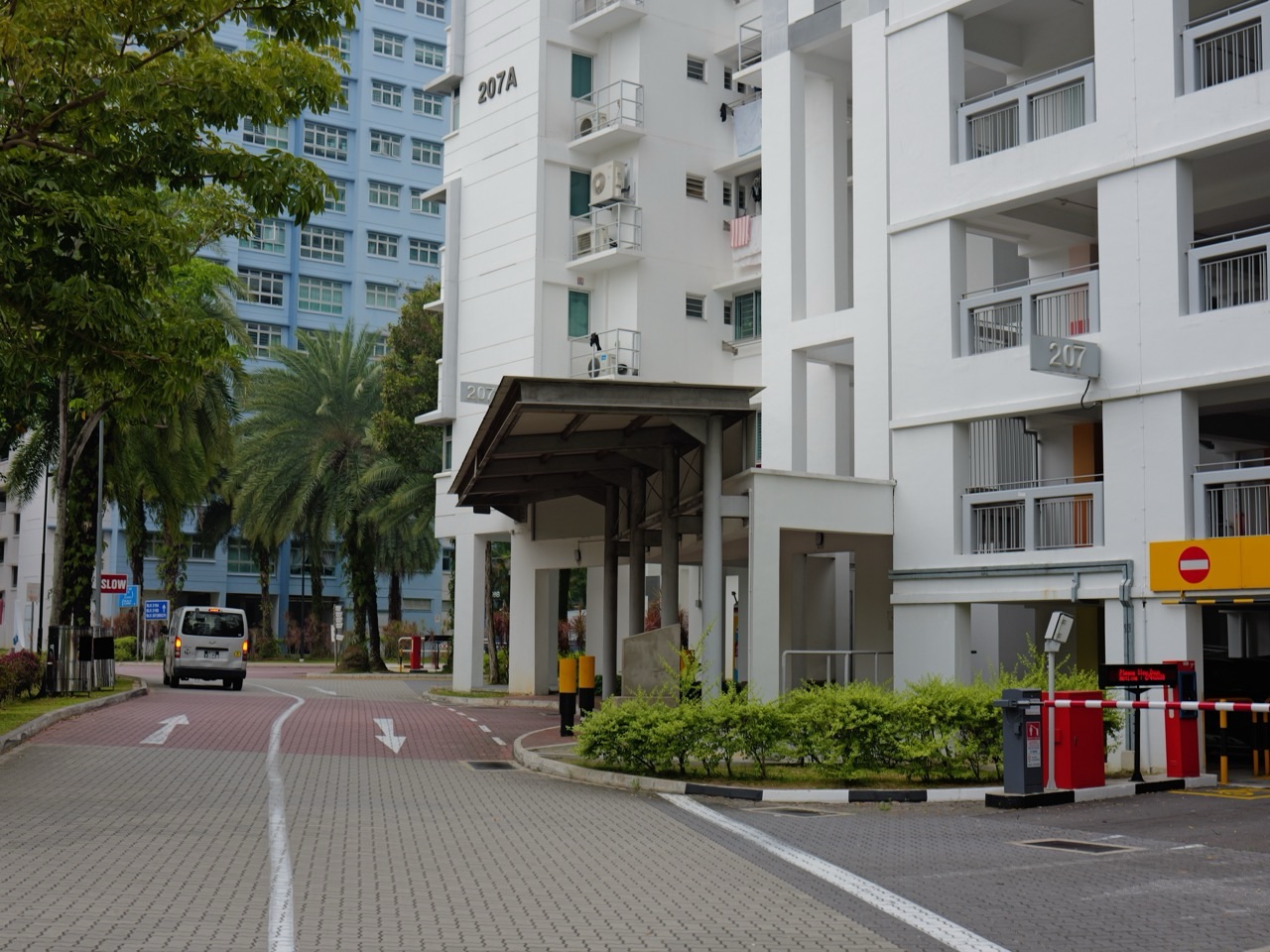
How do you keep haze out of a car in Punggol? When smoke pollution is elevated, close the car windows and consider the air-conditioning recirculation setting to limit the intake of polluted outdoor air, while keeping the cabin filter maintained. But do not treat recirculation as a setting to leave on indefinitely: passengers breathe out carbon dioxide, fresh-air exchange remains important, and clear windows and safe driving always come first. For current activity decisions, use NEA’s live haze information rather than judging pollution from the view through the windscreen.
This Punggol haze car-cabin guide answers searches about car air-con during Singapore haze, cabin filters and PM2.5, recirculation for school pickups, driving with children during haze and keeping windscreen visibility clear. It concentrates on the air inside a passenger vehicle and safe practical choices, not a general MRT or bus guide. If you are walking to Punggol MRT, taking the LRT or waiting at a bus stop, the existing Punggol Haze Commuting Guide is a better starting point.
The answer in six practical checks
- Check official conditions: Punggol falls in NEA’s North reporting region. Use current one-hour PM2.5 guidance for immediate activity decisions and the 24-hour PSI forecast and corresponding advisory when planning ahead.
- Check the windows: When outdoor air is smoky, closed windows generally reduce direct entry of particles compared with open-window driving.
- Check the ventilation mode: Recirculation may lower the intake of smoke, especially for shorter trips, but fresh air and carbon dioxide management matter during longer or crowded journeys.
- Check the cabin filter: Its specifications, correct fit, condition and the vehicle’s airflow system affect particle removal. An old or incompatible filter should not be assumed effective.
- Check windscreen visibility: Use the correct demisting or defogging mode whenever necessary, even when that changes how much fresh air the system brings in.
- Check the entire journey: Time in an open-air pickup queue, on a platform, in a carpark or outside a school gate can matter as well as time inside the car.
This is a practical sequence, not a guarantee of a certain air-quality number inside every vehicle. Car models, leakage rates, cabin systems, weather and occupant needs differ.
Why a car cabin is neither outdoors nor a perfectly sealed room
A passenger car is a relatively small occupied enclosure with doors, seals, vents, windows and its own heating, ventilation and air-conditioning system. Closing windows reduces direct exchange with outside air, but leakage remains possible and every opened door introduces more outdoor air.
In a 2017 study in PLOS ONE, researchers comparing travel modes found that the tested car with closed windows and air recirculation gave occupants lower measured PM2.5 exposure than several alternative modes in that study. The authors also stressed the importance of vehicle condition, ventilation choices and study-specific circumstances.
That is not a promise that every car in Punggol filters the same proportion of haze particles. A vehicle with missing cabin filters, damaged seals or an inappropriate ventilation setting can perform differently.
The useful mental model is outside-air entry, particles already inside, filtration and ventilation. Every trip changes these four factors.
How the car air-con recirculation button works
Most cars have a setting that largely recirculates air already inside the passenger cabin rather than continuously drawing in the full normal quantity of fresh outside air. A familiar symbol often shows a vehicle outline with a curved arrow inside it. Your own model’s controls and automation may differ, so consult the handbook.
When regional smoke concentrations are elevated, temporarily favouring recirculation may reduce how much outside particulate pollution enters through the ventilation intake. The US Environmental Protection Agency explicitly includes closing windows and using a car’s air conditioner in recirculation mode among ways to reduce exposure to wildfire smoke in a vehicle.
This is a particle-exposure measure, not a universal setting for every driving condition. Some cars automatically change fresh-air mixing, and selecting front-windscreen demisting may override manual recirculation to clear glass.
Do not spend time hunting for the right air-con symbol while driving. Learn the controls safely while parked, with the engine off when appropriate, before relying on them during the journey.
Why recirculation cannot be the only setting forever
People exhale carbon dioxide (CO2). In a confined, occupied space, limiting outdoor-air exchange can let carbon dioxide build up. Its concentration depends on cabin volume, the number of occupants, activity, leakage and how the system brings in fresh air.
Research on vehicle cabin air quality, particles and CO2 describes a trade-off: greater recirculation may reduce entry of outdoor particles but can increase cabin CO2. Research on fractional recirculation shows why some systems aim to balance particle protection with fresh-air exchange.
There is no single scientifically reliable “exactly 30 minutes” or “exactly 45 minutes” rule appropriate for every model, occupant count or weather condition. Advice that ignores cabin size, occupancy and the vehicle’s own settings is oversimplified.
For long journeys, follow the manufacturer’s operating instructions, maintain ventilation and remain alert to fatigue, discomfort and windscreen visibility. If you feel drowsy or unwell, stop safely and reassess; do not rely on an invented fixed timer.
The windscreen rule always outranks a smoke-minimisation trick
On a humid Singapore day, glass can fog because water vapour condenses on a cooler surface. Rain, the vehicle’s temperature and the number of occupants can all affect whether the windscreen remains clear.
Some vehicles use outside-air ventilation automatically in defog or demist mode. If so, accept the necessary change in airflow when driving visibility requires it. Poor visibility through the windscreen can create an immediate traffic hazard.
Use the vehicle’s recommended defogging controls, maintain clean glass, and do not improvise by wiping a large fogged area while driving. If the windows remain unclear, pull over safely before continuing.
A lower estimated PM2.5 intake is not worth driving with a misted windscreen. The best haze advice must remain compatible with ordinary road safety.
How much difference can closed windows make?
It depends on the actual vehicle, airflow configuration and outdoor conditions. Opening a window can greatly increase the rate at which outside air exchanges with cabin air, while closing it and choosing recirculation may reduce particulate exposure.
But the amount of reduction is not a universal percentage. Vehicle seals age. Some systems continue to admit fresh air even in recirculation. Different filters catch different sizes of particles, and doors may open repeatedly during a short school run.
Singapore-specific research on passenger-car PM2.5 under different ventilation settings found that window-open settings can substantially increase in-car exposure relative to more protective closed-window arrangements under the study’s tested conditions.
Treat those findings as evidence for a sensible direction of action, not permission to advertise that a named Punggol vehicle is always “90% haze-free”.
Worked example: a percentage reduction is not a medical guarantee
Imagine a fictional test where the measured concentration just outside a car is 100 μg/m³ of PM2.5 and the measured concentration inside, after an appropriate period at a defined operating setting, is 35 μg/m³.
The absolute difference is 100 − 35 = 65 μg/m³. As a fraction of the outdoor level, the reduction in measured concentration is 65 ÷ 100 × 100 = 65%.
That arithmetic is valid for those two hypothetical measurements. It does not prove the driver had 65% less clinical risk, nor that the same ratio applies for every road, car, speed, ventilation system or passenger.
For a real test, one would need matched measurements, calibrated instruments, a documented method and consideration of changing outdoor air along the route. A car dashboard’s air-quality icon is not automatically comparable with NEA’s official regional measurement.
What exactly is a cabin air filter?
A cabin air filter is part of the car’s air-handling system. Depending on the vehicle, it can remove dust, pollen and some fraction of finer particles from air moving through the filter. The efficiency depends on filter design, particle size, sealing and airflow.
A cabin filter is not the same component as the engine air filter, which serves the engine intake in combustion-powered cars. Replacing the wrong filter because someone wrote “air filter” vaguely will not address the cabin ventilation question.
Some vehicles use higher-efficiency filtration systems; others have more basic particle filters. Marketing terms such as “HEPA-like” should not be treated as proof of performance to a specific standard without documentation. A small add-on device in a cup holder is not necessarily equivalent to a professionally designed vehicle filtration system.
Look up the exact compatible part for the vehicle model, variant and year. A poorly fitting filter may allow air to bypass the material.
The difference between particle filtration and odour control
The fine-particle component of haze is relevant to PM2.5 exposure. Particle filters can remove particles carried through them, with differing efficiencies. However, smell and gases are separate issues.
A filter using activated carbon or another adsorbent may reduce some odorous gases when appropriately designed, but no generic carbon label guarantees removal of every combustion gas, and its capacity is finite. A pleasant smell after adding a fragrance is not evidence that particles disappeared.
The same principle applies to car air fresheners. A perfume can mask a smell while leaving the underlying source unchanged or adding its own airborne chemicals.
A more trustworthy question than “Does it smell fresh?” is “Does the filter have documented performance for the particle size or contaminant I am concerned about, and is it installed correctly?”
When should a cabin filter be changed?
Use the vehicle manufacturer’s service interval and inspection guidance as your starting point. Some driving patterns and dusty conditions may call for earlier inspection, but a regional haze headline alone does not mean every car requires an immediate replacement.
Warning signs can include restricted airflow, a persistently dirty filter on inspection or problems identified during servicing. A musty smell may also come from moisture, microbial growth or other causes and should not automatically be attributed to smoke particles.
A Singapore Straits Times motoring advice article from February 2026 discusses recirculation and filter maintenance during smoky conditions. It remains general advice; your car’s precise schedule and filter specifications take priority.
Do not rinse or wash a disposable paper or pleated filter unless the manufacturer explicitly permits the method. Improvised cleaning may damage the filter medium, seals or structure.
A maintained air-con system matters beyond the filter
Airflow paths include the cabin filter, blower, cooling coil, vents and seals. If airflow is poor, simply buying a more expensive filter might not solve the underlying issue. Moisture and mechanical faults can also affect performance.
Follow regular servicing guidance and seek a competent technician if the system produces abnormal noises, airflow is unusually low, the cabin develops persistent mustiness, or windscreen demisting does not work properly.
Do not open high-voltage components, refrigerant circuits or electrical housings yourself to “improve haze filtration”. Those systems have separate hazards and servicing requirements.
A working car climate system can help comfort on hot days, but a cool cabin and a well-filtered cabin are not the same thing. Both need separate consideration.
School pickups in Punggol: the complete trip is what matters
A parent driving from a Punggol HDB carpark to a Primary or Secondary school may spend a few minutes getting ready, several minutes on the road and additional time in a school pickup queue. The exposure picture includes walking outside, waiting near roads, opening doors and time inside the vehicle.
If the official haze advisory calls for reducing unnecessary outdoor time, a brief organised pickup may be more practical than a prolonged outdoor wait. Coordinate through the school’s actual collection procedures rather than creating a private queue or blocking an entrance.
Children often open a car door to put bags inside while adults continue waiting. Each door opening exchanges air with the surroundings. There is no reason to frighten the child about one ordinary door opening; the goal is to avoid prolonged unnecessary exposure and make the journey efficient.
The Punggol Haze Parents Gateway and School Pickup Guide covers institutional instructions, while this article addresses the car’s interior airflow and safety.
Worked journey example: count the overlooked minutes
Imagine a hypothetical school run with 5 minutes of waiting outside the HDB block, 12 minutes driving in a closed-window car, and 8 minutes standing at an open-air collection point. Total journey time is 25 minutes.
But time spent outside the vehicle is 5 + 8 = 13 minutes, more than half the journey. Improving the cabin filter cannot address those outdoor segments.
A family may reduce avoidable outdoor waiting by confirming the school’s pickup procedure, arriving at the appropriate time and keeping bags ready. The example illustrates time allocation only; it does not claim an exact personal PM2.5 dose for the child.
This is the practical difference between optimising the car system and planning the entire journey. Neither substitutes for health advice when someone has a chronic condition.
Never create an engine-idling pollution problem at a school gate
One tempting but harmful idea is to start the engine early and let the air conditioner run while a child waits in a parked car. In Singapore, the NEA’s vehicular emissions regulations generally make it an offence to leave a motor vehicle’s engine idling when stationary for reasons other than traffic conditions, subject to specific exceptions.
NEA states that the rule aims to minimise air pollution and fuel wastage. In enclosed or poorly ventilated spaces, engine exhaust also raises immediate safety concerns. Do not leave an engine running in a garage or enclosed carpark to create a supposed “clean air room”.
For petrol or diesel cars, turn the engine off when parked as required. Electric-vehicle climate-control features operate differently, but a parked car still is not a substitute for appropriate supervision, safe ventilation or an actual indoor facility.
Never leave children or vulnerable passengers unattended in a parked vehicle, especially in Singapore’s heat. Managing haze does not justify creating a heat or supervision emergency.
HDB carparks, shopping-centre carparks and underground garages
A multi-storey carpark, basement carpark or service road may contain local vehicle exhaust and have different ventilation conditions from an open park. The presence of a roof does not guarantee cleaner air.
When moving between the car and an indoor destination, keep the trip practical and short, but follow normal traffic rules, pedestrian routes and carpark instructions. Do not improvise unsafe drop-off points to avoid a few extra steps.
If you detect exhaust fumes inside a vehicle, do not simply spray fragrance to hide them. Stop in a safe place and have the vehicle inspected as appropriate. Unusual symptoms or suspected carbon monoxide exposure require urgent assessment.
Regional haze and local vehicle exhaust can coexist. The official North-region haze value is not a measurement of the air inside a particular Punggol basement carpark.
Taxi and private-hire rides: what passengers can reasonably ask
A passenger does not control the vehicle’s maintenance or every setting. It is reasonable to ask politely whether the windows can stay closed during an elevated haze period, particularly when someone in the group is more vulnerable to particle pollution.
The driver must maintain visibility, safe ventilation and road safety. If demisting requires a change of mode, do not insist on permanent recirculation. A passenger with an urgent health need should follow medical advice and select a suitable journey rather than rely on an uncertain filter specification.
Try to avoid unnecessary prolonged waiting at kerbsides or pick-up locations, but comply with designated traffic arrangements. Curbside smoke from a nearby vehicle can be a local issue distinct from regional haze.
A taxi ride also involves short outdoor segments at the start and end. This article’s car-cabin focus does not mean those segments cease to matter.
Electric vehicles, hybrids and conventional cars
The core particle-exposure problem concerns outside air entering the cabin and any air filtration used. That applies to electric cars, hybrids and conventional petrol vehicles alike.
The powertrain changes how cabin conditioning is powered and how the vehicle generates its own exhaust emissions. An electric car has no tailpipe exhaust while operating on electricity, but it can still admit pollution from other vehicles and regional smoke through vents or openings.
Different cars offer different ventilation strategies, automatic climate-control logic and filter specifications. Some may have special air-purification modes. Do not infer certified haze protection from a model’s price, technology branding or battery propulsion alone.
Check the actual feature description and maintenance documentation. The correct comparison is of the system’s demonstrated performance, not a slogan about the kind of car.
Why a dashboard air-quality reading can mislead
Some cars show an in-cabin air-quality indication or a PM2.5 estimate. It may be helpful for understanding the system’s operation, but it has a particular sensor location, response time, algorithm and calibration limits.
NEA’s public haze service reports regional outdoor information. A cabin sensor measures or estimates a different physical location, and its averaging method may differ. If the dashboard shows a small number while the North-region reading is elevated, that difference does not mean the official service is wrong.
Nor does a small dashboard value prove the car is free from every relevant gas or contaminant. A PM2.5 display only addresses the quantity it is designed to estimate.
For general data literacy, read Punggol Haze Data Literacy, which explains why units, location and period matter.
Car-cabin CO2 and PM2.5 are different problems
Fine particles are suspended matter, while CO2 is a gas produced by respiration. A good particle filter cannot automatically prevent CO2 from accumulating inside a recirculating, occupied cabin.
One 2017 vehicle study demonstrated the trade-off by comparing levels of recirculation, particles and CO2. The study supported intelligently mixed or partial recirculation in its tested systems, rather than assuming an always-closed cabin is best.
Modern vehicle systems may manage fresh air and recirculation automatically. The practical instruction is to understand the car’s intended settings, keep clear windows, maintain safe airflow and avoid making universal claims about the perfect mode.
If a long drive causes stuffiness, fatigue or discomfort, do not ignore it in the belief that avoiding every breath of outside air must be safer. Stop appropriately and reassess conditions.
Why a portable car purifier is not automatically an upgrade
A portable device may claim to clean air inside a car, but its actual effectiveness depends on particle filtration, airflow, placement, power, safety and the cabin’s volume and leakage. Advertising a filter class without showing air delivery or independent test data gives limited information.
Do not place a loose device where it can become a projectile during sudden braking, block airbags, obstruct visibility, interfere with controls or create a cable hazard. A product that reduces some particles but increases injury risk is not a sensible solution.
Start with the vehicle’s existing cabin air-handling system and correct maintenance. Evaluate any additional equipment only for a clearly identified need and with credible performance and safety information.
Never use a device that intentionally produces ozone or strong chemical by-products as an improvised way to neutralise smoke in an occupied car.
Haze and visibility: rain is a separate road hazard
Smoke haze can reduce outdoor visibility, but low visibility may also result from heavy rain, mist and windscreen condensation. Whatever its cause, drivers must use the correct lighting, speed and following distance for the actual conditions.
If visibility becomes poor, slow appropriately and allow more space to react. Do not switch off necessary defogging simply because it temporarily admits some outside air. Avoid looking at live haze charts while driving; a passenger can check updates or the driver can stop safely.
A brown-looking sunset through a windscreen cannot establish the PSI. Camera flare, sun angle and moisture can also change appearance, as covered in the site’s Punggol Haze Photography Guide.
Driving safety and health planning are compatible when each concern is addressed with the proper tool.
A short driver checklist before leaving a Punggol carpark
- Check the latest NEA North-region haze reading and the relevant advisory before setting out.
- Confirm the cabin filter is fitted and maintained according to the vehicle handbook.
- Close windows if outdoor smoke conditions warrant reducing incoming air, and learn how the recirculation control works.
- Test that front and rear demisting controls are functioning, and give visibility priority.
- Agree on school or passenger collection details to avoid unnecessary outdoor waiting.
- Follow all anti-idling rules when stopped or parked; do not use a running engine to turn a carpark into a waiting room.
- For a longer journey, follow the manufacturer’s ventilation guidance rather than leaving recirculation unchanged without considering occupants or CO2.
- If someone feels unwell, respond to their condition; never let a numeric air-quality display replace appropriate healthcare.
This checklist is intentionally manageable. It is designed for a busy family morning rather than a professional air-testing laboratory.
What Punggol parents should teach teen drivers
A new driver should understand that a car can look clean inside while still admitting outdoor pollutants. They should know the correct controls for recirculation, demisting, fan speed and temperature—but more importantly, which setting takes priority when the road becomes difficult to see.
Give a teenager a simple question: “Why shouldn’t we keep recirculation on indefinitely?” The answer is that CO2 can accumulate and ventilation needs remain important. “Why close the windows during smoky conditions?” Because direct outdoor-air entry generally increases when windows are open.
Then ask what a car cabin filter actually filters, and why the result varies by model and maintenance. That builds practical science and responsible driving knowledge.
The lesson should always be done with the car safely parked. Adjusting controls or reading phones while moving is itself a safety risk.
Five myths about car cabins during haze
Myth 1: “A closed car is airtight.” Cars still have leakage and ventilation pathways. Myth 2: “Recirculation is always best, for unlimited hours.” Particle reduction must be balanced with fresh air and occupant CO2. Myth 3: “The air smells clean, so PM2.5 is zero.” Odour and particle concentration are different. Myth 4: “An electric car must have cleaner cabin air than every petrol car.” Cabin filtration depends on the system, not just the motor. Myth 5: “A roofed HDB carpark is a clean-air shelter.” Vehicle exhaust and other pollutants may still be present.
A driver does not need an expensive sensor to avoid these mistakes. The underlying distinction is between the source of the air, how it enters and how well the system filters it.
A second worked example: comparing journey time, not invented exposure
Suppose two hypothetical Punggol routes both arrive at the same destination. Route A is 12 minutes of driving with a suitable closed-window system and 14 minutes of outdoor waiting. Route B involves 18 minutes driving and 3 minutes outside.
Route A lasts 26 minutes, while Route B lasts 21 minutes. The difference in outdoor waiting is 11 minutes. That arithmetic may help the family think about time and convenience, but it is not proof that Route B delivers a precisely quantified lower inhaled particle dose.
Outdoor pollution can change with road, traffic, time and weather, while air inside each car has its own characteristics. Choose a safe practical journey and follow current health advice without turning an illustrative timetable into a personal exposure model.
If a particular trip involves a medically vulnerable passenger, individual healthcare advice may affect the appropriate plan.
Frequently asked questions
Should the car air-con be on recirculation during haze?
Recirculation can reduce incoming smoke particles when outdoor conditions are poor. However, it should be balanced with safe fresh-air exchange, carbon dioxide buildup, demisting needs and the vehicle manufacturer’s instructions.
Does closing windows completely block PM2.5?
No. It generally reduces direct outdoor entry compared with driving with windows open, but vehicles still have air leaks and ventilation paths.
Does a normal cabin filter catch haze particles?
Performance varies by filter construction, fit and condition. A cabin filter may capture particles but should not be assumed equivalent to a certified HEPA system without evidence.
How often should I replace a cabin filter in Singapore?
Follow the vehicle manufacturer’s interval and inspect or service it if airflow or filter condition suggests a problem. There is no universal replacement schedule for every car or every haze episode.
Is activated carbon the same as a PM2.5 filter?
No. Carbon media can help with some gases and odours, while particle filtration targets suspended matter. A product’s actual tested performance and remaining capacity matter.
Can I use recirculation for a two-hour drive?
Do not follow a blanket rule that ignores cabin occupants, CO2, demisting, auto-ventilation and the handbook. Plan safe fresh-air exchange and follow the vehicle’s guidance for longer journeys.
Are carpark pickup queues safe places to idle with the air-con on?
Singapore generally prohibits leaving a vehicle engine idling while stationary for reasons other than traffic conditions, with defined exceptions. Follow NEA’s regulations and do not idle in an enclosed carpark.
Is an electric vehicle immune to haze?
No. It can still admit regional smoke through ventilation and openings. Its cabin filtration must be assessed on its own merits.
Why does the windscreen fog when I use recirculation?
Humidity, glass temperature and occupants’ moisture production can promote condensation. Use the car’s recommended defogging settings and always keep visibility clear.
Should a family buy a portable car purifier immediately?
Not automatically. First verify that the existing cabin filter and ventilation work correctly. Evaluate additional devices only for genuine needs and verified performance and safety.
Does a taxi’s dashboard PM2.5 display replace the NEA reading?
No. It measures or estimates a different space and may use a different method and time window. NEA’s reading is the public regional outdoor reference.
What if a child or elderly passenger becomes breathless?
Respond to the person’s symptoms, stop safely and seek appropriate medical attention; severe or acute symptoms require urgent help. A car’s filtration setting is not a substitute for medical care.
Where this fits in Punggol’s haze library
For walking, bus stops and LRT commutes, use the Punggol Haze Commuting Guide. For school changes and collection notices, use the Punggol School Pickup Guide. For indoor filters and HDB windows, use Punggol Haze at Home.
For the question of regional smoke or local vehicle exhaust, consult Punggol Haze or Construction Dust?. If you want the entire environmental background, Why Is Punggol Hazy? explains transport and monitoring. This guide’s distinct purpose is vehicle interior air management and road safety.
Official references and evidence limits
Reviewed on 17 October 2026. No vehicle-specific cabin PM2.5 readings are claimed. Numerical examples are fictional and designed to teach interpretation, not to represent the real air in a particular car.
- NEA: Official Haze Readings and Health Advisories
- NEA: Managing Haze and Particle Entry into Buildings
- NEA: Vehicle Exhaust Rules and Engine-Idling Restrictions
- US EPA: Reducing Wildfire Smoke Exposure While Driving
- PLOS ONE: Measured Commuter PM2.5 Across Travel Modes
- Atmospheric Environment: Singapore Passenger-Car PM2.5 and Ventilation
- Vehicle Cabin Air Quality: Recirculation, Particles and CO2
- Straits Times: Car Recirculation and Filter Maintenance, February 2026
A comfortable car journey during haze is not a sealed-box competition. Keep the windows and vents managed appropriately, the cabin filter maintained and the glass clear—and keep the driver’s attention on the road.
Punggol Haze: Connected Reference Library
For current air-quality decisions, consult NEA’s live PM2.5, PSI and health advisories. These different Punggol guides help with photography evidence, seasonal climate, urban infrastructure, car-cabin air and other haze questions without substituting old readings for current conditions.
- Punggol Haze Photography: Skyline, Visibility and Honest Images
- Punggol Haze Climate: El Niño, IOD, Monsoons and Fire Weather
- Punggol Haze Urban Design: Northshore, Green Buildings and Walkways
- Punggol Haze Check: PM2.5 and PSI
- Punggol During Haze: Family and School Routines
- Punggol Haze or Construction Dust?
- Reading PSI, PM2.5, Satellite Hotspots and Wind Maps
Road Visibility and Legal Headlight Rules During Haze
Driving in Punggol haze: headlights, cyclists, school pickup and safe visibility


