
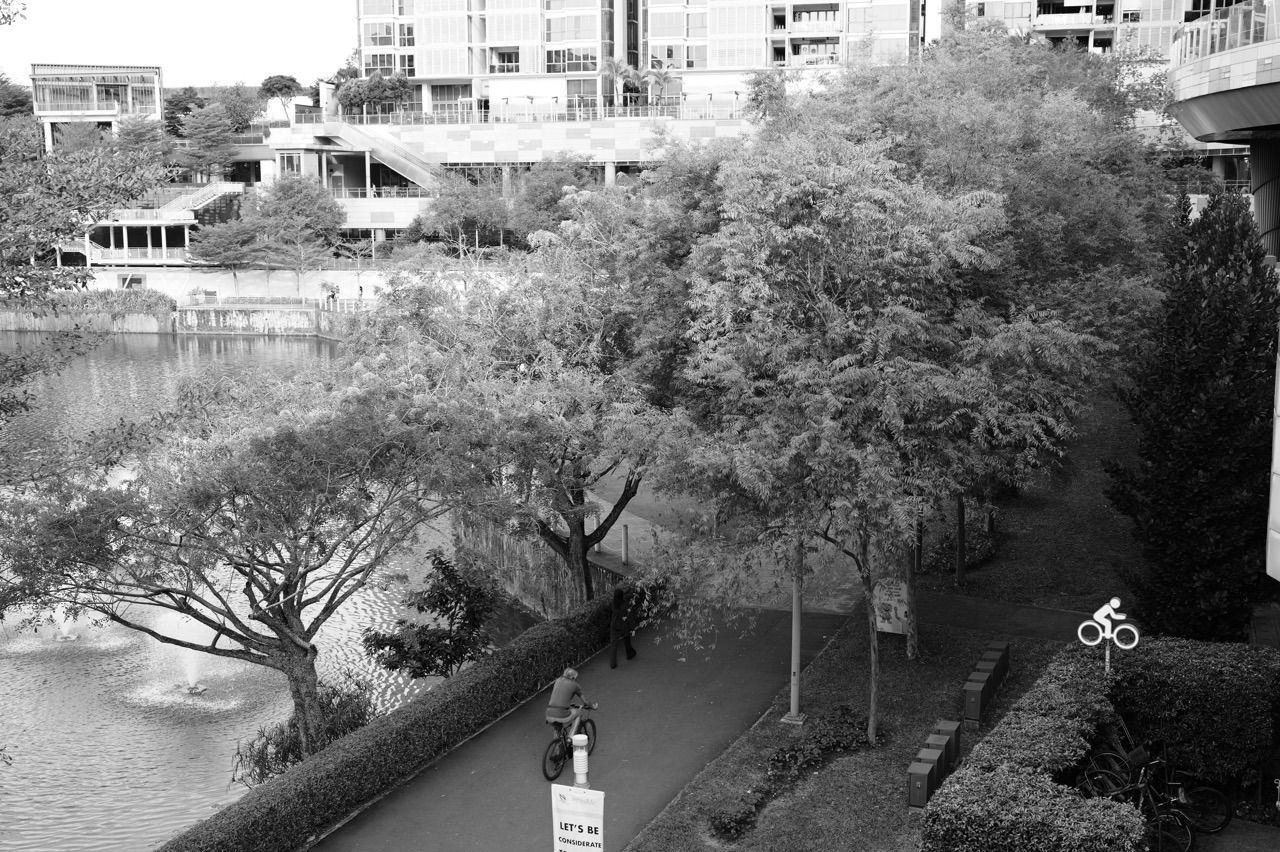
Planning Punggol Waterway Park during haze, a Coney Island walk, Punggol cycling, or an outdoor school activity? Check the latest NEA haze readings and health advisory before you leave. When conditions are poorer, a long run or high-intensity game may need more adjustment than a short essential journey. The answer is not that Punggol’s parks permanently close whenever haze is reported; it is that outdoor plans should match the official advice, the activity’s intensity and the people involved.
This practical Punggol haze outdoor activities guide covers waterfront runs, bicycle rides, Coney Island nature walks, playground visits, school PE and CCAs, as well as indoor alternatives around Punggol. For help deciding one-hour PM2.5 versus the 24-hour PSI forecast, start with the existing Punggol haze check. This article takes the next step: once you know what the advisory means, how do you change the outing without losing the day?
The answer in one minute
- For an activity starting soon: Check the latest one-hour PM2.5 band, its timestamp, the North reporting region and the current official guidance.
- For tomorrow or a later outdoor commitment: Read the 24-hour PSI forecast and its corresponding health advisory during the haze season, and check again before the activity starts.
- Distinguish effort and duration: An easy short transfer, a gentle stroll, a 90-minute run and a full afternoon of outdoor games are not equivalent exposures.
- Take account of the group: Children, elderly people, pregnant women and anyone with chronic heart or lung disease may require a more cautious plan.
- Keep an indoor alternative: A sensible backup can preserve exercise, social time or learning without treating every changed outdoor plan as a ruined weekend.
Read these as a decision process, not a schedule frozen for the entire haze season. Outdoor air quality can change across hours and days.
Why Punggol’s outdoor lifestyle makes haze an important local question
Punggol is a town built around connected public spaces. The Waterway, park connectors, neighbourhood playgrounds and coastal nature areas make it easy to add movement to ordinary life. That is good for wellbeing, but it also means a family’s normal activities may include more time outdoors than they initially notice.
A child may walk from home to an LRT station, spend recess outside, join an after-school sports session and cycle with friends on the weekend. A parent may commute, walk after dinner and exercise on the Waterway. A grandparent may take a comfortable daily stroll. These are not the same exposure scenarios.
Haze does not make all movement harmful. The decision turns on current conditions, duration and physical exertion. The Ministry of Health’s haze framework uses the distinction between prolonged (several hours) and strenuous (substantial effort) precisely because exposure is not a simple yes-or-no label.
Our existing What happens in Punggol during haze looks broadly at family and school routines. Here we focus on individual outdoor plans so readers can act immediately.
Which official air-quality reading applies in Punggol?
NEA publishes regional readings for North, South, East, West and Central Singapore. Punggol is in the North reporting region, together with nearby areas including Sengkang. The North reading is the official regional guide; it is not a sensor mounted at every Waterway bench, Northshore balcony or Coney Island trail.
For a run happening in the next hour, NEA directs people to the one-hour PM2.5 concentration and its band as a more immediate air-quality indicator. For planning tomorrow’s activity during the haze season, use the 24-hour PSI forecast and health advisory. The numbers represent different averaging periods and should never be treated as if they were on the same scale.
Always check the timestamp and whether the figure is an observation or forecast. An 8am screenshot can be outdated for a 5pm decision. A forecast made yesterday is not proof of what has happened today.
If these details sound technical, use the short Punggol PSI and PM2.5 guide. The important action for outdoor users is simple: check the right information at the right time.
Four kinds of outdoor activity, four different decisions
The brief necessary trip
Walking a short distance from an HDB block to the LRT, bus stop or nearby shop is often less prolonged and less strenuous than a planned workout. NEA states that N95 masks are generally not needed for short exposure such as commuting to school or work. Follow the latest situation and your individual health needs.
The relaxed family walk
A short walk at a comfortable pace usually involves less exertion than a hard run, but duration still matters. A child with asthma and a healthy adult may need different limits under the same advisory. Decide on an indoor alternative if the latest guidance calls for minimising outdoor activity.
The vigorous fitness session
Fast running, interval training, intense cycling and outdoor team sports increase breathing effort. Under unhealthy haze, the official framework may advise reducing or avoiding prolonged or strenuous exertion depending on the group. The sensible change is often to shorten, reschedule or move the session indoors.
The extended nature day
Several hours on trails, park connectors or at an outdoor event combine duration, limited shelter and sometimes physical effort. Conditions can change during the outing. At higher haze levels or for vulnerable participants, postponement or a fully indoor plan can be the better choice.
The aim is to distinguish the activities, not assign a fake ‘safe PSI’ to each named Punggol attraction.
Punggol Waterway Park: what to change for a haze day
The Punggol Waterway Park Connector is described by NParks as an 8.4 km route for activities such as jogging, cycling and birdwatching along the Waterway. It is a long and useful outdoor network, which also means that ‘a quick visit’ can unexpectedly become a substantial period of exposure.
If the official advice calls for reducing prolonged or strenuous outdoor exertion, a planned training run along the full Waterway is a different decision from a brief, necessary crossing. Do not rely on the breeze near the canal as proof that the air is cleaner. Air movement may make a walk feel pleasant without eliminating airborne particles.
For a group outing, think about the least resilient participant. If the plan includes young children or someone with a chronic heart or lung condition, the relevant advisory may be more restrictive than it is for a healthy adult. Agree on the approach before the group leaves rather than asking everyone to keep pace once outdoors.
If you switch to a different park connector or another stretch of the waterfront, remember that a different view is not an alternative to haze protection. The official regional conditions and duration of exposure remain the central considerations.
Coney Island: a nature visit is an outdoor commitment
Coney Island Park is a favourite for nature walks and wildlife interest. NParks lists opening hours of 7am to 7pm on its park page, with entrances at the Punggol Point side and near Lorong Halus Wetland. Check the latest NParks notices before travelling, because access or operational information can change.
A Coney Island outing may be longer than a simple neighbourhood stroll. Trails and exposed stretches make it important to plan the return journey, bring water for comfort and avoid setting out when the air-quality advisory advises against prolonged outdoor activity for the people attending.
The park’s natural character is the attraction, not a reason to ignore health guidance. A forested or coastal setting should not be treated as a certified ‘haze-free zone’. Plants offer many benefits, but outdoor vegetation does not guarantee that smoke particles are absent during a regional event.
If conditions are poor, save the wildlife walk for a better day. An indoor nature documentary, sketching session or visit to a suitable indoor learning space can keep the interest alive without trying to force an outing that no longer fits the weather and air quality.
Running during haze: why pace and duration matter
A runner who normally trains beside Punggol Waterway may inhale more air per minute during vigorous activity than during ordinary walking. When outdoor fine-particle levels are elevated, this is why reducing exertion and duration is part of public health advice.
MOH’s 24-hour PSI advisory distinguishes healthy people from groups requiring additional care. At PSI 101–200 (unhealthy), healthy people should reduce prolonged or strenuous outdoor exertion. At 201–300 (very unhealthy), they should avoid it. At above 300 (hazardous), healthy people should minimise outdoor activity more broadly. Always follow the latest official advisory for the specific situation.
That guidance does not mean a person must achieve a particular daily kilometre target. One changed training day is often easy to accommodate. Options include an appropriately ventilated indoor workout, strength or mobility exercises suited to one’s ability, a rest day or a rescheduled session when conditions improve.
Runners sometimes ask whether running early in the morning is always safer. No fixed time of day guarantees lower haze exposure. Smoke transport, wind and particle readings change. Check the actual time and regional reading rather than assuming dawn automatically means clean air.
Cycling and park connectors: speed does not erase exposure
Cyclists may cover a long distance quickly, which can make the outing feel shorter than it is. However, fast cycling can involve considerable exertion and a substantial volume of inhaled air. The relevant question is not just kilometres completed but the intensity and duration of the effort.
A brief utility ride to a local destination differs from a long endurance circuit. When an advisory limits prolonged or strenuous outdoor activity, the long circuit is the first thing to reconsider. If a group ride includes children, adjust for their guidance and individual circumstances rather than taking the strongest rider as the reference point.
A cloth face covering or ordinary surgical mask should not be treated as a guarantee against PM2.5. Even a correctly fitted particulate respirator is not a reason to ignore advice to reduce strenuous exertion. Respirators also increase breathing effort, which can be relevant during physical activity.
For everyday transport, use the option that reduces avoidable exposure where possible. The best route is often the practical, short one, not a long detour in pursuit of a possibly ‘cleaner’ street without reliable evidence.
Playgrounds, football and school sports
For children, the difference between outdoor play and vigorous organised sport can matter, but prolonged playground activity can also count as extended exposure. Parents should read the group-specific advisory for children rather than borrowing the less restrictive guidance for healthy adults.
School physical education and CCAs involve institutional supervision and instructions. On 9 October 2026, Singapore’s Government Haze Task Force said MOE schools were ready to keep lessons going in appropriate indoor spaces, modify activities, monitor one-hour PM2.5 through the day and avoid outdoor activities when the situation warranted. That was a dated operational update, not a prediction that every school is closed or every CCA is cancelled indefinitely.
Preschools have their own protective arrangements. In the same October 2026 advisory, ECDA required preschools to cease outdoor activities and strenuous indoor activities when air quality was in the very unhealthy range and take additional indoor precautions. Parents should follow the institution’s current communications.
For families, a useful message to a child is: ‘Your activity has moved indoors today because the official air-quality advice changed.’ It explains the decision without describing the entire outdoor world as permanently unsafe.
What about outdoor tuition, camps and enrichment activities?
Some enrichment includes outdoor observations, sports, nature study or travel between sites. Organisers should consider the current haze advisory, the nature of the activity, the age and health of participants, and whether the activity is essential or can be changed.
A school science observation along the Waterway can be rescheduled or replaced with indoor data analysis. A geography lesson about wind and haze can use official satellite maps and the NEA readings rather than requiring children to spend a long period outdoors on a poor-air day.
For a study group meeting at a library or tuition room, the transport portion may be brief while most of the learning is indoors. Families can use that distinction instead of cancelling learning automatically or pretending the journey and classroom environment need no thought at all.
If someone has a medical condition, share appropriate instructions with the responsible adult through normal channels. A group leader should never insist that wearing a mask makes every outdoor task acceptable.
Outdoor workers, deliveries and essential activities
Not everyone is choosing between a fun cycle and an indoor alternative. Some Punggol residents work outdoors, deliver goods, maintain infrastructure or perform essential tasks that cannot simply be paused.
NEA directs employers to the Ministry of Manpower’s haze guidance. Controls can include reducing strenuous work, planning breaks, using mechanical aids, rotating duties and suitable respiratory protection where the occupational risk assessment requires it. Workplace decisions should be based on current advisories and specific work demands.
A delivery rider’s risk profile differs from a family’s 30-minute park visit, just as an outdoor maintenance worker has different constraints from a casual runner. Recognise those differences rather than giving a generic ‘stay inside’ instruction to someone whose job requires a safer operating plan.
If you are an employer or worker, use the latest MOM haze guidance together with NEA and your workplace procedures; a general neighbourhood guide cannot replace occupational health requirements.
Indoor alternatives: keep the fun, change the setting
Punggol has useful indoor destinations. The Punggol Regional Library can offer a change of scene for reading or family learning, subject to its current opening and programme information. A visit to Waterway Point or another indoor public space may suit a family that originally planned a long waterfront afternoon.
Indoor does not always mean filtered or appropriate for everybody. Spaces differ in ventilation, occupancy and facilities. If a family member has a significant health condition, check what they need rather than assuming an enclosed mall or sports venue automatically meets every medical requirement.
For exercise, consider activities that can be done inside an appropriately managed space, or a mobility and stretching session at home. Not every outdoor football game needs to be replaced with an equally intense indoor workout; MOH’s concern also includes exertion for vulnerable people during poorer air-quality periods.
A rainy-day itinerary can be adapted, but remember that haze and rain are different problems. You may be able to use a different indoor routine without relying on weather forecasts as the sole signal. Our Punggol rainy-day guide offers general local ideas to verify against current opening information.
A worked example: planning a Saturday in Punggol
Imagine a family of four planning three outdoor activities: a brisk 8am cycle, a noon walk near the Waterway and a late-afternoon nature visit. One family member is a child, and another has asthma. The family sees yesterday’s PSI forecast and a morning one-hour PM2.5 reading on a screenshot.
First, they establish the current source and timestamp. A screenshot may no longer describe the air by noon. Second, they separate the long strenuous cycle from the short walk and the extended nature visit. Third, they apply the child and asthma-specific health precautions rather than using the healthiest adult’s plan.
Suppose the official advice calls for avoiding prolonged or strenuous outdoor exertion for the person with asthma and minimising that exertion for the child. The family need not run a complex argument about whether a 20-minute crossing is identical to an 8km ride. They can remove the high-exertion plan, choose an indoor alternative and review the later outing when fresh information is available.
The example gives no invented PSI reading and makes no claim about the air in Punggol on a particular Saturday. It shows a reliable approach: read, classify, adapt, recheck.
What if the air quality changes while you are outside?
A walk may begin in comfortable conditions and meet worsening readings later. Do not rely on the reading you saw before leaving if the official service publishes a significant update. The next action depends on the guidance, the group’s health and the activity underway.
If someone feels unwell, stop strenuous activity and respond to symptoms appropriately. Move to a more suitable environment and seek medical attention when needed, especially for a person with chronic heart or lung disease. For severe breathing difficulty, chest pain or other emergencies, obtain urgent help.
If a family is far into a long route, choose a practical way to return without unnecessary exertion. Never make a child hurry through a potentially unsuitable run simply to ‘finish the loop’. A route can be completed on another day.
Having an indoor backup, charged phone and ordinary return transport option is useful planning, but no special gadget replaces official information and judgement.
Why a cool waterfront breeze is not an air-quality test
The Punggol coast may feel windier or cooler than some sheltered streets. Wind affects comfort, but it can also transport smoke. A breeze does not prove PM2.5 has fallen below a particular threshold.
A clear distant view has similar limits. Humidity, sunlight, clouds and particle properties influence what the eye can see. The atmosphere may look attractive at sunset without that being a quantitative measure of safe exertion.
Some families look to a wooded path and assume ‘more trees means no haze’. Urban greenery has many benefits, but regional smoke can reach green spaces too. Choose an outdoor itinerary because the official conditions are suitable, not because a location is visually appealing.
For a deeper explanation of wind, fire sources and particle science, see Why Is Punggol Hazy?.
The simplest before-you-leave decision ladder
- Where? Identify the destination and region. Punggol belongs to NEA’s North reporting region.
- When? Check live one-hour PM2.5 for an outing starting now and the 24-hour PSI forecast for ahead-of-time planning.
- Who? Identify children, older people, pregnant participants and anyone with chronic heart or lung disease.
- What kind of activity? Decide whether it is brief, prolonged, light or strenuous.
- What does the current advisory say? Apply the official category and the group-specific guidance.
- What is Plan B? Shorten, reschedule or move indoors where appropriate.
- When will you recheck? Before departure and if there is a meaningful update or change in the group.
Use this as a short conversation, not as another administrative burden. An ordinary family can make a sensible decision in minutes.
Frequently asked Punggol outdoor haze questions
Can I run at Punggol Waterway Park during haze?
Check current NEA guidance first. During unhealthy or worse conditions, the official 24-hour PSI framework may advise healthy adults to reduce or avoid prolonged or strenuous exercise, with more cautious advice for vulnerable groups. A run is not automatically safe because the park looks clear.
Is Coney Island closed whenever Singapore has haze?
Do not assume haze automatically means a park is closed. Check NParks official park hours and notices separately from NEA’s health advice. A park can be open yet not be the right place for a long visit under a particular advisory.
Does Punggol Waterway have its own PSI reading?
No separate official block- or park-level PSI reading is published for Punggol. NEA lists Punggol under the North reporting region.
Is an early-morning run always better?
Not necessarily. Smoke and particle levels may change over the day. Use the current timestamped indicator and health advice rather than assuming early hours guarantee cleaner air.
Should schools cancel PE and CCAs?
School decisions depend on current MOE and school instructions, and on the haze conditions. The government described plans in October 2026 to modify lessons and avoid outdoor activities when needed. Follow your school’s latest direct communication.
What can children do if outdoor play is reduced?
Try a suitable indoor game, library visit, arts activity or family learning time. The appropriate intensity depends on the child and the official advice, particularly when a child has an underlying health condition.
Will cycling faster reduce exposure because I finish sooner?
Faster riding can increase exertion and breathing volume, so speed alone is not a reliable protective strategy. Consider both duration and intensity; change or postpone the ride when the advisory calls for it.
Can an N95 make it safe to train outside at any PSI?
No. A respirator can reduce some particle exposure when used correctly, but it is not a substitute for activity limits, and it increases breathing effort. NEA does not recommend N95 use for every short trip.
Are outdoor dogs’ walks different from family walks?
A pet still needs basic care, but prolonged exercise can often be shortened or rescheduled when air quality is poor. For an animal with breathing difficulties or unusual symptoms, consult a veterinarian. This does not change the public-health guidance for the person accompanying the pet.
When is it reasonable to return to ordinary outdoor plans?
Check the newest official readings, forecast and relevant health advice. As conditions improve, activities can be reconsidered in light of each participant’s health and any remaining symptoms. Avoid declaring a fixed ‘all-clear’ based only on a single shower or an old photograph.
Connect this outdoor guide to the full Punggol haze series
The existing Punggol Haze Check answers which air-quality indicator and time horizon to use. Why Is Punggol Hazy? explains regional smoke, wind and rainfall. Punggol Haze at Home tackles windows, filters, cooling and ventilation.
The companion Punggol Haze Health Guide covers asthma, children, N95 masks and symptoms in greater detail. The older Punggol family routine guide gives a town-life overview.
This page has one job: to turn the official advice into realistic decisions about real Punggol outdoor activities.
Official sources and update note
Article reviewed on 17 October 2026. The official 9 October 2026 government statement is cited as a dated example of school preparedness, not a real-time order for every school. Park access and air-quality advisories can change; check source websites when planning.
- NEA: Live Haze Readings, Forecasts and Advice
- MOH HealthHub: Haze, Health and Outdoor Activity Guidance
- NEA: Air-Pollution FAQs and Reporting Regions
- NEA: Singapore Ready to Step Up Haze Response, 9 October 2026
- NParks: Punggol Waterway Park Connector, 8.4 km
- NParks: Coney Island Park, Hours and Visitor Information
- MOM: Haze Guidance for Workplaces
- Punggol Haze Check: Which Indicator to Use?
- Punggol Haze Health Guide
Good outdoor habits include the ability to change plans. Use reliable readings, respect individual health needs, keep one enjoyable backup, and save the longer Punggol routes for a day when the guidance supports them.
Punggol Haze Reference Library: Related Reading
Use these distinct Punggol guides to move from the current air-quality advisory to the right practical question. Always check NEA’s live service for current readings; these articles are evergreen explanations and planning tools.
- Punggol 48-hour haze preparedness — Plan the next two days without panic
- Punggol haze and pets — Dog walks, cats, birds and vet signs
- Punggol haze and schools — Preschools, PE, CCAs, school closures and exams
- Punggol haze at work — MOM advice, delivery riders and employers
Punggol Haze: Connected Reading Library
These reader-first guides answer different questions about Punggol and Singapore haze. For a decision about today, check the official NEA live readings and advisories rather than using an old article as a real-time report.
- Indoor destinations and verified PA haze shelters
- Balcony plants, laundry, vegetables and safe dust cleaning
- Reading PM2.5 graphs, PSI, satellite hotspots and wind maps
- Indoor Science, Geography, Mathematics and English learning projects
- Punggol Haze Check: one-hour PM2.5 and 24-hour PSI
- What happens in Punggol during haze: family routines
- eduKateSG Singapore Haze: transboundary smoke and connectivity
- eduKateSG Punggol Haze Lifestyle: work, school and daily errands


