
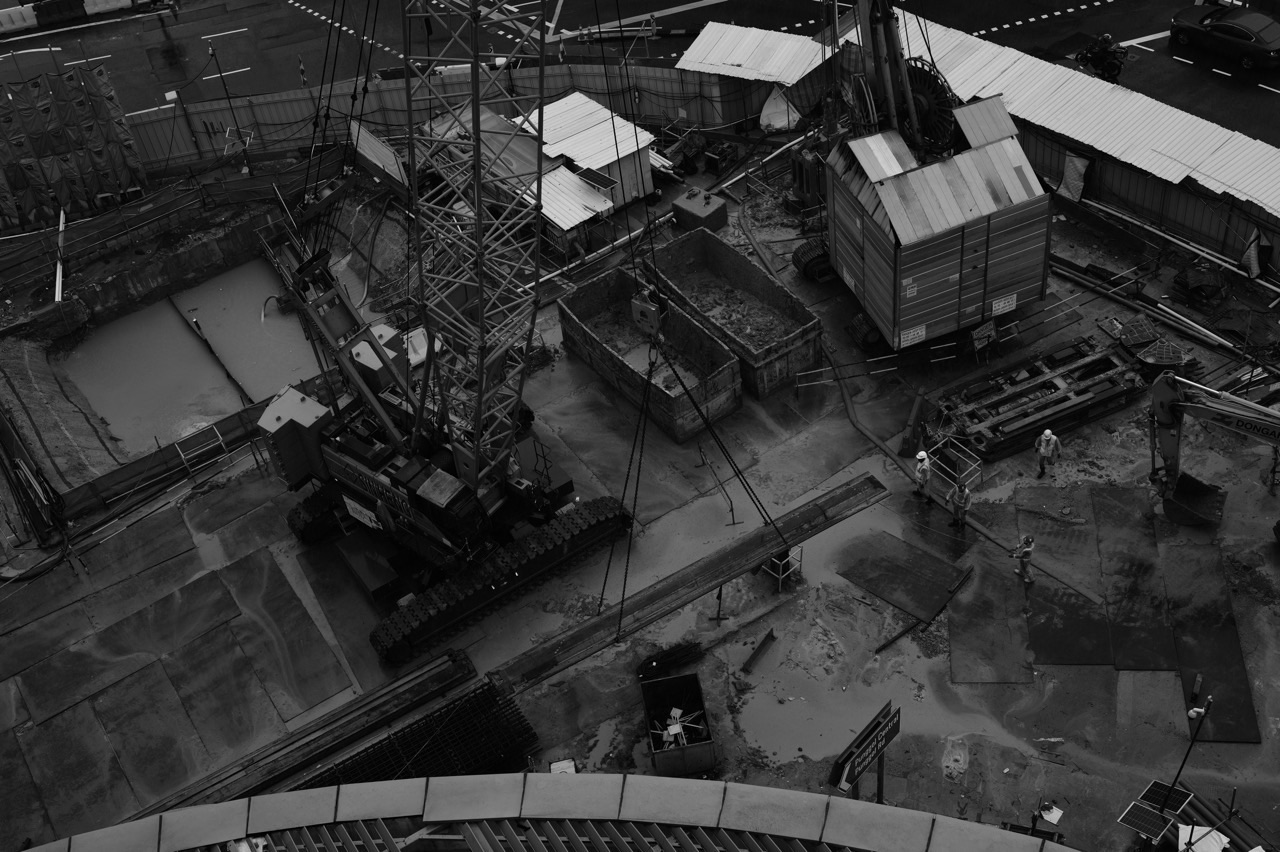
Is the grey air around Punggol caused by regional haze or construction dust? It can be either, or both. Transboundary smoke can raise fine-particle concentrations across larger parts of Singapore when regional fires and winds align. Construction dust may be concentrated around earthworks, demolition, cutting, vehicle movements or exposed material. You cannot reliably distinguish them from colour, smell or one photo alone. Start with the official NEA North-region haze readings, then look for a specific, safely observed local source if you suspect an issue near your block.
Residents searching Punggol construction dust complaint, haze or roadworks, dust near Punggol MRT, smoky smell from construction, or how to report air pollution in Singapore need a practical method rather than an accusation. This article explains how to describe what you notice, what the measurements can and cannot prove, and when to use NEA or the OneService reporting channels. It does not claim any named Punggol contractor or building site is violating environmental requirements.
Quick answer: a five-step local air-quality check
One: Check NEA’s latest North-region one-hour PM2.5 band and health advice for the time and place of your outdoor plans. Two: Note the precise location and when you observed dust or smoke. Three: Look for a source safely, without entering a worksite, climbing or approaching moving machinery. Four: Consider whether the issue is visible airborne dust, deposited material, a strong odour or actual smoke. Five: Submit a factual report through an appropriate official channel if there is a specific continuing local concern.
A higher regional PM2.5 reading cannot by itself prove a nearby project is responsible. A visible dust plume near a vehicle or demolition activity can justify a factual concern, but it does not establish a legal breach or the precise chemical makeup of the dust.
If someone has severe breathing difficulty, chest pain or another urgent health concern, respond to the person and seek medical assistance. The source investigation should never delay necessary care.
Why this question matters in a developing town
Punggol continues to change, with residential developments, public facilities, road connections and urban construction activity. HDB’s Punggol town overview describes its evolution from earlier village and waterfront uses into a planned Eco-Town with new housing and Punggol Digital District.
Construction is not inherently evidence of pollution wrongdoing. Sites may operate legitimately while still having activities that need environmental controls. Nearby residents are entitled to describe a concern accurately and use official feedback channels.
Regional haze and local works can also occur simultaneously. When a national smoke episode arrives, a resident might notice dust from nearby roadworks at the same time. The correct answer may be both sources contributing to a person’s experience, not an either-or contest.
Understanding that possibility prevents a common failure: blaming an obvious nearby crane for every hazy skyline, or dismissing every local dust cloud because the regional haze forecast is already poor.
What exactly is construction dust?
Construction dust is a broad description for airborne particles arising from site activities. Sources may include excavated earth, sand, cementitious material, cutting, drilling, demolition, handling dry materials and vehicle movement over dusty ground.
Not all construction particles are the same size. Some coarse particles settle relatively quickly near the activity, while finer particles may stay airborne longer and travel farther. Certain tasks may generate respirable fine particles; equipment exhaust and other site emissions can also differ from ordinary soil dust.
PM10 and PM2.5 refer to aerodynamic size categories, not a label identifying the source. PM2.5 is not automatically “smoke” and PM10 is not automatically “construction dust”. Both regional and local activities can contribute to particulate matter.
A black deposit on a window ledge or a grey cloud above a site cannot tell you the exact size distribution or chemical composition without suitable measurements.
What is transboundary smoke haze?
Transboundary haze often involves smoke from vegetation and peatland fires outside Singapore being transported on regional winds. The mixture can include fine particles and gases, with chemistry that depends on what burned and what happened during atmospheric transport.
NEA notes that PM2.5 is usually the predominant pollutant of concern during significant regional smoke episodes. Singapore monitors air quality across five reporting regions, with Punggol in North.
The official readings describe regional outdoor pollution but do not identify a particular nearby Punggol source or tell you exactly what is deposited on one balcony. They also do not guarantee that a local worksite is contributing zero pollution.
For the wider physical mechanism, see Why Is Punggol Hazy?. Here the question is how to investigate an apparent local issue without jumping to a conclusion.
The geography clue: broad regional pattern or small local hotspot?
A large regional smoke episode may affect multiple areas, although air quality and visibility vary across Singapore. A local dusty task may produce a more concentrated plume near one part of a neighbourhood, especially while that task is occurring.
This difference in spatial scale can be a clue, not conclusive proof. The regional measurement network does not publish a certified individual value for every Punggol corridor, road, building or construction fence. A resident may observe a dusty spot even when the North-region reading is not especially high.
Conversely, visible dust near a site does not prove it produced the full regional PM2.5 increase. Other sources may be present simultaneously.
Look at where the problem occurs and whether it changes with a visible activity. Avoid assigning a precise source contribution unless proper evidence is available.
The timing clue: what happened before, during and after?
Suppose a resident notices a dust cloud while trucks are entering a nearby development, then sees the dust diminish when that movement stops. The temporal association is useful for reporting. It does not, on its own, give a measured concentration or establish a breach of environmental rules.
Keep a simple record with a date, start time, approximate duration, location and what you observed. If the concern recurs, several well-labelled observations may help the responsible authority understand the pattern.
Avoid writing a conclusion first and selecting only observations that support it. “A visible dusty plume appeared near the worksite entrance at 11:20am” is stronger evidence than “this company is poisoning the estate” without verification.
Likewise, a general burning smell arriving overnight may prompt a different investigation. NEA’s FAQ recognises that smells can be related to regional fires or sometimes local burning sources, and that odour does not always track the particulate index.
The appearance clue: colour is not a chemical test
Regional haze may appear as diminished skyline contrast. Local earthworks may produce a brownish or pale dust cloud. But sunlight, humidity, the background colour of buildings and camera processing can substantially alter perceived colour.
A grey sky over Punggol does not prove one particular site generated the pollution. Fine smoke particles can be nearly invisible as individual specks while still contributing to a measured increase.
Some dust settles on leaves, railings and cars. It can come from construction, road traffic, normal outdoor deposition and other sources. Examining the deposit visually rarely establishes the particle’s exact origin or whether it belongs to a legally regulated category.
For photographic evidence and limitations, read the Punggol Haze Photography Guide.
What NEA’s official readings can tell you
NEA’s regional monitors measure several air pollutants and produce the 24-hour PSI. The agency also reports one-hour PM2.5 concentrations, which can change relatively quickly as weather and pollution conditions evolve.
This is valuable for making an activity decision, especially when children, older people or someone with chronic heart or lung disease are involved. But a region-wide public value is not a measurement inside a specific corridor or a parcel of air next to a fence.
Punggol is grouped with other areas in North. It would be wrong to label a regional value “Punggol construction dust concentration” or claim that an observed PM2.5 increase automatically implicates a local project.
For the difference between measurements, averages and forecasts, the existing Punggol Haze Data Literacy article gives worked examples.
Why low-cost phone-connected sensors need caution
Some residents use low-cost indoor particle sensors. They may show useful relative changes but can be affected by humidity, calibration, the measurement environment and other factors. A consumer device beside a window is not automatically more accurate than NEA’s specialised monitoring equipment.
A high number on one gadget cannot by itself prove a legal violation by the nearest contractor. The device may be indoors, differently calibrated or reporting another index such as a foreign AQI. It may also use a different averaging period.
If you use a sensor for your own record, preserve the exact model, settings, units, time and placement. Treat it as supplementary information rather than the sole basis for a definitive accusation.
For public health decisions, rely on the authoritative Singapore advisory. For enforcement, let the relevant authority determine which observations and measurements are required.
Construction-site responsibilities in Singapore
NEA’s Environmental Control Officers for Specified Construction Sites guidance describes the role of environmental control officers (ECOs) in monitoring and preventing environmental health issues.
Among the listed areas of responsibility are air pollution and dust abatement, along with noise, waste, vector control, earth littering and water pollution. The system involves environmental management plans and site inspections, depending on the type of site and applicable requirements.
This supports a practical conclusion: dust concerns can be real matters for construction environmental management. It does not mean every site has exactly the same ECO requirements or that every visible dusty moment is a proven statutory offence.
Specific obligations depend on the relevant site classification, legislation, code of practice and the facts. Residents should report observable issues; qualified operators and authorities assess compliance.
Dust controls: reducing the source before it spreads
Possible controls in construction and material-handling settings include managing exposed dry surfaces, using appropriate dust suppression where safe, covering or containing loose material, controlling vehicle movement and keeping site access areas clean.
The suitable measure depends on the task, weather, site layout, worker safety and the applicable environmental management requirements. Residents should not instruct workers to apply a particular method without understanding site conditions.
The important concept is source control. Trying to solve pollution only after it reaches a neighbour’s window is less effective than reducing unnecessary releases where work is carried out.
This is analogous to regional haze prevention: preventing or controlling emission at source is different from managing exposure after smoke travels.
Why a dust net and a noise barrier are not the same tool
Construction neighbours may see netting, hoardings, screens or tarpaulins. These materials can serve different purposes. NEA’s construction-noise mitigation guidance notes that ordinary netting is designed chiefly for falling debris and visual screening, not effective acoustic insulation. It also discusses tarpaulins as materials commonly used for weather protection and dust control.
A screen used to manage dust should not be presumed to block sound. A sound barrier should not automatically be considered a certified PM2.5 filtration system. Each design needs to be evaluated for the particular environmental issue.
If your concern is both dust and noise, describe each separately in your feedback. The evidence, legal limits and responsible processes may differ.
That avoids the common question “Why is the pollution screen not stopping the drilling noise?”—it may never have been intended or designed to perform that function.
Construction dust, road mud and silty runoff are different problems
A construction vehicle can carry soil onto a road, producing a cleanliness or dust concern. Rain washing exposed soil into drains creates a silt and water-pollution problem, which may require different controls. Noise from machinery is another separate category.
PUB’s Earth Control Measures information explains measures intended to prevent sediment being washed into drains and waterways. These water protections are important but do not establish air-quality performance for every worksite.
A photograph of brown runoff into a drain is not evidence that the regional PSI rose. Conversely, a visible dust plume does not automatically prove a breach of water-discharge requirements.
Describe the physical medium: air, water, road surface or noise. That helps the relevant authority route the concern appropriately.
How to report a specific local dust problem
NEA’s Contact Us page directs residents to OneService for local environmental issues such as cleanliness, pests and maintenance, and also provides an online feedback route and its 6225 5632 contact number for other environmental matters.
The OneService reporting service can route eligible municipal feedback to the relevant authority or Town Council. OneService’s current chatbot FAQ asks for a detailed description, a photo, precise location, time and contact details. The exact interface and requirements may vary by reporting route.
A useful factual report might say: “On [date] at approximately [time], I observed a visible dust cloud near the gate of the works along [verified road name]. It appeared during vehicle movement and drifted towards the nearby footpath. Attached are photos taken from a safe public location.” Do not invent site identity or demand a penalty in the text.
You do not need to know which agency is ultimately responsible before using the official routing channel. Supply evidence and let the authority assess the situation.
Taking safe documentation photos
Take photographs only from a location where you are legally allowed and can stand safely. Do not enter fenced worksites, cross active vehicle paths, stand in dangerous road positions or lean from balconies to get a better angle.
A useful picture can show the general location and the visible activity. If possible, a separate wider photo may help identify the junction or site gate without exposing private information about workers or children. Include date and time in the report.
Avoid heavy filters or editing that makes a plume appear more intense than it was. If cropping is necessary, retain the original image and mention what was changed. OneService permits photo attachments; check its current requirements before submitting.
Evidence does not need to be dramatic to be helpful. Accurate, ordinary documentation is preferable to a risky close-up.
A simple observation log over one week
Create five columns: date/time, location, activity observed, what changed and official feedback reference if one exists. For example, a fictional note might read: “Tuesday 10:15am; footpath near a named worksite; truck movement; visible dust for about five minutes; feedback not yet submitted.”
Another entry could say: “Wednesday 4pm; same route; no visible dust during a quiet period.” Including ordinary observations as well as concerning ones helps prevent selective reporting.
Do not fabricate entries, use photos from different dates as one event or add a contractor’s name based only on rumours. If a personal diary involves other people, respect privacy.
The log cannot replace certified sampling. It can, however, make an environmental feedback report more precise and help identify whether the issue recurs.
Worked example: two sources on the same afternoon
Imagine a fictional Punggol resident sees a dusty plume near a construction entrance at 11am. At the same time, NEA’s North-region PM2.5 band is elevated due to wider regional conditions. Can we conclude the construction site caused the entire regional rise?
No. The local plume may indicate a local issue, while the regional reading describes a much larger area. They can coexist. There is no source-apportionment analysis in the scenario proving how much each source contributes.
Can we conclude the local plume is harmless because regional haze is already present? Also no. A specific visible release may still merit environmental management and factual feedback.
The evidence supports two separate actions: use the official air-quality advice to adjust personal exposure, and report the observed local issue if warranted. Neither requires a false definitive attribution.
Worked example: distinguishing a rate from an observation
Suppose a resident records that a dusty task lasted 8 minutes on one day and 20 minutes on another. The second observed period was 12 minutes longer, or 2.5 times as long. Those are valid descriptions of observed duration.
It would be wrong to conclude that air pollution increased by 150% solely from the duration comparison. Particle concentration, release rate, distance and weather might all differ. An activity lasting longer does not automatically create proportionally higher exposure.
This is the same principle used in science and statistics: identify what was measured. A stopwatch records time, not PM2.5 mass per cubic metre.
Students can learn this distinction without being sent outdoors to measure dust themselves.
Can local dust be worse on certain floors?
Building geometry and wind may influence the movement of local dust around a development. A floor facing an exposed site or wind path might receive different visible deposits from another location. But the exact pattern is not obvious without observations and appropriate measurements.
A resident on a high floor should not assume that every airborne particle rises from the nearest project. Transboundary smoke can occupy large parts of the atmosphere, and urban pollution also has multiple local sources.
If deposits recur inside the home, consider windows, open areas and cleaning practices while reporting any specific external issue. Do not interfere with safety-critical ventilation or make unsafe building alterations to stop a suspected source.
For ordinary indoor particle management, read Punggol Haze at Home.
What if the problem is a burning smell, not visible dust?
NEA explains that a burning smell during haze may arise from a mixture of gases released by vegetation or peat fires, while local burning activities can sometimes produce odours as well. Smell does not map perfectly to the regional PSI or one-hour PM2.5 level.
If you notice a persistent unusual local odour, report the factual location, time and nature of the smell through the appropriate environmental feedback route. Avoid claiming the source is a particular business or household without evidence.
If there is a suspected active fire or immediate danger, use the appropriate emergency response channel instead of treating it as routine municipal feedback. For serious breathing symptoms, seek medical attention without waiting to establish the odour’s cause.
A responsible neighbourhood guide distinguishes annoyance, suspected local incident, regional haze and emergency rather than calling all four the same event.
Home cleaning after local dust or haze
If dust has settled on suitable surfaces, NEA recommends using damp wiping or mopping rather than vigorous dry dusting that sends material airborne again. This is useful for ordinary cleaning, though the exact surface material and contaminant may require special handling.
Do not spray strong disinfectants simply to “kill haze”. Airborne particulate matter is not automatically a microbial contamination problem. Avoid mixing cleaning chemicals and follow product safety directions.
For laundry, balcony plants and edible herbs exposed to outdoor deposits, the Punggol Haze and Balcony Gardens guide addresses household maintenance and food hygiene.
If you suspect a specific hazardous industrial substance rather than ordinary environmental dust, follow authoritative safety guidance; casual wiping may not be the correct response for every substance.
Preventing needless conflict with construction workers
A worker operating equipment may not control the site-wide dust management plan. Confronting an individual at a worksite entrance can be unsafe and unproductive. Use the posted site contact where appropriate or an official feedback service.
Describe the evidence and let the responsible site management and regulator investigate. Avoid publicly identifying and accusing individuals from photographs. A visible issue may have several possible causes, and the company responsible should be verified rather than guessed.
This approach is not weaker than an angry neighbourhood post. It creates a clearer record, avoids defamation and helps environmental controls be considered through the proper process.
Residents can still ask legitimate questions about mitigation and report ongoing problems. Accurate reporting respects both public health and fair treatment of those whose responsibility has not been established.
Why haze and construction dust need different remedies
Regional haze prevention involves fire management, land-use practices, atmospheric monitoring and cross-border cooperation. Local dust management is primarily about controlling releases from a particular activity or site and protecting nearby areas.
A family can reduce unnecessary exposure under official haze guidance, but it cannot directly repair a worksite’s dust controls. A developer can manage local dust emissions but cannot personally extinguish regional fires across the sea.
Confusing the two can send complaints to the wrong place or produce unrealistic demands. It also distracts from the separate technical measures that can help.
The Punggol Haze and Regional Law guide covers the wider institutional response; this page covers local observations and environmental feedback.
Frequently asked questions
Is all PM2.5 in Punggol from Indonesia?
No. PM2.5 is a particle-size category, not a source label. During transboundary haze, regional smoke can be a major contributor, while local combustion, traffic and other activities may also contribute.
Is brown dust definitely from a construction site?
Not necessarily. Dust can arise from multiple sources, including road activity, exposed earth and ordinary deposition. A visible plume associated with particular work may justify a factual report, but source identity should not be presumed.
Does an elevated North-region reading prove local works are polluting?
No. NEA’s North-region value reflects regional monitoring and does not identify a precise local source contribution or an individual building’s exposure.
Can construction work generate fine particles as well as coarse dust?
Yes, depending on the activity and materials. Cutting, grinding, equipment exhaust and other processes can generate different particle sizes. The exact mixture requires suitable evidence.
Who handles local dust complaints in Singapore?
Use NEA’s official feedback channels and OneService as appropriate for the issue. These channels direct feedback to the relevant authorities.
Do I have to know the contractor’s name?
Not to describe a local concern. Provide the precise verified location, date, time, activity and any safe supporting photo. Do not guess the identity of responsible parties.
Should I enter a worksite to photograph dust?
No. Stay in safe public areas, respect barriers and avoid machinery and vehicle movements. A wide factual photograph is preferable to a dangerous close-up.
Do nettings block both dust and noise?
Different screens have different purposes. Ordinary netting is not the same as an engineered acoustic barrier or a certified particle filter. Evaluate the stated function rather than assuming one material solves every issue.
Does rain wash away every source of pollution?
No. Rain may reduce certain airborne particles, but it can also cause sediment runoff, and new smoke or dust can appear afterward. Different media require different environmental controls.
What if someone develops breathing difficulty?
Follow relevant medical guidance and seek prompt care for concerning symptoms. Severe breathing difficulty or chest pain warrants urgent assistance, regardless of whether the suspected source is local or regional.
More Punggol haze references
For the regional causes, begin with Why Is Punggol Hazy?. For the official measurements and their limits, read Punggol Haze Data Literacy. For town design and building ventilation, see Punggol Haze and Urban Design.
For practical health decisions, see Punggol Haze Check and Punggol Haze Health. This guide’s separate subject is how to recognise and report a possible local source without confusing it with regional smoke or making unsupported accusations.
Official sources and reporting disclaimer
Reviewed 17 October 2026. No particular contractor, development or individual in Punggol is accused of a breach. All worked observations are explicitly fictional examples.
- NEA: Air Pollution, PSI, PM2.5, Visibility and Smell FAQs
- NEA: Environmental Control Officers for Specified Construction Sites
- NEA: Construction Noise Guidance, Dust Screens and Other Controls
- NEA: Contact Us and Environmental Feedback
- OneService: Municipal Reporting
- OneService: Reporting Requirements and FAQ
- PUB: Earth Control Measures for Sediment and Water
- NEA: Live Haze Readings and Health Advice
A useful neighbourhood report begins with something a person can verify: a location, a time, a carefully described activity and an appropriate official channel. That is how residents can raise genuine concerns without turning every dusty day into an unfounded haze accusation.
Continue Through the Punggol Haze Reference Library
Explore linked guides on photographic evidence, El Niño and fire weather, Punggol building design, and distinguishing local dust from regional smoke. For current decisions use NEA’s live air-quality information.
- Punggol Haze Photography: Visibility and Honest Skyline Evidence
- Punggol Haze Climate: El Niño, IOD, Monsoons and Fire Weather
- Punggol Haze Urban Design: Northshore and Cleaner Indoor Spaces
- Punggol Haze Check: One-Hour PM2.5 Versus 24-Hour PSI
- Punggol During Haze: Family and School Routines
- eduKateSG: Singapore Haze and Transboundary Smoke
- eduKateSG: Singapore PSI and Haze Monitoring
Punggol Haze: Four New Complementary Guides
Explore the differences between air-quality myths, reservoir-water evidence, community access and wider economic costs. These articles have distinct reader purposes and link back to the existing Punggol haze library.
New Punggol Haze Guides: Homes, Travel and Insurance
Read practical follow-up guides about humidity when windows are closed, renovation pollutants, insurance eligibility and actual airport disruptions. For live air-quality decisions, use NEA’s official readings.


