
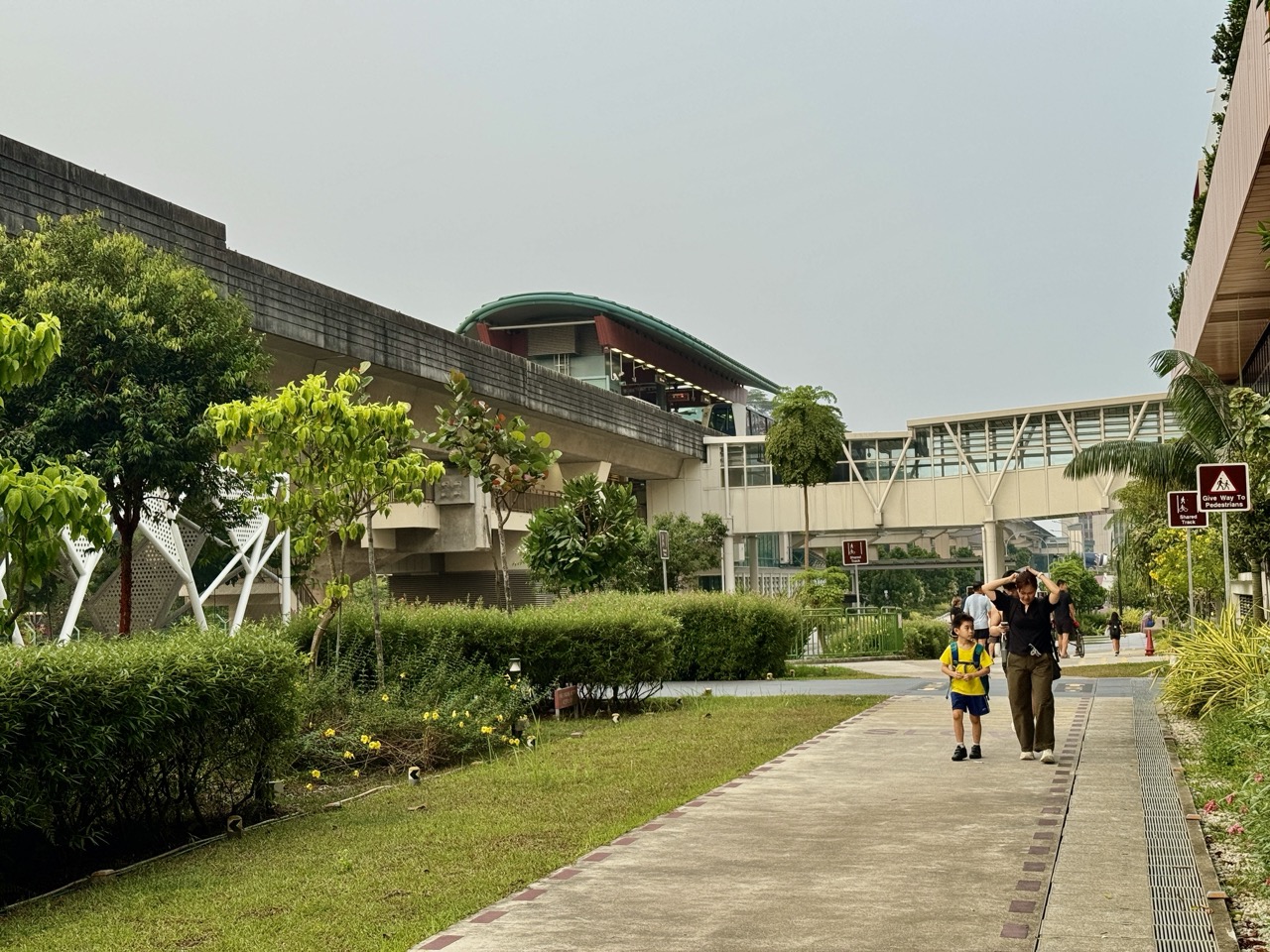
Getting to school in Punggol is a six-year family decision for Primary school and a four- or five-year routine for Secondary school. A school can look close on a map and still involve an awkward road crossing, LRT transfer or long afternoon pickup. Another school may be slightly farther away but sit directly on a familiar family route. This guide helps Punggol parents compare walking, LRT, public bus and school-bus options without pretending that one route works for every block.
The rule is simple: verify the exact journey from your actual home at the time your child will travel. Walking times, bus services, construction, school-bus operators and pickup points can change. This page maps the decision and links to the live school and transport owners; it does not freeze a 2026 route into a permanent instruction.
Four Ways Punggol Students Usually Reach School
| Mode | Best when… | Check carefully |
|---|---|---|
| Walk | The school is genuinely close and the route is simple. | Road crossings, sheltered paths, morning heat/rain, child’s age and whether the route feels safe independently. |
| LRT / MRT | Home and school sit near the same loop or a simple interchange. | Peak crowding, transfers, walking at both ends and whether the child can manage the route independently. |
| Public bus | A direct bus replaces a less convenient LRT route. | Live service changes, peak traffic, stop location and travel-time variability. |
| School bus | Younger children need door/cluster pickup or both parents have difficult work schedules. | Current operator, pickup point, fee, ride duration, waiting time and availability for your block. |
Use the Punggol LRT as a Network, Not a Rule
Punggol’s LRT has East and West loops feeding Punggol MRT, while Punggol Coast MRT now serves the northern end of town. The useful question is not simply “Which station is nearest?” but “How many transitions does the school journey require?”
Use the live Punggol LRT Guide for station codes, East/West Loop orientation and neighbourhood context. For the newer northern transport node, use the Punggol Coast MRT Station Guide.
Primary Schools: Start With the School Address
The 11 actual primary schools in Punggol are distributed across several neighbourhood clusters. The address is the stable starting point; the best live route should then be checked from your block.
| Primary school | Address / local cluster | Current parent guide |
|---|---|---|
| Edgefield Primary | 41 Edgefield Plains | Guide |
| Greendale Primary | 50 Edgedale Plains | Guide |
| Horizon Primary | 61 Edgedale Plains | Guide |
| Mee Toh School | 21 Edgedale Plains | Guide |
| Oasis Primary | 71 Edgefield Plains | Guide |
| Punggol Cove Primary | 52 Sumang Walk | Guide |
| Punggol Green Primary | 98 Punggol Walk | Guide |
| Punggol View Primary | 9 Punggol Place | Guide |
| Waterway Primary | 70 Punggol Drive | Guide |
| Northshore Primary | 30 Northshore Drive | Guide |
| Valour Primary | 49 Punggol Central | Guide |
Important name warning: Punggol Primary School is not one of these 11 Punggol-town schools. Despite the name, its current official address is at 61 Hougang Avenue 8. Do not confuse “Punggol Primary School” with “a primary school in Punggol”.
Secondary Schools: Four Local Destinations
| Secondary school | Address | Current parent guide |
|---|---|---|
| Edgefield Secondary | 36 Punggol Field | Guide |
| Greendale Secondary | 51 Edgedale Plains | Guide |
| Punggol Secondary | 51 Edgefield Plains | Guide |
| Yusof Ishak Secondary | 8 Sumang Walk | Guide |
Edgefield Secondary’s official site currently lists Punggol MRT as its nearest MRT station. Yusof Ishak Secondary lists both Soo Teck and Sumang LRT stations. For the other schools, verify the live route from your block rather than assuming a single station is universally best.
Walking: Test the Route, Not the Distance
A school 700 metres away can be easier or harder than one 900 metres away depending on crossings, sheltered walkways, construction and the child’s age. Before registration or Secondary 1 posting decisions, walk the route at approximately the time your child will travel.
- How many major road crossings are there?
- Is most of the route sheltered?
- Where does crowding occur near the school gate?
- Can the child carry the school bag comfortably?
- What happens during heavy rain?
- Would you be comfortable with this route when the child begins travelling independently?
School Bus: Verify the Current Operator Directly
School-bus arrangements are not permanent infrastructure. Operators, routes, pickup clusters, fees and capacity can change. Some school websites publish current bus-provider information; others ask families to contact the school or operator.
Before committing, ask:
- Does the bus serve our exact block or only a pickup cluster?
- What is the morning pickup time?
- How long is the full ride?
- What is the afternoon arrangement on CCA days?
- What happens when school ends early?
- Is there a separate arrangement for after-school programmes?
- What notice is needed to change or cancel?
A “school bus” can be convenient while still creating a very early morning if your block is near the start of the route. Compare the full journey, not just whether transport exists.
LRT: Count Transfers and Waiting, Not Just Stops
One direct LRT ride plus a short walk can be easier than a theoretically shorter journey involving a loop change or an awkward interchange. For younger children, route simplicity matters because every transition adds a decision point.
When testing the LRT route:
- travel at school peak time;
- check the correct East/West Loop direction;
- include the walk from station to gate;
- consider whether a direct bus is simpler;
- check the return journey after CCA, not only morning arrival.
Primary 1: The Journey Is Part of School Fit
Home-school distance already matters formally within P1 registration balloting rules. It also matters operationally after admission. A six-year journey that is easy for the family can return significant time for breakfast, sleep, reading, play and after-school recovery.
Use Primary 1 Registration in Punggol for the admission side and this page for the practical route side.
Secondary 1: A Longer Commute Can Still Be Rational
Secondary students can travel more independently and may reasonably choose a school with a somewhat longer journey because of programme fit, subject combinations, CCA or school preference. The cost still exists. Forty extra minutes a day becomes more than three hours a week.
Use Secondary Schools in Punggol Compared and then test the actual journey for the schools on your shortlist.
The Family Capacity Calculation
The school route affects more than transport. It changes the entire afternoon.
| Route effect | Possible downstream consequence |
|---|---|
| Earlier morning departure | Less sleep or more rushed breakfast. |
| Longer afternoon journey | Less recovery before homework. |
| Complex CCA return route | Later dinner and reduced study capacity. |
| Easy walk / direct transport | More time available for independent reading, play or rest. |
This is why “nearest school” and “best school” are not entirely separate questions. Travel changes what the child has left for the rest of the day.
Frequently Asked Questions
Which Punggol school is nearest to an LRT station?
Several are close to LRT stations, but the useful answer depends on your starting block and the walking segment. Use the live Punggol LRT guide and the individual school address, then test the route.
Do all Punggol schools have school buses?
Transport arrangements vary by school and year. Confirm the current operator, route and availability directly with the school or provider.
Is Punggol Primary School in Punggol?
No. Its current official address is in Hougang. Punggol town currently has 11 other primary schools listed in our local comparison.
Should school travel affect Secondary 1 choices?
Yes, but it should be considered alongside programme fit, subject offerings, CCA and the student’s preference. The daily journey is repeated hundreds of times each year.
Useful Punggol Transport and School Routes
- Punggol LRT Guide
- Punggol Coast MRT Station Guide
- All 11 Primary Schools in Punggol
- Secondary Schools in Punggol Compared
- The Complete Punggol Guide
Checked 26 September 2026. Addresses are taken from current school information. Transport services, construction, school-bus vendors and exact walking conditions can change; verify the live journey before relying on it.
Getting to Punggol Schools: Family Route Operating System
This Future Build section deepens the existing canonical owner instead of creating a competing URL. The reader job is school travel: convert current official information into a workable sequence for walking, LRT, bus, school-bus, parent pickup, rain, waiting and last-mile movement across Punggol. transport operators, schools and official agencies remain the authorities for current services, road conditions and school arrangements.
The local layer owns implementation—what to verify, what to decide, what to prepare, who owns the next action, what travel costs and how the family will know whether the plan works. The intended return is a route the student and family can actually execute on ordinary and disrupted days.
Official Rule vs Family Action
The practical move is to identify the current authority for the rule, then translate only the family action that follows. This prevents a local guide from becoming a stale substitute for MOE, SEAB, a school or a transport operator. The family should always know which part must be rechecked externally and which part it owns internally.
Use the smallest action that resolves the uncertainty. Separate what is fixed by an authority from what the family can change. Then test the family assumption against real timing, current evidence and the learner’s actual capacity rather than adding more administration.
A useful result is visible behaviour: the form is submitted, the route works, the deadline is owned, the child arrives prepared, the week remains sustainable, or the family can explain why its decision still makes sense after conditions change.
One Current Version
The practical move is to retire old screenshots, remembered dates and superseded instructions. Multiple versions create false certainty. One current instruction, one family owner and one next action are usually enough.
Use the smallest action that resolves the uncertainty. Separate what is fixed by an authority from what the family can change. Then test the family assumption against real timing, current evidence and the learner’s actual capacity rather than adding more administration.
A useful result is visible behaviour: the form is submitted, the route works, the deadline is owned, the child arrives prepared, the week remains sustainable, or the family can explain why its decision still makes sense after conditions change.
Backward Planning
The practical move is to start at the fixed deadline or reporting time and work backward through every dependency. Backward planning exposes documents, conversations, travel, materials and decision points that are easy to miss when planning forward from a vague intention.
Use the smallest action that resolves the uncertainty. Separate what is fixed by an authority from what the family can change. Then test the family assumption against real timing, current evidence and the learner’s actual capacity rather than adding more administration.
A useful result is visible behaviour: the form is submitted, the route works, the deadline is owned, the child arrives prepared, the week remains sustainable, or the family can explain why its decision still makes sense after conditions change.
Door-to-Door Reality
The practical move is to include walking, waiting, transfers, shelter gaps and last-mile movement. Punggol education decisions are lived through routes. A nominally nearby school or activity can still impose a large repeated time cost.
Use the smallest action that resolves the uncertainty. Separate what is fixed by an authority from what the family can change. Then test the family assumption against real timing, current evidence and the learner’s actual capacity rather than adding more administration.
A useful result is visible behaviour: the form is submitted, the route works, the deadline is owned, the child arrives prepared, the week remains sustainable, or the family can explain why its decision still makes sense after conditions change.
Ordinary-Tuesday Test
The practical move is to run the plan against a normal work-and-school day. A plan should survive CCA, sibling logistics, meals and homework, not only an open house or holiday rehearsal.
Use the smallest action that resolves the uncertainty. Separate what is fixed by an authority from what the family can change. Then test the family assumption against real timing, current evidence and the learner’s actual capacity rather than adding more administration.
A useful result is visible behaviour: the form is submitted, the route works, the deadline is owned, the child arrives prepared, the week remains sustainable, or the family can explain why its decision still makes sense after conditions change.
Sleep Protection
The practical move is to refuse to finance every ambition by reducing sleep. Learning capacity is part of implementation. A schedule that chronically exhausts the child is not a successful education plan even if every activity fits on paper.
Use the smallest action that resolves the uncertainty. Separate what is fixed by an authority from what the family can change. Then test the family assumption against real timing, current evidence and the learner’s actual capacity rather than adding more administration.
A useful result is visible behaviour: the form is submitted, the route works, the deadline is owned, the child arrives prepared, the week remains sustainable, or the family can explain why its decision still makes sense after conditions change.
Learner Evidence
The practical move is to include the child’s actual work, independence and support needs. School choice, tuition and timetable decisions should be tied to demonstrated capability rather than adult status signals or one anecdote.
Use the smallest action that resolves the uncertainty. Separate what is fixed by an authority from what the family can change. Then test the family assumption against real timing, current evidence and the learner’s actual capacity rather than adding more administration.
A useful result is visible behaviour: the form is submitted, the route works, the deadline is owned, the child arrives prepared, the week remains sustainable, or the family can explain why its decision still makes sense after conditions change.
Preference vs Constraint
The practical move is to write down what the family prefers and what the system actually requires. Eligibility, distance, route, timetable and family care obligations can constrain a preference. Naming the difference improves judgment.
Use the smallest action that resolves the uncertainty. Separate what is fixed by an authority from what the family can change. Then test the family assumption against real timing, current evidence and the learner’s actual capacity rather than adding more administration.
A useful result is visible behaviour: the form is submitted, the route works, the deadline is owned, the child arrives prepared, the week remains sustainable, or the family can explain why its decision still makes sense after conditions change.
Scenario Planning
The practical move is to test normal, busy and disrupted cases. Rain, late CCA, a missed connection or a parent work change should not force the family to invent the whole system from zero.
Use the smallest action that resolves the uncertainty. Separate what is fixed by an authority from what the family can change. Then test the family assumption against real timing, current evidence and the learner’s actual capacity rather than adding more administration.
A useful result is visible behaviour: the form is submitted, the route works, the deadline is owned, the child arrives prepared, the week remains sustainable, or the family can explain why its decision still makes sense after conditions change.
Decision Ledger
The practical move is to keep only the facts and trade-offs that changed the decision. A short ledger prevents endless reopening of settled questions when new anecdotes appear.
Use the smallest action that resolves the uncertainty. Separate what is fixed by an authority from what the family can change. Then test the family assumption against real timing, current evidence and the learner’s actual capacity rather than adding more administration.
A useful result is visible behaviour: the form is submitted, the route works, the deadline is owned, the child arrives prepared, the week remains sustainable, or the family can explain why its decision still makes sense after conditions change.
Historical Data Boundary
The practical move is to use past demand or outcomes as context rather than a future promise. Previous patterns can inform planning but cannot guarantee a later registration, posting or demand outcome.
Use the smallest action that resolves the uncertainty. Separate what is fixed by an authority from what the family can change. Then test the family assumption against real timing, current evidence and the learner’s actual capacity rather than adding more administration.
A useful result is visible behaviour: the form is submitted, the route works, the deadline is owned, the child arrives prepared, the week remains sustainable, or the family can explain why its decision still makes sense after conditions change.
Multi-Dimensional Fit
The practical move is to consider route, programme, subject needs, CCA, independence and family sustainability together. No single metric captures family fit. Optimising one dimension can create costs elsewhere.
Use the smallest action that resolves the uncertainty. Separate what is fixed by an authority from what the family can change. Then test the family assumption against real timing, current evidence and the learner’s actual capacity rather than adding more administration.
A useful result is visible behaviour: the form is submitted, the route works, the deadline is owned, the child arrives prepared, the week remains sustainable, or the family can explain why its decision still makes sense after conditions change.
Adult Ownership
The practical move is to assign forms, travel, communication and deadlines to a named adult where adult action is required. Everyone knowing about an event is not the same as someone owning the action.
Use the smallest action that resolves the uncertainty. Separate what is fixed by an authority from what the family can change. Then test the family assumption against real timing, current evidence and the learner’s actual capacity rather than adding more administration.
A useful result is visible behaviour: the form is submitted, the route works, the deadline is owned, the child arrives prepared, the week remains sustainable, or the family can explain why its decision still makes sense after conditions change.
Student Ownership
The practical move is to give the learner age-appropriate responsibility for materials, route knowledge and schedule awareness. The family should not transfer formal adult duties to a child, but it should use transitions to build independence.
Use the smallest action that resolves the uncertainty. Separate what is fixed by an authority from what the family can change. Then test the family assumption against real timing, current evidence and the learner’s actual capacity rather than adding more administration.
A useful result is visible behaviour: the form is submitted, the route works, the deadline is owned, the child arrives prepared, the week remains sustainable, or the family can explain why its decision still makes sense after conditions change.
Primary Independence
The practical move is to teach packing, time sense, help-seeking and basic route awareness. These capabilities reduce friction later and allow adult support to retreat safely.
Use the smallest action that resolves the uncertainty. Separate what is fixed by an authority from what the family can change. Then test the family assumption against real timing, current evidence and the learner’s actual capacity rather than adding more administration.
A useful result is visible behaviour: the form is submitted, the route works, the deadline is owned, the child arrives prepared, the week remains sustainable, or the family can explain why its decision still makes sense after conditions change.
Secondary Independence
The practical move is to transfer more planning, travel and subject responsibility to the teenager. Secondary school multiplies subjects and commitments; the student needs an internal operating system rather than permanent parent prompting.
Use the smallest action that resolves the uncertainty. Separate what is fixed by an authority from what the family can change. Then test the family assumption against real timing, current evidence and the learner’s actual capacity rather than adding more administration.
A useful result is visible behaviour: the form is submitted, the route works, the deadline is owned, the child arrives prepared, the week remains sustainable, or the family can explain why its decision still makes sense after conditions change.
CCA Dependency
The practical move is to show CCA as a real calendar and travel dependency. CCA changes dismissal, food, transport, homework and sleep. It cannot remain an invisible footnote in the weekly plan.
Use the smallest action that resolves the uncertainty. Separate what is fixed by an authority from what the family can change. Then test the family assumption against real timing, current evidence and the learner’s actual capacity rather than adding more administration.
A useful result is visible behaviour: the form is submitted, the route works, the deadline is owned, the child arrives prepared, the week remains sustainable, or the family can explain why its decision still makes sense after conditions change.
Tuition Layer
The practical move is to use tuition only for a defined learning job that fits the actual week. A strong tutor cannot compensate indefinitely for an impossible schedule or a diagnosis that was never made.
Use the smallest action that resolves the uncertainty. Separate what is fixed by an authority from what the family can change. Then test the family assumption against real timing, current evidence and the learner’s actual capacity rather than adding more administration.
A useful result is visible behaviour: the form is submitted, the route works, the deadline is owned, the child arrives prepared, the week remains sustainable, or the family can explain why its decision still makes sense after conditions change.
Multi-Adult Handover
The practical move is to compress what grandparents, student care or another parent need to know. Several adults can strengthen continuity when each knows the next action and does not need the child to carry every adult message.
Use the smallest action that resolves the uncertainty. Separate what is fixed by an authority from what the family can change. Then test the family assumption against real timing, current evidence and the learner’s actual capacity rather than adding more administration.
A useful result is visible behaviour: the form is submitted, the route works, the deadline is owned, the child arrives prepared, the week remains sustainable, or the family can explain why its decision still makes sense after conditions change.
Digital Readiness
The practical move is to prepare files, logins, devices, printing and submission steps early. Administrative digital failure should not be mistaken for academic inability.
Use the smallest action that resolves the uncertainty. Separate what is fixed by an authority from what the family can change. Then test the family assumption against real timing, current evidence and the learner’s actual capacity rather than adding more administration.
A useful result is visible behaviour: the form is submitted, the route works, the deadline is owned, the child arrives prepared, the week remains sustainable, or the family can explain why its decision still makes sense after conditions change.
Document Readiness
The practical move is to prepare only the documents or items actually required by current instructions. Checklists should reduce uncertainty, not invent requirements.
Use the smallest action that resolves the uncertainty. Separate what is fixed by an authority from what the family can change. Then test the family assumption against real timing, current evidence and the learner’s actual capacity rather than adding more administration.
A useful result is visible behaviour: the form is submitted, the route works, the deadline is owned, the child arrives prepared, the week remains sustainable, or the family can explain why its decision still makes sense after conditions change.
Route Rehearsal
The practical move is to test unfamiliar journeys where practical before the high-stakes day. A rehearsal reveals entrances, transfers, walking time and shelter assumptions that a map may hide.
Use the smallest action that resolves the uncertainty. Separate what is fixed by an authority from what the family can change. Then test the family assumption against real timing, current evidence and the learner’s actual capacity rather than adding more administration.
A useful result is visible behaviour: the form is submitted, the route works, the deadline is owned, the child arrives prepared, the week remains sustainable, or the family can explain why its decision still makes sense after conditions change.
Wet-Weather Backup
The practical move is to decide how rain changes the route or margin. A plan that succeeds only in perfect weather has no resilience.
Use the smallest action that resolves the uncertainty. Separate what is fixed by an authority from what the family can change. Then test the family assumption against real timing, current evidence and the learner’s actual capacity rather than adding more administration.
A useful result is visible behaviour: the form is submitted, the route works, the deadline is owned, the child arrives prepared, the week remains sustainable, or the family can explain why its decision still makes sense after conditions change.
Arrival Buffer
The practical move is to plan from a sensible arrival target rather than the latest possible moment. A modest buffer absorbs ordinary variation and protects the child from unnecessary urgency.
Use the smallest action that resolves the uncertainty. Separate what is fixed by an authority from what the family can change. Then test the family assumption against real timing, current evidence and the learner’s actual capacity rather than adding more administration.
A useful result is visible behaviour: the form is submitted, the route works, the deadline is owned, the child arrives prepared, the week remains sustainable, or the family can explain why its decision still makes sense after conditions change.
Calendar Layers
The practical move is to separate fixed official dates, family commitments, preparation blocks and optional activities. Layering makes the calendar readable enough to support decisions.
Use the smallest action that resolves the uncertainty. Separate what is fixed by an authority from what the family can change. Then test the family assumption against real timing, current evidence and the learner’s actual capacity rather than adding more administration.
A useful result is visible behaviour: the form is submitted, the route works, the deadline is owned, the child arrives prepared, the week remains sustainable, or the family can explain why its decision still makes sense after conditions change.
Term Start
The practical move is to stabilise new timetables and routines before escalating academic intensity. The first weeks often reveal operational problems that look like subject problems.
Use the smallest action that resolves the uncertainty. Separate what is fixed by an authority from what the family can change. Then test the family assumption against real timing, current evidence and the learner’s actual capacity rather than adding more administration.
A useful result is visible behaviour: the form is submitted, the route works, the deadline is owned, the child arrives prepared, the week remains sustainable, or the family can explain why its decision still makes sense after conditions change.
Mid-Term Review
The practical move is to inspect recurring friction while there is still time to repair it. Small changes made early are cheaper than a full end-of-term crisis response.
Use the smallest action that resolves the uncertainty. Separate what is fixed by an authority from what the family can change. Then test the family assumption against real timing, current evidence and the learner’s actual capacity rather than adding more administration.
A useful result is visible behaviour: the form is submitted, the route works, the deadline is owned, the child arrives prepared, the week remains sustainable, or the family can explain why its decision still makes sense after conditions change.
Assessment Runway
The practical move is to distribute retrieval and practice before the final week. A visible runway reduces last-minute volume and protects sleep.
Use the smallest action that resolves the uncertainty. Separate what is fixed by an authority from what the family can change. Then test the family assumption against real timing, current evidence and the learner’s actual capacity rather than adding more administration.
A useful result is visible behaviour: the form is submitted, the route works, the deadline is owned, the child arrives prepared, the week remains sustainable, or the family can explain why its decision still makes sense after conditions change.
Exam Morning
The practical move is to close materials, route and reporting decisions before the child wakes where possible. The final morning should preserve attention for the paper.
Use the smallest action that resolves the uncertainty. Separate what is fixed by an authority from what the family can change. Then test the family assumption against real timing, current evidence and the learner’s actual capacity rather than adding more administration.
A useful result is visible behaviour: the form is submitted, the route works, the deadline is owned, the child arrives prepared, the week remains sustainable, or the family can explain why its decision still makes sense after conditions change.
Results Day
The practical move is to read the score and inspect the mechanism before changing the plan. A result is evidence, not a complete diagnosis.
Use the smallest action that resolves the uncertainty. Separate what is fixed by an authority from what the family can change. Then test the family assumption against real timing, current evidence and the learner’s actual capacity rather than adding more administration.
A useful result is visible behaviour: the form is submitted, the route works, the deadline is owned, the child arrives prepared, the week remains sustainable, or the family can explain why its decision still makes sense after conditions change.
Holiday Reset
The practical move is to use breaks for recovery, selected repair and system maintenance. Holidays do not need to become automatic acceleration blocks.
Use the smallest action that resolves the uncertainty. Separate what is fixed by an authority from what the family can change. Then test the family assumption against real timing, current evidence and the learner’s actual capacity rather than adding more administration.
A useful result is visible behaviour: the form is submitted, the route works, the deadline is owned, the child arrives prepared, the week remains sustainable, or the family can explain why its decision still makes sense after conditions change.
Editorial Review Test
The practical move is to remove information or activity that does not change an action. A good family system becomes quieter as it improves.
Use the smallest action that resolves the uncertainty. Separate what is fixed by an authority from what the family can change. Then test the family assumption against real timing, current evidence and the learner’s actual capacity rather than adding more administration.
A useful result is visible behaviour: the form is submitted, the route works, the deadline is owned, the child arrives prepared, the week remains sustainable, or the family can explain why its decision still makes sense after conditions change.
Evidence Review Test
The practical move is to find the clue that changes the interpretation. Changing one condition and observing the result is stronger than guessing about motive.
Use the smallest action that resolves the uncertainty. Separate what is fixed by an authority from what the family can change. Then test the family assumption against real timing, current evidence and the learner’s actual capacity rather than adding more administration.
A useful result is visible behaviour: the form is submitted, the route works, the deadline is owned, the child arrives prepared, the week remains sustainable, or the family can explain why its decision still makes sense after conditions change.
Cross-Disciplinary Review Test
The practical move is to route national rules, school facts, subject depth and local logistics to the correct owner. Owner discipline keeps the Punggol layer useful and prevents cannibalisation.
Use the smallest action that resolves the uncertainty. Separate what is fixed by an authority from what the family can change. Then test the family assumption against real timing, current evidence and the learner’s actual capacity rather than adding more administration.
A useful result is visible behaviour: the form is submitted, the route works, the deadline is owned, the child arrives prepared, the week remains sustainable, or the family can explain why its decision still makes sense after conditions change.
Review and Exit
The practical move is to define when temporary support can be reduced or retired. Good systems contain their own retirement path.
Use the smallest action that resolves the uncertainty. Separate what is fixed by an authority from what the family can change. Then test the family assumption against real timing, current evidence and the learner’s actual capacity rather than adding more administration.
A useful result is visible behaviour: the form is submitted, the route works, the deadline is owned, the child arrives prepared, the week remains sustainable, or the family can explain why its decision still makes sense after conditions change.
A Family Meeting Should End With an Owner and a Date
Do not finish a discussion with “we will think about it.” State the next action, who owns it and when it must be checked. This converts concern into an operating state and stops the same conversation from repeating without progress.
Editorial discipline applies: keep the information that changes the decision and remove what merely makes the process look thorough. Evidence review applies: look for the clue that would make the family revise its interpretation. Source routing applies: send each rule, school fact, subject question and local implementation problem to the correct owner.
Use a One-Page Working Sheet
A single page can hold the official source, the current family decision, important dates, route assumptions, unresolved questions and the next review. If the process needs several chats and scattered screenshots to remain understandable, compress it.
Editorial discipline applies: keep the information that changes the decision and remove what merely makes the process look thorough. Evidence review applies: look for the clue that would make the family revise its interpretation. Source routing applies: send each rule, school fact, subject question and local implementation problem to the correct owner.
Do Not Optimise for Other Families
Another family may value a different commute, programme, CCA or support level. Their decision is evidence about their constraints, not a prescription for yours. Compare mechanisms and trade-offs rather than copying outcomes.
Editorial discipline applies: keep the information that changes the decision and remove what merely makes the process look thorough. Evidence review applies: look for the clue that would make the family revise its interpretation. Source routing applies: send each rule, school fact, subject question and local implementation problem to the correct owner.
The Child’s Voice Is Evidence, Not the Whole Decision
Ask what the learner notices, fears, prefers and finds difficult. Then compare that account with work, route and current official constraints. Agency is strongest when the child is heard without being asked to carry an adult decision alone.
Editorial discipline applies: keep the information that changes the decision and remove what merely makes the process look thorough. Evidence review applies: look for the clue that would make the family revise its interpretation. Source routing applies: send each rule, school fact, subject question and local implementation problem to the correct owner.
Recheck After the Transition
A plan that looked sensible before registration, posting, term start or timetable release should be tested again after real conditions appear. The purpose is not to prove the family was right; it is to update the system when reality supplies better evidence.
Editorial discipline applies: keep the information that changes the decision and remove what merely makes the process look thorough. Evidence review applies: look for the clue that would make the family revise its interpretation. Source routing applies: send each rule, school fact, subject question and local implementation problem to the correct owner.
Build a Stop-Doing List
Every new commitment should make the family ask what will be reduced, moved or removed. Calendars fail when additions have no corresponding capacity decision. A stop-doing list makes trade-offs explicit.
Editorial discipline applies: keep the information that changes the decision and remove what merely makes the process look thorough. Evidence review applies: look for the clue that would make the family revise its interpretation. Source routing applies: send each rule, school fact, subject question and local implementation problem to the correct owner.
Use Friction as a Sensor
Repeated lateness, forgotten items, rushed meals and bedtime spillover are not merely annoyances. They are evidence that a transition or load assumption may be wrong. Repair the repeated friction before adding more reminders.
Editorial discipline applies: keep the information that changes the decision and remove what merely makes the process look thorough. Evidence review applies: look for the clue that would make the family revise its interpretation. Source routing applies: send each rule, school fact, subject question and local implementation problem to the correct owner.
Review the Cost After Four Weeks
Once the new route or calendar has operated for several weeks, compare expected and actual travel, fatigue, homework time and adult coordination. A plan can be revised without treating revision as failure.
Editorial discipline applies: keep the information that changes the decision and remove what merely makes the process look thorough. Evidence review applies: look for the clue that would make the family revise its interpretation. Source routing applies: send each rule, school fact, subject question and local implementation problem to the correct owner.
The Final Implementation Principle
Use official sources for official rules. Use school sources for school facts. Use the Punggol layer for route, timing, family capacity and local handoffs. Use the learner’s own evidence for learning decisions.
Verify. Decide. Prepare. Rehearse. Execute. Review. Then retire the support that is no longer needed.


