
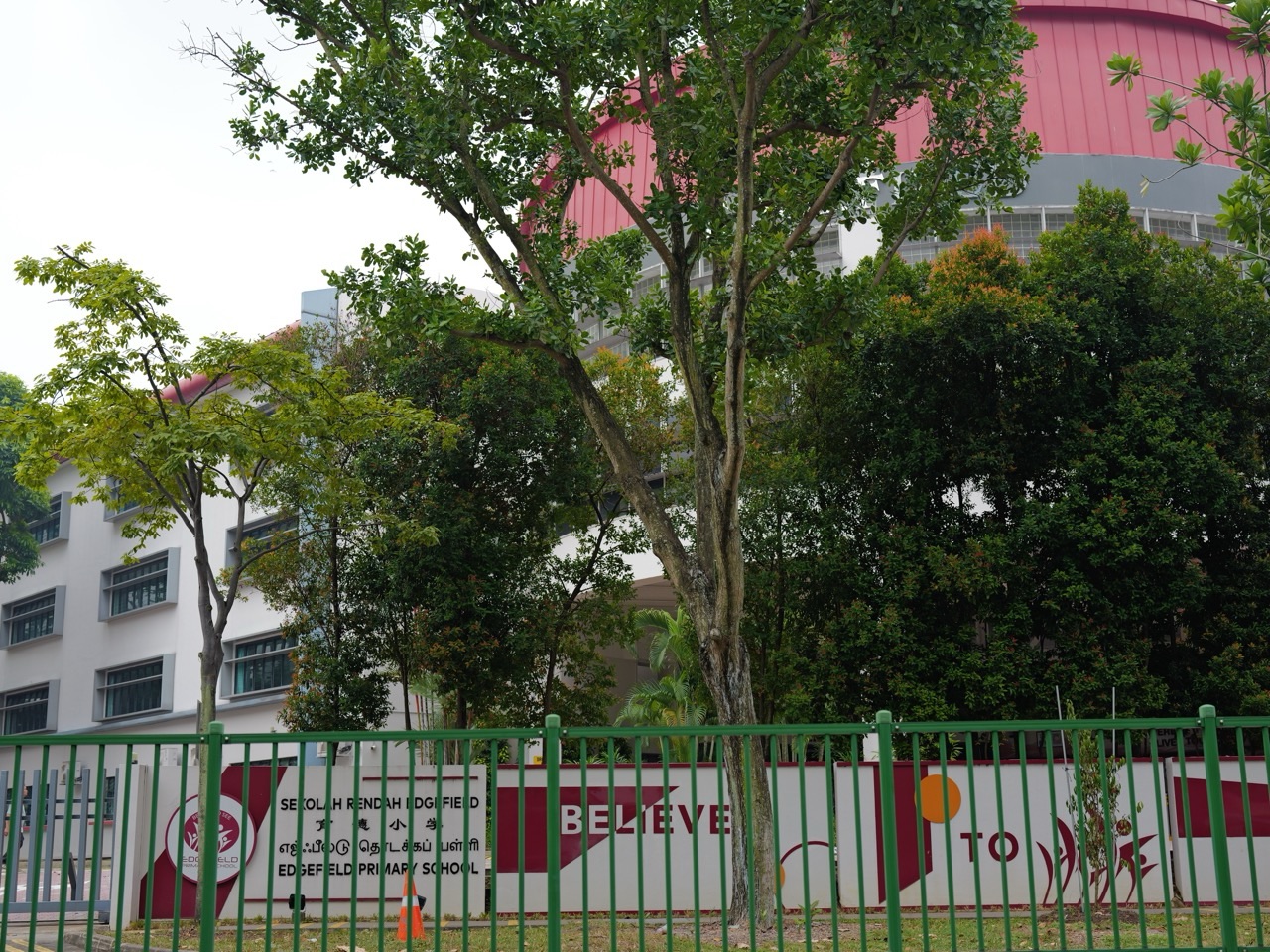
The short answer: Edgefield Primary School is a co-educational government primary school at 41 Edgefield Plains, Singapore 828869. Opened in 2002, it was the very first primary school in the Punggol 21 estate. It runs an Applied Learning Programme in environmental science and sustainability and a Learning for Life Programme in the performing arts. In the 2026 Primary 1 registration exercise it did not ballot in Phase 2C, with 39 applicants for 141 places.
If you are standing at the edge of the P1 decision, you already know the feeling. The forms are simple. The choice is not. You are picking the gate your child will walk through roughly 1,200 mornings in a row, and you want to get it right without drowning in forum threads.
This guide is written for exactly that moment. It tells you what Edgefield is, what it offers, how hard it is to get into, and the honest questions worth asking before you put it on your form.
Edgefield Primary School: Quick Facts
| Address | 41 Edgefield Plains, Singapore 828869 |
| School type | Government, co-educational |
| Session | Single session |
| Opened | 2002 (the first primary school in the Punggol 21 estate) |
| Applied Learning Programme (ALP) | STEM: Environmental Science and Sustainability |
| Learning for Life Programme (LLP) | Music and Performing Arts: “Artful Living” |
| Mother Tongue | Chinese, Malay and Tamil, including Higher Mother Tongue for all three |
| CCAs | 11 (full list below) |
| 2026 P1 Phase 2C | 39 applicants for 141 places. No ballot. |
| Phone | 6312 6091 |
| edgefield_ps@moe.edu.sg | |
| Website | edgefieldpri.moe.edu.sg |
A School That Grew Up With Punggol
When Edgefield opened its doors in 2002, much of today’s Punggol did not exist yet. There was no Waterway Point, no Punggol Waterway Park and no Punggol Coast MRT. The school took in its first batch of pupils under its founding principal, Mrs Sabrina James, and it has since grown to more than 1,500 students.
That history matters for a practical reason. Edgefield sits among the older, settled blocks of the Punggol Field and Edgefield area, not in the newest construction zones. For many families that means mature trees, established walking routes and neighbours who have lived here for two decades. The school’s vision, “Lives empowered, Lives touched”, fits a place that has quietly served several generations of Punggol children.
What Your Child Will Actually Do Here: ALP and LLP
Every MOE primary school teaches the same national syllabus. What makes one school feel different from the next is mostly its two signature programmes.
ALP: Environmental Science and Sustainability
Edgefield’s Applied Learning Programme sits in the STEM domain, with a focus on environmental science and sustainability. In plain terms, children learn science by applying it to real questions about the world around them: resources, waste, living things and how we look after them.
It is a natural fit for a town built around a waterway, a wetland and a coastline. If your child is the one who stops to watch the monitor lizards along the park connector or asks where the recycling goes, this programme speaks their language.
LLP: “Artful Living” Through the Performing Arts
The Learning for Life Programme is in Music and Performing Arts, titled “Artful Living: Developing Confidence and Nurturing Talents through Performing Arts”. The school has a long tradition here: its earlier LLP used dancesport, basic ballroom dancing, to build graciousness and teamwork.
For a shy child, this kind of programme can be quietly powerful. Standing on a stage in front of classmates at age nine is often where confidence starts to take root, long before any exam asks for it.
All 11 CCAs at Edgefield Primary
Co-curricular activities usually begin in Primary 3. Here is the full list from MOE SchoolFinder, grouped so you can scan it quickly.
| Category | CCA | Open to |
|---|---|---|
| Sports | Artistic Gymnastics | Girls and boys |
| Sports | Basketball | Boys |
| Sports | Netball | Girls |
| Sports | Track and Field | Girls and boys |
| Performing arts | Choir | Boys |
| Performing arts | Malay Dance | Girls and boys |
| Performing arts | Modern Dance | Girls and boys |
| Clubs | Art and Crafts | Girls and boys |
| Clubs | Infocomm Technology (Computing) | Girls and boys |
| Clubs | Physical Science | Girls and boys |
| Uniformed group | Scouts | Girls and boys |
A detail worth noticing: Choir and Basketball are listed for boys only, and Netball for girls only. If your daughter dreams of singing in a choir, or your son wants to play netball, ask the school during your visit whether that is likely to change.
Subjects and Mother Tongue Options
Edgefield offers all three official Mother Tongue languages, Chinese, Malay and Tamil, and Higher Mother Tongue in all three. Not every school does. If your child is strong in Tamil or Malay and you want them stretched, this is a genuine point in Edgefield’s favour.
At the other end, the school offers Foundation levels in English, Mathematics, Science, Chinese and Malay for upper primary pupils who need more time with the basics. Art, Music, Physical Education and Social Studies complete the timetable.
Support for Children With Special Educational Needs
According to MOE SchoolFinder, Edgefield provides:
- Barrier-free accessibility across the campus.
- Special Educational Needs Officers who support pupils with mild special needs in school.
- P1 TRANSIT (Social and Behavioural Needs), a programme that helps children with social or behavioural needs settle into Primary 1.
If your child has a diagnosis, or you simply suspect the jump to Primary 1 will be hard for them, the P1 TRANSIT programme is worth a direct conversation with the school. It is not offered everywhere.
How Hard Is It to Get Into Edgefield Primary?
Here is the good news for families nearby. In the 2026 P1 registration exercise, Edgefield had 39 applicants for 141 places in Phase 2C, the phase most families without a school connection register in. There was no ballot, and plenty of room to spare.
Compare that with Horizon (88 applicants for 46 places) or Mee Toh (155 for 137), both of which balloted. For many Punggol families, Edgefield is a school you can choose with confidence rather than hope.
One caution: MOE announced in April 2026 that it will gradually reduce P1 intakes at most schools as birth cohorts shrink. Fewer places can quickly eat into a comfortable margin, so check the live vacancy figures when registration opens. Our Primary 1 Registration in Punggol guide explains each phase and what to watch.
Is Edgefield the Right School for Your Child?
No school suits every child. Edgefield is likely to be a strong fit if:
- You live nearby in the Punggol Field or Edgefield area and want a short, safe daily walk.
- Your child loves nature, science or performing, which is where the ALP and LLP put their energy.
- You want Higher Malay or Higher Tamil as well as Higher Chinese available on site.
- You would rather not gamble on a ballot, based on recent Phase 2C demand.
Before you decide, walk the route from your block to the gate at about 7am on a school day. Notice the road crossings, the shade and how long it really takes with a six-year-old’s legs. That ten-minute walk will tell you more than any ranking table.
And remember: the habits your child builds at home, reading every night and talking about numbers at the dinner table, will shape the next six years more than the name on the school badge. Our guide to A Primary School Childhood in Punggol walks through those years, from Primary 1 to the PSLE.
Compare With Nearby Schools
Edgefield is one of 11 primary schools in Punggol. To see all of them side by side, with addresses and balloting results, read All 11 Primary Schools in Punggol. Individual guides to Greendale, Horizon and Mee Toh, its neighbours around the Edgedale and Edgefield plains, are coming next.
Frequently Asked Questions
Where is Edgefield Primary School?
At 41 Edgefield Plains, Singapore 828869, in Punggol. Use OneMap to check the distance from your home, which matters in P1 balloting.
Is Edgefield Primary School the oldest primary school in Punggol?
It was the first primary school to open in the Punggol 21 estate, in 2002. Mee Toh School has an older history, dating to 1954, but it only moved to Punggol in 2004.
Did Edgefield Primary ballot in 2026?
No. In Phase 2C of the 2026 P1 registration exercise, 39 children applied for 141 places, so there was no ballot.
What is Edgefield Primary’s ALP and LLP?
Its Applied Learning Programme is in STEM, focused on Environmental Science and Sustainability. Its Learning for Life Programme is in Music and Performing Arts, called “Artful Living”.
Is Edgefield Primary affiliated with a secondary school?
No. It is a government school with no secondary school affiliation, so pupils are posted to secondary school through the normal Secondary 1 posting exercise based on their PSLE results and choices.
Does Edgefield Primary have an MOE Kindergarten?
No MOE Kindergarten is listed on campus. Several other Punggol primary schools have one, including nearby Greendale Primary, Horizon Primary and Valour Primary.
Last updated: 25 September 2026. Sources: MOE SchoolFinder (programmes, CCAs, subjects, SEN support and contact details); Edgefield Primary School Virtual Heritage Gallery and MOE Heritage Centre school history (founding and history); 2026 P1 registration data compiled by SGSchoolKaki; MOE press release, 29 April 2026. Details can change, so always confirm with the school and MOE. Part of The Complete Punggol Guide by eduKatePunggol.
Edgefield Primary School: Family Learning Guide — From School Day to Independent Learner
The factual school profile above answers what Edgefield Primary School is. This section answers what a family does with that information. The Future Build job is to connect Punggol Field and Edgefield, sustainability learning and performing arts, the child’s actual schoolwork and the family’s real week without turning the school name into a diagnosis or a tuition sales claim.
Families around Punggol Field, Edgefield and Coral Edge should begin with actual evidence: school work, travel time, sleep, CCA, homework, the learner’s independence and the exact point where support is still required. The school is context. The child’s demonstrated capability is the decision signal.
Build the Real School Week
For a Edgefield Primary School family, the practical job is to map school, CCA, travel, meals, homework, reading, family work shifts and sleep before adding academic load. This matters because a Primary-school week is a connected system: school demands affect travel, travel affects energy, energy affects homework, homework affects sleep, and sleep changes what the child can do the next day. A local guide should therefore improve the family’s next decision rather than simply repeat school facts.
The useful action is to remove timetable collisions before interpreting tired performance as academic weakness. Keep the intervention as small as the evidence allows. Do not add a second curriculum at home when the problem is organisation; do not add more worksheets when the problem is concept; do not blame motivation when the timetable is impossible. Change the condition that actually carries the failure.
The evidence to look for is a week the child can actually sustain without borrowing from sleep. One good or bad day is not enough. Use fresh work, repeated observations and the child’s changing need for prompts. When support decreases while performance remains stable, something real has transferred into the learner.
Use the School as Context, Not Diagnosis
For a Edgefield Primary School family, the practical job is to separate the school name from the learner’s actual error pattern. This matters because a Primary-school week is a connected system: school demands affect travel, travel affects energy, energy affects homework, homework affects sleep, and sleep changes what the child can do the next day. A local guide should therefore improve the family’s next decision rather than simply repeat school facts.
The useful action is to bring marked work and fresh attempts instead of assuming pupils from one school need one standard intervention. Keep the intervention as small as the evidence allows. Do not add a second curriculum at home when the problem is organisation; do not add more worksheets when the problem is concept; do not blame motivation when the timetable is impossible. Change the condition that actually carries the failure.
The evidence to look for is a precise learning job that can be tested. One good or bad day is not enough. Use fresh work, repeated observations and the child’s changing need for prompts. When support decreases while performance remains stable, something real has transferred into the learner.
Home–School Handover
For a Edgefield Primary School family, the practical job is to make open tasks, completed tasks, submissions and tomorrow’s materials visible. This matters because a Primary-school week is a connected system: school demands affect travel, travel affects energy, energy affects homework, homework affects sleep, and sleep changes what the child can do the next day. A local guide should therefore improve the family’s next decision rather than simply repeat school facts.
The useful action is to use a short daily handover and teach the child the difference between completed, submitted and checked. Keep the intervention as small as the evidence allows. Do not add a second curriculum at home when the problem is organisation; do not add more worksheets when the problem is concept; do not blame motivation when the timetable is impossible. Change the condition that actually carries the failure.
The evidence to look for is fewer lost tasks and fewer repeated adult questions. One good or bad day is not enough. Use fresh work, repeated observations and the child’s changing need for prompts. When support decreases while performance remains stable, something real has transferred into the learner.
The School-Bag Reset
For a Edgefield Primary School family, the practical job is to treat books, papers, devices and chargers as learning infrastructure. This matters because a Primary-school week is a connected system: school demands affect travel, travel affects energy, energy affects homework, homework affects sleep, and sleep changes what the child can do the next day. A local guide should therefore improve the family’s next decision rather than simply repeat school facts.
The useful action is to give important items fixed homes and run one brief reset before the school day closes. Keep the intervention as small as the evidence allows. Do not add a second curriculum at home when the problem is organisation; do not add more worksheets when the problem is concept; do not blame motivation when the timetable is impossible. Change the condition that actually carries the failure.
The evidence to look for is the child increasingly packs correctly without rescue. One good or bad day is not enough. Use fresh work, repeated observations and the child’s changing need for prompts. When support decreases while performance remains stable, something real has transferred into the learner.
Reading Beyond Homework
For a Edgefield Primary School family, the practical job is to protect reading as vocabulary, knowledge and model-building rather than another worksheet. This matters because a Primary-school week is a connected system: school demands affect travel, travel affects energy, energy affects homework, homework affects sleep, and sleep changes what the child can do the next day. A local guide should therefore improve the family’s next decision rather than simply repeat school facts.
The useful action is to keep some reading free of comprehension drills and talk briefly about ideas, words and connections. Keep the intervention as small as the evidence allows. Do not add a second curriculum at home when the problem is organisation; do not add more worksheets when the problem is concept; do not blame motivation when the timetable is impossible. Change the condition that actually carries the failure.
The evidence to look for is greater reading stamina and richer language across subjects. One good or bad day is not enough. Use fresh work, repeated observations and the child’s changing need for prompts. When support decreases while performance remains stable, something real has transferred into the learner.
Mathematics Diagnosis
For a Edgefield Primary School family, the practical job is to find the earliest wrong step rather than reacting only to the final answer. This matters because a Primary-school week is a connected system: school demands affect travel, travel affects energy, energy affects homework, homework affects sleep, and sleep changes what the child can do the next day. A local guide should therefore improve the family’s next decision rather than simply repeat school facts.
The useful action is to separate concept, procedure, reading, retrieval, representation and checking errors. Keep the intervention as small as the evidence allows. Do not add a second curriculum at home when the problem is organisation; do not add more worksheets when the problem is concept; do not blame motivation when the timetable is impossible. Change the condition that actually carries the failure.
The evidence to look for is a fresh question completed with less support. One good or bad day is not enough. Use fresh work, repeated observations and the child’s changing need for prompts. When support decreases while performance remains stable, something real has transferred into the learner.
Science Explanation
For a Edgefield Primary School family, the practical job is to connect observations and question evidence to the scientific mechanism. This matters because a Primary-school week is a connected system: school demands affect travel, travel affects energy, energy affects homework, homework affects sleep, and sleep changes what the child can do the next day. A local guide should therefore improve the family’s next decision rather than simply repeat school facts.
The useful action is to ask what evidence supports the answer and what idea links the evidence to the explanation. Keep the intervention as small as the evidence allows. Do not add a second curriculum at home when the problem is organisation; do not add more worksheets when the problem is concept; do not blame motivation when the timetable is impossible. Change the condition that actually carries the failure.
The evidence to look for is a new context explained without copying a model answer. One good or bad day is not enough. Use fresh work, repeated observations and the child’s changing need for prompts. When support decreases while performance remains stable, something real has transferred into the learner.
Homework Independence
For a Edgefield Primary School family, the practical job is to prevent adult help from making dependent work look independent. This matters because a Primary-school week is a connected system: school demands affect travel, travel affects energy, energy affects homework, homework affects sleep, and sleep changes what the child can do the next day. A local guide should therefore improve the family’s next decision rather than simply repeat school facts.
The useful action is to let the child start, give the smallest useful prompt, then withdraw again. Keep the intervention as small as the evidence allows. Do not add a second curriculum at home when the problem is organisation; do not add more worksheets when the problem is concept; do not blame motivation when the timetable is impossible. Change the condition that actually carries the failure.
The evidence to look for is more of the task completed without an adult beside the learner. One good or bad day is not enough. Use fresh work, repeated observations and the child’s changing need for prompts. When support decreases while performance remains stable, something real has transferred into the learner.
CCA and Whole Education
For a Edgefield Primary School family, the practical job is to treat CCA and school programmes as part of development rather than automatic enemies of study. This matters because a Primary-school week is a connected system: school demands affect travel, travel affects energy, energy affects homework, homework affects sleep, and sleep changes what the child can do the next day. A local guide should therefore improve the family’s next decision rather than simply repeat school facts.
The useful action is to adjust academic load around demanding days instead of trying to maximise every component simultaneously. Keep the intervention as small as the evidence allows. Do not add a second curriculum at home when the problem is organisation; do not add more worksheets when the problem is concept; do not blame motivation when the timetable is impossible. Change the condition that actually carries the failure.
The evidence to look for is a sustainable portfolio of school, activity, family and rest. One good or bad day is not enough. Use fresh work, repeated observations and the child’s changing need for prompts. When support decreases while performance remains stable, something real has transferred into the learner.
Travel as Educational Cost
For a Edgefield Primary School family, the practical job is to count door-to-door time around support, activities and family transfers. This matters because a Primary-school week is a connected system: school demands affect travel, travel affects energy, energy affects homework, homework affects sleep, and sleep changes what the child can do the next day. A local guide should therefore improve the family’s next decision rather than simply repeat school facts.
The useful action is to compare the real time cost of a programme with the learning job it solves. Keep the intervention as small as the evidence allows. Do not add a second curriculum at home when the problem is organisation; do not add more worksheets when the problem is concept; do not blame motivation when the timetable is impossible. Change the condition that actually carries the failure.
The evidence to look for is support that fits the Punggol week rather than consuming it. One good or bad day is not enough. Use fresh work, repeated observations and the child’s changing need for prompts. When support decreases while performance remains stable, something real has transferred into the learner.
The First 20 Minutes Home
For a Edgefield Primary School family, the practical job is to protect the transition from school into family time. This matters because a Primary-school week is a connected system: school demands affect travel, travel affects energy, energy affects homework, homework affects sleep, and sleep changes what the child can do the next day. A local guide should therefore improve the family’s next decision rather than simply repeat school facts.
The useful action is to confirm urgent changes, allow food and decompression, then begin the planned work block. Keep the intervention as small as the evidence allows. Do not add a second curriculum at home when the problem is organisation; do not add more worksheets when the problem is concept; do not blame motivation when the timetable is impossible. Change the condition that actually carries the failure.
The evidence to look for is less conflict at the start of homework. One good or bad day is not enough. Use fresh work, repeated observations and the child’s changing need for prompts. When support decreases while performance remains stable, something real has transferred into the learner.
Marked Work as Handover
For a Edgefield Primary School family, the practical job is to use school evidence to tell tutors what actually happened. This matters because a Primary-school week is a connected system: school demands affect travel, travel affects energy, energy affects homework, homework affects sleep, and sleep changes what the child can do the next day. A local guide should therefore improve the family’s next decision rather than simply repeat school facts.
The useful action is to bring recent papers, teacher comments and representative work, then test whether the error repeats. Keep the intervention as small as the evidence allows. Do not add a second curriculum at home when the problem is organisation; do not add more worksheets when the problem is concept; do not blame motivation when the timetable is impossible. Change the condition that actually carries the failure.
The evidence to look for is a bounded hypothesis instead of a generic weak-subject label. One good or bad day is not enough. Use fresh work, repeated observations and the child’s changing need for prompts. When support decreases while performance remains stable, something real has transferred into the learner.
After-Tuition Evidence
For a Edgefield Primary School family, the practical job is to record task, difficulty, support, independent output and next check. This matters because a Primary-school week is a connected system: school demands affect travel, travel affects energy, energy affects homework, homework affects sleep, and sleep changes what the child can do the next day. A local guide should therefore improve the family’s next decision rather than simply repeat school facts.
The useful action is to keep feedback short enough that it guides action without becoming surveillance. Keep the intervention as small as the evidence allows. Do not add a second curriculum at home when the problem is organisation; do not add more worksheets when the problem is concept; do not blame motivation when the timetable is impossible. Change the condition that actually carries the failure.
The evidence to look for is support that visibly fades as capability grows. One good or bad day is not enough. Use fresh work, repeated observations and the child’s changing need for prompts. When support decreases while performance remains stable, something real has transferred into the learner.
Primary 1–2 Foundations
For a Edgefield Primary School family, the practical job is to build routines, reading, number sense, basic fluency, listening and help-seeking. This matters because a Primary-school week is a connected system: school demands affect travel, travel affects energy, energy affects homework, homework affects sleep, and sleep changes what the child can do the next day. A local guide should therefore improve the family’s next decision rather than simply repeat school facts.
The useful action is to allow the child to learn the institution as well as the curriculum before escalating support. Keep the intervention as small as the evidence allows. Do not add a second curriculum at home when the problem is organisation; do not add more worksheets when the problem is concept; do not blame motivation when the timetable is impossible. Change the condition that actually carries the failure.
The evidence to look for is stable daily operations and early academic foundations. One good or bad day is not enough. Use fresh work, repeated observations and the child’s changing need for prompts. When support decreases while performance remains stable, something real has transferred into the learner.
Primary 3–4 Complexity
For a Edgefield Primary School family, the practical job is to notice the move toward inference, multi-step problems, richer Science explanations and greater organisation. This matters because a Primary-school week is a connected system: school demands affect travel, travel affects energy, energy affects homework, homework affects sleep, and sleep changes what the child can do the next day. A local guide should therefore improve the family’s next decision rather than simply repeat school facts.
The useful action is to diagnose whether the bottleneck is knowledge, language, load, method selection or routine. Keep the intervention as small as the evidence allows. Do not add a second curriculum at home when the problem is organisation; do not add more worksheets when the problem is concept; do not blame motivation when the timetable is impossible. Change the condition that actually carries the failure.
The evidence to look for is a more precise repair and more learner responsibility. One good or bad day is not enough. Use fresh work, repeated observations and the child’s changing need for prompts. When support decreases while performance remains stable, something real has transferred into the learner.
Primary 5 Without Premature Panic
For a Edgefield Primary School family, the practical job is to prepare for rising demand without turning the whole year into PSLE rehearsal. This matters because a Primary-school week is a connected system: school demands affect travel, travel affects energy, energy affects homework, homework affects sleep, and sleep changes what the child can do the next day. A local guide should therefore improve the family’s next decision rather than simply repeat school facts.
The useful action is to repair foundations, preserve reading and sleep, and use tuition only for a defined job. Keep the intervention as small as the evidence allows. Do not add a second curriculum at home when the problem is organisation; do not add more worksheets when the problem is concept; do not blame motivation when the timetable is impossible. Change the condition that actually carries the failure.
The evidence to look for is entry into Primary 6 with stronger foundations and ownership. One good or bad day is not enough. Use fresh work, repeated observations and the child’s changing need for prompts. When support decreases while performance remains stable, something real has transferred into the learner.
Primary 6 Assembly
For a Edgefield Primary School family, the practical job is to combine retrieval, execution, pacing, checking and recovery. This matters because a Primary-school week is a connected system: school demands affect travel, travel affects energy, energy affects homework, homework affects sleep, and sleep changes what the child can do the next day. A local guide should therefore improve the family’s next decision rather than simply repeat school facts.
The useful action is to prioritise recurring error families instead of endlessly adding materials. Keep the intervention as small as the evidence allows. Do not add a second curriculum at home when the problem is organisation; do not add more worksheets when the problem is concept; do not blame motivation when the timetable is impossible. Change the condition that actually carries the failure.
The evidence to look for is reliable performance under fresh and timed conditions. One good or bad day is not enough. Use fresh work, repeated observations and the child’s changing need for prompts. When support decreases while performance remains stable, something real has transferred into the learner.
Strong Student Stretch
For a Edgefield Primary School family, the practical job is to stretch depth, transfer, explanation, reading and responsibility instead of simply increasing volume. This matters because a Primary-school week is a connected system: school demands affect travel, travel affects energy, energy affects homework, homework affects sleep, and sleep changes what the child can do the next day. A local guide should therefore improve the family’s next decision rather than simply repeat school facts.
The useful action is to ask what capability is missing rather than treating spare time as unused academic capacity. Keep the intervention as small as the evidence allows. Do not add a second curriculum at home when the problem is organisation; do not add more worksheets when the problem is concept; do not blame motivation when the timetable is impossible. Change the condition that actually carries the failure.
The evidence to look for is growth without unnecessary overload. One good or bad day is not enough. Use fresh work, repeated observations and the child’s changing need for prompts. When support decreases while performance remains stable, something real has transferred into the learner.
Struggling Student Recovery
For a Edgefield Primary School family, the practical job is to reduce simultaneous repair targets so the learner can stabilise one dependency at a time. This matters because a Primary-school week is a connected system: school demands affect travel, travel affects energy, energy affects homework, homework affects sleep, and sleep changes what the child can do the next day. A local guide should therefore improve the family’s next decision rather than simply repeat school facts.
The useful action is to identify the earliest prerequisite that explains several later failures. Keep the intervention as small as the evidence allows. Do not add a second curriculum at home when the problem is organisation; do not add more worksheets when the problem is concept; do not blame motivation when the timetable is impossible. Change the condition that actually carries the failure.
The evidence to look for is a small foundation that stays repaired on later work. One good or bad day is not enough. Use fresh work, repeated observations and the child’s changing need for prompts. When support decreases while performance remains stable, something real has transferred into the learner.
Parent–Teacher–Tutor Roles
For a Edgefield Primary School family, the practical job is to keep school authority, family routine and specialist teaching distinct. This matters because a Primary-school week is a connected system: school demands affect travel, travel affects energy, energy affects homework, homework affects sleep, and sleep changes what the child can do the next day. A local guide should therefore improve the family’s next decision rather than simply repeat school facts.
The useful action is to route each question to the adult who can actually act on it and return only the evidence the next person needs. Keep the intervention as small as the evidence allows. Do not add a second curriculum at home when the problem is organisation; do not add more worksheets when the problem is concept; do not blame motivation when the timetable is impossible. Change the condition that actually carries the failure.
The evidence to look for is less duplication and fewer conflicting instructions. One good or bad day is not enough. Use fresh work, repeated observations and the child’s changing need for prompts. When support decreases while performance remains stable, something real has transferred into the learner.
Student Care and Grandparents
For a Edgefield Primary School family, the practical job is to make after-school roles explicit when several adults share the week. This matters because a Primary-school week is a connected system: school demands affect travel, travel affects energy, energy affects homework, homework affects sleep, and sleep changes what the child can do the next day. A local guide should therefore improve the family’s next decision rather than simply repeat school facts.
The useful action is to state what is complete, what remains, what must travel and who owns the next step. Keep the intervention as small as the evidence allows. Do not add a second curriculum at home when the problem is organisation; do not add more worksheets when the problem is concept; do not blame motivation when the timetable is impossible. Change the condition that actually carries the failure.
The evidence to look for is a clean handover without making the child the only message bus. One good or bad day is not enough. Use fresh work, repeated observations and the child’s changing need for prompts. When support decreases while performance remains stable, something real has transferred into the learner.
Digital Readiness
For a Edgefield Primary School family, the practical job is to treat charging, files, logins, printing and submission as operational dependencies. This matters because a Primary-school week is a connected system: school demands affect travel, travel affects energy, energy affects homework, homework affects sleep, and sleep changes what the child can do the next day. A local guide should therefore improve the family’s next decision rather than simply repeat school facts.
The useful action is to prepare devices and files before the deadline window and separate completed work from submitted work. Keep the intervention as small as the evidence allows. Do not add a second curriculum at home when the problem is organisation; do not add more worksheets when the problem is concept; do not blame motivation when the timetable is impossible. Change the condition that actually carries the failure.
The evidence to look for is fewer avoidable digital failures. One good or bad day is not enough. Use fresh work, repeated observations and the child’s changing need for prompts. When support decreases while performance remains stable, something real has transferred into the learner.
Projects and Group Work
For a Edgefield Primary School family, the practical job is to separate the child’s responsibility from the group’s shared dependencies. This matters because a Primary-school week is a connected system: school demands affect travel, travel affects energy, energy affects homework, homework affects sleep, and sleep changes what the child can do the next day. A local guide should therefore improve the family’s next decision rather than simply repeat school facts.
The useful action is to define role, file owner, meeting point, materials and final assembly before the deadline becomes urgent. Keep the intervention as small as the evidence allows. Do not add a second curriculum at home when the problem is organisation; do not add more worksheets when the problem is concept; do not blame motivation when the timetable is impossible. Change the condition that actually carries the failure.
The evidence to look for is a project that can be merged and submitted without last-minute chaos. One good or bad day is not enough. Use fresh work, repeated observations and the child’s changing need for prompts. When support decreases while performance remains stable, something real has transferred into the learner.
Examination Morning
For a Edgefield Primary School family, the practical job is to protect sleep, breakfast, materials, travel buffer and calm arrival. This matters because a Primary-school week is a connected system: school demands affect travel, travel affects energy, energy affects homework, homework affects sleep, and sleep changes what the child can do the next day. A local guide should therefore improve the family’s next decision rather than simply repeat school facts.
The useful action is to finish packing and route decisions before the morning whenever possible. Keep the intervention as small as the evidence allows. Do not add a second curriculum at home when the problem is organisation; do not add more worksheets when the problem is concept; do not blame motivation when the timetable is impossible. Change the condition that actually carries the failure.
The evidence to look for is the child reaches the paper with existing capability intact. One good or bad day is not enough. Use fresh work, repeated observations and the child’s changing need for prompts. When support decreases while performance remains stable, something real has transferred into the learner.
Results Review
For a Edgefield Primary School family, the practical job is to treat a result as evidence about a system rather than a verdict on the child. This matters because a Primary-school week is a connected system: school demands affect travel, travel affects energy, energy affects homework, homework affects sleep, and sleep changes what the child can do the next day. A local guide should therefore improve the family’s next decision rather than simply repeat school facts.
The useful action is to compare the paper with prior error patterns, support levels and fresh-task performance. Keep the intervention as small as the evidence allows. Do not add a second curriculum at home when the problem is organisation; do not add more worksheets when the problem is concept; do not blame motivation when the timetable is impossible. Change the condition that actually carries the failure.
The evidence to look for is a next action based on mechanism rather than emotion. One good or bad day is not enough. Use fresh work, repeated observations and the child’s changing need for prompts. When support decreases while performance remains stable, something real has transferred into the learner.
When to Keep Tuition
For a Edgefield Primary School family, the practical job is to continue when the live problem remains and independence is improving. This matters because a Primary-school week is a connected system: school demands affect travel, travel affects energy, energy affects homework, homework affects sleep, and sleep changes what the child can do the next day. A local guide should therefore improve the family’s next decision rather than simply repeat school facts.
The useful action is to name what is getting better and what still requires support. Keep the intervention as small as the evidence allows. Do not add a second curriculum at home when the problem is organisation; do not add more worksheets when the problem is concept; do not blame motivation when the timetable is impossible. Change the condition that actually carries the failure.
The evidence to look for is continuity with a narrower next target. One good or bad day is not enough. Use fresh work, repeated observations and the child’s changing need for prompts. When support decreases while performance remains stable, something real has transferred into the learner.
When to Change Tuition
For a Edgefield Primary School family, the practical job is to change method, pace, grouping, frequency or tutor only when evidence identifies a persistent mismatch. This matters because a Primary-school week is a connected system: school demands affect travel, travel affects energy, energy affects homework, homework affects sleep, and sleep changes what the child can do the next day. A local guide should therefore improve the family’s next decision rather than simply repeat school facts.
The useful action is to alter one meaningful condition where possible and test the result. Keep the intervention as small as the evidence allows. Do not add a second curriculum at home when the problem is organisation; do not add more worksheets when the problem is concept; do not blame motivation when the timetable is impossible. Change the condition that actually carries the failure.
The evidence to look for is a clearer causal signal instead of programme hopping. One good or bad day is not enough. Use fresh work, repeated observations and the child’s changing need for prompts. When support decreases while performance remains stable, something real has transferred into the learner.
When to Reduce Tuition
For a Edgefield Primary School family, the practical job is to reduce support when fresh work, school work and self-correction become reliably independent. This matters because a Primary-school week is a connected system: school demands affect travel, travel affects energy, energy affects homework, homework affects sleep, and sleep changes what the child can do the next day. A local guide should therefore improve the family’s next decision rather than simply repeat school facts.
The useful action is to remove one layer of prompting or frequency and observe whether capability holds. Keep the intervention as small as the evidence allows. Do not add a second curriculum at home when the problem is organisation; do not add more worksheets when the problem is concept; do not blame motivation when the timetable is impossible. Change the condition that actually carries the failure.
The evidence to look for is a learner carrying more of the system. One good or bad day is not enough. Use fresh work, repeated observations and the child’s changing need for prompts. When support decreases while performance remains stable, something real has transferred into the learner.
When to Stop Tuition
For a Edgefield Primary School family, the practical job is to treat stopping as a possible successful endpoint when the original job is complete. This matters because a Primary-school week is a connected system: school demands affect travel, travel affects energy, energy affects homework, homework affects sleep, and sleep changes what the child can do the next day. A local guide should therefore improve the family’s next decision rather than simply repeat school facts.
The useful action is to check transfer, independence, ordinary school management and upcoming transitions before exiting. Keep the intervention as small as the evidence allows. Do not add a second curriculum at home when the problem is organisation; do not add more worksheets when the problem is concept; do not blame motivation when the timetable is impossible. Change the condition that actually carries the failure.
The evidence to look for is support no longer running by inertia. One good or bad day is not enough. Use fresh work, repeated observations and the child’s changing need for prompts. When support decreases while performance remains stable, something real has transferred into the learner.
Family Learning Review
For a Edgefield Primary School family, the practical job is to review the whole term using a few representative work samples rather than every worksheet. This matters because a Primary-school week is a connected system: school demands affect travel, travel affects energy, energy affects homework, homework affects sleep, and sleep changes what the child can do the next day. A local guide should therefore improve the family’s next decision rather than simply repeat school facts.
The useful action is to ask what became independent, what still repeats, what the week costs and what the smallest next support state should be. Keep the intervention as small as the evidence allows. Do not add a second curriculum at home when the problem is organisation; do not add more worksheets when the problem is concept; do not blame motivation when the timetable is impossible. Change the condition that actually carries the failure.
The evidence to look for is one clear keep, change, reduce, pause or stop decision. One good or bad day is not enough. Use fresh work, repeated observations and the child’s changing need for prompts. When support decreases while performance remains stable, something real has transferred into the learner.
The Editorial Review Test
For a Edgefield Primary School family, the practical job is to remove activity, reporting and materials that do not change the learning decision. This matters because a Primary-school week is a connected system: school demands affect travel, travel affects energy, energy affects homework, homework affects sleep, and sleep changes what the child can do the next day. A local guide should therefore improve the family’s next decision rather than simply repeat school facts.
The useful action is to keep the decisive evidence and cut decorative administration. Keep the intervention as small as the evidence allows. Do not add a second curriculum at home when the problem is organisation; do not add more worksheets when the problem is concept; do not blame motivation when the timetable is impossible. Change the condition that actually carries the failure.
The evidence to look for is a quieter system with stronger signal. One good or bad day is not enough. Use fresh work, repeated observations and the child’s changing need for prompts. When support decreases while performance remains stable, something real has transferred into the learner.
The Evidence Review Test
For a Edgefield Primary School family, the practical job is to look for the clue that changes the diagnosis. This matters because a Primary-school week is a connected system: school demands affect travel, travel affects energy, energy affects homework, homework affects sleep, and sleep changes what the child can do the next day. A local guide should therefore improve the family’s next decision rather than simply repeat school facts.
The useful action is to change one condition, use a fresh task and see whether performance changes. Keep the intervention as small as the evidence allows. Do not add a second curriculum at home when the problem is organisation; do not add more worksheets when the problem is concept; do not blame motivation when the timetable is impossible. Change the condition that actually carries the failure.
The evidence to look for is less guessing about motive and more testable explanation. One good or bad day is not enough. Use fresh work, repeated observations and the child’s changing need for prompts. When support decreases while performance remains stable, something real has transferred into the learner.
The Cross-Disciplinary Review Test
For a Edgefield Primary School family, the practical job is to send each problem to the correct owner rather than making one local page own everything. This matters because a Primary-school week is a connected system: school demands affect travel, travel affects energy, energy affects homework, homework affects sleep, and sleep changes what the child can do the next day. A local guide should therefore improve the family’s next decision rather than simply repeat school facts.
The useful action is to use English, Mathematics, Science, school, family or specialist routes according to the actual job. Keep the intervention as small as the evidence allows. Do not add a second curriculum at home when the problem is organisation; do not add more worksheets when the problem is concept; do not blame motivation when the timetable is impossible. Change the condition that actually carries the failure.
The evidence to look for is clean handoffs and a return to the learner’s local week. One good or bad day is not enough. Use fresh work, repeated observations and the child’s changing need for prompts. When support decreases while performance remains stable, something real has transferred into the learner.
The Independence Exit
For a Edgefield Primary School family, the practical job is to design every support layer so it can eventually retreat. This matters because a Primary-school week is a connected system: school demands affect travel, travel affects energy, energy affects homework, homework affects sleep, and sleep changes what the child can do the next day. A local guide should therefore improve the family’s next decision rather than simply repeat school facts.
The useful action is to teach the learner to pack, plan, start, seek targeted help, check and recover. Keep the intervention as small as the evidence allows. Do not add a second curriculum at home when the problem is organisation; do not add more worksheets when the problem is concept; do not blame motivation when the timetable is impossible. Change the condition that actually carries the failure.
The evidence to look for is a child who can carry more without constant adult control. One good or bad day is not enough. Use fresh work, repeated observations and the child’s changing need for prompts. When support decreases while performance remains stable, something real has transferred into the learner.
How Edgefield Primary School Fits the Wider Punggol School Map
Edgefield Primary School should be compared with Greendale Primary, Horizon Primary and other Punggol primary schools through the family’s actual needs: current official information, journey, programme fit, child fit and the practical week. A school comparison should not become a ranking. Different families can reasonably value different routes.
Use the existing All 11 Primary Schools in Punggol guide for the wider school map, Getting to Punggol Schools for movement, and the Complete Punggol Guide for town context.
The Final Principle
A useful Edgefield Primary School family guide does not promise that one school, one tutor or one routine produces one outcome. It gives the family a better operating question: what does this child need next, what evidence supports that conclusion, and how can the support become lighter as capability grows?
Keep the school facts current. Keep the learning diagnosis individual. Keep the week workable. Keep the evidence small enough to use. Then give the learning back to the child, one responsibility at a time.


