
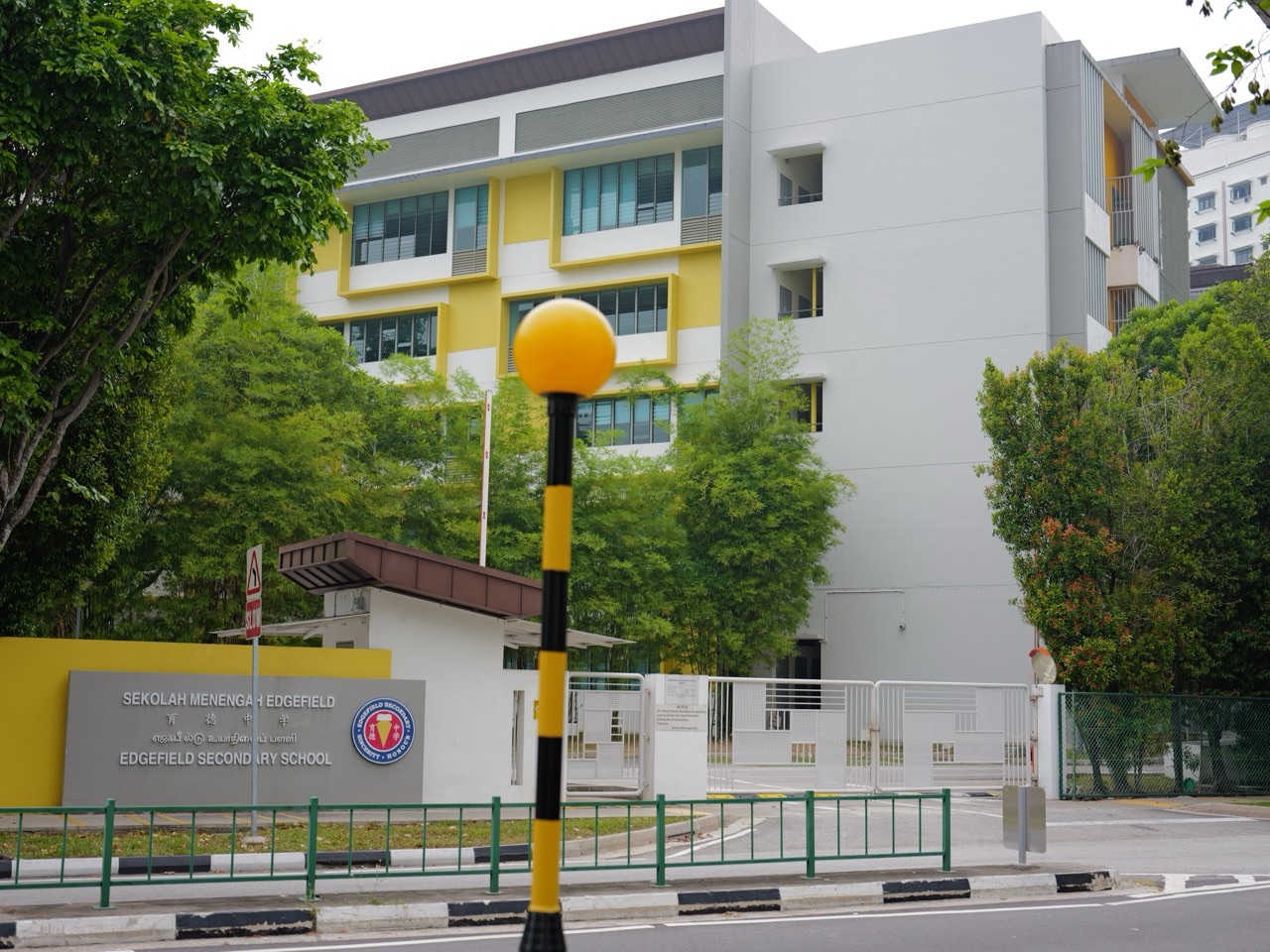
The short answer: Edgefield Secondary School is a co-educational government secondary school at 36 Punggol Field, Singapore 828814, near Punggol MRT. Established in 2011, its current distinctive programmes include Growing an Entrepreneurial Mindset (G.E.M.) as its Applied Learning Programme and character development through Taekwondo as its Learning for Life Programme. Edgefield was also one of the schools that piloted aspects of Full Subject-Based Banding before the national rollout.
For 2026 admission, our current Punggol secondary-school comparison records the previous year’s last-admitted PSLE Scores at 14 for Posting Group 3, 23 for Posting Group 2 and 27 for Posting Group 1. These are historical admission outcomes, not targets or guarantees; families should confirm the current year on MOE SchoolFinder.
Edgefield Secondary: Quick Facts
| Address | 36 Punggol Field, Singapore 828814 |
| Opened | 2011 |
| ALP | Growing an Entrepreneurial Mindset (G.E.M.) |
| LLP | Character development through sports, anchored on Taekwondo |
| Full SBB | Early pilot school from 2020 |
| 2026 admission reference | PG3 14 · PG2 23 · PG1 27 |
| Phone | 6883 9511 |
ALP: Growing an Entrepreneurial Mindset
Edgefield’s G.E.M. programme uses entrepreneurial thinking as a way to develop problem-solving, opportunity awareness and future-ready skills. The point is broader than starting businesses. Students are asked to identify needs, generate possibilities, work with constraints and turn ideas into solutions.
For parents, this is useful to read as a thinking programme. A student who learns to notice problems, ask what value could be created and test solutions is developing habits that travel across subjects and later work.
LLP: Character Through Taekwondo
The school’s Learning for Life Programme uses Taekwondo as a common character-development platform. Edgefield connects the physical discipline to values such as respect, resilience and self-control. A sports-based LLP gives students repeated situations in which effort, composure and practice are visible rather than abstract.
A Full SBB Pioneer
Edgefield was selected to pilot aspects of Full Subject-Based Banding from 2020. Its public materials describe reorganised form classes and opportunities for students to take selected subjects at more demanding levels. That history matters because the school has had several years to operate in a mixed-form-class environment before Full SBB became the national secondary-school structure.
Parents should still ask current questions rather than rely on old pilot details: which subjects can be taken at G1, G2 or G3, how movement between subject levels works, and how the school manages overall workload when a student takes subjects at different levels.
What Kind of Student May Fit Edgefield?
- A student who enjoys problem-solving, designing or entrepreneurial projects.
- A learner who may benefit from a school with long experience of mixed Full SBB classes.
- A child comfortable with a school identity that uses sport and physical discipline for character development.
- A Punggol family for whom the Punggol Field location creates a manageable daily journey.
Do Not Choose by Cut-Off Alone
A previous cut-off is one piece of admission evidence. It does not describe teaching quality, school culture or whether your child will thrive there. Use all six secondary-school choices thoughtfully and compare programmes, journey, CCAs, subject offerings and the learner’s own preferences.
See Secondary Schools in Punggol Compared and What Happens After PSLE?.
Learning Support and Tuition
Secondary 1 should not automatically trigger tuition in every subject. First observe how the student handles the new pace, independent work and subject levels. If intervention is needed, diagnose the actual weak link.
- Secondary English Tuition in Punggol
- Secondary Mathematics Tuition in Punggol
- Additional Mathematics Tuition in Punggol
Frequently Asked Questions
Where is Edgefield Secondary School?
36 Punggol Field, Singapore 828814. The school lists Punggol MRT as its nearest MRT station.
What is Edgefield Secondary’s ALP?
Growing an Entrepreneurial Mindset (G.E.M.), developing entrepreneurial and real-world problem-solving skills.
What is its LLP?
Character development through sports, anchored on Taekwondo.
Was Edgefield involved in Full SBB early?
Yes. Edgefield was one of the schools selected to pilot aspects of Full Subject-Based Banding from 2020.
Sources Checked
- Edgefield Secondary — Contact
- Edgefield Secondary — About Edgefield
- Edgefield Secondary — Full SBB
- eduKatePunggol — Secondary Schools in Punggol Compared
Checked 26 September 2026. Programmes and admission ranges can change; verify current information with the school and MOE.
Return to the town map: The Complete Punggol Guide connects this page to schools, transport, housing, family services, food, parks and the wider Punggol knowledge estate.
Edgefield Secondary School: Family Learning Guide — Secondary 1 to SEC, Home, Travel and Independence
The factual profile above remains the canonical school owner. This Future Build section adds the missing family-learning implementation layer. For Edgefield Secondary School, the practical job is to connect Punggol Field and Edgefield, entrepreneurship, taekwondo and the school’s Full SBB context, the student’s real subject evidence and the family’s actual week without turning the school name into a diagnosis or a generic tuition advertisement.
Families around Punggol Field, Edgefield, Coral Edge and nearby eastern Punggol routes should begin with the student’s demonstrated capability: marked work, fresh tasks, timetable, sleep, travel, CCA, subject load and degree of independence. The school provides context. The learner’s work provides the clue.
Secondary School Is a Systems Transition
For a Edgefield Secondary School family, the useful action is to treat Secondary 1 as a change in workload, subject structure, movement, independence and identity rather than only a harder syllabus. A learner who was well supported in Primary school may suddenly need to manage more teachers, materials, subject-specific homework and longer days. The family should expect an operating transition and build the system before interpreting every wobble as academic weakness.
Use the smallest intervention that can test the explanation. Avoid adding volume before the bottleneck is known. If the problem is retrieval, retrieve. If it is concept, reteach the concept. If it is execution, install a checking or pacing routine. If it is the weekly system, repair the week rather than blaming the subject.
The evidence to seek is the student increasingly managing the week without constant parental reconstruction. Look for recurrence across fresh work rather than relying on one easy or difficult task. When the learner succeeds under changed conditions with less support, the capability is becoming real.
Build the Real Secondary Week
For a Edgefield Secondary School family, the useful action is to map school, CCA, travel, meals, homework, device work, tuition, revision and sleep. Secondary students often have less spare time than a timetable suggests because transitions, transport and recovery occupy real hours. The weekly plan should use actual door-to-door time rather than idealised blocks.
Use the smallest intervention that can test the explanation. Avoid adding volume before the bottleneck is known. If the problem is retrieval, retrieve. If it is concept, reteach the concept. If it is execution, install a checking or pacing routine. If it is the weekly system, repair the week rather than blaming the subject.
The evidence to seek is a week that remains usable during ordinary busy periods, not only on an unusually easy week. Look for recurrence across fresh work rather than relying on one easy or difficult task. When the learner succeeds under changed conditions with less support, the capability is becoming real.
Use the School as Context, Not Diagnosis
For a Edgefield Secondary School family, the useful action is to separate the school identity from the learner’s actual error pattern. Two students in the same class can need completely different support. One may have missing prerequisites, another may have weak examination execution, and a third may need no additional tuition at all.
Use the smallest intervention that can test the explanation. Avoid adding volume before the bottleneck is known. If the problem is retrieval, retrieve. If it is concept, reteach the concept. If it is execution, install a checking or pacing routine. If it is the weekly system, repair the week rather than blaming the subject.
The evidence to seek is a precise learning problem supported by work samples and fresh tasks. Look for recurrence across fresh work rather than relying on one easy or difficult task. When the learner succeeds under changed conditions with less support, the capability is becoming real.
Full SBB and Subject Levels: Keep the Family Question Practical
For a Edgefield Secondary School family, the useful action is to focus on the learner’s current subject demands, evidence and next transition rather than turning labels into identity. Subject-level arrangements affect timetables, assessment and progression, but a family still needs the same operational clarity: what can the student do now, what is changing next, and what evidence should be reviewed before making support decisions.
Use the smallest intervention that can test the explanation. Avoid adding volume before the bottleneck is known. If the problem is retrieval, retrieve. If it is concept, reteach the concept. If it is execution, install a checking or pacing routine. If it is the weekly system, repair the week rather than blaming the subject.
The evidence to seek is a student who understands the current learning demand and can prepare for the next one without being reduced to a label. Look for recurrence across fresh work rather than relying on one easy or difficult task. When the learner succeeds under changed conditions with less support, the capability is becoming real.
Secondary 1: Stabilise Before Accelerating
For a Edgefield Secondary School family, the useful action is to protect the first-year transition while building subject routines. Secondary 1 is often the year in which familiar Primary habits stop being sufficient. Students need new note systems, homework control, subject switching and stronger reading of instructions. Adding aggressive academic acceleration too early can hide these operating gaps.
Use the smallest intervention that can test the explanation. Avoid adding volume before the bottleneck is known. If the problem is retrieval, retrieve. If it is concept, reteach the concept. If it is execution, install a checking or pacing routine. If it is the weekly system, repair the week rather than blaming the subject.
The evidence to seek is stable routines, clear subject folders and increasingly independent task initiation. Look for recurrence across fresh work rather than relying on one easy or difficult task. When the learner succeeds under changed conditions with less support, the capability is becoming real.
Secondary 2: Build Reliability and Choice Awareness
For a Edgefield Secondary School family, the useful action is to use the year to strengthen foundations, transfer and self-management before upper-secondary demands increase. Secondary 2 can expose which habits are durable and which were held together by close adult supervision. Families should inspect error patterns, workload and growing subject preferences without forcing premature certainty about future routes.
Use the smallest intervention that can test the explanation. Avoid adding volume before the bottleneck is known. If the problem is retrieval, retrieve. If it is concept, reteach the concept. If it is execution, install a checking or pacing routine. If it is the weekly system, repair the week rather than blaming the subject.
The evidence to seek is more reliable performance across fresh work and a clearer understanding of strengths and dependencies. Look for recurrence across fresh work rather than relying on one easy or difficult task. When the learner succeeds under changed conditions with less support, the capability is becoming real.
Secondary 3: Manage the Load Increase
For a Edgefield Secondary School family, the useful action is to treat upper-secondary entry as a new load state with more subject depth and higher prerequisite dependence. Students can appear to decline because several subjects become more abstract simultaneously. The family should identify which subject has the highest propagation risk rather than trying to repair everything with equal intensity.
Use the smallest intervention that can test the explanation. Avoid adding volume before the bottleneck is known. If the problem is retrieval, retrieve. If it is concept, reteach the concept. If it is execution, install a checking or pacing routine. If it is the weekly system, repair the week rather than blaming the subject.
The evidence to seek is one or two high-value repairs that stabilise the wider week. Look for recurrence across fresh work rather than relying on one easy or difficult task. When the learner succeeds under changed conditions with less support, the capability is becoming real.
Secondary 4 and SEC: Assemble, Do Not Panic
For a Edgefield Secondary School family, the useful action is to combine knowledge, retrieval, examination execution, pacing and recovery. Near the final secondary examinations, endless new material can reduce clarity. The family should know which topics are stable, which error families repeat, how the student manages timed papers and what support can still change the outcome.
Use the smallest intervention that can test the explanation. Avoid adding volume before the bottleneck is known. If the problem is retrieval, retrieve. If it is concept, reteach the concept. If it is execution, install a checking or pacing routine. If it is the weekly system, repair the week rather than blaming the subject.
The evidence to seek is reliable execution on fresh and timed tasks rather than impressive-looking revision volume. Look for recurrence across fresh work rather than relying on one easy or difficult task. When the learner succeeds under changed conditions with less support, the capability is becoming real.
English Across Secondary School
For a Edgefield Secondary School family, the useful action is to diagnose reading, vocabulary, inference, summary, writing, oral and response control separately. Secondary English becomes increasingly dependent on background knowledge, precision and the ability to infer or argue. A generic “weak English” label hides the component that should actually be trained.
Use the smallest intervention that can test the explanation. Avoid adding volume before the bottleneck is known. If the problem is retrieval, retrieve. If it is concept, reteach the concept. If it is execution, install a checking or pacing routine. If it is the weekly system, repair the week rather than blaming the subject.
The evidence to seek is a fresh English task completed with the correct method and less prompting. Look for recurrence across fresh work rather than relying on one easy or difficult task. When the learner succeeds under changed conditions with less support, the capability is becoming real.
Mathematics Across Secondary School
For a Edgefield Secondary School family, the useful action is to trace errors to concept, algebra, representation, interpretation, retrieval, method selection or checking. Secondary Mathematics compounds. A weak prerequisite can leak into later topics and make a current chapter look harder than it is. The earliest repeated fracture should be repaired first.
Use the smallest intervention that can test the explanation. Avoid adding volume before the bottleneck is known. If the problem is retrieval, retrieve. If it is concept, reteach the concept. If it is execution, install a checking or pacing routine. If it is the weekly system, repair the week rather than blaming the subject.
The evidence to seek is a fresh problem solved independently with a method the learner can justify. Look for recurrence across fresh work rather than relying on one easy or difficult task. When the learner succeeds under changed conditions with less support, the capability is becoming real.
Additional Mathematics Decision
For a Edgefield Secondary School family, the useful action is to treat A-Math as a subject with prerequisite and workload demands, not as a status symbol. Where A-Math is relevant, the family should inspect algebraic fluency, willingness to practise, schedule capacity and the student’s broader subject portfolio. The decision should be educational rather than social.
Use the smallest intervention that can test the explanation. Avoid adding volume before the bottleneck is known. If the problem is retrieval, retrieve. If it is concept, reteach the concept. If it is execution, install a checking or pacing routine. If it is the weekly system, repair the week rather than blaming the subject.
The evidence to seek is a workable subject load and clear evidence that prerequisite Mathematics can support the course. Look for recurrence across fresh work rather than relying on one easy or difficult task. When the learner succeeds under changed conditions with less support, the capability is becoming real.
Science Across Secondary School
For a Edgefield Secondary School family, the useful action is to separate fact recall, mechanism, data interpretation, experimental design and written explanation. Students may know a scientific fact but fail when the question changes. Others may reason well but write incomplete answers. The tutor or family should identify which layer is limiting performance.
Use the smallest intervention that can test the explanation. Avoid adding volume before the bottleneck is known. If the problem is retrieval, retrieve. If it is concept, reteach the concept. If it is execution, install a checking or pacing routine. If it is the weekly system, repair the week rather than blaming the subject.
The evidence to seek is a new scientific context explained from evidence without copying the original wording. Look for recurrence across fresh work rather than relying on one easy or difficult task. When the learner succeeds under changed conditions with less support, the capability is becoming real.
Humanities and Source-Based Reasoning
For a Edgefield Secondary School family, the useful action is to build reading, evidence selection, comparison and bounded claims. History, Geography and related work can become difficult when the student reads passively or treats every source as equally useful. The learner should learn to identify the question, select relevant evidence and distinguish what is known from what is inferred.
Use the smallest intervention that can test the explanation. Avoid adding volume before the bottleneck is known. If the problem is retrieval, retrieve. If it is concept, reteach the concept. If it is execution, install a checking or pacing routine. If it is the weekly system, repair the week rather than blaming the subject.
The evidence to seek is answers that use evidence deliberately rather than reproducing notes. Look for recurrence across fresh work rather than relying on one easy or difficult task. When the learner succeeds under changed conditions with less support, the capability is becoming real.
Mother Tongue and Language Maintenance
For a Edgefield Secondary School family, the useful action is to protect regular exposure and manageable practice instead of allowing the subject to disappear between tests. Language capability degrades when contact becomes episodic. The family can preserve reading, vocabulary and ordinary use without turning every evening into formal tuition.
Use the smallest intervention that can test the explanation. Avoid adding volume before the bottleneck is known. If the problem is retrieval, retrieve. If it is concept, reteach the concept. If it is execution, install a checking or pacing routine. If it is the weekly system, repair the week rather than blaming the subject.
The evidence to seek is more stable retrieval and less emergency relearning before assessments. Look for recurrence across fresh work rather than relying on one easy or difficult task. When the learner succeeds under changed conditions with less support, the capability is becoming real.
CCA and Leadership Are Part of the Education Portfolio
For a Edgefield Secondary School family, the useful action is to coordinate academic load around real school commitments. CCA, leadership, competitions, performance and service can build capabilities that examination practice cannot. The problem arises when every domain is scheduled at maximum intensity at the same time.
Use the smallest intervention that can test the explanation. Avoid adding volume before the bottleneck is known. If the problem is retrieval, retrieve. If it is concept, reteach the concept. If it is execution, install a checking or pacing routine. If it is the weekly system, repair the week rather than blaming the subject.
The evidence to seek is a week where activity and academics coexist without chronic sleep loss. Look for recurrence across fresh work rather than relying on one easy or difficult task. When the learner succeeds under changed conditions with less support, the capability is becoming real.
Travel Is Part of the School Day
For a Edgefield Secondary School family, the useful action is to count walking, waiting, LRT or bus transfers and pickup as real time. For families around the Punggol estate, a lesson or activity should be evaluated door-to-door. Travel can convert a manageable programme into an unsustainable evening.
Use the smallest intervention that can test the explanation. Avoid adding volume before the bottleneck is known. If the problem is retrieval, retrieve. If it is concept, reteach the concept. If it is execution, install a checking or pacing routine. If it is the weekly system, repair the week rather than blaming the subject.
The evidence to seek is a route whose time cost is visible before the family adds commitments. Look for recurrence across fresh work rather than relying on one easy or difficult task. When the learner succeeds under changed conditions with less support, the capability is becoming real.
The First Hour After School
For a Edgefield Secondary School family, the useful action is to use food, movement and a transition before the heaviest independent work. Students often need to change state after a long school day. Immediate interrogation can create conflict while an unstructured afternoon can dissolve into screens and delay. A short predictable transition works better than either extreme.
Use the smallest intervention that can test the explanation. Avoid adding volume before the bottleneck is known. If the problem is retrieval, retrieve. If it is concept, reteach the concept. If it is execution, install a checking or pacing routine. If it is the weekly system, repair the week rather than blaming the subject.
The evidence to seek is a reliable start cue for the next work block. Look for recurrence across fresh work rather than relying on one easy or difficult task. When the learner succeeds under changed conditions with less support, the capability is becoming real.
Homework as Diagnostic Evidence
For a Edgefield Secondary School family, the useful action is to let the student attempt before adults or tutors rescue the task. A completed worksheet can hide the level of support required. The family should know which questions were independent, which needed a prompt and which were impossible without reteaching.
Use the smallest intervention that can test the explanation. Avoid adding volume before the bottleneck is known. If the problem is retrieval, retrieve. If it is concept, reteach the concept. If it is execution, install a checking or pacing routine. If it is the weekly system, repair the week rather than blaming the subject.
The evidence to seek is schoolwork that reveals the learner’s actual state. Look for recurrence across fresh work rather than relying on one easy or difficult task. When the learner succeeds under changed conditions with less support, the capability is becoming real.
Notes, Files and Devices
For a Edgefield Secondary School family, the useful action is to build a system for subject folders, digital files, charging, printing and submissions. Secondary school multiplies materials. Losing the correct version of a file or arriving without a required item creates failure unrelated to subject knowledge.
Use the smallest intervention that can test the explanation. Avoid adding volume before the bottleneck is known. If the problem is retrieval, retrieve. If it is concept, reteach the concept. If it is execution, install a checking or pacing routine. If it is the weekly system, repair the week rather than blaming the subject.
The evidence to seek is the student finding, carrying and submitting work without repeated parent intervention. Look for recurrence across fresh work rather than relying on one easy or difficult task. When the learner succeeds under changed conditions with less support, the capability is becoming real.
Marked Work as the Best Tutor Handover
For a Edgefield Secondary School family, the useful action is to bring recent papers and teacher feedback instead of giving only a grade summary. The paper shows question type, attempt, working, marks and repeated errors. A tutor can then test whether the same failure appears on a fresh question.
Use the smallest intervention that can test the explanation. Avoid adding volume before the bottleneck is known. If the problem is retrieval, retrieve. If it is concept, reteach the concept. If it is execution, install a checking or pacing routine. If it is the weekly system, repair the week rather than blaming the subject.
The evidence to seek is a bounded diagnosis that can be confirmed or rejected. Look for recurrence across fresh work rather than relying on one easy or difficult task. When the learner succeeds under changed conditions with less support, the capability is becoming real.
3-Pax Tuition Fit
For a Edgefield Secondary School family, the useful action is to judge the group by compatible learning direction rather than identical speed. Three students can learn together while making different mistakes if shared teaching remains useful, individual repairs are bounded and everyone can return to common work.
Use the smallest intervention that can test the explanation. Avoid adding volume before the bottleneck is known. If the problem is retrieval, retrieve. If it is concept, reteach the concept. If it is execution, install a checking or pacing routine. If it is the weekly system, repair the week rather than blaming the subject.
The evidence to seek is each learner receiving the required repair without turning the class into one private lesson plus two waiting students. Look for recurrence across fresh work rather than relying on one easy or difficult task. When the learner succeeds under changed conditions with less support, the capability is becoming real.
What the Parent Should Record After Tuition
For a Edgefield Secondary School family, the useful action is to compress the lesson into task, difficulty, support, independent output and next check. Parents need enough evidence to make a decision, not a transcript. Over-reporting can turn support into surveillance while still failing to measure transfer.
Use the smallest intervention that can test the explanation. Avoid adding volume before the bottleneck is known. If the problem is retrieval, retrieve. If it is concept, reteach the concept. If it is execution, install a checking or pacing routine. If it is the weekly system, repair the week rather than blaming the subject.
The evidence to seek is a small record showing support decreasing over time. Look for recurrence across fresh work rather than relying on one easy or difficult task. When the learner succeeds under changed conditions with less support, the capability is becoming real.
Fresh-Task Transfer
For a Edgefield Secondary School family, the useful action is to test learning after the exact lesson context has disappeared. Immediate success can reflect memory of the tutor’s example. A fresh question with changed numbers, wording or context tests whether the method has become portable.
Use the smallest intervention that can test the explanation. Avoid adding volume before the bottleneck is known. If the problem is retrieval, retrieve. If it is concept, reteach the concept. If it is execution, install a checking or pacing routine. If it is the weekly system, repair the week rather than blaming the subject.
The evidence to seek is correct performance without the original scaffold. Look for recurrence across fresh work rather than relying on one easy or difficult task. When the learner succeeds under changed conditions with less support, the capability is becoming real.
Retrieval and Spacing
For a Edgefield Secondary School family, the useful action is to return to important knowledge after delay rather than repeatedly reviewing it in one sitting. A student can feel fluent while notes are open and forget quickly later. Retrieval after time gives stronger evidence of memory.
Use the smallest intervention that can test the explanation. Avoid adding volume before the bottleneck is known. If the problem is retrieval, retrieve. If it is concept, reteach the concept. If it is execution, install a checking or pacing routine. If it is the weekly system, repair the week rather than blaming the subject.
The evidence to seek is important knowledge becoming easier to retrieve across weeks. Look for recurrence across fresh work rather than relying on one easy or difficult task. When the learner succeeds under changed conditions with less support, the capability is becoming real.
Interleaving and Method Choice
For a Edgefield Secondary School family, the useful action is to mix related problem types so the student must decide what method applies. Blocked practice trains execution after the method is already known. Mixed practice trains recognition, selection and switching—closer to examination conditions.
Use the smallest intervention that can test the explanation. Avoid adding volume before the bottleneck is known. If the problem is retrieval, retrieve. If it is concept, reteach the concept. If it is execution, install a checking or pacing routine. If it is the weekly system, repair the week rather than blaming the subject.
The evidence to seek is the learner choosing an appropriate method without a chapter label as a cue. Look for recurrence across fresh work rather than relying on one easy or difficult task. When the learner succeeds under changed conditions with less support, the capability is becoming real.
Examination Technique
For a Edgefield Secondary School family, the useful action is to separate knowing from performing. Reading command words, allocating time, showing necessary working, moving past a difficult item and checking high-risk errors are trainable performance skills. They should be taught explicitly rather than dismissed as carelessness.
Use the smallest intervention that can test the explanation. Avoid adding volume before the bottleneck is known. If the problem is retrieval, retrieve. If it is concept, reteach the concept. If it is execution, install a checking or pacing routine. If it is the weekly system, repair the week rather than blaming the subject.
The evidence to seek is more marks converted from existing knowledge under timed conditions. Look for recurrence across fresh work rather than relying on one easy or difficult task. When the learner succeeds under changed conditions with less support, the capability is becoming real.
Error Analysis
For a Edgefield Secondary School family, the useful action is to turn every repeated mistake into a training decision. The useful question is not merely what was wrong but why the error happened and what fresh task would show the repair. Errors that repeat across topics may reveal a deeper dependency.
Use the smallest intervention that can test the explanation. Avoid adding volume before the bottleneck is known. If the problem is retrieval, retrieve. If it is concept, reteach the concept. If it is execution, install a checking or pacing routine. If it is the weekly system, repair the week rather than blaming the subject.
The evidence to seek is a shrinking error family rather than pages of corrections. Look for recurrence across fresh work rather than relying on one easy or difficult task. When the learner succeeds under changed conditions with less support, the capability is becoming real.
Blank Questions
For a Edgefield Secondary School family, the useful action is to diagnose why the student leaves work empty. A blank can mean missing knowledge, failure to start, overload, fear of being wrong, poor time allocation or inability to recognise the method. These require different interventions.
Use the smallest intervention that can test the explanation. Avoid adding volume before the bottleneck is known. If the problem is retrieval, retrieve. If it is concept, reteach the concept. If it is execution, install a checking or pacing routine. If it is the weekly system, repair the week rather than blaming the subject.
The evidence to seek is a student who can at least enter the problem and produce an inspectable first step. Look for recurrence across fresh work rather than relying on one easy or difficult task. When the learner succeeds under changed conditions with less support, the capability is becoming real.
When Marks Improve but Dependence Remains
For a Edgefield Secondary School family, the useful action is to distinguish score improvement from independent capability. A student can score better while still depending heavily on tuition prompts, selected questions or parent monitoring. The family should test what happens when support is withdrawn on fresh work.
Use the smallest intervention that can test the explanation. Avoid adding volume before the bottleneck is known. If the problem is retrieval, retrieve. If it is concept, reteach the concept. If it is execution, install a checking or pacing routine. If it is the weekly system, repair the week rather than blaming the subject.
The evidence to seek is performance that survives outside the tuition environment. Look for recurrence across fresh work rather than relying on one easy or difficult task. When the learner succeeds under changed conditions with less support, the capability is becoming real.
Strong Student Stretch
For a Edgefield Secondary School family, the useful action is to increase depth, unfamiliar transfer, explanation and responsibility before simply adding volume. A strong secondary student can be overloaded by constant acceleration. Stretch should create broader capability rather than a permanent race ahead of school.
Use the smallest intervention that can test the explanation. Avoid adding volume before the bottleneck is known. If the problem is retrieval, retrieve. If it is concept, reteach the concept. If it is execution, install a checking or pacing routine. If it is the weekly system, repair the week rather than blaming the subject.
The evidence to seek is more flexible thinking without sacrificing sleep or balance. Look for recurrence across fresh work rather than relying on one easy or difficult task. When the learner succeeds under changed conditions with less support, the capability is becoming real.
Academic Recovery
For a Edgefield Secondary School family, the useful action is to repair the earliest high-propagation dependency first. When several subjects are weak, trying to repair all of them equally can keep the learner in permanent emergency mode. The family should identify the bottleneck whose repair unlocks the most downstream work.
Use the smallest intervention that can test the explanation. Avoid adding volume before the bottleneck is known. If the problem is retrieval, retrieve. If it is concept, reteach the concept. If it is execution, install a checking or pacing routine. If it is the weekly system, repair the week rather than blaming the subject.
The evidence to seek is one stable foundation that makes several later tasks easier. Look for recurrence across fresh work rather than relying on one easy or difficult task. When the learner succeeds under changed conditions with less support, the capability is becoming real.
Parent–Student Handover
For a Edgefield Secondary School family, the useful action is to move planning, packing, deadlines and help-seeking gradually to the teenager. Secondary school should not leave the parent as the student’s external executive function forever. Support can be scaffolded and then withdrawn as the learner proves reliability.
Use the smallest intervention that can test the explanation. Avoid adding volume before the bottleneck is known. If the problem is retrieval, retrieve. If it is concept, reteach the concept. If it is execution, install a checking or pacing routine. If it is the weekly system, repair the week rather than blaming the subject.
The evidence to seek is more self-management with fewer reminders. Look for recurrence across fresh work rather than relying on one easy or difficult task. When the learner succeeds under changed conditions with less support, the capability is becoming real.
Parent–Teacher–Tutor Roles
For a Edgefield Secondary School family, the useful action is to keep institutional authority, family routine and specialist teaching distinct. Parents should not ask tutors to decide school rules, and tutors should not replace parent logistics. Each owner should handle the part they can actually change.
Use the smallest intervention that can test the explanation. Avoid adding volume before the bottleneck is known. If the problem is retrieval, retrieve. If it is concept, reteach the concept. If it is execution, install a checking or pacing routine. If it is the weekly system, repair the week rather than blaming the subject.
The evidence to seek is cleaner handoffs and fewer contradictory instructions. Look for recurrence across fresh work rather than relying on one easy or difficult task. When the learner succeeds under changed conditions with less support, the capability is becoming real.
Exam Week at Home
For a Edgefield Secondary School family, the useful action is to protect sleep, meals, materials, route and calm paper-to-paper recovery. A family can damage performance by converting every waking hour into revision. Exam week is an execution phase; the system should reduce avoidable noise.
Use the smallest intervention that can test the explanation. Avoid adding volume before the bottleneck is known. If the problem is retrieval, retrieve. If it is concept, reteach the concept. If it is execution, install a checking or pacing routine. If it is the weekly system, repair the week rather than blaming the subject.
The evidence to seek is the student arriving at each paper prepared rather than depleted. Look for recurrence across fresh work rather than relying on one easy or difficult task. When the learner succeeds under changed conditions with less support, the capability is becoming real.
After Results
For a Edgefield Secondary School family, the useful action is to review the mechanism before changing the whole plan. One result can contain clues about knowledge, timing, interpretation, checking and subject load. Families should compare the paper with prior evidence before changing tutor or timetable.
Use the smallest intervention that can test the explanation. Avoid adding volume before the bottleneck is known. If the problem is retrieval, retrieve. If it is concept, reteach the concept. If it is execution, install a checking or pacing routine. If it is the weekly system, repair the week rather than blaming the subject.
The evidence to seek is a next action tied to the actual failure mode. Look for recurrence across fresh work rather than relying on one easy or difficult task. When the learner succeeds under changed conditions with less support, the capability is becoming real.
Keep, Change, Reduce or Stop Tuition
For a Edgefield Secondary School family, the useful action is to review support as a correctable intervention rather than a permanent assumption. Keep when the live job remains and progress is visible. Change when the same dependency survives. Reduce when independence is reliable. Stop when the original job is complete.
Use the smallest intervention that can test the explanation. Avoid adding volume before the bottleneck is known. If the problem is retrieval, retrieve. If it is concept, reteach the concept. If it is execution, install a checking or pacing routine. If it is the weekly system, repair the week rather than blaming the subject.
The evidence to seek is a support state justified by evidence rather than habit. Look for recurrence across fresh work rather than relying on one easy or difficult task. When the learner succeeds under changed conditions with less support, the capability is becoming real.
The Editorial Review Test
For a Edgefield Secondary School family, the useful action is to remove activities, reports and materials that do not change the learning decision. Secondary-school weeks become crowded easily. Editing the system is as important as adding resources.
Use the smallest intervention that can test the explanation. Avoid adding volume before the bottleneck is known. If the problem is retrieval, retrieve. If it is concept, reteach the concept. If it is execution, install a checking or pacing routine. If it is the weekly system, repair the week rather than blaming the subject.
The evidence to seek is less noise and a clearer priority structure. Look for recurrence across fresh work rather than relying on one easy or difficult task. When the learner succeeds under changed conditions with less support, the capability is becoming real.
The Evidence Review Test
For a Edgefield Secondary School family, the useful action is to look for the clue that changes the diagnosis. Change one condition, use a fresh task and observe the result. This is stronger than guessing about motivation or intelligence.
Use the smallest intervention that can test the explanation. Avoid adding volume before the bottleneck is known. If the problem is retrieval, retrieve. If it is concept, reteach the concept. If it is execution, install a checking or pacing routine. If it is the weekly system, repair the week rather than blaming the subject.
The evidence to seek is a diagnosis that can survive an evidence test. Look for recurrence across fresh work rather than relying on one easy or difficult task. When the learner succeeds under changed conditions with less support, the capability is becoming real.
The Cross-Disciplinary Review Test
For a Edgefield Secondary School family, the useful action is to route deep English, Mathematics, Science, recovery, policy or local questions to the correct owner. A school guide should connect systems rather than duplicate them. The student should return from each specialist route with an action that fits the local week.
Use the smallest intervention that can test the explanation. Avoid adding volume before the bottleneck is known. If the problem is retrieval, retrieve. If it is concept, reteach the concept. If it is execution, install a checking or pacing routine. If it is the weekly system, repair the week rather than blaming the subject.
The evidence to seek is stronger owner boundaries and less content collision. Look for recurrence across fresh work rather than relying on one easy or difficult task. When the learner succeeds under changed conditions with less support, the capability is becoming real.
The Exit Ramp to Independent Learning
For a Edgefield Secondary School family, the useful action is to design support so it can become unnecessary in specific skills. The learner should increasingly pack, plan, begin, retrieve, check, ask targeted questions and recover without an adult running every step.
Use the smallest intervention that can test the explanation. Avoid adding volume before the bottleneck is known. If the problem is retrieval, retrieve. If it is concept, reteach the concept. If it is execution, install a checking or pacing routine. If it is the weekly system, repair the week rather than blaming the subject.
The evidence to seek is a student carrying the learning system into post-secondary life. Look for recurrence across fresh work rather than relying on one easy or difficult task. When the learner succeeds under changed conditions with less support, the capability is becoming real.
Compare Punggol Secondary Schools Without Creating a Ranking
Edgefield Secondary School can be compared with Greendale Secondary, Punggol Secondary and Yusof Ishak Secondary through current official information, actual commute, subject and programme fit, the learner’s needs and the family’s weekly constraints. Different students can thrive in different environments. A useful comparison clarifies trade-offs; it does not manufacture a universal winner.
Use Secondary Schools in Punggol Compared for the wider local map, Full SBB in Punggol Secondary Schools for the local family route, Getting to Punggol Schools for movement, and the Complete Punggol Guide for town context.
Edgefield Secondary School: The Final Family Principle
Secondary school should produce more than completed worksheets and examination scores. The deeper target is a learner who can increasingly understand the task, manage the week, seek the right help, inspect mistakes, recover and carry responsibility forward.
Keep the school facts current. Keep the diagnosis individual. Keep the week workable. Use evidence. Reduce support as independence grows.


