
How can you begin calisthenics in Punggol without joining a gym? Start with suitable, controlled bodyweight movements in a safe area at home or a properly maintained fitness corner. You do not need to perform a pull-up, muscle-up or handstand before you can say you are learning calisthenics. Many beginners begin with comfortable versions of pushing, squatting, balancing and trunk control. The goal is to build a routine you can repeat safely—not to imitate an advanced athlete swinging on a public bar.
This Calisthenics for Beginners in Punggol 2026 guide explains the difference between bodyweight strength and advanced street-workout skills, a progression framework for push-ups and pull-ups, public fitness-corner etiquette, how to check equipment, HDB home noise and space, heat and haze, recovery, costs, and three worked household examples. It complements—not duplicates—the Strength Training for Beginners in Punggol article, which compares broader resistance training, commercial gyms and machines. Here the practical question is how to learn a bodyweight movement safely from your own starting point.
Calisthenics in Punggol: quick answers
| Question | Plain-language answer | Check before starting |
|---|---|---|
| What does calisthenics mean? | Training muscles and movement using body weight as resistance. | It does not require tricks, hanging or jumping. |
| Where can I practise? | A suitable uncluttered home space or authorised neighbourhood exercise area. | Equipment condition, path access and neighbour comfort. |
| Are Punggol outdoor fitness corners free? | Many public fitness corners are generally accessible without venue admission. | Their machines and suitability vary by location. |
| Must beginners do pull-ups? | No. Pull-ups are demanding skills, and many alternatives exist. | Seek instruction when unsure about shoulder or bar safety. |
| What are useful first skills? | Controlled pushing, sitting-to-standing, appropriate leg and trunk movements. | Choose variations appropriate to individual health. |
| How often should adults include strengthening? | Singapore guidance recommends activity for major muscle groups on at least two days weekly. | The total load and recovery should suit you. |
| Do push-ups substitute for cardio? | Not automatically. | Aerobic movement and resistance work have different functions. |
| What if it is too hot or hazy outside? | Move to an appropriate indoor plan, shorten activity or rest. | Check official WBGT, haze and lightning guidance. |
| Can children follow adult calisthenics videos? | Not automatically; age, supervision and technique matter. | Avoid advanced skills without qualified coaching. |
| Is soreness a measure of success? | No. Comfortable progression and control matter more. | Stop with sharp or persistent pain. |
1. Bodyweight training is the foundation; flashy tricks are optional
SportSG’s Calisthenics: The Ultimate Guide introduces the discipline as using the body’s own weight to develop strength and endurance, with little necessary equipment. Its May 2026 Developing Strength Through Bodyweight Training describes push-ups, squats, lunges and planks as familiar examples. These count even if the person has never seen a calisthenics competition.
That distinction saves newcomers from a frustrating mistake. A person who cannot perform a pull-up may think the sport is unavailable to them, yet a gentle wall-based pushing exercise or an appropriate squat variation could provide a suitable start. What matters is that the body meets a chosen level of resistance in a controlled way. The movement should match the person’s current ability, not a social-media performance standard.
Advanced skills such as muscle-ups, handstands, human flags and lever holds demand specific strength, joint preparation, coaching and equipment. They are not introductory tests and may carry serious injury risk if attempted without adequate readiness. You do not have to pursue any of them to enjoy calisthenics. For many people in Punggol, the real goal is becoming more comfortable with ordinary movement and staying consistently active.
Start by identifying why you want to train. Do you prefer a no-subscription fitness routine? Would you like enough strength for everyday errands? Are you interested in a progressive athletic hobby? These are different goals. The first two may require simple movements and convenient sessions; the third may justify qualified coaching and specialist apparatus later. A sound beginner plan begins with intention before difficulty.
2. Choose the movement category before choosing an exercise
| Movement family | Everyday use | Appropriate first-learning idea |
|---|---|---|
| Push | Move or support a load away from the body. | Ask about a controlled wall or raised push-up variation. |
| Squat or sit-to-stand | Rise from a chair or lower the body. | Learn a supported version if appropriate. |
| Hip extension and lower-body control | Stand, walk and handle ordinary tasks. | Choose a suitable unloaded movement with guidance. |
| Trunk stability | Maintain body control during movement. | Explore a safe adapted stability exercise. |
| Pull | Draw a load toward the body. | A qualified trainer may suggest an accessible supervised option. |
| Balance and coordination | Control stepping and position changes. | Use simple stable movement suitable to ability. |
| Walking and aerobic activity | Build stamina and general activity. | Combine with suitable Waterway or neighbourhood walking. |
The categories are a learning map, not a mandatory workout. A participant with shoulder pain may need to avoid certain pushing or pulling movements pending clinical advice, while someone at risk of falling may need support for standing work. Good instruction adapts movements, ranges and resistance. No table can evaluate a reader’s medical history or predict which joint will tolerate which exercise.
The HealthHub exercise guide distinguishes aerobic from strengthening exercise and encourages adult muscle work across major groups. A Punggol resident who already walks regularly may find bodyweight strength a useful complementary interest, but the two activities serve different functions. Do not substitute several rushed push-ups for all aerobic movement.
3. A push-up progression is about control, not a number
The standard floor push-up shown in fitness videos can be demanding. It asks the arms, shoulders and trunk to manage a substantial part of body weight. Someone beginning from little upper-body strength should not be embarrassed about using a more manageable variation. SportSG explicitly describes raised or wall push-ups as possible modifications. The first priority is controlled movement without concerning pain.
Think of a progression as a ladder with adjustable steps rather than a timetable. An instructor might help a beginner use a wall, later a stable elevated surface, and eventually a more demanding version if appropriate. The person should remain able to control their position. Moving to a harder variation while collapsing, straining or twisting unnecessarily is not a success, even if it produces more impressive footage.
A park bench or railing is not automatically an approved exercise platform. Check whether the surface is fixed, stable, dry, permitted for that use and designed to bear the forces involved. Avoid delicate park furniture, handrails by water edges and surfaces used by other visitors. When uncertain, a safe home wall or qualified instructor’s equipment may be preferable.
Progress should be assessed with questions: Can I repeat the movement with similar control? Does it feel suitable for my joints? Can I recover comfortably before the next session? If not, stay with an easier version or ask for help. Repetition targets in an official article are illustrative, not proof that every beginner should undertake the same sets.
4. Pull-ups and bars: why they are not a compulsory starting point
A pull-up requires the body to be lifted by the arms and upper back against gravity. It is physically demanding, and some people with excellent everyday fitness cannot yet perform one. Hanging from an unfamiliar bar can also strain hands and shoulders, especially if the bar is wet or the person cannot dismount safely. Do not test the skill impulsively after watching an advanced park workout.
The important introductory question is whether suitable pulling activity exists at your current level. Some gym machines or coached exercises can develop pulling strength in a more adjustable way; a trainer may also select an assisted movement. Public fitness corners differ considerably. Many provide mobility stations but not equipment meant for progressive pulling. Never assume a bar at a playground was designed for adults to perform dynamic swing routines.
If a calisthenics programme promotes high-repetition pull-ups, kipping, acrobatic dismounts or partner assistance, ask about qualification, spotting and equipment. Avoid makeshift elastic systems attached to unknown bars. A snapped band, unstable anchor or uncontrolled fall can cause injury. Skill progress should follow safe apparatus and assessed ability, not a desire to complete a named trick by next weekend.
5. Punggol fitness corners and Waterway Park: know the difference
Punggol neighbourhoods have outdoor fitness areas with varying equipment. NParks’ older Punggol Waterway Park trail material mentions a multi-generational fitness corner within the Recreation Zone, but a 2014 illustration cannot confirm that every individual machine remains unchanged in 2026. Our Outdoor Fitness Corners in Punggol guide helps locate options, while current on-site instructions and maintenance conditions control actual use.
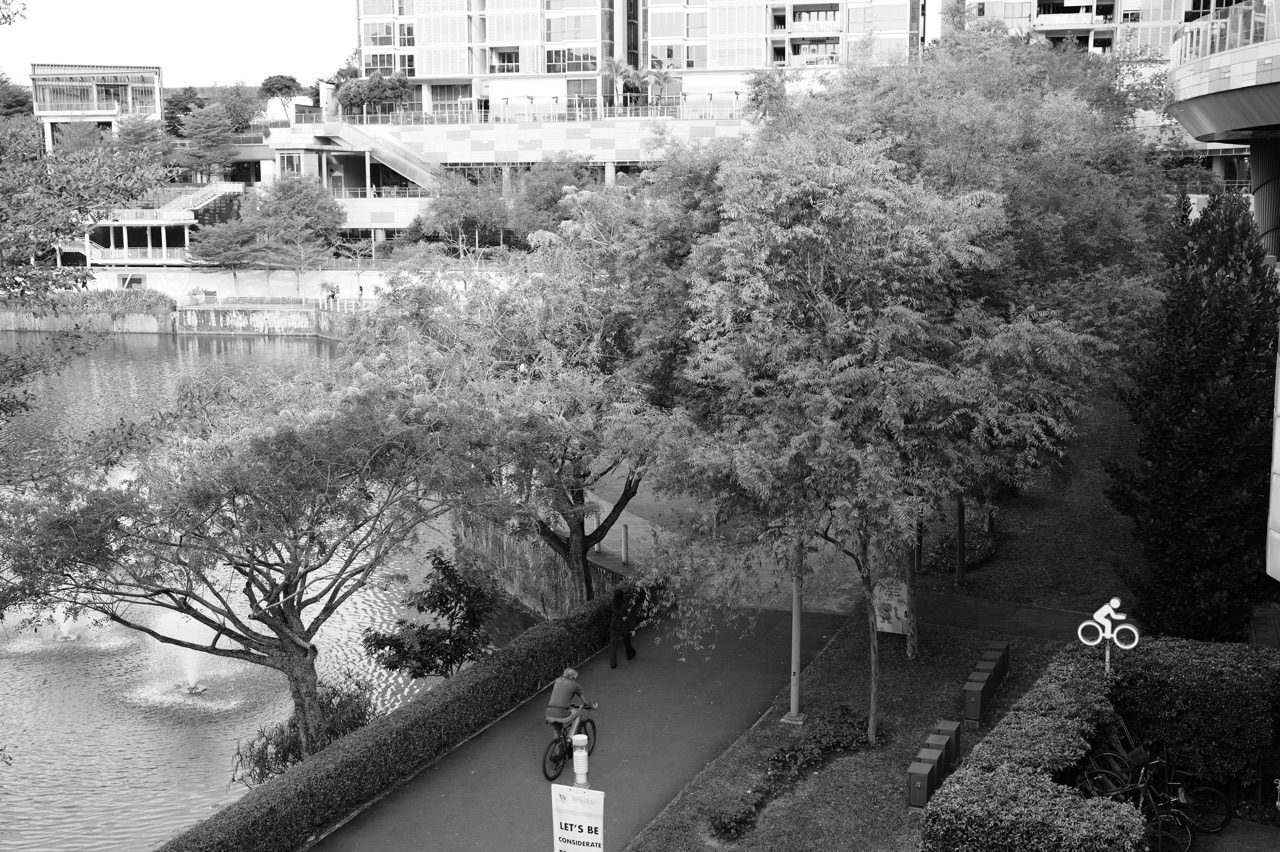
The Waterway park connector is useful for running or walking as well as moving between facilities, but it is not a dedicated calisthenics gym. Pedestrians, cyclists and people using wheelchairs must be able to pass safely. Do not hang equipment across a path, leave bags on the cycling lane or turn bridge railings into workout bars. The town’s green spaces are shared civic facilities.
A good first outdoor visit can be primarily a reconnaissance. Walk to the potential exercise area and check accessibility, lighting, surface, shade, signs and whether the equipment fits your goals. If the area is crowded or a machine appears damaged, choose another suitable option instead of improvising. Report maintenance concerns through the appropriate park or estate channel where necessary.
Different households may find different routes convenient. Residents near Oasis, Northshore, Matilda or Punggol MRT need not travel to the same exercise corner. Consistency often improves when a routine is near an ordinary journey. A location that looks impressive online but takes twenty additional minutes to reach may not be the best practical choice for a shift worker or parent with childcare duties.
6. A safe HDB home workout is not a miniature sports hall
Bodyweight training can be convenient in a flat because some movements require little equipment, but the environment matters. Clear a small private space and check for loose cables, wet surfaces, unstable furniture, ceiling fans and children walking through the movement area. Do not obstruct common corridors, staircase landings or lift lobbies. Those spaces serve emergency access and neighbours’ normal movement.
Noise can also become a problem in high-density housing. Repeated jumps, dropping equipment or dragging a bench may disturb neighbours. Fortunately, beginners often do not need these actions. Quiet controlled bodyweight movements can be an alternative, when appropriate to the person’s health and space. The Healthy HDB Home in Punggol guide explains household pathways and safety in greater detail.
A chair is not automatically an exercise device, and a wheeled desk chair is particularly unsuitable as a stabilising support. Some generic videos demonstrate bench dips on loose furniture, which can become hazardous. Choose adaptations approved for your needs and avoid equipment or supports that might slip. A qualified coach can help identify safe versions where a standard exercise is difficult.
Families should also decide where children and pets will be during an adult workout. A toddler walking beneath a moving arm or a dog playing beside a squat can create a risk of contact. Good household organisation may require exercising when another adult can supervise the child, or choosing a short movement break when the room is clear.
7. Warm-up, movement control and recovery
SportSG’s bodyweight training guide encourages gradual progression, and HealthHub emphasises appropriate form. Start any suitable session at manageable effort rather than immediately doing the hardest movement. A short comfortable warm-up can help a participant move and check how they feel. Its exact content and duration depend on the planned exercises and individual health. Warming up cannot guarantee that injuries never occur.
A beginner should distinguish ordinary temporary effort from concerning pain. A muscle may feel challenged during a safe movement, but sharp joint pain, dizziness, severe breathlessness or chest discomfort are reasons to stop and seek appropriate assessment. Don’t count an exercise as successful because it left you unable to move normally for several days. Recovery is part of sustainable training.
Singapore’s general adult activity guidance recommends strength work at least twice a week, but that does not mean twice a week of maximum effort or two identical workouts for every person. A shift worker, older adult or individual recovering from illness may need adaptations. The separate Punggol Warm-Up and Cool-Down guide addresses broader pre-activity and post-activity decisions.
8. What an example week could look like
| Day | Possible activity | Why it belongs |
|---|---|---|
| Monday | Suitable controlled bodyweight practice. | Learn technique at a manageable level. |
| Tuesday | Comfortable neighbourhood walking. | Aerobic movement and recovery. |
| Wednesday | Rest, ordinary errands or light movement. | Allow time for work, family and adaptation. |
| Thursday | Another appropriate strength opportunity. | Practise major movement families under control. |
| Friday | Social leisure, walking or a quiet evening. | Fitness should coexist with daily life. |
| Saturday | Optional Waterway outing or supervised skill session. | Enjoy a different setting when weather permits. |
| Sunday | Rest and review. | Decide which habits were sustainable. |
This table is a planning menu rather than a personal prescription. Some people already do strenuous work, others have sport CCAs or caring responsibilities, and people with chronic conditions may have different exercise needs. The purpose is to show that calisthenics fits into a balanced week without taking over every free hour. A routine people can repeat is usually more valuable than an exhausting one-off challenge.
If the table clashes with your life, rearrange or simplify it. A parent whose children have tuition on Monday may prefer a different day. A night-shift worker may need sleep after a demanding roster rather than a prescribed morning workout. These adjustments are not failures; they are why a local lifestyle guide should be built around real households.
9. A four-stage first-month learning experiment
| Stage | Question to resolve | Appropriate action | Useful outcome |
|---|---|---|---|
| 1 — Observe | Which movements are comfortable and which are unfamiliar? | Try an appropriate basic introduction with guidance. | A safe starting point. |
| 2 — Control | Can you repeat easy variations without straining? | Focus on a small number of suitable movements. | Improved confidence and consistency. |
| 3 — Balance | Are legs, upper body and trunk considered? | Discuss suitable overall movement categories. | A plan beyond one favourite exercise. |
| 4 — Review | Does this habit fit actual Punggol life? | Keep useful movements and reconsider unsuitable ones. | A repeatable routine rather than a deadline. |
The stages are not a promise of completing a pull-up in four weeks or of reaching a prescribed number of push-ups. Someone may spend several weeks making a wall push-up comfortable. Another person may have prior strength training and begin at a higher level. The useful measure is the suitability and repeatability of the movement, not an arbitrary calendar.
A diary can record which variation was used, whether it felt controlled, any symptoms, what instruction was helpful and whether sleep and recovery remained adequate. That is more informative than photographing an exercise and declaring it complete without knowing its effect. Never encourage children to compare strength scores publicly; age and development create substantial differences.
10. Three worked Punggol household cases
An office worker who wants no gym membership
The resident spends the day at a desk and worries that training requires a paid gym. They read SportSG’s bodyweight article and try a short suitable introduction in a clear living-room area. They choose manageable pushing and sit-to-stand work instead of trying a dramatic muscle-up. Later, they decide whether an outdoor fitness corner or coached gym class would add anything useful. The approach creates a habit before buying equipment.
A secondary student impressed by park calisthenics videos
The student sees older athletes swinging across bars and wants to copy them. A parent and coach discuss age-appropriate strength, technique and the student’s existing CCA load. The first lessons focus on control and safe movement. The student is not pushed into unsupported hanging tricks, and family expectations remain compatible with schoolwork and sleep. Read Healthy Teenage Life in Punggol for the bigger schedule picture.
A senior who wants to rise from chairs more confidently
The older resident is interested in strength but has recent balance concerns. The family does not send them straight to a pull-up bar. Instead, they seek appropriate healthcare or qualified exercise advice and explore suitable supported movements. The aim is everyday independence and confidence, not matching the technique of a young athlete. The Active Ageing in Punggol article explains falls prevention and local social activity.
11. Cost: why ‘no equipment’ does not mean ‘no planning’
An ordinary bodyweight routine may require no membership fee, making it attractive for budget-conscious residents. But suitable footwear, a clear space, instruction and safe travel still matter. A public park with free entrance is not necessarily the right exercise facility for someone needing adapted equipment or a coach. The value of professional support can be greater than the fee saved by improvising unsafe movements.
Avoid purchasing rings, pull-up bars, door-frame attachments, resistance systems or heavy weighted vests before understanding what is appropriate. Mounting equipment incorrectly can damage a home or create a falling hazard. Some devices are subject to weight limits and installation specifications. No internet article can certify an HDB doorway or wall for a particular load.
Our Low-Cost Fitness in Punggol guide compares hidden costs, free parks and membership alternatives. The question here is narrower: what is the smallest safe level of equipment and instruction needed to learn controlled bodyweight movement? For many healthy novices, that may be very little; for others, proper assessment is essential.
12. Weather: the bar may be dry at home but wet outside
Outdoor equipment can be slippery after rain, and Singapore heat can make exercise less comfortable. MSS issues Wet-Bulb Globe Temperature guidance for prolonged outdoor exertion. NParks may close or maintain facilities, while lightning risk changes outdoor decisions entirely. Don’t hang from wet or damaged bars, continue through a thunderstorm or assume an open-sided shelter makes an outdoor workout safe.
Check MSS heat stress, lightning information and official haze guidance when planning outside. On an unsuitable day, consider safe quiet indoor movement, a suitable supervised facility or rest. The activity does not need to be completed on the same day simply because a fitness app expects a streak.
People with respiratory symptoms, recent illness or other relevant conditions may need to postpone or obtain medical advice. Environmental data guides public safety decisions but does not diagnose an individual. The local Punggol Heat Stress and Outdoor Exercise page explains why apparent temperature and heat stress should not be confused.
13. Calisthenics versus other options in Punggol
| Goal | One sensible possibility | Why it is different |
|---|---|---|
| Begin bodyweight strength | Simple suitable calisthenics. | Uses own body weight rather than machines. |
| Develop progressive pulling strength | Qualified coached resistance or suitable equipment. | May allow adjustable loads or support. |
| Improve aerobic stamina | Waterway walking, jogging or other suitable activity. | Strength alone is not the full cardio programme. |
| Build flexibility and range of motion | Appropriately adapted mobility practice. | Movement control is different from maximum strength. |
| Learn a complex skill | A competent instructor and approved apparatus. | Safety and technique needs rise with difficulty. |
| Exercise with friends | A suitable class or social sport. | Shared enjoyment may help participation. |
| Support older-age independence | A clinically appropriate balance and strength plan. | Health and falls risks may need special assessment. |
This table is not intended to sell one method as superior. A person who loves swimming should not abandon it to become a calisthenics athlete merely because the equipment is free. Some will enjoy resistance machines because their loads can be adjusted. Others like bodyweight exercise because it fits a small home and unpredictable schedule. Matching method to goal is more important than fashionable terminology.
14. Mistakes that make starting harder than it needs to be
- Beginning with muscle-ups or handstands. These are advanced skills, not a first-day test.
- Using a playground bar as adult training equipment without approval. Check suitability and permission.
- Choosing a variation that causes pain. Stop, adapt or seek professional help.
- Increasing repetitions and difficulty simultaneously. Progress gradually and understand the change.
- Copying a stranger’s exercise without knowing its purpose. Choose movements that serve your goals.
- Assuming a home chair or doorway can safely support bodyweight. Do not improvise unstable anchors.
- Jumping repeatedly in a quiet HDB block. Consider neighbours and a safer low-impact option.
- Blocking park paths with equipment and bags. Keep public access open.
- Ignoring haze, heat or lightning. Use official advisories.
- Judging progress by soreness or appearance. Focus on control, consistency and wellbeing.
15. Frequently asked questions
Is calisthenics suitable for beginners in Punggol?
Many adults can begin with appropriate bodyweight variations, but individual health, skill and safe space matter.
Does calisthenics require a gym?
No. Bodyweight strength work may be possible at home or authorised public exercise spaces.
Where can I find Punggol fitness corners?
Use the existing Outdoor Fitness Corners in Punggol guide, then confirm the actual equipment and on-site signs.
Must I do a pull-up to start?
No. Pull-ups are demanding and are not a prerequisite for basic bodyweight exercise.
Can I start with wall push-ups?
SportSG includes wall or raised push-ups as potential adaptations; choose appropriate form and individual guidance.
Are muscle-ups beginner movements?
No. They require significant strength, technique and suitably supervised apparatus.
Can I train on Waterway bridge rails?
Do not turn bridge or park railings into exercise apparatus; use equipment actually intended and approved for activity.
Are outdoor fitness areas free?
Many public fitness corners are generally free to access, but use and suitability vary and the equipment may be unavailable.
How many times should adults strengthen muscles weekly?
Singapore guidance recommends work involving major muscle groups on two or more days weekly.
Does calisthenics replace walking?
Not automatically. Strength and aerobic activity have different roles.
Can children use the same movements as adults?
Only where age-appropriate and supervised. Avoid advanced videos and unsuitable apparatus.
What about older adults?
Choose suitable adapted movements and seek advice, particularly with falls risk or medical conditions.
Do I need to buy bands or a doorway bar?
Not generally for the first steps; unsafe installation and anchors can create hazards.
Is soreness necessary?
No. Sharp or persistent pain should not be pushed through.
Can I exercise after midnight in an HDB flat?
Choose considerate low-noise activity in a safe private space without disturbing neighbours or blocking corridors.
What if the park equipment is wet?
Avoid unsafe or slippery apparatus and select a suitable alternative.
Can I follow SportSG’s sets exactly?
Official examples are general education; individual loads and progression need suitability and sometimes professional guidance.
How can I know I am making progress?
Notice control, comfort, technique, consistent participation and adequate recovery rather than pursuing tricks on a deadline.
Build a balanced active Punggol routine
Bodyweight skill is only one part of everyday health. These companion articles discuss mobility, food and family water safety, each with its own practical purpose.
- Stretching and mobility around Punggol. Build suitable quiet movement breaks into desk work, Waterway walks and ordinary home life.
- What to eat before and after Punggol exercise. Understand ordinary hawker food, snacks, water, recovery and food storage around activity.
- Punggol family pool and water safety. Separate SAFRA Splash, Sengkang pools, SwimSafer learning and PUB-managed Waterway rules.
Return to the Life in Punggol master lifestyle guide for the wider neighbourhood, food, family and exercise system.
Explore connected eduKate Punggol lifestyle guides
- Life in Punggol — Master Lifestyle Hub
- Exercise in Punggol — Four-Week Beginner Plan
- Strength Training in Punggol — Gyms and Fitness Corners
- Low-Cost Fitness in Punggol
- Resistance Band Training in a Punggol HDB
- Warm-Up and Cool-Down in Punggol
- Healthy HDB Home in Punggol
- Active Ageing in Punggol
- Accessible Exercise in Punggol
- Outdoor Fitness Corners in Punggol
- eduKateSG — Punggol Waterway and Student Life
Authoritative sources and review
- SportSG — Calisthenics Beginner Guide
- SportSG — Bodyweight Training, May 2026
- HealthHub — Adult Physical Activity Recommendations
- HealthHub — Safe Exercise Form
- HealthHub — Strength and Aerobic Fitness
- NParks — Punggol Waterway Park
- MSS — Heat Stress
- MSS — Lightning Information
- Singapore Official Haze Guidance
Reviewed 20 October 2026. This is educational fitness guidance, not personal medical clearance, a supervised coaching programme or confirmation of the current condition of specific public equipment. Seek appropriate professional advice for injuries, significant medical conditions and advanced calisthenics skills; obey local park and shared-space rules.


