
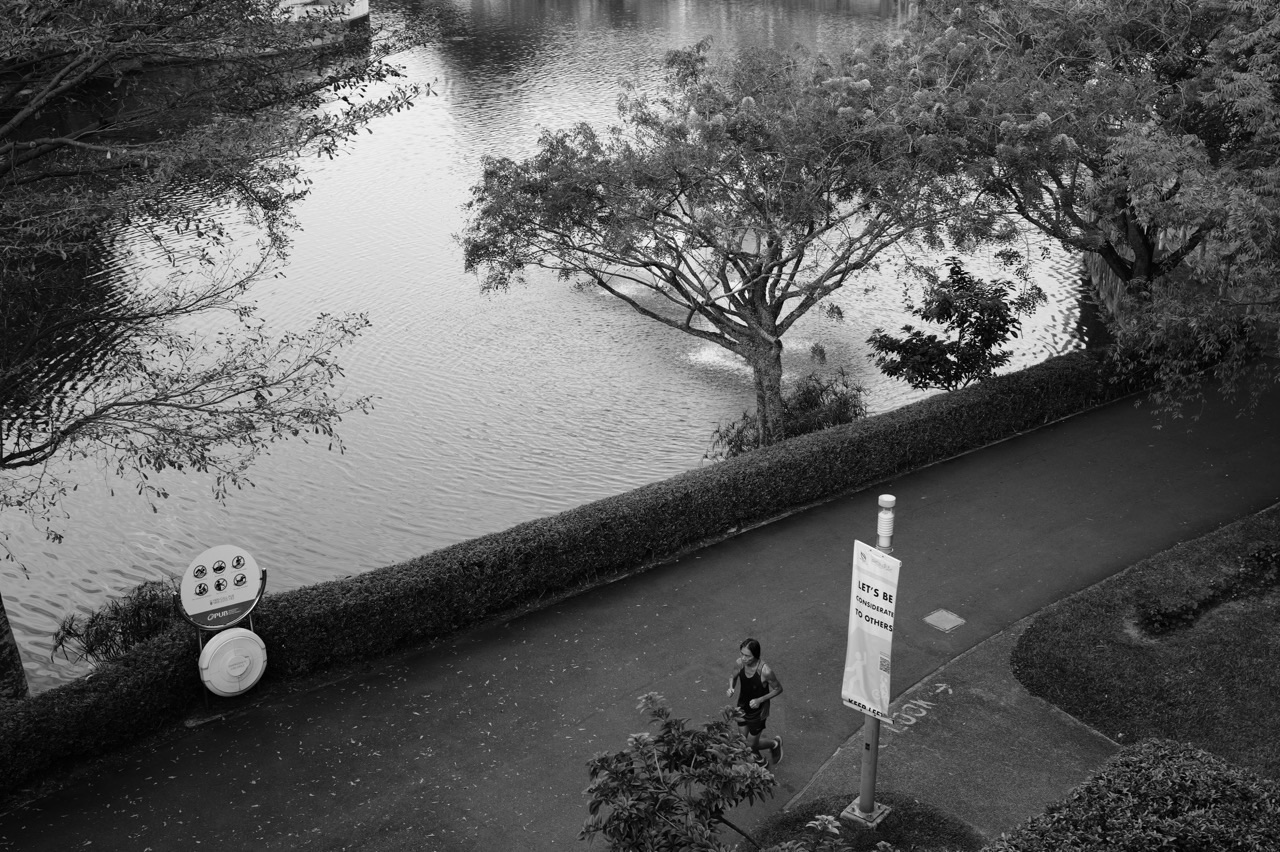
Is it safe to run or cycle at Punggol Waterway Park when Singapore is hot? Check the official heat-stress advisory, not just the weather app’s air temperature. For prolonged outdoor exercise, Singapore’s Meteorological Service uses Wet-Bulb Globe Temperature (WBGT), which considers humidity, radiation, wind and air temperature. At moderate heat stress, reduce outdoor activity and take breaks. At high heat stress, minimise outdoor activity, seek shade and increase cooling and recovery measures.
This Punggol heat-stress and outdoor exercise guide for 2026 helps residents choose when to walk, jog, cycle, visit Coney Island or switch to an indoor plan. It explains WBGT, water and rest decisions, heat-illness warning signs and the different needs of children, older adults and people with medical conditions. It does not report a live Punggol heat-stress reading. For the daily map, use MSS Heat Stress; for a general neighbourhood guide, start at Life in Punggol 2026.
Quick heat-stress guide: the levels that matter
| MSS advisory | WBGT | General-public action for prolonged outdoor activity |
|---|---|---|
| Low | Below 31°C WBGT | Normal activities may continue; hydrate normally and remain alert to personal conditions. |
| Moderate | 31°C to below 33°C WBGT | Reduce outdoor activity, take regular breaks indoors or in shade, and increase appropriate fluid intake. |
| High | 33°C WBGT or above | Minimise outdoor activity, stay in shade where possible, take more frequent or longer breaks and cool actively. |
| Any level with concerning symptoms | Personal warning signs override the numeric band | Stop activity, move to a cooler place and obtain appropriate medical attention; serious symptoms are an emergency. |
Those categories are from the government’s 2026 heat-stress advisory for the general population undertaking prolonged outdoor activities, especially with direct sun exposure. They should not be treated as a personal green light or a rule for a very brief walk to the bus stop. SportSG, MOM and schools have their own sector-specific activity guidelines. An individual who is ill, unacclimatised or vulnerable may need more caution than the general chart suggests.
1. Why a waterfront breeze can mislead a Punggol runner
One reason people enjoy Punggol is the open feeling along the Waterway and coast. The paths invite a longer jog, and a breeze can feel reassuring. Yet heat stress is not simply ‘Does the air feel warm?’ In humid weather, sweat evaporates less effectively, reducing the body’s ability to lose heat. Direct sun and radiant heat from surrounding surfaces also matter. A route that feels comfortable when you stop may be demanding during sustained exertion.
The MSS explanation of heat stress describes WBGT as a composite indicator. That is why two afternoons with the same familiar air temperature can produce different heat-stress readings. Do not convert a 33°C standard temperature forecast into a WBGT reading; they are different measurements. Instead, consult the actual advisory, remember its limits and consider your personal health and intended activity.
Also resist the idea that evenings must always be safe. MSS notes that hot, humid nights can still produce heat-related illness during strenuous activity, especially when humidity is high. An early morning may sometimes be more comfortable, but the clock alone does not guarantee a safe level. Check current conditions, and use your own capacity, hydration and symptoms in deciding whether to continue.
2. What the Punggol landscape changes — and what it does not
The Waterway Park connector offers an 8.4 km route according to NParks, but an attractive path does not require an 8.4 km session. A person returning to exercise can choose a short segment with a clear turnaround and a safe exit. Punggol’s riverside benches, bridges and links to neighbourhoods can help plan breaks, while direct sun and exposed sections may still be demanding. Do not assume all benches are shaded or that a nearby shop is always open.
The official Punggol Waterway Park page and Punggol Waterway Park Connector page help with route context. Our Walking for Everyday Errands guide explains short, repeatable routes rather than ambitious loops. Exercise should fit the destination and conditions. A shorter route near your HDB block may be safer and more useful than travelling to an exposed waterfront simply because it looks scenic.
Cycling introduces a different form of exposure. Moving air can feel cooling, but the rider still generates heat, may stop at exposed crossings and can be far from a convenient rest point. A helmet is important for cycling safety, but clothing and equipment also affect comfort. Use an appropriate route, plan places to stop and follow the official heat advisory. Feeling a breeze is not evidence that your body temperature is under control.
3. Hydration without rigid online water rules
Drinking fluids can help manage heat, but requirements vary with body size, effort, sweating, duration, weather and individual medical conditions. Do not copy an athlete’s litres-per-hour rule and impose it on a small child, older adult or someone whose clinician has advised fluid restrictions. The general MSS heat advisory recommends normal hydration at low heat stress and more fluids at moderate and high levels, tailored sensibly to the person and activity.
For an ordinary healthy adult planning a short walk, having accessible drinking water may be sufficient. A long workout or prolonged outdoor exposure requires more deliberate preparation. Check whether water can be obtained on the route and whether you will have a cool place to rest. Do not rely on a particular public water point without verifying it, and do not turn hydration into a competition involving excessive water consumption.
Sweating and thirst are useful clues, but no single sign determines safety. A participant who feels faint, confused or very weak needs immediate attention regardless of whether they have finished a water bottle. Someone taking medicines that affect fluid balance or living with kidney or heart conditions should discuss appropriate hydration with their healthcare professional. A local article cannot personalise these needs.
4. The shade, rest and exit plan
| Before the session | Why it matters | A practical Punggol action |
|---|---|---|
| Choose an appropriate time | Heat conditions change throughout the day. | Check current WBGT rather than assuming sunrise or sunset is safe. |
| Identify shade and rest points | Breaks help reduce continued exposure. | Pick a short route with known benches or accessible indoor options. |
| Set a turnaround point | It is easy to keep going along attractive water. | Decide when to turn back before fatigue appears. |
| Bring what you need | Fluids, suitable clothes and communication help. | Carry appropriate water and ensure someone can be contacted if needed. |
| Review the advisories | Heat, haze and lightning are distinct risks. | Check MSS WBGT, lightning and haze information separately. |
| Have a genuine Plan B | A cancelled session should not become a crisis. | Use appropriate indoor activity or rest. |
A runner may prefer a familiar loop with predictable shade. A parent with a child needs frequent opportunities to stop, access to transport and realistic distances for the child’s age. Someone walking with an older relative may value a flat route and seating over pace or distance. All three can enjoy Punggol without doing the same activity. The destination is only one part of the decision; the person and environmental conditions are equally important.
A smart exit plan is uncomplicated. Tell someone your intended route when appropriate, carry a phone and know the nearest practical way back. When you feel tired or notice discomfort, use the exit rather than adding a ‘last kilometre’. There is no need to be heroic beside a popular waterfront. Protecting the ability to exercise another day is more important than completing today’s app target.
5. Recognising heat-related illness early
MSS lists possible heat-related symptoms including weakness, dizziness, headache, intense thirst, nausea, vomiting, muscle cramps and unusual breathlessness. These symptoms may develop during exertion or following prolonged exposure. Stop the activity, move to a cooler place, start cooling and seek appropriate medical advice. Do not keep exercising to see whether the discomfort disappears. Someone who is unwell should not be left alone to finish the route.
Heat stroke is a medical emergency. Confusion, disorientation, collapse, altered consciousness or seizures after heat exposure can signal serious danger. Call Singapore’s emergency ambulance service on 995 for severe symptoms, move the person out of heat if safe, and begin appropriate cooling while following emergency instructions. Do not delay emergency care to finish an exercise session, and do not force an unconscious or confused person to drink.
Cooling can involve moving into shade or an appropriately cool indoor area, reducing unnecessary clothing layers and using cool water on the skin where suitable. However, what is safe for a child, an older adult or someone with medical conditions can differ. Government guidance is a starting reference, not a replacement for a trained responder. When in doubt about severe symptoms, prioritise emergency assistance.
6. Children, school sport, pregnancy and older adults
MSS specifically highlights groups that may be more vulnerable to heat stress: children and infants, older adults, people who are ill or recently recovered, pregnant women, people with chronic conditions and visitors recently arrived from cooler climates. They may require greater caution at the same environmental reading. Adult athletes and their performance targets are not an appropriate comparison for children or vulnerable family members.
For school PE, CCAs or organised competitions, follow the school’s or event organiser’s heat safety rules, including decisions about intensity, breaks and cancellations. Do not override school guidance using a parent’s screenshot of the public WBGT map. An infant should not be taken on a prolonged exposed outdoor fitness route simply because the adult wants to finish the walk.
Older residents may also have balance, mobility or fluid-management considerations. Our Active Ageing in Punggol guide focuses on safe route planning and suitable activity. A person recovering from illness or with serious ongoing health concerns should seek individual advice before joining prolonged outdoor exercise. The purpose of this article is to make questions and environmental decisions clearer, not to diagnose fitness or issue medical clearance.
7. WBGT, one-hour PM2.5 and lightning are three different checks
Punggol’s outdoor plans may be affected by more than heat. Haze is assessed through air-pollution measures, while lightning and thunderstorms are weather hazards requiring their own decisions. A low heat-stress reading does not mean air pollution is low; an acceptable haze reading does not make thunderstorm exercise safe. For immediate activity during haze, NEA advises checking the one-hour PM2.5 information and current health guidance on haze.gov.sg.
For lightning, use MSS Lightning Information and avoid outdoor exercise when a thunderstorm threatens. For heat, use MSS WBGT readings with the public heat-stress advisory. If more than one hazard is present, take the safer option. Our Rainy-Day Exercise in Punggol guide covers indoor alternatives and venue choices; it is not interchangeable with the heat guidance.
A child can learn an important science lesson from this distinction. WBGT responds to heat-related environmental factors, PM2.5 measures fine particulate pollution and lightning detection concerns electrical discharges from storms. These are not three ways of measuring the same ‘bad weather’. Families can make better choices by asking which hazard is present and how that hazard affects their intended activity.
8. Four worked scenarios for a hot Punggol day
A beginner runner near Waterway Point
A runner plans a longer afternoon route after lunch. They check the heat-stress advisory and see moderate conditions. Instead of insisting on the full planned distance, they reduce outdoor exertion and include rest or choose a shorter session. If conditions rise to high, the general-public advice is to minimise prolonged outdoor activity; a suitable indoor alternative or postponement makes sense. Their fitness goal has not vanished simply because the session is revised.
A family planning Coney Island
The family sees a warm sunny sky and considers a lengthy nature walk with younger children. Rather than treating the forecast temperature as the only decision, the adults consider WBGT, available shade, the children’s age, route length and reliable transport home. If conditions are unsuitable, they shorten or postpone the trip. The same family may still have a pleasant day in Punggol without completing the island route.
An older walker meeting friends
A senior wants to meet friends near a community destination. The social activity may be valuable, but the optional exposed walk is not mandatory. They choose transport or an accessible shaded route as appropriate, bring the personal supplies they need and agree on somewhere comfortable to rest. Any concerning symptoms mean stopping and seeking advice. This balances independence and caution rather than prohibiting every outdoor outing.
A regular cyclist who feels fine in the wind
A cyclist says the breeze makes hot weather tolerable. They still consult the WBGT guidance, plan stops and shorten prolonged exertion when necessary. The route may include sections without shade and delays at junctions. A breeze is a comfort sensation, not a substitute for monitoring heat strain. They accept that a strong training day may need to move to another time or an appropriate facility.
9. A seven-day heat-aware activity experiment
| Day | Planning skill | Practical question |
|---|---|---|
| Monday | Look up official WBGT information. | Did I use heat stress rather than air temperature alone? |
| Tuesday | Identify a shorter version of a favourite route. | Can I return without finishing a long loop? |
| Wednesday | Check where cooling and rest are possible. | Is the rest point actually available on my route? |
| Thursday | Review drinking needs for my own health and effort. | Do I have suitable fluids and any medical restrictions? |
| Friday | Compare heat, haze and thunderstorm conditions. | Which hazard changes the plan today? |
| Saturday | Choose an enjoyable outing or a safe alternative. | Did the activity remain comfortable for the participants? |
| Sunday | Keep one useful habit for next week. | Is the plan realistic, even on busy days? |
Use this as a decision exercise, not an obligation to train outdoors seven days in a row. The week may be too hot, wet or hazy for several planned outings. That is normal. A safe programme has rest and indoor options. The purpose is to improve judgement, not encourage compulsive monitoring or risky exertion.
Worked science example: why two 32°C days can feel different
Suppose the familiar dry-bulb air temperature reads 32°C on two afternoons. It is tempting to assume the heat risk is identical. MSS provides an illustrative comparison in which 32°C air temperature corresponds to different WBGT values under different humidity and radiant-heat conditions: a lower WBGT of around 30.6°C in one example and a higher value of around 32.3°C in another. In the general public advisory, these fall into different bands: low and moderate. The calculation illustrates why ordinary air temperature alone is insufficient to choose the length of a prolonged outdoor run.
WBGT also incorporates the effects of wind and solar radiation. This is why a shaded area may offer a different exposure from an open sunlit path, but a park visitor cannot reliably derive an exact personal WBGT from looking at the sky. Use the official readings and remember that they are environmental measurements rather than individual health assessments. Someone who is unwell or recently recovered may need to reduce exertion regardless of which band appears on the map.
How a Waterway route can be split into safer choices
For a runner who enjoys the Punggol Waterway corridor, the first decision is whether prolonged outdoor activity is appropriate at all. If it is, choose a manageable section near a familiar entrance and identify where to turn back. A route that becomes longer merely because the next bridge looks beautiful can be harder to exit safely. Choosing a short out-and-back route is a simple way to retain options if discomfort appears.
A family visiting Coney Island has a different problem. The group may include a child or older adult who tires sooner than the most enthusiastic participant. Plan for the person who needs the most support, not the person who can cover the greatest distance. Understand the return journey and access before committing to a long trail. If a group has disagreement about whether to continue, favour safety and the ability to return comfortably.
Three separate signals: heat, air pollution and storms
A high WBGT reading is a heat warning, not evidence of haze. Elevated one-hour PM2.5 is an air-quality problem, not an indicator of direct sunlight or humidity. A lightning warning is a storm safety issue, not a proxy for temperature. The same Punggol day can involve one, two or all three. A good decision therefore checks the right source for each hazard: MSS heat-stress map, NEA haze information and MSS lightning service.
A practical reader example: the WBGT band is low but the one-hour PM2.5 advisory calls for reducing strenuous outdoor exercise. The low heat band does not overrule the air-quality guidance. Another example: air quality is normal but thunderstorm risk is present. The absence of haze does not make a Waterway cycle safe. The safest relevant advisory, individual health and actual activity all matter.
Cooling and help: what changes when symptoms appear
There is a difference between deciding to reduce a workout and responding to illness. Before symptoms appear, shorten the route, rest in shade, use suitable clothing and hydrate according to individual needs. If someone begins to feel unwell with heat-related signs such as dizziness, headache, nausea or weakness, stop activity immediately, move into a cooler environment where possible and arrange appropriate assistance. Do not send an affected person alone along a long return route.
Confusion, disorientation, collapse or seizures after heat exposure are signs of possible heat stroke, which is an emergency. Call 995 in Singapore and begin safe cooling while following emergency directions. Never try to force drinks into someone who is not fully alert. Rapid action matters more than attempting to diagnose the exact temperature or finish a kilometre. This is a safety response, not a do-it-yourself treatment protocol.
A checklist to prepare before the next sunny outing
Write down a modest route, likely duration, rest and exit options, the people involved and any specific support needs. Check the MSS heat-stress information shortly before leaving. Verify conditions again if the outing will be long or weather changes. Bring suitable drinking water or know where it can be obtained, while respecting any medical fluid guidance. Choose clothing and timing suitable for the weather, and be willing to reschedule.
For someone beginning exercise, progress is not simply extra distance each week. Being able to judge heat, avoid unsafe conditions and finish a comfortable session is part of fitness literacy. The goal is to keep enjoying Punggol’s parks across many seasons rather than turn one hot afternoon into an injury or medical emergency.
10. Frequently asked questions
Is 33°C on my phone the same as high WBGT heat stress?
No. Air temperature and WBGT are different measures. Use the official MSS WBGT advisory for prolonged outdoor activity.
Is jogging at night always cooler and safe?
Not necessarily. MSS notes that high humidity can still impair heat dissipation at night, particularly during vigorous activity.
Does the waterfront breeze prevent heat stroke?
No. Wind can affect comfort and heat exchange, but prolonged effort, humidity, sun and personal health still matter.
How much water should I drink while running?
Fluid needs vary. Use sensible hydration guidance appropriate to effort and health, and follow individual medical advice where applicable.
Can children follow an adult’s heat-adapted run?
Not automatically. Children may require extra protection and school or organised-sport rules should be followed.
What if the reading is low but I feel unwell?
Stop. Symptoms and personal health override any environmental category; obtain appropriate care.
Is high heat stress the same as hazardous haze?
No. Heat-stress WBGT and air-pollution PM2.5/PSI measure different risks and require separate checks.
What are emergency heat-stroke warning signs?
Confusion, collapse, altered consciousness or seizures after heat exposure are red flags. Seek emergency help via 995.
Explore the wider Punggol lifestyle knowledge network
- Life in Punggol 2026 — main lifestyle guide
- Exercise in Punggol — beginner plan
- Walking for Everyday Errands in Punggol
- Active Ageing in Punggol
- Rainy-Day Exercise in Punggol
- Working From Home in Punggol
- Accessible Exercise and Inclusive Sport in Punggol
- Punggol Haze Check — PM2.5 and PSI
- eduKateSG — Punggol Geography, Accessibility and Urban Mobility
- eduKateSG — Waterway Park and Student Life
Official references and last review
- Meteorological Service Singapore — Learn About Heat Stress
- MSS — Heat Stress Map and Advisory
- MOH/MSS — Manage Heat Stress 2026 PDF
- NParks — Punggol Waterway Park
- NParks — Punggol Waterway Connector
- NEA — Air Quality and Haze Health Advice
- MSS — Lightning Information Service
Reviewed 17 October 2026. The table summarises the government’s general-public heat advisory for prolonged outdoor activity; it is not a personal exercise prescription or live heat-stress report. Check current WBGT, haze and lightning information and consult appropriate healthcare professionals about individual risks. Local route and facility conditions may change.


