
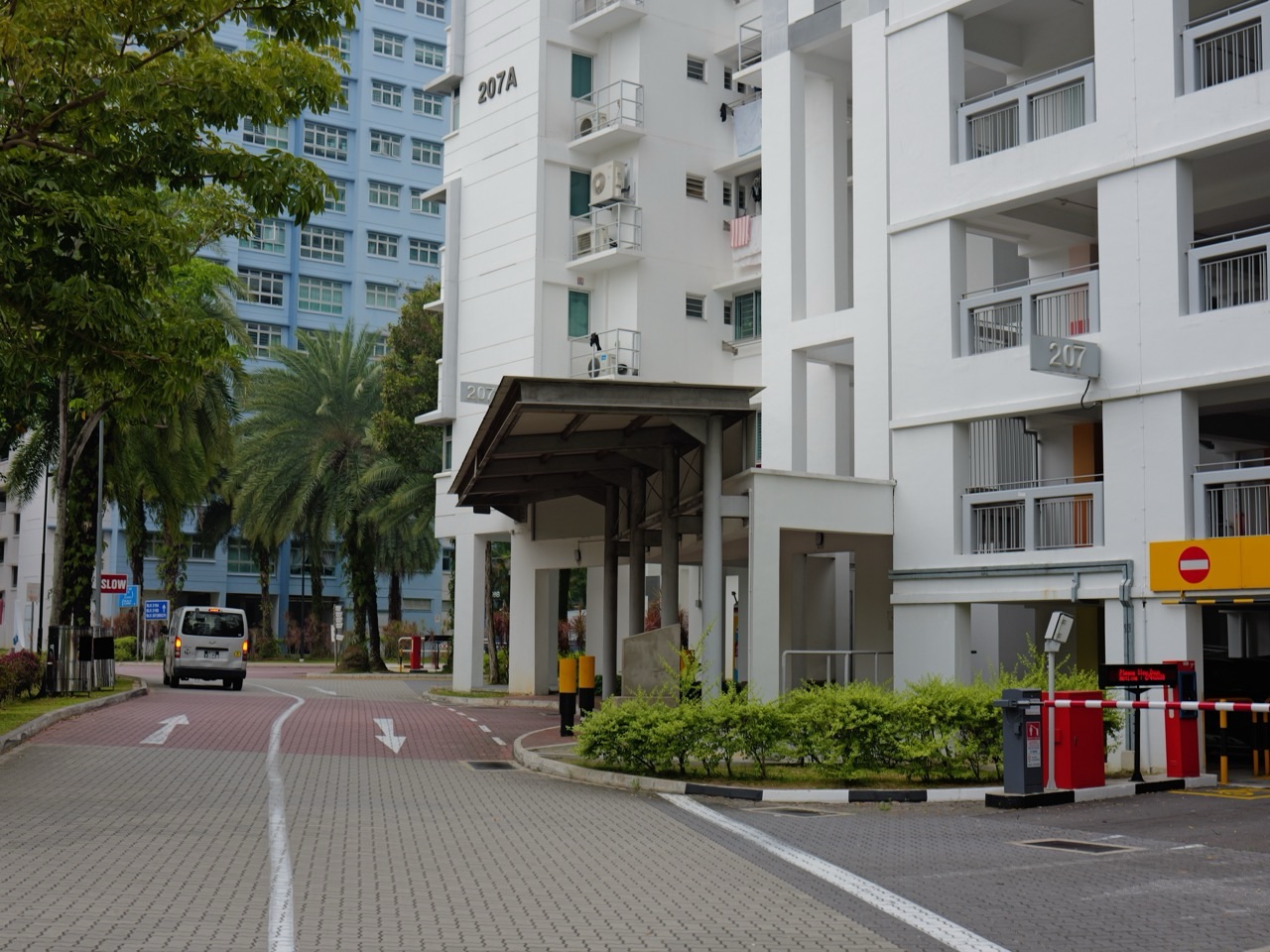
Is that white cloud outside your Punggol HDB block haze, or mosquito fogging? You cannot reliably identify the source from colour or smell alone. Mosquito fogging is a targeted pest-control operation at a particular place and time, while transboundary haze involves regional smoke carried through the atmosphere. Both can occur on the same day. If you see an active spraying operation, read the operator’s notice and keep a safe distance; if you are deciding about exercise or children’s activities, check NEA’s official haze readings for Singapore’s North reporting region.
This guide answers Punggol haze versus mosquito fogging, why fogging smoke appears near HDB estates, whether pest-control fog is the same as PM2.5, who should notify residents, and how to report concerns. It does not allege that any named Punggol estate or pest-control company acted improperly. The key practical lesson is to separate what you see, what the operator has confirmed, and what an air-quality instrument has actually measured.
The 30-second answer: check the source, time and authority
A visible cloud associated with a worker operating fogging equipment may indicate a nearby pest-control operation. A broad loss of skyline contrast across town during a documented regional smoke episode may fit transboundary haze. But neither observation proves a chemical composition, certified particle concentration or legal violation.
Ask three questions. Was an operation announced? Check your managing agent, Town Council or the relevant premises’ notice. Is NEA reporting elevated haze? Open the latest official PM2.5 and PSI information. Is there an immediate safety concern? Move away from active spraying, follow the operator’s safety instructions, and use the relevant official reporting route if necessary.
Do not conclude that an entire estate is safe simply because the visible plume came from fogging. Equally, do not assume every smoky-looking patch around a construction site is caused by fires overseas. The correct explanation can involve more than one local and regional source.
What mosquito fogging actually does
Mosquito fogging distributes an insecticide in fine droplets intended to contact adult mosquitoes during an appropriate targeted control operation. The visible mist is not ordinary water vapour in every product or method, and it should not be casually described as harmless steam.
Singapore’s National Environment Agency explains that fogging is used judiciously as one part of dengue response, particularly where there are high mosquito populations or active transmission. It is not intended as the main routine method of dengue prevention everywhere.
The effectiveness is temporary because mosquitoes can emerge again from breeding sites. NEA therefore emphasises removing stagnant-water breeding habitats rather than relying indefinitely on repeated chemical fogging.
A household can appreciate mosquito control while still asking clear questions about notification, timing, permitted products and personal precautions. Responsible pest control and accurate public information go together.
What is transboundary haze?
Transboundary haze is smoke from fires that moves from one jurisdiction into another. In Southeast Asia, vegetation and peatland fires may release fine particles and gases, which prevailing winds can transport towards Singapore.
Unlike a single local fogging operation, regional haze may affect much wider areas and fluctuate with wind, rain, emissions and atmospheric mixing. NEA supplies one-hour PM2.5 concentration readings and 24-hour PSI information to support public decisions.
Punggol appears in NEA’s North reporting region. The official regional value is not a calibrated measurement taken beside every Punggol playground or individual HDB corridor.
For the geography and smoke science, read Why Is Punggol Hazy?. This article instead deals with the local fogging confusion that can arise during a regional haze episode.
Why both events might happen in the same week
Rainfall, warm weather and urban surroundings can create conditions in which mosquito breeding prevention remains important. Regional haze depends on a different set of drivers: source-region fires and smoke transport.
A wet afternoon in Punggol does not mean there can be no smoke plume from elsewhere, and a haze episode does not suspend ordinary dengue prevention. Town management and health agencies may have to deal with both issues at once.
For example, a resident might see a known vector-control worker near a void deck while NEA’s regional PM2.5 band is also elevated. That observation supports investigating two separate processes, not forcing them into one explanation.
A good neighbourhood update identifies the confirmed spraying event and independently links the official haze readings. A single blurry phone photograph cannot establish which particles originated from which source.
What does NEA say about the proper use of fogging?
NEA’s March 2025 explanation, “Fogging should be used judiciously”, says fogging and chemical misting should not be used indiscriminately as routine mosquito control.
The agency explains that indiscriminate chemical use may affect non-target insects and contribute to insecticide resistance. It recommends prioritising the removal of mosquito breeding sites, while using targeted adult-mosquito control when warranted.
NEA also states that fogging operations must be notified to the agency in advance and the public must be informed of upcoming operations by the pest-control operator, managing agent or premises owner. Relevant vector-control personnel are trained and licensed.
Those are useful facts for residents. However, a published general explanation does not establish that a particular spraying operation was illegal merely because one person did not notice the announcement.
What an estate fogging notice should help you understand
A useful notice tells residents where and when a pest-control operation is planned, how it will affect nearby areas and which contact to use for operational questions. The exact format varies by property and operator.
Rather than assuming an unlabelled social-media picture is the complete notice, check the original communication from the relevant management office or operator. Dates matter: a notice from last month should not be reused as proof of today’s schedule.
If you have a child, pet or family member with an existing respiratory problem, follow any specific safety instructions and seek appropriate professional advice if you have concerns. Do not invent universal exclusion distances or fixed waiting times that the actual operator has not issued.
The goal is timely information that lets people avoid unnecessary direct exposure during an authorised operation, without treating every announced fogging session as a town-wide environmental emergency.
Why mosquito source reduction comes first
Aedes mosquitoes breed in stagnant water in suitable containers and locations. Removing breeding habitats interrupts the life cycle before another generation of adults emerges.
NEA’s explanation of why the entire island cannot simply be fogged states that fogging only kills exposed adult mosquitoes under appropriate conditions. It does not remove all breeding sites and is not a sustainable standalone strategy.
That is why households are encouraged to regularly check plant-pot plates, pails, vases and other places where water can collect. The right steps concern source reduction and ordinary upkeep, not the creation of smoke around every block.
The lesson resembles haze prevention at a different scale: controlling a problem at its source is often more durable than responding only after the consequence spreads.
Why fogging may happen in the morning or late afternoon
NEA explains that fogging in dengue cluster areas may be timed for the earlier morning or later afternoon, when Aedes mosquitoes are relatively active and cooler ambient conditions can help fog remain near ground level for better contact.
This does not mean every cloud observed at 6pm is fogging. Haze can also change with weather and time of day. Conversely, the absence of a visible cloud does not prove that pest-control work has never occurred nearby.
If an operator has announced a location and time, that context is more meaningful than comparing the sighting to an arbitrary clock rule.
For why regional smoke sometimes changes after sunset, see Why Punggol Haze Changes Hour by Hour.
Can thermal fogging create a visible white cloud?
Yes, fogging equipment can generate a mist or aerosol that appears as a visible cloud under suitable conditions. Its appearance depends on the formulation, equipment, droplet characteristics, background lighting and local air movement.
The cloud’s colour is not a chemical identification test. A white plume may prompt a question, but only the responsible operator and relevant documents can confirm the actual product and procedure.
Do not lean over a balcony, enter restricted areas or approach machinery to take a close-up photograph of the fog. A clear description of where and when you observed the activity is often enough to ask a useful question.
The visible cloud may disperse quickly while other background pollution remains. Visual disappearance is not a guarantee of zero chemical residue or a statement about regional haze conditions.
Are insecticide fog and PM2.5 the same thing?
No. PM2.5 is an aerodynamic particle-size category, and fogging describes an application process for a particular pest-control purpose. A fog can contain droplets across a range of sizes and compositions, depending on the formulation and equipment.
A nearby consumer particle sensor may sometimes respond to aerosol droplets, moisture or other materials. That does not turn the sensor into a laboratory capable of identifying a pesticide ingredient or judging whether a spraying operation complies with regulations.
Likewise, the public NEA regional PM2.5 value is not a chemical analysis of any visible plume beside a particular estate. It measures a relevant ambient pollutant concentration within the reporting framework.
When discussing a local spraying concern, ask about the operation and product through the proper authority rather than announcing a specific chemical from a generic particle reading.
Why smell cannot settle the argument
Regional vegetation smoke can contain odour-causing gases, while local pest-control formulations may have different odours. The human sense of smell is neither a calibrated particle monitor nor a reliable chemical detector.
An unfamiliar smell may warrant attention. The correct response is to move away from a suspected source when appropriate and investigate through a verified operator notice or official channel.
Do not use the absence of odour to override NEA’s haze guidance. Fine-particle exposure cannot be inferred solely from whether someone finds the air unpleasant.
For a detailed explanation of visibility and photo limitations, read Punggol Haze Photography.
What families should do during announced fogging
Read the actual operator’s notice and follow its safety instructions. Avoid walking into active spraying or standing beside operating fogging equipment to watch. Where an area is temporarily restricted, respect the restriction.
If a family member has specific medical concerns, consult their healthcare professional rather than substituting a general neighbourhood article for individual advice. Do not assume every person responds identically to chemicals or smoke.
Pets should not be allowed to investigate operating equipment or newly treated areas contrary to operator directions. Follow product-specific precautions rather than fitting improvised masks to animals.
If the family wants to exercise outdoors later that day, assess the separate haze question using official PM2.5 guidance. The end of a fogging operation does not automatically prove the wider air is suitable for a long run.
What should parents tell children?
A practical explanation is: “The workers are carrying out mosquito control. We will follow the area’s safety instructions and keep away from the spraying. We will check the official air-quality reading separately before our outdoor activity.”
This tells children what they need to know without making unsupported claims that “all smoke is poisonous” or “this is only harmless steam”.
Ask children to distinguish a confirmed observation from an assumption. “A worker is using equipment and a notice says fogging is scheduled” is stronger than “that cloud must have come from a forest fire”.
For age-appropriate environmental learning, see Punggol Haze Learning Activities.
Punggol blocks, drains and construction sites
Mosquito-control operations may be relevant around residential common spaces, drainage areas, workplaces or construction sites. However, the presence of a construction project does not mean fogging must occur daily.
NEA’s mosquito-control guidance for construction sites expressly states that fogging is not mandatory at every construction site. Site management must identify and remove breeding habitats and use appropriate measures for actual mosquito problems or disease outbreaks.
A Punggol resident observing fog near an active worksite can ask the management whether a control operation was scheduled. They should not infer that every person on site has acted improperly.
The broader distinction between local dust and regional smoke is explained in Punggol Haze versus Construction Dust.
What about smoke from mosquito coils?
A mosquito coil is different from a professional fogging operation. NEA’s spatial repellents guide explains that coils are ignited and emit smoke containing mosquito-repelling substances.
NEA cautions that coils should be used in well-ventilated areas, can present a fire hazard and are not recommended for people with respiratory problems. During a haze period when households may be reducing outdoor smoke entry, adding avoidable indoor combustion particles is generally an unhelpful trade-off.
Electric and other spatial repellents have different technologies and safety instructions, which should be checked product by product. Do not describe all mosquito repellents as smoke-based.
The goal is to prevent bites responsibly while also managing the indoor environment, not to exchange one avoidable particle source for another.
Two separate reporting paths for two separate problems
If you suspect a specific local spraying issue, first identify the operator or premises management if possible and review the notice. If the concern remains unresolved or appears serious, use NEA’s official contact and feedback channels or an appropriate municipal reporting service.
If your question is about the general outdoor haze reading, use haze.gov.sg, not a complaint form to infer a precise concentration. If you have an immediate emergency or serious health symptoms, use the appropriate emergency or medical response instead of waiting for an online reply.
A helpful factual report states location, date, time, observed operation, any relevant notice and the concern. Avoid attributing wrongdoing to named people without evidence.
Official reporting is stronger when it describes what the reporter actually knows.
Worked example: two observations on one afternoon
Imagine a fictional household notices a visible white cloud near a block at 5:10pm. A posted notice says a pest-control operator planned mosquito fogging between 5pm and 6pm. At the same time, the family’s phone shows a regional haze advisory.
What can the family conclude? The matching notice and observed operation make local fogging a plausible explanation for the nearby visible cloud. The regional advisory separately establishes that wider smoke conditions may affect outdoor activities.
What can they not conclude? They cannot decide the plume’s exact chemical composition from its colour, assign the full regional PM2.5 level to the operator, or declare the entire haze episode over when the local fog disappears.
The correct next steps are simple: follow the posted operational precautions and check the official air-quality guide for any longer outing.
Worked example: why a single sensor spike is not chemical proof
Suppose a hypothetical consumer sensor beside a window displays 25 µg/m³ and then 110 µg/m³ during an observed local fog. The numerical difference is 85 µg/m³. If the device reports those units accurately, that is a measured change from its perspective.
But the sensor reading does not identify the specific chemical or determine legal compliance. Optical consumer sensors can respond differently to aerosol types and humidity, and their readings are not automatically interchangeable with the official NEA ambient network.
A sound report would say: “The consumer device displayed a rise at a stated time; a spraying operation was reported nearby.” It would not say “NEA proved the fog was 110 µg/m³ of pesticide”.
For more about consumer sensor placement and limitations, see Punggol Haze Home PM2.5 Sensors.
A better neighbourhood message
Instead of forwarding “There is poisonous haze at Block X because workers are spraying again!”, share verified information. An example is: “The managing agent announced mosquito fogging near [confirmed location] between [published times]. Please follow their site instructions. For regional haze readings, check NEA’s North-region update.”
This does not minimise a genuine concern. It identifies the relevant source and avoids amplifying unverified claims about hazardous concentrations or misconduct.
If a neighbour asks a specific question about formulation or application, refer them to the operator or NEA for the product details. The author of an estate post should not pretend to know more than the evidence permits.
Good communication reduces unnecessary alarm while preserving legitimate environmental feedback.
Five important mistakes to avoid
- Treating a visible white plume as chemical proof of a particular pesticide.
- Assuming a local fogging operation explains every high regional haze reading.
- Ignoring NEA’s latest personal guide because the fogging equipment has left.
- Describing all fogging as illegal, or every chemical fog as harmless.
- Entering an active spraying zone to take a photograph or question workers closely.
A sixth common mistake is relying on chemical fogging while ignoring standing-water breeding sites. NEA emphasises source reduction precisely because short-lived adult control does not remove the next mosquito generation.
The best response combines verified operations, practical precautions, source reduction and accurate air-quality information.
Frequently asked questions
Is fogging the same as Singapore haze?
No. Fogging is a targeted pest-control operation, while transboundary haze is regionally transported smoke. Both may be present in Punggol at the same time.
Does the white colour prove workers are using water only?
No. Appearance cannot identify an aerosol’s formulation. Check the operator’s notice and approved product information through the appropriate source.
Must operators inform residents before mosquito fogging?
NEA states that fogging operations must be notified to the agency in advance and the public must be informed of upcoming operations by the operator, managing agent or premises owner.
Why doesn’t Singapore fog every neighbourhood every day?
NEA says routine fogging is not sustainable and should be used judiciously. Removing breeding habitats is the primary dengue-control strategy.
Is construction-site fogging compulsory?
No. NEA’s construction-site guidance says fogging is not mandatory everywhere and should be linked to relevant mosquito nuisance or disease-control needs.
Can a fogging cloud affect a consumer PM2.5 sensor?
A sensor can respond to certain airborne droplets or particles, but readings depend on the instrument and conditions. A spike does not chemically identify a pesticide.
Should children or pets watch the fogging at close range?
No. Follow the operator’s directions and avoid unnecessary proximity to active spraying. Seek specific medical or veterinary advice for concerns.
Is a mosquito coil safer than haze because it is used at home?
A burning coil adds smoke and may pose breathing or fire concerns. NEA advises careful, ventilated use and does not recommend coils for people with respiratory problems.
Do I need to stop all outdoor activities because fogging happened nearby?
Follow the operation’s actual access and safety instructions. The separate decision about haze-related outdoor exertion should use NEA’s current air-quality guide and personal circumstances.
Can I report fogging that appears unannounced?
You can ask the premises management and use official NEA feedback channels with a factual time and location. Do not announce a violation without verifying the circumstances.
Connected Punggol reference library
Use Punggol Haze Check: PM2.5 and PSI for current numbers. Use Why Is Punggol Hazy? for regional fire and wind explanations. Use Punggol Haze versus Construction Dust to investigate a different local source.
For indoor smoke and household particles, read Punggol Haze Indoor Smoke Guide. These articles answer different reader questions; this page is specifically about pest-control fogging versus transboundary smoke.
Official references and publication note
Reviewed on 17 October 2026. No individual pest-control company or named Punggol building is accused of wrongdoing, and no live PM2.5 reading is invented.
- NEA: Fogging Should Be Used Judiciously, 2025
- NEA: Why Not Fog the Entire Island?
- NEA: Mosquito Control at Construction Sites
- NEA: Spatial Repellents and Mosquito Coils
- NEA: Air-Pollution FAQs
- NEA: Current Haze Readings
When smoke or fog appears near home, the best question is not “Which explanation sounds scarier?” It is what source has been verified, what precautions apply to it, and which official measurement answers the family’s actual decision.
Punggol Haze: Continue Through the Connected Guide Library
These distinct articles connect immediate haze decisions to local fogging, practical room-size calculations, breathing and exposure mathematics, and a 50-term vocabulary reference. Always use NEA’s live air-quality advice for today’s conditions.
- Punggol Haze Cleaner-Air Room Calculator | Smoke CADR and Layout
- Punggol Haze Exposure Maths | Breathing Rate and Time
- Punggol Haze Vocabulary | 50 Essential Air-Quality Terms
- Punggol Haze Check | Which PM2.5 or PSI Reading to Use
- Why Is Punggol Hazy? | Fire, Wind and Rain Explained
- Punggol Haze at Home | Windows, HEPA and Cleaner Indoor Air
- Punggol Haze Outdoor Activities | Waterway and Coney Island


