
Fast answer: Punggol’s HDB playgrounds, Punggol Waterway Park and Waterway Point Happy Park are outdoor or open-air play spaces; a roof or mall location does not guarantee filtered indoor air. Check NEA’s current one-hour PM2.5 and MOH’s child-sensitive guidance, then choose the playground, a lower-effort plan or a genuine indoor alternative.
For a day planned in advance, check the next-day PSI forecast; for a playdate happening now, use the latest PM2.5 and the child’s actual health. An open park is not an official guarantee that prolonged vigorous play is appropriate.

Jump to what you need: Should children go to a Punggol playground when it is hazy? · What about the playground right below a Punggol HDB block? · Preschool haze rules are not the same as a neighbourhood gate · Where can children play indoors around Punggol? · Lightning, rain and heat do not disappear when PM2.5 falls · Frequently asked questions: Punggol haze playgrounds
Should children go to a Punggol playground when it is hazy?
Check the current one-hour PM2.5 and the child’s health before heading outdoors. MOH’s 2026 haze guidance treats children as a group for whom precautions can be more protective than for healthy adults. At Elevated readings, minimise prolonged or strenuous outdoor exertion; at higher bands, minimise or avoid outdoor activity as specified. Do not interpret an outdoor playground’s open gate or a blue patch in the sky as medical clearance.
The best family decision can be simple. If the air and child’s health suit a short, ordinary play session, choose an accessible location and an easy route home. If the current advisory discourages it, use a suitable indoor alternative or play at home. A toddler does not need to spend an hour running around outside to make a Saturday successful. Read Punggol’s immediate PM2.5 guide before making the decision, especially if a child has asthma.
Why playground play is not the same as a gentle adult stroll
Preschoolers often burst into running, climbing and repeated jumping without pacing themselves like adults. A ten-minute walk beside the Waterway may involve relatively gentle exertion for a caregiver, while a child plays intensely for most of the same ten minutes. MOH’s public advice considers physical effort, duration and vulnerability. Therefore, ‘we are just visiting a small playground’ does not automatically mean the activity is non-strenuous.
Adults should also count the journey to the play area, waiting around, the time spent with other children and the return trip. A playdate that includes forty minutes of walking, an hour of outdoor play and a walk home is not a short outing even if nobody planned a formal workout. A clearer schedule prevents a parent from discovering too late that the child is overtired and far from home.
Punggol Waterway Park: attractive, but genuinely outdoors
NParks describes Punggol Waterway Park as having four areas: Nature Cove, Recreation Zone, Heritage Zone and Green Gallery. It lists activities for families, including walking, cycling and time outdoors. Some areas feature sand play or play features near the waterway, with several entrances and bridges. The park can be an excellent ordinary-day outing, but shade and nearby water do not filter region-wide smoke from the air.
Check the current park access and weather independently. A park described as open 24 hours does not mean every playground component, water feature, trail or nearby business is continuously available. If haze advice makes prolonged play unsuitable, the park remains an option for another day rather than an activity that must be completed because someone drove to Punggol.
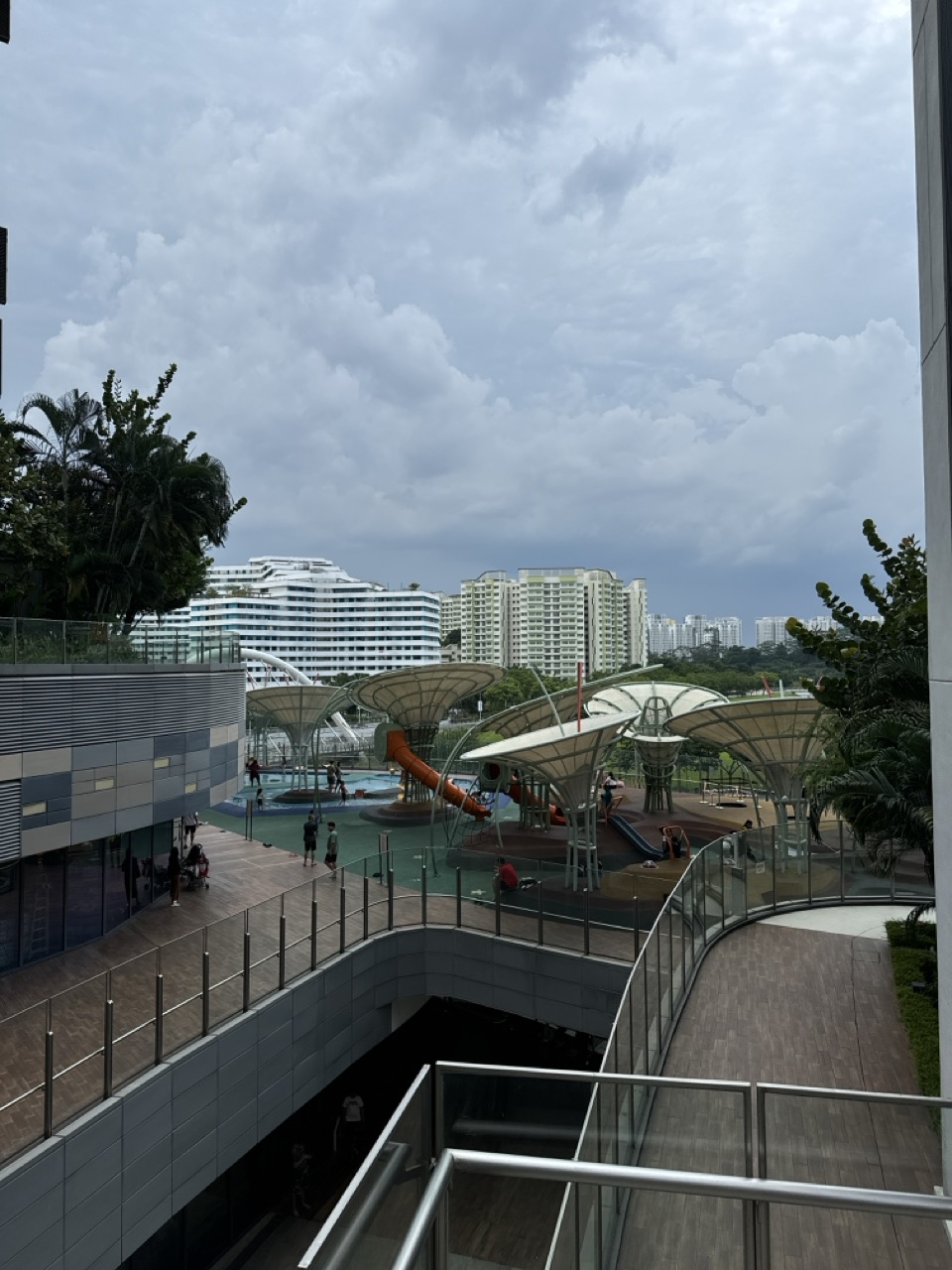
Waterway Point Happy Park: an outdoor rooftop wet-and-dry playground
Frasers Property has described Happy Park at Waterway Point as a Level 2 rooftop wet-and-dry playground, with terraced dry-play areas and water features. Its outdoor setting is easy to misunderstand because the playground is attached to a shopping mall. Going to the mall does not make the rooftop playground an enclosed, filtered indoor room. When outdoor activity restrictions apply, the family should not assume the wet-play area is a protected substitute.
Check the mall’s own current information for opening, maintenance and operation of individual play facilities. Do not copy opening hours from an old holiday promotion, or claim that every feature is active on 17 October 2026. If an outdoor playground is unsuitable, an indoor family activity at the mall may be another choice, subject to access and the actual indoor environment. The point is to choose the right space, not just the right building name.
What about the playground right below a Punggol HDB block?
A neighbourhood play area may be only a short lift ride from home, which reduces travel. But an unsheltered or open-sided HDB playground is still exposed to outdoor air even if several tall flats surround it. A void deck is more sheltered from rain and direct sun, yet is not generally a sealed air-cleaned environment. Do not tell children that an open-sided area has ‘indoor air’ just because there is a ceiling.
For genuinely discretionary play, the parent can compare the current advisory against the child’s age and health. Some families may choose a brief lower-intensity activity when the guidance permits, while others will postpone. Avoid turning a simple visit into prolonged strenuous play when the advisory recommends limiting exertion. Building management may also issue site-specific instructions; respect them.
Does a covered slide, bridge or tree canopy help with haze?
Shade helps reduce exposure to direct sun and can make the temperature feel more comfortable. Trees and vegetation are valuable for the environment, but their presence does not create a guaranteed clean-air bubble. Fine haze particles travel with regional winds through open park spaces. A sheltered bridge may offer rain protection without the filtration of a properly managed enclosed indoor room.
A parent must separate the risks: heat and sun, rain and lightning, fine-particle pollution, and ordinary playground equipment safety. A well-shaded place may still be unsuitable for strenuous play when PM2.5 is high. Conversely, low PM2.5 does not justify playing outdoors during a thunderstorm. Respect each hazard on its own terms.
Water play: the child can breathe outdoor air while splashing
Wet playgrounds are often perceived as cooler and more comfortable. Yet fountains do not remove haze particles from the wider atmosphere, and a child may still run and splash energetically. If MOH’s current guidance recommends reducing or avoiding the intended outdoor activity, standing near spray features is not a workaround. Parents should also follow venue rules on supervision, hygiene, footwear and any water-play operating restrictions.
A lower-intensity indoor water-themed game may be an option: use cups, toys and a waterproof tray in a safe supervised setting without deliberately creating humidity or wet electrical hazards. The goal is to preserve sensory exploration while avoiding unnecessary outdoor exposure. A family should not assume that wet surfaces make inhaled smoke harmless.
Age 2, 5 and 10: three different playground days
A two-year-old may need close adult supervision, frequent breaks and help communicating discomfort. A five-year-old may alternate slides with fast running. A ten-year-old may turn an ordinary playdate into vigorous games. These behaviours affect effort and duration. Children with asthma or other conditions may need advice and a more conservative plan regardless of age.
The caregiver’s duty is not to convert every family into a medical risk calculation. It is to understand the real play activity, read current public guidance and notice whether the child is comfortable. There is no universal safe playground duration that can be promised for every PM2.5 value and every child’s health. When unsure, a flexible indoor plan is easier than an argument over the clock.
Preschool haze rules are not the same as a neighbourhood gate
ECDA says preschools should use the next-day 24-hour PSI forecast for advance planning and one-hour PM2.5 for immediate adjustments. On 9 October 2026, Singapore agencies described more stringent measures at Very Unhealthy air levels, including stopping preschool outdoor activities and strenuous indoor exertion. These are institutional safeguarding requirements. They do not automatically create a legal closure order for every unfenced HDB playground in the town.
A child’s own preschool may contact parents directly and adjust outdoor play. A neighbour’s forwarded preschool notice should not be treated as proof that a mall, a student care centre and a school playground have all made the same decision. Use the correct institution’s message and follow MOH’s public guidance for ordinary family choices.
After-school children also need a clear plan
A Primary 2 pupil leaving lessons and attending student care may have a scheduled outdoor game. If current conditions make strenuous exposure unsuitable, the provider may adapt its programme and communicate with parents under its own operating rules. A separately operated student care centre is not automatically subject to precisely the same procedures as a preschool. Verify its actual notice and safe pickup arrangements.
A useful family message names the child, the operator’s updated activity and who is collecting them. Avoid vague announcements such as ‘all Punggol playgrounds closed because PSI high’ unless a responsible agency really made that announcement. The Punggol Haze Student Care Guide provides the detailed afternoon handover questions.
What if a child coughs or rubs their eyes at the playground?
Short-term haze exposure can irritate the eyes, nose and throat, and people with chronic lung disease may develop more serious symptoms. Stop the outdoor activity if the child feels unwell, take them to a suitable lower-exposure environment, follow any prescribed medical plan and seek advice when needed. Significant or worsening breathing difficulty warrants prompt medical attention and severe symptoms need urgent care.
Do not diagnose the cause simply because the child was outdoors. Allergy, a cold and other problems can overlap with a haze episode. Tell a healthcare professional what happened and what symptoms you observed. The Punggol health guide describes warning signs and the role of personal medical advice; this page is about playground choices and routines.
Should a child wear an N95 for outdoor playground play?
MOH emphasises reducing outdoor exposure and physical effort during worse haze rather than using a mask to justify continued strenuous activity. Proper respirator fit varies, and adult-sized N95 masks do not automatically fit young children. A tight-fitting respirator can also be uncomfortable for some wearers. It is not a licence to turn a vigorous playground session into a safe one at any air-quality band.
Instead of relying on protective equipment alone, parents can change location, duration or intensity and follow their child’s medical guidance. If a school or care provider supplies specific mask advice under official measures, ask for those instructions directly. Never improvise a homemade respirator seal around a toddler’s face to continue optional outdoor play.
Where can children play indoors around Punggol?
Families can consider appropriate enclosed spaces such as a library, a shopping mall interior, a confirmed indoor play facility, or their own living room. The choice depends on the child’s age, venue rules, availability, accessibility and cost. The existence of a mall or community hub does not certify a particular play area as actively operating, free of charge or equipped with a specific air-filtration system.
For example, the Punggol Regional Library at One Punggol offers reading and child-friendly learning spaces, while Waterway Point has shopping and dining options. SAFRA Punggol operates play facilities under its own rules and bookings. Verify current opening hours and availability before travelling. The Punggol indoor family planner provides short and longer itineraries; this article focuses on the playground decision.
Five indoor play activities that do not require intense exercise
A toddler can build a bridge from blocks, sort coloured objects or listen to a story. A preschooler may enjoy a low-key treasure hunt, an obstacle model using cushions without jumping dangerously, or drawing the Waterway’s bridges. An older child can create a mini-park plan, practise storytelling with toy figures or design a board game. These can preserve imagination and parent-child connection without demanding indoor high-intensity exercise.
Parents do not need an expensive educational kit for a one-day substitution. Keep the space safe, supervise age-appropriate toys and protect neighbours from noisy jumping in an HDB flat. If children are unwell, quiet rest may be preferable to a full replacement activity. Missing one outdoor play session does not derail healthy development.
How to keep a cancelled playdate friendly
A child’s disappointment is understandable when friends have already planned to meet at Happy Park or Punggol Waterway Park. A short explanation can help: ‘The outdoor air isn’t suitable for the running we planned today, so we’re switching to a quieter activity and we can return later.’ Avoid frightening a young child with exaggerated descriptions of smoke poisoning or making them obsess over readings.
For an organised playdate, tell the other parents whether the meeting point and time changed and confirm that the alternative venue is genuinely available. Do not surprise families with entry fees, an unsuitable group size or a facility that is closed. A simple indoor craft activity at home can be enough if everyone agrees. The Punggol Playdate Planner covers the broader family-coordination problem.
What counts as prolonged or strenuous play?
MOH describes prolonged exposure as continuing for several hours and strenuous activity as involving considerable energy or effort. Children’s play can range from sitting with sand to repeated running and climbing. A short outdoor walk through a park is not identical to a full morning at a playground. Personal susceptibility still matters, particularly for children with respiratory conditions.
Do not create a rigid table saying every three-year-old can safely play 20 minutes at one numerical value. The official health guidance is broader and child circumstances differ. If an outdoor plan is not clearly appropriate, postpone or choose an indoor alternative. The family can enjoy the same slide, swings or play area on a later day when conditions are more suitable.
Lightning, rain and heat do not disappear when PM2.5 falls
Punggol is tropical, so an ordinary playground trip also involves rain, wet equipment, sun and thunderstorm risk. A low PM2.5 band is not a permission to play beside an exposed metal climbing frame during lightning. A shaded playground helps with sun but cannot guarantee adequate cooling during high heat stress. Water features may be shut for maintenance or storms even when the air seems clear.
Before leaving, check the weather and actual venue information. Keep shoes and clothing appropriate to the play structure and make sure a young child knows they cannot enter an unsafe area just because other people are there. Haze is one part of safe outdoor play, not the only one.
A good Plan B is not an exhausting trip across Singapore
From Punggol MRT and the LRT loops, families can reach several local amenities without going far. A fallback should take account of the child’s age, the stroller or wheelchair situation, waiting time and the route back home. Spending an hour outdoors in transit to reach an indoor play space may defeat the original intention of limiting exposure.
Pick one realistic destination with known access, a sensible departure and enough indoor comfort. On a worse day, staying at home may be the simplest option. A child can return to the Punggol waterfront once the official advice and their health support outdoor play; there is no need to demonstrate parental dedication through a long complicated substitute itinerary.
Worked example: a Saturday Happy Park playdate
Imagine three families have arranged a 10am Saturday playdate at Waterway Point’s Happy Park. The parents check the latest one-hour PM2.5 and MOH’s advice. They realise the outdoor rooftop play, especially repeated running and water play, is not a suitable plan for some children that morning. They contact the group and switch to a confirmed indoor activity at a realistic venue, or postpone.
They do not claim that Happy Park was officially shut unless its operator says so. They also do not assume the rooftop becomes safe because the park is attached to an air-conditioned mall. The children have a shorter but happy morning. This case illustrates the right sequence of decisions without inventing a real venue closure.
Worked example: a HDB playground after dinner
A parent returns home from work and a preschooler asks to visit the small playground downstairs. The adult reads the current PM2.5 band rather than reusing the noon screenshot. If advice and the child’s condition support a short ordinary outing, the parent plans a comfortable route and stops if needed. If the reading is unsuitable, the family builds a pretend playground with soft blocks at home.
The response is calm, proportionate and consistent. The child learns that a planned activity can move without becoming a disaster. Parents need not invent a numerical safe duration or ask the neighbourhood chat whether all children are allowed outside. Current public guidance and the particular child’s health are enough to choose sensibly.
Frequently asked questions: Punggol haze playgrounds
Is Punggol Waterway Park an indoor haze shelter? No. Does a roof above a HDB play area filter smoke? Not in general. Is Waterway Point Happy Park indoors? Frasers Property describes it as a rooftop wet-and-dry playground. Does a fountain make the air cleaner? Do not assume so. Should preschoolers obey the same caution as healthy adults? MOH gives age- and vulnerability-sensitive guidance.
Do ECDA preschool rules automatically close all playgrounds? No; institutional programme rules and public park access differ. Do children have to wear an N95 to play? An N95 is not a substitute for following activity restrictions. Can a family still visit an indoor mall? Consider current guidance, health and the specific venue. When should we try the playground again? When current air, weather, health and actual access make it appropriate.
Play can change location without losing its value
Punggol has a generous supply of playgrounds, green spaces and family destinations. Haze sometimes changes the best choice for the day, but the underlying need to play, connect and learn can still be met. An indoor story, a board game or a few minutes building together may be every bit as memorable as a trip to a slide.
The long-term habit worth teaching children is simple: enjoy outdoor life when it is suitable, take public health advice seriously, and know how to make a pleasant Plan B. The park will still be there after the sky clears.
Punggol playground choices during a haze day
| Location or idea | Is it enclosed indoor air? | What parents should do |
|---|---|---|
| HDB downstairs playground | Usually outdoors or open-sided | Use the latest PM2.5, child’s health and actual activity intensity |
| Punggol Waterway Park | No, outdoor park | Check air, weather and park rules; postpone if needed |
| Waterway Point Happy Park | Rooftop wet-and-dry outdoor play | Confirm operating status; do not confuse rooftop with filtered mall interiors |
| Regional Library or suitable indoor venue | Enclosed space, with its own arrangements | Confirm admission, hours, suitability and child supervision |
| Living-room calm play | Indoor household environment | Keep appropriate ventilation/filtration, child-safe play and a relaxed routine |
More Punggol family and haze guides
- Haze check for the current hour
- Best Playgrounds in Punggol 2026
- Punggol Playdate Planner
- Active Play for Primary School Children
- Indoor venues in Punggol during haze
- 30-, 60- and 120-minute indoor plans
- Quiet HDB exercise for families
- Student care pickup and activity changes
- Schools, PE and CCAs during haze
- eduKateSG: Punggol haze family weekends
Official sources and boundaries
- MOH: 2026 haze activity and child health guidance
- NEA: one-hour PM2.5 and 24-hour PSI
- ECDA: how preschools plan and modify outdoor activities
- NParks: Punggol Waterway Park facilities and opening
- NParks: Find a playground
- Frasers Property: Waterway Point Happy Park rooftop wet and dry design
- Waterway Point: operator information and updates
- SportSG: Haze management for sports facilities
Reviewed 17 October 2026. Venue status, exact playground operating hours and local conditions may change. This is a practical family guide, not an announcement of closures, a child-specific medical assessment or a claim that a pictured scene represents current haze.


