
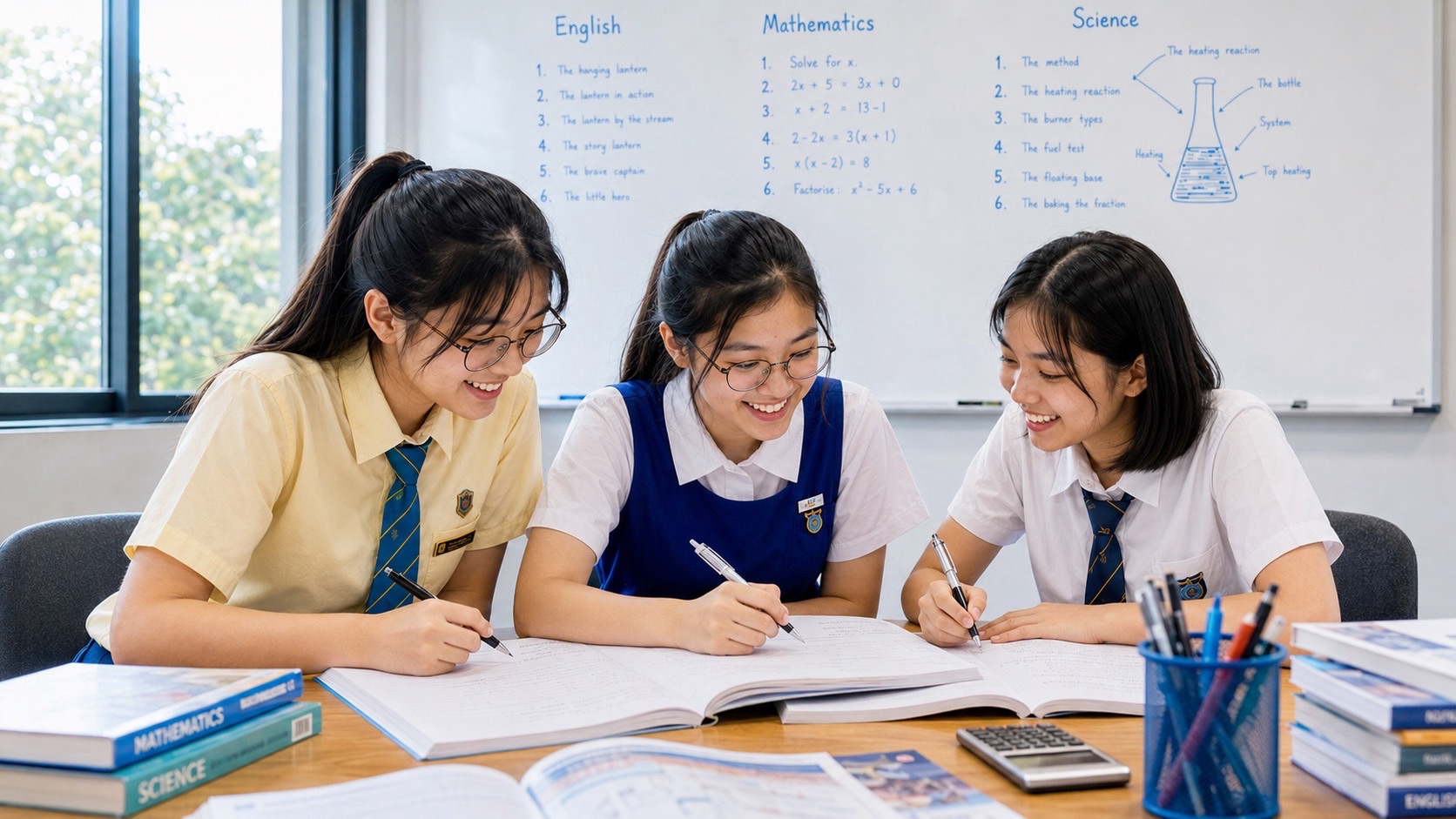
21st Century Skills for students in Punggol are not a fashionable add-on to English, Mathematics, Science and the rest of school. They are the capabilities that help students use knowledge when the situation is unfamiliar: thinking critically, adapting, communicating, collaborating, solving problems, managing themselves, using technology responsibly and continuing to learn when the syllabus changes.
That is the core aim of Punggol education through 21st Century Skills: help students turn subject knowledge into independent capability that still works when the problem changes, the instructions are incomplete and the future does not look exactly like the past. Strong grades remain useful, but grades become much more powerful when students can think, explain, decide, create, work with others and keep learning beyond the paper.
The Core Aim in One Sentence
21st Century Skills mean using knowledge with judgment, communication, adaptability, responsibility and self-management in situations that are not fully scripted.
The phrase covers many capabilities, but the educational principle is simple: knowing matters, and knowing what to do with what you know matters too.
Did You Know? The Future-Ready Skill Is Often a Combination, Not a Single Skill
Real tasks rarely test one capability at a time.
A school project may require research, writing, teamwork, time management and presentation. A Science investigation may require measurement, critical thinking, collaboration and communication. A career decision may require information literacy, self-awareness, financial literacy and judgment.
That is why 21st Century Skills should be taught as a connected system rather than a checklist of isolated traits.
The Core Skill Families
1. Critical, Adaptive and Inventive Thinking
Students need to evaluate claims, recognise patterns, solve unfamiliar problems, generate alternatives and adjust when the first plan fails.
These capabilities connect directly to:
2. Communication, Collaboration and Information Skills
Students need to explain ideas clearly, listen, work with others and judge the quality of information they encounter.
These capabilities connect to:
3. Civic, Global and Cross-Cultural Literacy
Students need to understand that they live and work among people with different experiences, responsibilities and perspectives.
They should be able to participate constructively in school, community and wider society without losing the ability to think independently.
4. Digital and AI Literacy
Modern students need to use technology confidently without outsourcing judgment.
These capabilities connect to:
5. Self-Management and Lifelong Learning
Students need to set goals, manage time, regulate attention, recover from setbacks and keep learning independently.
These capabilities connect to:
21st Century Skills Are Not a Replacement for Knowledge
Students cannot think critically about a topic they know nothing about.
Creativity needs raw material. Problem solving needs concepts and methods. Communication needs language. Research needs background knowledge. Digital literacy needs enough subject understanding to recognise when a tool is wrong.
The strongest education therefore combines knowledge + capability, not one instead of the other.
Knowledge Gives Skills Something to Work With
A student with strong vocabulary can communicate with more precision. A student with strong Mathematics foundations can model more complex problems. A student with rich Science knowledge can ask better experimental questions.
This is why the best 21st Century Skills education still takes subject mastery seriously.
The 21st Century Skills Mistake: Turning Skills Into Posters
Schools and families sometimes talk about creativity, collaboration and critical thinking as values without building the conditions in which students actually practise them.
A poster that says “Think Critically” does very little by itself.
Students need tasks that require them to:
- compare evidence;
- justify choices;
- solve unfamiliar problems;
- work with other people;
- revise after feedback;
- communicate clearly;
- make decisions with consequences.
Capability grows through use.
The Other Mistake: Treating Skills as Natural Personality Traits
Some children appear naturally confident, creative or organised. That does not mean these capabilities are fixed.
Students can become better at communication, planning, collaboration, research and decision making through deliberate practice.
The educational question is not “Does this child have the trait?” It is “What practice would strengthen the capability?”
21st Century Skills in Primary School
Primary-school students should build these capabilities through concrete experiences.
- Explain a Mathematics method to a classmate.
- Investigate why a familiar Science phenomenon happens.
- Plan a small project.
- Compare two sources.
- Take responsibility for packing and deadlines.
- Work with a partner and divide roles.
- Present an idea clearly.
The goal is not to turn children into miniature executives. It is to build the first habits of thoughtful participation.
21st Century Skills During PSLE Years
PSLE preparation can feel narrow because the examination is important, but many 21st Century Skills still improve exam performance.
Students benefit from:
- critical reading;
- problem solving;
- time management;
- self-regulation;
- confidence;
- error analysis;
- independent revision;
- clear communication.
The examination may be traditional, but the capabilities required to prepare well are not.
21st Century Skills in Secondary School
Secondary school expands the need for independent judgment.
Students encounter subject combinations, CCAs, project work, devices, group tasks, more complex assessments and post-secondary decisions.
This is where 21st Century Skills begin to operate as a genuine personal system rather than isolated classroom behaviours.
Critical Thinking
Critical thinking means asking whether a claim deserves to be believed.
Students learn to distinguish evidence from assertion, identify assumptions, compare explanations and notice where confidence exceeds the available evidence.
See The Core Aim of Punggol Education | Critical Thinking.
Problem Solving
Problem solving begins when the answer is not obvious.
Students need to define the problem, represent it, choose a strategy, execute, verify and adapt.
See The Core Aim of Punggol Education | Problem Solving.
Creativity
Creativity is not merely artistic flair.
It is the ability to generate useful possibilities, combine ideas, work within constraints and improve through iteration.
See The Core Aim of Punggol Education | Creativity.
Adaptability
Adaptability means changing strategy without losing direction.
Students who adapt can recover when a familiar method stops working, a timetable changes or a new tool appears.
See The Core Aim of Punggol Education | Adaptability.
Communication Skills
Students need to explain ideas to different audiences, listen carefully and repair misunderstandings.
See The Core Aim of Punggol Education | Communication Skills.
Collaboration Skills
Collaboration is more than dividing a project into pieces.
Students need shared goals, accountability, role clarity and enough communication that the final work becomes coherent.
See The Core Aim of Punggol Education | Collaboration Skills.
Leadership Skills
Leadership means responsible influence.
Students build leadership when they coordinate people, make decisions, communicate expectations and take responsibility for outcomes.
See The Core Aim of Punggol Education | Leadership Skills.
Decision Making
Decision making turns thinking into action.
Students learn to define options, gather evidence, compare trade-offs and review consequences.
See The Core Aim of Punggol Education | Decision Making.
Media and Information Literacy
Students need to navigate a world of headlines, feeds, screenshots, persuasive messages and abundant information.
They should know how to slow down, inspect sources and distinguish popularity from credibility.
See Media Literacy and Information Literacy.
Research Skills
Research teaches students to move from a question to a defensible answer through evidence.
See The Core Aim of Punggol Education | Research Skills.
Digital Literacy
Digital literacy means using technology safely, critically and effectively.
Students need to manage devices, information and online behaviour rather than being managed by them.
See The Core Aim of Punggol Education | Digital Literacy.
AI Literacy
AI literacy adds an important modern layer: students need to understand that fluent output can still be wrong, important claims need verification and human responsibility remains.
See The Core Aim of Punggol Education | AI Literacy.
Self-Regulation
21st Century Skills fail if students cannot manage their own attention, time and effort.
Self-regulated learners know how to set goals, monitor progress, seek help and adjust.
See The Core Aim of Punggol Education | Self-Regulated Learning.
Confidence and Resilience
Future-ready students need enough confidence to attempt unfamiliar work and enough resilience to recover when the first attempt fails.
See Confidence and Resilience.
Financial Literacy
Students eventually need to understand trade-offs, spending, saving and risk.
Financial literacy is a practical combination of Mathematics, judgment and responsibility.
See The Core Aim of Punggol Education | Financial Literacy.
Career Readiness
Career readiness integrates many 21st Century Skills into future study and work.
Students need transferable skills, pathway literacy, self-knowledge and lifelong-learning ability.
See The Core Aim of Punggol Education | Career Readiness.
The Skills Stack
One useful way to think about future readiness is as a stack:
- Foundation — literacy, numeracy, subject knowledge.
- Learning — memory, study skills, metacognition, self-regulation.
- Thinking — critical thinking, problem solving, creativity, decision making.
- Working With Others — communication, collaboration, leadership.
- Navigating Information — research, digital, media and AI literacy.
- Managing Life — responsibility, financial literacy, time management, wellbeing.
- Continuing Forward — adaptability, career readiness and lifelong learning.
The stack becomes more powerful because each layer supports the others.
21st Century Skills in the Age of AI
AI can produce text, images, code and explanations quickly. That changes what students need to practise.
The most valuable learners will not simply be those who can generate output. They will be those who can:
- define the right problem;
- ask useful questions;
- verify claims;
- judge quality;
- communicate decisions;
- work with others;
- take responsibility;
- keep learning as tools change.
AI increases the value of judgment because production becomes cheaper.
The Human Advantage Is Not One Skill
Students sometimes hear that “creativity” or “critical thinking” will save them from automation.
The stronger view is that human advantage comes from combinations: domain knowledge + judgment + communication + responsibility + adaptability.
The future-ready student is not anti-technology. They are capable enough to use technology without becoming dependent on it.
How Parents Can Build 21st Century Skills
- Ask children to explain their thinking.
- Give them age-appropriate responsibility.
- Let them make small decisions.
- Encourage questions.
- Use real household problems.
- Discuss media and online claims.
- Let children collaborate on family tasks.
- Praise evidence, strategy and recovery.
- Model lifelong learning.
Parents do not need a special curriculum. Many of these capabilities grow through ordinary family life when children are given meaningful participation.
How Tutors Can Build 21st Century Skills
- Ask for reasoning, not only answers.
- Use unfamiliar applications.
- Require students to explain and defend methods.
- Include collaborative tasks where appropriate.
- Make students check sources.
- Fade prompts.
- Use reflection after mistakes.
- Connect academic content to real problems.
At eduKatePunggol, tuition reaches beyond worksheets when students become more capable of thinking, communicating and learning without constant support.
What Progress Looks Like
21st Century Skills progress is visible when students:
- ask better questions;
- explain ideas more clearly;
- work more independently;
- adapt when conditions change;
- verify information;
- collaborate responsibly;
- use digital and AI tools intelligently;
- manage time and attention better;
- make more thoughtful decisions;
- connect school knowledge to unfamiliar problems.
A Simple 21st Century Skills Routine
- Know — what knowledge does this task require?
- Question — what is unclear?
- Think — what evidence or strategy fits?
- Communicate — can I explain the idea?
- Collaborate — who else is involved?
- Check — is the information trustworthy?
- Adapt — what changes if the first plan fails?
- Reflect — what capability did I build?
Frequently Asked Questions
What are 21st Century Skills for students?
They are capabilities such as critical thinking, problem solving, communication, collaboration, creativity, digital literacy, self-management, adaptability and lifelong learning.
Are 21st Century Skills more important than academic subjects?
No. They work together. Strong knowledge makes higher-level skills more powerful, and strong skills help students use subject knowledge effectively.
How can parents teach 21st Century Skills?
Give children real responsibilities, ask for reasoning, discuss trade-offs, encourage questions and let them solve age-appropriate problems rather than supplying every answer.
How does AI affect 21st Century Skills?
AI makes some forms of production faster, which increases the importance of problem definition, verification, judgment, communication, responsibility and adaptability.
Do 21st Century Skills help with exams?
Yes. Critical reading, self-regulation, time management, confidence, problem solving and communication all improve how students prepare and perform.
What is the strongest sign of 21st Century capability?
The student can use knowledge independently in an unfamiliar situation, explain the reasoning, adapt when necessary and remain responsible for the outcome.
Useful Routes for Punggol Families
- eduKatePunggol home — local education, tuition, parent, student and pathway routes.
- The Core Aim of Punggol Education | Critical Thinking.
- The Core Aim of Punggol Education | Communication Skills.
- The Core Aim of Punggol Education | Collaboration Skills.
- The Core Aim of Punggol Education | Creativity.
- The Core Aim of Punggol Education | Adaptability.
- The Core Aim of Punggol Education | Career Readiness.
- Developing a 21st-Century Singapore Student.
- MOE 21st Century Competencies.
- Punggol Atlas.
The Best Future-Ready Student Is Not the One Who Knows the Future
Nobody can predict every technology, industry or challenge a child will face.
That is the core aim of Punggol education through 21st Century Skills: help students build enough knowledge, judgment, communication, adaptability and learning capacity that they can remain capable even when the future refuses to follow the script.
Properly taught kids shine a bright light into the future.


