
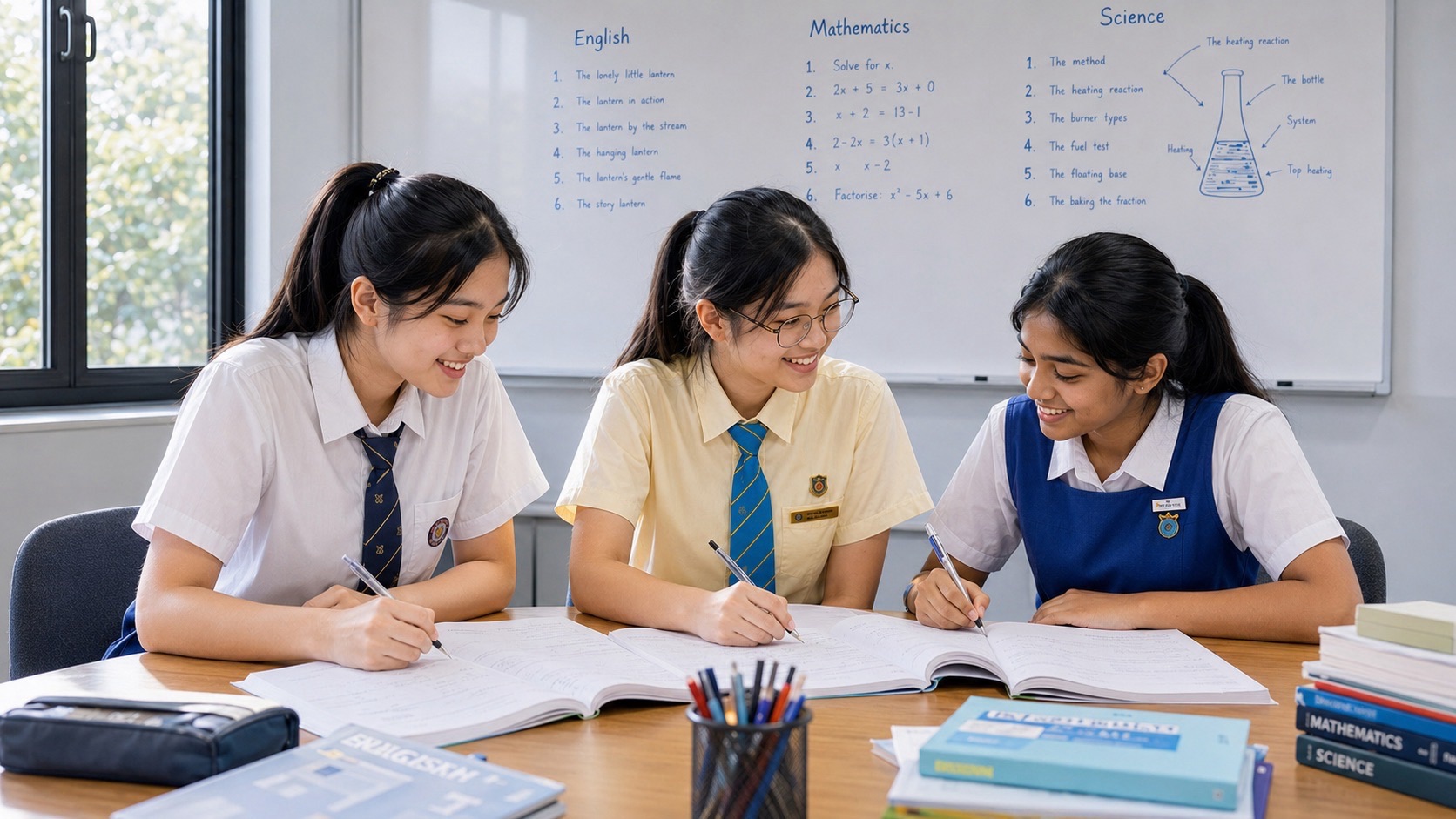
Research skills for students in Punggol matter because school increasingly asks learners to do more than remember an answer. They need to find information, decide which sources deserve trust, compare evidence, organise notes, ask better questions, explain what the evidence supports and communicate a conclusion clearly. These skills appear in Science inquiry, project work, English, Humanities, presentations and increasingly in everyday life.
That is the core aim of Punggol education through research skills: help students move from “searching for information” to building a disciplined answer from a clear question, reliable evidence, careful reasoning and transparent sources. Good research is not about collecting the most links. It is about knowing what question you are answering and why the evidence you chose deserves to support it.
The Core Aim in One Sentence
Research skills mean asking a worthwhile question, finding relevant evidence, evaluating it carefully, organising what matters and producing a conclusion that can be checked.
The student should be able to explain not only what they found, but how they know.
Did You Know? Searching Is Only One Small Part of Research
Students often begin research by opening a search engine and typing the assignment title. That is understandable, but it can create a pile of disconnected information before the question is properly defined.
Strong research begins earlier.
The first task is to clarify:
- What exactly am I trying to find out?
- What kind of evidence would answer that question?
- Which terms should I search?
- Which sources are likely to be authoritative?
- How will I know when I have enough?
The Seven-Part Research Cycle
1. Define the question
A weak question is too broad: “Tell me about climate change.”
A stronger question narrows the task: “How does urban design affect heat exposure in dense residential areas?”
The sharper the question, the easier it becomes to search intelligently.
2. Build search terms
Students should identify the important concepts in the question and generate useful variants.
For example, a topic on water quality might use combinations such as:
- water quality indicators;
- dissolved oxygen;
- urban waterways;
- runoff pollution;
- aquatic ecosystems.
Good search terms are not simply copied from the assignment title.
3. Find sources
Students should search across appropriate source types rather than relying on the first result.
Depending on the task, useful sources may include official agencies, textbooks, academic publications, established educational sites, reputable news organisations, primary documents and carefully verified databases.
4. Evaluate credibility
Every source should be tested.
- Who created it?
- What expertise do they have?
- When was it published or updated?
- What evidence is provided?
- Is the purpose to inform, persuade or sell?
- Can important claims be checked elsewhere?
This connects directly with The Core Aim of Punggol Education | Information Literacy.
5. Take selective notes
Research notes should capture evidence, source details and relationships — not simply copy paragraphs.
See The Core Aim of Punggol Education | Note-Taking Skills.
6. Synthesize
Synthesis means combining information from several sources into one coherent understanding.
The student asks: what do these sources agree on, where do they differ, and what conclusion is justified by the combined evidence?
7. Communicate transparently
The final product should distinguish the student’s own reasoning from sourced information and make important sources traceable.
Research Begins With a Better Question
Strong research questions are usually focused enough to investigate, open enough to require thought and specific enough to guide evidence collection.
Useful question forms include:
- What causes…?
- How does… affect…?
- What evidence supports…?
- How do two approaches differ?
- Which factors explain…?
- Under what conditions does…?
- What are the trade-offs between…?
Questions that can be answered with one copied sentence rarely produce deep research.
Curiosity and Research
Curiosity opens the door to research.
A curious student notices something unexplained and wants to know more. Research adds discipline: define the question, gather evidence and test the answer.
See The Core Aim of Punggol Education | Curiosity.
Research and Critical Thinking
Research without critical thinking becomes information collection.
Students need to distinguish:
- claim from evidence;
- correlation from causation;
- example from proof;
- strong source from weak source;
- plausible explanation from demonstrated explanation.
See The Core Aim of Punggol Education | Critical Thinking.
Research and Information Literacy
Information literacy asks whether the student can locate, evaluate and use information responsibly.
Research skills take that capability into a larger workflow: the learner uses information to answer a defined question.
The two should reinforce one another rather than become separate school topics.
Research and Note-Taking
Research often fails in the notes stage because students copy too much and lose the source trail.
A useful research note includes:
- source title or link;
- main claim;
- supporting evidence;
- important quotation only when necessary;
- the student’s own interpretation;
- how the source connects to the question.
That makes later writing far easier because the student knows where each idea came from.
Research in Primary School
Primary students can learn research through small, guided investigations.
For example:
- find three reliable facts about an animal;
- compare two explanations of a natural phenomenon;
- observe a local environment and record patterns;
- read two sources and identify what they agree on;
- write one question that still remains.
The goal is not to turn young children into miniature academics. It is to teach the habits of asking, checking and explaining.
Research During PSLE Years
PSLE itself is not a research exam, but research skills still strengthen learning.
Students can use research to build background knowledge for English, deepen Science understanding and connect school concepts to real-world examples.
The important boundary is time: research should support core learning rather than become an elaborate side project during a heavily scheduled revision period.
Research in Secondary School
Secondary students encounter more opportunities for projects, presentations, source work and independent inquiry.
They need to become more deliberate about:
- search strategy;
- source credibility;
- citation;
- evidence comparison;
- bias and perspective;
- data interpretation;
- group research roles;
- academic integrity.
These skills prepare them for post-secondary learning, where independent research becomes increasingly important.
Research in Science
Science research is structured by questions, evidence and testable explanations.
Students can investigate local phenomena such as water, heat, biodiversity, materials, energy use or transport patterns.
The local article Punggol Science Inquiry | Turn the Family’s Actual Environment Into Evidence, Questions and Reports shows how the neighbourhood itself can become a source of scientific questions.
Research in English
English research appears when students gather background knowledge, compare viewpoints, prepare presentations or support argumentative writing.
The key is to avoid copying source language. Students should understand the material first, then explain it in their own structure and vocabulary.
Research in Humanities
Humanities research requires sensitivity to perspective.
Two sources may describe the same event differently because they were created by different people, for different audiences, at different times and for different purposes.
Students should ask not only “What does the source say?” but “Why does this source say it this way?”
Research in Mathematics
Mathematics research can include exploring patterns, comparing solution methods, analysing data or investigating how a model changes when assumptions change.
The goal is not simply to search for a final numerical answer. It is to understand the structure well enough to test and explain it.
The Research Mistake: Using the First Search Result
Search rankings are not quality rankings.
The first result may be useful, irrelevant, commercial, outdated or simply well optimised.
Students should inspect the source itself rather than assuming position equals authority.
The Other Research Mistake: Collecting Too Many Sources
More sources do not automatically create better research.
Students can become overwhelmed by twenty weak sources when five strong sources would answer the question more clearly.
The better question is: What evidence is still missing?
Primary Sources and Secondary Sources
Students should gradually understand the difference.
Primary sources are original materials such as data, interviews, official records, original research, photographs or historical documents.
Secondary sources interpret, summarise or analyse primary material.
Both can be valuable. The important thing is knowing what role each source is playing.
The Source Ladder
A practical source ladder asks students to move from lower-confidence material toward stronger evidence when the claim matters more.
- informal explanation;
- established educational source;
- reputable news or reference source;
- official institution;
- original research or primary document.
Not every homework fact needs a journal article. Research skill includes matching source strength to the importance of the claim.
Research and Bias
Bias does not automatically mean a source is useless.
It means the student should understand perspective and incentives.
Useful questions include:
- Who benefits if I believe this?
- What information is emphasised?
- What is omitted?
- Would another stakeholder describe this differently?
- Does the evidence still hold when the framing changes?
Research and Data
Students should be cautious with numbers.
Ask:
- What exactly is being measured?
- Who was included?
- What time period does the data cover?
- Is the sample large enough?
- Is the graph scale misleading?
- Does the number support the conclusion being claimed?
Data can look authoritative while still being interpreted badly.
Research and Collaboration
Group research works best when roles are clear.
Useful roles may include:
- question lead;
- source finder;
- evidence checker;
- note organiser;
- writer or presenter.
But every member should understand the final argument. Dividing tasks should not create four isolated mini-projects.
See The Core Aim of Punggol Education | Collaboration Skills.
Research During School Project Week
Projects often combine research, group chats, deadlines, materials and presentation pressure.
The local guide What happens in Punggol | During School Project Week looks at how families can support the logistics without taking over the student’s work.
Research and Academic Integrity
Students should not present someone else’s words, ideas or generated work as though it were independently created.
They need to understand:
- when to paraphrase;
- when to quote;
- when to cite;
- how to keep source notes;
- how to distinguish assistance from authorship.
Academic integrity becomes more important, not less, when information is easy to obtain.
Research in the Age of AI
AI can accelerate research by suggesting search terms, explaining unfamiliar ideas, summarising material and helping organise notes.
But it also creates new risks:
- fabricated references;
- outdated facts;
- confident errors;
- missing context;
- oversimplified synthesis;
- untraceable claims.
The student should use AI as a research assistant, not as the final source of truth.
See The Core Aim of Punggol Education | AI Literacy.
A Strong AI-Assisted Research Workflow
- Define the question yourself.
- Ask AI for search terms or subquestions.
- Locate real sources.
- Read the important sources directly.
- Take your own notes.
- Use AI to compare or organise only after understanding.
- Verify all important claims.
- Write the conclusion in your own reasoning structure.
The student should be able to explain where the evidence came from even if the AI conversation disappears.
Research and Digital Literacy
Research increasingly happens online, so students need to manage browsers, documents, links, files and digital search tools efficiently and safely.
See The Core Aim of Punggol Education | Digital Literacy.
Research and Focus
Research can easily become endless browsing.
A student opens one source, follows three links, watches a video and forgets the original question.
A simple protection is to keep the research question visible at the top of the document.
See The Core Aim of Punggol Education | Focus and Concentration.
The Evidence Table
One useful student tool is an evidence table with four columns:
- Claim or subquestion;
- Evidence found;
- Source;
- What the evidence allows me to conclude.
This prevents sources from becoming a pile of disconnected notes.
The Two-Source Rule
For important factual claims, students can make it a habit to compare at least two reliable sources when practical.
Agreement does not automatically prove truth, but comparison can reveal discrepancies, outdated information or differences in interpretation.
The Stop Rule
Students need to know when research is sufficiently complete.
A sensible stop rule is reached when:
- the main question can be answered;
- important claims have adequate evidence;
- major conflicting evidence has been considered;
- new sources mostly repeat what is already known.
Without a stop rule, research can expand forever.
How Parents Can Support Research Skills
- Ask what the research question is before asking what the answer is.
- Encourage children to compare sources.
- Ask who created the source and why.
- Help younger students search safely without doing the research for them.
- Ask what evidence changed their mind.
- Encourage proper source tracking.
- Avoid writing or rewriting the final project yourself.
Parents can support the process while preserving ownership.
How Tutors Can Teach Research Skills
- Model how to narrow a question.
- Compare a strong source with a weak one.
- Teach search-term variation.
- Ask students to explain why a source is credible.
- Require source notes.
- Use evidence tables.
- Separate collection from synthesis.
- Ask students to defend the conclusion with traceable evidence.
At eduKatePunggol, research skills are strongest when students leave with a method they can reuse rather than one completed project.
What Progress Looks Like
Research-skill progress is visible when students:
- ask narrower questions;
- search with better terms;
- use stronger sources;
- compare information instead of copying;
- record sources consistently;
- take selective notes;
- distinguish claim from evidence;
- identify uncertainty;
- synthesize across sources;
- explain why the conclusion is justified.
A Simple Research Routine
- Question — what exactly am I trying to know?
- Terms — what should I search?
- Sources — where should I look?
- Evaluate — which sources deserve trust?
- Notes — what evidence matters?
- Compare — where do sources agree or conflict?
- Synthesize — what does the evidence collectively show?
- Cite — can another person trace the source?
- Reflect — what remains uncertain?
Frequently Asked Questions
What are research skills for students?
Research skills include defining a question, finding information, evaluating sources, taking notes, comparing evidence, synthesising ideas and communicating a traceable conclusion.
How can students improve research skills?
Practise narrowing questions, using better search terms, checking source credibility, recording source details and writing conclusions from evidence rather than from copied material.
How many sources should a student use?
There is no universal number. Use enough strong sources to answer the question, verify important claims and address meaningful disagreement. Quality matters more than quantity.
Can students use AI for research?
Yes, but AI should support the process rather than become the sole source. Students should locate and read real sources, verify important claims and keep ownership of the final reasoning.
What is the difference between research skills and information literacy?
Information literacy focuses on finding, evaluating and using information responsibly. Research skills use those abilities inside a larger process for answering a defined question.
What is the strongest sign of good research?
The student can explain the question, identify the strongest evidence, show where it came from and defend a conclusion that matches what the evidence actually supports.
Useful Routes for Punggol Families
- eduKatePunggol home — local education, tuition, parent, student and pathway routes.
- The Core Aim of Punggol Education | Curiosity.
- The Core Aim of Punggol Education | Information Literacy.
- The Core Aim of Punggol Education | Critical Thinking.
- The Core Aim of Punggol Education | Note-Taking Skills.
- The Core Aim of Punggol Education | AI Literacy.
- Punggol Science Inquiry.
- During School Project Week.
- Punggol Atlas.
The Best Research Leaves a Trail Another Person Can Check
Strong research is not a performance of certainty. It is a disciplined path from question to evidence to conclusion.
That is the core aim of Punggol education through research skills: help students become capable investigators who know what they are asking, why they trust the evidence and how far the evidence really allows them to go.
Properly taught kids shine a bright light into the future.


