
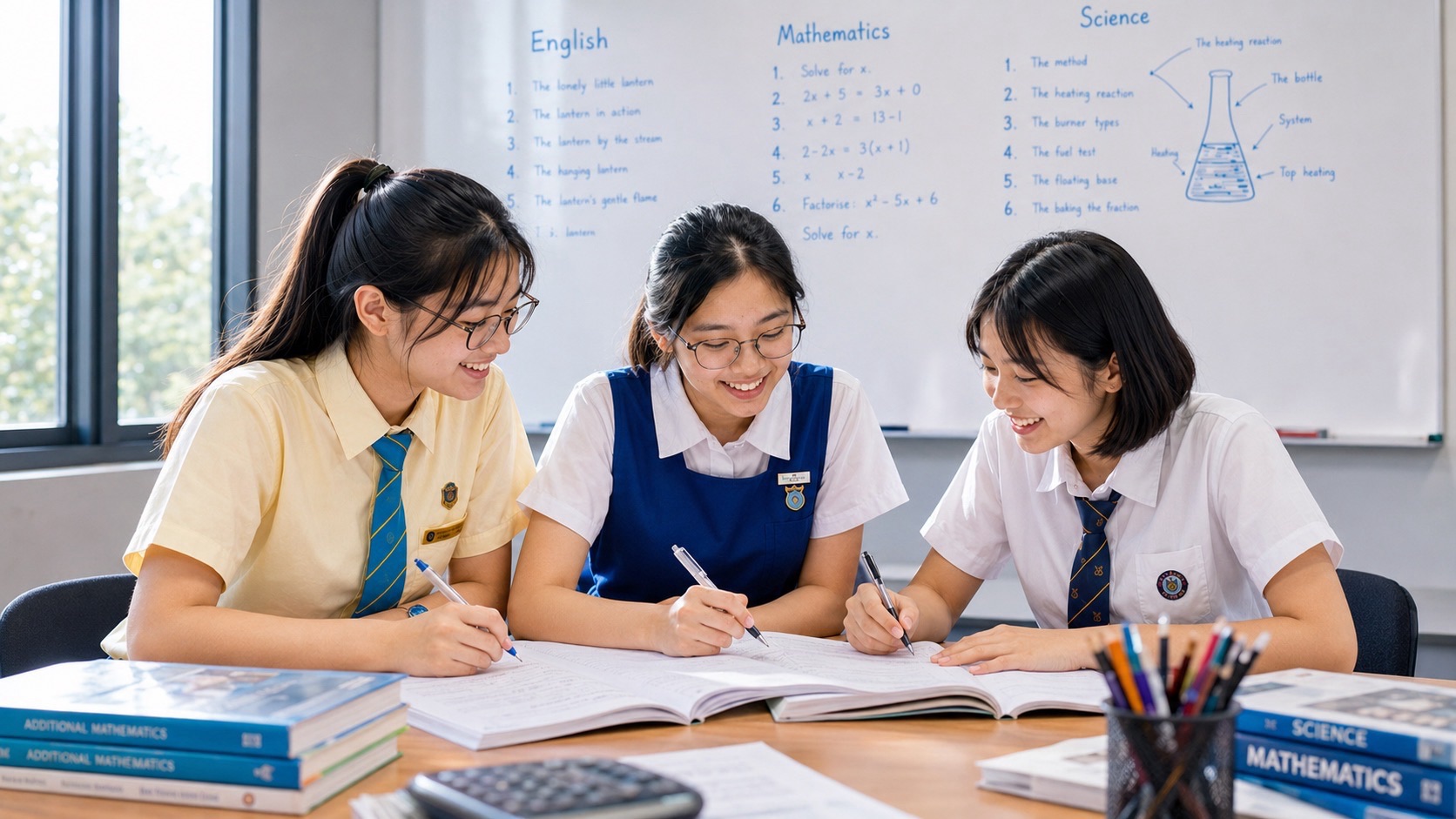
Digital literacy for students in Punggol is no longer just about knowing how to use a laptop, type quickly or open the right app. Students now live inside a world of search engines, social media, school platforms, personal learning devices, data, AI tools, online collaboration and an endless supply of information. The real skill is knowing how to find useful information, judge whether it deserves trust, use digital tools responsibly and create something worthwhile without becoming controlled by the technology itself.
That is the core aim of Punggol education through digital literacy: help students become confident, critical and responsible users of digital technology who can find, think, apply and create. Singapore’s EdTech Masterplan 2030 uses this Find–Think–Apply–Create frame to guide digital literacy and technological skills in schools. The point is not simply more screen time. It is better judgment with powerful tools.
Explore related education guides and choose your next reading step.
The Core Aim in One Sentence
Digital literacy means being able to use technology without surrendering thinking, responsibility or control.
A digitally literate student can search, verify, organise, communicate, create and solve problems with technology while still knowing when the tool is wrong, distracting, unsafe or unnecessary.
Did You Know? Digital Literacy Is Bigger Than Computer Skills
Computer skills answer questions such as: Can you operate the device? Can you use the software? Can you upload the file?
Digital literacy asks harder questions:
- Is this information trustworthy?
- Who created it and why?
- What data am I giving away?
- Is this tool helping me learn or replacing the learning?
- Should I share this?
- Can I verify this answer somewhere else?
- Am I using technology efficiently or simply spending more time on a screen?
The difference is the difference between operating technology and thinking well with technology.
Singapore’s Find–Think–Apply–Create Frame
Under Singapore’s current digital literacy approach, students develop capabilities through four broad moves: Find, Think, Apply and Create. This is useful because it describes a complete digital workflow rather than one isolated technical skill.
Find
Students need to gather information and use digital resources safely, securely, responsibly and ethically.
Finding is not merely typing a question into a search box. It includes search strategy, source selection, digital safety, information management and recognising that the first result is not automatically the best result.
Think
Students interpret information, analyse data and solve problems.
This is where digital literacy meets critical thinking. A student needs to distinguish evidence from assertion, correlation from causation, reliable information from manipulation and useful patterns from noise.
Apply
Students use devices and software productively and transfer knowledge into new contexts.
The useful question is not “Do you know this app?” It is “Can you learn the next tool when the current one changes?”
Create
Students use digital tools to produce, communicate and collaborate.
Creation includes writing, presentation, coding, data visualisation, media production, design and collaborative work. The quality of the output still depends on knowledge, purpose and judgment.
Digital Literacy in Primary School
Primary-school digital literacy should begin with habits that keep technology understandable and safe.
- Know which websites and apps are being used and why.
- Ask before sharing personal information.
- Use school platforms carefully.
- Recognise that online content can be wrong.
- Learn to type, save, organise and retrieve files.
- Practise respectful online communication.
- Understand that copying from the internet is not the same as learning.
The goal is not to turn young children into technical specialists. It is to build safe, sensible digital habits before online independence increases.
Digital Literacy in Secondary School
Secondary students usually gain more device access, more digital assignments and more autonomy.
They therefore need stronger skills in:
- research;
- source evaluation;
- digital note-taking;
- file organisation;
- collaborative documents;
- presentation tools;
- data interpretation;
- AI-assisted learning;
- cyber wellness;
- digital responsibility.
The student is increasingly expected to manage not just the device, but the learning system around the device.
Digital Literacy and the Personal Learning Device
A Personal Learning Device can expand access to lessons, notes, digital resources and collaborative work. But ownership of a device does not automatically create digital literacy.
Students still need routines for:
- charging the device;
- managing files;
- keeping school and leisure use distinct;
- reducing notifications;
- backing up important work;
- protecting accounts;
- knowing when paper may be the better tool.
The local guide Punggol Education System | Personal Learning Device (PLD) explains the wider school-device context.
Digital Literacy and the Student Learning Space
Singapore’s Student Learning Space gives students access to curriculum-aligned digital resources and school-assigned learning.
A digitally literate learner does more than click through activities. They know how to use the platform deliberately, revisit weak areas and connect digital practice with independent study.
See Punggol Education System | Student Learning Space (SLS).
The Search Problem: Finding Is Not Knowing
Search engines make information retrieval easy, but retrieval is not understanding.
Students should learn a simple search discipline:
- define the question;
- choose useful search terms;
- open more than one source;
- check who produced the source;
- check whether the information is current enough;
- compare important claims;
- keep the source if the information will be used later.
The faster information becomes available, the more important source judgment becomes.
The Verification Habit
A strong digital learner develops one powerful habit: verify before trusting.
Verification might include checking an official source, comparing two independent sources, tracing a quote back to its origin or testing a numerical claim against known constraints.
This is especially important for health information, current events, school policies, financial claims and AI-generated answers.
Digital Literacy and Critical Thinking
Technology can deliver information faster than a student can evaluate it.
Critical thinking slows the process just enough to ask:
- What is the claim?
- What evidence supports it?
- Who benefits if I believe it?
- What is missing?
- Is the source primary or secondary?
- Could this image, chart or quotation be misleading?
The article The Core Aim of Punggol Education | Critical Thinking develops these evaluation skills.
Digital Literacy and Information Literacy
Information literacy is one of the most important parts of digital literacy because digital environments contain enormous amounts of content with very uneven quality.
Students need to distinguish:
- fact from opinion;
- evidence from repetition;
- original reporting from copied summaries;
- current information from outdated information;
- expertise from confidence;
- consensus from popularity.
This matters far beyond school assignments. It shapes how students interpret the world.
Digital Literacy and AI Literacy
AI adds a new layer because students can now generate explanations, summaries, drafts, code, images and study materials almost instantly.
The strongest AI literacy begins with four questions:
- What is the tool doing?
- What could it get wrong?
- How will I verify the important parts?
- What part of the thinking should remain mine?
The existing eduKatePunggol article Digital English and AI Literacy | How Students Read, Write, Verify and Think With Machines develops this more deeply.
The AI Mistake: Confusing Fluent Output With Correct Output
AI can sound confident even when the answer is incomplete, outdated or wrong.
Students need to understand that fluency is a presentation quality, not proof of truth.
A polished paragraph still needs checking. A neat table can still contain false data. A citation can still be fabricated. Digital literacy protects students from being impressed by surface quality alone.
The Other AI Mistake: Outsourcing the Difficult Part
If the learning objective is to build reasoning, then asking AI to perform all the reasoning removes the practice.
A useful student workflow is:
- attempt independently;
- identify the exact difficulty;
- ask for a hint, explanation or alternative method;
- compare the response with trusted knowledge;
- close the tool;
- retry independently.
Technology should increase capability, not merely increase completed output.
Digital Literacy and Communication
Students now communicate through email, collaborative documents, messaging platforms, presentations and digital media.
Good digital communication still requires audience awareness, tone, clarity and responsibility.
See The Core Aim of Punggol Education | Communication Skills.
Digital Literacy and Collaboration
Digital collaboration makes it possible for students to work in the same document, share research and coordinate across time and place.
But digital collaboration also creates new responsibilities:
- name files clearly;
- do not overwrite other people’s work carelessly;
- track decisions;
- communicate changes;
- respect access permissions;
- contribute rather than simply watch.
See The Core Aim of Punggol Education | Collaboration Skills.
Digital Literacy and Creativity
Digital tools make creation cheaper and faster. Students can prototype, edit, publish, visualise and remix more easily than previous generations.
That increases the importance of creative judgment: what should be made, for whom, and why?
See The Core Aim of Punggol Education | Creativity.
Digital Citizenship
Digital citizenship means behaving online with the same responsibility expected offline.
Students need to consider:
- privacy;
- consent;
- copyright and attribution;
- online tone;
- forwarding harmful content;
- cyberbullying;
- account security;
- the permanence of digital footprints.
The screen changes the medium. It does not remove character.
Cyber Wellness
Cyber wellness is not simply “less screen time”. It is healthy, safe and responsible participation in digital life.
Students need enough self-awareness to notice when digital use is interfering with sleep, attention, schoolwork or relationships.
The goal is not fear of technology. It is self-control around technology.
The Attention Problem
Digital devices are unusually good at interrupting attention.
Notifications, messages, videos and browser tabs create constant switching costs. Students may spend a long time “studying” while doing very little sustained thinking.
A useful focus routine is:
- define one task;
- close unrelated tabs;
- silence notifications;
- put the phone out of reach;
- work for a defined block;
- check messages after the block.
This connects with The Core Aim of Punggol Education | Self-Discipline.
Digital Literacy and Student Wellbeing
Technology can support learning and social connection while also extending school pressure into every hour of the day.
Students need boundaries that protect recovery.
See The Core Aim of Punggol Education | Student Wellbeing.
Digital Literacy in Mathematics
Digital tools can help students graph, calculate, model and visualise. But students still need enough number sense and mathematical understanding to judge whether the output is plausible.
The calculator, spreadsheet or AI model can produce a number. The student needs to know whether that number makes sense.
Digital Literacy in Science
Science students increasingly encounter simulations, datasets, online sources and digital measurement tools.
They need to distinguish generated data from measured data, simulation assumptions from real-world evidence and visualisation from proof.
Digital Literacy in English
English students need digital reading skills as well as traditional reading skills.
They must interpret hyperlinks, visual text, source credibility, online tone, multimodal communication and AI-generated language.
The challenge is no longer simply “Can the student read this text?” It is also “Can the student understand why this text exists and whether it deserves trust?”
How Parents Can Build Digital Literacy at Home
- Talk about why a source is trusted rather than saying only “the internet is wrong”.
- Ask children to compare two sources.
- Create clear device boundaries.
- Discuss privacy before problems occur.
- Let children solve small technology problems themselves.
- Ask them to explain how AI was used in schoolwork.
- Model verification when adults receive surprising information.
- Keep shared family standards for online behaviour.
Parents do not need to know every new app. They need durable principles that survive changing apps.
How Tutors Can Build Digital Literacy
- Ask students to show where information came from.
- Use official sources for current educational facts.
- Require verification of AI-generated claims.
- Teach students to organise digital notes and files.
- Make them explain the answer after digital assistance.
- Use technology where it improves learning, not merely because it is available.
- Discuss when paper, mental work or face-to-face explanation is the better tool.
At eduKatePunggol, digital tools are most useful when they increase independence, clarity and transfer rather than hide weak understanding.
What Progress Looks Like
Digital literacy progress is visible when students:
- search more precisely;
- check source credibility;
- verify important claims;
- organise files reliably;
- protect accounts and personal information;
- use AI with judgment;
- communicate responsibly online;
- manage digital distraction;
- learn new tools without panic;
- know when not to use a digital tool.
A Simple Digital Literacy Routine
- Find — locate useful information.
- Check — judge the source.
- Think — analyse what the information means.
- Apply — use the appropriate tool.
- Create — produce something useful.
- Verify — check accuracy and quality.
- Protect — safeguard privacy, security and wellbeing.
- Reflect — did technology improve the learning or merely speed up the output?
Frequently Asked Questions
What is digital literacy for students?
Digital literacy is the ability to use digital technologies confidently, critically, safely and responsibly for information, communication, learning, problem solving and creation.
What is the Find–Think–Apply–Create framework?
It is a Singapore digital literacy framework used under the EdTech Masterplan 2030. Students learn to find and evaluate information, think with data and problems, apply digital tools productively and create or collaborate digitally.
Is digital literacy the same as coding?
No. Coding can be one part of technological capability, but digital literacy also includes information evaluation, safety, responsibility, communication, data, problem solving and tool use.
How does AI fit into digital literacy?
AI literacy requires students to understand what AI can do, verify important outputs, recognise limitations and use the tool without replacing essential thinking and learning.
How can parents teach digital literacy?
Discuss sources, privacy, online behaviour and AI use openly. Build routines for verification and device boundaries instead of relying only on restrictions.
What is the strongest sign of digital literacy?
The student can use a digital tool effectively while still judging the information, protecting themselves and retaining ownership of the thinking.
Useful Routes for Punggol Families
- eduKatePunggol home — local education, tuition, parent, student and pathway routes.
- Digital English and AI Literacy.
- Punggol Education System | Personal Learning Device (PLD).
- Punggol Education System | Student Learning Space (SLS).
- The Core Aim of Punggol Education | Critical Thinking.
- The Core Aim of Punggol Education | Creativity.
- The Core Aim of Punggol Education | Student Wellbeing.
- MOE | EdTech Masterplan 2030.
- Punggol Atlas.
The Best Digital Literacy Keeps the Human in Charge
Technology should extend capability without weakening judgment. Students should be able to search faster, create more powerfully and collaborate more easily while remaining responsible for what they believe, share and submit.
That is the core aim of Punggol education through digital literacy: help students use increasingly powerful tools while keeping truth, judgment, responsibility and human agency at the centre of the learning process.
Properly taught kids shine a bright light into the future.


