
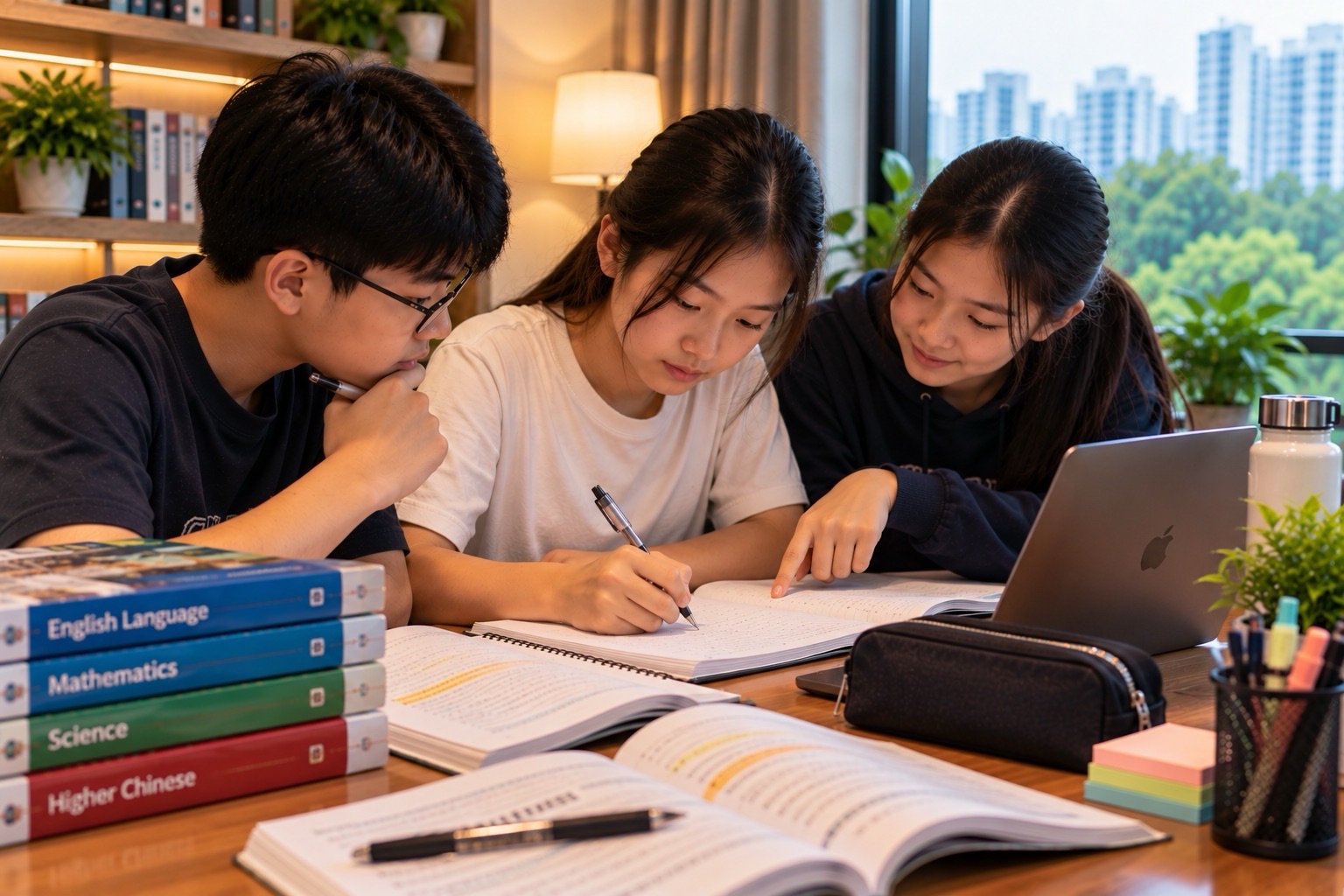
Collaboration skills for students in Punggol matter because school is full of tasks that no student completes entirely alone. Group projects, CCAs, classroom discussion, laboratory work, presentations, peer learning and future workplaces all depend on the ability to coordinate with other people. A student can be intelligent, hardworking and knowledgeable yet still struggle in a team if they cannot listen, communicate, negotiate roles or adapt when another person sees the problem differently.
That is the core aim of Punggol education through collaboration skills: teach students how to combine different strengths, share responsibility, communicate clearly and produce something together that none of them could achieve as effectively alone. Collaboration is not simply being friendly. It is coordinated thinking and coordinated action.
Explore related education guides and choose your next reading step.
The Core Aim in One Sentence
Collaboration teaches students how to work with other minds without losing responsibility for their own contribution.
This balance matters. Weak collaboration can become one student doing everything while others watch. It can also become endless discussion without decisions. Strong collaboration creates clear goals, roles, communication, accountability and a way to resolve disagreement.
Did You Know? Teamwork Is Not the Same as Collaboration
Teamwork often describes people working together toward a common goal. Collaboration goes a little deeper: the members influence one another’s thinking and combine knowledge, perspectives and skills as the work develops.
A group can divide a poster into four sections and work separately. That is teamwork. A group that compares evidence, challenges ideas, reorganises the argument and improves one another’s work is collaborating.
The Six Parts of Strong Collaboration
1. A shared goal
Students need to know what the group is trying to produce. “Do the project” is too vague. A clear goal might be: create a five-minute presentation that explains the problem, presents evidence and recommends one solution.
2. Clear roles
Roles reduce duplication and hidden gaps. One student may research, another organise the data, another design visuals and another lead the presentation. Roles can change, but responsibility should be visible.
3. Communication
Groups fail quietly when members assume everyone understands. Good collaboration includes updates, questions, summaries and explicit decisions.
This is why The Core Aim of Punggol Education | Communication Skills is a natural companion to collaboration.
4. Listening
Listening is not waiting for your turn to speak. It means understanding the other person well enough to respond to the actual idea.
Students should be able to say, “I think your point is that…” before disagreeing. That one habit reduces a surprising amount of unnecessary conflict.
5. Accountability
Collaboration works when each person owns their part. Shared responsibility does not mean blurred responsibility.
A useful group question is: Who owns the next action, and by when?
6. Adaptation
Teams change as information changes. A strong collaborator can give up a favourite idea when evidence points elsewhere, take on a different role when someone is absent or help another member when the bottleneck shifts.
Collaboration in Primary School
Primary-school collaboration begins with simple social learning:
- take turns;
- listen without interrupting;
- share materials;
- ask before taking over;
- explain an idea to a classmate;
- accept that another method can also work;
- finish the part you agreed to do.
These habits look ordinary, but they form the basis of later teamwork and leadership.
Collaboration During PSLE Years
PSLE is individually assessed, but students still benefit from collaboration during learning. Peer explanation can reveal misunderstandings, discussion can strengthen oral language and comparing methods can deepen Mathematics and Science reasoning.
The important boundary is that collaboration should prepare the student for independent performance. The final paper is completed alone.
Collaboration in Secondary School
Secondary students encounter more complex group work because tasks become more open-ended and roles more specialised. CCAs also become important environments for teamwork, leadership, responsibility and conflict resolution.
Students learn that collaboration is not always comfortable. Different personalities, standards and working speeds have to be coordinated.
Collaboration and Critical Thinking
Groups become stronger when members can challenge ideas without attacking people.
A good collaborative phrase is: “What evidence supports that option?” A poor one is: “That idea is stupid.”
Critical thinking improves group decisions because students compare reasons, test assumptions and consider alternatives. See The Core Aim of Punggol Education | Critical Thinking.
Collaboration and Problem Solving
Many difficult problems are too large for one perspective. Groups can divide information, generate multiple approaches and detect weaknesses that one person misses.
The article The Core Aim of Punggol Education | Problem Solving develops the define, represent, choose, test and adapt cycle that teams can use together.
The Collaboration Mistake: One Strong Student Does Everything
Teachers and parents sometimes praise the final product while missing an unhealthy group process.
If one student consistently rescues the team, that student may learn over-responsibility while others learn dependence.
A better system makes individual contributions visible and includes checkpoints before the final deadline.
The Other Mistake: Equal Work Instead of Fair Work
Collaboration does not always mean everyone does identical amounts of identical work.
Fair collaboration uses strengths intelligently while keeping contribution balanced. A strong speaker may present, but should not be the only thinker. A strong designer may build visuals, but should still understand the content.
How to Handle Disagreement
Disagreement is not a collaboration failure. It can improve the result when handled well.
- State the point of disagreement clearly.
- Separate the idea from the person.
- Ask what evidence would decide.
- Compare trade-offs.
- Try a small test if possible.
- Agree on a decision rule before arguing forever.
Students who learn to disagree respectfully gain a capability that matters far beyond school.
Collaboration and Leadership
Leadership in a group is not always being the loudest person or assigning tasks.
A strong student leader can:
- clarify the goal;
- invite quieter members in;
- notice when the group is drifting;
- resolve ambiguity;
- protect standards without humiliating others;
- help the group make a decision.
Good leadership increases the capability of the whole group.
Collaboration in the Age of AI
AI changes teamwork because groups can generate ideas, summaries and drafts more quickly. That makes human coordination even more important.
Teams should decide:
- what AI is being used for;
- who verifies the output;
- which claims need checking;
- how generated material will be rewritten and integrated;
- whether every group member actually understands the final work.
AI should not become the invisible fifth group member whose work nobody checks.
How Parents Can Build Collaboration at Home
- Give siblings or family members shared tasks with clear roles.
- Ask children to plan something together rather than assigning every step.
- Let them negotiate small disagreements before intervening.
- Ask each child to explain their contribution.
- Model respectful disagreement between adults.
- Praise useful coordination, not only the final result.
How Tutors Can Build Collaboration Skills
Small-group tuition can create excellent collaboration practice when the tutor designs for it deliberately.
- Ask students to compare methods.
- Let one student explain while another checks.
- Use short pair tasks with individual accountability.
- Rotate who presents the group reasoning.
- Ask students to improve one another’s explanations.
- End with independent work so the tutor can see what each learner retained.
At eduKatePunggol, small-group learning is most valuable when students benefit from one another without becoming dependent on one another.
What Progress Looks Like
Collaboration progress is visible when students:
- share ideas without dominating;
- listen and paraphrase accurately;
- complete agreed responsibilities;
- ask for clarification early;
- challenge ideas respectfully;
- help the group recover when plans change;
- accept useful feedback from peers;
- know when to lead and when to support;
- produce stronger work together than they would separately;
- can still perform independently afterwards.
A Simple Collaboration Routine
- Goal — what are we producing?
- Roles — who owns what?
- Standards — what does good work look like?
- Checkpoint — when will we compare progress?
- Decision — how will disagreements be resolved?
- Integration — how will the parts become one coherent result?
- Review — what did the group learn about working together?
Frequently Asked Questions
What are collaboration skills for students?
Collaboration skills include listening, communication, role coordination, shared problem solving, accountability, conflict resolution and adapting to other people’s ideas and strengths.
Why are collaboration skills important in school?
Students use collaboration in group projects, CCAs, discussions, practical work and peer learning. The same skills later matter in post-secondary education and work.
How can students improve teamwork?
Make goals and roles explicit, communicate updates, listen carefully, resolve disagreements with evidence and review whether each person completed their responsibility.
What if one student does all the work?
Break the project into visible responsibilities, use checkpoints and assess both the group product and individual contribution where possible.
Can group work hurt independent learning?
It can if students rely on stronger peers. Good collaboration should be followed by individual explanation or independent practice so each learner owns the knowledge.
Is collaboration part of 21st-century skills?
Yes. Singapore’s 21st Century Competencies framework includes communication, collaboration and information skills alongside critical, adaptive and inventive thinking.
Useful Routes for Punggol Families
- eduKatePunggol home — local education, tuition, parent, student and pathway routes.
- The Core Aim of Punggol Education | Communication Skills.
- The Core Aim of Punggol Education | Critical Thinking.
- The Core Aim of Punggol Education | Problem Solving.
- Developing a 21st-Century Singapore Student.
- Learning for Contribution.
- Punggol Atlas.
The Best Collaboration Makes Everyone More Capable
The point of collaboration is not to make every student identical. It is to let different strengths interact without losing standards, accountability or independence.
That is the core aim of Punggol education through collaboration skills: teach students to think with other people, contribute responsibly and build better outcomes together while still owning their own learning.
Properly taught kids shine a bright light into the future.


