
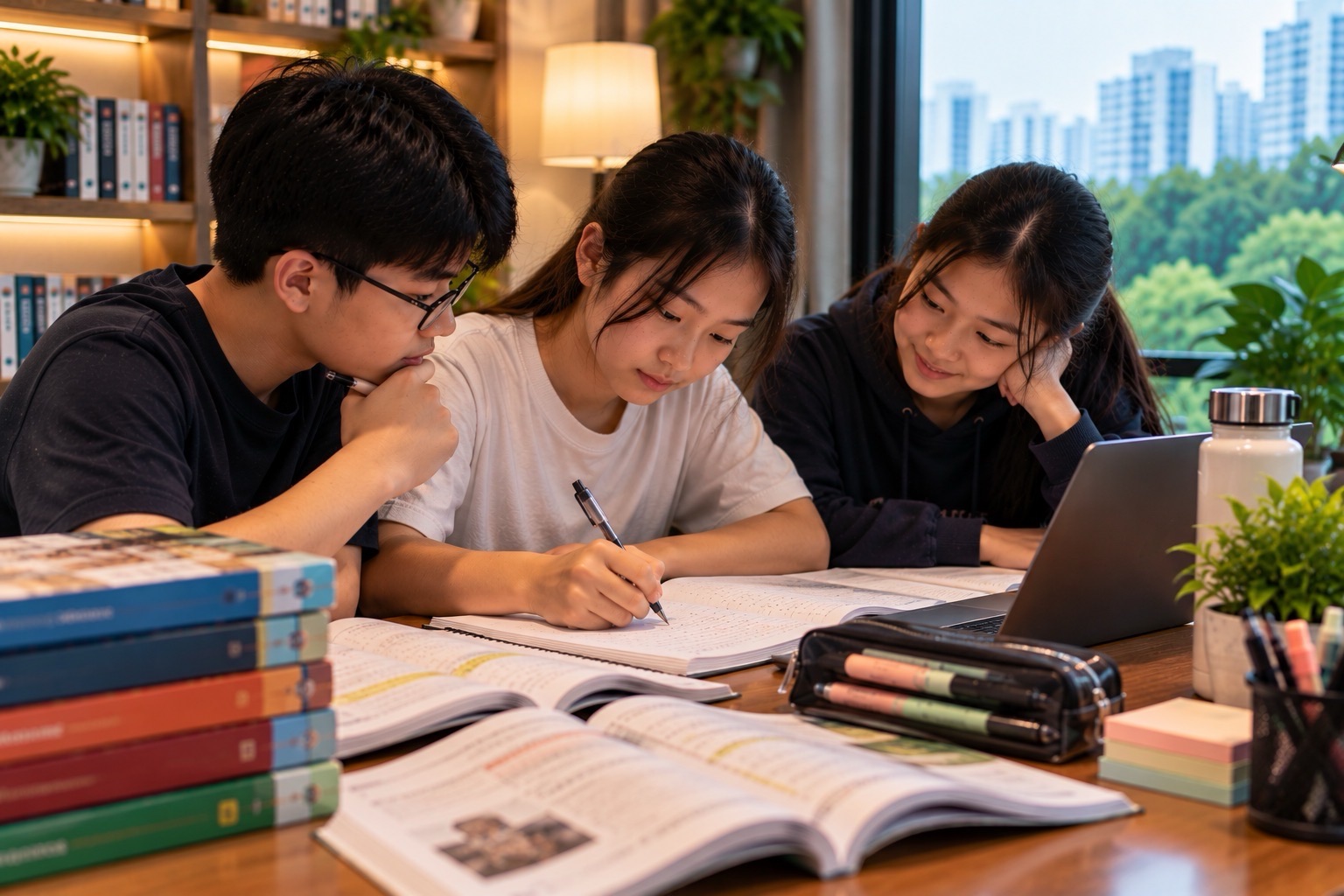
Creativity for students in Punggol is much bigger than drawing, storytelling or coming up with unusual ideas. Creativity appears whenever a learner combines knowledge in a useful new way: finding another route through a Mathematics problem, designing a Science investigation, improving an English composition, building a presentation, solving a CCA challenge or imagining a better response when the obvious method fails.
That is the core aim of Punggol education through creativity: help students generate possibilities, test them against reality, improve what works and turn imagination into useful outcomes. Singapore’s refreshed 21st Century Competencies framework groups Critical, Adaptive and Inventive Thinking together because future-ready learning requires students not only to judge ideas, but also to adapt and create when familiar solutions are no longer enough.
Explore related education guides and choose your next reading step.
The Core Aim in One Sentence
Creativity is the ability to produce something novel enough to matter and useful enough to survive contact with reality.
That definition keeps creativity grounded. An idea is not educationally valuable merely because it is different. A strong creative response fits the problem, audience, evidence, constraints and purpose.
Did You Know? Creativity Needs Knowledge
Creativity is sometimes described as the opposite of memorisation, as though students should choose between knowing things and imagining things. In practice, creativity grows from knowledge.
A student can write a richer story when they have vocabulary, world knowledge and narrative control. A student can invent a better Science experiment when they understand variables, measurement and causation. A student can find an elegant Mathematics solution because they recognise several structures and methods.
Knowledge gives creativity raw material.
The Five Moves of Creative Thinking
1. Notice the problem differently
Creative work often begins by framing the problem better.
Instead of “How do I memorise more Science notes?”, a student might ask, “How do I make the important ideas easier to retrieve?” Instead of “How do I make this composition longer?”, the better question may be, “How do I make the turning point more meaningful?”
A new question can create a new solution space.
2. Generate more than one possibility
The first idea is often the most familiar one. Creative thinkers deliberately generate alternatives.
- another method;
- another explanation;
- another example;
- another perspective;
- another design;
- another route through the constraint.
Quantity matters early because it prevents the learner from becoming emotionally attached to the first answer.
3. Combine ideas
Many creative ideas are combinations rather than inventions from nothing.
A student may combine a diagram with a written explanation, borrow a structure from one subject for another, connect a local Punggol observation to a Science concept or use a mathematical model to clarify a real-world decision.
4. Test against constraints
Creativity becomes useful when it respects the task.
A composition may be imaginative but irrelevant to the prompt. A Science design may be clever but impossible to measure. A Mathematics method may work but be too slow under examination conditions.
Constraints do not kill creativity. They shape it.
5. Iterate
Strong creative work is rarely the untouched first attempt.
Students generate, test, revise and improve. This is why feedback matters: creativity grows through cycles, not flashes of inspiration.
Creativity and Inventive Thinking
MOE’s 21st Century Competencies framework describes inventive thinking as the ability to frame, investigate and explore issues, generate innovative ideas, and evaluate them to form novel and useful responses.
That combination is important because it joins imagination with judgment. Students do not simply brainstorm; they evaluate which ideas deserve to survive.
This is why creativity belongs beside critical thinking rather than opposite it.
Creativity and Problem Solving
Problem solving asks how to move from difficulty to solution. Creativity expands the number of possible paths.
When the standard method fails, creative students can reframe, simplify, model differently or borrow an approach from another context.
The companion article The Core Aim of Punggol Education | Problem Solving develops this define, represent, choose, test and adapt loop.
Creativity in Primary School
Primary-school creativity thrives when children have enough structure to succeed and enough freedom to make choices.
- Ask for more than one solution where possible.
- Invite children to explain a different method.
- Let stories have multiple plausible endings.
- Use real objects and local observations as starting material.
- Allow drawings, models and oral explanation alongside written work.
- Praise useful originality rather than novelty for its own sake.
The aim is not to turn every lesson into free play. It is to help young learners discover that knowledge can be rearranged and used.
Creativity During PSLE Years
PSLE preparation can become highly repetitive, so creativity needs deliberate protection.
Students still benefit from asking:
- Is there another method?
- Can I explain this concept in my own example?
- Can I create a new question using the same structure?
- Can I improve this composition without adding unnecessary words?
- Can I design a better way to remember this Science relationship?
Creative thinking does not conflict with examination preparation. It often strengthens transfer because the learner understands the structure deeply enough to use it in new forms.
Creativity in Secondary School
Secondary school gives creativity more sophisticated material. Students can build arguments, design experiments, code, create performances, prototype solutions, interpret texts and combine disciplines.
This is also the stage where students increasingly encounter real constraints: time, evidence, technical requirements, teamwork and audience expectations.
Those constraints are educationally useful because they teach students to make creativity operational.
Creativity in English
English creativity is not only decorative vocabulary.
A strong writer makes choices about viewpoint, structure, pacing, imagery, evidence and tone. Creativity appears when the writer finds a fresh but controlled way to communicate meaning.
The existing article How to Improve English Writing Skills connects writing improvement with planning, clarity, control and revision.
Creativity in Mathematics
Mathematics contains creativity whenever students choose representations, notice patterns, find alternate proofs or compare efficient methods.
A student who solves the same problem two different ways begins to see the structure more deeply.
Mathematical creativity is constrained by logic. The answer must still follow. That makes Mathematics a wonderful training ground for disciplined imagination.
Creativity in Science
Science combines imagination and evidence beautifully.
Students imagine explanations, design tests, choose measurements and think about how to reduce uncertainty. But every creative idea must eventually answer to evidence.
The eduKatePunggol article How Scientific Engineering Design Works | Requirements, Constraints, Prototypes and Iteration shows how inventive thinking becomes practical design.
Creativity in Art, Design and Making
Art and design make the creative cycle especially visible: explore, make, compare, revise and communicate.
Students learn that originality is not produced by waiting for inspiration. It grows from observation, technique, experimentation and repeated decisions.
MOE’s current Art syllabuses explicitly connect art making and discussion with Critical, Adaptive and Inventive Thinking, including exploring alternatives and taking considered creative risks.
The Creativity Mistake: “There Are No Wrong Answers”
Some creative tasks have many possible answers, but that does not mean every answer is equally strong.
A creative response can still be irrelevant, unsupported, impractical, unclear or poorly executed.
Students need standards. The useful message is: there may be many possible answers; your job is to make yours work.
The Other Creativity Mistake: Only Rewarding the Most Unusual Idea
If students learn that creativity means being strange, they may optimise for novelty instead of usefulness.
A quiet improvement can be highly creative if it solves the problem elegantly. The best idea is sometimes simple.
Creativity and Constraints
Constraints are often productive because they force students to make decisions.
- Write within a word limit.
- Use only the available materials.
- Solve within the examination time.
- Design for a particular audience.
- Keep the experiment fair.
- Use evidence from the given sources.
The creative challenge becomes: what is the best response possible inside these boundaries?
Creativity and Collaboration
Creative teams can generate more possibilities because members bring different experiences and strengths.
But collaboration helps only when students listen, build on ideas and challenge weak assumptions respectfully.
See The Core Aim of Punggol Education | Collaboration Skills.
Creativity and Communication
An idea has little impact if nobody else can understand it.
Creative students therefore need to explain what they made, why they made it and how it solves the problem.
The article The Core Aim of Punggol Education | Communication Skills develops that translation from thought to shared meaning.
Creativity and Resilience
Creative work produces failed attempts. The prototype breaks. The story drifts. The method is too slow. The first idea does not work.
Resilience keeps the student experimenting long enough to improve the idea instead of treating the failed attempt as proof of inability.
See The Core Aim of Punggol Education | Resilience.
Creativity in the Age of AI
AI can generate enormous numbers of ideas quickly. That changes what creative education should value.
Students need to become stronger at:
- framing the problem;
- setting useful constraints;
- judging originality and relevance;
- combining ideas intelligently;
- verifying factual claims;
- adding local knowledge and human purpose;
- deciding which output deserves development.
When generation becomes cheap, selection and judgment become more valuable.
The question is no longer only “Can you produce an idea?” It is “Can you recognise which idea is worth building?”
How Parents Can Build Creativity at Home
- Ask for three possibilities before choosing one.
- Let children redesign ordinary routines or objects.
- Encourage explanation of why one option is better.
- Provide materials for making, drawing, writing and building.
- Allow some boredom; not every free minute needs structured entertainment.
- Discuss improvements instead of asking only whether something is finished.
- Treat questions as invitations to investigate.
Creativity grows when children regularly experience themselves as people who can change things.
How Tutors Can Teach Creativity
Tuition does not need to become an art class to build creative thinking.
- Ask for alternative methods.
- Change one condition and ask what follows.
- Use open-ended questions after core mastery.
- Let students create examples and counterexamples.
- Compare two plausible answers.
- Ask students to redesign a weak solution.
- Require explanation of why the new version is better.
At eduKatePunggol, small-group learning can support this because students see different approaches and learn that the first method is not always the only method.
What Progress Looks Like
Creative-thinking progress is visible when students:
- generate more than one possibility;
- ask better framing questions;
- combine ideas across topics;
- use constraints intelligently;
- improve rather than merely replace weak ideas;
- explain why one solution is stronger;
- take considered intellectual risks;
- recover after unsuccessful attempts;
- use AI as a creative tool without surrendering judgment;
- produce work that is both original and fit for purpose.
A Simple Creativity Routine
- Frame — what is the real problem?
- Gather — what knowledge and examples do I have?
- Generate — produce several possibilities.
- Combine — connect useful parts.
- Constrain — test against requirements.
- Prototype — make a workable version.
- Evaluate — what is strong or weak?
- Iterate — improve and try again.
This works for writing, design, Science, Mathematics, project work and real-life decisions.
Frequently Asked Questions
What is creativity for students?
Creativity is the ability to generate, combine and develop ideas into responses that are novel and useful for a particular task or problem.
Can creativity be taught?
Yes. Students can practise idea generation, alternative methods, problem framing, experimentation, feedback and iteration. Knowledge and technique make creative work stronger.
Is creativity only for art and writing?
No. Creativity appears in Mathematics, Science, coding, project work, engineering, communication and everyday problem solving.
Does creativity require freedom from rules?
No. Constraints often improve creativity by giving the learner a real problem to solve. Strong creative work fits the purpose and requirements.
How does AI affect creativity?
AI makes idea generation faster, so students need stronger judgment about which ideas are relevant, accurate, original enough and worth developing.
What is the best sign of creative growth?
The student can produce several possibilities, evaluate them and improve one into a solution that works.
Useful Routes for Punggol Families
- eduKatePunggol home — local education, tuition, parent, student and pathway routes.
- The Core Aim of Punggol Education | Critical Thinking.
- The Core Aim of Punggol Education | Problem Solving.
- The Core Aim of Punggol Education | Collaboration Skills.
- The Core Aim of Punggol Education | Communication Skills.
- How Scientific Engineering Design Works.
- Ken Robinson on Education: Creativity, Curiosity, Teaching and the Conditions for Learning.
- MOE | 21st Century Competencies.
- Punggol Atlas.
The Best Creativity Produces Something Worth Keeping
Creativity is not the opposite of discipline. It depends on discipline: enough knowledge to generate strong possibilities, enough critical thinking to reject weak ones and enough resilience to improve an idea more than once.
That is the core aim of Punggol education through creativity: help students imagine beyond the obvious, test ideas against reality and build solutions that are both original and useful.
Properly taught kids shine a bright light into the future.


