
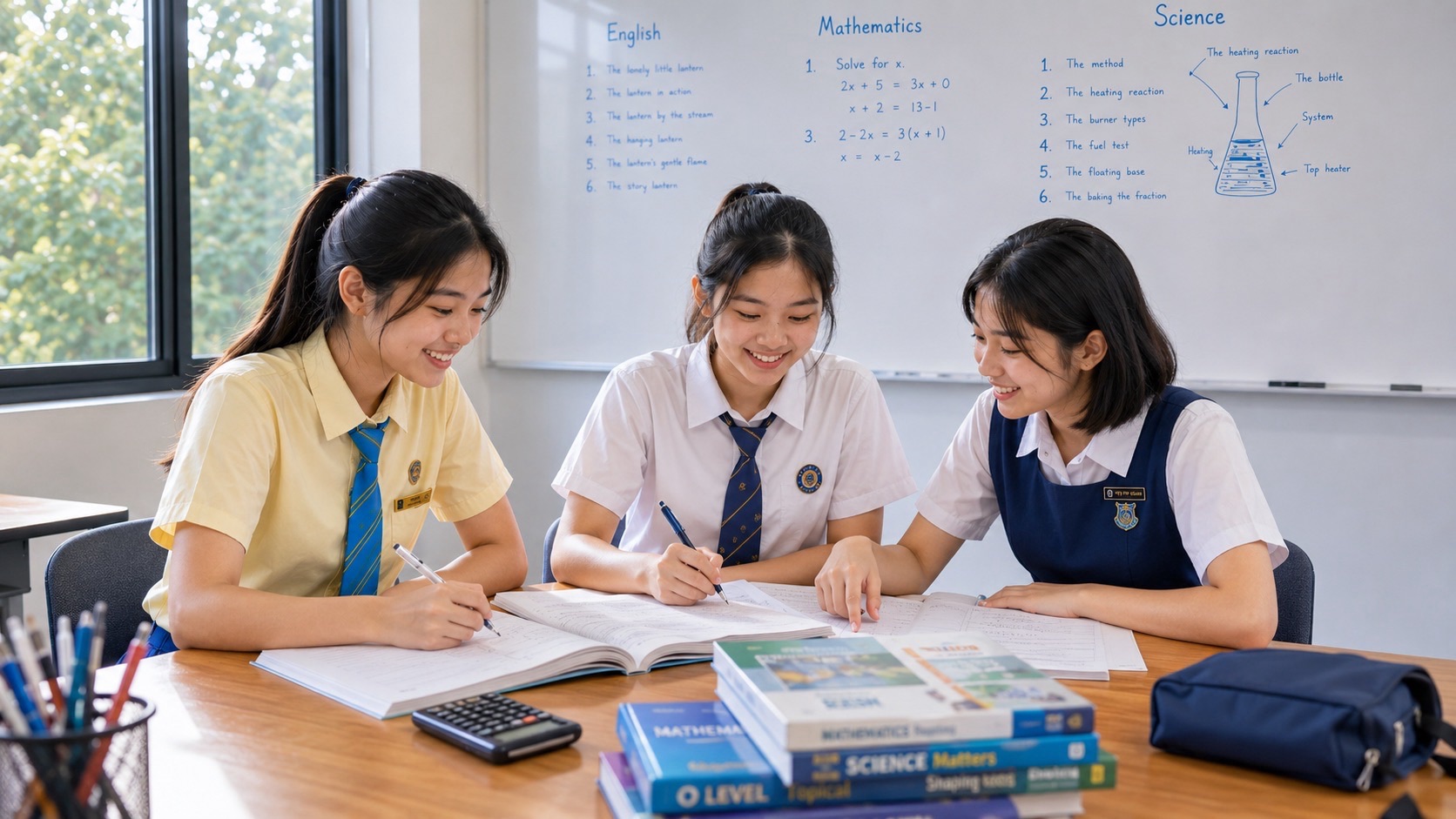
Information literacy for students in Punggol has become one of the most important learning skills because information is no longer scarce. Students can search almost any question, watch an explanation in seconds, ask an AI system for a summary and receive thousands of opinions before they have decided what the original problem was. The challenge has changed. It is no longer only “Can you find information?” It is “Can you decide what deserves trust, what is relevant, what is missing and what should be done with it?”
That is the core aim of Punggol education through information literacy: help students find, evaluate, compare, organise and use information responsibly enough to build knowledge rather than merely collect content. In an age of search engines, social media and generative AI, the student who can judge information well gains a lasting advantage.
Explore related education guides and choose your next reading step.
The Core Aim in One Sentence
Information literacy is the ability to know what information you need, find it efficiently, judge its quality and use it responsibly.
This sounds simple until the student faces conflicting sources, outdated pages, persuasive language, copied claims, anonymous posts, misleading charts or AI-generated answers that sound excellent but may be wrong.
Did You Know? Finding an Answer Is Not the Same as Knowing
A search result can give a student a sentence. Knowledge requires much more: understanding what the sentence means, how it connects to other facts, why it should be trusted and where its limits are.
This is why information literacy belongs beside critical thinking and digital literacy. Search retrieves. Critical thinking evaluates. Information literacy coordinates the whole process.
The Seven Moves of Information Literacy
1. Define the information need
Before searching, students should ask what they are actually trying to know.
A vague question such as “Tell me about climate change” produces a vague information pile. A sharper question such as “What evidence shows sea levels are rising, and what mechanisms contribute to that rise?” gives the search direction.
2. Search strategically
Good search is not about typing more words. It is about choosing terms that reflect the concept.
- Use specific nouns.
- Add location or date when freshness matters.
- Use official terminology where possible.
- Search exact phrases when needed.
- Try alternative wording if results are weak.
- Look beyond the first result.
3. Identify the source
Students should ask who produced the information.
Is it an official agency, university, news organisation, company, advocacy group, anonymous account, content farm or AI-generated summary? Different sources can be useful for different purposes, but the source tells you what kind of evidence you are dealing with.
4. Evaluate the evidence
A claim deserves more trust when it is supported by evidence that can be checked.
Students should distinguish between:
- data and anecdote;
- primary source and commentary;
- expert consensus and individual opinion;
- measurement and speculation;
- correlation and causation;
- quotation and paraphrase.
5. Compare sources
Strong information literacy rarely stops at one source when the claim matters.
If two reliable sources agree independently, confidence may rise. If they disagree, the disagreement itself becomes useful information. The student then asks why.
6. Organise what matters
Information overload can be as harmful as information scarcity.
Students need to extract the most relevant facts, organise them by idea and separate supporting evidence from background detail.
7. Use information responsibly
Information should be represented accurately. Students should not distort a source, remove important context, copy without attribution or present uncertain claims as facts.
Information Literacy in Primary School
Primary-school information literacy can begin very simply.
- Who wrote this?
- Where did this fact come from?
- Is this a fact or an opinion?
- Can we check it somewhere else?
- Is this page trying to teach, sell or persuade?
- What part of this information answers our question?
Children do not need advanced terminology to start learning source awareness. They need repeated habits of asking how we know.
Information Literacy During PSLE
PSLE does not require students to perform open-web research during the paper, but information literacy still strengthens the underlying skills needed for comprehension, Science reasoning and revision.
Students learn to identify relevant information, separate signal from distraction, infer from evidence and avoid overclaiming. These are the same habits that later become source evaluation.
The article The Core Aim of Punggol Education | PSLE places these skills inside the broader Primary 6 learning system.
Information Literacy in Secondary School
Secondary students increasingly encounter research projects, presentations, current affairs, data, longer essays and more independent digital work.
They therefore need stronger source habits:
- record the source while researching;
- check publication dates;
- distinguish original reporting from summaries;
- understand why a source exists;
- compare claims across references;
- quote or paraphrase accurately;
- avoid citing material they have not actually read.
The Source Ladder
Not every task needs the same level of evidence. A useful source ladder is:
- Primary source — original data, law, official announcement, research paper, speech or direct record.
- Authoritative secondary source — expert synthesis, reputable textbook or institutional explanation.
- High-quality journalism — useful for events, context and reporting.
- Specialist commentary — useful when expertise is clear and claims are supported.
- Community discussion — useful for experience and sentiment, but not automatically reliable for facts.
- Anonymous or unsourced content — treat cautiously.
The point is not that lower levels are useless. It is that students should know what kind of claim each level can safely support.
Authority Is Contextual
A source can be authoritative for one question and weak for another.
A government agency may be best for official policy. A scientific journal may be best for a research finding. A local resident may be valuable for lived experience. A company is the best source for its own product specifications but not necessarily for an unbiased comparison with competitors.
Information literacy means matching the source to the question.
The Date Test
Some information ages quickly.
- school policies;
- software features;
- transport schedules;
- admissions rules;
- prices;
- scientific guidance;
- current events.
Other information changes slowly, such as mathematical theorems or the meaning of many established concepts.
Students should therefore ask: How current does this source need to be for this question?
The Relevance Test
A source can be accurate and still not answer the question.
Students often collect facts because they sound intelligent. Good information literacy asks whether each fact earns its place.
A useful rule is: if removing the information does not weaken the answer, it may not be necessary.
The Evidence Test
Students should ask what makes the claim believable.
- Is there data?
- Is there a cited source?
- Can the evidence be inspected?
- Does the evidence actually support the conclusion?
- Are important limitations acknowledged?
Confidence without evidence is not expertise.
The Bias Test
All information is produced from some position. Bias does not automatically make a source useless, but students should notice incentives and perspective.
Ask:
- Who created this?
- Who funded or benefits from it?
- What is the intended audience?
- What does the source want the audience to think or do?
- What relevant information might be omitted?
The eduKatePunggol article Learning for Discernment develops this signal, noise, incentive and manipulation layer.
Information Literacy and Media Literacy
Media literacy asks students to understand how messages are framed through headlines, images, charts, video, editing and platform incentives.
Two reports can contain the same underlying fact and create very different impressions through what they emphasise.
Students should learn to ask not only “Is this true?” but also “How is this being framed?”
Information Literacy and Visual Literacy
Charts, photographs and infographics can feel objective because they look like evidence.
Yet visual information still involves choices: framing, scale, crop, axis range, colour, timing and what was left outside the image.
The local article Photography as Observation — Framing, Evidence, Change and Visual Literacy explores how seeing is shaped by framing.
Information Literacy and Critical Thinking
Information literacy supplies the evidence environment. Critical thinking decides what to believe and what follows.
A useful reasoning chain is:
- What is the claim?
- What evidence supports it?
- How reliable is that evidence?
- What alternative explanation exists?
- What would change my mind?
- How confident should I be?
See The Core Aim of Punggol Education | Critical Thinking.
Information Literacy and AI
Generative AI makes information literacy more important because it can produce fluent summaries without showing the quality of every underlying source.
Students should treat AI output as a starting point for investigation when accuracy matters, not automatic authority.
A useful routine is:
- ask the AI for the claim;
- identify which parts matter most;
- request sources where appropriate;
- open the original sources;
- check whether they actually support the claim;
- compare with an independent source;
- rewrite the conclusion based on verified evidence.
The article Digital English and AI Literacy develops how students should read, write, verify and think with machines.
The AI Citation Problem
Students should never assume that a citation generated by AI exists merely because it looks realistic.
A proper verification step opens the source, checks the title, author and publication, then confirms that the cited material actually supports the statement being made.
This habit becomes increasingly important as generated text becomes harder to distinguish from carefully researched text by surface style alone.
The Information Literacy Mistake: First Result Wins
Search ranking is not a truth ranking.
The first result may be excellent. It may also be the best optimised page, the most popular page or the result the system predicts you are most likely to click.
Students should learn to compare before committing.
The Other Mistake: “Official Means Always Right”
Official sources are often the best place for official rules, policy and public data. But students should still read carefully.
An official source may answer a specific administrative question perfectly while being irrelevant to a broader evaluative question. Information literacy is not blind trust. It is appropriate trust.
Information Literacy in Science
Science depends on evidence quality.
Students should learn to distinguish controlled experiments, observational data, models, hypotheses, reviews and public summaries.
The article How Scientific Literacy Works | Using Evidence to Navigate the Real World develops how scientific evidence can be interpreted responsibly.
Information Literacy in English and Humanities
English and Humanities students routinely evaluate perspective, language, evidence, purpose and reliability.
Information literacy strengthens comprehension because the learner becomes more alert to the difference between what a source says, what it implies and what it leaves unproven.
Information Literacy in Mathematics
Mathematics students also need information literacy when interpreting graphs, statistics and numerical claims.
A number without context can mislead. Students should ask about sample size, units, scale, baseline, average type and whether the comparison is fair.
Information Literacy and Digital Citizenship
Responsible information use is also a citizenship skill.
Before forwarding a claim, screenshot or video, students should ask whether it is verified and whether sharing it could cause harm.
The digital environment makes transmission effortless. Responsibility must therefore move earlier in the chain.
How Parents Can Build Information Literacy at Home
- Ask “How do we know?” during everyday conversations.
- Compare two sources for the same question.
- Check dates on changing information.
- Discuss why a source might be trying to persuade.
- Verify surprising claims before forwarding them.
- Let children watch adults correct themselves after new evidence.
- Use libraries and official sources alongside search engines.
One of the most powerful family habits is normalising the sentence: “I am not sure yet; let us check.”
How Tutors Can Build Information Literacy
- Ask students to show the source behind a factual claim.
- Distinguish explanation from evidence.
- Use source comparison tasks.
- Teach students to summarise without distorting.
- Ask which evidence is relevant and sufficient.
- Require verification of AI-generated material.
- Model uncertainty when the evidence is incomplete.
At eduKatePunggol, information literacy supports the broader goal of independent learning because students become less dependent on someone else telling them what to trust.
What Progress Looks Like
Information literacy progress is visible when students:
- search with clearer questions;
- identify who produced a source;
- check dates when freshness matters;
- compare more than one source;
- separate evidence from opinion;
- notice framing and incentives;
- verify AI-generated claims;
- organise information by relevance;
- cite or attribute sources accurately;
- change their mind when better evidence appears.
A Simple Information Literacy Routine
- Question — what exactly do I need to know?
- Find — where are the best places to look?
- Source — who produced this information?
- Evidence — what supports the claim?
- Compare — what do other reliable sources say?
- Relevance — does this answer my actual question?
- Use — how should I represent the information?
- Review — how confident should I be?
Frequently Asked Questions
What is information literacy for students?
Information literacy is the ability to recognise an information need, find useful sources, evaluate credibility and evidence, organise relevant material and use it responsibly.
Why is information literacy important now?
Students face far more information than previous generations, including social media, search results and AI-generated content. The key challenge is deciding what deserves trust.
How is information literacy different from digital literacy?
Digital literacy is broader and includes using digital tools safely and effectively. Information literacy focuses specifically on finding, evaluating, organising and using information.
How can students check whether a source is reliable?
Check who produced it, when it was published, what evidence it provides, why it exists and whether independent reliable sources support the same claim.
Can students trust AI-generated information?
AI can be useful, but important claims should be verified against reliable original or authoritative sources because AI systems can produce incomplete or incorrect information.
What is the strongest sign of information literacy?
The student can explain not only what they believe, but why the evidence and sources justify that level of confidence.
Useful Routes for Punggol Families
- eduKatePunggol home — local education, tuition, parent, student and pathway routes.
- The Core Aim of Punggol Education | Digital Literacy.
- The Core Aim of Punggol Education | Critical Thinking.
- Learning for Discernment.
- Learning for Judgment.
- How Scientific Literacy Works.
- Digital English and AI Literacy.
- Photography as Observation and Visual Literacy.
- Punggol Atlas.
The Best Information Literacy Produces Better Judgment
The future will not reward students merely for locating information. Machines can already do that quickly. The durable advantage is deciding what information matters, how much confidence it deserves and what action should follow.
That is the core aim of Punggol education through information literacy: help students move from information abundance to evidence-based understanding — and from understanding to wiser decisions.
Properly taught kids shine a bright light into the future.


