
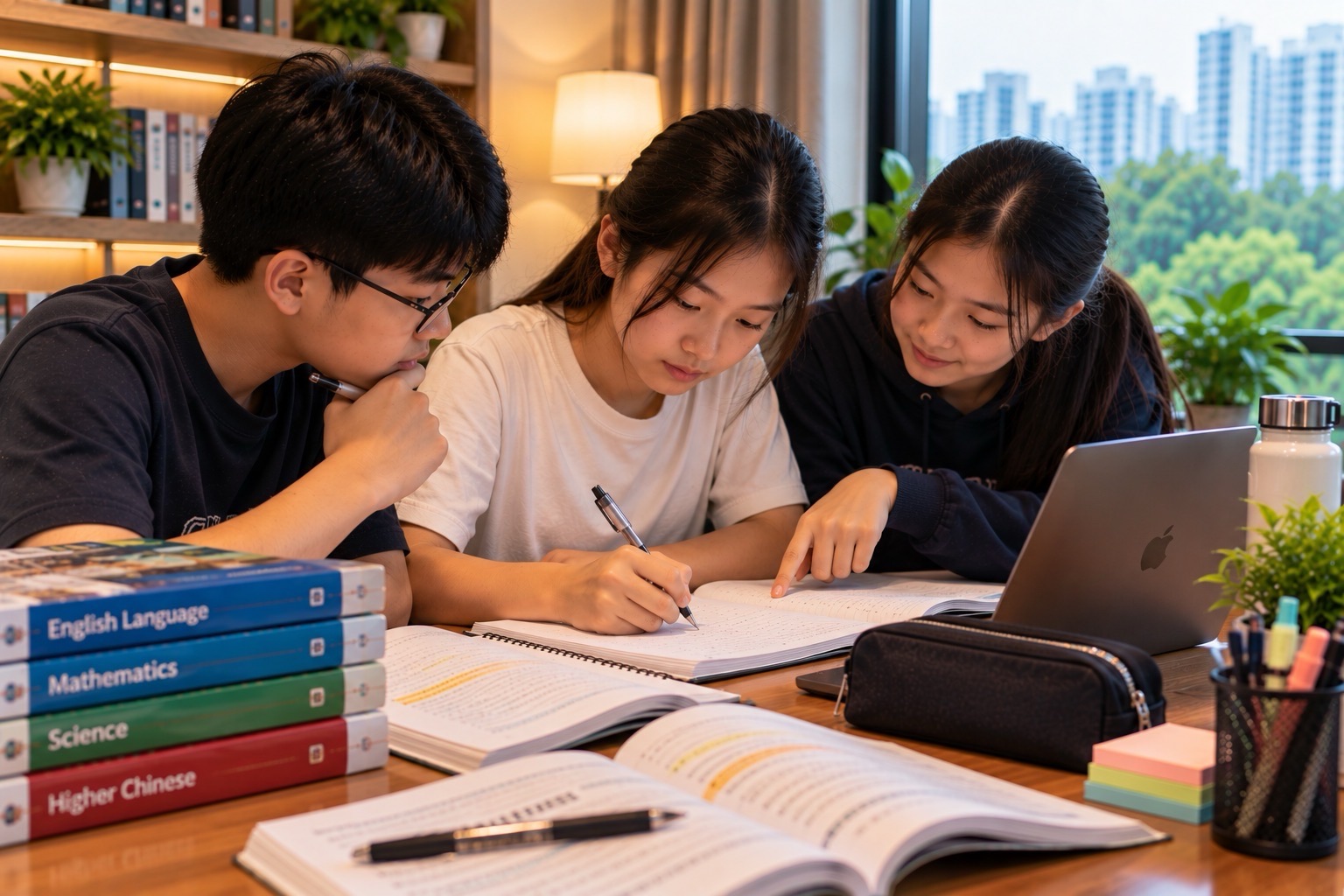
Self-regulated learning for students in Punggol is what happens when a learner gradually becomes able to manage the whole learning process: setting a goal, planning the work, protecting attention, choosing a strategy, monitoring progress, handling frustration, asking for help, checking results and changing course when the evidence says the plan is not working. It is one of the clearest bridges between school success today and lifelong learning later.
That is the core aim of Punggol education through self-regulated learning: help students become active managers of their own learning instead of passive receivers of instructions. A self-regulated learner does not wait for every next step to be prescribed. They learn to decide what matters, act on it, observe the outcome and improve the system.
Explore related education guides and choose your next reading step.
The Core Aim in One Sentence
Self-regulated learning means the student can plan, monitor and adjust learning with decreasing dependence on external control.
This does not mean children should be left alone. In fact, self-regulation grows through good support. Adults first provide structure, then share control, then gradually transfer more responsibility as the student becomes capable.
Did You Know? Self-Regulated Learning Is Bigger Than Self-Discipline
Self-discipline is one part of self-regulated learning, but not the whole system.
A disciplined student may sit down and work for an hour. A self-regulated learner asks whether the hour was spent on the right task, whether the method worked, what the mistakes mean and what should happen next.
The difference is important: discipline controls behaviour; self-regulation coordinates behaviour, thinking, emotion, time and strategy.
The Three Phases of Self-Regulated Learning
1. Forethought — plan before acting
Before beginning, the student clarifies the goal and chooses a sensible approach.
- What am I trying to learn?
- What does success look like?
- What do I already know?
- How much time do I have?
- Which strategy fits this task?
- What might distract or block me?
Forethought reduces wasted effort because the learner starts with direction rather than activity.
2. Performance — monitor while working
During the task, the student watches the process.
- Am I still focused?
- Does this method make sense?
- Am I understanding or merely copying?
- Should I slow down?
- Do I need a hint?
- Am I stuck because the task is hard or because I am missing a prerequisite?
This is where metacognition becomes practical.
3. Reflection — learn from the outcome
Afterward, the student compares the result with the goal.
- What worked?
- Where did I lose marks or understanding?
- Was the problem knowledge, strategy, attention or time?
- What will I do differently next time?
- When should I revisit this?
Reflection turns one learning event into a better future learning system.
Self-Regulated Learning and Learning How to Learn
Self-regulated learning is one of the operational forms of learning how to learn.
The broader idea asks how memory, practice, feedback and strategy work. Self-regulated learning asks how the student coordinates those tools across a real task or week.
See The Core Aim of Punggol Education | Learning How to Learn.
Self-Regulated Learning and Metacognition
Metacognition is the ability to think about and monitor one’s own thinking. Self-regulated learning uses metacognition as part of a larger control loop.
A metacognitive student notices, “I am recognising these notes but cannot retrieve them.” A self-regulated learner then acts: switch from rereading to active recall, retest later and compare results.
See The Core Aim of Punggol Education | Metacognition.
Self-Regulated Learning and Independent Learning
Independent learning is the long-term outcome: the student can continue learning with less adult direction.
Self-regulation is the mechanism that makes this possible. Without planning, monitoring, help-seeking and reflection, “independence” can become nothing more than being left alone.
See The Core Aim of Punggol Education | Independent Learning.
The Seven Skills of a Self-Regulated Learner
1. Goal setting
The student can turn a vague intention such as “study Science” into a defined goal such as “retrieve the key concepts in electricity and complete ten mixed application questions without notes.”
2. Strategic planning
The student chooses a method that matches the task rather than using the same habit for everything.
3. Attention control
The student notices distraction and uses environmental controls such as device boundaries, a clear workspace and short focused blocks.
4. Effort regulation
The student can continue through ordinary difficulty without treating discomfort as evidence that learning has failed.
5. Help-seeking
The student asks for help at the right level and at the right time.
Good help-seeking is specific: “I understand the setup but not why this step changes the sign” is more useful than “I don’t get anything.”
6. Self-monitoring
The student checks whether understanding, recall and performance are improving instead of relying on feeling.
7. Reflection and adjustment
The learner changes the plan when evidence shows that another strategy would work better.
Self-Regulated Learning in Primary School
Primary students need external structure first. A seven-year-old cannot be expected to manage learning like a teenager.
Useful early routines include:
- one visible homework list;
- a predictable study time;
- simple timers;
- bag-packing checklists;
- short self-check questions;
- small choices between two valid strategies;
- one reflection question after completing work.
The adult is initially the external regulator. Over time, the child learns to take over each function.
The Transfer Ladder
A useful transfer ladder looks like this:
- Adult does it for the child.
- Adult does it with the child.
- Child does it with adult prompts.
- Child does it; adult checks afterward.
- Child does it independently unless evidence shows support is needed.
This ladder can apply to homework planning, packing, revision, checking work or seeking help.
Self-Regulated Learning During PSLE
PSLE preparation is an ideal context for self-regulation because the student must manage several subjects over many months.
A self-regulated Primary 6 student increasingly knows:
- which topics are weak;
- which errors repeat;
- which subjects need daily maintenance;
- which practice should be timed;
- when a full paper is useful;
- when a foundation gap needs repair first;
- when to ask a teacher, parent or tutor for help.
The goal is not that the child runs the entire PSLE year alone. The goal is that the learner understands the system well enough to participate in managing it.
Self-Regulated Learning in Secondary School
Secondary school sharply increases the need for self-regulation because students face more teachers, more subjects, longer-term projects, CCAs, devices and greater autonomy.
A student who waits for reminders in every subject may become overwhelmed even if they are academically capable.
Self-regulated learning helps the student coordinate the week rather than react to each deadline separately.
Self-Regulation Under Full Subject-Based Banding
Under Full Subject-Based Banding, students may face different levels of challenge across subjects. One subject may require foundational repair, another routine maintenance and another deeper extension.
Self-regulation helps students allocate effort according to actual need rather than giving every subject identical treatment.
The Self-Regulation Mistake: Overplanning
Some students spend more time designing study systems than studying.
Colour-coded schedules, elaborate trackers and perfect notes can create the appearance of control while delaying the actual learning.
A useful plan should be simple enough to execute. The system exists to support learning, not become another project.
The Other Mistake: No Planning at All
At the other extreme, students may work only on whatever feels urgent.
This creates a cycle of missed deadlines, last-minute revision and repeated recovery.
Good self-regulation places important work into the week before urgency decides everything.
Self-Regulated Learning and Time Management
Time management is the scheduling layer inside self-regulation.
Students need to estimate task duration, protect buffers, distribute revision and know when the current schedule cannot realistically fit.
See The Core Aim of Punggol Education | Time Management.
Self-Regulated Learning and Self-Discipline
Self-discipline helps the student follow through after the plan is made.
The article The Core Aim of Punggol Education | Self-Discipline develops routines, attention control and the gradual reduction of adult reminders.
Self-Regulated Learning and Motivation
Motivation influences whether students begin and persist, but self-regulated learners are less dependent on motivation being high every day.
They can use routines, smaller goals, visible progress and environmental design to keep moving.
See The Core Aim of Punggol Education | Student Motivation.
Self-Regulated Learning and Emotion
Students regulate learning better when they can distinguish different internal states.
“I am bored”, “I am anxious”, “I am confused” and “I am exhausted” may all look like avoidance from outside, but they need different responses.
This is why Social Emotional Learning connects directly to academic self-regulation.
Self-Regulated Learning and Feedback
Feedback becomes powerful when students use it to choose the next action.
Instead of merely reading a correction, the learner asks:
- What category of error is this?
- Is this a one-off or a pattern?
- What should I practise?
- How will I know the repair worked?
- When should I retest?
Feedback should change behaviour, not simply decorate the page with red ink.
The Error Log as a Self-Regulation Tool
An error log can help students turn mistakes into a learning plan.
A useful entry includes:
- question or topic;
- error type;
- why it happened;
- correct principle;
- repair action;
- date to retest.
The purpose is not to collect mistakes forever. It is to stop the same mistake from remaining invisible.
The Weekly Self-Regulation Review
A ten-minute weekly review can coordinate the whole learning system.
- What is due next week?
- Which subject is slipping?
- Which topic is improving?
- What repeated error needs repair?
- Where did I lose time?
- What help do I need?
- What should I stop doing?
- What is the most important next action?
This turns reflection into control.
Self-Regulated Learning in the Age of AI
AI can either strengthen or weaken self-regulation.
It strengthens self-regulation when students use it to clarify a gap, generate targeted practice, compare explanations or receive feedback.
It weakens self-regulation when the student sends every difficult task to the tool before attempting, diagnosing or deciding anything independently.
A strong AI-assisted self-regulation routine is:
- set the learning goal;
- attempt independently;
- identify the precise difficulty;
- ask AI for targeted support;
- verify the response;
- retry without support;
- record what changed.
See The Core Aim of Punggol Education | AI Literacy.
How Parents Can Build Self-Regulated Learning
- Ask children what their plan is before giving your plan.
- Use shared checklists, then gradually transfer ownership.
- Ask what evidence shows a topic is secure.
- Let children choose between valid study methods.
- Discuss why a schedule failed instead of immediately adding punishment.
- Praise accurate self-diagnosis.
- Reduce reminders as reliability improves.
- Keep support available without taking back total control.
The long-term goal is not a perfectly managed child. It is a young person who can increasingly manage themselves.
How Tutors Can Build Self-Regulated Learning
- Ask students to state the learning goal.
- Let them predict where they may struggle.
- Use the smallest hint that restarts thinking.
- Require self-checking before tutor checking.
- Ask students to classify their own errors.
- Let students choose the next repair task when appropriate.
- Use delayed retrieval to test whether learning lasted.
- Fade support deliberately as competence grows.
The eduKatePunggol article How Tuition Works | The Prompt Migration develops one powerful idea: tutor cues should eventually become the student’s own internal questions.
What Progress Looks Like
Self-regulated learning progress is visible when students:
- set clearer goals;
- begin tasks with less prompting;
- choose strategies more deliberately;
- monitor whether methods are working;
- ask more precise questions;
- change approach when evidence justifies it;
- recover after disrupted weeks;
- use feedback to plan repair;
- need fewer reminders;
- can explain what they will do next and why.
A Simple Self-Regulated Learning Routine
- Goal — what am I trying to learn?
- Plan — what strategy and time will I use?
- Start — what is the first concrete action?
- Monitor — is the method working?
- Help — what is the smallest support I need?
- Check — what evidence shows learning?
- Repair — what should change?
- Reflect — what will I carry into the next task?
Frequently Asked Questions
What is self-regulated learning?
Self-regulated learning is the process by which students plan, monitor and adjust their goals, attention, strategies, effort, emotions and learning behaviour.
How is self-regulated learning different from independent learning?
Independent learning describes the learner’s growing ability to function with less external control. Self-regulation describes the planning, monitoring and adjustment processes that make that independence possible.
How is self-regulated learning different from self-discipline?
Self-discipline focuses mainly on behavioural follow-through. Self-regulated learning also includes goal setting, strategy choice, metacognition, emotion, feedback and adaptation.
Can Primary-school children learn self-regulation?
Yes, but the support should be age-appropriate. Young children begin with visible routines, checklists, small choices and adult-guided reflection.
How can parents encourage self-regulated learning?
Gradually transfer planning and checking responsibilities, ask children to explain their strategy and use mistakes as opportunities for diagnosis rather than simply correction.
What is the strongest sign of self-regulated learning?
The student can notice that learning is not going as planned, identify the likely cause and choose a reasonable next action without waiting for someone else to prescribe it.
Useful Routes for Punggol Families
- eduKatePunggol home — local education, tuition, parent, student and pathway routes.
- The Core Aim of Punggol Education | Learning How to Learn.
- The Core Aim of Punggol Education | Metacognition.
- The Core Aim of Punggol Education | Independent Learning.
- The Core Aim of Punggol Education | Self-Discipline.
- The Core Aim of Punggol Education | Time Management.
- English Education Systems and Self-Regulation.
- How Tuition Works | The Prompt Migration.
- Punggol Atlas.
The Best Learning System Gradually Hands the Controls to the Student
Parents, teachers and tutors begin by providing structure because beginners need structure. Good education does not keep that control forever.
That is the core aim of Punggol education through self-regulated learning: help students become capable of directing, checking and improving their own learning so support can gradually become lighter while capability becomes stronger.
Properly taught kids shine a bright light into the future.


