
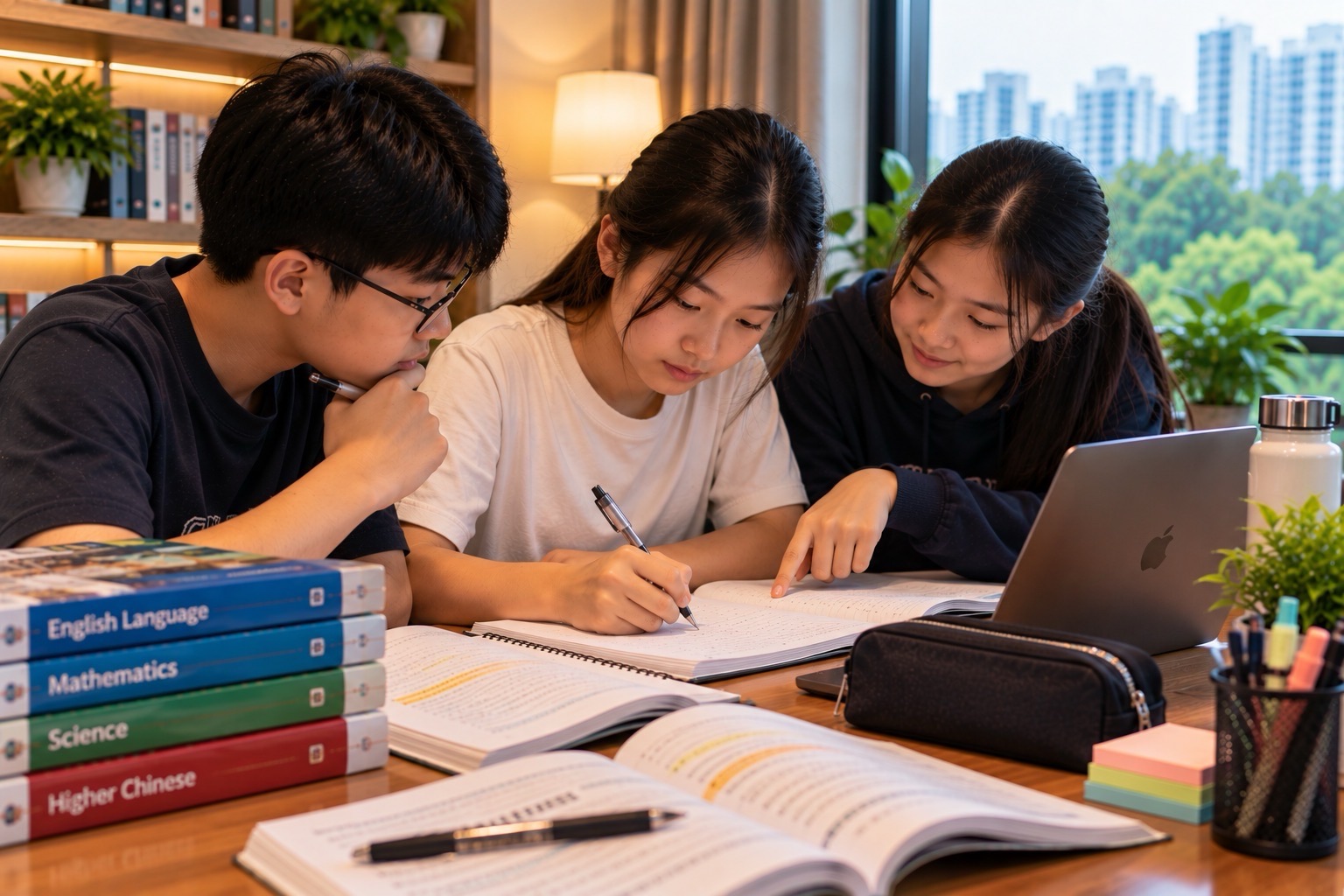
Critical thinking skills for students in Punggol are becoming more important because children now learn in a world overflowing with information, opinions, short videos, AI-generated answers, search results, advertisements, statistics and very confident people saying completely different things. Good education cannot stop at “remember the correct answer”. Students also need to ask whether an answer makes sense, what evidence supports it, what assumptions are hiding underneath it and what would make them change their mind.
That is the core aim of Punggol education through critical thinking: teach students to reason carefully, evaluate information, solve problems, test explanations and make responsible decisions without becoming permanently dependent on someone else to tell them what to think. Singapore’s refreshed 21st Century Competencies framework places Critical, Adaptive and Inventive Thinking alongside communication, collaboration and information skills because future-ready learning requires more than knowledge alone.
Explore related education guides and choose your next reading step.
The Core Aim in One Sentence
Critical thinking turns knowledge into judgment.
A student may know many facts and still make a weak decision. Another may have excellent vocabulary but accept a poor argument because it sounds impressive. A third may solve familiar Mathematics questions beautifully but freeze when the problem changes shape. Critical thinking is the bridge between possessing information and using it intelligently.
Did You Know? Critical Thinking Is Not “Criticising Everything”
The word critical sometimes sounds negative, as though a critical thinker is the person in the room who keeps saying, “No, that is wrong.” That is not the educational goal.
A strong critical thinker can agree as carefully as they disagree. They can say, “The evidence is strong,” “This explanation is plausible,” “I need more information,” or “I was wrong because this new evidence changes the picture.”
That last sentence is especially powerful. Good thinking is not about defending the first answer forever. It is about improving the answer when reality gives us better evidence.
What Singapore Means by Critical, Adaptive and Inventive Thinking
MOE’s 21st Century Competencies framework groups Critical, Adaptive and Inventive Thinking together. Critical thinking involves reasoning, analysing information and evidence, drawing conclusions, making decisions and solving problems. Adaptive thinking is the ability to use knowledge flexibly in changing contexts. Inventive thinking involves framing problems, exploring possibilities and developing useful new responses.
These capabilities belong together. A student first asks, “What is actually happening?” Then, “Does my existing method still work here?” Then, when necessary, “What else could I try?”
That is why the modern learner needs more than memorisation. The world keeps changing the question.
The Six Moves of Critical Thinking
1. Clarify the claim
Before deciding whether something is true, students need to know what is actually being claimed. Vague language creates vague thinking.
“This school is better.” Better in what sense? Academic outcomes? CCA opportunities? Travel time? Subject offerings? School culture? Support for a particular learner?
“This revision method works.” Works for what? Short-term recall? Long-term retention? Mathematics procedures? Vocabulary? Examination pacing?
A surprisingly large amount of good thinking begins by making the sentence more precise.
2. Find the evidence
A claim becomes stronger when the evidence is relevant, sufficient and trustworthy. Students should learn to ask where information came from, whether the source had access to the facts and whether another source reaches the same conclusion.
This matters in school research, Science investigations, Humanities source work and everyday digital life. It also matters when a viral post, an AI answer or a friend’s confident opinion arrives faster than the evidence behind it.
3. Separate observation from inference
Observation is what we can directly see or measure. Inference is what we think the observation means.
A plant has yellow leaves: observation. “It needs more water”: inference. A Mathematics result changed after a new study routine: observation. “The new routine caused the change”: possible inference. A classmate is quiet: observation. “They are angry with me”: inference.
Students who learn this distinction become more careful scientists, readers, writers and human beings.
4. Surface the assumption
Arguments often contain an invisible middle step. Critical thinking makes that step visible.
If someone says, “This student completes homework quickly, therefore the work is easy,” the hidden assumption is that speed accurately measures difficulty. Maybe it does. Maybe the student has strong prior knowledge. Maybe the homework is repetitive. Maybe the student rushed.
Finding the assumption does not automatically destroy the argument. It simply tells us what else needs checking.
5. Generate alternatives
Weak thinking often becomes trapped by the first plausible explanation. Stronger thinking asks, “What else could explain this?”
A falling test score could come from weak understanding, poor sleep, missed lessons, rushed reading, timing, anxiety, forgotten prerequisite knowledge or a mismatch between practice and assessment. Different causes need different solutions.
This is one reason first-principles diagnosis matters across the eduKate ecosystem: before prescribing more work, find out which mechanism is actually failing.
6. Make a provisional judgment
Eventually, thinking has to produce a decision. Students should learn to say, “Given the evidence we have, this is the best conclusion for now.”
The words for now matter. Good judgment can be firm without pretending to be permanently infallible.
Critical Thinking in English
English lessons are full of reasoning. Comprehension asks students to infer meaning from evidence. Writing requires selecting relevant ideas, organising them and anticipating how a reader will interpret them. Oral communication requires listening, responding and adjusting to context.
A useful English-thinking chain is:
- What is the claim or idea?
- Which words or details support it?
- What can reasonably be inferred?
- What alternative interpretation is possible?
- Which interpretation best fits the whole passage?
This is the logic behind Critical Thinking Through English, where claim, evidence, assumption, alternative and judgment are treated as connected language skills.
Critical Thinking in Mathematics
Mathematics is often mistaken for a subject where thinking ends once the formula is known. In reality, strong Mathematics students constantly make judgments.
- What information matters?
- What is the unknown?
- Which representation makes the structure visible?
- Which method is efficient?
- Is there another method?
- Is the final answer reasonable?
- What would change if one condition changed?
A calculator can execute arithmetic. It cannot decide which relationship is the right one unless the student or the system has correctly represented the problem first.
This becomes even more important when students use graphing tools or AI. The technology can accelerate computation, but the learner still needs to judge whether the output answers the actual question.
Critical Thinking in Science
Science gives students one of the clearest training grounds for evidence-based reasoning. A scientific explanation should connect observations, models and evidence rather than merely sound technical.
Students learn to ask:
- What changed?
- What stayed controlled?
- What evidence supports the conclusion?
- Could another variable explain the result?
- Is the data sufficient?
- What limitation affects confidence?
- What further test would reduce uncertainty?
MOE Science syllabuses explicitly connect science learning with critical and inventive thinking because scientific literacy helps students make informed decisions about real-world issues, including technological disruption and sustainability.
Critical Thinking in Humanities and Social Studies
Humanities subjects make perspective visible. Students encounter sources created by people with different interests, experiences and purposes. The educational task is not to become cynical and assume every source is dishonest. It is to read context intelligently.
Who created this? For whom? When? What evidence is included? What is missing? What might another perspective emphasise?
These are also excellent questions for social media.
Did You Know? Information Literacy Is Now Part of Thinking
In an information-rich world, “knowing where to find an answer” is no longer enough. Students need to evaluate accuracy, credibility and relevance. MOE’s 21st Century Competencies framework explicitly includes information skills alongside communication and collaboration.
That makes critical thinking inseparable from digital literacy. A polished page can be wrong. A confident AI response can hallucinate. A popular video can simplify a complex issue. A screenshot can remove context. A graph can use a distorted scale.
The modern student needs a quiet internal question: “What would convince me that this is reliable?”
Critical Thinking in the Age of AI
AI is useful precisely because it can generate possibilities quickly. It can explain, compare, summarise, produce practice questions and suggest approaches. But speed creates a new responsibility: verification.
Students using AI well should learn to:
- state the problem clearly before asking for help;
- compare the answer with trusted course material;
- check calculations and factual claims;
- ask for the reasoning, not only the conclusion;
- test the answer on a new example;
- look for hidden assumptions;
- use AI to widen thinking rather than replace it.
A student who copies an AI answer may finish faster. A student who interrogates an AI answer may actually become smarter.
The Critical-Thinking Error: Treating Confidence as Evidence
Human beings are easily impressed by certainty. A confident answer feels safer than a hesitant one. Unfortunately, confidence and correctness are not the same variable.
Teach students to ask for reasons. A softly spoken explanation with strong evidence may be better than a dramatic answer with none.
This habit is useful in classrooms, friendships, advertising, politics, investing, health information and almost every adult domain the child will eventually enter.
How Primary Students Can Learn Critical Thinking
Young children do not need formal logic textbooks to become better thinkers. They need good questions and time to answer them.
- “What do you notice?”
- “How do you know?”
- “What makes you think that?”
- “Could there be another reason?”
- “What would happen if we changed this?”
- “Which answer is stronger, and why?”
- “What evidence would help us decide?”
Primary Social Studies already provides opportunities for students to evaluate information, reason about issues and reflect on their own thinking. The larger educational habit can be practised in every subject and at home.
How Secondary Students Can Strengthen Critical Thinking
Secondary students can handle a more explicit reasoning routine. A simple version is:
- Claim — what is being said?
- Evidence — what supports it?
- Assumption — what must be true for the reasoning to work?
- Alternative — what else could explain the same facts?
- Test — what evidence would distinguish the alternatives?
- Judgment — what is the best conclusion at this point?
This routine works across essays, Science explanations, source-based questions, Mathematics modelling, project work and ordinary life decisions.
Why Good Questions Matter More Than Fast Answers
A classroom becomes more intellectually powerful when students are allowed to ask precise questions. “Why?” is useful, but students can learn richer forms:
- What evidence would change this conclusion?
- Which part of this explanation is weakest?
- What are we assuming?
- Does this example generalise?
- What information is missing?
- Who benefits if this claim is accepted?
- What would the opposite view say?
- Can both explanations be partly true?
The ability to generate the next useful question is one of the clearest signs that a learner is becoming independent.
Critical Thinking and Metacognition
Metacognition means thinking about one’s own thinking. It helps students notice when they are guessing, when a method is not working, when confidence is outrunning evidence or when an old assumption needs revision.
After solving a problem, a metacognitive student can ask: “Why did I choose this method?” After a mistake: “Where did my reasoning first change direction?” After feedback: “What will I do differently next time?”
That is why critical thinking and good study skills reinforce each other. The new series article The Core Aim of Punggol Education | Study Skills builds the practical learning loop around retrieval, spacing, errors and independence.
The Danger of Teaching Critical Thinking as a Separate “Skill”
Critical thinking needs knowledge. It is difficult to evaluate a Biology explanation without Biology knowledge, judge a historical claim without historical context or test a Mathematics solution without mathematical structure.
So the educational aim is not “content versus thinking”. It is content that becomes usable through thinking. Knowledge gives the mind material; critical thinking helps the mind organise and judge it.
How Parents Can Build Critical Thinking at Home
You do not need to turn dinner into a debate club. Everyday conversations are enough.
- Ask for reasons instead of immediately supplying your own.
- Let children predict what will happen before revealing the result.
- Compare two options and discuss the trade-offs.
- When a claim appears online, check the original source together.
- Ask what information is missing.
- Allow a child to revise an opinion without treating the change as weakness.
- Model the phrase, “I do not know yet.”
That last habit is underrated. Intellectual confidence includes being comfortable with temporary uncertainty.
How Tutors Should Teach Critical Thinking
A tutor can either become the student’s answer machine or the student’s reasoning coach. The second role creates more transferable capability.
Useful tutoring moves include:
- ask the student to explain before correcting;
- request evidence for an answer;
- compare two methods;
- introduce one plausible wrong answer and diagnose it;
- change one condition and ask what follows;
- delay hints long enough for productive struggle;
- ask the student to create a question that would test the same concept differently.
The aim is not to make every lesson slower. It is to make the student’s thinking increasingly visible and increasingly self-correcting.
What Progress Looks Like
Critical-thinking progress is visible when a student:
- asks more precise questions;
- explains why rather than only what;
- uses evidence more carefully;
- notices assumptions;
- considers alternatives before committing;
- distinguishes fact from interpretation;
- changes a conclusion when stronger evidence appears;
- checks AI or online information instead of accepting it automatically;
- can transfer a method into an unfamiliar context;
- becomes less dependent on an adult to validate every answer.
These habits improve academic work, but their value extends far beyond examinations.
Frequently Asked Questions
What is critical thinking for students?
Critical thinking is the disciplined use of reasoning and evidence to understand information, solve problems, draw conclusions and make decisions. It also includes reflecting on one’s own thinking and revising conclusions when evidence changes.
Is critical thinking the same as problem solving?
Problem solving is one important part of critical thinking. Critical thinking also includes evaluating claims, judging evidence, identifying assumptions, comparing explanations and deciding what to trust.
Can young children learn critical thinking?
Yes. Young children can compare, classify, explain reasons, predict, notice patterns and ask what evidence supports an idea. The language becomes more sophisticated as they grow, but the habit can begin early.
Does memorisation prevent critical thinking?
No. Strong thinking needs knowledge. The problem is stopping at memorisation. Students should know important material well enough to retrieve it, then use it to analyse, explain, compare, solve and judge.
How does AI affect critical thinking?
AI makes verification more important. Students can use AI to generate explanations and possibilities, but they still need to check evidence, test reasoning and decide whether the output fits the task.
What is a simple critical-thinking routine?
Use six moves: clarify the claim, find the evidence, identify assumptions, generate alternatives, test the possibilities and make a provisional judgment.
Useful Routes for Punggol Families
- eduKatePunggol home — local education, tuition, parent, student and pathway routes.
- Critical Thinking for Students | Evidence, Inference, Assumptions, Alternatives and Better Questions.
- Critical Thinking Through English.
- Learning for Judgment.
- Learning for Discernment.
- The Core Aim of Punggol Education | Study Skills.
- MOE | 21st Century Competencies.
- MOE Education Conversations.
The Best Critical Thinker Is Not the Person With the Fastest Opinion
The best critical thinker is often the person who can slow down just enough to see what the question really is, separate evidence from assumption, test another explanation and then make a decision they can defend — while remaining willing to improve it.
That is the core aim of Punggol education through critical thinking: give students enough knowledge to think with, enough discipline to test their thinking and enough confidence to change their mind when the evidence deserves it.
Properly taught kids shine a bright light into the future.


