
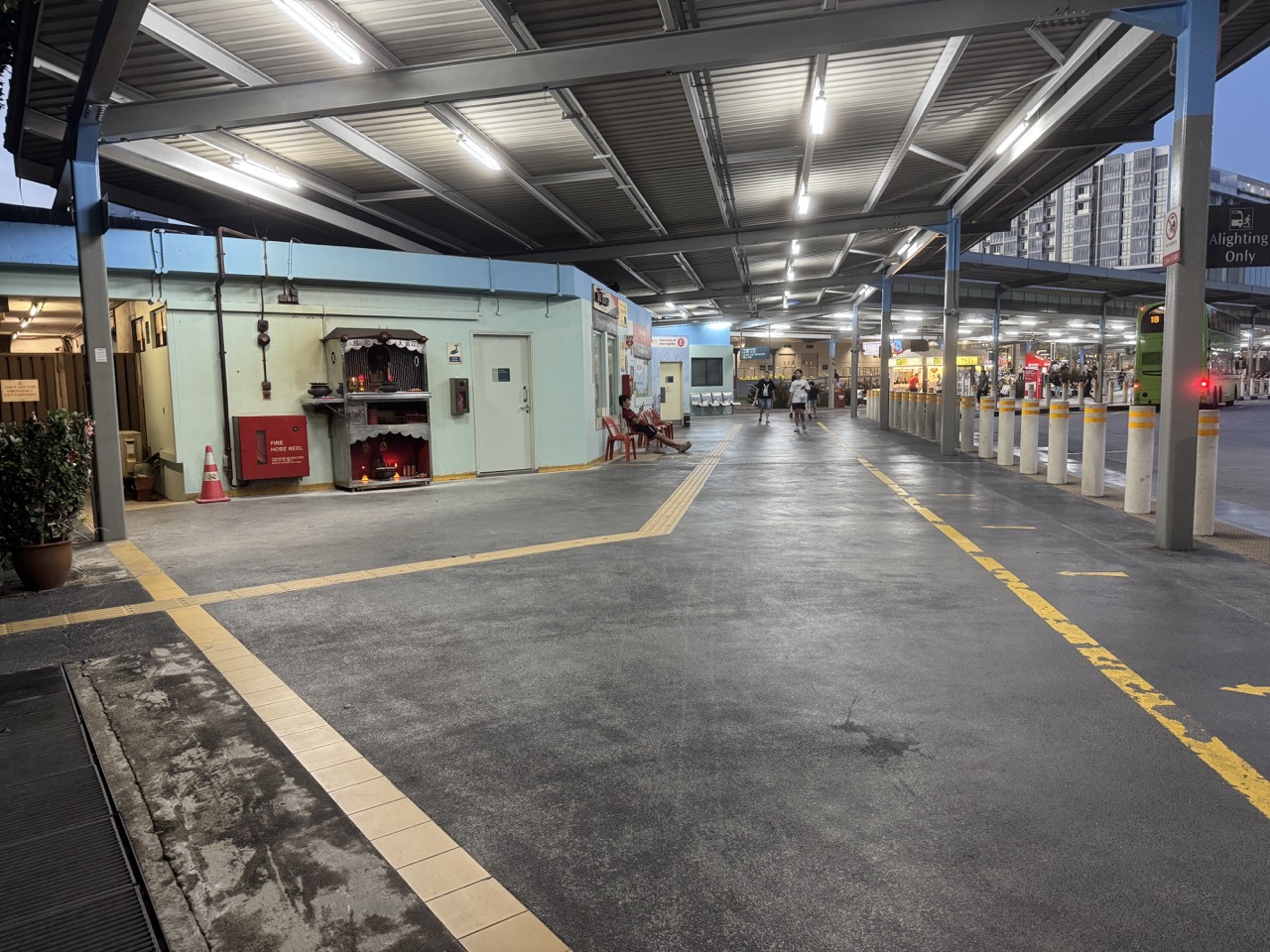
How should you travel through Punggol MRT, the LRT loops, bus stops and neighbourhood walkways during haze? Keep necessary journeys simple, avoid needless outdoor waiting and check Singapore’s current NEA one-hour PM2.5 reading before an immediate outdoor transfer. The 24-hour PSI forecast helps with planning tomorrow. MOH says an N95 mask is generally not needed for an ordinary short commute to school or work; personal health, the latest advisory and the length and intensity of outdoor exposure remain relevant. A covered bus stop protects from rain, but it does not automatically filter fine smoke particles.
This Punggol haze commuting guide is about the route from your front door to the station, school, clinic, office, library or home—not the safety rules for eight-hour outdoor work shifts. We look at walking time, LRT platforms, bus transfers, Punggol Coast journeys, children, older residents and avoiding unnecessary detours. For employers, couriers, delivery riders, construction teams and workplace respiratory protection, use our dedicated Punggol haze workplace safety guide instead. This clear separation gives commuters a direct answer without burying them in regulations intended for employers.

Go directly to: Break the journey into small sections before making decisions · Using the Punggol LRT East Loop during haze · Bus stops: shelter from weather is not particulate filtration · Older adults: pace and comfort before the journey begins · Driving, car pickups and ride-hailing during haze · Morning versus evening: do not invent a permanently cleaner hour · Do not confuse the commute with the outdoor job that follows · Punggol commuting myths that cause unnecessary confusion
Break the journey into small sections before making decisions
A real commute is rarely simply ‘inside’ or ‘outside’. It may begin in an HDB corridor, follow an exposed estate path, pass through a covered bus stop, continue on an air-conditioned train and end with a short outdoor walk. The number of transitions matters because the whole journey cannot be described by its most comfortable segment. Air conditioning in one carriage does not prove that every part of the route has clean indoor air.
Start by marking the unavoidable outdoor sections, then ask which ones can be shortened without creating other safety problems. A direct route to Punggol MRT may be preferable to adding a scenic walk by the Waterway. Do not rush across a road, ignore pedestrian signals or skip an accessible lift merely to save a minute outside. Good travel planning always includes normal road and mobility safety.
Which number should a Punggol commuter read?
For something happening now, such as walking to the bus stop before lunch, consult the latest one-hour PM2.5 band and MOH’s activity guide. For a necessary journey tomorrow, the 24-hour PSI forecast and broader advisory provide planning context. These are different indicators and time horizons. A screenshot of today’s one-hour concentration cannot be treated as a fixed forecast for tomorrow’s school pickup or work shift.
NEA’s reported figures describe monitoring regions, not a pollutant sensor at each residential block or station staircase. A parent should check the timestamp rather than guessing from the skyline’s colour. Our Punggol PSI and PM2.5 guide explains units and interpretation. For a commute, it is usually enough to use the proper official source and adjust unnecessary outdoor time; there is no need to become an atmospheric scientist between breakfast and the lift.
Punggol MRT: make the station a convenient destination, not a race
Punggol MRT is an important North East Line and LRT interchange. Many journeys begin with a walk from homes along Punggol Central, Punggol Field or neighbouring estates, while others involve a feeder bus or LRT transfer. During haze, the best route is typically one that is familiar, safe and requires no extra recreational detour. If an adult needs assistance or extra time, arrange it rather than encouraging them to hurry through outdoor sections.
A station concourse, platform, covered entrance and nearby retail walkway can each have different ventilation conditions. None should be assumed to be a medically certified clean-air environment. If the family needs to wait for someone, choose a practical designated waiting place and communicate clearly so nobody stands outside unnecessarily. Follow SMRT/SBS Transit and LTA operating notices for service changes; haze advice is separate from transport service information.
Using the Punggol LRT East Loop during haze
The East Loop connects residential areas with the town centre and may help shorten a long street-level walk. But a transfer still includes the journey from the block to the station, waiting and the final segment to the destination. Check the station and the platform’s actual environment rather than assuming every part of a transit route is enclosed. For a school journey, a straightforward LRT transfer may be appropriate when the child is well and official guidance permits.
Avoid converting the commute into an extra exercise session during high PM2.5 readings. If walking a longer waterfront route normally doubles as daily fitness, save that walking habit for better-air times. The school, employer or care provider can supply any relevant institutional notice. Transport route planning is about managing necessary movement, not finding a loophole to continue an otherwise unsuitable long outdoor workout.
Using the Punggol LRT West Loop and Northshore connections
The West Loop serves neighbourhoods including parts of Sumang and the Northshore side of Punggol. It can be practical for connecting people to Punggol MRT, local homes and amenities. The best transfer depends on the actual starting block and destination. Do not assume that a bus stop, station or elevated structure filters outdoor particles merely because it provides cover. The actual enclosed interior and its ventilation are separate matters.
Families with small children or older residents can plan a slightly less demanding transfer, even if the journey has one extra transport stop. The priority is a workable route rather than the shortest distance on a map at all costs. If someone is already wheezy or unusually breathless, the problem may require medical attention, not a more elaborate travel itinerary. Personal health can legitimately change the travel decision.
Punggol Coast MRT and Digital District journeys
Punggol Coast MRT and the surrounding Digital District support commuting, study and appointments, but visitors should still check how to get from the station to their exact building. A meeting at the SIT campus, a mall visit and a delivery to a neighbourhood block have different final approaches. Keep the route specific: entrance, accessible gate or lift where needed, and the final outdoor transfer.
A new building is not automatically a clean-air refuge, and a glass canopy does not convert an open plaza into a filtered room. If the destination offers an appointment or a class, confirm its instructions for any haze-related change. The Teck Lee LRT and Digital District neighbourhood guide and Punggol visitor transport guide explain local context, while the relevant transport operator has the final say on services.
Bus stops: shelter from weather is not particulate filtration
A covered bus shelter can make a journey comfortable in rain and sunshine. During smoke haze, the roof and side panels do not prove that PM2.5 has been removed from the air inside. Keep the distinction clear, especially when travelling with a child or someone with chronic lung or heart disease. If a long wait is avoidable, use reliable transport arrival information and leave home at a reasonable time rather than standing unnecessarily on an open pavement.
Do not take risks with traffic or boarding etiquette to shorten the waiting time. If a bus is crowded, ask whether the destination can wait or a practical alternative is available. Public transport continues to play an important role for essential journeys, but comfort and exposure can vary between an open bus stop, vehicle interior and final walk.
Footpaths, sheltered linkways and pedestrian crossings
Punggol’s paths are designed to make neighbourhood life walkable. They include open streets, covered connectors near developments and numerous crossings. When haze affects the outdoor air, it is reasonable to choose a direct route that keeps time outside manageable. But a shortcut that requires crossing away from a designated crossing is never an acceptable respiratory-health strategy. Road safety remains non-negotiable.
A person using a stroller, mobility aid or wheelchair may prioritise ramps and lifts instead of a route with stairs. A slightly longer safe path can be the correct choice. The important question is whether the walking route is realistic for the person making the trip, not whether it creates the most impressive step count. Explain to children that sheltered means protected from rain, not automatically protected from haze.
School journeys and the pickup-time problem
For Punggol families, school transport can involve walking, LRT, bus, a school-bus service or a family car. Haze may change PE and CCA arrangements without closing classrooms or changing dismissal. Parents therefore need two different checks: the environmental information for the journey and the school’s own communication for timing and location. A child should not be left waiting outside because an adult assumed that a cancelled CCA also cancelled the usual bus.
Confirm the actual pickup adult and handover spot, particularly when another caregiver normally helps. Have prescribed medicines accessible according to the child’s care plan, and seek advice for symptoms. The separate Punggol Parents Gateway and school pickup guide provides the detailed messaging and caregiver checklist. This commute guide addresses where the journey takes place and how to avoid unnecessary outdoor transfers.
Older adults: pace and comfort before the journey begins
An older Punggol resident travelling to a clinic, library or family meal may need more time for a familiar route. If chronic heart or lung disease is present, official haze guidance may call for greater precautions than those for a healthy adult. Plan the trip around the person’s usual capacity, medicine and appointments. Ask whether another adult can collect an item or accompany them when necessary.
A less hurried route with lifts and rest opportunities may be preferable to a short staircase climb or a rapid transfer. However, do not make a person sit outside waiting for a perfect low-pollution moment if urgent medical care is needed; follow appropriate clinical and emergency instructions. A good plan respects both the person’s independence and the actual risk. The Punggol wheelchair travel and assistance guide covers lift and staff-help considerations.
Wheelchairs, prams and accessible train help
For a wheelchair user or parent pushing a pram, the easiest route may depend on station lift access, ramps, the location of an accessible gate and whether a pathway is temporarily obstructed. Check the actual operator’s current service information and allow adequate time. The aim is not to force a shorter route through an inaccessible stairwell because an air-quality reading seems discouraging.
If assistance is needed, use recognised transport staff support channels. Helping Hand Cards in Punggol transport and wheelchair train-travel planning offer complementary accessibility information. Indoor and outdoor exposure still matter, but inclusive route planning recognises that a person cannot simply swap every path for another on command.
Cycling as transport is not the same as a leisure ride
Some Punggol residents cycle to nearby amenities or transport connections. This can be practical in ordinary conditions, but exercise intensity and outdoor duration also count during haze. Do not treat a bicycle as an automatic way around official recommendations to reduce strenuous outdoor activity. A person riding quickly to save time may exert themselves more than someone walking gently to a nearby station.
For a necessary bicycle journey, consider whether a safe alternative is available under current guidance. If riding is appropriate for your health and the official reading, plan a clear, familiar route, follow cycling rules and wear suitable safety equipment. Postpone optional long loops when advisories call for less outdoor activity. The broader Punggol haze cycling and park guide handles leisure routes rather than everyday transfers.
Driving, car pickups and ride-hailing during haze
A private car or hired vehicle may reduce some time spent walking outdoors, but it is not automatically practical or affordable for every family. Vehicle cabin filtration differs, and traffic exposure and pickup rules still apply. If a school, clinic or residential complex has a designated pickup area, follow it instead of blocking entrances or making unsafe stops in the name of reducing haze exposure.
A car can be useful for a person whose mobility or health requires a shorter outdoor transfer. Yet combining necessary trips and travelling at sensible hours may be more useful than changing transport modes for every journey. Road safety, driving attention and the normal need to secure children properly do not disappear because the sky looks smoky.
Combining supermarket errands and a meal
A Punggol resident may need groceries near Waterway Point, One Punggol, Northshore Plaza or a neighbourhood shop. If an outing is appropriate, list the essentials, visit the actual required stops and avoid adding an optional waterside stroll when outdoor exposure needs to be reduced. The benefit of a retail hub is that multiple errands may be close together, not that every part of the complex provides the same clean indoor air.
Someone with symptoms or an elevated health risk may prefer a household member collecting items or a suitable delivery arrangement. This is simply a practical division of labour, not a medical statement that everyone must remain indoors throughout a haze episode. Punggol indoor things to do during haze gives destination options for a separate leisure question.
Why an N95 is usually unnecessary for ordinary commuting
MOH’s current haze guidance says N95 masks or equivalent are generally not required for commuting from home to school or work and are also not needed in indoor environments. Protection begins with avoiding unnecessary prolonged exposure and changing strenuous activities when the official advice calls for it. A respirator may be relevant to some different situations, but fit, breathing resistance, duration and personal health matter.
A person working outdoors for hours is not in the same position as a student riding the LRT to school. That is why workplace guidance discusses job rotation, fit testing and employer controls in more detail. Read Punggol Haze Workplace: outdoor workers and employer responsibilities rather than copying workplace respirator advice onto a short family commute.
Morning versus evening: do not invent a permanently cleaner hour
It is tempting to decide that an early-morning train walk or late-night return must be safer because it is cooler or the air seems clearer. Smoke haze can shift with wind, rain and regional fires, so there is no universal Punggol clock time that guarantees a lower PM2.5 concentration. Check the current NEA reading for the period in question, especially if the person is planning to add outdoor exertion.
A pleasant breeze is not a pollutant measurement, just as a heavy shower is not a certificate of clean air for the rest of the evening. Keep the travel choice tied to the activity, the source time and the individual’s health. It is more useful to become familiar with the official advisory than to memorise an unsupported ‘best hour’ from a social post.
Teenagers travelling independently to tuition or a friend’s home
A teenager may travel across Punggol independently for tuition, a library study group or a social appointment. Agree on one direct route, a realistic return time and how to contact an adult if the school or activity changes. The teenager can check the official one-hour PM2.5 and understand why a long exercise detour may be inappropriate, without being made responsible for everyone’s health decisions.
Encourage them to distinguish a transport instruction from an environmental observation. A screenshot of haze over Punggol does not mean the train has stopped running, and a parent’s concern does not mean an entire CCA has been cancelled. Check the provider or operator’s actual messages. This develops practical judgement and independent travel skills without presenting haze as a reason for perpetual restriction.
What if someone feels unwell during the journey?
Move to a safer practical environment, stop unnecessary physical exertion and seek appropriate medical care if symptoms develop. People with asthma or chronic heart or lung disease should follow their individual healthcare plans and keep prescribed medicines accessible. Persistent wheeze, worsening cough or unusual breathing difficulty deserves medical assessment; the cause may not be haze alone.
Severe breathing difficulty, chest pain, collapse or other emergency symptoms require urgent help. In Singapore, call 995 for an emergency ambulance. This article does not diagnose a passenger from the PSI or tell people to change a medicine dose. Personal health can override an otherwise sensible travel plan; a necessary medical journey should be planned with clinical advice when possible.
Do not confuse the commute with the outdoor job that follows
Someone might make a five-minute outdoor transfer to Punggol Digital District and then work in an enclosed office. Someone else may arrive at the same station and spend hours outdoors maintaining buildings or delivering goods. Their first five minutes resemble each other, but their subsequent occupational exposure is very different. MOM’s employer guidance uses 24-hour PSI categories and job-level risk assessment for prolonged or strenuous work.
To avoid repeating another article, this guide does not reproduce detailed employer PPE, fit-testing, shift-rota or 24-hour PSI workplace tables. Those belong in Punggol Haze Workplace Guide: Outdoor Workers, Delivery Riders and Employers. A commuter needs the shortest workable safe journey and correct current health advice; an outdoor worker needs an additional properly managed workplace exposure plan.
Worked example: parent and grandparent travel through Punggol
Imagine a working parent, a Primary 3 child and an older grandparent. The child finishes school at 1.30pm, the parent travels by LRT and the grandparent usually meets them at the block. Today’s one-hour PM2.5 reading is higher than usual and the parent receives a school message changing an after-school activity. The family first checks whether the actual dismissal time changed and who has responsibility for pickup.
If the grandparent has a chronic heart condition, the family considers whether a healthier adult can handle any optional exposed waiting. The parent chooses a direct safe transport route, avoids adding an unnecessary waterfront walk and confirms the handover. The child goes home for a snack and rest. The plan succeeds because each decision addresses one real issue instead of turning a hazy day into a complicated travel experiment.
A route-time example that does not pretend to measure inhaled pollution
Suppose one route includes twelve minutes outdoors before the train, while another includes seven minutes outdoors but adds a safer accessible transfer. The difference is five minutes in outdoor time; that can be a useful planning input. It does not prove a specific reduction in inhaled PM2.5 dose because air concentrations, ventilation, exertion and other conditions vary. Use travel arithmetic to plan time, not diagnose health.
For a child, this is a neat mathematics and science example: identify the data given, calculate the duration difference, then ask which conclusions would require additional measurements. The correct numerical answer does not give permission to abandon pedestrian safety, assistive access or official advice. Good judgement connects mathematics to the living world without overstating precision.
Punggol commuting myths that cause unnecessary confusion
‘The covered path is filtered’ is not a reliable statement. ‘The LRT is always cleaner than every walking route’ cannot be established without relevant measurements. ‘Rain means the evening trip is automatically safe’ ignores how conditions change. ‘Everyone needs an N95 for a five-minute walk’ is not MOH’s general advice. And ‘Unhealthy PSI means the trains stop’ invents a transport suspension that only the operator could actually announce.
A strong commuter habit consists of simple questions: What does the latest official air-quality guidance say? Who is travelling? What is the unavoidable outdoor part? Which route is safe and accessible? Has the transport or destination operator changed anything? That is enough structure for a calm Punggol morning without making ordinary daily life a source of constant anxiety.
Frequently asked questions about Punggol haze commuting
Should I wear N95 on the LRT? MOH says an N95 is generally not needed for an ordinary short commute; personal circumstances and current advice still matter. Are covered walkways clean-air spaces? Not necessarily; rain cover is different from particle filtration. Can my child attend school by bus? Follow actual school and transport instructions, and consider their health and outdoor transfers. What about a long outdoor delivery shift? Consult the dedicated workplace guide and applicable employer arrangements.
Is Punggol Coast MRT open during haze? Do not infer service disruption from an air-quality photograph; check the operator’s current notices. Should I cycle to save time? Consider exertion, health and official guidance; fast cycling can be strenuous. Can we choose the evening because rain fell earlier? Recheck the current reading. What if someone feels unwell? Stop unnecessary exertion and seek appropriate medical care.
A good Punggol journey is a quiet, well-planned one
Haze changes how we think about outdoor transitions, but it does not remove the value of public transport or neighbourhood walkability. Punggol residents still need to attend school, work, medical appointments and essential errands. Most can benefit from the same modest adjustment: verify the official source, choose a direct safe route and avoid stretching a necessary journey into an optional outdoor workout when the advisory calls for less exposure.
A commuter should not have to solve the whole regional haze problem before boarding a train. Use reliable information, respect health and mobility differences, follow transport instructions and arrive without rushing. The Punggol waterway will be waiting when the air is more suitable for a leisurely walk.
| Journey type | Main consideration | Correct source |
|---|---|---|
| Short school/work commute | Necessary outdoor transfers, safe route and health | MOH one-hour guide plus school or transport notice |
| Tomorrow’s journey planning | Forecast, health, expected transfers | NEA 24-hour PSI forecast |
| Trip to Punggol Coast or Digital District | Actual station exit, destination building and access | Relevant operator and destination |
| Prolonged outdoor delivery or maintenance shift | Occupational risk assessment and employer controls | MOM workplace haze guidelines |
| Older or medically vulnerable person | Comfort, accessibility, medications and symptoms | MOH plus individual medical advice |
Continue with the matching Punggol topic
- Punggol Haze Workplace: employer duties and delivery riders
- Punggol haze school pickup and Parents Gateway
- Indoor Punggol destinations during haze
- 48-hour household haze preparedness
- Asthma, children, older adults and N95 guidance
- Things to do near Punggol MRT
- Wheelchair train travel in Punggol
- PM2.5 and PSI: which reading to use
Official sources and update policy
Reviewed 17 October 2026. This is a neighbourhood travel-planning guide, not a live train-status service or medical clearance. There are no invented station air-monitor readings, specific travel restrictions or claims that covered walkways filter haze. Check current operator notices and health advice.
- NEA: official current haze readings
- MOH: haze health advice and commuter mask position
- LTA: transport operator and accessibility information
- MOM: workplace haze guidelines for workers with prolonged exposure
- NEA: 9 October 2026 general haze readiness measures
New Punggol Haze Guides: Homes, Travel and Insurance
Read practical follow-up guides about humidity when windows are closed, renovation pollutants, insurance eligibility and actual airport disruptions. For live air-quality decisions, use NEA’s official readings.


