
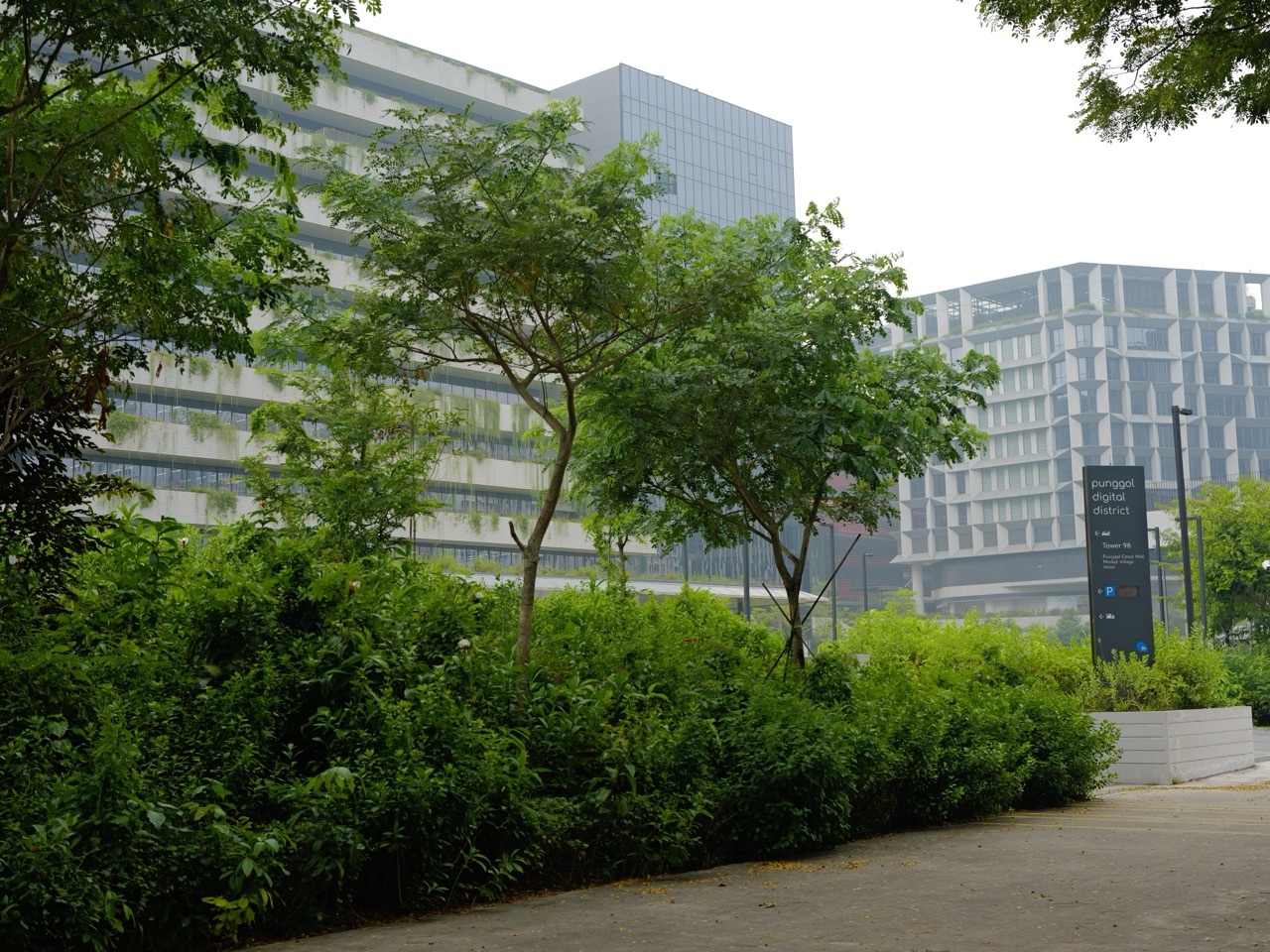
Market Village is the planned low-rise waterfront dining and leisure cluster inside Punggol Digital District. It sits at the coastal end of the district, beside the waterfront promenade and close to Coney Island, and is intentionally designed very differently from Punggol Coast Mall: small-scale, single-storey pavilions among existing Casuarina trees rather than a conventional multi-level shopping mall.
Status checked 3 October 2026: official public sources still require careful wording. JTC’s main Punggol Digital District page now uses present-tense language saying the district has retail and dining options at Punggol Coast Mall and The Market Village. However, JTC’s dedicated public PDD site currently sends shoppers to Punggol Coast Mall and does not expose a Market Village tenant directory, pavilion-by-pavilion trading map or clear walk-in opening announcement. Older JTC tender/story material also describes Market Village as a planned lifestyle destination. This guide therefore recognises the stronger present-tense JTC positioning without inventing a tenant list, universal operating hours or a claim that every pavilion is trading today.
The correct 2026 owner is a what-it-is + design + opening-status guide. When JTC publishes a clear public opening announcement and tenant directory, this page should be refreshed immediately.
Market Village at a glance
| Question | Current answer |
|---|---|
| Where is it? | Waterfront edge of Punggol Digital District, near the Punggol Promenade / Coney Island side |
| What is it? | Low-rise waterfront retail/F&B / leisure cluster |
| Building height | URA requires maximum one storey within Market Village |
| Design character | Discrete pavilions integrated among existing Casuarina trees |
| Main view | Coastal / waterfront promenade |
| Nearest major transport | Punggol Coast MRT; Teck Lee LRT; Punggol Coast Bus Interchange |
| Opening status | Official public sources are not yet consistent enough for this guide to state a firm walk-in opening date/tenant roster |
Why Market Village exists when Punggol Coast Mall already exists
The two places solve different urban jobs.
| Punggol Coast Mall | Market Village |
|---|---|
| Distributed retail across PDD towers and SIT Campus Court | Low-rise waterfront leisure/dining cluster |
| Everyday shopping, restaurants, services | Coastal destination character |
| Higher-density district retail | Single-storey, tree-integrated pavilions |
| Strong MRT/work/university convenience | Promenade, nature and waterfront connection |
The mall is the district’s practical retail system. Market Village is meant to create a slower waterfront destination.
The design rule: maximum one storey
URA’s current Punggol Digital District design guidelines are unusually explicit about Market Village. Within the waterfront Market Village zone, buildings are to be kept to a maximum of one storey.
The purpose is to preserve an intimate scale along the promenade rather than build another wall of commercial space between people and the coast.
Pavilions among Casuarina trees
URA says the waterfront buildings should be articulated as a series of discrete pavilions interspersed among existing Casuarina trees. Existing natural features are not supposed to be treated as empty land waiting to be cleared.
That is one of the strongest design ideas in Market Village: the dining space is supposed to inherit some of the older coastal character rather than reproduce the visual language of the nearby business towers.
The 50-metre waterfront design zone
URA’s urban-design guide identifies a roughly 50-metre-deep waterfront zone for Market Village where the low-rise design and tree integration are controlled carefully.
The transition to the lower promenade is also supposed to be smooth and barrier-free, reinforcing the idea that Market Village belongs to the waterfront walk rather than sitting above it as a separate commercial podium.
Outdoor refreshment and public space
URA’s guidelines encourage landscaping, seating, kiosks and outdoor refreshment uses along the waterfront edge. Earlier development material also described outdoor seating associated with the individual Market Village buildings.
That suggests the intended experience is not only indoor dining. The waterfront itself should be part of the meal and leisure environment.
Promenade Plaza beside Market Village
The district plan also requires a major Promenade Plaza where Campus Boulevard reaches the waterfront. URA specifies at least 3,000 square metres of public space, with shade, seating and community-event potential.
The plaza is meant to connect seamlessly to Market Village and the waterfront Park Connector Network. In other words, the future visit should work as:
MRT / Campus Boulevard → Promenade Plaza → Market Village → Waterfront → Nature Walk / Coney Island direction.
Why the Coney Island relationship matters
Market Village sits at the point where the highly engineered PDD meets Punggol’s coastal/nature system. Coney Island lies nearby, and the waterfront promenade links into the broader northern recreation network.
That gives Market Village a very different potential use from a business-park food court: it can become a before/after stop for cycling, walking, families and visitors using the coast.
Not the same as The Punggol Settlement
Punggol already has one seafront restaurant cluster: The Punggol Settlement at Punggol Point. Market Village is a separate PDD development closer to the Digital District / Coney Island side.
Do not mix the addresses or tenant lists.
Use The Punggol Settlement 2026 for the existing seafront-dining cluster.
Not the same as Punggol Coast Hawker Centre
Punggol Coast Hawker Centre is already a functioning 40-stall hawker anchor. Market Village is intended as a separate leisure/F&B destination with a different waterfront form.
That separation is useful: hawker food handles affordable everyday meals; Market Village can create a slower waterfront restaurant / leisure layer.
The current status problem: official wording is not fully aligned
As of 27 September 2026, the public record is still mixed rather than fully unresolved: JTC’s main PDD homepage uses present-tense language saying the district “boasts retail and dining options” at Punggol Coast Mall and The Market Village. However, JTC’s current Community amenities page lists Punggol Coast Mall, Punggol Coast Hawker Centre and the first open section of the Heritage Trail as active amenities without publishing a Market Village tenant directory, while another current JTC story still says the district “will feature” a Market Village. No clear public walk-in opening notice or official tenant roster is exposed in the current PDD directory.
- JTC’s main PDD homepage says the district “boasts retail and dining options at Punggol Coast Mall and The Market Village”.
- JTC’s community-story material says the district “will feature a Market Village”.
- URA’s June/August 2026 planning material says “The Market Village will provide” leisure and dining options.
- The dedicated PDD public shopping website currently showcases Punggol Coast Mall and does not expose a clear Market Village store directory.
Those differences may reflect construction completion, leasing, fit-out and phased public opening happening on different schedules. This guide will not turn that ambiguity into a fictional launch date.
So can I go there today?
If your purpose is specifically to dine at a Market Village tenant, check the current JTC/PDD directory first. At the time of this update, this page does not have an authoritative live tenant list or a single confirmed public opening notice to point you to.
If your purpose is simply to explore PDD, Punggol Coast Mall, the hawker centre, SIT, Campus Boulevard and the open parts of the district are already separate reasons to visit.
How to get there when Market Village is fully activated
The district is designed so Market Village can be reached without a car:
- Punggol Coast MRT: walk through PDD toward the waterfront;
- Teck Lee LRT: JTC/URA plans include a covered connection toward the waterfront;
- Bus: Punggol Coast Bus Interchange is inside the district;
- Walking/cycling: Campus Boulevard and waterfront paths are core parts of the car-lite plan.
Use Punggol Coast MRT Station Guide.
What kind of tenants should residents expect?
The official planning documents identify Market Village as an activity-generating retail/F&B zone. Property-leasing material has marketed individual Market Village parcels as F&B spaces with outdoor areas.
That supports an expectation of restaurants, cafés and leisure-oriented food uses—but until JTC publishes the actual tenant roster, specific brand predictions are just speculation.
Why Market Village matters even before the tenant list
Its planning idea is important because it prevents the waterfront from becoming the back edge of a business district.
- Campus Boulevard draws people toward the water.
- Promenade Plaza creates a public destination.
- Market Village gives the waterfront active use.
- low-rise pavilions preserve coastal scale;
- Casuarina trees retain some pre-district landscape character;
- the Promenade connects onward to recreation and nature.
Family use
Once the dining layer is fully public and operating, Market Village should be especially useful for families combining:
- Punggol Coast / PDD exploration;
- SIT visits;
- waterfront walking;
- cycling;
- Coney Island / Nature Walk route;
- an evening meal near the coast.
Office-worker / student use
PDD is planned for tens of thousands of workers and around 12,000 SIT students. Market Village adds a destination food/leisure layer outside the ordinary lunch-food-court system.
The district works better if workers and students have a reason to stay after office/class hours rather than leave immediately for another town.
Evening use
The strongest long-term role may be evening: coastal breeze, lower-rise buildings, outdoor dining and the contrast between PDD’s towers and the waterfront edge.
Opening hours will depend on actual tenants once the public F&B roster is clear.
What this guide will update when JTC confirms it
- official public opening date;
- live F&B tenants;
- unit/pavilion map;
- operating hours;
- pet-friendly tenant rules;
- outdoor seating arrangements;
- access during construction/fit-out;
- parking/drop-off specifics;
- connection to the fully completed Heritage Trail and waterfront.
Official current sources
- JTC — Punggol Digital District
- URA — Punggol Digital District
- URA — PDD Urban Design Guidelines
- Punggol Digital District public site
Last checked: 28 September 2026. JTC’s current PDD homepage now presents Market Village in present tense as part of the district’s retail and dining offer. However, the current public Community amenities page still does not expose a dedicated Market Village tenant directory or a clear all-pavilions walk-in opening notice. Until those appear, this page treats Market Village as a confirmed PDD waterfront dining/retail component whose exact public tenant and operating status must be checked live.
Continue the PDD route
- Punggol Digital District Guide 2026
- Punggol Coast Mall Guide 2026
- Punggol Coast Hawker Centre
- Punggol Promenade Guide 2026
- The Complete Punggol Guide
Market Village matters because it is where PDD is supposed to stop feeling like a business district and meet the coast. The architecture is already clear: low, tree-filled, public and waterfront. The only thing this guide will not do is pretend the tenant/opening story is clearer than the official record currently makes it.
Punggol future web: 2026–2036 Timeline · Punggol Digital District · Cross Island Line · Habyt Punggol Hotel · OBS Coney Island · CJC 2034 · Marine Fire Post · Complete Punggol Guide.
Estate routing: Return to the eduKatePunggol Atlas for the full learning, family and town knowledge graph, or continue through the future and local-life routes above.
Market Village 2026 | What is verified, what is still unclear, and how to plan a visit
Market Village is one of the easiest Punggol Digital District projects to misunderstand because several kinds of official evidence now coexist. JTC’s main district page speaks about Market Village in present-tense retail-and-dining language. JTC’s dedicated public PDD visitor site currently promotes shopping at Punggol Coast Mall and does not show a Market Village tenant directory. Earlier tender documents describe four waterfront pavilions and their intended F&B/retail role. Those sources are not useless because they differ; together they define the current verification boundary.
The safe 2026 conclusion is therefore narrower than either “Market Village is still only a plan” or “Market Village is fully open with a complete tenant mix.” JTC now treats Market Village as part of PDD’s retail-and-dining proposition, while the public information needed for a confident pavilion-by-pavilion walk-in guide remains incomplete. A high-quality local article should preserve that distinction until JTC or the operating tenants publish clearer live details.
1. Read the evidence in layers
Use the most specific source for the question you are trying to answer. JTC’s district homepage establishes that Market Village belongs to the current PDD lifestyle proposition. The concept-price tender establishes the physical vision, pavilion count and intended uses. The dedicated visitor site establishes what JTC is actively surfacing to ordinary visitors for shopping today. A tenant’s own current page would establish its own hours and trading state if and when one is publicly listed.
Those layers should not be collapsed. A master-planning document can prove that a pavilion exists in the development concept without proving a restaurant is serving tonight. A homepage can show that Market Village is part of the district’s present identity without proving every parcel is occupied. A mall directory can show current tenants without answering the architecture question.
This is the same source discipline used elsewhere on eduKatePunggol: define the reader job first, then choose the authority that owns that job. For Market Village, the open question is operational detail, not whether the place exists in PDD planning.
2. The physical concept is well documented: four waterfront pavilions
JTC’s concept-price tender describes Market Village as a cluster of four single-storey pavilions at the eastern end of Punggol Digital District, facing Coney Island and sitting along the existing Punggol Promenade Nature Walk park connector. The tender treats each pavilion as a separate parcel and allows F&B, with or without retail use.
The same tender gives the approximate indoor and outdoor sizes of the parcels and describes outdoor refreshment areas facing Coney Island. That matters because Market Village is not conceived as a conventional enclosed mall. Its commercial identity is tied to the waterfront edge, low-rise scale and outdoor relationship.
A large Colonnade Court is described between Market Village and the business-park towers, with the intention that tenants can organise programmes and placemaking activities. That public-space relationship helps explain why JTC positions Market Village as part of the district’s “work meets play” layer rather than merely another row of food outlets.
These are strong design facts. They still do not tell a visitor which pavilion is trading today. Keep the physical concept and the operating state in separate columns.
3. Why the design is deliberately different from Punggol Coast Mall
Punggol Coast Mall serves the practical district-retail job: a broad tenant mix, daily shopping, food and services connected closely to the MRT, offices and campus. Market Village was designed to serve a slower waterfront job. Its low-rise pavilions, outdoor refreshment areas and promenade relationship make sense only if the visit includes the place itself rather than treating it as another mall floor.
That distinction should shape expectations. If you need a supermarket, a known chain, a climate-controlled shopping route or a tenant directory you can verify before leaving home, Punggol Coast Mall is currently the easier public source to use. If you are interested in the waterfront architecture, promenade and eventual pavilion dining experience, Market Village is the relevant place to watch.
A local guide should resist turning those different jobs into a “which is better?” ranking. A family can use the mall for an errand and still value Market Village as a destination. A worker can buy lunch in one and meet friends at the other when the operating offer is clear.
4. JTC’s present-tense wording changes the status, but not enough to invent a live directory
The material status change since the earlier HOLD is JTC’s current main PDD wording: the district “boasts retail and dining options at Punggol Coast Mall and The Market Village.” That is stronger than an old development page saying Market Village “will feature” dining in the future. It means the article should no longer describe Market Village only as a distant future concept.
However, JTC’s dedicated visitor-facing PDD site currently tells users to “Shop at Punggol Coast Mall” and its shopping route does not expose a Market Village store list. That absence is not proof that no pavilion is operating. It is proof that the public evidence is still insufficient for this guide to publish a complete current tenant roster.
The correct status language is therefore: Market Village is now presented by JTC as part of PDD’s retail-and-dining offer, but a dedicated live public tenant/operating directory remains unclear. That sentence is less dramatic than “now open”, but it is much harder to make wrong.
5. What a visitor can confidently plan today
You can confidently plan a visit to Punggol Digital District itself. JTC’s current directions identify Punggol Coast MRT, Teck Lee LRT, bus routes, cycling access and the district carpark/drop-off system. Punggol Coast Mall, the hawker centre, SIT surroundings and the open first section of the Punggol Heritage Trail provide current public destinations around the district.
You can also plan to explore the waterfront side of the district from public routes that are currently open. Use current signage and park-connector notices. The fact that Market Village sits along the promenade does not grant access through a closed construction or tenant-fit-out area.
What you should not plan without another check is a meal at a specific Market Village operator whose current trading page you cannot find. Use Punggol Coast Mall or the hawker centre as the reliable dining fallback. A waterfront outing remains successful even if the commercial pavilion you hoped to use is not yet confirmed.
6. How to reach the Market Village side of PDD
JTC’s current PDD directions establish the district’s main gateways. Punggol Coast MRT has exits inside PDD. Teck Lee LRT Exit B is another approach. Buses connect to Punggol Coast station and interchange, while cyclists can enter by the park connector. Private-hire drop-off is currently identified at 90 Punggol Way.
Market Village is on the eastern waterfront side rather than directly above the MRT fare gates. Give yourself time to walk through the district rather than treating “Punggol Coast MRT” and “Market Village” as the same point. The full value of the destination is partly in that transition from the denser district toward the coast.
For a first visit, use JTC’s current map or on-site wayfinding rather than a screenshot from the tender packet. Development-stage diagrams are useful for understanding the concept, but pedestrian routes can change as fit-out and public-space work progress.
7. A family outing should have a verified fallback
If you are taking children specifically to “see Market Village”, frame the trip as a PDD waterfront exploration rather than promising a particular restaurant. Start at Punggol Coast, visit the open public areas, see the Heritage Trail section if appropriate, then use the mall or hawker centre for a confirmed meal.
This turns uncertainty into resilience. The family can still enjoy architecture, public space and the waterfront even if the Market Village tenant information is not ready for action. Children also learn an important planning lesson: a place can be real while one part of its operating offer remains unclear.
For younger children, keep the walk proportionate. PDD is large enough that an architectural outing can become tiring quickly if the family keeps adding destinations. One district walk, one meal and one optional stop are enough for a first visit.
8. Accessibility should be checked as a complete waterfront journey
JTC describes PDD as accessible by MRT, LRT, bus, bicycle and car, but a visitor using a wheelchair or stroller still needs to check the full route to the waterfront. A station lift and a barrier-free district do not tell you whether a temporary fit-out barrier, construction diversion or outdoor surface affects the exact path you want.
Use the current district map and follow on-site signs. If a family member cannot manage stairs or long detours, choose a shorter public-space loop and keep the meal at an operating venue whose access is clear. The outing does not need to reach every landmark to be worthwhile.
The Market Village design itself was conceived with a close promenade relationship and outdoor refreshment areas, which is promising for a public waterfront destination. Treat that as design intent until the specific tenant and route you need are operationally confirmed.
9. Heat, rain and waterfront exposure are part of the experience
Market Village’s outdoor relationship is one of its attractions and one of its practical constraints. A waterfront walk in late afternoon can be pleasant; midday sun or heavy rain can make the same route less comfortable. Bring water, check weather and use indoor PDD destinations as a fallback.
Do not assume outdoor refreshment areas mean every dining seat will be sheltered from every weather condition. That depends on the final operator layout and the conditions on the day. When current tenants publish booking or seating information, use those pages for the specific meal.
For lightning or severe weather, leave exposed waterfront plans and follow current official advice. The district has enough indoor options that there is no reason to preserve a scenic itinerary at the expense of safety.
10. Pet-friendly tender language is not a promise about every future restaurant
JTC’s tender material allowed pet-friendly concepts within the Market Village parcels. That is an interesting design and leasing flexibility. It does not mean every pavilion, restaurant or indoor dining area is pet-friendly.
When a tenant is confirmed, check that operator’s rules. Ask where pets are permitted, whether the seating is outdoor only, and whether reservations have special conditions. A master tender can authorise a concept; the tenant decides how its actual service operates within applicable rules.
For now, pet owners should treat the promenade and current public-space rules separately from any future dining assumption. A dog-friendly walk and a dog-friendly restaurant table are two different questions.
11. Market Village is useful for understanding PDD’s urban design
Even before a complete tenant directory is clear, Market Village is a strong piece of the PDD story. It demonstrates that the district was not designed only as towers, offices and campus buildings. JTC deliberately placed a low-rise leisure cluster at the point where the business district meets the waterfront and park connector.
The contrast is educational: dense mixed-use towers inland, a broad pedestrian district, then smaller pavilions and outdoor refreshment areas near the coast. A student can read those changes in scale and ask how architecture signals a change in purpose.
This is a better learning use than memorising the names of future tenants. Tenants change; the planning logic remains visible. The article can therefore teach the durable system while keeping commercial claims current-source dependent.
12. A photography visit needs the same status discipline
Market Village’s low-rise waterfront form can be visually interesting, but photographs should not be used to prove operating status. An exterior image can show that buildings exist; it cannot establish that a restaurant is open, accepting walk-ins or serving at the time the photograph was made.
Caption the date. If a pavilion appears fitted out but no current tenant source is available, describe what is visible rather than guessing. “Market Village pavilion at PDD, photographed October 2026” is honest. “New restaurant now open” requires current operator evidence.
Stay within public routes and respect barriers. A visually completed facade is not an invitation to enter a controlled or unfinished space. The Photo Spots in Punggol owner carries the wider photography, rights and provenance guidance.
13. Food guides should not list Market Village tenants until they can be verified
It is tempting to fill a local food guide with every concept mentioned in tender or leasing documents. That would confuse proposed concepts with operating businesses. The Punggol Food Guide should add a Market Village tenant only when a current operator or JTC public directory establishes the business in a way a resident can use.
Until then, Market Village can appear as a status-sensitive dining node: JTC includes it in PDD’s retail-and-dining proposition, while current public tenant detail remains incomplete. That wording tells the truth and gives the reader a reason to check again later.
When a tenant directory becomes available, update this status page first, then route the current operators into the food guide. One clean source of truth is better than four pages copying an uncertain list.
14. Business and leasing documents explain intent, not consumer opening hours
JTC’s tender documents were written for prospective operators, so they contain details that consumer pages often omit: parcel sizes, allowable uses, tenure, outdoor areas and expectations for placemaking. These are valuable for understanding the development.
They are not customer operating pages. A five-year tenancy framework does not tell a family whether the kitchen is serving this Saturday. A requirement to submit an events calendar does not prove an event is scheduled this month. Keep commercial-development evidence and visitor-action evidence separate.
This distinction is especially important in a district opening progressively. Fit-out, tenant handover, soft opening, public opening and mature operation can be different stages. A guide should name only the stage the evidence supports.
15. What would be enough evidence to declare a specific pavilion open?
A current JTC or PDD visitor directory naming the tenant, an operator’s current location page with Market Village address/hours, or an official opening announcement would all materially strengthen the operational status. Ideally, two of those sources would align.
One social post, an exterior photograph or an old tender award is weaker. It may be a useful clue, but not enough for this guide to promise a visitor that a specific business is open for walk-in service.
When that evidence appears, the article should update the top status paragraph, add the confirmed tenant with a dated source, and remove any HOLD language that is no longer true. Do not create a new Market Village URL simply because the operational state changes.
16. What would be enough evidence to say the whole Market Village is fully operational?
A complete public directory or clear JTC announcement describing the Market Village as open with its operating businesses would be the cleanest trigger. A map showing all four parcels and live tenants would be even stronger.
Until then, avoid a binary all-open/all-closed claim. Progressive districts often have partial operation. One pavilion can trade while another fits out. Public-space access can open before all commercial units. Status language should be able to represent that middle state.
This is why the article’s title includes “opening status.” The page is designed to absorb staged evidence rather than force a premature verdict.
17. A practical first-visit plan right now
Start at Punggol Coast MRT and use current JTC wayfinding. Walk through the operating district toward the public waterfront side, keeping to open routes. Explore the first open Heritage Trail section if it fits your route and conditions. Use Market Village as a design/status point of interest rather than promising the family a particular meal there.
For food, choose a current verified provider at Punggol Coast Mall or Punggol Coast Hawker Centre unless you have separately confirmed a Market Village operator. That keeps the outing resilient and still lets you see how the waterfront leisure cluster relates to the rest of PDD.
Finish with one question: what changed as you moved from MRT and towers toward the coast? Buildings become lower, public space opens out and the district begins to meet the park connector. That observation is the durable Market Village story even while the tenant layer continues to mature.
18. Current official source desk
- JTC — Punggol Digital District main site: current district positioning, including present-tense reference to Market Village retail/dining.
- Punggol Digital District visitor site: current public Shop/Work/Stay discovery route; shopping currently foregrounds Punggol Coast Mall.
- JTC — PDD Community: current public attractions and first 400m of Heritage Trail.
- JTC — PDD directions: current MRT, LRT, bus, cycling, car and private-hire access.
- JTC — Market Village tender particulars: four parcels, intended uses, outdoor refreshment areas and waterfront concept.
Status conclusion, 3 October 2026: Market Village has moved beyond being described only as a future concept in JTC’s main district positioning, but current public evidence still does not justify a complete live tenant map or a claim that all four pavilions are operating for walk-in dining. Refresh this canonical owner when JTC or tenants publish the missing operational detail.
Market Village practical decision layer | Use the district without overstating the status
Scenario 1: “We want dinner by the waterfront tonight”
Do not make Market Village your only dinner plan unless you have a current operator page or booking confirmation for the specific pavilion. Use the PDD visit to enjoy the district and waterfront, then keep Punggol Coast Mall or Punggol Coast Hawker Centre as the confirmed dining route. If a Market Village tenant is visibly and verifiably operating when you arrive, you can adjust.
This is not pessimism. It is good destination design. A family should not need the uncertain component to succeed. When the tenant layer becomes fully public, Market Village can move from “interesting status-sensitive destination” to a meal you plan around confidently.
Scenario 2: “We work or study in PDD and want to know whether Market Village is useful day to day”
For workers and SIT students, the key question is not whether Market Village looks attractive on a district map. It is whether an operating provider fits the lunch, after-work or study-day route. Until a clear public tenant directory exists, use the current PDD visitor and operator pages for the services you can act on now.
The location still matters strategically. Market Village sits between the business/campus environment and the waterfront, so an operating F&B cluster there would create a different break pattern from eating inside the mall or hawker centre. The intended use is credible; the article simply refuses to fill in the live operator details before the public evidence does.
Scenario 3: “We are showing visiting relatives the new Punggol”
Market Village can be included as part of a PDD architecture and waterfront route even when dining detail is uncertain. Start with Punggol Coast MRT, show the mixed-use district, take an open route toward the heritage/waterfront side and explain that Market Village is the low-rise leisure cluster JTC designed to face the coast.
Do not tell visitors that a particular restaurant is waiting unless you have checked it. Older relatives may have limited walking tolerance, so use a verified meal location and treat Market Village as one stop in the story of how Punggol has changed.
Scenario 4: “We saw people eating there, so can the article say it is open?”
An observation can be valuable but needs a precise scope. Seeing people at one pavilion can support “this pavilion appeared to be serving visitors at this time” if the observer knows the exact location and date. It does not establish that all four parcels are operating, that the same hours apply tomorrow or that the businesses are the tenants originally proposed in tender documents.
The next step is to identify the operator and find a current owner source. A business website, JTC/PDD directory or official social account with address and hours can convert observation into useful visitor guidance. The status page should then update only the verified pavilion or tenant, not jump directly to “Market Village fully open”.
Scenario 5: partial opening is a legitimate status
Large developments often open progressively. Market Village has four separate parcels, so partial operation is entirely plausible. A status system needs language for that middle state: “one confirmed operator open”, “public space accessible while fit-out continues”, or “two pavilions trading, others not yet confirmed”. Binary open/closed language can become less accurate than a slightly longer sentence.
If future evidence confirms partial opening, record the date and source for each known component. That lets the page mature naturally without rewriting its history or creating competing URLs for each stage.
For students: Market Village is a case study in evidence and urban change
A student can compare four source types: a tender that describes intended use, a master district page that describes current identity, a visitor site that shows what is actively promoted, and a future tenant page that shows operational details. Ask what each source proves and where it stops. The exercise teaches source evaluation far better than simply copying “Market Village is open” or “Market Village is coming soon”.
It also teaches time. A statement can be accurate in June and stale in October without anyone lying. The correct research response is to attach dates, identify the newest reliable evidence and update the conclusion proportionately.
For English, the student can practise qualifying language: “JTC positions”, “the tender envisages”, “the visitor site currently lists”, “this source does not establish”. Those verbs make evidence boundaries visible to the reader.
For residents: do not confuse the Market Village HOLD with a “do not visit PDD” warning
The HOLD applies to a precise editorial question: whether this guide can state a complete, current Market Village operating/tenant status. It is not a safety warning and it is not a claim that the district is closed. Punggol Digital District itself is operating, with current public transport, retail, hawker, campus and public-space routes.
This distinction is important because cautious information should still help people act. Residents can visit PDD today. They simply should not rely on an unverified Market Village tenant list.
For the site: one canonical owner is enough through every stage
This URL should remain the Market Village owner when the status changes. Do not create “Market Village opening soon”, “Market Village opened”, “Market Village restaurants” and “Market Village 2027” pages that compete for the same reader job. Update the status section, add verified tenants when available and route restaurant-level detail to the food system if it becomes large enough to need it.
The canonical page can preserve a short timeline: tender/design phase, stronger present-tense JTC positioning, first confirmed operator, fuller directory, and mature operation. That produces a useful historical record without fragmenting search ownership.
Exact triggers that should change the current wording
- Tenant trigger: a current JTC/PDD or operator page names a Market Village business with address and operating information.
- Partial-operation trigger: reliable sources establish that one or more specific pavilions are trading while others remain unconfirmed.
- Full-directory trigger: JTC/PDD publishes a Market Village directory or map sufficient for visitors to identify the operating tenants.
- Opening-announcement trigger: JTC explicitly announces Market Village or its remaining pavilions open to the public.
- Access trigger: current public routes, barriers or promenade access materially change how a visitor reaches the site.
Until one of those triggers fires, the current wording should remain deliberately precise: Market Village is part of JTC’s present PDD retail-and-dining positioning, its design and four-parcel concept are well documented, but the public evidence does not yet support a complete live tenant/operations map.
Market Village status FAQ — October 2026
Is Market Village real and physically part of PDD?
Yes. JTC’s planning and tender documents identify Market Village as a four-pavilion waterfront cluster at the eastern end of Punggol Digital District. The unresolved question is not whether Market Village exists in the district plan; it is the current public operating status and tenant detail for each pavilion.
Can this page say “Market Village is open”?
Not as a blanket statement yet. JTC’s main PDD homepage now speaks about retail and dining at Market Village in present tense, which is meaningful current evidence. But the visitor-facing PDD site still does not provide the complete tenant and pavilion information this guide would need to promise a visitor that the whole cluster is operating normally.
Can I still visit the PDD waterfront area?
Yes, using current public routes and signage. PDD has operating MRT, LRT, bus and public-space access, and the first 400m of Punggol Heritage Trail is open. Market Village’s uncertain tenant layer should not be confused with a closure of the entire district or waterfront.
Where should I eat if I cannot verify a Market Village restaurant?
Use a currently listed provider at Punggol Coast Mall or Punggol Coast Hawker Centre and treat the Market Village side as part of the walk. This keeps the outing useful without forcing an unsupported dining claim.
Why not publish the tenant names from old tender or leasing material?
Because tender intent, awarded concepts, fit-out and current trading are different states. A consumer guide should name a business only when current public evidence establishes the operator in a way a visitor can act on. Old proposal material can explain design and leasing history but should not be converted into a live restaurant directory.
What happens when a clear directory appears?
This same canonical page should be updated. Confirm the tenant, address or parcel, hours source and date checked; change the opening-status language proportionately; then connect verified dining operators into the Punggol Food Guide. No replacement Market Village URL is needed.
Reader takeaway: Market Village has moved into JTC’s present-day PDD lifestyle language, so an old “purely future project” description is no longer sufficient. At the same time, the evidence still supports a status-sensitive guide rather than an unqualified full-opening claim. That middle position is the current answer.


