
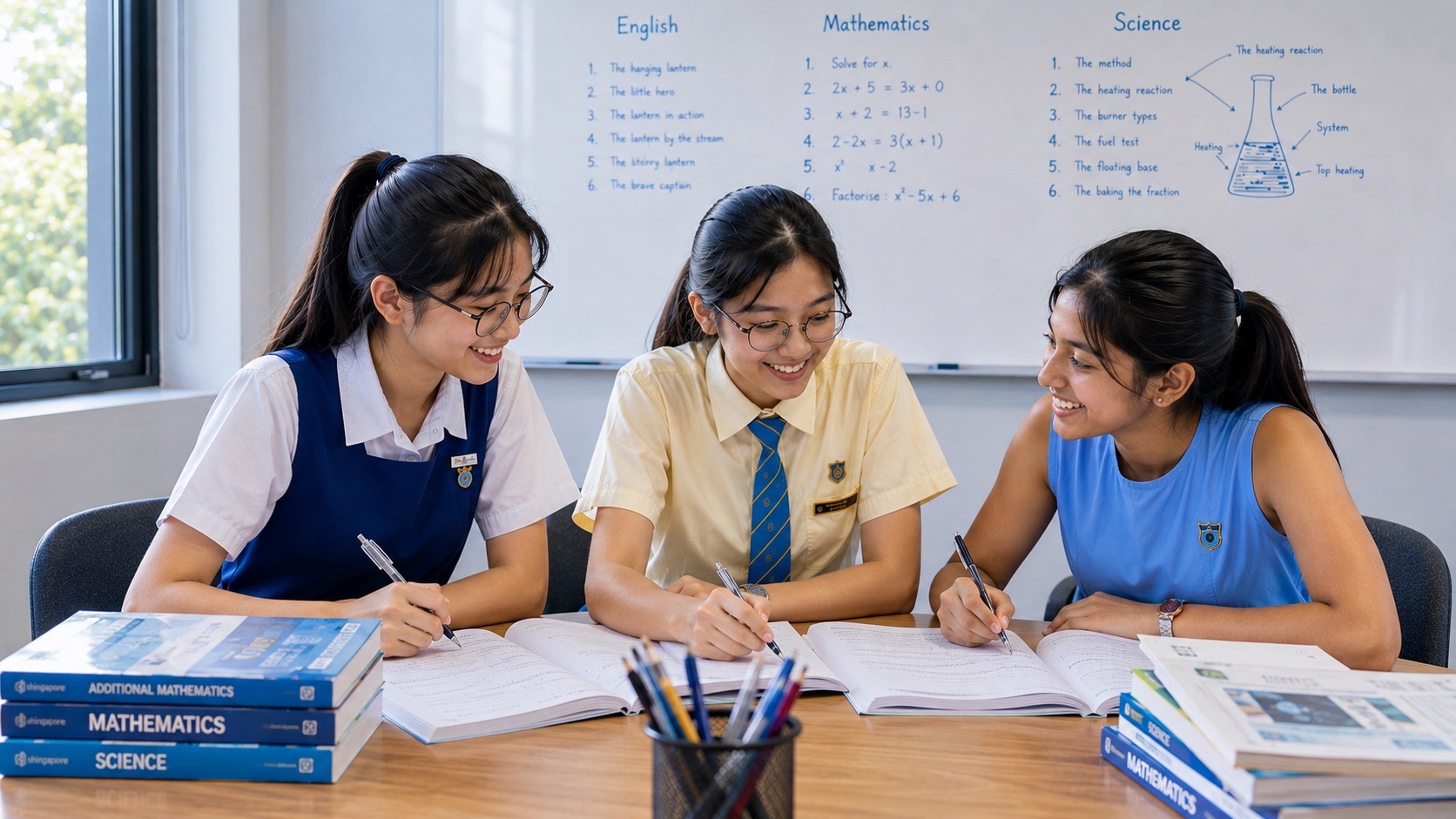
Full Subject-Based Banding (Full SBB) is how Singapore mainstream secondary schools customise learning around each student’s strengths, needs and interests. Instead of putting every subject into a permanent Express, Normal (Academic) or Normal (Technical) stream, students enter secondary school through Posting Groups (PG1, PG2 or PG3), study individual academic subjects at G1, G2 or G3 where appropriate, and belong to mixed form classes with shared school experiences. These are three distinct ideas: admission, individual subject demand and classroom belonging.
For Punggol families navigating PSLE results, Secondary 1 in 2027, school-life challenges, subject choices or graduation pathways, begin with the question that matters today. A Primary 6 parent usually needs to understand Posting Groups and school choices before reading a long SEC examination guide. A Secondary 2 student needs help with subject combinations and readiness. A family worried about school attendance, cost or accessibility needs an immediate practical answer, not another page of unexplained acronyms. This parent hub connects the decisions in their real order.
- Full SBB began with the Secondary 1 intake in 2024 and removes the old course stream labels for these cohorts.
- Posting Groups help determine Secondary 1 admission; G levels describe academic subjects, not the child’s permanent identity.
- Lower-secondary students belong to mixed form classes and share common curriculum subjects, while academic lessons may be at different G levels.
- Eligibility for more- or less-demanding subject levels is determined through official school processes, not a single online promise.
- Parents submit up to six school choices through the Secondary 1 Posting process and should use genuine preference order with realistic historical cut-off evidence.
- The first Singapore-Cambridge Secondary Education Certificate (SEC) examinations are in 2027 for the relevant graduating cohort; that is not the exam year for a child just entering Secondary 1 in 2027.
- From 2028, the announced Post-Secondary Admissions Exercise (PSE) brings revised admissions arrangements for relevant JC, MI, polytechnic and ITE routes.
- Financial help, school transfers, special educational needs, friendship difficulties and CCAs must be addressed independently of academic labels.
- For anything involving dates, fees, eligibility, vacancies or examination components, verify the current official MOE, SEAB or school notice.
Find your answer: the Full SBB parent guide library
Every guide below begins with immediate answers, then explains why the system works that way, what happens in school, practical family decisions and frequently asked questions. Choose the one most relevant to your child today.
| Question parents are asking | Open the detailed guide |
|---|---|
| What happens after PSLE results? PG1, PG2, PG3 and six school choices | Read the posting guide |
| What happens in mixed form classes and Secondary 1 timetables? | Read the mixed guide |
| Can G1, G2 and G3 subject levels change? | Read the levels guide |
| How do Secondary 3 choices, A-Math, Sciences and Humanities work? | Read the s3 guide |
| What happens if the student fails an exam or needs a different promotion plan? | Read the exams guide |
| What happens with Mother Tongue and Higher Mother Tongue? | Read the mtl guide |
| How do friends, CCAs, school support and wellbeing work? | Read the friends guide |
| What are the 2027 school fees and financial assistance options? | Read the money guide |
| Can my child transfer schools after posting or during secondary school? | Read the transfer guide |
| What SEN and SEC examination access support is available? | Read the sen guide |
| What happens at SEC 2027 and in post-secondary admissions in 2028? | Read the sec guide |
Contents: how the entire Full SBB journey works
- 1. Start here: the one-minute Full SBB explanation
- 2. The school system in five connected stages
- 3. What Posting Groups do
- 4. Why G1, G2 and G3 are different
- 5. Why the old stream names are no longer suitable
- 6. What a mixed form class does
- 7. What the common curriculum includes
- 8. How to read the Secondary 1 timetable
- 9. What a PSLE score actually decides
- 10. How the six school choices work
- 11. Choosing a school in and beyond Punggol
- 12. What is different about Secondary 1 adjustment
- 13. What happens when a subject level changes
- 14. Why marks alone do not explain readiness
- 15. The role of English, Mathematics and Science
- 16. Mother Tongue and Higher Mother Tongue choices
- 17. What changes in Secondary 2
- 18. Choosing Secondary 3 subjects
- 19. How Additional Mathematics should be considered
- 20. What happens if a child fails an exam
- 21. When a less-demanding subject is helpful
- 22. Friendships, CCAs and a mixed school community
- 23. Student wellbeing is not an examination score
- 24. What financial assistance can cover
- 25. Edusave, meals and transport
- 26. Can a child transfer to another school?
- 27. What to do while a transfer is pending
- 28. Special educational needs under Full SBB
- 29. What SEC Access Arrangements are
- 30. Why SEC begins in 2027
- 31. The SEC examination calendar
- 32. What happens after SEC results
- 33. Why the new JC and poly rules matter
- 34. PFP, ITE and applied pathways
- 35. A fictional family navigating four school years
- 36. A parent decision table for urgent questions
- 37. A four-week family research plan
1. Start here: the one-minute Full SBB explanation
Full SBB recognises that a student can be strong in one subject while needing more time or support in another. Academic subjects are offered at levels called G1, G2 and G3, with G standing for General. The system also brings students together in mixed form classes for a shared lower-secondary experience.
The structure is not designed to pretend that different curricula have identical demand. It is designed to avoid applying one broad academic label to every area of a teenager’s learning. That distinction can reduce unnecessary comparisons and make practical subject decisions clearer.
Useful next step: Explain Full SBB to a child as ‘one school community, subjects at appropriate levels, with chances to grow’.
2. The school system in five connected stages
A family’s journey can be read as PSLE results, Secondary 1 posting, lower-secondary learning and adjustment, upper-secondary subjects, then national examinations and eligible post-secondary routes. Different official bodies and school teams matter at different stages.
Trying to answer all five stages at once can create anxiety. A Primary 6 child does not need every 2030 examination detail during the first week of Secondary 1 orientation. Likewise, a Secondary 4 pupil should not spend results week revisiting a Posting Group choice made years earlier.
Useful next step: Identify today’s stage and open the corresponding topic guide before planning anything else.
3. What Posting Groups do
PG1, PG2 and PG3 are used to facilitate admission to secondary schools. The child’s PSLE performance determines eligibility, and some borderline scores can give a choice between two groups under the published rules. That group is relevant to posting, but it does not become a permanent description of every subject the pupil studies.
Families should read the official result and MOE Secondary 1 Posting instructions. They should avoid naming a child only by the admission group in family or neighbourhood conversations. The group is important administrative information, not a judgement of ability across all domains.
Useful next step: If this is your current decision, read the linked guide on PG1, PG2, PG3 and the six school choices.
4. Why G1, G2 and G3 are different
A G level refers to the demand of a particular academic subject. A student may learn at G3 for one subject and at G2 for another where eligible. Teachers and school processes determine actual offers and changes at the relevant points in a pupil’s education.
The number is useful for choosing the correct syllabus, booklist and teaching pace. It is much less useful as an overall description of a child. A student who needs help with English comprehension may still excel at musical performance, leadership or practical design.
Useful next step: Ask for a confirmed subject-by-subject list rather than guessing from the Posting Group.
5. Why the old stream names are no longer suitable
Older family members may remember Express, Normal (Academic) and Normal (Technical) as separate courses. Those names belonged to an earlier secondary model. Full SBB was fully implemented from the 2024 Secondary 1 intake, replacing those course labels for the relevant cohorts.
The academic demands remain differentiated, but students now have more flexibility to customise individual subjects and a broader shared school experience. Families should not describe G3 Mathematics as proof that every other subject is at an old Express standard.
Useful next step: Use the actual modern terms whenever writing to a school or discussing requirements.
6. What a mixed form class does
A form class is the student’s familiar classroom community for pastoral contact and shared experiences. Students from different Posting Groups and subject combinations can learn alongside one another in this setting. For particular academic lessons, they may move to subject groups at their approved G levels.
A new child can initially find this confusing because ‘my class’ may refer to a form class or to a Mathematics group. A timetable, clear room numbers and accessible staff help more than an abstract explanation of the national policy.
Useful next step: Show your child a real timetable and distinguish form class from subject class in two sentences.
7. What the common curriculum includes
At lower secondary, shared curriculum subjects create opportunities to learn beyond academic subject classifications. They include Art, Character and Citizenship Education, Design and Technology, Food and Consumer Education, Music and Physical Education, as described in MOE Full SBB materials.
These experiences can reveal strengths in communication, craftsmanship, teamwork, creative decision-making, movement and responsible participation. They are part of education, not merely breaks between examinable lessons. Different schools may timetable them in different ways.
Useful next step: Ask the child what they learned in a common subject and how the experience involved classmates.
8. How to read the Secondary 1 timetable
The timetable may identify subjects, classrooms, laboratories, specialist spaces and lesson groups. Because some academic lessons are arranged by G level, a child can have different peers across subjects. School reporting, assembly, recess and CCA commitments vary by school.
Parents should not invent a universal bell schedule for every Punggol school. Instead, confirm the actual receiving school’s timetable and help the teenager identify room changes, material requirements and whom to ask for directions.
Useful next step: Practise the first two subject transitions and have the child explain where they will go.
9. What a PSLE score actually decides
The overall PSLE Score is central to Secondary 1 admission, while individual subject Achievement Levels can be relevant to opportunities to study particular subjects at a more demanding starting level. This helps explain why two students with the same total can have different academic subject arrangements.
A high aggregate number does not determine a child’s ability to contribute in every area, just as a low aggregate number does not mean all learning challenges have vanished. Families should use the official slip for eligibility and the school’s subject information for the next step.
Useful next step: Record the overall score separately from each subject’s AL and any school-confirmed offer.
10. How the six school choices work
Families rank up to six eligible secondary schools in genuine preference order through the official exercise. Schools’ previous-year cut-off points are historical outcomes, not promises of admission in the next year. School-choice order can matter in tie situations.
MOE encourages using all six choices, with a sensible spread of historical competitiveness. A family should also consider travel, CCAs, subject availability and the school environment. Filling all six with famous but very competitive schools may leave a child with no chosen school allocation.
Useful next step: Use the linked posting guide to build and verify a six-school shortlist before submitting.
11. Choosing a school in and beyond Punggol
Punggol families may compare local secondary schools with institutions in Sengkang, Hougang, Pasir Ris or farther away. No travel duration applies to every Punggol block, and a short route on a map may not reflect a long wait or a difficult transfer.
The child will live the schedule five days a week, often with CCA sessions that extend the afternoon. A school’s distinctive programmes and learning environment matter, but so do safe journeys, sleep, meals and a realistic family routine.
Useful next step: Test the actual trip at reporting time and again after a late CCA before finalising preferences.
12. What is different about Secondary 1 adjustment
The move from Primary 6 to Secondary 1 means new subjects, teachers, building layouts and independence. Full SBB can introduce additional variation in lesson groups, but much of the transition is simply ordinary growing up: learning deadlines, making friends and taking responsibility.
A student who forgets a book or misses a room change has not necessarily chosen the wrong Posting Group. Parents can diagnose whether the issue is logistical, social or academic before responding.
Useful next step: Spend the first fortnight on accurate routines, food, transport and trusted school contacts.
13. What happens when a subject level changes
A student who demonstrates readiness may be considered for a more demanding level, while another may benefit from an appropriate less-demanding level. Schools review such adjustments using evidence, eligibility, teacher judgement, student interest and overall workload.
There is no nationwide promise that one high test score produces an automatic G3 transfer. Changes can affect textbooks, subject groups and future syllabus foundations. A thoughtful decision asks whether the child can understand and sustain the new learning demands.
Useful next step: Read the subject-level change guide and ask the school for the actual review criteria.
14. Why marks alone do not explain readiness
Two students with similar test percentages may have different strengths. One can explain unfamiliar problems independently, while the other has memorised methods and finds adaptation difficult. Teachers may consider the quality of work, sustained effort and capacity to cope with the whole week.
Parents can help by gathering representative marked work and asking the child to explain where a mistake occurred. Comparing raw scores across G levels or different schools can be misleading because the assessed material differs.
Useful next step: Replace ‘Is 75% enough?’ with ‘What evidence does this school require for this subject and intake?’
15. The role of English, Mathematics and Science
Core academic subjects remain fundamental to later study options. Under Full SBB, a pupil may be offered different levels according to subject-specific readiness. A child with strong Mathematics but weaker reading comprehension should not automatically be described as ‘weak overall’.
Support should target the real gap: algebraic reasoning, accurate explanation in Science or comprehension of extended English texts. Extra worksheets may be useful, but without a diagnosis of the underlying mistake, more practice can reproduce confusion.
Useful next step: Use school feedback to identify one precise skill that will make the next concept more manageable.
16. Mother Tongue and Higher Mother Tongue choices
Mother Tongue arrangements can depend on the child’s language background, academic readiness and school options. Higher Mother Tongue has its own eligibility and curriculum demands. It should not be treated as an automatic result of the child’s general Posting Group or a single confident spoken-language experience.
Families should distinguish ordinary conversational language ability from reading, writing and formal comprehension. The best option balances learning, cultural connection, school advice and realistic workload.
Useful next step: Use the linked Mother Tongue guide and verify the actual offer with the receiving school’s department.
17. What changes in Secondary 2
By Secondary 2, students usually have more evidence about their learning strengths, independent habits and interests. School reviews can guide appropriate subject-level decisions and prepare for upper-secondary combinations. The child may be more settled socially but still require support in one subject.
Parents should not interpret an unsettled first year as a permanent limit. Nor should they promise that every desired combination will become available. Curriculum offerings and prerequisites vary by school.
Useful next step: Schedule a review of subjects, interests, evidence and the school’s published combination rules.
18. Choosing Secondary 3 subjects
Upper-secondary choices may include different combinations of Mathematics, Sciences, Humanities, languages, arts and applied subjects, within the school’s available provision and prerequisites. A pupil should choose a manageable set that supports credible future interests.
Taking the largest possible number of demanding subjects can overload a student. Taking fewer subjects without checking later course requirements can also close useful options. The right comparison includes workload, aptitude, breadth and realistic future prerequisites.
Useful next step: Open the Secondary 3 subject-choice guide before deciding about A-Math, Sciences and Humanities.
19. How Additional Mathematics should be considered
Additional Mathematics can be appealing for a student who enjoys algebra, abstraction and problem solving, but it has its own demands and school criteria. It is not simply a prestige badge to collect because a friend is taking it.
Some students need stronger foundational algebra or time to improve accuracy before attempting a heavier curriculum. The receiving school is best placed to explain available combinations and approved prerequisites. External tuition should begin with a clear diagnosis, not an assumption that every pupil needs it.
Useful next step: Ask which mathematical skills the child can currently explain independently and what the next course requires.
20. What happens if a child fails an exam
A disappointing test or report-book result is a reason to investigate the specific learning problem, not automatically evidence of a failed life pathway. Promotion and subject-level continuation follow school and MOE arrangements that may consider multiple subjects and overall progress.
Parents should read the school’s current promotion guidelines rather than assume an old streaming system still applies. A weak result can arise from missed concepts, examination technique, fatigue or an unsuitable academic load. Different causes require different interventions.
Useful next step: Use the linked promotion and report-book guide to identify the school’s actual next step.
21. When a less-demanding subject is helpful
A less-demanding G level may allow a learner to consolidate essential concepts, protect confidence and manage the broader timetable. It should not be framed as punishment or an automatic end to educational progression.
Future options depend on the actual subjects, levels, grades and admissions rules. Families should discuss any adjustment’s consequences with teachers and understand when the child might be reviewed again. Hiding the difficulty behind motivational slogans is less helpful than planning concrete support.
Useful next step: Ask what skills will be strengthened, what review point applies and whether future prerequisites are affected.
22. Friendships, CCAs and a mixed school community
Friends and CCA participation matter greatly during adolescence. A pupil can have form-class friends, subject-class peers and teammates who take different G levels. Shared experiences help students see strengths outside examination results.
However, a mixed classroom does not guarantee friendship or prevent bullying. Schools and families still need to address exclusion, student wellbeing and respectful conduct. A child who feels unsafe should receive timely support rather than more academic pressure.
Useful next step: Read the wellbeing guide if the immediate concern is friendship, CCA overload, school anxiety or bullying.
23. Student wellbeing is not an examination score
A teenager may seem academically successful while facing poor sleep, social isolation or severe commuting fatigue. Another may score poorly in a subject while feeling socially supported and ready to improve. The family’s response should fit the actual concern.
Ask about meals, attendance, sleep, friendships and confidence as well as grades. A subject-level change does not automatically solve a bullying problem, while academic tuition cannot replace counselling or school safety arrangements when those are needed.
Useful next step: If safety or serious distress is involved, contact the appropriate school or professional support promptly.
24. What financial assistance can cover
For government and government-aided schools, eligible Singapore Citizen pupils may receive MOE Financial Assistance Scheme support. The 2027 school notices available in October 2026 give a monthly gross household income threshold of S$4,000 or less, or monthly per-capita income of S$1,000 or less, subject to other criteria.
Published secondary benefits include covered school and miscellaneous fees, textbooks and school attire, meal support and a public transport subsidy. Independent schools use different bursary arrangements. FAS eligibility is not determined by PG or G level.
Useful next step: Open the 2027 FAS and school-costs guide before buying books or uniforms if applying for aid.
25. Edusave, meals and transport
Edusave is separate from means-tested FAS. The MOE Student Finance System provides information about account uses and the current financial-aid process. Families should avoid treating an account balance as unrestricted cash or assuming every optional expense is subsidised.
Punggol travel, meal choices, school devices and CCA materials can also affect the actual household budget. Different schools and pupils have different needs, so there is no single true price for ‘Full SBB life’.
Useful next step: Build a budget from official school notices and the child’s real weekly routine, marking approved assistance separately.
26. Can a child transfer to another school?
Transfer appeals immediately after Secondary 1 Posting and later-year requests are different processes. A transfer can depend on the actual year’s cut-off, vacancies, current school results, application windows and sometimes interviews or placement tests.
A family moving house does not automatically receive a place in the nearest secondary school. A Secondary 3 pupil also needs to check the new school’s actual subject combination and curriculum. The existing placement should remain in force until another is confirmed.
Useful next step: Use the secondary-school transfer guide and verify the receiving school’s year-specific notice.
27. What to do while a transfer is pending
Families can feel tempted to delay the current school’s registration or stop preparing because another school might accept a transfer request. That can leave a teenager without clear attendance, materials and orientation arrangements.
Schools have published instructions telling families to report to their posted school while appeals are considered. An application receipt is not an offer. Serious wellbeing or safety issues also need their own immediate school response rather than waiting for transfer.
Useful next step: Continue with the current school unless the relevant authority has officially confirmed a change.
28. Special educational needs under Full SBB
Academic G levels are not medical labels. A student may have SEN and be ready for advanced content, while another may study a less-demanding subject without a disability. Mainstream schools can provide relevant learning and functional support according to the pupil’s needs and their resources.
A useful transition plan describes strengths, practical barriers, previous effective strategies and the child’s own preferences. It should protect privacy and identify whom to contact. Subject-level decisions and accessibility decisions must not be confused.
Useful next step: Read the SEN support guide and ask the receiving school who coordinates your child’s needs.
29. What SEC Access Arrangements are
For national examinations, SEAB may approve accommodations for candidates with special educational needs, subject to assessment objectives and supporting evidence. Examples include extra time, enlarged print, approved assistive resources and separate venues in suitable cases.
A school-based accommodation is not automatic national examination approval. SEAB has formal evidence requirements, annual deadlines and rules concerning annotations on result documents. Parents should ask early rather than assuming a familiar classroom arrangement will carry over.
Useful next step: Use the linked SEC access guide and current SEAB instructions for the actual exam year.
30. Why SEC begins in 2027
Full SBB was introduced for the 2024 Secondary 1 cohort. Students progressing through the ordinary four-year route reach Secondary 4 in 2027, when the new Singapore-Cambridge Secondary Education Certificate examinations begin. The certificate reflects the subjects and subject levels candidates actually sit.
A pupil entering Secondary 1 in 2027 ordinarily will not sit the 2027 SEC examination; they would generally reach Secondary 4 in 2030, subject to their actual route. Families should not confuse the policy’s first examination year with an individual child’s examination year.
Useful next step: Write the student’s entry year, expected graduation year and post-secondary intake year separately.
31. The SEC examination calendar
SEAB’s published SEC framework places English and Mother Tongue written examinations in September and other written papers in October and November. Non-written components, such as oral, listening comprehension or Science practicals, occur before the relevant written examinations.
The detailed annual timetable, subjects and examination conditions must be verified for the specific candidate. A generic calendar is not a safe substitute for SEAB’s actual schedule. Families should avoid inventing dates or promising a particular room arrangement.
Useful next step: Check SEAB’s official SEC page and exact annual paper timetable when the child is nearing graduation.
32. What happens after SEC results
The announced first SEC results release takes place in January 2028. MOE also announced a new Post-Secondary Admissions Exercise beginning in 2028 for relevant pathways, including junior colleges, Millennia Institute, polytechnics and specified ITE Higher Nitec routes.
Eligibility depends on actual subject levels, combinations, grades and current admission requirements. A child should not be told that their original Posting Group alone determines every future option. Likewise, a general threshold is not a guarantee of a particular course place.
Useful next step: Use the linked SEC 2027 and PSE 2028 guide for the first cohort’s published changes.
33. Why the new JC and poly rules matter
MOE has announced changes to the JC aggregate framework from L1R5 to L1R4 for the relevant 2028 intake and adjustments to polytechnic admissions so that one eligible G2 subject may count in the specified ELR2B2 calculation alongside four G3 subjects. Exact subject and eligibility rules remain essential.
Parents should not compare an old score directly with a new aggregate without accounting for the changed calculation. Course-specific prerequisites and competition still matter. Some routes require specified subject levels even when the overall application seems plausible.
Useful next step: Record the correct admissions year and calculate eligibility using the official year’s rules.
34. PFP, ITE and applied pathways
Students can learn through different post-secondary environments, including academic, polytechnic and vocational routes. The Polytechnic Foundation Programme and ITE Higher Nitec pathways should be evaluated using their current eligibility, course content and progression opportunities.
A route should not be labelled a failure because it differs from a neighbour’s plan. At the same time, parents should not promise that every diploma is accessible through every subject-level combination. Honest eligibility checks and genuine interests are necessary.
Useful next step: Compare realistic subject prerequisites, programme demands, costs and travel rather than relying on social prestige.
35. A fictional family navigating four school years
Imagine a fictional Punggol family with a child called Ben who finishes Primary 6 and enters Secondary 1. His first concerns are finding a school that fits, learning the timetable and making friends. By Secondary 2, he discovers he enjoys Science and needs better organisation in English.
The family discusses subject levels with school staff instead of treating one score as destiny. By upper secondary, Ben explores suitable pathways and understands that formal admission conditions will matter when results arrive. This is an illustration, not a guaranteed trajectory.
Useful next step: Solve the next genuine educational decision before attempting to control every future outcome.
36. A parent decision table for urgent questions
If the concern is school choice, start with the result slip and S1 Posting. If it is a room change or friendship difficulty, start with the timetable or wellbeing guide. If it is a subject upgrade, consult academic feedback. If it is affordability, use the official FAS application route.
If a child is unsafe or unable to access lessons, prompt school support takes precedence over reading a long article. A family should separate what is confirmed by MOE, what a school must decide and what the parent or teenager can do today.
Useful next step: Write one sentence describing the immediate problem and choose the most relevant link in the navigation above.
37. A four-week family research plan
Week one: establish the child’s current school year, actual PG and subject levels, and relevant official documents. Week two: identify one priority question and read the corresponding guide. Week three: ask the school for a decision, policy or support plan where needed. Week four: review whether the action helped and file the correct information for later.
This is a flexible learning routine, not an instruction to delay urgent applications, school safety concerns, exam accommodations or official deadlines. The purpose is reducing confusion by working from the current problem to accurate information and practical action.
Useful next step: Keep one updated folder for verified letters, school deadlines and useful contact details.
Quick choices: where to go next
- If your child receives PSLE results: <a href=”https://edukatepunggol.com/2026/11/06/what-happens-full-subject-based-banding-fullsbb-life-after-psle-pg1-pg2-pg3-six-school-choices/”>understand six school choices and Posting Groups</a>.
- If your child is new to Secondary 1: <a href=”https://edukatepunggol.com/2026/11/06/what-happens-full-subject-based-banding-fullsbb-life-mixed-form-classes-secondary-1-timetable/”>understand mixed classes, subject rooms and daily routines</a>.
- If your child wants to move between G levels: <a href=”https://edukatepunggol.com/2026/11/06/what-happens-full-subject-based-banding-fullsbb-life-g1-g2-g3-subject-level-changes/”>read about subject-level reviews and readiness</a>.
- If Secondary 3 decisions are approaching: <a href=”https://edukatepunggol.com/2026/11/06/what-happens-full-subject-based-banding-fullsbb-life-secondary-3-subject-choices-a-math-science-humanities/”>review A-Math, Sciences and Humanities</a>.
- If the report book is worrying: <a href=”https://edukatepunggol.com/2026/11/06/what-happens-full-subject-based-banding-fullsbb-life-failed-exams-promotion-report-books/”>understand examinations, promotion and next steps</a>.
- If language choices are confusing: <a href=”https://edukatepunggol.com/2026/11/06/what-happens-full-subject-based-banding-fullsbb-life-mother-tongue-higher-mother-tongue-after-psle/”>check Mother Tongue and Higher Mother Tongue</a>.
- If the child is struggling socially: <a href=”https://edukatepunggol.com/2026/11/06/what-happens-full-subject-based-banding-fullsbb-life-friends-ccas-student-wellbeing/”>read the guide to friends, CCAs and wellbeing</a>.
- If school costs are a concern: <a href=”https://edukatepunggol.com/2026/11/06/what-happens-full-subject-based-banding-fullsbb-life-school-fees-fas-2027-edusave-transport-costs/”>check FAS 2027, Edusave and transport costs</a>.
- If the family wants a school transfer: <a href=”https://edukatepunggol.com/2026/11/06/what-happens-full-subject-based-banding-fullsbb-life-secondary-school-transfer-s1-appeal/”>learn the appeal and vacancy process</a>.
- If the child needs accessibility support: <a href=”https://edukatepunggol.com/2026/11/06/what-happens-full-subject-based-banding-fullsbb-life-sen-sec-access-arrangements/”>read about SEN and SEC access arrangements</a>.
- If graduation is approaching: <a href=”https://edukatepunggol.com/2026/11/06/what-happens-full-subject-based-banding-fullsbb-life-sec-2027-post-secondary-admissions-2028/”>understand SEC 2027 and PSE 2028</a>.
Frequently asked questions
What is Full Subject-Based Banding in one sentence?
It is Singapore’s framework for learning in mixed secondary form classes while offering individual academic subjects at G1, G2 or G3 levels suited to readiness.
Is PG3 the same as G3?
No. PG3 is for admission, while G3 is a subject level.
Does G1 mean a child has less ability in everything?
No. Subject-level demand is not an overall personal judgment, and individual strengths can differ widely.
When did Full SBB start?
It was fully implemented starting with the 2024 Secondary 1 intake.
Are Express and Normal streams still the entry labels?
Not for the new Full SBB Secondary 1 cohorts. Posting Groups and subject levels are used instead.
Can students have different G levels across subjects?
Yes, subject combinations can vary where eligibility and school arrangements permit.
Do students share form classes?
Yes, mixed form classes and common curriculum learning are part of lower-secondary Full SBB.
Does 75% always mean a G-level upgrade?
No nationwide automatic transfer should be assumed. Follow the actual school’s eligibility and review process.
How many S1 school choices are available?
Parents can submit up to six eligible schools through the official posting exercise.
Does an old school cut-off guarantee admission?
No. A cut-off records a past posting outcome, not an advance reservation.
Can my child change school after posting?
An appeal or transfer may be considered under current criteria and available vacancies; it is not guaranteed.
Does G1 qualify a child for FAS?
FAS eligibility concerns citizenship, household means and school type, not the academic G level.
Can a G3 student have SEN support?
Yes. Academic learning level and functional access needs are separate.
When is the first SEC examination?
2027 for the relevant first Full SBB graduating cohort.
When does PSE begin?
The revised Post-Secondary Admissions Exercise is announced to begin in 2028 for the first relevant SEC cohort.
Where do families find the correct policy?
Use MOE, SEAB and the actual school’s current notices for the relevant cohort, then use this hub to interpret the sequence.
Official information worth bookmarking
MOE Full Subject-Based Banding explains the framework; MOE Secondary 1 Posting explains admission; SEAB SEC explains the national examinations; SEAB Access Arrangements covers eligible examination support; MOE 2026 announcements covers the revised admissions exercise; MOE Student Finance System covers FAS and Edusave.
Further Full SBB Guides for Punggol Families
These practical guides cover four additional everyday concerns for students and parents. Read the one relevant to your child’s current need, then check the school’s official instructions where dates, assessments or eligibility may vary.
- Full SBB Life with HBL, Student Learning Space and Personal Learning Devices — school-prescribed devices, SLS assignments, AI feedback, home learning, technical problems and digital wellbeing.
- Full SBB Life with Homework, Weighted Assessments, Grades and School Exams — formal assessment, G-level papers, exam changes, missed assessments and corrections.
- Full SBB Life with DSA-Secondary Offers, Waitlists and 2027 School Posting — talent domains, confirmed offers, waitlists, preference decisions and PSLE eligibility.
- Full SBB Life When Students Are Absent, Late or Returning After Long School Absence — school attendance, MCs, assessment absence, safe return and catch-up plans.
Further Full SBB Life: School Phone Rules and CCA Participation
School life involves practical decisions beyond subject levels. These two guides cover the 2026 secondary-school phone restrictions and co-curricular participation, with separate explanations of official school requirements and everyday routines.
- What happens in Full SBB Life with School Phone Rules, Smartwatches and Digital Wellbeing — recess and CCA restrictions, approved exceptions, PLDs, parental contact and safe Punggol journeys.
- What happens in Full SBB Life with LEAPS 2.0, CCA Bonus Points, Leadership and Community Service — understanding participation, achievement, leadership, service and the school’s current CCA rules.
- New Full SBB Life guides for 2027:
- LEAPS 2.0, CCA bonus points, leadership and community service
- Smartphone and smartwatch rules, screen time and cyber wellness
- MOE school calendar 2027, vacations, CCAs and examination dates
- Secondary 1 outdoor camps, OBS, packing and consent
- New Full SBB parent support guides:
- Parent–Teacher Meetings, Parents Gateway and Subject-Level Reviews
- School Rules, Detention, Bullying Reports and Restorative Discipline
- Further Full SBB life guides, published 6 November 2026
- Code for Fun 2027: AI projects and digital literacy
- Edusave Scholarships, EAGLES, ECHA and Good Progress Awards
- ECG, MySkillsFuture and secondary subject choices
- How ALP and LLP projects work in Full SBB
- Full SBB Life: November 2026 additions for parents
- AEP, MEP, Higher Art and Higher Music centre classes
- G1, G2 and G3 Science labs, experiments and practical safety
- 2027 SEC applied electives: D&T, Computing, NFS, POA and Sports Science
- Boys’, girls’ and coeducational schools: what mixed form classes mean
- Full SBB Life: new parent guides, 13 November 2026
- Secondary 3 subject-combination appeals, unmet prerequisites and alternative plans
- Overseas learning journeys, international school exchanges and parent consent
- School CCA accidents, MOE student insurance and claims
- Full SBB school life for international students after AEIS and S-AEIS
- Full SBB Life — further parent guides published 13 November 2026
- School Smart Cards, MRT/LRT, bus passes and Punggol commutes in 2027
- Secondary 1 G1/G2/G3 booklists, textbook editions and uniform exchanges
- SEC 2027 e-exams, computer-based papers and technical problems
- Holiday work, part-time jobs, legal age restrictions and student safety
- Full SBB Life — new parent guides published 15 November 2026
- Secondary school canteens, healthy meals, food allergies and food safety
- Edusave accounts, PSEA, annual contributions and approved education payments
- Fire drills, evacuation routes, assembly points and school emergency procedures
- Haze, lightning, heat stress and outdoor PE/CCA safety
- Full SBB Life — new parent guides published 17 November 2026
- Attendance, latecoming, medical certificates and Parents Gateway
- School libraries, book borrowing, NLB membership and digital reading
- Student photos, video consent, school publications and online privacy
- Weighted assessments, report books, EOY exams and feedback
Editorial review: 6 November 2026. Rules and school-specific details can change, especially future-year timetables, subject combinations, vacancies, and admissions criteria. The purpose of this hub is to route families to the next accurate question and verified source, not to guarantee any school offer, course place, financial award or examination arrangement.
New connected guides — 14 November 2026
Use these focused guides for the individual subject, examination paper or school-life decision facing your child. Posting Groups and individual subject levels have different jobs; choose the route named in the guide.
G2 subject and examination guides
- What happens in G2 Urdu Language | SEC 2027 K243 Nastaliq, Letters, Essays and Comprehension
- What happens in G2 Science Physics and Chemistry | SEC 2027 K223 Papers, Topics and Examination Preparation
- What happens in G2 Science Physics and Biology | SEC 2027 K224 Papers, Human Systems, Energy and Revision
- What happens in G2 Science Chemistry and Biology | SEC 2027 K225 Papers, Cells, Reactions and Health
- What happens in G2 Humanities Social Studies and Geography | SEC 2027 K229 Climate, Tectonics and Source-Based Questions
- What happens in G2 Humanities Social Studies and History | SEC 2027 K230 Source-Based Case Study, Cold War and Essays
- What happens in G2 Humanities Social Studies and Literature | SEC 2027 K231 Set Texts, Unseen Poetry and Source-Based Questions
- What happens in G2 Social Studies Syllabus | SEC 2027 K229 K230 K231 Source-Based Questions, Digital Answers and SRQ
G1 subject and examination guides
- What happens in G1 Social Studies | Living in a Multicultural Society, Identity and Harmony
- What happens in G1 Social Studies | Embracing Migration, Push and Pull Factors and Integration
- What happens in G1 Social Studies | Resolving Conflict, Building Peace, Total Defence and SGSecure
- What happens in G1 Social Studies | Protecting Our Environment, 3Rs, Pollution and Climate Change
- What happens in G1 English Language Writing Paper 1 | SEC 2027 K100 Editing, Situational and Continuous Writing
- What happens in G1 English Language Use and Comprehension Paper 2 | 2027 K100 Grammar, Cloze and Reading
- What happens in G1 English Listening Paper 3 | SEC 2027 K100 Multiple Choice and Matching
- What happens in G1 English Oral Communication Paper 4 | SEC 2027 K100 Reading Aloud and Video Discussion
- What happens in G1 Mathematics Paper 1 | SEC 2027 K110 Algebra, Geometry, Calculator and Worked Examples
- What happens in G1 Mathematics Paper 2 | SEC 2027 K110 Statistics, Probability, Graphs and Finance
- What happens in G1 Science Paper 1 | SEC 2027 K123 e-Examination, MCQ and Interactive Questions
- What happens in G1 Science Paper 2 | SEC 2027 K123 Data Response, Structured Questions and Experiments
Posting Group 1: subject choices and next steps
- What happens in PG1 | Can My Child Qualify for PFP After SEC? G2 Subjects, ELMAB3 and 2028 Entry
- What happens in PG1 | Can I Appeal SEC Results? Review of Marking, Fees and 2028 Admissions Deadlines
- What happens in PG1 | Missed an SEC Examination? Illness, Medical Certificates and Special Consideration
- What happens in PG1 | Which G1 SEC Elective Should My Child Choose? Computing, D&T, NFS, Art, Music or Business Skills
- What happens in PG1 | Which G1 SEC Elective Should My Child Choose? Computing, D&T, Food Science, Art, Music and Business Skills
Posting Group 2: school life and progression
- What happens in PG2 | Secondary 1 PE and NAPFA 2027: Fitness Tests, Six Stations and Safe Preparation
- What happens in PG2 | MOE Sexuality Education 2027: Secondary 1 CCE, eTeens and Parent Opt-Out
- What happens in PG2 | Secondary 1 Booklist 2027: G2 Textbooks, G3 Offers, Online Orders and Exchanges
- What happens in PG2 | AI Homework, Plagiarism and SEC 2027 Examination Rules: Academic Integrity for Parents
- What happens in PG2 | PSLE Scores 23 and 24: Six Secondary School Choices, Cut-Off Points and Posting Results
- What happens in PG2 | Polytechnic Foundation Programme 2028: ELMAB3 12, G2/G3 Mapping and the Three PFP Clusters
- What happens in PG2 | Direct Polytechnic Year 1 in 2028: ELR2B2 22 and the G2 Best Subject Rule
- What happens in PG2 | Can You Enter JC or MI in 2028? Five G3 Subjects, L1R4 16 or 20 and Bonus Points
G3 subject and examination guides
- What happens in G3 Literature in English Syllabus | SEC 2027 K331 Prose, Unseen Poetry, Drama and Set Texts
- What happens in G3 Chinese Language Syllabus | SEC 2027 K320 Composition, Email, Reading and Video Oral
- What happens in G3 Malay Language Syllabus | SEC 2027 K321 Karangan, Kefahaman and Video Oral
- What happens in G3 Tamil Language Syllabus | SEC 2027 K322 Functional Writing, Comprehension and Video Oral
- What happens in G3 Principles of Accounts Syllabus | SEC 2027 K342 Paper 1, Paper 2, Financial Statements and 7-Mark Business Decisions
- What happens in G3 Higher Chinese Syllabus | SEC 2027 K355 500-Character Essay, Summary and Video Oral
- What happens in G3 Higher Malay Syllabus | SEC 2027 K356 380-Word Karangan, 60-Word Summary and Oral Presentation
- What happens in G3 Higher Tamil Syllabus | SEC 2027 K357 300-Word Composition, Language Correction and Video Oral
Continue exploring Punggol: Browse the Punggol Education and Town-Life Article Index for the connected school, subject, career and everyday-life guides.


