
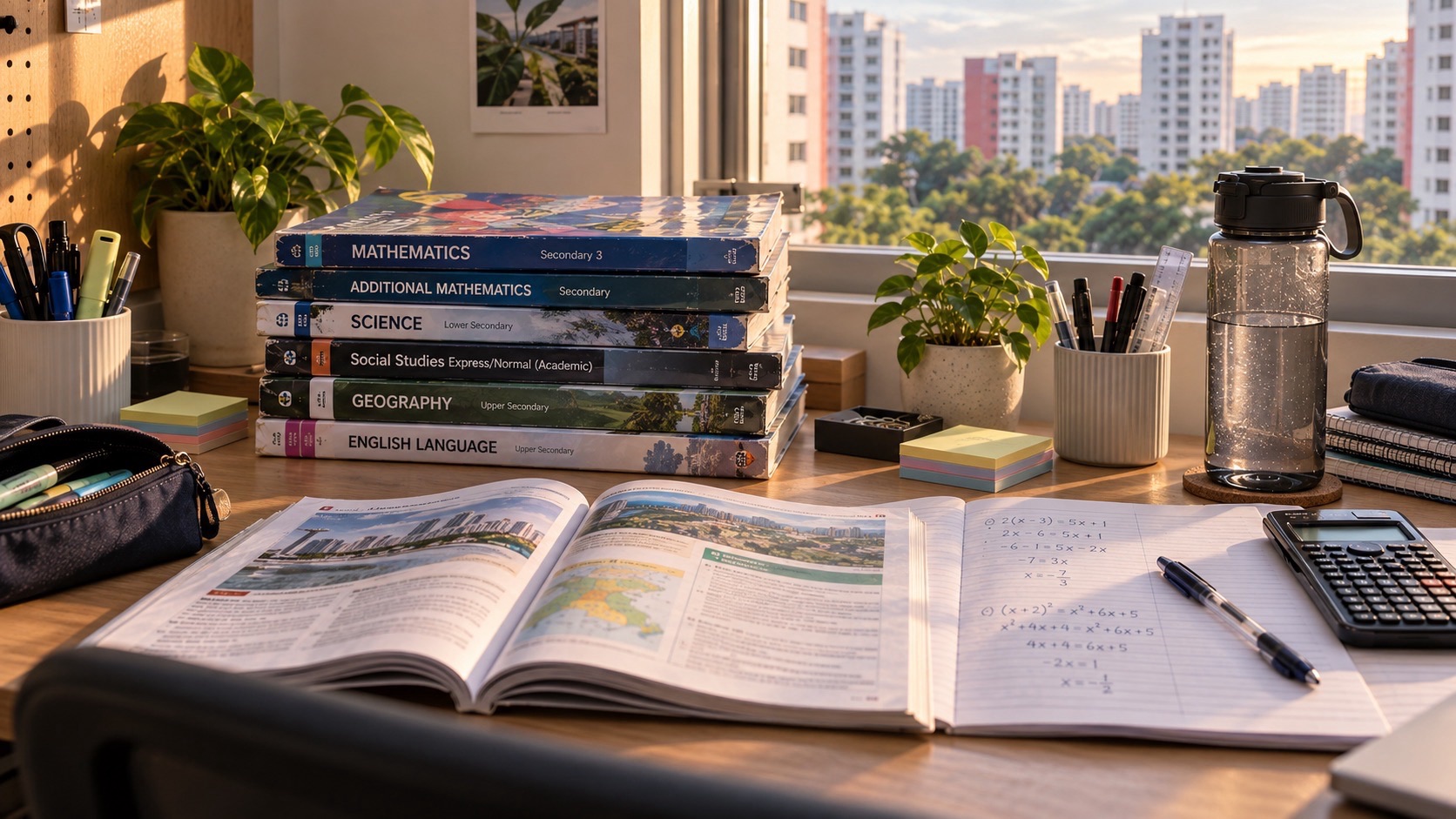
G1 Mathematics Paper 1 in the 2027 Singapore-Cambridge Secondary Education Certificate (SEC) tests Number and Algebra together with Geometry and Measurement. Under syllabus K110, it lasts 1 hour 30 minutes, carries 50 marks and makes up 50% of the Mathematics grade. It is not a non-calculator paper: SEAB permits an approved calculator in both G1 Mathematics papers. Students also need suitable geometrical instruments for Paper 1, must show essential working and should learn to explain what a numerical result means. The most useful starting point for a Punggol parent is to identify the first mathematical relationship the child cannot yet explain, rather than send them through more questions without diagnosis.
The published 2027 K110 scheme has 11–13 short-answer questions worth 2–4 marks each, followed by two longer contextual questions worth 6–8 marks each; all questions are compulsory. The syllabus gives an assessment balance of approximately 65% standard techniques, 30% contextual problem solving and 5% reasoning and communication across both papers. Relevant mathematical formulae are provided, but students lose marks if essential working is omitted. These requirements apply to the 2027 graduating cohort. A child entering Secondary 1 in 2027 would usually sit the SEC around 2030, so their school teaching plan and later examination-year rules remain important.
- 2027 paper: SEC G1 Mathematics K110 Paper 1, Number and Algebra with Geometry and Measurement.
- Duration and weighting: 90 minutes, 50 marks, 50% of Mathematics.
- Question pattern: 11–13 short questions (2–4 marks each) and two longer contextual questions (6–8 marks each).
- Calculator: approved calculators permitted in Paper 1 and Paper 2; never assume G1 Paper 1 is non-calculator.
- Equipment: bring required geometry instruments for Paper 1.
- Core topics: fractions, ratios, percentages, algebra, equations, graphs, angles, shapes, Pythagoras, trigonometry and mensuration.
- Working: omission of essential steps can lose marks even when the answer is correct.
- Accuracy: normally three significant figures, or one decimal place for angles, unless otherwise specified.
- For parents: teach meaning, method, working, units and reasonableness as one connected routine.
- Useful next step: ask the child to solve one unfamiliar question and explain why that operation fits.

The exact 2027 Paper 1 format
Paper 1 assesses Number and Algebra plus Geometry and Measurement, with short-answer items followed by two more substantial real-world questions. The short questions largely test fundamental skills without extensive contexts; the longer questions demand interpreting a situation and connecting several calculations. A student should not assume the longer questions require an advanced formula. Often the challenge is identifying which familiar idea applies and carrying the steps through accurately.
The 50 raw marks account for half the K110 grade. All questions are compulsory. Relevant formulae appear in the examination material, and the published scheme notes that essential working must be shown. A correct final number without a traceable solution may not receive all available credit. The sensible revision goal is accurate methods and explanations across unfamiliar contexts, not only memorising examples from one workbook.
G1 is the subject level; PG1 is admission
Posting Group 1 is used for secondary-school admission under Full Subject-Based Banding. G1 describes the Mathematics level a student actually offers. A child may progress at different rates in English, Mathematics and other subjects. The school applies criteria for any appropriate subject-level adjustment; a tuition-centre prediction or practice mark cannot automatically promote a subject. Parents should ask the school which syllabus and assessment the learner currently faces.
A student can be confident in number operations but weak in geometry, or comfortable with diagrams but unfamiliar with algebraic notation. Those are teachable differences, not permanent traits. An effective diagnosis examines actual work, identifies where meaning becomes confused and teaches a repair that transfers to a fresh task. This respects the learner’s ability and avoids treating the posting label as a personal definition.
The calculator question parents often get wrong
The 2027 official K110 syllabus expressly allows an approved calculator in both Paper 1 and Paper 2. Paper 1 therefore should not be advertised as a non-calculator paper merely because another Mathematics level or examination uses a no-calculator component. However, permission to use a calculator does not remove the need for number sense, rounding, working or mathematical reasoning. A machine can accurately evaluate an incorrect expression entered by the student.
For example, a bag priced at $48 with a 25% discount should cost $36. A pupil who types 48 × 25 instead of 48 × 0.75 may get a confidently displayed number that makes no sense for the final sale price. Teach an estimate first: a quarter of 48 is 12, so the price falls below 48 by about 12. The calculator verifies the arithmetic after the correct relationship has been selected.
Number operations and negative numbers
The K110 content includes negative numbers, integer operations and fractions and decimals. Students need to understand signs and order rather than memorise a list of contradictory tricks. A temperature change from −3°C to 5°C is an increase of 8°C, not 2°C. A number line makes the movement visible: three units to zero and five further units to five. This concept later supports equations, rate changes and graph interpretation.
A useful diagnostic separates the mathematical relationship from calculation. Ask what “increase” means, which value is the starting point and how far the change travels. Then give another example, from 2°C to −4°C, where the change is a decrease of 6°C. A learner who can reverse the reasoning independently understands more than one memorised number-line story.
Fractions and decimal operations
Fractions represent parts in relation to a whole or another quantity. A pupil who can multiply fractions mechanically but cannot recognise what 3/4 of a quantity means may struggle with later problems. Start with simple representations, then explain why division by a fraction changes the question: 6 ÷ 1/2 asks how many half-units fit into six. It is twelve. This meaning makes the reciprocal rule less arbitrary.
Decimals and fractions can represent the same relationship in different forms. A quarter is 0.25 or 25%. Students should recognise which form is convenient for the situation. For an original question, three quarters of 240 mL is 180 mL. Ask whether the result should be larger or smaller than the total and why. That reasonableness check is an important habit even when a calculator is used.
Ratios: parts versus a whole
Suppose a fictional drink uses syrup and water in the ratio 1:4. That represents five total equal parts: one syrup part and four water parts. If 100 mL is syrup, the water requirement is 400 mL and the combined volume is 500 mL, assuming volumes add. If 500 mL is the total, syrup occupies one of five parts, or 100 mL. The question’s given quantity determines how the ratio is used.
A frequent error is dividing the total by four because there are four parts of water. Drawing five simple boxes often fixes the mistake. Then change the ratio to 2:3 with the same total, so the syrup becomes 200 mL and water 300 mL. The child should explain why the total still has five parts and which quantity changed. That demonstrates transfer beyond a copied model.
Direct and inverse proportion
Direct proportion means that as one quantity changes by a factor, the linked quantity changes by the same factor when the relationship is truly proportional. If three identical notebooks cost $9, six cost $18 at the same unit price. Inverse proportion involves one quantity decreasing as another increases so their product remains constant under suitable assumptions, such as workers and completion time for an idealised fixed workload with equal rates.
Students should not assume every real-world situation is exactly proportional. A promotion, fixed service fee, shared equipment or changing efficiency may break the relationship. An examination question provides the conditions to use. A good learner states what remains constant before calculating. The habit stops indiscriminate cross-multiplication and helps with recipes, map scales and rates.
Percentages and percentage increase
Percentages express a part out of one hundred. The 2027 K110 syllabus includes percentage comparison, increase, decrease and values exceeding 100%. A 25% discount on $48 is $12, leaving $36. A 20% increase on 50 results in 60. But applying a 20% reduction afterward gives 48, not the original 50, because the second percentage has a new base. Students must identify which quantity each percentage refers to.
A useful short practice asks the student to label “original,” “change” and “new” before operating. If a price grows from $40 to $50, the percentage increase is 10/40 × 100% = 25%. If it falls from $50 to $40, the percentage decrease is 10/50 × 100% = 20%. The two percentages differ because their bases differ. This distinction matters in finance and data reporting.
Rates, speed and units
Rate compares quantities with different units. Average speed is total distance divided by total time. A person travelling 12 km in 30 minutes has average speed 24 km/h because thirty minutes is half an hour. Students should write the units and convert before dividing. Using 12 ÷ 30 and labelling it km/h is not correct because the time was measured in minutes.
A child’s first task is to identify which unit the question requires. If the answer needs metres per second, convert both distance and time appropriately. Then estimate whether the result is plausible. For a fictional walk of 1.5 km in 30 minutes, average speed is 3 km/h. This illustrates that a numerical answer must describe a real quantity, not merely a calculator display.
Algebra is a language for relationships
In algebra, letters represent numbers or quantities whose values may be unknown or variable. The expression 3x means three times x, while 3(x+2) multiplies the entire bracket by three. This notation compresses a relationship. Students should learn to translate from ordinary words before manipulating symbols: “Three tickets cost $x each” gives 3x for total ticket cost. If a fixed $2 fee is added, the expression is 3x+2.
An error occurs when students expand 3(x+2) as 3x+2. Ask them to substitute x=4: the original expression gives 18, while the incorrect expansion gives 14. Testing a simple value reveals the mismatch. A child who understands multiplication over a bracket will recognise why 3x+6 is correct. Substitution can verify many algebraic steps and build conceptual confidence.
Expressions, formulae and changing the subject
K110 includes evaluating expressions, simplifying and expanding, factorising suitable cases, and changing the subject of simple formulae. A formula states a relationship, not a command to insert values without understanding. If C=2πr for a circle’s circumference, finding r from a known C requires dividing by 2π: r=C/(2π). Students should explain how the equality is preserved. Algebra is easier when each operation has a purpose.
For a simpler example, if total cost T=5n+3, and T=28, solve 5n+3=28, then 5n=25 and n=5. A useful check is to substitute n=5 back into the original expression. This is the difference between an answer that happens to look plausible and one tested against the original relationship. Essential working also makes errors easier to diagnose.
Linear equations and simultaneous equations
An equation is a statement that two expressions are equal. Solving means finding a value that makes the statement true. In 4x+3=19, subtract 3 from both sides, then divide by 4 to obtain x=4. Verification gives 4×4+3=19. Simultaneous equations involve two relationships that must hold at the same time. In x+y=9 and x−y=3, adding the equations gives 2x=12, so x=6 and y=3.
The syllabus includes substitution, elimination and graphical methods for simultaneous linear equations. A learner should not switch among methods randomly; they should know what each equation represents and why their chosen step preserves the solution. A graph also provides a visual explanation: a common solution lies where the two relevant lines intersect. It can help check a numerical answer.
Quadratic equations and graphs
K110 includes quadratic expressions and equations, plus features of quadratic graphs. A quadratic expression such as x²−5x+6 can be factorised as (x−2)(x−3). The equation x²−5x+6=0 therefore has solutions x=2 or x=3. The syllabus also includes solving quadratic equations with the provided formula. Students should distinguish factorising an expression from solving an equation, since they are related but different tasks.
On a graph, a quadratic may have a turning point, an axis of symmetry and a shape that depends on the coefficient of x². A negative coefficient produces an opening downward; a positive one opens upward. Students should learn to read what the axes mean and identify features from the actual graph rather than memorising a sketch without labels. A real-world graph’s interpretation depends on the quantities plotted.
Geometry: angles on a straight line and at a point
A straight angle measures 180°. If two adjacent angles on a straight line are 58° and x°, then x=180°−58°=122°. Vertically opposite angles are equal when two straight lines intersect. Corresponding and alternate angles for parallel lines require the relevant geometrical condition. The student should not use a rule simply because the sketch appears similar: check which lines are parallel and which angle relationship applies.
A good practice includes drawing and labelling the actual property used: “angles on a straight line sum to 180°.” This is essential working, not needless decoration. The learner should also use a protractor appropriately when the task asks for construction or measurement. Approximate visual guesses are insufficient when a question supplies a geometric property to calculate.
Triangles and quadrilaterals
Triangle and quadrilateral properties allow unknown angles, lengths and relationships to be found. The interior angles of a triangle sum to 180°. In a triangle with two angles 40° and 65°, the third angle is 75°. But a pupil should not apply triangle rules to an unidentified shape or assume all drawn triangles are isosceles because they appear symmetrical.
K110 includes properties of special quadrilaterals, symmetry, congruence and similarity. These ideas help students see why corresponding lengths or angles may be related. A similar pair of shapes has matching angles and proportional corresponding sides, while congruent shapes match in size and shape. A learner who distinguishes these concepts can reason about scale drawings and measurements without guessing.
Pythagoras and simple trigonometry
For a right-angled triangle with perpendicular sides of lengths 3 and 4 units, the hypotenuse is 5 units by 3²+4²=5². The right angle is essential. Applying the rule to any triangle without checking its shape is a common error. The syllabus also covers sine, cosine and tangent of acute angles in right-angled triangles, including appropriate angles of elevation and depression contexts.
Teach the child to mark the right angle and identify which side is opposite, adjacent and hypotenuse relative to the stated angle. The trigonometric ratio comes after that identification. A calculator can evaluate a trigonometric function, but it cannot decide which physical length the question calls “opposite.” Ask for a labelled sketch and an estimate of whether the unknown side should be long or short.
Mensuration: areas, surface areas and volumes
Paper 1 includes geometry and measurement topics such as perimeters, areas, circles, composite figures, volumes and surface areas of standard solids. A common mistake is mixing area, measured in squared units, with volume, measured in cubed units. For a rectangular floor 4 m by 3 m, the area is 12 m². A cuboid 4 m by 3 m by 2 m has volume 24 m³. Those results describe different kinds of quantity and cannot be interchanged.
Units matter in practical contexts. Converting 1 m² to cm² requires accounting for both dimensions: 1 m² = 10,000 cm². Similarly, 1 m³ = 1,000,000 cm³. A pupil who only moves the decimal point by 100 in an area conversion is applying a length rule to an area. Use a 1 m by 1 m square diagram to show why the conversion factor is squared.
Area and volume of composite objects
A composite shape is made from simpler parts. Students may need to split a floor plan into rectangles or subtract a missing section. For example, a 6 m by 4 m rectangular area with a 2 m by 1 m cut-out has area 24−2=22 m². The most important step is choosing a correct decomposition. Multiple methods may be valid if they represent the same physical shape.
Students should label parts and check that they are not counted twice. A calculator will readily compute 24+2, but that is wrong if the smaller rectangle is a hole rather than an added extension. Ask the learner to sketch the shape, explain why the part is added or subtracted, then perform the arithmetic. The representation comes before the button press.
A contextual Paper 1 example: planning a room
Imagine an original practice question involving a fictional reading room in Punggol. Its floor is 5 m long and 4 m wide. A mat covers a 2 m by 1.5 m rectangular section. The floor area is 20 m² and the mat covers 3 m², leaving 17 m² uncovered. If floor material is sold by square metre, this number may help estimate the quantity needed, but real purchasing may require allowance for cuts, packaging and installation.
The example combines geometry with a practical interpretation. A child should identify what “uncovered” means rather than add the mat area to the room area. Ask the learner to draw the room, mark dimensions, calculate each area and explain the result in words. Then change the mat size and let them update the answer without using the original solution as a template.
A contextual Paper 1 example: a school journey
Suppose a fictional bus ride starts at 15:20 and ends at 16:05. The elapsed time is 45 minutes, not 85 minutes. A learner can split the interval into 15:20→16:00 (40 minutes) and 16:00→16:05 (5 minutes). If the route length is 18 km, its average speed over that interval is 18 ÷ 0.75=24 km/h. These two calculations combine time and rate.
A real trip may include waiting and transfers, so the interpretation of “journey time” depends on the question’s definition. The example is invented, not a current service timetable. A student should not treat a worked journey as directions or an official bus timing. The key learning is converting time accurately before calculating and checking that the resulting speed is plausible.
Essential working and answer accuracy
The 2027 K110 scheme warns that leaving out essential working can lose marks. This is especially important for questions that require more than one relationship. Write the calculation that leads to a result and label the relevant quantity. Relevant mathematical formulae are provided in the paper, but students must know which to apply. A list of answers without an explanation gives the marker less evidence of the student’s method.
Unless otherwise specified, non-exact answers should normally be given to three significant figures and angles to one decimal place. For example, 12.3456 becomes 12.3 to three significant figures, while an angle of 42.67° becomes 42.7° to one decimal place. If a question instructs another level of accuracy, follow the question. Keep unrounded values through intermediate steps where possible to avoid accumulating rounding error.
Geometrical instruments: prepare them before the exam
SEAB specifies that candidates should have geometrical instruments for Paper 1. A ruler, protractor, compasses and other appropriate items may support construction and measurement tasks according to school requirements. A learner should practise identifying when a question requires an exact mathematical result and when it asks for a drawn construction. A rough sketch is useful for reasoning but may not satisfy a construction task.
Parents should ask the school which instruments are permitted and required for the actual sitting rather than buying an unfamiliar oversized set at the last moment. Make sure the child can use the tools safely and accurately. A construction drawn by guessing is not the same as one produced with the specified method. School-directed practice remains the appropriate guide.
The 65–30–5 assessment emphasis
Across the two 2027 K110 Mathematics papers, the assessment objectives are approximately 65% use and application of standard techniques, 30% solving problems in different contexts, and 5% mathematical reasoning and communication. These are approximate weightings across the assessment, not guaranteed counts of marks in one particular paper or chapter. Students therefore need secure fundamental skills and the ability to select them appropriately.
A learner who practises only short routine sums may struggle when the same arithmetic appears in a recipe or floor plan. Conversely, assigning elaborate word problems before a student can multiply decimals reliably may create unnecessary frustration. Teach the base technique, then a contextual example, then one unseen context to test transfer. Reasoning and communication should be part of each step rather than an optional final flourish.
How to approach a longer contextual question
Begin by reading the whole situation and identifying the actual question. Next list the given quantities with units, decide which relationship connects them, calculate carefully, and interpret the result. A two-part question may use an answer from the first part in the second. If the child makes an early mistake, later work becomes harder to assess or debug. Label steps to make the sequence visible.
Do not assume more text always means more difficult Mathematics. Some long questions include irrelevant background details. The learner should identify which values matter and which are merely context. After solving, ask “Would this answer make sense if I were actually standing in that room or making this purchase?” A reality check can reveal wrong units or an operation performed on the wrong number.
Common mistakes parents can detect without marking every line
Look for repeated patterns. The child may misread a negative sign, take a percentage of the wrong base, forget to convert minutes to hours, expand brackets incorrectly, apply an angle rule without parallel lines, mix area with volume or omit essential working. Each mistake belongs to a different mathematical concept. A worksheet full of crossed-out answers does not tell the tutor which concept needs rebuilding unless the working is inspected.
Ask the learner why they chose the first step. If they cannot explain it, the problem may be conceptual. If they explain it correctly but make a small arithmetic error, use estimation and checking. If they know the topic but answer the wrong part, practise reading the command and labelling unknowns. A good correction names the mechanism and checks a fresh problem, rather than simply telling the child to be more careful.
A four-week Paper 1 foundation plan
Week 1: diagnose number operations, fractions and basic ratio with short independent tasks. Week 2: practise percentages, algebraic expressions and equations, explaining the first step before calculating. Week 3: review angle relationships, right triangles, mensuration and units. Week 4: attempt a fresh short-and-contextual set that combines several topics, then identify which types of errors remain. The sequence is an illustrative study plan rather than an official teaching timetable.
Each practice session should include one unfamiliar item. A child who can reproduce yesterday’s solution but cannot solve a changed version has not yet transferred the concept. If the learner already understands fractions but struggles with area conversion, focus on that. Build skill in small increments that can be checked independently. Avoid extending a tired student’s practice simply because a long syllabus looks intimidating.
Three student learning journeys
Alicia can calculate percentages but repeatedly uses the discounted price as the base when asked for percentage decrease; her tutor teaches “original → change → new” and checks a new context. Kai Kai uses a calculator confidently but omits steps and cannot explain how he obtained a right-triangle length; he learns to label the triangle and show the relevant rule. Mira has accurate algebra but confuses area and volume units; her teacher uses diagrams and a new measurement task to stabilise the distinction.
Their next lessons should differ. A single long practice paper would reveal the mistakes but not automatically repair them. In a three-learner class, each student can work on a separate foundation while the tutor checks understanding. The best progress measure is a new question solved without prompts, not merely a neater corrected page.
Maths tuition and the right reason to seek help
eduKate provides small-group Mathematics tuition in Punggol, with an approach that aims to explain underlying relationships before increasing speed. Parents can ask for a diagnostic of the child’s current General level, school topics and recurring error types. A tutor should be able to explain why a particular exercise is being assigned and how independent progress will be measured. Broad promises about every student achieving a distinction are less useful than evidence of the learner’s actual next step.
Some students improve sufficiently through school feedback and steady short practice. More tuition is not automatic insurance against a difficult question. If the child can solve unfamiliar problems, check units, show working and explain choices independently, the foundation may be developing well. The goal is mathematical confidence that transfers to real tasks, not dependence on a model answer for every new context.
2027 K110 Mathematics Paper 1 versus Paper 2
| Feature | Paper 1 | Paper 2 |
|---|---|---|
| Duration | 1 hour 30 minutes | 1 hour 30 minutes |
| Marks / weight | 50 / 50% | 50 / 50% |
| Shared strand | Number and Algebra | Number and Algebra |
| Additional strand | Geometry and Measurement | Statistics and Probability |
| Calculator | Approved calculator permitted | Approved calculator permitted |
| Question pattern | 11–13 short and 2 long | 11–13 short and 2 long |
Frequently asked questions
Is G1 Mathematics Paper 1 non-calculator in 2027?
No. SEAB allows an approved calculator in both 2027 G1 Mathematics papers.
How long is Paper 1?
One hour thirty minutes, 50 raw marks, worth 50% of the subject.
How many short questions appear?
The published format has 11–13 short-answer questions worth 2–4 marks each.
How many longer questions are there?
Two contextual longer questions, each worth 6–8 marks.
What strands appear?
Number and Algebra, together with Geometry and Measurement.
Does statistics belong to Paper 1?
The 2027 scheme specifies Statistics and Probability for Paper 2, not Paper 1.
Must students show working?
Yes. SEAB explicitly warns that omission of essential working will lose marks.
Do candidates need geometrical instruments?
Yes. The syllabus says candidates should have geometrical instruments for Paper 1.
How should answers be rounded?
Generally three significant figures for non-exact results and one decimal place for angles, unless instructed otherwise.
Are formulae provided?
Relevant mathematical formulae are supplied, but learners must know how and when to apply them.
Can Paper 1 include finance or journey contexts?
Yes. The syllabus allows realistic contextual problems including time, recipes, floor plans, finance and bills where the relevant Mathematics strand applies.
How can parents quickly help?
Ask the learner to name the known quantity, unknown quantity, mathematical relationship and unit before calculating.
Does one good practice score guarantee G2 Mathematics?
No. Subject-level decisions depend on official school criteria and demonstrated readiness.
Official sources and further reading
- SEAB: official 2027 G1 Mathematics K110 syllabus PDF
- SEAB: 2027 G1 national examination subjects
- What happens in G1 Mathematics: syllabus, calculator and pathways
- How PG1 Works: G1 Mathematics and the two SEC papers
Parent takeaway: ask the student to solve one short algebra problem and one geometry problem without copying a method. Then ask them to explain the first step, show essential working and state the correct unit. This reveals which concept needs teaching next.
Continue with the connected guide: What happens in Full Subject Based Banding | FullSBB Life 2027 Complete Parent Guide and Topic Hub. Use its linked index to compare the related questions and choose your next reading.


