
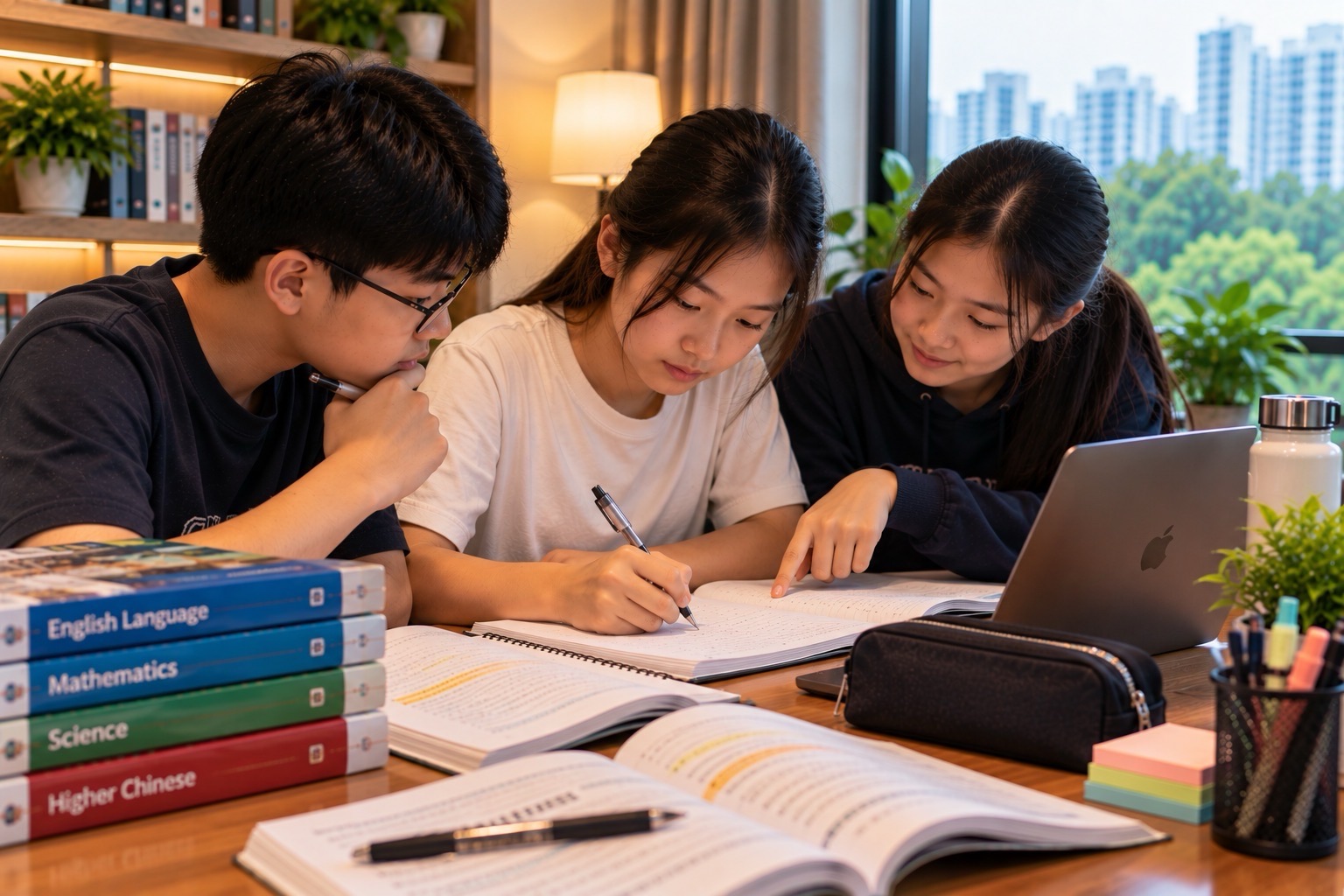
Under Full Subject-Based Banding (Full SBB), choosing Secondary 3 subjects is not simply selecting an old Express or Normal stream. Students reaching the end of Secondary 2 choose from combinations that the school actually offers, subject to academic readiness, interest, prerequisites, available places and timetable resources. English, Mother Tongue, Mathematics, Science and Humanities remain important parts of the upper-secondary learning plan; electives may include Additional Mathematics, separate Sciences, Art, Design and Technology, Principles of Accounts or other subjects where provided.
The useful decision for a Punggol family is to start with the actual 2027 subject-option booklet from the child’s school, not a generic catalogue of every possible Singapore subject. Compare the child’s current G1, G2 and G3 levels, marks, preferred ways of learning and plausible later pathways. A student can be strong in Science without automatically qualifying for every separate Science, and a love of puzzles does not guarantee an Additional Mathematics place. This guide explains how to read the form and make a sustainable choice.
- Secondary 3 subject combinations are allocated under the receiving school’s published annual subject-option exercise.
- English, Mother Tongue, Mathematics, Humanities and Science remain core considerations, though their exact combinations and subject levels vary by student and school.
- Additional Mathematics is distinct from core Mathematics; it is an elective subject offered according to school-level and eligibility arrangements.
- Some schools offer separate Physics, Chemistry and Biology; others have combined Science combinations; these are not interchangeable labels.
- Humanities may include Social Studies with an elective History, Geography or Literature component; separate humanities have their own prerequisites where offered.
- 2027 examples from Pasir Ris Secondary show actual G1, G2 and G3 combinations but explicitly warn that allocation depends on performance, aptitude, vacancies and school resources.
- Meeting a published qualifying score does not guarantee every requested combination will run.
- Keep the planned 2027 SEC subject level in mind, but remember that course prerequisites and admissions rules can change for later cohorts.
Quick decision: Obtain the current school option booklet first. Then compare readiness, subject content, formal prerequisites, the school’s real combinations and the week-long workload before ranking choices.
Contents: Secondary 3 subject combinations explained
- 1. Secondary 2 is the point where choices become real
- 2. Full SBB does not mean every school has every combination
- 3. Start by mapping the student’s actual G levels
- 4. What the option exercise usually asks
- 5. Core Mathematics versus Additional Mathematics
- 6. What A-Math readiness actually looks like
- 7. A-Math is not essential for every worthwhile future
- 8. Separate Sciences versus combined Science
- 9. Why Chemistry appears frequently
- 10. Physics and the mathematics connection
- 11. Biology and the language of living systems
- 12. Why the Science choice is not a prestige contest
- 13. What Humanities means in the option form
- 14. Social Studies is more than memorising facts
- 15. Geography and the real world around Punggol
- 16. History, evidence and competing explanations
- 17. Literature and close reading
- 18. The role of Mother Tongue and Higher Mother Tongue
- 19. Principles of Accounts: learn what the subject does
- 20. Design and Technology for practical thinkers
- 21. Art, Music and other creative routes
- 22. Computing and applied digital learning
- 23. Subjects that are absent from a particular booklet
- 24. What a published score threshold means
- 25. Merit, preference and resource availability work together
- 26. Avoiding the heaviest combination by default
- 27. Looking ahead to SEC without deciding too early
- 28. Why a subject combination is not a career contract
- 29. How to read a real 2027 school example
- 30. Fictional student: strong Mathematics, uncertain Science
- 31. Fictional student: strong Humanities, practical interests
- 32. A conversation with the subject teachers
- 33. What to do if the desired combination is not offered
- 34. A four-week subject-choice preparation plan
1. Secondary 2 is the point where choices become real
The lower-secondary years expose students to a broad curriculum and give teachers evidence of how they learn. Toward the end of Secondary 2, schools ask students to rank possible upper-secondary subject combinations. This is not just an administrative click: it affects the subjects and levels they will study repeatedly through Secondary 3 and 4.
A teenager may approach the exercise by asking which combination friends are taking. Parents may focus on what sounds impressive. Neither is a reliable substitute for understanding the syllabus and the student’s actual strengths. The most useful conversation considers readiness, interest, school availability and possible future study needs together.
Practical next step: Ask the pupil what kinds of problems they enjoy and which tasks they can complete independently. That evidence starts a more grounded choice.
2. Full SBB does not mean every school has every combination
Full SBB is a national framework, but individual secondary schools plan subjects based on staffing, rooms, facilities, timetable feasibility, demand and student eligibility. A school may offer G3 separate Sciences and G2 combined Science, or have a particular Art or Computing option unavailable at another school.
Even a published list is sometimes provisional. Pasir Ris Secondary’s 2027 subject page states that subjects are allocated based on academic performance and aptitude, subject to vacancies and school resources; combinations with small enrolments may not eventually run. This is not a defect unique to that school but an important practical warning about treating an option as guaranteed.
Practical next step: Open the correct school-issued option form. Do not select a combination by copying a school elsewhere in Singapore.
3. Start by mapping the student’s actual G levels
Before interpreting elective requirements, the family should record which subjects the student currently offers at G1, G2 or G3. One child may take G3 Mathematics and G2 English; another may have a different distribution. The original Posting Group at Secondary 1 admission does not describe every current subject.
Upper-secondary choice forms may show G levels by subject. A family that treats them as one fixed overall stream can accidentally misunderstand what is being selected. Teachers can clarify whether an offered subject stays at its current level or requires a separate eligibility decision to move to a more demanding level.
Practical next step: Make a one-page table: subject, current level, current evidence, possible next level and official condition. Keep personal scores private.
4. What the option exercise usually asks
Schools commonly ask eligible students to rank subject combinations and may publish prerequisites for particular electives or separate Sciences. Academic results, aptitude, student preference and available places contribute to placement. Different schools can use different forms, sequencing or naming conventions.
A first choice expresses preference rather than entitlement. A child who satisfies a published condition may still face a capacity or timetable constraint, and a combination with insufficient interest may not run. The correct action is to read the entire school’s notice, including footnotes about conditions and deadlines.
Practical next step: Before submitting, ask the child to explain their first three choices without simply repeating the names of friends who selected them.
5. Core Mathematics versus Additional Mathematics
Core Mathematics supports essential numerical reasoning, algebra, geometry, graphs, data interpretation and applications. Additional Mathematics is a separate upper-secondary subject requiring stronger symbolic fluency and often greater abstraction. A student may be enthusiastic about numbers while still needing time to strengthen algebra before taking on the extra subject.
The school determines who may offer Additional Mathematics and at which available G level. A blanket online statement that every PG3 pupil must take A-Math, or that no G2 pupil can take it, is unreliable. The actual 2027 subject booklet and academic prerequisites govern.
Practical next step: Ask for sample A-Math work, not merely a syllabus title. The teenager should see how the questions are different from familiar E-Mathematics.
6. What A-Math readiness actually looks like
Good readiness begins with fluent manipulation of expressions, equations, fractions, indices, graphs and multi-step symbolic working. A student who can reproduce a model solution but becomes lost when one condition changes may need additional foundation before the A-Math pace feels manageable.
Parents should inspect recent schoolwork and ask teachers which misconceptions are recurring. Frequent negative-sign errors, weak fraction handling and poor equation balance can become more costly as algebra grows. A strong work ethic matters, but no amount of time replaces missing understanding unless the underlying skill is taught.
Practical next step: Try one unfamiliar, syllabus-appropriate algebra problem with no hints. Ask the student to explain every step and verify the final result.
7. A-Math is not essential for every worthwhile future
Additional Mathematics can support later advanced Mathematics, engineering-related study and other quantitatively demanding routes. However, whether it is a strict prerequisite, an advantage or unnecessary depends on the actual post-secondary programme and intake year.
Some students are better served by a focused combination they can master than by taking A-Math solely to prove status. Others genuinely enjoy the subject and benefit from being stretched. Both decisions deserve careful information rather than social pressure.
Practical next step: Research the prerequisites for plausible future courses while accepting that a thirteen-year-old may change interests. Keep opportunities open when reasonable, not at any cost.
8. Separate Sciences versus combined Science
Secondary 3 Science combinations vary. A school might offer separate Chemistry, Physics and Biology, or combined Science courses joining two scientific disciplines. The separate-subject route is not simply ‘two times the experiments’, and the combined route is not a refusal to learn real Science.
The syllabuses, assessed depth, laboratory skills and resulting qualifications differ. Parents should check the exact subject names, G levels and examination specifications, not rely on casual words such as ‘pure’ or ‘combined’ without context. Requirements for offering separate subjects are school-specific.
Practical next step: Ask the child which concepts they enjoy, how they handle experimental reasoning and whether their current Science work shows secure foundations.
9. Why Chemistry appears frequently
Chemistry helps explain materials, reactions, properties and evidence at scales students cannot always see directly. In upper-secondary science combinations it may be offered separately or as a component of combined Science, subject to the school’s actual options. It is important in some further study programmes but not every future route requires the same Chemistry qualification.
Some teenagers enjoy learning equations and particle models; others prefer ecology, motion or applied technology. Neither reaction alone is enough to decide the final subject group. Look at accuracy, interest and what is required later.
Practical next step: Ask the Science teacher which Chemistry skills in lower secondary are already secure and which concepts would need more practice.
10. Physics and the mathematics connection
Physics uses mathematical representation to describe motion, energy, forces, circuits and other physical systems. Students often discover that a concept they understand verbally still requires careful graph reading, proportional reasoning or algebra when solving questions.
A learner interested in robotics or engineering may enjoy Physics, but taking the subject should be based on the available combination and readiness. The relevant pathway may also require particular Mathematics qualifications. A claim that Physics automatically leads to a specific career is too broad to be useful.
Practical next step: Ask whether the student can connect a diagram, a physical explanation and a valid calculation. That combination is a better signal than enthusiasm alone.
11. Biology and the language of living systems
Biology explores organisms, structures, processes and relationships, and can involve both conceptual explanation and precise scientific terminology. Some students enjoy the connection to health and the natural world; others find the amount of detailed explanation challenging.
Upper-secondary Biology might be available separately or as a component of a combined Science course. The family should check exact school provision and programme prerequisites if the student has a potential health or life-science interest. Avoid promising a healthcare diploma or profession from one secondary elective alone.
Practical next step: Ask the pupil to explain a biological process as a sequence of causes and effects. Clear reasoning matters more than memorising isolated terms.
12. Why the Science choice is not a prestige contest
A separate Science combination can be demanding; a combined Science option can also offer substantial learning at the appropriate syllabus level. The central question is whether the student can understand the course well enough to progress, not whether the title sounds more impressive at a family gathering.
Parents should compare workload with other subjects. A pupil who takes several additional electives may have less time for experimentation, reading or reflection than expected. The highest count of subjects is not automatically the best educational plan.
Practical next step: Discuss the week’s actual hours and the student’s demonstrated skills. Select depth that is sustainable.
13. What Humanities means in the option form
Humanities may include Social Studies paired with an elective Geography, History or Literature component, as well as separate disciplines where schools offer them. The names reflect different forms of inquiry and assessment. Geography studies places and human–environment relationships; History examines evidence and change over time; Literature explores texts, interpretation and language.
Students need to understand whether the combination refers to a paired Humanities subject or an additional separate elective. The paper structure and required subject level can differ. Do not claim that every school offers each humanities variant.
Practical next step: Ask to see the actual course description and a sample of the kind of written reasoning the student will perform.
14. Social Studies is more than memorising facts
Social Studies teaches students to examine citizenship, governance, diversity and society through evidence and reasoned responses. It is not simply a set of slogans to reproduce. Pupils may need to interpret sources, compare perspectives and construct balanced explanations.
A teenager who struggles with long answers may need help sequencing claims and citing evidence, whether or not they enjoy current affairs. A student who speaks confidently about social issues still needs to learn how exam tasks assess sources and argument.
Practical next step: Use a short news example and ask what is known, whose perspective is represented and what evidence might be missing. This develops transferable thinking.
15. Geography and the real world around Punggol
Geography connects ideas such as land use, water, transport, weather, resources and human decisions. A Punggol family can discuss drainage, green spaces, routes and urban change as everyday examples, though these conversations must not be confused with a school-approved fieldwork task.
Choosing Geography requires more than liking maps. The upper-secondary subject may demand reading data, explaining processes, evaluating evidence and writing logically. Schools decide available subject combinations and levels.
Practical next step: Ask the child to explain a familiar place using both observation and evidence. Link curiosity to the discipline’s actual reasoning style.
16. History, evidence and competing explanations
History asks how people know what happened, which sources are reliable and why interpretations differ. It can require careful reading and structured argument. A pupil who likes historical stories may enjoy the subject but must still develop the skills of source analysis.
Parents should not choose History merely because the child likes documentaries, nor reject it because facts must be remembered. Review the school topics and assessment tasks. Look for interest in explaining cause, consequence, continuity and change.
Practical next step: Give two accounts of the same event and ask what evidence each uses. Such a discussion reveals whether the child’s curiosity extends to historical reasoning.
17. Literature and close reading
Literature in English develops interpretation, attention to language, perspectives and argument. Students may read poems, plays or prose and explain how details support meaning. A love of novels is valuable but does not automatically guarantee comfort with timed analytical essays.
A child with strong verbal insight but weak paragraph structure might still flourish with proper guidance; another may prefer the more data-focused reasoning of Geography. Check school texts and assessment expectations before deciding.
Practical next step: Ask the teenager to choose a short passage and explain why one word changes its tone. This is a practical test of close reading.
18. The role of Mother Tongue and Higher Mother Tongue
Mother Tongue remains a significant part of the programme, and Higher Mother Tongue can be available to eligible students under specific national and school arrangements. The family must distinguish language level from overall Posting Group and from the academic level of other subjects.
From 2026, MOE expanded eligibility for Secondary 1 Higher Mother Tongue to students who achieved AL1 or AL2 in PSLE Mother Tongue, or Distinction or Merit in PSLE Higher Mother Tongue, regardless of overall PSLE Score. An upper-secondary continuation still requires consultation about the actual pathway and learning load.
Practical next step: Do not assume a general high PSLE total is the only sign of advanced language aptitude. Check the child’s official language record and school advice.
19. Principles of Accounts: learn what the subject does
Principles of Accounts introduces accounting ideas, financial transactions and structured reporting. Some students enjoy its clear relationships, careful classification and applications to business activity. Others find that the precision and format require more attention than expected.
POA is not identical to Business Studies or Economics. Families should read the actual syllabus before deciding that one subject guarantees a particular finance career. The course may be offered at different levels or not at all in some schools.
Practical next step: Ask the student whether they enjoy organising information, tracing an error and explaining why a financial record balances. These habits relate more closely to the subject than its name alone.
20. Design and Technology for practical thinkers
Design and Technology combines problem identification, planning, development, testing and communication of an artefact or solution. A pupil who likes making objects can become interested in the process behind a design, including constraints, safety and iterative improvement.
Upper-secondary D&T has its own demands and assessment requirements. Projects take time, and success depends on how well students plan, document and explain decisions, not just how attractive the finished object looks. Offering the subject depends on school combinations and facilities.
Practical next step: Ask to review the nature of coursework and required time commitment. Practical subjects deserve as much serious analysis as academic electives.
21. Art, Music and other creative routes
Art and Music at upper secondary can be demanding subjects involving visual or aural analysis, creative decisions and sustained practice. Students attracted by a beautiful final portfolio may underestimate the revisions and disciplined work needed to produce it.
Some schools provide these routes, others have different specialist options, and certain electives may be timetabled after ordinary dismissal. Parents should understand how assessment, equipment, time and the student’s genuine interest fit into the week’s commitments.
Practical next step: Examine the process, not merely the showcase. Ask whether the child enjoys practising the underlying skills even when there is no applause.
22. Computing and applied digital learning
Computing can develop logical thinking, decomposition, programming and the responsible use of digital tools. Schools may offer various computing or business-skills subjects at different levels, and a school project involving devices is not the same thing as the formal examinable Computing syllabus.
Families should verify what the subject actually teaches, how it is assessed and what background is useful. Technology names change rapidly, while durable reasoning and careful debugging remain valuable. A teenager who loves playing games may or may not enjoy writing and testing programs.
Practical next step: Ask the pupil to explain how they would find a bug in an algorithm. Curiosity about the work is a better basis than the word ‘AI’.
23. Subjects that are absent from a particular booklet
When an option is not listed in a school’s current subject combinations, it should not be represented as automatically available because another Singapore school offers it. Some students may have separate opportunities for selected language or specialised subjects outside the school, but those require official eligibility and arrangements.
Parents should ask whether the school can advise on alternative legitimate routes and what constraints apply. Avoid buying tuition for an unconfirmed school subject that may never be available to the child. The most practical plan works with the actual programme and its recognised qualifications.
Practical next step: Treat the school handbook as the starting authority for that student’s next-year options.
24. What a published score threshold means
Schools may set minimum overall subject marks, grade bands or teacher recommendations for certain higher-demand subjects and electives. The threshold helps identify students likely to cope. It is not a general right to force a combination to be opened when there are insufficient places or timetable restrictions.
Some schools use 75% in a current-level subject as one criterion for offering a more demanding level, but holistic judgement and the actual year’s rules matter. The number does not become a national guarantee that every 75% result triggers a move.
Practical next step: Ask what evidence, deadline and allocation rules apply to the particular subject and the 2027 cohort.
25. Merit, preference and resource availability work together
Students normally rank preferences, while schools consider academic readiness and the feasibility of running each combination. A pupil may meet the prerequisite but still be allocated an alternative because capacity, demand or scheduling prevents the original combination.
Parents can prepare by discussing several acceptable combinations. The student should understand which underlying interest each option serves. If a preferred combination does not run, another course may still develop the intended skills or lead toward a related post-secondary route.
Practical next step: Ask the school whether a substitute combination preserves the prerequisites that matter for the student’s plausible next steps.
26. Avoiding the heaviest combination by default
Taking many demanding subjects can appear attractive to ambitious families. But a teenager also needs sleep, CCA time, transport, meals, friendships and room to become independent. An overloaded combination may reduce actual learning because the student spends every evening catching up.
MOE has revised future post-secondary criteria, including the move to JC L1R4 from 2028, which reinforces the importance of understanding which subjects truly count for an intended route. Counting subjects without knowing the rule is not a plan.
Practical next step: Map the typical week before adding an elective. The best combination is the one the student can learn well and live with sustainably.
27. Looking ahead to SEC without deciding too early
Students graduating from 2027 enter the Singapore-Cambridge Secondary Education Certificate system, in which their subjects are examined at the G levels offered. A family preparing a 2027 Secondary 3 combination should therefore understand the actual subject name and level rather than compare only with old O- or N-Level labels.
Still, a child currently in Secondary 1 has time to develop. They should not be forced to decide a final profession before they have explored lower-secondary disciplines. When the choice becomes real, check the correct annual SEAB syllabus and post-secondary prerequisites.
Practical next step: Keep future pathways visible but provisional. Strong foundations and genuine interest are useful regardless of later policy adjustments.
28. Why a subject combination is not a career contract
An interest in healthcare does not mean every teenager must select Biology, and enjoying Mathematics does not mean every child must become an engineer. Real courses have specific prerequisites, and careers often require skills that cross disciplines.
The more valuable approach is to research the actual next qualification, not a vague occupation title. A student can discover what engineers, designers, nurses, technicians, accountants and writers really do before deciding which learning style and subject base are appropriate.
Practical next step: Ask for one authentic example of a job task connected to a school subject. It turns an abstract aspiration into an informed question.
29. How to read a real 2027 school example
Pasir Ris Secondary School published 2027 subject combinations with separate G3, G2 and G1 pathways. Its G3 options include English, Mother Tongue, Mathematics, Humanities and combinations involving Chemistry, Physics or Biology, Additional Mathematics and other electives. Its G2 examples include combined Science and choices such as Art, D&T, POA or Additional Mathematics.
These are real illustrations of school-level diversity, not the official choices for every Punggol school. The same page explicitly says academic merit, aptitude, vacancies and resources affect allocation, and that a small combination may not be implemented.
Practical next step: Use the example to learn how subject tables work. Then replace it with the actual current booklet from your child’s school.
30. Fictional student: strong Mathematics, uncertain Science
Consider ‘Kai’, a fictional Secondary 2 pupil with good algebra and a genuine interest in problem solving. He likes Physics demonstrations but his Science assessments show gaps in written explanations. His family considers Additional Mathematics and separate Science, then asks teachers which combination he can realistically manage.
Instead of demanding the most demanding combination, the family diagnoses Science reasoning and examines what support is needed. Kai might choose a viable combination that includes A-Math if eligible, or another balance if workload would otherwise be excessive. The story does not guarantee any school offer.
Practical next step: The lesson is that one strong subject can be nurtured without pretending every subject is equally secure.
31. Fictional student: strong Humanities, practical interests
Imagine ‘Mira’, a fictional pupil who writes perceptively about social issues, enjoys Geography fieldwork and is interested in design. Her teachers show her how Social Studies and elective Geography differ from separate Humanities, and what the school’s D&T offering involves.
She compares the types of assessment, timetable demands and possible future programmes. Her family takes her interest seriously rather than treating non-Science options as second class. The final decision is made from real choices and qualifications, not a parent’s memory of school twenty years earlier.
Practical next step: Different strengths deserve accurately understood routes. The goal is intellectual growth, not sameness.
32. A conversation with the subject teachers
Teachers can describe the student’s conceptual accuracy, independence, pace and interest. A parent consultation is most useful when it includes specific evidence from marked work rather than only asking whether the child is ‘good enough for A-Math’.
Bring the recent assessment, the subject-option guide and a shortlist of combinations. Ask about prerequisites, availability, likely homework load and the child’s observed readiness. Request clear information on what happens if a combination is over-subscribed or does not run.
Practical next step: Finish with a short written decision note. Families reduce uncertainty when they can distinguish confirmed eligibility from a hopeful preference.
33. What to do if the desired combination is not offered
A school may not offer a particular elective or may be unable to allocate a seat. Disappointment is understandable, but it does not mean the teenager’s interest has ended. They may develop related capabilities through another available subject, a CCA, reading, projects or an officially recognised external option.
However, some pathways have strict subject prerequisites. Parents must check whether an alternative course will satisfy these before making reassuring promises. An informal hobby is not automatically interchangeable with an examinable qualification.
Practical next step: Ask two questions: ‘What skill or interest are we trying to develop?’ and ‘What formal qualification will the next step require?’
34. A four-week subject-choice preparation plan
Week one: collect the official option booklet and current academic results. Week two: learn the syllabus and assessment style of the three most relevant electives. Week three: speak to teachers about readiness, workloads, prerequisites and genuine availability. Week four: rank acceptable combinations, verify the final submission and save confirmation.
This is a preparation sequence, not a reason to ignore the actual school deadline. If the school opens the form for only a short period, complete the necessary tasks within that window. Students should be involved in choosing rather than handed an unexplained parental instruction.
Practical next step: End by asking whether the student can explain what they will study and why. That is a better decision test than how impressive the combination sounds.
Subject-choice worksheet for families
- Current subject and approved G level
- Most recent relevant assessment evidence and recurring errors
- Actual subject combination and course code in the school booklet
- What the subject really teaches and how it is assessed
- Academic threshold, aptitude or teacher recommendation required
- Whether the combination is provisional or capacity-limited
- How the subject affects the teenager’s weekly workload
- Whether the subject preserves important post-secondary prerequisites
- A backup choice the student can genuinely accept
- Official deadline, submission acknowledgement and person to ask
Frequently asked questions
Does every Full SBB school offer the same Secondary 3 subject combinations?
No. The national framework permits flexibility, but each school publishes its actual options and allocation conditions.
Is Additional Mathematics compulsory for G3 students?
No. It is a separate subject offered when available and when the student’s eligibility and school allocation support it.
Can G2 students ever take Additional Mathematics?
Some school option guides list Additional Mathematics in certain G2 combinations. Check the actual school and subject-level arrangements rather than assuming a universal rule.
What is the difference between core Mathematics and A-Math?
Core Mathematics teaches essential mathematical foundations and applications. Additional Mathematics extends more abstract and symbolic mathematical work.
Is separate Chemistry the same as Combined Science?
No. Subject combinations, syllabuses, assessments and qualifications differ.
Does every child have to take all three Sciences?
No. Students take the combinations available and approved at their school according to readiness and eligibility.
What is Combined Humanities?
A subject combining Social Studies with a Humanities elective component such as Geography, History or Literature, according to the school’s and syllabus’s options.
Can an interest in History guarantee a separate History subject?
No. School provision, assessment readiness, prerequisites, vacancies and combination rules apply.
Can I force the first-choice combination if my child meets the grade requirement?
A qualifying grade may not guarantee allocation. Schools also consider programme demand and resources.
Should we select the largest number of examinable subjects?
Not automatically. Choose a sustainable combination that meets meaningful learning and future pathway needs.
What if a combination has too few students?
Schools may decide not to run it. Read the current booklet and ask about alternatives.
How does SEC affect choices?
The graduating student takes subjects at the actual G levels offered, and those qualifications can affect later eligibility.
Should we buy upper-secondary textbooks before allocation?
Wait for the confirmed combination and official booklist to avoid purchasing unnecessary materials.
How can a parent help without controlling the decision?
Review real school options, the child’s evidence and teacher guidance, then let the student explain the reasons behind the ranked preferences.
Where can we check genuine 2027 examples?
Use the actual secondary school’s subject-option information; Pasir Ris Secondary publishes a 2027 example, but its list does not determine another school’s offering.
Official references and related reading
For a dated school example, use Pasir Ris Secondary 2027 subject combinations, alongside the Anderson Secondary subject guide, MOE Full SBB and SEAB syllabuses. Learn about the wider route in our G-level changes guide and SEC and post-secondary options guide.
Reviewed 6 November 2026. School examples are explicitly school-specific. Upper-secondary combination lists and qualifying rules change by cohort. Fictional pupils are illustrative only.


