
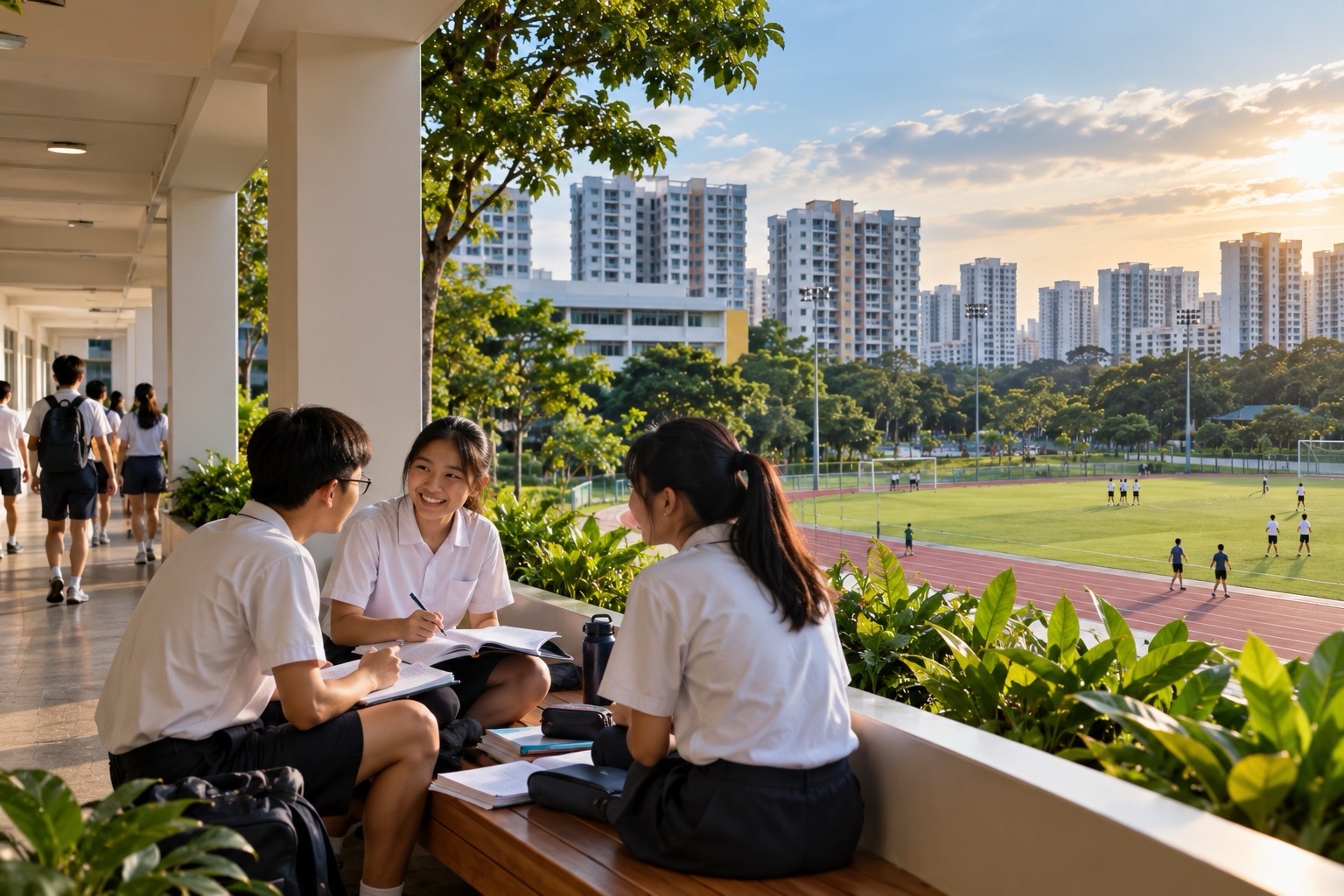
From January 2026, Singapore secondary schools restrict students’ use of smartphones and smartwatches throughout school hours, not only during formal academic lessons. The restriction includes recess, co-curricular activities (CCAs) and supplementary, enrichment or remedial sessions, with school-approved exceptions where necessary. Devices are generally kept in schoolbags or designated storage areas according to the school’s rules. This applies to the secondary-school day regardless of whether a pupil studies academic subjects at G1, G2 or G3 under Full Subject-Based Banding (Full SBB).
For Punggol parents preparing for Secondary 1 in 2027, the most useful questions are practical: where the child keeps the phone, how to contact the child in an emergency, what happens when CCA ends, whether a smartwatch counts, and how the rules differ from using a school-prescribed Personal Learning Device (PLD) for educational tasks. The rules do not mean a family must buy an expensive new phone or that a teenager will be unreachable in a genuine emergency. The school establishes approved contact arrangements and any exceptions.
- MOE’s enhanced secondary-school guidelines took effect in January 2026 and cover school hours beyond classroom lessons.
- Smartphones and smartwatches are included; don’t assume a watch escapes the rule just because it is small.
- Recess, breaks, CCA, remedial, enrichment and supplementary sessions are covered by the enhanced restrictions.
- Devices are stored according to school instructions; the national guideline does not require every campus to use the same lockers or collection system.
- Schools can allow exceptions where necessary, and have discretion to set school-level implementation and disciplinary procedures.
- An ordinary school-managed PLD for approved learning is distinct from personal smartphone use, though device-management rules still apply.
- Parents should use the school’s emergency contact procedures rather than expect an immediate phone reply from their child during lessons.
- Digital wellness includes safe social media, sleep, physical activity, screen boundaries, privacy and critical thinking about AI-generated material.
- Full SBB Posting Groups and G levels do not create separate phone privileges or penalties.
- Use current school handbooks for the 2027 cohort, since storage and after-hours arrangements can differ.
Quick answer: Smartphones and smartwatches are restricted across the school day from 2026, including recess and CCAs. Check how your school stores devices and handles parent contact and necessary exceptions.
Contents: Full SBB smartphone and smartwatch rules
- 1. What MOE changed from January 2026
- 2. Why the rule applies across Full SBB
- 3. What school hours include
- 4. Are smartphones entirely banned from school premises?
- 5. Smartwatches are included
- 6. Why recess is included
- 7. CCA hours are part of the rule
- 8. Supplementary and remedial lessons
- 9. Where devices are kept
- 10. What parents do during an emergency
- 11. What if a child needs their phone for health reasons?
- 12. Can the child use a school PLD?
- 13. Difference between personal phone and SLS
- 14. What if a teacher needs a student to use a phone?
- 15. Why digital wellbeing goes beyond confiscation
- 16. What parents should discuss before Secondary 1
- 17. How parents can support offline friendship
- 18. What about bullying through class chats?
- 19. Privacy and school photographs
- 20. AI-generated content and deepfakes
- 21. Why the rule is not about G1 versus G3 status
- 22. What happens after misuse
- 23. Does the rule apply outside school?
- 24. Punggol school journeys and pickup plans
- 25. What about smartwatch location tracking?
- 26. When a child becomes distressed without their phone
- 27. Keeping homework and screen time separate
- 28. An example of a school locker policy
- 29. A fictional student’s first week
- 30. A fictional medical exception conversation
- 31. Four weeks of building healthy habits
- 32. Where families should check the rules
1. What MOE changed from January 2026
Earlier MOE guidance already restricted personal smartphone and smartwatch use during lessons. The enhanced rule extends the restriction to secondary students during other parts of the school day, including recess and CCAs. The intention is to reduce unnecessary digital distraction and strengthen face-to-face interaction and wellbeing.
This is not a claim that every device must be permanently surrendered or that a parent may never contact the school. Schools implement the guideline through their own rules and provide exceptions where justified. The local school’s published arrangements matter.
Try this: Read the receiving school’s exact 2027 mobile-device policy rather than repeating a rumour about a universal locker system.
2. Why the rule applies across Full SBB
Full SBB pupils may attend academic subject groups at G1, G2 or G3 and share mixed form classes. Phone restrictions are part of school conduct and wellbeing policy, not an academic syllabus decision. A student in G3 Science does not automatically receive extra phone privileges.
A consistent expectation can also reduce awkward divisions in a mixed form class. Students can interact during breaks without needing to compare device access as a sign of academic status. Any exception should arise from genuine circumstances rather than prestige.
Try this: Explain that classroom level and school phone conduct are different matters.
3. What school hours include
MOE’s enhancement explicitly extends beyond formal lessons. The covered periods include recess, time between lessons, supplementary teaching, enrichment sessions, remedial classes and co-curricular activities. Families who assumed the child could use a phone freely at lunch should update that expectation.
The exact boundaries of school hours and approved communication or collection procedures can vary. A child should not guess that a late afternoon CCA means the restriction ended after the last academic classroom lesson. The school’s own policy provides the operational answer.
Try this: Ask whether the student may access the phone after the final scheduled school activity and how the school defines that point.
4. Are smartphones entirely banned from school premises?
The enhanced rule restricts use during school hours; it should not automatically be described as a nationwide prohibition on possession. MOE describes devices being kept in schoolbags or designated storage, with necessary exceptions allowed by schools. Individual campuses may have stronger local requirements.
Parents should distinguish bringing a device, storing it, viewing notifications and using it for communication. Those actions may be governed differently by the actual school. A child cannot rely on a friend’s policy from another campus.
Try this: Check whether the school permits a phone to be brought and exactly where it must be stored.
5. Smartwatches are included
A smartwatch can send messages, display notifications, record information or distract during learning. MOE’s enhanced secondary guidance explicitly mentions smartwatches alongside smartphones. A parent who buys a smartwatch instead of a phone should not assume the device becomes an unrestricted exception.
Schools can specify how watches are stored or when an exception is appropriate. A conventional non-connected timepiece may be treated differently, but the school should clarify the details. Do not claim that a certain brand or model is universally exempt.
Try this: Ask the school whether the child’s particular watch must be stored and what alternatives exist for checking time.
6. Why recess is included
Recess is a chance to eat, move and talk to classmates. Constant personal-device use can reduce the time students spend interacting with peers and noticing their surroundings. MOE’s restrictions reflect the intention to encourage more offline social contact during the school day.
Some teenagers genuinely use phones to manage anxiety or maintain contact, so a family may need to discuss individual circumstances rather than insist every child responds identically to the change. The rule nevertheless creates a common expectation for school routines.
Try this: Encourage the child to learn the canteen routine and initiate one simple conversation without checking a screen.
7. CCA hours are part of the rule
CCAs support physical, creative and social development. Under the enhanced guidelines, smartphone and smartwatch restrictions also cover CCA sessions rather than ending automatically when academic classes finish. Training, rehearsal and team activities require attention and safe conduct.
Parents may need to coordinate transport or pickup when CCA dismisses later than usual. Do this through the school’s permitted contact method, not by repeatedly messaging the child’s stored phone and then assuming they are ignoring you.
Try this: Agree on pickup or safe-travel arrangements before the CCA, including how changes will be communicated.
8. Supplementary and remedial lessons
A pupil receiving extra support or attending an enrichment lesson is still participating in school learning. MOE included supplementary, enrichment and remedial sessions in the enhanced restriction. Being in a different G-level subject group does not change that conduct expectation.
Parents should not expect the student to answer a personal call just because it is ‘after regular classes’ while a school lesson is still in progress. A school-approved exception may apply in genuine circumstances. Timetable clarity is essential.
Try this: Use the school’s official schedule to understand when the student is still attending a supervised school activity.
9. Where devices are kept
Schools implement storage arrangements through their own rules. MOE has described schoolbags or designated storage areas, while some individual schools have used lockers. The national rule should not be represented as one exact locker design or retrieval time for every campus.
Students need to know how and when to store devices, whether devices must be switched off or silenced, and what to do if an item is lost or damaged. Parents should not give instructions that conflict with the school’s security requirements.
Try this: Ask the school for its storage, security and retrieval instructions at orientation.
10. What parents do during an emergency
A parent may urgently need to reach a child because of a medical issue or family event. Rather than expecting instant direct access to a stored smartphone, families should know the school general office or designated emergency contact process. Schools can arrange appropriate communication when necessary.
The procedure should be learned before a crisis, and students should understand whom to approach if they themselves need urgent help. Do not assume a disabled notification implies the school is unable to reach a family.
Try this: Save the school’s verified contact and communicate any serious ongoing medical circumstances through the appropriate channel.
11. What if a child needs their phone for health reasons?
Some pupils may have a legitimate medical, accessibility or safety reason to use a particular device. MOE’s guidance provides for school-approved exceptions where necessary. The decision requires conversation with the actual school, not a blanket claim that every health-related app is automatically allowed.
Parents can explain the functional need, what the device does, which periods require access and whether a different approved solution exists. Sensitive details should be shared privately, especially when classmates are curious about an exception.
Try this: Ask the receiving school for its exception process and documentation requirements before the first school day.
12. Can the child use a school PLD?
Secondary schools use school-prescribed Personal Learning Devices for educational activities under the National Digital Literacy Programme. Approved PLD use is distinct from unrestricted use of a personal smartphone or smartwatch. School device management and teacher instructions still apply.
A student should not treat the PLD as a backdoor for private messaging, gaming or social media during restricted periods. Schools may manage software, internet access and device availability. The point is purposeful learning rather than total prohibition of technology.
Try this: Follow the teacher’s approved educational use and the school’s device management rules.
13. Difference between personal phone and SLS
Student Learning Space is MOE’s national learning platform, and pupils may access it through approved school devices in lessons or HBL. That is educational software, not a general permission to check personal social-media notifications. The account also has privacy and responsible-use requirements.
Families should help pupils understand which technology supports study and which patterns create distraction. A child can learn digital literacy while still accepting reasonable boundaries on personal screen use. These aims are complementary, not contradictory.
Try this: Explain the purpose of each device and app rather than saying all screens are identical.
14. What if a teacher needs a student to use a phone?
MOE’s framework allows schools to make exceptions where necessary. Any classroom task genuinely requiring a specific personal device should therefore follow the school’s authorised instructions. A pupil should not decide independently that a useful-looking app constitutes permission.
A student can ask the teacher which device is approved, when the permission begins and when it ends. If the assigned task can be done through a school PLD, the teacher may prefer that method. Parents should not create alternative arrangements without school approval.
Try this: Have the child confirm the explicit permission and relevant duration before using the device.
15. Why digital wellbeing goes beyond confiscation
A school rule can reduce one source of distraction, but a healthy digital routine also depends on sleep, attention, physical activity, friendships and safe online behaviour. A teenager who stores the phone at school but uses it until late at night may still arrive exhausted.
Families can discuss how devices affect mood and concentration without presenting all technology as harmful. Useful digital tools can support creativity, communication and learning; the challenge is purposeful, bounded use. The best home plan is realistic enough to sustain.
Try this: Agree on charging locations and a bedtime routine that gives sleep priority.
16. What parents should discuss before Secondary 1
The transition from Primary 6 can feel socially complicated. A child may worry about not receiving messages, missing a friendship conversation or being unable to call a parent during recess. These worries deserve an explanation and a practical plan.
Tell the teenager whom to approach at school, when the phone can be accessed and how pickup arrangements will work. A student can then practise asking a trusted teacher for help instead of relying exclusively on direct messaging. Independence grows from predictable support.
Try this: Before orientation, rehearse one example: ‘If my pickup changes, I will contact the office or follow the approved school procedure.’
17. How parents can support offline friendship
A mixed form class under Full SBB brings together students with different academic profiles. Opportunities for conversation occur at recess, shared subjects, class projects and CCAs. Restricting personal devices may create space for those interactions, though it does not guarantee everyone will become friends.
A pupil who is shy or new to Singapore may still need gentle coaching. Parents can suggest simple introductions and interests rather than forcing a teenager to join a popular group immediately. School belonging develops through repeated safe interactions.
Try this: Ask which classmate the student enjoyed working with, not how many messages they received.
18. What about bullying through class chats?
Digital harassment can continue outside school hours. A phone restriction during recess does not remove the need to respond to cyberbullying, hurtful group messages or privacy violations. Schools and parents should address concrete incidents appropriately.
A child should not retaliate by publishing another student’s personal information or sharing screenshots widely. Preserve relevant evidence privately, use the school’s pastoral or discipline channels, and escalate urgent threats through appropriate safety procedures.
Try this: Teach the child to pause, preserve necessary evidence and ask for adult help rather than replying in anger.
19. Privacy and school photographs
Mobile cameras make it easy to share images of classmates, school documents, uniforms or private conversations. Consent and school rules matter even if a photograph is taken after a lesson. A pupil should understand that another person’s appearance or work is not free content for social media.
Parents can model the same respect by asking before posting photographs of their teenager’s classmates. Avoid sharing class lists, subject-level information and assessment results in public groups. Digital responsibility extends beyond compliance with a storage rule.
Try this: Ask whose privacy a photograph might affect before posting or forwarding it.
20. AI-generated content and deepfakes
MOE’s 2026 initiatives include strengthening students’ AI literacy and cyber wellness, with attention to validating generative AI output and recognising deepfakes. Smartphones and other devices can expose children to convincing false material even outside the school day.
Families should teach students to examine the original source, ask whether an image was manipulated and avoid circulating unverified accusations. Generative AI can be useful for learning, but fluent output is not proof of truth. Students should also follow school academic-integrity expectations.
Try this: Practise verifying one online claim using a trustworthy independent source before sharing it.
21. Why the rule is not about G1 versus G3 status
Some pupils may assume that an advanced subject group deserves greater autonomy in phone use. The enhanced MOE guidelines are designed as student wellbeing expectations across secondary school, not as academic rewards. Exceptions are for genuine operational or individual needs.
Parents can explain that freedom and responsibility are connected to conduct, not a single exam grade. A student struggling in Mathematics still deserves respectful treatment, and a student excelling academically must still follow school rules.
Try this: Do not use subject-level labels to explain or justify disciplinary action.
22. What happens after misuse
MOE has said schools may respond to misuse through educational engagement and appropriate discipline, according to school rules. Consequences can therefore differ with the circumstances and the school policy. Parents should not invent a national penalty scale for every first or repeated incident.
Where a student repeatedly misuses a device, the family can ask what happened, whether the child understood the rule and what practical habits would prevent recurrence. Persistent conflict may also signal anxiety or difficulty disconnecting. Support and accountability can coexist.
Try this: Ask for the documented school response and agree on a realistic behaviour plan.
23. Does the rule apply outside school?
MOE’s enhanced secondary restrictions apply during school hours, including school activities identified in the guidance. Families still set appropriate boundaries for home and travel. A pupil travelling alone after dismissal may need to contact caregivers, but that use must fit any school premises rules and safety procedures.
A school’s after-hours instructions may differ from those of another campus. Parents should not assume personal phone use in the neighbourhood is governed by the same classroom restriction. Conversely, responsible use outside school remains important.
Try this: Confirm where school restrictions end and agree on safe communication during the journey home.
24. Punggol school journeys and pickup plans
Some Punggol families live near the child’s campus, while others rely on longer bus and MRT journeys. After-CCA pickup arrangements need to be clear because the child may not be permitted to message during the activity. Parents may also need to account for wet weather and timetable changes.
Create a primary meeting place, a backup location and a procedure if transport is delayed. Do not ask the student to ignore a school rule to provide frequent location updates. In an emergency, follow the school’s designated channel.
Try this: Write the plan with the child and make sure they can explain it from memory.
25. What about smartwatch location tracking?
Some caregivers use connected watches for location sharing or reassurance. A smartwatch with communications functions falls within MOE’s enhanced guidance on smartwatches during school hours. Families should not assume a tracker or watch automatically qualifies for unrestricted access.
If there is a genuine safety or health need, discuss it through the school’s exception arrangements. Otherwise, agree on safe travel and school contact plans that do not depend on constant tracking. Protecting independence is also part of adolescent development.
Try this: Ask what the school permits rather than buying a tracking device before checking the rules.
26. When a child becomes distressed without their phone
A teenager who has used a phone as a constant source of reassurance may find the new boundaries uncomfortable at first. Parents can recognise that experience while helping the child identify school-based sources of support. The aim is not to punish emotional needs.
If the pupil experiences severe anxiety, recurring distress or school refusal, seek appropriate pastoral or professional assistance. A phone exception may or may not be suitable; the school should examine the actual situation. A subject-level change is unrelated to this question.
Try this: Help the pupil identify a trusted adult and one offline coping routine rather than promising constant direct access.
27. Keeping homework and screen time separate
SLS and other school platforms may require screen time after lessons. That does not mean every hour spent on a device is equal in purpose. A family can distinguish school tasks, creative work, communication, entertainment and aimless scrolling.
A clear homework plan makes it easier to finish essential assignments and step away from digital activity. Parents who simply measure total device hours without understanding the task may mistake necessary learning for entertainment, or overlook distractions during supposed study.
Try this: Ask what task is being done and when the student will know it is complete.
28. An example of a school locker policy
St Andrew’s Secondary’s letter to parents for Term 1 of 2026 describes a particular school implementation involving storing phones in lockers before the school day and restricting use during school hours. That is evidence of one school’s concrete operational rules, not a nationwide requirement for identical lockers.
A different campus may use schoolbags, designated collection areas or its own schedule. Parents need to read their own school’s current handbook, including requirements for keys, locks, security and permitted exceptions.
Try this: Use the school-specific storage policy rather than copying another campus’s timetable or equipment list.
29. A fictional student’s first week
Imagine fictional Secondary 1 pupil Tricia in Punggol. She usually texts her parent at recess but discovers that her new school restricts phone use through the CCA session. She feels worried until a teacher explains the general office contact and the parent confirms a safe meeting point after training.
Tricia gradually makes a form-class friend during recess and learns to check the timetable without messaging constantly. She still uses her school-approved PLD for learning. The story illustrates a possible adjustment, not a report about a real student or a guarantee of outcomes.
Try this: Rehearse contact and pickup arrangements before the first week rather than in the middle of a difficult afternoon.
30. A fictional medical exception conversation
Imagine Kai, a fictional pupil who relies on a connected device for an important health-related function. His family asks the school in advance whether a permitted exception or an alternative arrangement can support him during lessons and CCA.
The school reviews the actual functional need and its safety procedures; neither the family nor this article assumes automatic approval. The important lesson is accurate, confidential communication and a workable support plan that does not compromise wellbeing.
Try this: Tell the school what the device does and when it is needed, then obtain the actual approved instruction.
31. Four weeks of building healthy habits
Week one: understand the school’s storage and permitted-use rules. Week two: practise the emergency and pickup contact procedures. Week three: discuss offline friendships and safe digital habits after school. Week four: review sleep, homework, device conflict and what still needs school guidance.
A serious safety, medical or bullying concern should be addressed immediately rather than waiting for the next week. The plan is a family transition routine, not an additional school policy. A small number of clearly understood habits is more useful than a long list of punishments.
Try this: Review one successful new habit with the teenager and agree on one practical improvement.
32. Where families should check the rules
MOE’s November 2025 press release explains the enhanced national guideline effective January 2026. Individual school handbooks and parent letters explain campus-level implementation. The 2027 receiving school’s current notice takes precedence over an older example online.
For related digital learning, MOE’s Student Learning Space and the school PLD programme explain why authorised technology continues to be used for education. Parents should not confuse school-managed learning access with personal phone messaging during restricted periods.
Try this: Keep the MOE guidance and the receiving school’s current conduct policy in the same family information folder.
Parent and student phone-rules checklist
- Verify the current school-hours definition
- Confirm whether phones or smartwatches may be brought and where they are stored
- Understand rules during recess, CCA and remedial lessons
- Know the school’s emergency contact method
- Agree on a safe Punggol school journey and pickup plan
- Clarify any genuine medical or accessibility exception privately
- Use the school-approved PLD only for permitted learning tasks
- Protect personal data, classmates’ images and school accounts
- Learn how to report online harassment or suspicious AI content
- Agree on home device boundaries that protect sleep and homework
- Check school disciplinary guidance without inventing consequences
Frequently asked questions
Can secondary pupils use phones during recess in 2026?
MOE’s enhanced rule restricts smartphone use throughout school hours, including recess, subject to approved exceptions.
Does the restriction include smartwatches?
Yes, smartwatches are explicitly included.
Can pupils use phones during CCA?
The restriction includes school CCAs and supplementary, remedial and enrichment sessions.
Are phones banned from being brought to school?
The guideline restricts use and requires school-approved storage; individual schools set their operational policies.
Does every school have phone lockers?
No. Storage may be in bags or designated areas according to school rules.
Can parents still contact children during an emergency?
Yes, through the school’s designated contact and safety procedures; necessary exceptions may be considered.
Can a child use a PLD for schoolwork?
School-approved PLD activities are distinct from unrestricted personal smartphone use and follow device-management rules.
Does G3 allow more phone privileges than G1?
No. Subject level is not a general phone-privilege category.
Are medical exceptions possible?
Schools can allow exceptions where necessary; discuss the actual need through official channels.
What happens if a student breaks the rule?
Schools apply their conduct and educational discipline procedures; there is no single universal penalty assumed here.
Does the rule apply after a student travels home?
The MOE school-hours restriction is separate from household rules; confirm any school-premises or after-school arrangements.
What if a student feels anxious without a phone?
Discuss appropriate pastoral support and a safe communication plan with the school.
How can families handle pickup after CCA?
Arrange a clear meeting point and backup contact procedure in advance.
Where do parents find the actual 2027 rule?
MOE’s enhanced-device guideline and the allocated school’s current handbook and parent communications.
Official sources and additional reading
Read MOE’s 30 November 2025 enhanced school-device guidelines, the St Andrew’s Secondary 2026 implementation example, and MOE’s 2026 announcements about AI literacy and cyber wellness. For school learning devices see our HBL, SLS and PLD guide and our friendship and wellbeing guide.
Editorial review: 6 November 2026. MOE’s national guideline is distinguished from the receiving school’s storage, exceptions and after-hours procedures. All fictional examples are illustrative and not reports about actual pupils.


