
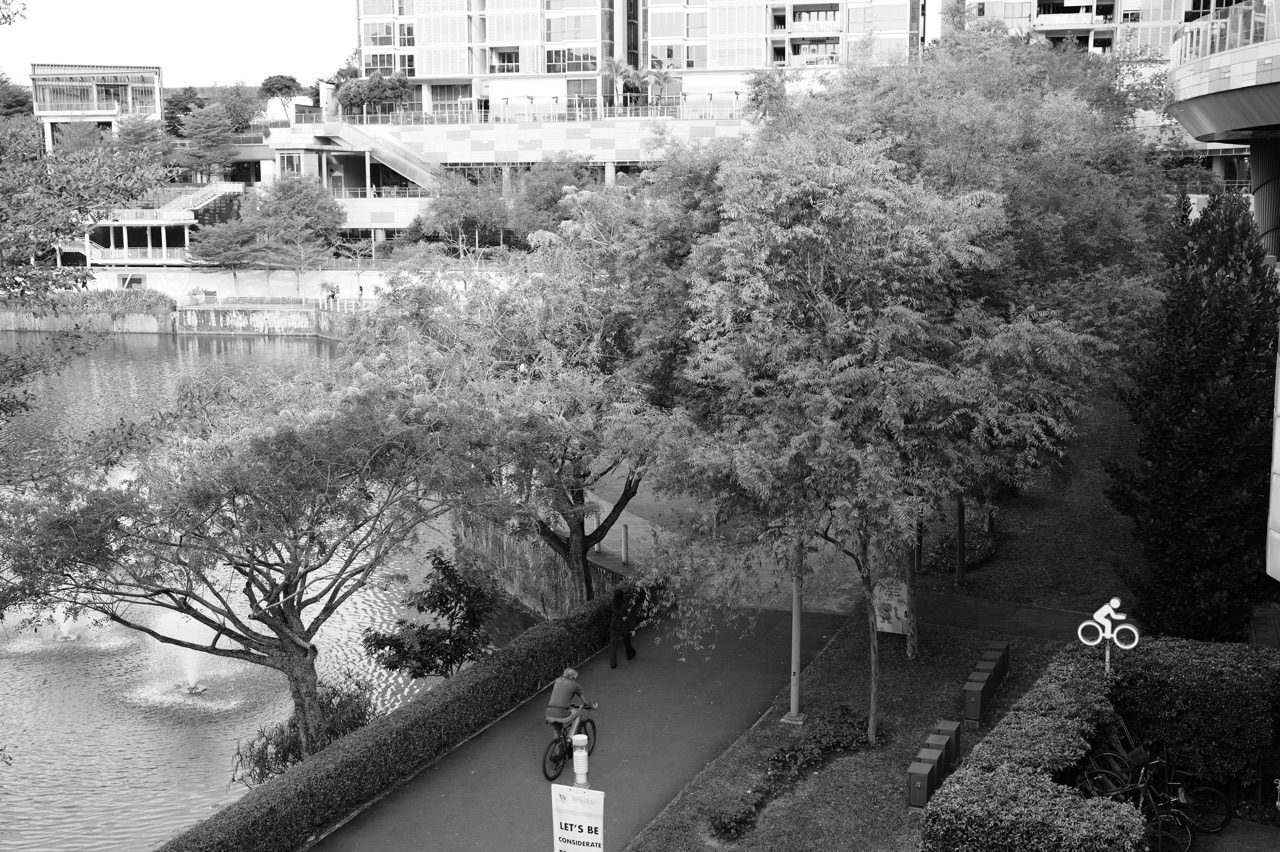
How do you learn to ride a bicycle as an adult in Punggol? Begin with a properly fitted, working bicycle and a quiet authorised practice area, ideally under competent instruction. Learn to stop predictably, balance, look ahead and steer before joining the busy Waterway paths or cycling to an MRT station. Adults do not need to apologise for learning late, and they should never begin by riding on a public road simply because an experienced friend says it is easy.
This 2026 adult learn-to-cycle guide for Punggol takes you from choosing a practice venue to controlled braking, balance, basic turning, the distinction between a dedicated cycling path and a Pedestrian-Only Path, helmets, LTA rules, how to assess the first route and how to make cycling part of everyday life without buying expensive equipment prematurely. It is not a list of cycling destinations: the existing Cycling in Punggol guide covers routes and rental discovery. This page is specifically for the person who cannot yet ride or feels uncertain after a long break.
Learning to cycle in Punggol: the quick-answer checklist
| Beginner question | Direct answer | Do not assume |
|---|---|---|
| Where should I begin? | A flat, suitable, authorised low-traffic learning area with room to stop. | Any open park connector is safe for first attempts. |
| Do I need a new bicycle? | Not necessarily. Use a well-maintained bicycle that fits and is safe. | An unfamiliar rented bicycle always fits. |
| Which skill comes first? | Knowing how to stop and control the bicycle at walking speed. | Pedalling fast creates stable control automatically. |
| Should I wear a helmet? | Strongly recommended on paths, mandatory on Singapore roads. | A helmet alone removes collision risk. |
| Can I ride on footpaths? | Standalone footpaths and shared paths differ from converted Pedestrian-Only Paths. | Every footpath beside a cycling path permits cycling. |
| When did Pedestrian-Only Path enforcement begin? | 1 July 2025. | A pedestrian logo or ‘Pedestrians-Only’ marking is decorative. |
| Are paths speed-limited? | 10 km/h on applicable footpaths; 25 km/h on shared/cycling paths, under current rules. | The legal maximum is a target beginner speed. |
| Can I practise on every Waterway bridge? | No. NParks marks selected bridges and the boardwalk as no-cycling. | A pleasant bridge is always rideable. |
| How much time will learning take? | It depends on balance, confidence, coaching and repetition. | Everyone learns in one afternoon. |
| When am I ready to commute? | When you can control the bike and navigate legal crossings safely. | A single short successful pedal makes a commuter. |
The essential official references are LTA’s Active Mobility Rules and Code of Conduct and NParks’ October 2026 path safety guidance. They address real shared-space rules, not a hypothetical cycling class. No adult cycling class availability is asserted here; enquire with a suitably qualified coach or recognised programme and obtain confirmation before arriving.
1. Why learning cycling as an adult feels different from learning at age six
An adult may understand traffic signs perfectly but have no experience of balancing on two wheels. They may worry about looking silly, falling in front of colleagues or being watched by children who can already cycle. The fear is real, but it is not evidence that the skill is unavailable to them. Learning involves coordination, safe control and confidence that can develop gradually. A good teacher recognises that the adult’s main problem may be uncertainty rather than effort.
Two adults of the same age can have completely different starting points. One remembers childhood cycling but has not ridden in fifteen years; another has never touched a bicycle; a third can pedal but freezes at crossings. Each needs a different assessment. A lesson that sends all three directly onto a busy park connector would ignore the most important information: what skill is missing and what environment permits it to be learnt safely.
The first principle is that cycling is a coordinated system. Pedals generate forward motion, steering balances direction, brakes reduce speed, and the rider’s eyes and body anticipate the path. Speed alone is not competence. A person can briefly travel forward yet struggle to stop, check behind or avoid pedestrians. The correct beginner programme isolates control before adding the demands of a shared public path.
2. Select the right bicycle before deciding which park to visit
A beginner bicycle should fit the adult well enough that the rider can operate the controls confidently and has appropriate support under the teacher’s instruction. Different designs, frame sizes, saddle heights and handlebar positions change handling. A heavy rental bike may feel less manageable than a suitable lighter bicycle, while an extremely small bicycle can create an awkward pedalling position. There is no universally correct model for every learner.
Before use, check that the brakes function, tyres are appropriately inflated, handlebars and saddle are secure, and the bicycle complies with current public-path requirements. LTA’s code advises checking lights, brakes, tyres and the rider’s ability to control a sudden stop. If something is damaged or unfamiliar, ask a competent bicycle technician or instructor rather than trying to ride through the problem.
Borrowing or using appropriate training equipment may make sense before buying. If borrowing, confirm that the owner permits your use, that the bicycle is suitable for your size, and that the mechanical condition is sound. If renting, understand deposit, liability, permitted areas and parking instructions. A shared bicycle is a transport service, not automatically designed as a beginner-training bicycle or supplied with a helmet.
The simplest shopping rule is to avoid paying for a premium bicycle before knowing whether the style suits you. A basic safe learner arrangement is more valuable than expensive gears or branded accessories. The right purchase is easier to make after you know your size, comfort, likely journey and frequency of use.
3. Why braking and stopping come before longer riding
A person who can pedal three metres but cannot stop at will is not ready for a busy shared route. Stopping is particularly important around children, dogs, buses, other cyclists and the Waterway’s bridges. Ask a suitable instructor to explain the braking system and supervise practice in a permitted controlled setting. The goal is predictable stopping without panic and without pulling a control so abruptly that balance is lost.
Beginner lessons may also involve getting on and off the bicycle safely, walking it, recognising the effect of steering and gradually practising balance. An appropriately trained instructor determines the sequence based on the learner. Do not copy a viral “learn in five minutes” trick that requires another person to push the bicycle at speed. Sudden uncontrolled acceleration can make a fearful learner less confident and endanger bystanders.
A useful progress question is: can the rider stop deliberately at a safe agreed place, dismount and walk the bike when needed? If yes, there is evidence of growing control. If not, repeat suitable earlier learning in the appropriate setting. Distance can wait. A rider who understands stopping has built a foundation that matters much more than their first digital speed record.
4. Balance is a skill, not proof of a person’s athletic worth
People often say “just keep pedalling and balance will happen.” It is an incomplete explanation. Cycling balance involves feedback from the bicycle, the direction of travel, steering and body position. Beginners need enough safe room and coaching to make small corrections without obstacles or surprise traffic. Some people learn quickly and others need repeated calm practice. That variation is ordinary.
Avoid comparing a parent learning at forty with a child riding around a playground. Their body size, risk perception and available practise time differ. The adult may have learned to drive or swim, but those skills do not automatically transfer into two-wheeled balance. An instructor can break the coordination into manageable experiences while respecting medical or disability-related needs.
If dizziness, a history of falls, recent surgery, significant knee or balance problems or another medical issue might affect safe cycling, obtain appropriate professional advice before beginning. An article cannot clear a particular person for a moving bicycle. Some adults will prefer a suitable adapted cycle or supervised stationary cycling, and this is a valid choice rather than a failure.
5. Choose a learning area by risk, not by scenery
| Potential setting | What it may offer | The critical limit |
|---|---|---|
| Authorised low-traffic training space | Room for instruction, simple stopping and turns. | Must actually permit cycling or supervised practice. |
| Quiet suitable cycling path | Legal bicycle use when clearly marked. | May still have other cyclists and obstacles. |
| Busy Waterway park connector | Scenery and a useful later route. | Usually a poor first balance-learning environment when crowded. |
| Pedestrian-Only Path | Safer reserved pedestrian movement. | Bicycles cannot be ridden there under current rules. |
| Condominium or school compound | A possible controlled venue. | Requires the owner/operator’s permission and appropriate safeguards. |
| Public road | Actual traffic interactions. | Not a suitable first-timer learning substitute for qualified instruction. |
| Park bridge or boardwalk | An attractive scenic feature. | Some have signed no-riding restrictions; dismount. |
Punggol Waterway Park attracts walkers, parents pushing prams, dogs, older residents and cyclists. It is not a private cycling classroom. A beginner making uncertain wide turns may unintentionally obstruct a path or create a collision. Find a permitted quiet place with suitable space, and learn how to stop and steer there before thinking about Waterway sightseeing. A lesson should also explain how to yield to others and when to walk the bicycle.
If the selected learning area becomes crowded, unsuitable or wet, change the plan. A learner should not be pressured to continue because the instructor has travelled to the site. Correct venue choice is part of instruction. The aim is a skill that can be enjoyed for years, not proving courage during one risky first session.
6. The July 2025 Pedestrian-Only Path change is not optional
LTA has converted certain footpaths located beside dedicated cycling paths into Pedestrian-Only Paths. From 1 July 2025, bicycles and non-motorised personal mobility devices are not permitted to ride on those converted paths. The ground markings include pedestrian symbols and words such as “Pedestrians-Only”. A beginner who sees two parallel paths must not guess which one is for cycling.
The initiative does not mean that every standalone footpath in Singapore has been converted to a pedestrian-only path. LTA distinguishes standalone footpaths and shared paths from the specifically converted paths. Always read signs and markings rather than generalising from one route to another. A cyclist should generally use the dedicated cycling path where it exists and give way to more vulnerable users as applicable.
LTA’s 2025 enforcement notice and current active mobility code provide the primary references. This matters in Punggol because cycling paths and pedestrian routes are part of everyday movement to MRT, LRT, HDB precincts and parks.
The speed limits also need correct interpretation. LTA sets 10 km/h on applicable footpaths and 25 km/h on shared paths; a legal upper limit is not a speed goal. An adult learner should be moving slowly enough to maintain control in a suitable training environment. At crowded junctions, stop or walk your bicycle as appropriate rather than treating a maximum sign as a right to overtake.
7. Helmets, crossings, bells and visibility
Singapore requires helmets for cyclists on roads, and LTA and NParks recommend protective gear such as a helmet on public paths. A correctly fitted helmet is a practical safety choice for beginners, even when learning in a controlled environment. But the helmet does not remove the need to stop, see other users and follow signs. Lights and reflective measures may be necessary for certain conditions, with specific road and path requirements.
Learn to dismount and walk across areas where riding is prohibited or unsafe. An experienced cyclist may handle busy intersections comfortably; a beginner should not assume the same. Check crossings, give priority where required and look in the direction of oncoming traffic rather than relying only on a phone’s route instructions. A route that looks short on a map may involve several difficult crossings.
LTA advises keeping left unless overtaking, going slowly around others, using appropriate bells or gentle warnings before overtaking and avoiding phone use that interferes with attention. Those behaviours should be introduced during lessons, not added only after someone buys a bicycle. A rider who can handle a bike but ignores people around them has not completed the safety-learning task.
If the adult intends to cycle after sunset, they should first become comfortable in easier conditions and understand the relevant lights and visibility rules. Do not make the first independent ride a dark waterfront trip. Path lighting, wet surfaces, other users and the rider’s fatigue affect risk. A conservative daytime progression is often simpler and more enjoyable.
8. What Punggol Waterway and NParks rules mean for a first route
The Punggol Waterway park connector is a scenic and useful cycling environment once skills are reliable, but it is shared and has specific restrictions. NParks lists an 8.4 km Waterway park connector—a description of the route, not a distance any beginner must finish. It also identifies selected bridges and the Waterway boardwalk as no-riding areas, with names such as Kelong, Wave and Adventure bridges. Read on-site signs and dismount as required.
The official Waterway park connector and NParks path-safety page help explain the route. An adult’s first independent ride should preferably use a short known legal section with a clear turnaround. The goal is not completing a loop, discovering a difficult ramp midway or accidentally entering a crowded boardwalk.
The user’s preferred companion may be an experienced friend, but friends need to respect the beginner’s pace. It is inappropriate to ride far ahead and expect someone uncertain to follow through complex crossings. Agree on a stop signal, a short destination and a simple plan if the rider wants to end early. The Family Cycling in Punggol guide covers grouped rides and child-related safety separately.
9. A skill ladder for a first month—without a deadline
| Stage | Capability to check | Potential supervised focus | Advance when |
|---|---|---|---|
| 1: Fit and safety | Can you access all controls and understand braking? | Bicycle check, helmet, familiarisation. | Equipment and stopping concepts make sense. |
| 2: Balance | Can you maintain calm controlled forward movement? | Appropriate balance exercises selected by a coach. | No dangerous uncontrolled swerving. |
| 3: Stopping | Can you stop and dismount predictably? | Controlled braking and returning to a safe position. | A stop is deliberate, not a panic event. |
| 4: Turning | Can you change direction in suitable clear space? | Gradual steering and awareness. | You remain in control. |
| 5: Path literacy | Can you identify legal markings and crossings? | Practice interpreting signs and dismount points. | You recognise path types. |
| 6: Short route | Can you ride a familiar permitted section? | An easy out-and-back with appropriate support. | Safe return and comfortable recovery. |
| 7: Everyday trip | Can you manage the path, parking and route? | A trial short errand at a suitable time. | Confidence without rushing. |
These stages are not a seven-week guarantee or a promise that everyone reaches independent cycling on a specified date. Some adults will become comfortable quickly; others need more coached sessions or a different bicycle. A person who wants to remain with a supervised companion is making a valid choice. The correct progress measure is actual safe control and willingness to ride again.
Do not increase distance, speed, route complexity and group size all at once. When too many variables change, it is difficult to know why a learner becomes anxious or unsafe. A more useful approach is to repeat a familiar safe path, then alter only one element when ready. That is the cycling equivalent of learning one concept correctly before attempting a difficult mixed problem.
10. How to choose adult cycling instruction in Singapore
A suitable adult class should say explicitly that it accepts first-timers, assess bicycle fit and stopping ability, explain how practice areas are authorised, and provide supervision rather than merely directing learners to a busy path. Ask about coach experience, ratio of instructors to learners, rental gear, helmets, location, session length, cancellation and age or medical restrictions. If a class advertises children only, do not assume an adult can register simply because the activity is called learn to cycle.
This guide does not claim that a named adult cycling course is currently open in Punggol. Availability should be established through the actual provider, SportSG or LTA’s safety education programmes where appropriate. An event that teaches path etiquette is not necessarily a beginner-balance lesson, and a weekend group ride is not a first-time cycling class. Name the skill you need when making an enquiry.
Example enquiry: “I am an adult and cannot yet balance or stop on a normal bicycle. Do you teach complete beginners using a suitably quiet authorised area, can you supply a fitting bike, and how do you decide if someone is ready to ride on a shared public path?” This helps a provider explain the real instructional service, not simply sell a tour package.
11. Using a bicycle for Punggol errands comes later
Once basic control is reliable, cycling can be a useful way to reach selected neighbourhood facilities. But an errand includes more than pedalling: parking, locking, carrying items safely, reading path signs and returning while tired are all separate tasks. A crowded shopping entrance may require dismounting. Shared-bicycle parking zones may be regulated through an operator’s app, and a bicycle should not block a footpath or accessibility route.
The Walking for Everyday Errands guide shows how movement integrates with a Punggol work or school day. Cycling can serve a similar transport goal for suitably skilled riders, but should not be presented as automatically safer, faster or healthier for every resident. A person anxious about traffic may prefer walking and MRT/LRT travel.
Different parts of Punggol have different access routes. A trip from Oasis to Waterway Point is not the same as one from Northshore to Punggol Coast. Start with an easy real journey, check bicycle parking and dismount zones, and avoid carrying heavy groceries in an unsafe way. The purpose is to make life more convenient, not turn a beginner into a delivery rider.
12. Heat, haze and wet paths during learning
Singapore weather is not merely background. A new cyclist may be concentrating so hard on balance that they forget to notice heat and fatigue. The Meteorological Service publishes heat stress by WBGT, which differs from ordinary temperature. High humidity and exposure to direct sun can make long outdoor practice uncomfortable. A suitable learner environment should have rest options, and the instructor should be prepared to shorten or postpone.
During haze, consult official Singapore haze advisories and adjust outdoor activity as appropriate. Do not infer air quality only from how the Waterway looks. Lightning requires separate caution; check MSS lightning information and do not practise beneath trees or open-sided shelters when storm risk is present. Rain makes surfaces slippery and may interfere with safe braking or visibility.
A parent may be tempted to move an adult learner’s session into an HDB void deck when the park becomes wet. Such spaces have pedestrians and may not permit cycling practice. Seek an authorised safe alternative or reschedule. Learning does not become more urgent because rain has interrupted a calendar plan.
13. Original worked case: learning from the wrong first move
Case A: the adult who can pedal but cannot brake calmly
A Punggol resident tries a friend’s bicycle near a busy park and manages several metres forward. Their friend declares success and proposes a full Waterway outing. But when a child walks nearby, the learner panics and cannot stop smoothly. The diagnosis is not lack of courage. The missing prerequisite is controlled stopping and path awareness. The correct next step is to return to an appropriate supervised practice setting and learn those skills before joining shared traffic.
This is a transfer lesson. A cyclist’s ability to travel in a straight line is not proof they can handle a market entrance, turning vehicle or sudden pedestrian. In a new context, the earlier skill must work with braking, attention and steering. A short deliberate stop can reveal more readiness than a photograph of the learner pedalling over a long distance.
Case B: the commuter who accidentally rides on a pedestrian-only strip
A new cyclist sees a dedicated cycling path beside a path stamped “Pedestrians-Only”. They choose the latter because it looks emptier and think the ten-kilometre footpath speed limit gives them permission. The mistake is confusing a legal maximum with permission to use a particular type of path. LTA specifically prohibits riding on converted pedestrian-only paths, with enforcement from July 2025. The correct decision is to follow the actual cycling markings and, where necessary, dismount.
This case shows why reading public signs is as important as balancing. A rider can have competent bicycle technique but still create danger through poor legal understanding. A responsible learning programme teaches both. An instructor should not tell students that an empty path can always be used if they travel slowly.
Case C: the parent choosing between an expensive bike and a coached lesson
A parent who has never ridden considers buying a new bicycle to cycle with a child. They have a limited budget and are unsure which frame fits. Rather than purchase a high-priced model before testing their ability, they enquire about a proper adult beginner lesson with suitable training equipment. After learning to stop and turn, they can select an appropriate bike, helmet, parking arrangement and route. The purchase is then based on actual needs.
The family may discover that cycling still feels uncomfortable or that a group walking activity is more enjoyable. The trial was still valuable because it provided information. A good lifestyle decision is not proven by owning equipment; it is proven by choosing activities that remain safe and meaningful.
14. The hidden third dimension: cycling with other people
Individual riding is only part of the skill. On a shared path, others may be faster, slower or less predictable. A child might move suddenly, a dog walker may need extra room, and someone in a wheelchair must be able to travel without a cycle blocking their route. The rider should learn to anticipate and give appropriate priority rather than assuming the correct solution is always a bell and overtaking.
Group rides also have responsibilities. A friend should not make a beginner follow an ambitious route, ride two abreast through a narrow section or enter a road before they are ready. When cycling with children, the adult organiser must assess the youngest rider’s abilities, not merely their enthusiasm. For the specialist rules, read Punggol Family Cycling 2026.
A person who chooses to walk the bicycle through a crowded area is not failing at cycling. LTA specifically recommends walking devices in crowded areas. Dismounting is part of skilful path sharing and can be the safest decision for a highly capable cyclist as well as a novice.
15. A two-week household trial without a stopwatch
| Opportunity | Practical priority | What to record | When to change plans |
|---|---|---|---|
| First appropriate lesson | Fit, brake, balance and safety briefing. | What still feels uncertain? | When any control is unsafe. |
| Repeat learning | Practice the same safe skill deliberately. | Can stopping be repeated? | When fatigue or fear rises. |
| Observe a cycling path | Read signs, symbols and crossings while walking. | Which sections require cycling or dismounting? | When a path is ambiguous. |
| Short supported ride | Use only a known legal low-complexity route. | Was the return safe and comfortable? | If crowded or poor weather. |
| Next practical decision | Assess enjoyment and equipment needs. | Continue instruction or choose another activity. | When the plan no longer fits health or time. |
This plan is illustrative and should never be treated as a guaranteed timetable. Adults learn at varied speeds, and access to suitable coaching differs. What matters is that the learner can make a better choice after each session. If a problem returns, diagnose it: bicycle fit, braking, balance, turning, traffic anxiety or path rules. Do not respond to every difficulty by urging the rider to pedal faster.
16. Frequently asked questions about adult cycling in Punggol
Can adults learn to cycle for the first time?
Yes. Many can learn progressively with suitable equipment and competent instruction; time required varies.
Where should an adult practise in Punggol?
Use a genuinely authorised, quiet and appropriately supervised learning area rather than a busy Waterway path.
Is there a verified adult cycling class in Punggol today?
This guide does not claim a current slot; ask a suitable provider for actual beginner instruction and venue confirmation.
Do I need to buy my own bike first?
Not necessarily. A properly fitted borrowed or training bicycle can help determine what you need.
Why practise stopping before distance?
A rider who cannot brake predictably can endanger themselves and others even after pedalling successfully.
Does riding slowly allow me to use Pedestrian-Only Paths?
No. Converted Pedestrian-Only Paths prohibit cycling; follow LTA signage and rules.
When did the converted pedestrian-only restrictions begin?
Enforcement started on 1 July 2025.
What are the speed limits?
Current rules include 10 km/h on applicable footpaths and 25 km/h on shared paths; ride slower when needed.
Do I need a helmet?
A helmet is mandatory on roads and strongly advisable on public paths, especially for beginners.
Can I ride every Punggol Waterway bridge?
No. NParks has no-riding restrictions on designated bridges and boardwalks.
Do I have to complete the Waterway connector?
No. Its published 8.4 km length is not a beginner distance requirement.
Can I use a shared bicycle for the first lesson?
Only if it is safe, fits and the instructor or programme permits it; shared bikes are not automatically appropriate training equipment.
What if I am afraid to fall?
Explain concerns to a competent instructor and use an appropriate gradual learning environment.
Does learning cycling guarantee weight loss?
No. It can be enjoyable movement, but health outcomes depend on many factors and total activity.
Can an adult with a disability learn cycling?
Some adapted cycling options exist, but suitability and equipment require individual assessment and proper support.
Should I start riding on roads?
Not as a first-time learner. Road riding adds legal, traffic and skills demands and requires separate readiness.
Is it okay to dismount near pedestrians?
Yes. Walking a bicycle where required or sensible is part of responsible path sharing.
How can I use cycling for errands?
After developing control, choose a legal short route with confirmed parking and a safe return.
Can cycling continue during haze or lightning risk?
Follow official air-quality and weather guidance and postpone unsafe outdoor activity.
How do I know whether to buy a bike?
After suitable learning, compare fit, maintenance, actual routes, storage, cost and likely use.
Connected reading throughout eduKate’s Punggol lifestyle library
- Life in Punggol — Lifestyle Master Hub
- Cycling in Punggol — Routes, Rentals and Rules
- Family Cycling in Punggol — Children and Paths
- Walking for Everyday Errands and Active Commuting
- Low-Cost Fitness in Punggol
- Rainy-Day Exercise in Punggol
- Heat Stress and Outdoor Exercise in Punggol
- Inclusive Exercise in Punggol
- Step Count versus Brisk Walking in Punggol
- Children’s Fundamental Movement Skills in Punggol
- How to Choose Your First Sport in Punggol
- eduKateSG — Punggol Transport Geography and Mobility
Official sources and reviewed date
- LTA — Current Active Mobility Rules and Code of Conduct
- LTA — Pedestrian-Only Path Enforcement From 1 July 2025
- NParks — Current Path Rules and No-Riding Areas, October 2026
- NParks — Punggol Waterway Park Connector
- NParks — Punggol Waterway Park
- HealthHub — Gradual Return to Exercise
- MSS — Heat Stress
- MSS — Lightning
- Singapore Official Haze Guidance
Reviewed 23 October 2026. This is general educational adult cycling and local-path information, not live cycling-class availability, a route-risk clearance or medical advice. The learner’s health, competence, road conditions and bicycle fit require individual assessment. On-site signs and current LTA/NParks rules take precedence.


