
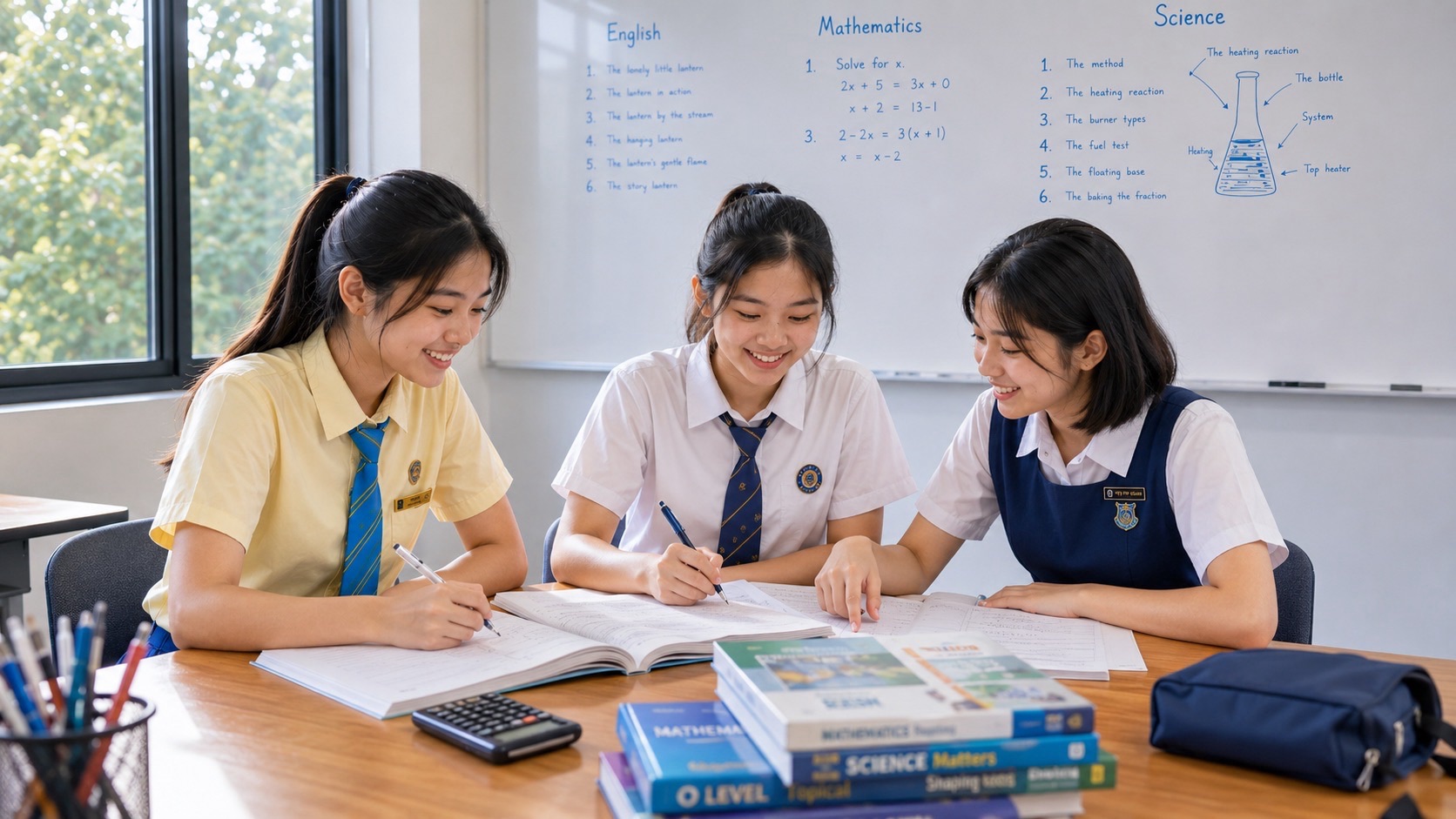
Mathematics education is easy to mistake for a sequence of topics. Addition comes before fractions, fractions before algebra, algebra before functions, and functions before calculus. A child moves from one chapter to the next, one textbook to the next, one examination to the next. Seen from a distance, the subject can look like a staircase made of content.
But a strong mathematics education system is not merely a staircase. It is a capability-building system. Its real work is to help a learner become increasingly able to notice structure, represent relationships, choose methods, reason under unfamiliar conditions, check whether an answer makes sense, learn from mistakes and eventually operate without constant external rescue.
That distinction matters. A student can cover every chapter and still remain dependent. Another student can know fewer procedures but possess a stronger mathematical operating system: she can reconstruct forgotten steps, identify what a problem is asking, test a conjecture and recover after getting stuck. The second student is closer to mathematical independence.
Featured answer: what is a mathematics education system?
A mathematics education system is the organised set of curriculum, teaching, practice, feedback, assessment and learner habits that develops mathematical problem-solving capability over time. It connects concepts and skills to reasoning, communication, modelling, metacognition and attitudes so that students can use mathematics accurately, flexibly and independently.
Singapore’s official Mathematics Curriculum Framework places mathematical problem solving at the centre, supported by five inter-related components: concepts, skills, processes, metacognition and attitudes. That is a useful starting point because it prevents mathematics from being reduced to speed or procedural memory. The curriculum is asking for something broader: understanding, execution, reasoning, self-monitoring and the willingness to persist.
1. The system begins before the child knows it is mathematics
Before a child writes 7 + 5 = 12, she is already encountering mathematical structure. She notices that three bowls remain three bowls even when they are spread farther apart. She compares which queue is longer. She divides snacks between siblings and objects when the shares are unequal. She recognises that bedtime follows dinner and that a lift moves through ordered floors. These are not formal lessons, but they provide raw material for number, order, comparison, conservation, measurement, pattern and fairness.
Formal schooling turns this informal experience into representations. A quantity becomes a numeral. A grouping becomes multiplication. A comparison becomes a bar, equation or ratio. A repeating event becomes a pattern. The child must learn that mathematics is not the printed symbol itself. The symbol is a compressed representation of a relationship.
This is why early number sense matters so much. If a child sees 8 only as a shape written on paper, later arithmetic becomes a collection of rules. If the child understands 8 as a quantity that can be decomposed into 5 + 3, 4 + 4, 10 − 2 or 2 × 4, the same number becomes a flexible object. Flexibility reduces cognitive load because the learner can choose a useful representation instead of forcing one memorised route.
For families, the practical lesson is simple: early mathematics should not become an arms race for advanced worksheets. Counting, estimating, comparing, measuring, explaining and noticing patterns are foundational work. The goal is not to make a seven-year-old look like a ten-year-old. The goal is to build structures that remain useful when the notation becomes harder.
2. Representation is the bridge between the world and the symbol
A strong mathematics learner can move between representations. She can read a sentence and express it as a diagram. She can look at a graph and describe the relationship in words. She can turn a ratio into a bar model, an algebraic expression or a table. She understands that different representations reveal different features of the same structure.
This is one reason Singapore Mathematics is often associated with visual models in the primary years. The deeper principle is not that every problem must use one diagram. It is that representation makes invisible relationships inspectable. A child who cannot yet manipulate algebra may still see that one quantity is three times another, that two parts form a whole, or that a difference remains constant.
Later, the representational language changes. Bars give way to variables, tables, graphs, coordinates, vectors and functions. Yet the intellectual job stays surprisingly similar: decide what matters, encode the relationship, operate on the representation and interpret the result. The student who learned to ask “What does this picture represent?” is preparing for the later question “What does this equation represent?”
When students become stuck, therefore, the first repair should not always be more calculation. Sometimes the failure happened earlier. The learner misunderstood the situation, chose an unhelpful representation or did not recognise the relationship. Repeating the arithmetic can strengthen the wrong layer.
3. Concepts and skills must grow together
There is a familiar false choice in mathematics education: understanding versus practice. In reality, students need both. Conceptual understanding without sufficient fluency can leave the learner unable to execute under load. Mechanical fluency without understanding can produce fast failure whenever a question changes form.
The useful relationship is cyclical. Understanding gives meaning to a procedure. Practice makes the procedure more reliable. Reliable execution frees attention for harder reasoning. Harder reasoning exposes gaps in understanding. The student returns to the concept at a deeper level. Good mathematics education moves through this loop repeatedly.
Consider fractions. A child may understand that one-half is one of two equal parts but still be slow when finding equivalent fractions. Practice matters. Yet if the child memorises cross-multiplication without understanding equivalence, ratio, common units or magnitude, the apparent fluency becomes brittle. Later percentage, rate, algebraic fractions and probability can expose the weakness.
The same applies in secondary mathematics. Algebraic manipulation must become fluent enough that it does not consume all working memory, but fluency is not the final aim. The student must know what transformations preserve equality, why a factorisation is useful, what a root means and when an algebraic answer must be checked against the original conditions.
4. Prerequisites create the hidden architecture
Mathematics is unusually cumulative. New learning often assumes that older knowledge is not merely remembered but usable. Percentage depends on multiplicative thinking. Ratio depends on comparison and scaling. Algebra depends on arithmetic structure. Trigonometry depends on geometry, ratio and algebra. Calculus depends on functions, graphs and manipulation.
This creates a hidden architecture beneath the visible syllabus. Two students can sit in the same lesson on quadratic equations while facing different problems. One is learning quadratics. The other is simultaneously fighting signed numbers, expansion, factorisation and equation balance. To an observer, both students are “doing quadratics”. Cognitively, they are in different rooms.
That is why diagnosis should ask more than “Which chapter is weak?” A more useful question is “What must already work for this chapter to work?” If a Secondary 3 student repeatedly loses marks in Additional Mathematics differentiation because she cannot manipulate algebraic expressions, doing twenty more differentiation questions may not repair the real bottleneck.
This dependency view runs through the existing eduKatePunggol mathematics library. The Additional Mathematics syllabus guide treats topics as dependencies rather than isolated chapters, while the Sec 3–4 Additional Mathematics roadmap follows the build from algebra towards calculus.
5. The primary years are not small secondary mathematics
A primary learner is not simply a smaller version of an older student. The mathematics system must account for the child’s developing language, attention, working memory, ability to generalise and experience with abstraction. A method that is efficient for an adult can be opaque to a nine-year-old because the adult is silently using years of background knowledge.
At Primary 1, mathematics should stabilise quantity, number bonds, place value, addition and subtraction, comparison, simple measurement and the habit of explaining. By Primary 2, the system widens operations and models. Primary 3 becomes an important transition because multiplication, division, fractions, measurement and multi-step thinking begin to interact. Primary 4 increases coordination. Primary 5 raises the conceptual load sharply through fractions, percentage, ratio and more complex problem solving. Primary 6 requires integration and examination control.
The progression is visible in the eduKatePunggol learning journeys: Primary 1 Mathematics in Punggol, Primary 2, Primary 3, Primary 4, Primary 5 and Primary 6 and PSLE Mathematics.
Read together, these years show why “getting ahead” is not the only useful metric. A strong Primary 4 learner is one whose Primary 4 system is becoming dependable: she can interpret, represent, calculate, check and explain at the level required. Acceleration without stability can move visible content forward while leaving the hidden architecture behind.
6. The PSLE is a systems test, not only a topic test
By Primary 6, students know most of the mathematical objects they will use in the examination. The difficult shift is coordination. A question may require the learner to interpret language, select relevant information, choose a representation, combine topics, execute accurately and regulate time. The marks can be lost at any layer.
This is why PSLE preparation should become more diagnostic as the year progresses. Early practice can still build topic competence. Later practice must reveal whether knowledge survives mixing. A student who succeeds when every page is labelled “percentage” may fail when percentage appears inside a ratio or geometry context. The cue supplied by the chapter title has disappeared.
Mixed practice forces the learner to identify the mathematical job before selecting the method. Full papers add timing, sequencing, attention management and recovery. The Primary 6 Mathematics Practice Architecture follows this movement from integration and diagnosis through representation, solving, verification and exam execution.
The key is not to turn every mistake into a crisis. A wrong answer is information. Was the concept absent? Was the method known but not retrieved? Was the representation wrong? Was arithmetic inaccurate? Was the student rushing? Did she fail to verify? The same lost mark can have very different causes, and therefore requires different repairs.
7. Secondary mathematics changes the language of the subject
The transition to secondary school can feel like mathematics has suddenly changed personality. Numbers are still present, but letters become more prominent. Problems increasingly ask students to generalise. Graphs become objects of study rather than merely displays. Geometry becomes more formal. Probability and statistics expand. The student must operate over longer chains of reasoning.
Algebra is the decisive language shift. In primary school, a child might solve a particular unknown. In secondary school, she increasingly reasons about classes of relationships. The symbol x does not merely hide a number; it can vary. An expression can represent a structure before any numerical value is known. This is a profound abstraction.
The four-year progression is explored in Secondary 1 Mathematics in Punggol, Secondary 2 Mathematics, Secondary 3 Mathematics and Secondary 4 Mathematics. The point of a four-year view is to see where each year’s work is heading and what it assumes from the year before.
A student who treats algebra as a bag of tricks may survive routine exercises for a while. But functions, coordinate geometry, trigonometry and Additional Mathematics eventually demand structure. The education system therefore needs to teach not only “how to get x” but what operations mean, why transformations are valid and what the result tells us.
8. Different subject levels should preserve mathematical dignity
Singapore’s secondary system now operates with subject levels rather than assuming one identical route for every learner. The important educational principle is that difference in breadth, pace or abstraction should not become a difference in respect. Every learner deserves coherent mathematics: ideas that connect, skills that become useful and problems that make sense at the appropriate level.
A well-designed system avoids two errors. The first is pushing students into abstraction before prerequisites are ready. The second is assuming that a learner who needs a different route should only receive repetitive low-level work. Both can damage mathematical identity. Stretch should be real, but it should be attached to readiness.
From 2027, Singapore’s Secondary Education Certificate syllabuses include Mathematics at G1, G2 and G3 levels, with Additional Mathematics available at G2 and G3. The formal routes differ, but the deeper educational work remains recognisable: concepts, skills, reasoning, application, communication and increasing independence.
For parents, this means the most useful question is rarely “Which label is best?” It is “What mathematics can my child currently do with understanding, reliability and independence, and what is the next demanding but reachable step?” That question protects both ambition and reality.
9. Additional Mathematics is a compression test
Additional Mathematics often exposes the quality of the earlier system because it compresses many dependencies into fewer lines. Algebraic fluency, functions, geometry, trigonometry and calculus interact. A small weakness can propagate quickly. One sign error can travel through differentiation. One weak factorisation can block an equation. One misunderstanding of a function can distort a graph.
The 2027 G3 Additional Mathematics syllabus describes three content strands—Algebra, Geometry and Trigonometry, and Calculus—and explicitly emphasises reasoning, communication, application and modelling alongside conceptual understanding and skill proficiency. It also assumes knowledge of G3 Mathematics. That assumption matters educationally: Additional Mathematics is not built on empty ground.
The eduKatePunggol learning journey follows this dependency structure through Secondary 3 Additional Mathematics and Secondary 4 Additional Mathematics. The examination-year article is deliberately not a collection of formulas. It treats the year as a movement from learning to consolidation to performance.
For a struggling student, the repair sequence should therefore be surgical. Identify the first weak link. Stabilise it. Reconnect it to the current topic. Retest in a fresh problem. Then return the repaired skill to mixed work. This is slower than blindly finishing a worksheet and faster than spending months practising at the wrong layer.
10. Mathematics at JC reveals whether the learner can operate at scale
Junior College Mathematics increases both abstraction and density. Students are expected to retrieve older material quickly while learning new content. A method may span several pages. Functions, calculus, vectors, probability and statistics require the learner to switch representations and maintain logical control across longer chains.
The transition is captured in JC1 H2 Mathematics in Punggol and JC2 H2 Mathematics in Punggol. JC1 is not simply “Secondary 5”. The volume and pace change. JC2 adds the pressure of integration, school examinations, preliminary examinations and the A-Level endpoint.
At this stage, mathematical independence becomes less optional. A learner cannot depend on a teacher to pre-classify every question. She must be able to inspect unfamiliar work, recognise likely structures, attempt a route, detect contradiction, switch methods and seek help with precision. “I do not know this chapter” needs to become “I can do the setup, but I lose control when the parameter changes” or “I cannot see why this substitution is valid.” Precise diagnosis accelerates repair.
11. Problem solving is the centre because life does not label its chapters
Textbooks organise knowledge so that it can be taught. Reality does not. A household budget does not announce that it is a percentage chapter. A transport decision may involve time, rate, distance, cost and probability. A building project can combine measurement, geometry, estimation, scale and constraints. Data arrives messy. Conditions change.
This is why problem solving sits at the centre of Singapore’s mathematics framework. The learner must use mathematics, not only reproduce it. The official framework recognises problems from everyday life, future work, other areas of study and mathematics itself, including both routine tasks and non-routine problems requiring deeper insight and reasoning.
Problem solving should not be interpreted as endless exposure to “hard questions”. Difficulty without structure can produce noise. Students need a repertoire: understand the problem, identify constraints, represent, search for relationships, choose a strategy, execute, check and reflect. Pólya’s classic four-step cycle remains useful because it turns getting stuck into a process rather than a verdict.
The mature learner does something more: she notices when the strategy is failing. She does not continue ten lines merely because she started. This self-monitoring is where problem solving meets metacognition.
12. Metacognition turns a student into her own supervisor
Metacognition sounds abstract until we translate it into classroom behaviour. Before solving, the student asks what the problem requires. During solving, she checks whether the method still fits. After solving, she asks whether the answer is plausible and what the error means. She becomes capable of supervising her own thinking.
This matters because no teacher can stand beside a student during every future problem. The long-term purpose of feedback is therefore not permanent correction from outside. It is to build an internal correction system. A good teacher initially notices what the student cannot notice. Over time, the student learns to notice it herself.
Useful metacognitive prompts in mathematics include: What do I know? What is unknown? What changed? What stays invariant? What representation would expose the relationship? Which condition have I not used? What would make this answer impossible? Can I solve it another way? Where exactly did my reasoning become uncertain?
These prompts should eventually disappear into habit. The destination is not a child who recites a checklist forever. It is a learner whose mathematical attention has been trained.
13. Attitudes are not decoration around the curriculum
Confidence, interest and perseverance are sometimes treated as motivational extras. In mathematics they affect whether the learner stays in contact with the problem long enough to think. A student who believes every difficult question proves she is “bad at maths” exits the reasoning process early. A student who believes effort means repeating the same failed method may persist without learning.
Healthy mathematical confidence is evidence-based. It is not “I will definitely get every answer right.” It is “I have ways to start, I can detect some errors, and if I get stuck I know how to locate the problem.” This kind of confidence grows from successful repair, not praise alone.
Families can protect this by separating identity from performance. “You are careless” turns an error into a trait. “You copied the denominator incorrectly on line three; what checking routine would catch that next time?” turns it into an observable event with a repair path. The second response preserves responsibility without making the child the mistake.
This becomes especially important during high-stakes years. A fearful student can consume large quantities of tuition and revision without becoming more independent because every task is experienced as threat management. The system should increase capability, not merely pressure.
14. Practice should change as competence changes
Early practice often needs to be narrow. A learner must stabilise a new operation before being asked to distinguish it from five similar operations. But practice should widen. Once a method is reliable, the student needs variation, spacing, retrieval, interleaving and mixed contexts. Otherwise the worksheet itself becomes the cue.
A useful progression is: understand a worked example; attempt a near example; explain why the method works; vary one feature; mix with earlier material; delay and retrieve; solve in an unfamiliar context; complete a timed set; return to errors. Each stage asks a different question about learning.
The eduKatePunggol primary practice architecture makes this progression visible. Primary 2 moves through place value, operations, models, word problems, verification and transfer. Primary 4 coordinates number, fractions, measurement and models. Primary 5 integrates fractions, percentage, ratio and multi-step work. The later the stage, the less useful it is to practise every skill in isolation forever.
Practice is therefore not measured only in pages completed. The better metric is what changed: accuracy, retrieval speed, representation choice, transfer, error detection or independence.
15. Feedback must travel into the next attempt
A correction that produces a neat red answer but no change in future behaviour has low educational value. Effective feedback closes a loop. The student sees the discrepancy, understands its cause, performs a repair and demonstrates the repair on a fresh problem.
This is why an error log should not become a scrapbook of wrong questions. It should compress patterns. “Forgot unit” is useful only if it leads to a unit-check routine. “Careless” is too vague. “Changes sign incorrectly when subtracting a negative expression” is actionable. “Uses radius as diameter when reading a diagram” can be retested.
Good feedback also distinguishes knowledge failure from performance failure. If a student cannot explain the concept tomorrow, the learning may be incomplete. If she knows it but repeatedly misreads under time pressure, the intervention is different. If she can solve only when prompted, the issue may be retrieval or independence.
Mathematical feedback becomes powerful when it teaches the learner what evidence to watch for. Eventually the student can open a marked paper and begin diagnosing before the adult speaks.
16. Assessment should be a sensor, not only a verdict
Assessment has two jobs that are often confused. One is certification: report how well the student performed under specified conditions. The other is diagnosis: reveal what the learner should do next. A school examination can serve both, but only if somebody reads beyond the total mark.
Suppose two students score 62. One loses marks through weak geometry and probability concepts. The other understands the topics but leaves twelve marks unfinished because she is slow. Their next month should not look identical. The aggregate score hides the mechanism.
A useful assessment review examines topic, question demand, representation, method selection, execution, communication, timing and checking. It looks for repeated failure modes. It also notices strengths because strong areas can be used as anchors for transfer.
This diagnostic view becomes the focus of the companion article How Mathematics Assessment Works, which follows assessment from classroom evidence through school tests, PSLE, SEC and A-Level Mathematics.
17. Tuition should connect back to the learner’s real system
Tuition can help when it adds visibility, explanation, guided practice, diagnosis or accountability that the learner currently needs. It becomes less useful when it creates a parallel curriculum that the student can perform only inside the tuition room.
The test is transfer. After the lesson, does the student read her school question differently? Can she choose the method without the tutor’s cue? Does the correction survive into a new paper? Can she explain the idea? Is she becoming less dependent on rescue?
Small-group teaching can be valuable because the tutor can observe individual working while still allowing students to hear alternative explanations. But group size itself is not the mechanism. The important question is whether the teaching system can see enough of the learner to identify the first weak link and respond before errors accumulate.
For parents in Punggol, the local learning journey matters too. School, travel, homework, rest, CCA, tuition and family time share one finite week. A mathematically excellent plan that cannot survive the child’s actual schedule is not an excellent system. Education must fit into life.
18. The home is part of the mathematics environment
Parents do not need to become replacement mathematics teachers. In many homes, the highest-value contribution is environmental: protect sleep, provide a workable routine, notice recurring difficulties, ask the child to explain, help organise materials and communicate clearly when support is needed.
Conversation can make mathematics visible without turning dinner into a lesson. Which supermarket offer is actually cheaper? How long will the train journey take if the transfer adds seven minutes? Why does a recipe scale differently for six people? How much floor area does a room have? What does a 30% chance of rain mean—and what does it not mean?
The point is not to force “real-world maths” into every moment. It is to preserve the connection between mathematics and reality. Students who experience mathematics only as school marks can miss why representation, estimation and modelling are powerful human tools.
A home can also normalise uncertainty. Adults routinely estimate, check, revise and use calculators. Saying “I don’t know; let’s work out what information we need” models mathematical behaviour more honestly than pretending competence means instant answers.
19. Punggol itself can become a mathematics classroom
A local education system becomes richer when the surrounding town is treated as usable context. Punggol contains transport networks, waterways, housing geometry, energy systems, construction, walking routes, population change, commercial spaces and an emerging digital district. Each can be read mathematically.
The Punggol as a Classroom article deliberately crosses history, geography, science, mathematics and urban design. A child can estimate walking time along the waterway, compare route efficiency, reason about scale on maps, interpret data, study symmetry in built forms or ask how sensors turn physical events into numerical information.
This does not replace the syllabus. It gives the syllabus somewhere to land. The learner discovers that a graph is not a school object; it is one way a city can describe change. A ratio is not a chapter title; it is a relationship. A function is not only algebraic notation; it is a way to express how one variable depends on another.
As Punggol’s school–SIT–industry corridor develops, students will increasingly live beside systems that depend on data, optimisation, computation and modelling. The useful response is not to teach children every future tool early. It is to give them durable mathematical foundations that let them learn new tools later.
20. Technology changes the tools but not the need for judgement
Calculators, graphing software, spreadsheets, dynamic geometry, computer algebra and AI can all extend mathematical work. They can produce results faster, visualise relationships, generate examples and remove repetitive computation. The educational question is not whether students should use tools. It is what thinking should remain visible when the tool is present.
A calculator can compute 19.8 × 4.7, but the learner should still recognise whether an answer of 9306 is absurd. Software can plot a curve, but the student should understand what the axes and scale mean. AI can propose a solution, but the learner needs enough mathematics to inspect assumptions, detect invalid steps and decide whether the result answers the question.
Technology therefore raises the value of estimation, reasoning and verification. When execution becomes cheap, judgement becomes more important. The future mathematics student may perform fewer hand calculations in adult life, but she will still need to decide what should be calculated, what model is appropriate and whether the output deserves trust.
A strong education system should make students tool-capable without making them tool-dependent.
21. Mathematical communication is part of mathematical competence
Working is not clerical decoration. It externalises reasoning. A well-written solution lets another person inspect assumptions, transformations and conclusions. It also lets the student inspect her own thinking.
This is especially important as mathematics becomes more abstract. Correct notation reduces ambiguity. Diagrams should carry enough information to support the argument. Units should survive into conclusions. Graphs require labels and scale. Explanations should distinguish observation from deduction.
The Additional Mathematics Mathematical Communication guide treats notation, working, reasoning, interpretation and verification as connected. This is a useful model for all levels: the mathematics is not complete simply because a number appears at the end.
Communication also improves learning because explanation forces compression. When a student can state why a method works in her own words, she is more likely to have a structure she can reconstruct later. Teaching someone else can reveal where an apparently familiar procedure is still opaque.
22. Verification is the habit that turns answers into claims
Mathematics is not only the production of answers. It is the production of justified answers. Verification is the point where the learner asks whether the output survives contact with the conditions of the problem.
At Primary 2, verification may mean estimating whether a subtraction answer is sensible. At Primary 6, it may mean reversing a calculation or checking the model against the story. In algebra, it can mean substitution. In geometry, it can mean angle sums or alternative properties. In calculus, it can mean differentiating an antiderivative. In modelling, it includes asking whether the assumptions fit reality.
The learner should collect verification methods just as she collects solving methods. This reduces the false belief that checking means redoing exactly the same arithmetic and hoping for a different outcome.
Verification is also an ethical habit of mind. It teaches the student that confidence should be proportional to evidence. In a world full of automated outputs, that habit travels far beyond mathematics.
23. Mathematical independence is not “doing everything alone”
Independence is sometimes misunderstood as the absence of help. Experts ask for help, consult references, use software and collaborate. Mathematical independence means something subtler: the learner can participate intelligently in her own learning.
An independent learner can start a problem without waiting for a cue. She can identify what she knows and where uncertainty begins. She can use a worked example as a reference without copying its surface. She can ask a precise question. She can test whether a correction has been learned. She can decide that a method is too cumbersome and search for another. She can manage a revision plan using evidence rather than panic.
This is the destination of the whole system. Number sense matters because it gives flexible objects to think with. Representation matters because it lets the learner see relationships. Fluency matters because it frees attention. Reasoning matters because new problems differ. Metacognition matters because the teacher eventually leaves the room. Assessment matters because the learner needs feedback about reality.
The paradox is that excellent teaching aims to make itself less necessary. The tutor who always tells the student what to do next can produce short-term smoothness and long-term dependence. The stronger teacher transfers control.
24. A practical mathematics education loop for families
For parents and students, the entire system can be compressed into a recurring loop:
- Read: understand what the current curriculum and assessment actually require.
- Diagnose: use schoolwork, marked papers and fresh questions to identify the first weak link.
- Prioritise: repair what blocks the greatest amount of future learning.
- Learn: connect explanation, representation and worked examples.
- Practise: move from narrow accuracy to mixed retrieval and transfer.
- Verify: build checking into the solution rather than treating it as an optional last minute.
- Perform: practise under realistic timing and examination conditions when appropriate.
- Review: ask what changed and what still fails.
- Return: reconnect repaired skills to normal school mathematics and independent work.
The loop is deliberately recursive. Learning rarely proceeds in a straight line. Old weaknesses reappear under new load. Strong skills become weak when neglected. A topic understood slowly must later become retrievable quickly. The system needs maintenance.
25. What parents should watch instead of only marks
Marks matter because examinations have consequences, but marks are lagging indicators. A family that watches only the total score receives information late. Earlier signals can reveal whether the system is improving.
- Does the child begin work with less prompting?
- Can she explain why a method applies?
- Are recurring errors becoming less frequent?
- Can she retrieve older material after a delay?
- Can she solve when the chapter label is removed?
- Does she check answers using more than one method?
- Can she identify precisely where she is stuck?
- Does she recover after a difficult question instead of abandoning the paper?
- Can she transfer a correction from tuition or school into a fresh problem?
These are signs of a learner gaining control. They often improve before a large examination jump appears, and they are more durable than one unusually good test.
26. What a world-class mathematics education system protects
A strong mathematics system protects several things at once. It protects foundational knowledge from being skipped. It protects understanding from being replaced by tricks. It protects fluency from being dismissed as mere drilling. It protects curiosity from being crushed by constant performance pressure. It protects standards by insisting that answers be justified. It protects the learner’s future by making transfer and independence explicit goals.
It also respects time. Not every weakness deserves equal attention. Not every difficult question is valuable. Not every worksheet should be finished. The system asks which intervention creates the greatest useful change for the learner now and later.
That is the systems view of mathematics education: topics are necessary, but they are components. Examinations are important, but they are sensors and gateways. Teachers are essential, but they are not the final control system. The final control system is the learner herself, equipped with enough mathematical knowledge, judgement and self-monitoring to continue learning after the lesson ends.
Continue the Mathematics Education Systems series
- How Mathematics Curriculum Works | Knowledge → Prerequisites → Progression → Transfer
- How Mathematics Teaching Works | Explanation → Representation → Practice → Feedback → Mastery
- How Mathematics Assessment Works | Diagnosis → School Tests → PSLE → SEC → A-Level Mathematics
Official references
- Ministry of Education Singapore: Primary Mathematics Syllabus
- Ministry of Education Singapore: G2 and G3 Mathematics Syllabuses
- SEAB: 2027 SEC G1 syllabuses
- SEAB: 2027 SEC G2 syllabuses
- SEAB: 2027 SEC G3 syllabuses
eduKatePunggol: Family Life Education Local Expert. Mathematics is taught for the examination in front of the learner, but built for the life beyond it.


