
Quick Read: Additional Mathematics is a dependency chain. Algebra supports functions; functions support graph reasoning; algebra and geometry support trigonometry; all of them feed into differentiation and integration; calculus then supports applications such as kinematics. Students struggle most when a later topic exposes an earlier weak link.
One-sentence answer: Sec 3–4 Additional Mathematics becomes manageable when students learn it as a connected system—algebra → functions → geometry/trigonometry → calculus → application—rather than as isolated chapters.
What this 2015 page originally did
The original page was a live Punggol Additional Mathematics tuition timetable. It listed a four-package Sec 3–4 course, an old GCE O-Level syllabus code, six-student classes, lesson-hour estimates and a former direct phone contact.
Its strongest learning value was not the timetable. It was the sequence: the page understood that A-Math should build from algebraic foundations toward trigonometry and calculus.
This update preserves that learning architecture while retiring obsolete schedule, class-size, tutor-contact and syllabus claims.
Current examination context
For school candidates in 2026, SEAB lists GCE O-Level Additional Mathematics as Syllabus 4049. From the 2027 graduating cohort, the Singapore-Cambridge Secondary Education Certificate (SEC) replaces the separate N- and O-Level certificates. SEAB’s 2027 G3 list includes Additional Mathematics as subject code K341, mapped to legacy syllabus number 4049.
The original 2015 page referred to syllabus 4047. That is now historical.
A-Math assumes ordinary Mathematics
The current 4049 syllabus explicitly assumes knowledge from O-Level Mathematics. That matters because A-Math does not reteach every prerequisite directly.
A student may appear to have a “calculus problem” when the actual weakness is:
- factorisation;
- indices;
- algebraic fractions;
- equation solving;
- graph interpretation;
- trigonometric manipulation.
This is why diagnosis should move backward through dependencies rather than repeatedly drilling the newest chapter.
Stage 1: algebraic control
The original Sec 3 sequence began appropriately with algebra-heavy material. A modern learning roadmap still benefits from securing:
- quadratic functions;
- equations and inequalities;
- polynomials;
- indices and surds;
- exponential and logarithmic functions;
- binomial expansion.
These are not merely first-semester topics. They recur throughout the entire course.
Quadratics: the first major structure
Quadratics connect several representations at once:
- expanded form;
- factorised form;
- completed-square form;
- roots;
- turning point;
- graph shape;
- inequalities.
A strong student can move between these forms because each reveals something different about the same function.
Polynomials: factor structure matters
Remainder and factor reasoning develops the idea that algebraic expressions contain structure that can be detected and exploited.
Students should understand why a factor corresponds to a root rather than only memorise a theorem statement.
Indices, surds and logarithms
These topics extend number and algebra rules into new representations.
- indices compress repeated multiplication;
- surds preserve exact irrational values;
- logarithms invert exponentiation.
They later reappear inside differentiation, integration, equations and modelling.
Stage 2: functions and graphs
A-Math becomes much easier when students stop seeing graphs as pictures drawn after algebra. A graph is another representation of the same function.
Students should connect:
- equation ↔ graph;
- root ↔ x-intercept;
- parameter ↔ shape change;
- derivative ↔ gradient;
- stationary point ↔ zero derivative.
For a fuller graph-reading framework, see How to Read a Mathematical Graph.
Coordinate geometry
Coordinate geometry joins algebra to space. Gradient, midpoint, distance and line equations let geometric relationships be manipulated symbolically.
Students should not treat the formulas as isolated. Ask what each quantity means geometrically.
Stage 3: trigonometry
Additional Mathematics extends trigonometry beyond solving triangles.
- trigonometric functions;
- identities;
- equations;
- graphs;
- angle relationships;
- applications in calculus.
The crucial move is recognising that sine, cosine and tangent are functions with structure, not merely SOH-CAH-TOA ratios.
Why identities feel difficult
Identity questions often require students to transform one expression into another without knowing the exact route in advance.
This demands:
- factorisation;
- common denominators;
- recognition of standard identities;
- strategic choice of which side to simplify;
- patience with intermediate forms.
Weak algebra becomes visible immediately.
Stage 4: differentiation
Differentiation studies rate of change and local gradient. It is not simply a collection of rules for lowering powers.
Students should connect differentiation to:
- graph gradient;
- increasing and decreasing behaviour;
- stationary points;
- maxima and minima;
- rates of change;
- kinematics.
The symbolic rule gains meaning when the graph and application remain attached.
Stage 5: integration
Integration reverses differentiation in many school contexts and also accumulates quantities over intervals.
Students need to understand:
- antiderivatives;
- constants of integration;
- definite integrals;
- areas under and between curves;
- applications to motion where appropriate.
A common error is performing integration correctly but interpreting the result incorrectly.
Stage 6: kinematics
Kinematics is a transfer test for calculus.
Students connect:
- displacement;
- velocity;
- acceleration;
- differentiation;
- integration;
- sign and direction;
- initial conditions.
The mathematics is no longer presented only as an abstract function; it describes changing motion.
The original four-package roadmap, translated into learning stages
| 2015 package idea | Durable learning job |
|---|---|
| Sec 3 Semester 1 | Secure algebra: equations, polynomials, quadratics, indices/surds/logarithms, binomial expansion |
| Sec 3 Semester 2 | Connect algebra to coordinate geometry and trigonometry |
| Sec 4 Semester 1 | Build differentiation and integration on top of functions and algebra |
| Sec 4 Semester 2 | Transfer calculus into kinematics and integrate the full syllabus under examination conditions |
The old hour counts and calendar promises are not preserved as current requirements because school sequencing and learner needs vary.
Why topic order can vary
Schools and programmes can sequence topics differently while respecting the same dependencies. For example, some graph or coordinate material may appear earlier, while particular calculus applications may be grouped differently.
A roadmap is therefore a dependency map, not a universal weekly timetable.
The earliest weak link principle
If a student cannot differentiate a rational expression, ask whether the problem is really differentiation.
- Can the expression be simplified?
- Are index laws secure?
- Can the student factorise?
- Can the student manipulate fractions?
Repairing the earliest unstable dependency often improves several later topics at once.
Accuracy before speed
A-Math contains many steps where small algebraic errors propagate.
Students should first make a method reliable, then retrieve it, then mix it with other methods, and only then compress the time needed under exam conditions.
Speed built on unstable algebra produces fast mistakes.
Error classes worth tracking
- sign error;
- factorisation error;
- incorrect domain restriction;
- wrong identity;
- method-selection error;
- derivative/integral rule error;
- constant-of-integration omission;
- graph interpretation error;
- incorrect physical interpretation in kinematics.
“Careless” is too broad to repair.
When A-Math becomes a transfer subject
Early questions may reveal their method clearly. Stronger examination questions increasingly require the learner to choose among several tools.
That is the point where mastery changes from:
“I know how to perform this method”
to:
“I can recognise when this method is the right one.”
How to revise A-Math across Sec 3–4
- Map every major topic to its prerequisites.
- Repair recurring algebra errors first.
- Retrieve old topics every week.
- Mix questions so the method is not announced.
- Practise graph ↔ algebra translation.
- Use full papers only after major topic gaps are under control.
- Analyse mistakes by mechanism, not just marks lost.
- Repeat difficult questions after a delay.
Current eduKatePunggol A-Math service
The old article stated a six-student cap and a former tutor contact. Those details are obsolete.
Current eduKatePunggol public information describes Secondary 3–4 Additional Mathematics tuition in groups of up to three students, with 1.5-hour lessons, learning materials provided and between-lesson WhatsApp support.
The working frame is Catch up · Keep up · Move ahead.
For current class information, use Start Here at eduKatePunggol.
Why this page no longer owns generic “Punggol A-Math tuition”
eduKatePunggol later published multiple Additional Mathematics tuition and syllabus pages. Rather than competing with all of them, this 2015 URL now owns the Sec 3→4 learning roadmap and dependency structure.
Official current sources
- SEAB — 2026 GCE O-Level syllabuses
- SEAB — 2026 Additional Mathematics syllabus 4049
- SEAB — 2027 SEC G3 syllabuses
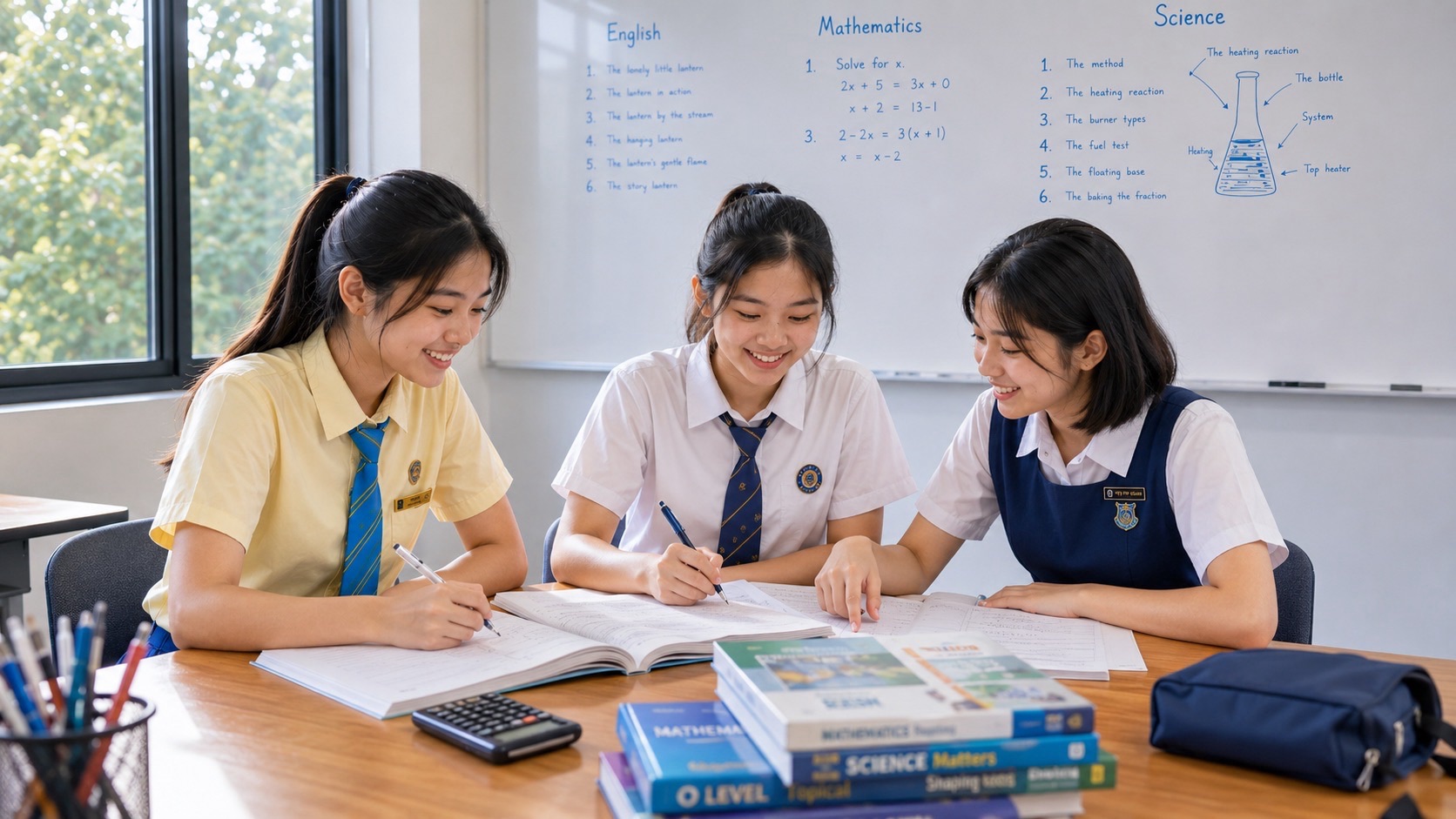
Historical photograph

Updated from eduKatePunggol’s October 2015 “Punggol Additional A Mathematics Tuition”. The original four-stage coursework logic is preserved, while obsolete syllabus 4047, six-student class, timetable and direct-contact claims have been replaced by a current Sec 3–4 learning roadmap.


