
Good mathematics teaching is often invisible after it has worked. The student eventually looks at a problem, decides what matters, chooses a representation, carries out a method, checks the result and moves on. The adult intervention that once made those actions possible has disappeared into the learner.
That is the paradox of teaching. A lesson succeeds partly by making future lessons less necessary. Explanation is important, but the learner cannot depend forever on somebody explaining. Worked examples are useful, but the student must eventually begin without one. Feedback matters, but the teacher’s corrections should gradually become the learner’s own checking routines.
Mathematics teaching therefore cannot be reduced to “show the method, give practice, mark the answers”. Strong teaching manages a progression of control. At first the teacher carries more of the cognitive load. Then responsibility moves: from explanation to guided construction, from guided construction to practice, from practice to mixed selection, from external feedback to self-monitoring, and from assisted success to independent performance.
Featured answer: how does mathematics teaching work?
Mathematics teaching works by making mathematical structure visible, connecting new ideas to prerequisites, selecting useful representations, modelling reasoning, giving students appropriately sequenced practice, using feedback to diagnose errors, and gradually removing support until learners can solve, explain and verify independently. The purpose is not only correct answers during the lesson but durable transfer after the lesson.
Singapore’s Mathematics Curriculum Framework places mathematical problem solving at the centre, supported by concepts, skills, processes, metacognition and attitudes. Teaching must therefore serve all five supporting components. Students need mathematical knowledge and fluency, but also reasoning, communication, application, self-regulation, confidence and perseverance.
1. Teaching starts by deciding what the student should notice
A mathematics lesson contains more information than a novice can attend to. A worked solution may have numbers, symbols, diagrams, arrows, annotations, formulas and several lines of transformation. The expert teacher sees structure. The beginner may see surface.
The first job of teaching is therefore attentional. What should the learner notice? In a fraction lesson it may be the size of the whole. In algebra it may be equality. In geometry it may be the condition that makes two lines parallel. In differentiation it may be the nested structure of a function rather than the visual complexity of the expression.
Good explanations guide attention toward features that determine the mathematics. Poor explanations can accidentally direct attention toward incidental details. If students learn “when the question looks like this, do that”, they become dependent on visual resemblance.
Teaching becomes stronger when the teacher repeatedly distinguishes signal from noise: this feature matters because it changes the relationship; this one does not. Over time, students learn to perform that filtering themselves.
2. Explanation should reveal a mechanism, not merely narrate steps
A student can copy every step of a solution and still not understand why the solution works. This happens when explanation follows the visible sequence without exposing the mathematical reason for the sequence.
“Move the 5 over and change the sign” may produce an answer. “Subtract 5 from both sides so equality is preserved” reveals the mechanism. “Cross multiply” may work in a proportion. Understanding equivalent ratios and multiplying both sides by denominators reveals why. The second form is more reconstructable because the rule is attached to a principle.
This does not mean every lesson should become a philosophical lecture. Efficient language matters. Once understanding is secure, shorthand is useful. But shorthand should compress an idea the learner already owns rather than substitute for the idea.
A strong teacher therefore asks: if the student forgets my exact wording next month, is there enough structure left for her to rebuild the method?
3. Prerequisites determine whether an explanation can land
An explanation can be perfectly clear and still fail because the learner is missing something it assumes. A Primary 5 percentage explanation may depend on fractions. A Secondary 1 algebra lesson may depend on signed numbers. A trigonometry lesson may depend on ratio and similarity. A calculus lesson may depend on functions and algebraic manipulation.
This creates one of the most important distinctions in teaching: current-topic failure versus prerequisite failure. If the teacher misclassifies the problem, she may explain the current topic repeatedly while the real blockage remains underneath.
The practical response is to search for the first weak link. Ask the smallest diagnostic question that distinguishes between possible causes. If the student cannot simplify the algebra inside a differentiation question, test the algebra directly. If she can, return to the calculus. Repair should occur at the layer where the error originates.
This dependency principle is developed across the Mathematics Curriculum article and the Additional Mathematics syllabus guide.
4. Representation is often the real explanation
Sometimes words are not the best way to explain mathematics. A number line can show magnitude and direction more clearly than a paragraph. A bar model can reveal a part-whole relationship. An area model can make multiplication or algebraic expansion visible. A graph can show change that is hard to feel from a table.
Representations are teaching tools because they expose structure. They also create bridges between levels of abstraction. A child can see a proportional relationship before being fluent with symbolic ratio. A secondary student can inspect a quadratic graph before fully mastering its algebraic form.
The teacher’s job is not to make one representation compulsory forever. It is to help students connect them. What does this diagram say in words? What equation matches it? What would its graph look like? Which representation would be most efficient here?
Mastery includes the freedom to change representation when the current one hides the relationship.
5. Worked examples are powerful when students learn the decisions inside them
Worked examples reduce cognitive load by letting students study a completed route without having to invent every step at once. They are especially valuable when a method is new or complex.
But students can use examples badly. They may copy surface features, memorise line shapes or search for a problem that looks similar. Then the example becomes a crutch rather than a model of reasoning.
Teaching should therefore expose decision points. Why was this variable introduced? Why was factorisation chosen instead of the quadratic formula? Why was this theorem applicable? What clue suggested substitution? What would change if one condition changed?
The strongest use of worked examples often includes fading. First the solution is complete. Then a step is missing. Then more is removed. Eventually only the problem remains. Support disappears as capability grows.
6. Questioning should make student thinking visible
A teacher cannot diagnose invisible thinking. Correct answers sometimes conceal fragile methods, lucky guesses or copied procedures. Wrong answers sometimes emerge from nearly correct reasoning.
Useful questions therefore reveal process: What did you think the question was asking? Why did you choose this method? What does this number represent? Which line are you least sure about? What would you expect the answer to be roughly? Can you show the same relationship another way?
These questions are not interrogation. They are sensors. A brief answer can tell the teacher whether to explain, demonstrate, prompt, ask for retrieval, or stop talking and let the student continue.
Good questioning also changes student culture. Instead of mathematics being a performance in which only the final answer matters, reasoning becomes discussable. Errors become inspectable objects.
7. Silence can be part of good teaching
Teachers who care deeply about students are often tempted to rescue too quickly. The student hesitates; the teacher supplies the next step. The page moves smoothly. Everybody feels productive. Yet the learner never practises generating the step herself.
Productive struggle requires calibrated silence. The teacher waits long enough for thinking to occur but not so long that the learner remains trapped without useful information. This timing is difficult because it depends on the student, the task and the purpose of the lesson.
A useful progression is: wait; ask what the student knows; point to a relevant condition; remind her of a related idea; provide a partial representation; model only the missing move. Each level preserves as much student control as possible.
The goal is not to make students suffer for authenticity. It is to ensure the learner—not the teacher—performs the thinking that the lesson is supposed to build.
8. Practice should begin narrow and become less predictable
When a student first learns a method, practice should make success possible. Problems can be closely related so attention stays on the target operation. Early errors can be corrected before they harden.
But predictable practice has an expiry date. If every question on the page uses the same method, the heading is choosing for the student. She is practising execution, not selection.
Teaching should therefore widen the field: vary numbers, orientation, wording and representation; mix the new method with older ones; delay retrieval; use unfamiliar contexts; ask for explanation; remove cues. Each change tests a different dimension of learning.
The primary practice architectures on eduKatePunggol show this movement. Primary 2 Mathematics Practice Architecture moves from place value and operations through models and word problems to verification and transfer. Primary 6 Mathematics Practice Architecture adds integration, diagnosis and exam execution.
9. Fluency frees attention for reasoning
Good teaching does not apologise for practice. Some mathematical operations need to become fast and reliable because working memory is limited. A student who expends enormous attention on multiplication facts, fraction equivalence or basic algebraic manipulation has less capacity left for planning a multi-step solution.
Fluency, however, should be purposeful. Repetition is useful when it strengthens a high-frequency skill that later reasoning needs. It becomes wasteful when the student is already fluent or when the real problem is conceptual.
A teacher should therefore know what she is automating and why. Is the target accuracy, speed, retrieval, notation, or coordination? How will we know when enough practice has occurred?
Fluency is not the opposite of thinking. It is often what makes higher-order thinking possible.
10. Error correction should identify the first wrong decision
When a long mathematics solution is wrong, students often inspect the last line because that is where the incorrect answer appears. The useful error may be much earlier.
Teaching should trace backwards to the first point where the solution stopped being valid. Was the problem misread? Was the representation wrong? Was a formula inappropriate? Did algebra change the expression illegally? Did arithmetic introduce an error? Did a correct answer become invalid because a domain restriction was ignored?
This first-error method prevents overcorrection. If line two is wrong, lines three to eight may simply be consequences. The student needs to repair line two and reconstruct the path.
It also changes the meaning of “careless”. Instead of treating carelessness as a personality, teaching identifies repeatable behaviours: copying a sign incorrectly, skipping units, failing to label a diagram, not checking the denominator. Specific behaviour can be trained.
11. Feedback should alter the next attempt
Feedback is not complete when the student has read the correction. It is complete when the correction changes future performance.
A useful feedback loop has four parts: identify the discrepancy; explain or reconstruct the correct reasoning; practise the repaired component; demonstrate the change on a fresh problem. Without the final step, neither teacher nor learner knows whether the feedback transferred.
Comments should therefore be actionable. “Be careful” gives no procedure. “Before finalising, substitute the root into the original equation because squaring may introduce an extraneous solution” gives a check. “Revise algebra” is broad. “You lose the negative sign when expanding −(2x − 3); practise this structure and retest tomorrow” identifies a trainable pattern.
The best feedback eventually teaches students how to generate feedback for themselves.
12. Retrieval tells the teacher whether learning survived the lesson
Immediate success is seductive. A student watches an example, solves a similar question and appears to understand. But the method may still be in short-term working memory.
Teaching needs delayed checks. Can the learner retrieve the idea tomorrow without the example open? Can she use it next week when mixed with other topics? Can she recognise the structure in a different context?
Retrieval practice is valuable because it changes both learning and diagnosis. The effort of recalling strengthens access, while failures reveal what has not yet consolidated.
This means a teacher should not judge a lesson only by how smoothly students performed during the lesson. The more meaningful question is what remains after the support and immediacy have faded.
13. Spacing prevents teaching from being trapped by the timetable
School schedules move forward because they must. Memory fades because it does. Teaching has to reconcile the two.
Important ideas should return after delay. A Secondary 2 class still needs Secondary 1 algebra. A Primary 6 learner still needs Primary 5 ratio and percentage. An Additional Mathematics student still needs ordinary algebra. If teaching never returns, the curriculum accumulates faster than the learner can retain.
Spacing can be modest: a few retrieval questions at the beginning of a lesson, mixed homework, cumulative quizzes or periodic review. The important feature is that older knowledge remains alive.
The PSLE Mathematics Revision Timetable uses spacing and mixed practice as part of a larger evidence-based revision cycle.
14. Interleaving changes the teacher’s question from “Can you do it?” to “Can you choose it?”
Blocked practice answers one question: can the student execute this method when the method is obvious? Interleaved practice answers another: can the student decide which method applies?
This is a major teaching transition. Students often appear strong in chapters and weak in examinations because the chapter heading was doing hidden cognitive work. Once methods are mixed, the learner must classify the problem.
Teachers should make this difficulty explicit. A temporary drop in accuracy is not necessarily evidence that interleaving “does not work”. It may reveal that method selection was never learned.
Teaching can support the transition by asking students to name the clue before solving: what feature makes you think similarity applies? Why differentiation rather than integration? Which quantity is the percentage base? The aim is to connect recognition to action.
15. Variation teaches students the boundary of a concept
If examples are too similar, students can succeed by imitation. If they are wildly different, beginners may not see the common idea. Carefully varied examples let the teacher control what changes.
Rotate a geometry diagram while preserving the properties. Change the numbers while preserving the algebraic form. Alter the context but keep the proportional relationship. Present one example that almost fits a method but violates a necessary condition.
That last type is especially powerful. Non-examples define boundaries. Students learn not only when a theorem works but when it does not. This reduces overgeneralisation.
Good variation teaches the learner to see mathematics underneath appearance.
16. Mathematical communication should be taught as reasoning made visible
Students sometimes experience working as something written for the marker. In fact, written mathematics serves the thinker too. A clear solution reduces the load of holding every step mentally and makes errors easier to inspect.
Teaching should therefore explain why notation, labels and logical sequence matter. Equality signs should connect equal quantities, not separate unrelated stages. Units should accompany quantities. Diagrams should record given information. Variables should be defined. Conclusions should answer the stated question.
The Additional Mathematics Mathematical Communication guide treats notation, working, reasoning, interpretation and verification as one chain.
When teaching communication well, we are teaching students to make thinking inspectable enough that another person—and their future self—can follow it.
17. Verification should be modelled, not merely requested
“Check your work” is common advice and often ineffective because students do not know what checking means. They reread the same steps and see what they expected to see.
Teachers should model verification methods. Estimate magnitude. Substitute a solution. Reverse an operation. Use a second representation. Inspect boundary conditions. Check units. Compare with a graph. Ask whether the answer is possible in context.
Different topics have different verification opportunities. Teaching should build a repertoire so students can choose a check suited to the problem.
This matters even more when technology is used. A calculator or AI-generated solution can be fast and wrong. Mathematical judgement depends on independent ways of testing outputs.
18. Primary mathematics teaching should protect meaning while building fluency
Primary students need many opportunities to work with quantities, operations, models and language. The teaching challenge is to build fluency without disconnecting procedures from meaning.
At Primary 1 and 2, teachers can use objects, pictures, number bonds and number lines to support number sense. By Primary 3 and 4, multiplication, division, fractions and measurement demand more coordination. Primary 5 introduces a heavy network of fractions, percentage and ratio. Primary 6 requires integration and examination control.
The local progression is mapped through Primary 1 Mathematics in Punggol, Primary 2, Primary 3, Primary 4, Primary 5 and Primary 6 and PSLE Mathematics.
Teaching should change as the learner changes. What begins as concrete support should not become permanent scaffolding. The child must gradually own the representation and the decision.
19. PSLE teaching should shift from topic acquisition to system integration
Early in Primary 6, teaching may still focus heavily on learning and stabilising content. As the examination approaches, the nature of teaching should change. Students need mixed practice, retrieval, timing, paper navigation, error analysis and recovery.
This does not mean abandoning concepts for exam tricks. It means teaching students to deploy concepts under realistic conditions. The PSLE is a coordination problem: reading, representation, topic selection, execution, checking and time all interact.
A marked paper becomes a powerful teaching object. Instead of simply correcting questions in order, identify patterns. Which errors repeat? Which are expensive? Which prerequisite affects several topics? Which mistakes disappear when time pressure is removed?
The aim is to make the final months narrower and more evidence-driven, not broader and more frantic.
20. Secondary Mathematics teaching must make abstraction readable
Secondary mathematics introduces a more compressed symbolic language. Students who were comfortable with numerical arithmetic may struggle when letters represent variables, relationships and general cases.
Teaching should slow down around the meaning of notation. What does an expression represent? How is an equation different? Why does a graph represent infinitely many coordinate pairs? What does a function rule say about dependence?
The four-year eduKatePunggol sequence follows this progression through Secondary 1, Secondary 2, Secondary 3 and Secondary 4 Mathematics.
The teacher’s task is to help students discover that abstraction is not mathematics becoming less meaningful. It is mathematics becoming able to express more with less.
21. G1, G2 and G3 teaching should differ in demand, not in respect
Students may study Mathematics at different subject levels, and the 2027 Secondary Education Certificate includes G1, G2 and G3 Mathematics syllabuses. Teaching must respond to differences in pace, breadth and abstraction while preserving mathematical coherence.
A harmful form of differentiation gives one group rich reasoning and another only repetitive procedure. Every student should encounter meaningful relationships, applications and opportunities to explain. The complexity and scaffolding can differ.
Teaching also needs realistic stretch. A learner should be challenged enough to grow but not asked to carry so many missing prerequisites that every lesson becomes failure management.
The question is not which label makes a student look strongest. It is which learning conditions allow the student to build the strongest mathematics she can currently sustain and extend.
22. Additional Mathematics teaching should separate new concepts from old algebra problems
Additional Mathematics places high demands on algebraic fluency. The 2027 G3 syllabus assumes G3 Mathematics and organises content across Algebra, Geometry and Trigonometry, and Calculus. When students struggle, teachers need to know whether the new idea is difficult or the old tool is failing.
Take differentiation. A student may understand the chain rule conceptually but make repeated algebraic errors in expansion or simplification. Another may be algebraically strong but fail to recognise composite functions. Their worksheets can look equally wrong while requiring different teaching.
The Secondary 3 Additional Mathematics journey and Secondary 4 Additional Mathematics examination-year guide treat this as a progression from dependency repair to independent performance.
Teaching becomes efficient when it isolates the layer briefly, repairs it, then reconnects it to the full problem.
23. JC Mathematics teaching should train compression and recovery
At JC, students face dense mathematical notation, faster pacing and long multi-stage problems. Teachers cannot explain every possible question type. The system must train students to operate with general structures.
Worked examples still matter, but they should emphasise choices. Why this substitution? Why this theorem? What makes this parameter important? What alternative representation is available? Students need to see how experts navigate uncertainty, not only polished final solutions.
Recovery becomes an explicit skill. When a route fails, what can the student salvage? Can she return to definitions? Can she inspect units or graphs? Can she simplify a special case? Can she articulate the exact gap and seek targeted help?
The progression through JC1 H2 Mathematics and JC2 H2 Mathematics is therefore as much about becoming an independent mathematical operator as covering content.
24. Small-group teaching is valuable when it increases visibility
Small-group tuition can create useful conditions for mathematics teaching: the teacher can see individual working, ask follow-up questions, compare strategies and respond quickly to misconceptions. Students can also hear peers explain ideas differently.
But a small group is not automatically good teaching. The advantage exists only if the teacher uses the visibility. If all students simply copy the same board solution, the group may be physically small and pedagogically large.
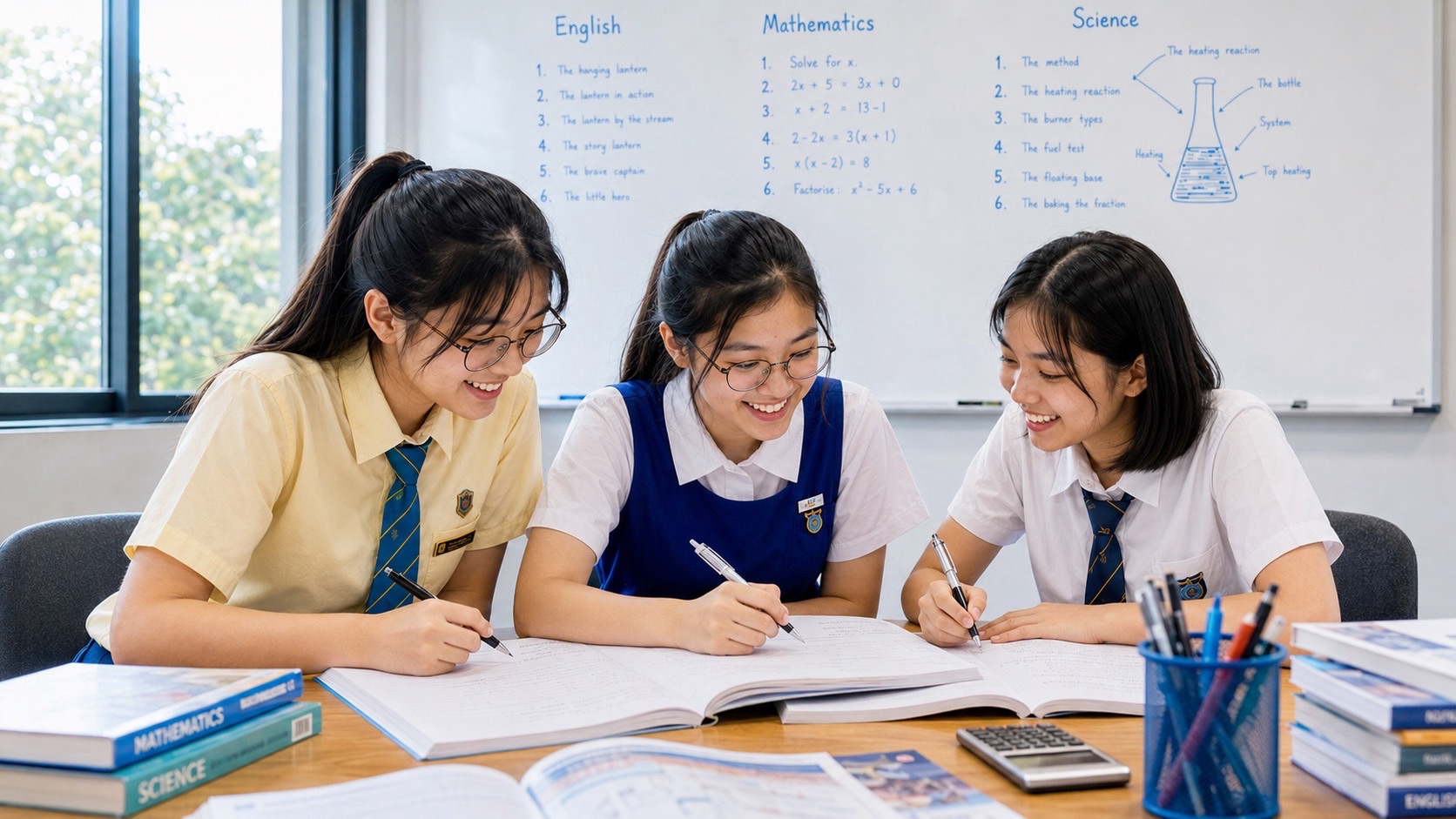
At eduKate, the 3-student format is most useful when it supports a diagnostic chain: visibility → diagnosis → intervention → fresh retest → return to independent work. The group lets the tutor observe enough detail to distinguish conceptual, procedural and performance problems.
The aim is not continuous personal attention. It is the right attention at the right moment, followed by space for the learner to act.
25. Teaching pace should respond to evidence, not anxiety
Parents and students often ask whether teaching should move faster. Acceleration can be useful for learners who are secure and under-challenged. It can be damaging when speed hides fragile foundations.
A better pace decision uses evidence. Can the learner explain the concept? Is execution reliable? Does the skill survive delay? Can she recognise it in mixed work? Can she transfer it? If yes, additional stretch may be productive. If not, moving on may create debt.
The same applies to slowing down. Repeating familiar easy work indefinitely is not support. Repair should target the missing structure, then rejoin progression.
Good teaching pace is therefore elastic. It protects the floor and keeps the ceiling open.
26. Motivation improves when students can see causality
Students become discouraged when mathematics feels arbitrary: some days they succeed, some days they fail, and nobody can explain why. Diagnosis restores causality.
“You are weak at maths” offers no action. “Your algebra is accurate until a negative sign sits outside brackets; let’s repair that structure” creates a finite problem. “You always panic in exams” is identity language. “You spend too long on the first difficult question and leave later marks untouched” is a trainable performance behaviour.
Teaching should help learners connect effort to specific change. More pages are not inherently motivating. Evidence that a once-recurring error has disappeared is.
This is confidence built from competence: not optimism without evidence, but a growing record that difficult things can be diagnosed and improved.
27. Mathematics anxiety changes the teaching problem
A fearful learner may know more mathematics than she can access under pressure. Attention narrows, working memory becomes crowded and avoidance grows. Teaching that simply increases difficulty or volume can strengthen the association between mathematics and threat.
The response should not be to remove all challenge. It is to restore a sequence of controllable success. Diagnose precisely, reduce irrelevant load, use representations, practise the weak component, then return to the full task. Let the learner experience recovery.
The eduKatePunggol article When a Child Fears Mathematics focuses on pace, scaffolding, mastery and rebuilding confidence.
The important distinction is between making mathematics easier forever and making learning structured enough that the student can re-enter difficulty with tools.
28. Technology should change what the teacher asks students to think about
Calculators, graphing software, spreadsheets and AI can perform more mathematical execution than previous generations of students could outsource. Teaching should respond intelligently rather than pretending the tools do not exist.
When a tool performs calculation, the teacher can place greater emphasis on model choice, estimation, interpretation and verification. When software plots a graph, students can investigate parameter changes. When AI generates a solution, students can critique assumptions, identify the first invalid step or produce an independent check.
The key is to avoid tool dependence. A student who cannot judge an output has not gained mathematical power merely because the output appeared quickly.
Teaching should make technology a lever for reasoning, not a substitute for it.
29. Parents support mathematics best when they protect the learning system
Parents do not need to reteach every method. Their highest-value role is often to protect conditions: sleep, time, materials, routines, communication and emotional stability.
They can also ask useful non-teaching questions. What part is confusing? Show me what you do know. Is this the same error as last week? What will you ask your teacher? How will you check the answer? These prompts encourage the learner to participate in diagnosis.
Parents should be cautious about becoming the second tutor every evening. Constant rescue can create dependence and conflict. If a recurring difficulty exceeds what can be resolved calmly at home, the system needs a clearer support route.
Family support is strongest when it increases the child’s capacity to return to school or tuition ready to learn, rather than making the home another examination hall.
30. Punggol is useful because mathematics can leave the worksheet
Teaching gains power when some mathematical ideas are connected to the learner’s environment. Punggol offers transport routes, the waterway, housing blocks, maps, distances, sports spaces, construction, energy systems and digital infrastructure.
The Punggol as a Classroom article uses the town as an interdisciplinary learning environment. Mathematics can appear in walking time, scale, geometry, data, optimisation and modelling.
This is not a demand that every lesson become an excursion. It is a teaching reminder: concepts become stronger when students encounter them in more than one representational world.
A student who sees mathematics only in printed questions may struggle to recognise it when reality presents the same relationship without a heading.
31. Mastery is not perfect performance
Mastery should not mean a student never makes mistakes. Even experts make errors. A more useful definition is that the learner has a stable enough combination of understanding, fluency, selection, verification and recovery to use the idea reliably across conditions.
A mastered skill survives some delay. It works in mixed practice. The learner can explain the key principle. Errors are noticed or corrected more often. The skill can support harder learning.
This definition prevents false mastery based on one perfect worksheet completed immediately after instruction. It also prevents perfectionism. A student can be ready to progress while still needing occasional review.
Teaching should therefore ask whether knowledge is durable and useful, not whether it has become flawless.
32. Gradual release is the central movement of teaching
Across all these methods, one movement repeats: the teacher begins with more control and transfers it to the learner.
- I show: the teacher models the structure and reasoning.
- We build: teacher and student solve with prompts and questions.
- You try with support: the learner performs most of the work while help remains available.
- You retrieve: support is removed after delay.
- You discriminate: the method is mixed with alternatives.
- You transfer: the idea appears in a new representation or context.
- You verify: the learner checks and explains.
- You recover: when something fails, the learner identifies the gap and repairs.
This progression can happen within one lesson, across weeks or across years. The time scale changes; the direction should not.
33. A teaching audit: what changed because of the lesson?
After a lesson, teachers and parents can ask a better question than “Did you finish the worksheet?”
- Can the student state the key idea in her own words?
- Can she represent the relationship another way?
- Can she perform the method accurately without copying?
- Can she retrieve it after a delay?
- Can she distinguish when to use it and when not to?
- Can she detect a common error?
- Can she solve a fresh problem?
- Can she explain where she is still uncertain?
If none of these changed, completion may have been activity rather than learning. If several changed, even a difficult lesson may have been productive.
34. Excellent teaching creates better questions in the student’s head
At the beginning, the teacher supplies questions: What do you know? What is the unknown? Which condition matters? Does that answer make sense? Which method fits? Where did the error begin?
Over time, the student starts asking them silently. That is one of the clearest signs that teaching has become internalised.
The best mathematical habits are therefore partly inherited conversations. A teacher’s repeated prompts become a learner’s private supervision. A parent’s calm request to “show me what you know first” becomes a strategy for entering unfamiliar problems. A tutor’s insistence on checking becomes a reflex.
Teaching leaves traces in attention long after the exact lesson is forgotten.
35. The final product of mathematics teaching is agency
Explanation matters because it gives access. Representation matters because it makes structure visible. Practice matters because access must become reliable. Feedback matters because error must produce change. Mastery matters because knowledge needs to remain usable under new conditions.
But the final product is agency: the learner can act mathematically without waiting for constant direction.
She can read an unfamiliar question and begin. She can recognise when her method is failing. She can search for a more useful representation. She can use tools without surrendering judgement. She can ask a precise question when help is needed. She can return to a prerequisite and repair it. She can practise strategically rather than compulsively.
This is what strong mathematics teaching has been trying to build from the beginning. The lesson is temporary. The learner’s capacity to continue is the enduring outcome.
Continue the Mathematics Education Systems series
- Mathematics Education Systems in Singapore | From Number Sense to Mathematical Independence
- How Mathematics Curriculum Works | Knowledge → Prerequisites → Progression → Transfer
- How Mathematics Assessment Works | Diagnosis → School Tests → PSLE → SEC → A-Level Mathematics
Official references
- Ministry of Education Singapore: Primary Mathematics Syllabus
- Ministry of Education Singapore: G2 and G3 Mathematics Syllabuses
- SEAB: 2027 SEC G3 syllabuses
eduKatePunggol: Family Life Education Local Expert. Good teaching helps a learner today and transfers more control to that learner tomorrow.


